Evolution of Coronaviruses &
Adaptations of the host Immune
System
Part-III
Dr. Rashmi Kumari
Department of Zoology
Assistant Professor
College of Commerce, Arts & Science
Patliputra University, Patna
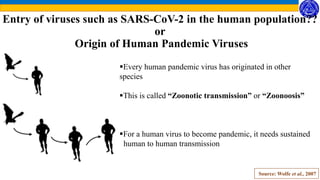
Questions to be answered in this lecture!!!
How do viruses such as SARS-CoV-2 enter
the human population?
How does SARS-CoV-2 relate to other
circulating and epidemic human viruses?
Based on other human viruses, what might
we expect for long-term immunity or co-
existence with SARS-CoV-2?
Source: Google Images
Entry of viruses such as SARS-CoV-2 in the human population??
or
Origin of Human Pandemic Viruses
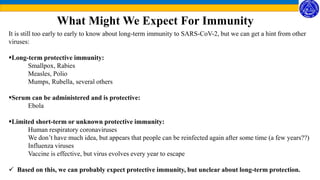
Every human pandemic virus has originated in other
species
This is called “Zoonotic transmission” or “Zoonoosis”
For a human virus to become pandemic, it needs sustained
human to human transmission
Source: Wolfe et al., 2007
Entry of viruses such as SARS-CoV-2 in the human population??
or
Origin of Human Pandemic Viruses
Spillover
Spillover Sustained human
transmission
Circulating animal viruses
•Many bat coronaviruses
•Assumed low case fatality rate
Zoonotic viruses with limited transmission
•Middle Eastern Respiratory Syndrome [MERS]
•1st case described in 2012; case fatality rate 30-
40%
Zoonotic viruses with pandemic potential
•Severe Acute Respiratory coronavirus 2 [SARS-CoV-2]
•1st case described in 2019; case fatality rate 1-3%
Circulating human viruses
•Human respiratory coronaviruses
•Common cold virus; low case fatality rate
Molecular Interaction Underlying Viral Adaptation
Spillover
Redrawn from Fundamentals of virology, Acheson
Coronavirus “spike”
protein
Host “ACE2”
protein
Cocrystal of the SARS-CoV RBD bound to human ACE2. Cyan indicates a region of the RBD
shared among group 2 coronaviruses, whereas red indicates the RBM, which is not homologous
to that of other group 2 viruses. ACE2 is shown in white, with its cleft bearing the enzyme-active
site facing forward and the membrane-associated C terminus at the bottom of the figure.
Evolved “spike”
protein
New host receptor
Human ACE2
Source: Huang et al., 2006
Spillover Sustained human
transmission
Other Circulating and Pandemic Viruses
Circulating animal viruses
•Many bat coronaviruses
•Avian and Swine influenza viruses
Zoonotic viruses with limited transmission
•Middle Eastern Respiratory Syndrome [MERS-CoV]
•H7N9 “bird” influenza, rabies virus, Nipah virus
Zoonotic viruses with pandemic potential
•Severe Acute Respiratory coronavirus 2 [SARS-CoV-2]
•1918 Spanish influenza, 1968 Hongkong flu, 2009
“swine” flu, Smallpox, HIV, Ebola
Circulating human viruses
•Human respiratory coronaviruses
•“Seasonal” influenza, measles, polio
Spillover
What Might We Expect For Immunity
It is still too early to early to know about long-term immunity to SARS-CoV-2, but we can get a hint from other
viruses:
Long-term protective immunity:
Smallpox, Rabies
Measles, Polio
Mumps, Rubella, several others
Serum can be administered and is protective:
Ebola
Limited short-term or unknown protective immunity:
Human respiratory coronaviruses
We don’t have much idea, but appears that people can be reinfected again after some time (a few years??)
Influenza viruses
Vaccine is effective, but virus evolves every year to escape
 Based on this, we can probably expect protective immunity, but unclear about long-term protection.
References:
1. World Health Organization (WHO) [https://www.who.int/emergencies/diseases/novel-coronavirus-
2019/technical-guidance/naming-the-coronavirus-disease-(covid-2019)-and-the-virus-that-causes-it].
2. Google Images.
3. Li, W., Wong, S-K., Li, F., Kuhn, J.H., Huang, I-C., Choe, H., Farzan, M. 2006. Animal Origins of the
Severe Acute Respiratory Syndrome Coronavirus: Insight from ACE2–S-Protein Interactions. J. Virol.
4211–4219.
4. Wolfe, N.D., Dunavan, C.P., Diamond, J. 2007. Origin of human infectious diseases. Nature 447:279-83.

Evolution of coronavirus

  • 1.
    Evolution of Coronaviruses& Adaptations of the host Immune System Part-III Dr. Rashmi Kumari Department of Zoology Assistant Professor College of Commerce, Arts & Science Patliputra University, Patna
  • 2.
    Questions to beanswered in this lecture!!! How do viruses such as SARS-CoV-2 enter the human population? How does SARS-CoV-2 relate to other circulating and epidemic human viruses? Based on other human viruses, what might we expect for long-term immunity or co- existence with SARS-CoV-2? Source: Google Images
  • 3.
    Entry of virusessuch as SARS-CoV-2 in the human population?? or Origin of Human Pandemic Viruses Every human pandemic virus has originated in other species This is called “Zoonotic transmission” or “Zoonoosis” For a human virus to become pandemic, it needs sustained human to human transmission Source: Wolfe et al., 2007
  • 4.
    Source: Wolfe etal., 2007 Entry of viruses such as SARS-CoV-2 in the human population?? or Origin of Human Pandemic Viruses Spillover Spillover Sustained human transmission Circulating animal viruses •Many bat coronaviruses •Assumed low case fatality rate Zoonotic viruses with limited transmission •Middle Eastern Respiratory Syndrome [MERS] •1st case described in 2012; case fatality rate 30- 40% Zoonotic viruses with pandemic potential •Severe Acute Respiratory coronavirus 2 [SARS-CoV-2] •1st case described in 2019; case fatality rate 1-3% Circulating human viruses •Human respiratory coronaviruses •Common cold virus; low case fatality rate
  • 5.
    Molecular Interaction UnderlyingViral Adaptation Spillover Redrawn from Fundamentals of virology, Acheson Coronavirus “spike” protein Host “ACE2” protein Cocrystal of the SARS-CoV RBD bound to human ACE2. Cyan indicates a region of the RBD shared among group 2 coronaviruses, whereas red indicates the RBM, which is not homologous to that of other group 2 viruses. ACE2 is shown in white, with its cleft bearing the enzyme-active site facing forward and the membrane-associated C terminus at the bottom of the figure. Evolved “spike” protein New host receptor Human ACE2 Source: Huang et al., 2006
  • 6.
    Spillover Sustained human transmission OtherCirculating and Pandemic Viruses Circulating animal viruses •Many bat coronaviruses •Avian and Swine influenza viruses Zoonotic viruses with limited transmission •Middle Eastern Respiratory Syndrome [MERS-CoV] •H7N9 “bird” influenza, rabies virus, Nipah virus Zoonotic viruses with pandemic potential •Severe Acute Respiratory coronavirus 2 [SARS-CoV-2] •1918 Spanish influenza, 1968 Hongkong flu, 2009 “swine” flu, Smallpox, HIV, Ebola Circulating human viruses •Human respiratory coronaviruses •“Seasonal” influenza, measles, polio Spillover
  • 7.
    What Might WeExpect For Immunity It is still too early to early to know about long-term immunity to SARS-CoV-2, but we can get a hint from other viruses: Long-term protective immunity: Smallpox, Rabies Measles, Polio Mumps, Rubella, several others Serum can be administered and is protective: Ebola Limited short-term or unknown protective immunity: Human respiratory coronaviruses We don’t have much idea, but appears that people can be reinfected again after some time (a few years??) Influenza viruses Vaccine is effective, but virus evolves every year to escape  Based on this, we can probably expect protective immunity, but unclear about long-term protection.
  • 8.
    References: 1. World HealthOrganization (WHO) [https://www.who.int/emergencies/diseases/novel-coronavirus- 2019/technical-guidance/naming-the-coronavirus-disease-(covid-2019)-and-the-virus-that-causes-it]. 2. Google Images. 3. Li, W., Wong, S-K., Li, F., Kuhn, J.H., Huang, I-C., Choe, H., Farzan, M. 2006. Animal Origins of the Severe Acute Respiratory Syndrome Coronavirus: Insight from ACE2–S-Protein Interactions. J. Virol. 4211–4219. 4. Wolfe, N.D., Dunavan, C.P., Diamond, J. 2007. Origin of human infectious diseases. Nature 447:279-83.