Mutation
Mechanism
behind
corona virus
1
COVID 19
Whatiscovid19?
 Universally called as Corona Virus Disease 2019
 First detected in human in the year 2003, mainly transmitted through animals, open air
market, Guangdong province, china.
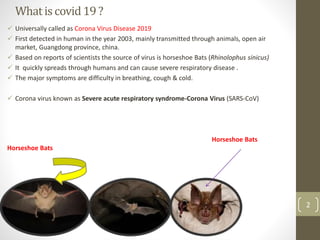
 Based on reports of scientists the source of virus is horseshoe Bats (Rhinolophus sinicus)
 It quickly spreads through humans and can cause severe respiratory disease .
 The major symptoms are difficulty in breathing, cough & cold.
 Corona virus known as Severe acute respiratory syndrome-Corona Virus (SARS-CoV)
Horseshoe Bats
Horseshoe Bats
2
Cont.
Corona virus have never been discovered from humans, so its called as
zoonotic virus means from animal to human but a lot of them are genetically
similar to some known human viruses such as beta corona virus
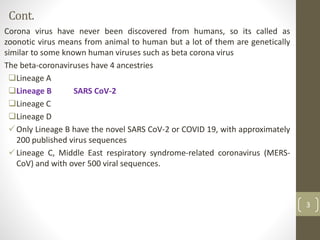
The beta-coronaviruses have 4 ancestries
Lineage A
Lineage B SARS CoV-2
Lineage C
Lineage D
Only Lineage B have the novel SARS CoV-2 or COVID 19, with approximately
200 published virus sequences
Lineage C, Middle East respiratory syndrome-related coronavirus (MERS-
CoV) and with over 500 viral sequences.
3
Currentscenarios
 Virus can cause both respiratory and intestinal infections in human and
animals.
 The first suspected cause reported was pneumonia like cases in Wuhan have
been linked with seafood and animal market.
 Corona virus first re-appear in mid-December 2019 at Wuhan city, China with
variable symptoms like Fever, Cough, invasive lesions and difficulty in
breathing.
 Researchers confirmed 6 sequences of Corona Virus associated with Wuhan
tragedy.
 Initially, The IMPERIAL COLLEGE OF LONDON, estimated that, there may be
1700 cases in the Wuhan city and possibility of spreading to countries like
Japan, Thailand, South Korea and USA.
 But things got more worsen than the data predicted by virological.org and
(GISAID) global initiative on sharing influenza data.
 Now the corona virus shaped into a Global pandemic from epidemic. Its
human to human transmission created a public health emergency (WHO) and
serious economic crisis worldwide.
 Inability to supply of diagnostic-test kits, ventilators and masks has put the
entire mankind in danger.
 Healthcare-workers lacking support of govt. on the mask, proper sanitization
facility.
4
Researchgap
 It is not yet clear whether this mutation is common in Group 4 viral isolates
from different geographical regions.
 whether this mutation enhances host cell entry.
 Every year, additional CoV sequences were discovered since 2003. However,
there is a massive knowledge gap and does not have adequate research in the
very field.
 Viral isolation from field samples is rarely successful.
 Reverse genetics recovery of recombinant virus is labour intensive and
expensive.
 Development diagnostic-test kits
 Development of potential drugs.
5
Storyofcoronainfectedfamily
• The family (an old female and two young family members) who
carrying the Group 4 variant has returned from Wuhan to their
hometown in Sichuan on January 20, 2020.
• By January 23, the old female exhibited symptoms of fever and
cough, and her two children also developed these symptoms in
the following days.
• Their throat swab samples were tested SARS-CoV-2 positive by
reverse real-time PCR assay on January 25. The old female with
chronic hypertension was in a critical condition after suffering
the COVID-19 disease.
• None of these individuals traveled outside of China but their
return to home at Sichuan has lead to the Group 4 variant
infection.
6
J. Virol. doi:10.1128/JVI.00567-20
Copyright © 2020 American Society for Microbiology. All
Rights Reserved
GeneralWorkingmechanismoftheCORONAvirus
Cell entry is an essential component of cross-species transmission of
corona virus.
Step 1:
 CoVs encode a surface glycoprotein (spike structures) and binds to the
host-cell receptor.
 Starts the process of viral entry
Step 2:
 Then a single region of the spike protein called the receptor-binding
domain (RBD) starts the interaction with the host-cell receptor.
 After binding the receptor.
Step : 3
 A nearby host protease cleaves the spike, which releases the spike
fusion peptide.
 Completes the process of virus entry.
7
GraphicalimageofMutationmechanism
8
Mutationofcoronavirus
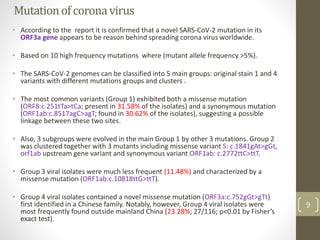
• According to the report it is confirmed that a novel SARS-CoV-2 mutation in its
ORF3a gene appears to be reason behind spreading corona virus worldwide.
• Based on 10 high frequency mutations where (mutant allele frequency >5%).
• The SARS-CoV-2 genomes can be classified into 5 main groups: original stain 1 and 4
variants with different mutations groups and clusters .
• The most common variants (Group 1) exhibited both a missense mutation
(ORF8:c.251tTa>tCa; present in 31.58% of the isolates) and a synonymous mutation
(ORF1ab:c.8517agC>agT; found in 30.62% of the isolates), suggesting a possible
linkage between these two sites.
• Also, 3 subgroups were evolved in the main Group 1 by other 3 mutations. Group 2
was clustered together with 3 mutants including missense variant S: c.1841gAt>gGt,
orf1ab upstream gene variant and synonymous variant ORF1ab: c.2772ttC>ttT.
• Group 3 viral isolates were much less frequent (11.48%) and characterized by a
missense mutation (ORF1ab:c.10818ttG>ttT).
• Group 4 viral isolates contained a novel missense mutation (ORF3a:c.752gGt>gTt)
first identified in a Chinese family. Notably, however, Group 4 viral isolates were
most frequently found outside mainland China (23.28%; 27/116; p<0.01 by Fisher’s
exact test).
9
HowORF3amutantmediatesviralentrytohostcell
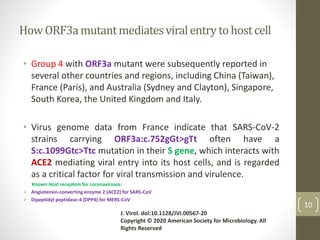
• Group 4 with ORF3a mutant were subsequently reported in
several other countries and regions, including China (Taiwan),
France (Paris), and Australia (Sydney and Clayton), Singapore,
South Korea, the United Kingdom and Italy.
• Virus genome data from France indicate that SARS-CoV-2
strains carrying ORF3a:c.752gGt>gTt often have a
S:c.1099Gtc>Ttc mutation in their S gene, which interacts with
ACE2 mediating viral entry into its host cells, and is regarded
as a critical factor for viral transmission and virulence.
Known Host receptors for coronaviruses:
 Angiotensin-converting enzyme 2 (ACE2) for SARS-CoV
 Dipeptidyl peptidase-4 (DPP4) for MERS-CoV
10
J. Virol. doi:10.1128/JVI.00567-20
Copyright © 2020 American Society for Microbiology. All
Rights Reserved
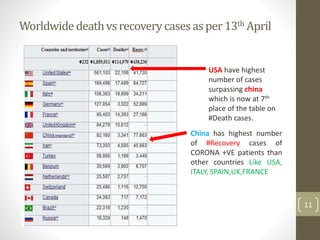
Worldwidedeathvsrecoverycasesasper13th April
11
USA have highest
number of cases
surpassing china
which is now at 7th
place of the table on
#Death cases.
China has highest number
of #Recovery cases of
CORONA +VE patients than
other countries Like USA,
ITALY, SPAIN,UK,FRANCE
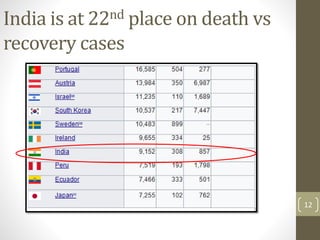
India is at 22nd place on death vs
recovery cases
12
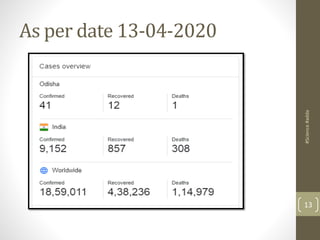
As per date 13-04-2020
#Science#adda
13
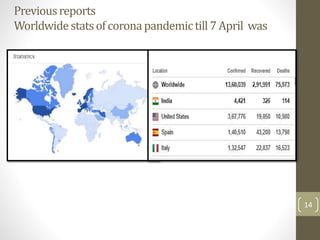
Previousreports
Worldwidestatsofcoronapandemictill 7April was
14
15
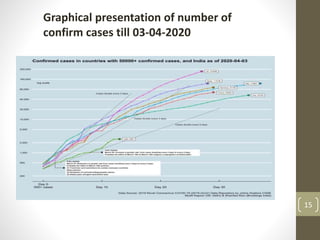
Graphical presentation of number of
confirm cases till 03-04-2020
Commonthingstoknow
• People may be sick with the virus for 1 to 14 days before developing
symptoms. The most common symptoms of coronavirus disease
(COVID-19) are fever, tiredness, and dry cough. Most people (about
80%) recover from the disease without needing special treatment.
• More rarely, the disease can be serious and even fatal. Older people,
and people with other medical conditions (such as asthma, diabetes, or
heart disease), may be more vulnerable to becoming severely ill.
• People may experience:
• cough
• fever
• tiredness
• difficulty breathing (severe cases)
#Science#adda
16
references
 Letko, M., Marzi, A. and Munster, V., 2020. Functional assessment of cell entry and receptor
usage for SARS-CoV-2 and other lineage B betacoronaviruses. Nature microbiology, 5(4),
pp.562-569.
 of the International, C.S.G., 2020. The species Severe acute respiratory syndrome-related
coronavirus: classifying 2019-nCoV and naming it SARS-CoV-2. Nature Microbiology, p.1.
 Huang, C., Liu, W.J., Xu, W., Jin, T., Zhao, Y., Song, J., Shi, Y., Ji, W., Jia, H., Zhou, Y. and Wen, H.,
2016. A bat-derived putative cross-family recombinant coronavirus with a reovirus gene. PLoS
pathogens, 12(9).
 Wang, M., Li, M., Ren, R., Brave, A., van der Werf, S., Chen, E.Q., Zong, Z., Li, W. and Ying, B.,
2020. International expansion of a novel SARS-CoV-2 mutant. medRxiv. J. Virol.
doi:10.1128/JVI.00567-20
 COVID-19 | MyGov.in
 http://virological.org/
 https://google.com/covid19-map/?hl=en
 https://www.google.com/search?sxsrf=ALeKk02UVLUKMy_iEFO4FvQSeyVG8Klu5g%3A1586267
244064&source=hp&ei=bISMXs_RAfnVz7sPpJOJuAE&q=covid+19&oq=covi&gs_lcp=CgZwc3ktY
WIQAxgAMgQIIxAnMgQIABBDMgcIABCDARBDMgUIABCDATIHCAAQgwEQQzIHCAAQgwEQQzIH
CAAQgwEQQzIFCAAQgwEyBAgAEEMyBAgAEEM6AggAOgcIABAUEIcCShUIFxIRMGc1MzFnMjk5Zz
I0MmcyMjlKDQgYEgkwZzFnMWcxZzFQimdYrXBg43toAnAAeACAAd4DiAGRCZIBBzItMy4wLjGYA
QCgAQGqAQdnd3Mtd2l6&sclient=psy-ab
17

Corona virus mutation mechanism #SCIENCE_ADDA

  • 1.
  • 2.
    Whatiscovid19?  Universally calledas Corona Virus Disease 2019  First detected in human in the year 2003, mainly transmitted through animals, open air market, Guangdong province, china.  Based on reports of scientists the source of virus is horseshoe Bats (Rhinolophus sinicus)  It quickly spreads through humans and can cause severe respiratory disease .  The major symptoms are difficulty in breathing, cough & cold.  Corona virus known as Severe acute respiratory syndrome-Corona Virus (SARS-CoV) Horseshoe Bats Horseshoe Bats 2
  • 3.
    Cont. Corona virus havenever been discovered from humans, so its called as zoonotic virus means from animal to human but a lot of them are genetically similar to some known human viruses such as beta corona virus The beta-coronaviruses have 4 ancestries Lineage A Lineage B SARS CoV-2 Lineage C Lineage D Only Lineage B have the novel SARS CoV-2 or COVID 19, with approximately 200 published virus sequences Lineage C, Middle East respiratory syndrome-related coronavirus (MERS- CoV) and with over 500 viral sequences. 3
  • 4.
    Currentscenarios  Virus cancause both respiratory and intestinal infections in human and animals.  The first suspected cause reported was pneumonia like cases in Wuhan have been linked with seafood and animal market.  Corona virus first re-appear in mid-December 2019 at Wuhan city, China with variable symptoms like Fever, Cough, invasive lesions and difficulty in breathing.  Researchers confirmed 6 sequences of Corona Virus associated with Wuhan tragedy.  Initially, The IMPERIAL COLLEGE OF LONDON, estimated that, there may be 1700 cases in the Wuhan city and possibility of spreading to countries like Japan, Thailand, South Korea and USA.  But things got more worsen than the data predicted by virological.org and (GISAID) global initiative on sharing influenza data.  Now the corona virus shaped into a Global pandemic from epidemic. Its human to human transmission created a public health emergency (WHO) and serious economic crisis worldwide.  Inability to supply of diagnostic-test kits, ventilators and masks has put the entire mankind in danger.  Healthcare-workers lacking support of govt. on the mask, proper sanitization facility. 4
  • 5.
    Researchgap  It isnot yet clear whether this mutation is common in Group 4 viral isolates from different geographical regions.  whether this mutation enhances host cell entry.  Every year, additional CoV sequences were discovered since 2003. However, there is a massive knowledge gap and does not have adequate research in the very field.  Viral isolation from field samples is rarely successful.  Reverse genetics recovery of recombinant virus is labour intensive and expensive.  Development diagnostic-test kits  Development of potential drugs. 5
  • 6.
    Storyofcoronainfectedfamily • The family(an old female and two young family members) who carrying the Group 4 variant has returned from Wuhan to their hometown in Sichuan on January 20, 2020. • By January 23, the old female exhibited symptoms of fever and cough, and her two children also developed these symptoms in the following days. • Their throat swab samples were tested SARS-CoV-2 positive by reverse real-time PCR assay on January 25. The old female with chronic hypertension was in a critical condition after suffering the COVID-19 disease. • None of these individuals traveled outside of China but their return to home at Sichuan has lead to the Group 4 variant infection. 6 J. Virol. doi:10.1128/JVI.00567-20 Copyright © 2020 American Society for Microbiology. All Rights Reserved
  • 7.
    GeneralWorkingmechanismoftheCORONAvirus Cell entry isan essential component of cross-species transmission of corona virus. Step 1:  CoVs encode a surface glycoprotein (spike structures) and binds to the host-cell receptor.  Starts the process of viral entry Step 2:  Then a single region of the spike protein called the receptor-binding domain (RBD) starts the interaction with the host-cell receptor.  After binding the receptor. Step : 3  A nearby host protease cleaves the spike, which releases the spike fusion peptide.  Completes the process of virus entry. 7
  • 8.
  • 9.
    Mutationofcoronavirus • According tothe report it is confirmed that a novel SARS-CoV-2 mutation in its ORF3a gene appears to be reason behind spreading corona virus worldwide. • Based on 10 high frequency mutations where (mutant allele frequency >5%). • The SARS-CoV-2 genomes can be classified into 5 main groups: original stain 1 and 4 variants with different mutations groups and clusters . • The most common variants (Group 1) exhibited both a missense mutation (ORF8:c.251tTa>tCa; present in 31.58% of the isolates) and a synonymous mutation (ORF1ab:c.8517agC>agT; found in 30.62% of the isolates), suggesting a possible linkage between these two sites. • Also, 3 subgroups were evolved in the main Group 1 by other 3 mutations. Group 2 was clustered together with 3 mutants including missense variant S: c.1841gAt>gGt, orf1ab upstream gene variant and synonymous variant ORF1ab: c.2772ttC>ttT. • Group 3 viral isolates were much less frequent (11.48%) and characterized by a missense mutation (ORF1ab:c.10818ttG>ttT). • Group 4 viral isolates contained a novel missense mutation (ORF3a:c.752gGt>gTt) first identified in a Chinese family. Notably, however, Group 4 viral isolates were most frequently found outside mainland China (23.28%; 27/116; p<0.01 by Fisher’s exact test). 9
  • 10.
    HowORF3amutantmediatesviralentrytohostcell • Group 4with ORF3a mutant were subsequently reported in several other countries and regions, including China (Taiwan), France (Paris), and Australia (Sydney and Clayton), Singapore, South Korea, the United Kingdom and Italy. • Virus genome data from France indicate that SARS-CoV-2 strains carrying ORF3a:c.752gGt>gTt often have a S:c.1099Gtc>Ttc mutation in their S gene, which interacts with ACE2 mediating viral entry into its host cells, and is regarded as a critical factor for viral transmission and virulence. Known Host receptors for coronaviruses:  Angiotensin-converting enzyme 2 (ACE2) for SARS-CoV  Dipeptidyl peptidase-4 (DPP4) for MERS-CoV 10 J. Virol. doi:10.1128/JVI.00567-20 Copyright © 2020 American Society for Microbiology. All Rights Reserved
  • 11.
    Worldwidedeathvsrecoverycasesasper13th April 11 USA havehighest number of cases surpassing china which is now at 7th place of the table on #Death cases. China has highest number of #Recovery cases of CORONA +VE patients than other countries Like USA, ITALY, SPAIN,UK,FRANCE
  • 12.
    India is at22nd place on death vs recovery cases 12
  • 13.
    As per date13-04-2020 #Science#adda 13
  • 14.
  • 15.
    15 Graphical presentation ofnumber of confirm cases till 03-04-2020
  • 16.
    Commonthingstoknow • People maybe sick with the virus for 1 to 14 days before developing symptoms. The most common symptoms of coronavirus disease (COVID-19) are fever, tiredness, and dry cough. Most people (about 80%) recover from the disease without needing special treatment. • More rarely, the disease can be serious and even fatal. Older people, and people with other medical conditions (such as asthma, diabetes, or heart disease), may be more vulnerable to becoming severely ill. • People may experience: • cough • fever • tiredness • difficulty breathing (severe cases) #Science#adda 16
  • 17.
    references  Letko, M.,Marzi, A. and Munster, V., 2020. Functional assessment of cell entry and receptor usage for SARS-CoV-2 and other lineage B betacoronaviruses. Nature microbiology, 5(4), pp.562-569.  of the International, C.S.G., 2020. The species Severe acute respiratory syndrome-related coronavirus: classifying 2019-nCoV and naming it SARS-CoV-2. Nature Microbiology, p.1.  Huang, C., Liu, W.J., Xu, W., Jin, T., Zhao, Y., Song, J., Shi, Y., Ji, W., Jia, H., Zhou, Y. and Wen, H., 2016. A bat-derived putative cross-family recombinant coronavirus with a reovirus gene. PLoS pathogens, 12(9).  Wang, M., Li, M., Ren, R., Brave, A., van der Werf, S., Chen, E.Q., Zong, Z., Li, W. and Ying, B., 2020. International expansion of a novel SARS-CoV-2 mutant. medRxiv. J. Virol. doi:10.1128/JVI.00567-20  COVID-19 | MyGov.in  http://virological.org/  https://google.com/covid19-map/?hl=en  https://www.google.com/search?sxsrf=ALeKk02UVLUKMy_iEFO4FvQSeyVG8Klu5g%3A1586267 244064&source=hp&ei=bISMXs_RAfnVz7sPpJOJuAE&q=covid+19&oq=covi&gs_lcp=CgZwc3ktY WIQAxgAMgQIIxAnMgQIABBDMgcIABCDARBDMgUIABCDATIHCAAQgwEQQzIHCAAQgwEQQzIH CAAQgwEQQzIFCAAQgwEyBAgAEEMyBAgAEEM6AggAOgcIABAUEIcCShUIFxIRMGc1MzFnMjk5Zz I0MmcyMjlKDQgYEgkwZzFnMWcxZzFQimdYrXBg43toAnAAeACAAd4DiAGRCZIBBzItMy4wLjGYA QCgAQGqAQdnd3Mtd2l6&sclient=psy-ab 17