Changes over Time:
Theory of Evolution of
Living Things
Part I
All words/terms in
PURPLE should be
copied into your
Vocabulary Packet
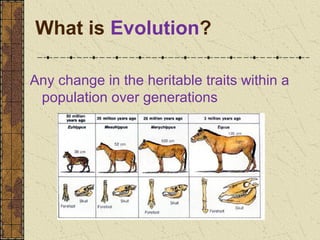
What is Evolution?
Any change in the heritable traits within a
population over generations
What are “Species”?
Organisms that can successfully
reproduce with each other and their
offspring can also reproduce
Theories of Evolutionhttp://www.youtube.com/watch?v=pPghdBIGW9g&list=PLF33D061B83551193
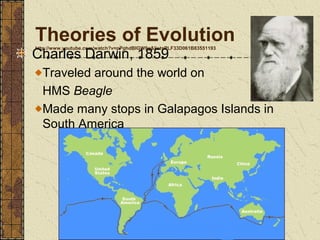
Charles Darwin, 1859
Traveled around the world on
HMS Beagle
Made many stops in Galapagos Islands in
South America
Darwin’s Theory of Evolution
Evolution by: Natural Selection
Also known as “Survival of the Fittest”
Definition: organism with the best
traits suited for their environment
survive and reproduce
Galapagos
Tortoises
Why are these iguanas
so different from each
other?
Iguana from Mainland
South America
Iguana from
Galapagos Islands
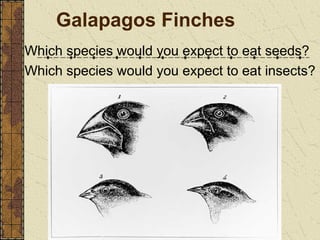
Galapagos Finches
Which species would you expect to eat seeds?
Which species would you expect to eat insects?
Adaptation
Characteristic making one more
suitable for their environment
Example:
Pointy beak for capturing insects
Broad, strong beak for eating hard seeds
Copy the information on the next
several slides onto the graphic
organizer.
Factors of Natural Selection
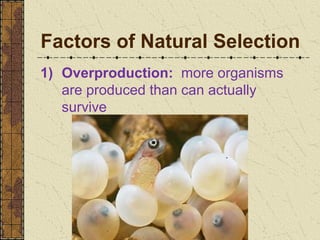
1) Overproduction: more organisms
are produced than can actually
survive
Factors of Natural Selection,
continued
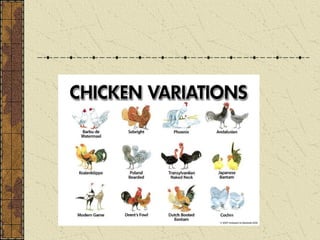
2) Variation: any difference between
individuals of the same species
Think about your own species, Homo sapiens
Why is variation important?
Can bring about new species after
evolving many generations
http://www.youtube.com/watch?
v=svHQ4BQY__o
Factors of Natural Selection,
continued
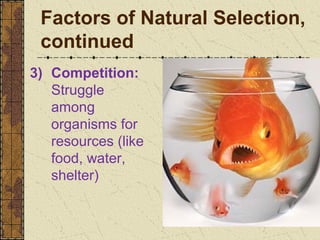
3) Competition:
Struggle
among
organisms for
resources (like
food, water,
shelter)
Factors of Natural Selection,
continued
4) Selection:
Offspring with the better traits have
higher reproduction rate, and over
time make up more of the population
(Population: group of species living in
the same area)

Evolution notes part 1

  • 1.
    Changes over Time: Theoryof Evolution of Living Things Part I All words/terms in PURPLE should be copied into your Vocabulary Packet
  • 2.
    What is Evolution? Anychange in the heritable traits within a population over generations
  • 3.
    What are “Species”? Organismsthat can successfully reproduce with each other and their offspring can also reproduce
  • 4.
    Theories of Evolutionhttp://www.youtube.com/watch?v=pPghdBIGW9g&list=PLF33D061B83551193 CharlesDarwin, 1859 Traveled around the world on HMS Beagle Made many stops in Galapagos Islands in South America
  • 5.
    Darwin’s Theory ofEvolution Evolution by: Natural Selection Also known as “Survival of the Fittest” Definition: organism with the best traits suited for their environment survive and reproduce
  • 6.
  • 7.
    Why are theseiguanas so different from each other? Iguana from Mainland South America Iguana from Galapagos Islands
  • 8.
    Galapagos Finches Which specieswould you expect to eat seeds? Which species would you expect to eat insects?
  • 9.
    Adaptation Characteristic making onemore suitable for their environment Example: Pointy beak for capturing insects Broad, strong beak for eating hard seeds
  • 10.
    Copy the informationon the next several slides onto the graphic organizer.
  • 11.
    Factors of NaturalSelection 1) Overproduction: more organisms are produced than can actually survive
  • 12.
    Factors of NaturalSelection, continued 2) Variation: any difference between individuals of the same species Think about your own species, Homo sapiens Why is variation important? Can bring about new species after evolving many generations http://www.youtube.com/watch? v=svHQ4BQY__o
  • 14.
    Factors of NaturalSelection, continued 3) Competition: Struggle among organisms for resources (like food, water, shelter)
  • 15.
    Factors of NaturalSelection, continued 4) Selection: Offspring with the better traits have higher reproduction rate, and over time make up more of the population (Population: group of species living in the same area)