Evidence-BasedEvidence-Based
Practice:Practice:
Course ExamplesCourse ExamplesCurry CollegeCurry College
Division of NursingDivision of Nursing
NSG 2200 Pathophysiolgy or your course
Spring 2007
Elizabeth KudzmaElizabeth Kudzma
Evidence-Based Practice (EBP)Evidence-Based Practice (EBP)
 Process by which health care providers knowProcess by which health care providers know
how to find, critically appraise, and use the besthow to find, critically appraise, and use the best
evidenceevidence
Why Evidence-Based Practice (EBP) ??Why Evidence-Based Practice (EBP) ??
Health care delivery is filled with uncertainty andHealth care delivery is filled with uncertainty and
many questions arise in every day practice…many questions arise in every day practice…
 What kind of guidance would be most helpful toWhat kind of guidance would be most helpful to
my patients?my patients?
 What clinical assessments and interventions areWhat clinical assessments and interventions are
of the most benefit?of the most benefit?
Common questions that arise inCommon questions that arise in
everyday practice:everyday practice:
 Which combination and sequence of treatmentsWhich combination and sequence of treatments
is most effective?is most effective?
 Which patient symptoms predict better or worseWhich patient symptoms predict better or worse
outcomes?outcomes?
 What is the experience of illness for a patientWhat is the experience of illness for a patient
with this diagnosis?with this diagnosis?
 Which treatment is most effective and willWhich treatment is most effective and will
produce the best patient outcome?produce the best patient outcome?
 If a diagnosis is left untreated, what might be theIf a diagnosis is left untreated, what might be the
outcome?outcome?
Evidence to Support BestEvidence to Support Best
Practices is Constantly ChangingPractices is Constantly Changing
Formulating the Clinical QuestionFormulating the Clinical Question
 The “PICO” format is used to construct theThe “PICO” format is used to construct the
clinical question specificallyclinical question specifically
 Using PICO format helps you find a needle in aUsing PICO format helps you find a needle in a
hay stack of research informationhay stack of research information
PICO FormatPICO Format
 PPatient Populationatient Population
 IIntervention of Interestntervention of Interest
 CComparison intervention or statusomparison intervention or status
 OOutcomeutcome
Patient PopulationPatient Population
 Consideration of the patient and population ofConsideration of the patient and population of
interestinterest
 Limit to age group or subgroup if possibleLimit to age group or subgroup if possible
InterventionIntervention
 ExposureExposure
 TreatmentTreatment
 Patient perceptionPatient perception
 Diagnostic testDiagnostic test
ComparisonComparison
 Could be true control, such as placebo or doingCould be true control, such as placebo or doing
nothingnothing
 Could be another treatmentCould be another treatment
 Sometimes it is the usual standard of careSometimes it is the usual standard of care
OutcomeOutcome
 Outcome may be very specific, e.g. deathOutcome may be very specific, e.g. death
 Outcome may be something that has a variety ofOutcome may be something that has a variety of
measures, e.g. dehydration could be a measure,measures, e.g. dehydration could be a measure,
also tachycardia, dry mouth, fever, restlessnessalso tachycardia, dry mouth, fever, restlessness
and irritabilityand irritability
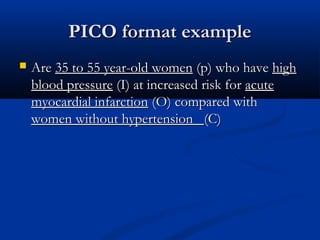
PICO format examplePICO format example
 AreAre 35 to 55 year-old women35 to 55 year-old women (p) who have(p) who have highhigh
blood pressureblood pressure (I) at increased risk for(I) at increased risk for acuteacute
myocardial infarctionmyocardial infarction (O) compared with(O) compared with
women without hypertensionwomen without hypertension (C)(C)
Rating System for EvidenceRating System for Evidence
 Level I: evidence from systematic review, randomized controlLevel I: evidence from systematic review, randomized control
trials (RCTs), or evidence-based reviewstrials (RCTs), or evidence-based reviews
 Level II: evidence from one well-designed RCTLevel II: evidence from one well-designed RCT
 Level III: evidence from well-designed studies withoutLevel III: evidence from well-designed studies without
randomizationrandomization
 Level IV: evidence from other types of studies including case-Level IV: evidence from other types of studies including case-
control and cohort studiescontrol and cohort studies
 Level V: evidence from systematic reviews of descriptive andLevel V: evidence from systematic reviews of descriptive and
qualitative studiesqualitative studies
 Level VI: evidence from one descriptive or qualitative studyLevel VI: evidence from one descriptive or qualitative study
 Level VII: evidence from the opinion of authorities and/ orLevel VII: evidence from the opinion of authorities and/ or
reports of expert committeesreports of expert committees
 Meynyk, B. & Fine-Overholt, E.. (2005). Evidence-Based Practice in Nursing and Healthcare. Lippincott, Wiliams & Wilkins.Meynyk, B. & Fine-Overholt, E.. (2005). Evidence-Based Practice in Nursing and Healthcare. Lippincott, Wiliams & Wilkins.
Siwek, J. et al. (2002). Am Fam
Physician 65, 251-258.
A Rating System for Looking atA Rating System for Looking at
Evidence in Individual StudiesEvidence in Individual Studies
 Level A: Randomized control trial (RCT)Level A: Randomized control trial (RCT)
 Level B: (other evidence)Level B: (other evidence)
 Well-designed, nonrandomized trialWell-designed, nonrandomized trial
 Non-quantitative systematic reviewNon-quantitative systematic review
 Lower quality RCT’s, clinical cohort studies, case-Lower quality RCT’s, clinical cohort studies, case-
control studiescontrol studies
 High-quality historical, less controlled studies, well-High-quality historical, less controlled studies, well-
designed epidemiological studiesdesigned epidemiological studies
 Level C: consensus/expert opinionLevel C: consensus/expert opinion
Searching for the Best Evidence:Searching for the Best Evidence:
Searchable DatabasesSearchable Databases
 CINAHLCINAHL
 MEDLINE: (PubMed)MEDLINE: (PubMed)
 National Guidelines Clearinghouse:National Guidelines Clearinghouse:
http://www.guideline.govhttp://www.guideline.gov
 Agency for Healthcare Research and Quality:Agency for Healthcare Research and Quality:
www.ahrq.gov/clinic/cpgsix.htmwww.ahrq.gov/clinic/cpgsix.htm
 National Institute of Nursing:National Institute of Nursing:
http://ninr.nih.gov/ninrhttp://ninr.nih.gov/ninr

Evidence based-practice upload

  • 1.
    Evidence-BasedEvidence-Based Practice:Practice: Course ExamplesCourse ExamplesCurryCollegeCurry College Division of NursingDivision of Nursing NSG 2200 Pathophysiolgy or your course Spring 2007 Elizabeth KudzmaElizabeth Kudzma
  • 2.
    Evidence-Based Practice (EBP)Evidence-BasedPractice (EBP)  Process by which health care providers knowProcess by which health care providers know how to find, critically appraise, and use the besthow to find, critically appraise, and use the best evidenceevidence
  • 3.
    Why Evidence-Based Practice(EBP) ??Why Evidence-Based Practice (EBP) ?? Health care delivery is filled with uncertainty andHealth care delivery is filled with uncertainty and many questions arise in every day practice…many questions arise in every day practice…  What kind of guidance would be most helpful toWhat kind of guidance would be most helpful to my patients?my patients?  What clinical assessments and interventions areWhat clinical assessments and interventions are of the most benefit?of the most benefit?
  • 4.
    Common questions thatarise inCommon questions that arise in everyday practice:everyday practice:  Which combination and sequence of treatmentsWhich combination and sequence of treatments is most effective?is most effective?  Which patient symptoms predict better or worseWhich patient symptoms predict better or worse outcomes?outcomes?  What is the experience of illness for a patientWhat is the experience of illness for a patient with this diagnosis?with this diagnosis?  Which treatment is most effective and willWhich treatment is most effective and will produce the best patient outcome?produce the best patient outcome?  If a diagnosis is left untreated, what might be theIf a diagnosis is left untreated, what might be the outcome?outcome?
  • 5.
    Evidence to SupportBestEvidence to Support Best Practices is Constantly ChangingPractices is Constantly Changing
  • 6.
    Formulating the ClinicalQuestionFormulating the Clinical Question  The “PICO” format is used to construct theThe “PICO” format is used to construct the clinical question specificallyclinical question specifically  Using PICO format helps you find a needle in aUsing PICO format helps you find a needle in a hay stack of research informationhay stack of research information
  • 7.
    PICO FormatPICO Format PPatient Populationatient Population  IIntervention of Interestntervention of Interest  CComparison intervention or statusomparison intervention or status  OOutcomeutcome
  • 8.
    Patient PopulationPatient Population Consideration of the patient and population ofConsideration of the patient and population of interestinterest  Limit to age group or subgroup if possibleLimit to age group or subgroup if possible
  • 9.
    InterventionIntervention  ExposureExposure  TreatmentTreatment Patient perceptionPatient perception  Diagnostic testDiagnostic test
  • 10.
    ComparisonComparison  Could betrue control, such as placebo or doingCould be true control, such as placebo or doing nothingnothing  Could be another treatmentCould be another treatment  Sometimes it is the usual standard of careSometimes it is the usual standard of care
  • 11.
    OutcomeOutcome  Outcome maybe very specific, e.g. deathOutcome may be very specific, e.g. death  Outcome may be something that has a variety ofOutcome may be something that has a variety of measures, e.g. dehydration could be a measure,measures, e.g. dehydration could be a measure, also tachycardia, dry mouth, fever, restlessnessalso tachycardia, dry mouth, fever, restlessness and irritabilityand irritability
  • 12.
    PICO format examplePICOformat example  AreAre 35 to 55 year-old women35 to 55 year-old women (p) who have(p) who have highhigh blood pressureblood pressure (I) at increased risk for(I) at increased risk for acuteacute myocardial infarctionmyocardial infarction (O) compared with(O) compared with women without hypertensionwomen without hypertension (C)(C)
  • 13.
    Rating System forEvidenceRating System for Evidence  Level I: evidence from systematic review, randomized controlLevel I: evidence from systematic review, randomized control trials (RCTs), or evidence-based reviewstrials (RCTs), or evidence-based reviews  Level II: evidence from one well-designed RCTLevel II: evidence from one well-designed RCT  Level III: evidence from well-designed studies withoutLevel III: evidence from well-designed studies without randomizationrandomization  Level IV: evidence from other types of studies including case-Level IV: evidence from other types of studies including case- control and cohort studiescontrol and cohort studies  Level V: evidence from systematic reviews of descriptive andLevel V: evidence from systematic reviews of descriptive and qualitative studiesqualitative studies  Level VI: evidence from one descriptive or qualitative studyLevel VI: evidence from one descriptive or qualitative study  Level VII: evidence from the opinion of authorities and/ orLevel VII: evidence from the opinion of authorities and/ or reports of expert committeesreports of expert committees  Meynyk, B. & Fine-Overholt, E.. (2005). Evidence-Based Practice in Nursing and Healthcare. Lippincott, Wiliams & Wilkins.Meynyk, B. & Fine-Overholt, E.. (2005). Evidence-Based Practice in Nursing and Healthcare. Lippincott, Wiliams & Wilkins.
  • 14.
    Siwek, J. etal. (2002). Am Fam Physician 65, 251-258. A Rating System for Looking atA Rating System for Looking at Evidence in Individual StudiesEvidence in Individual Studies  Level A: Randomized control trial (RCT)Level A: Randomized control trial (RCT)  Level B: (other evidence)Level B: (other evidence)  Well-designed, nonrandomized trialWell-designed, nonrandomized trial  Non-quantitative systematic reviewNon-quantitative systematic review  Lower quality RCT’s, clinical cohort studies, case-Lower quality RCT’s, clinical cohort studies, case- control studiescontrol studies  High-quality historical, less controlled studies, well-High-quality historical, less controlled studies, well- designed epidemiological studiesdesigned epidemiological studies  Level C: consensus/expert opinionLevel C: consensus/expert opinion
  • 15.
    Searching for theBest Evidence:Searching for the Best Evidence: Searchable DatabasesSearchable Databases  CINAHLCINAHL  MEDLINE: (PubMed)MEDLINE: (PubMed)  National Guidelines Clearinghouse:National Guidelines Clearinghouse: http://www.guideline.govhttp://www.guideline.gov  Agency for Healthcare Research and Quality:Agency for Healthcare Research and Quality: www.ahrq.gov/clinic/cpgsix.htmwww.ahrq.gov/clinic/cpgsix.htm  National Institute of Nursing:National Institute of Nursing: http://ninr.nih.gov/ninrhttp://ninr.nih.gov/ninr