Machine Learning-101
Hafiz M. Attaullah Shafiq
(Deeplearning.Ai)
Email: attaullahshafiq10@gmail.com
Webpage: attaullahshafiq10.github.io
LinkedIn: www.linkedin.com/in/attaullahshafiq10
/attaullahshafiq10
Essential Tools for
Machine Learning
Questions to Consider Before You Start…!
Every machine learning workflow begins with three
questions:
• What kind of data are you working with?
• What insights do you want to get from it?
• How and where will those insights be applied?
• Data processing capabilities
• Specialized machine learning
• Programmatic workflows
• Tools for scaling the machine learning
workflow
• Automatic code generation tools for rapidly
deploying your analytics
• To embedded targets
Essential things for a ML tool
Machine Learning Tools &
Languages
• MATLAB
• Python
• R
• Java-family/C-family
• Jupyter notebook
• Other concerns
Comparison
MATLAB???
Python???
R ???
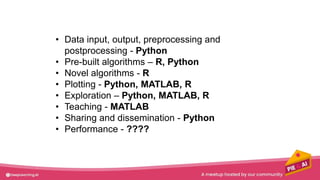
• Data input, output, preprocessing and
postprocessing - Python
• Pre-built algorithms – R, Python
• Novel algorithms - R
• Plotting - Python, MATLAB, R
• Exploration – Python, MATLAB, R
• Teaching - MATLAB
• Sharing and dissemination - Python
• Performance - ????
Pros and Cons of Each
Language for ML
• MATLAB
Advantage:
• Many wonderful libraries and the number one choice in signal processing, communication
system, and control theory.
• Simulink: One of the best toolboxes in MATLAB is used extensively in control and
dynamical system applications.
• Lots of available and robust packages for optimization, control, and numerical analysis.
• Nice toolbox for graphical work (Lets you plot beautiful looking graphs) and inherent
support for matrix and vector manipulation.
• Easy to learn and has a user-friendly interface.
Disadvantage:
• Proprietary and not free or open-source, which makes it very hard for collaboration.
• Lack of good packages and libraries for machine learning, AI, time series analysis, and
causal inference.
• Limited in terms of functionality: cannot be used for web development and app design.
• Not object-oriented language.
• Smaller user community compared to Python.
Advantage:
• Many wonderful libraries in machine learning, AI, web development, and optimization.
• Number one language for deep learning and machine learning in general.
• Open-source and free.
• A large community of users across GitHub, Stackoverflow, and …
• It can be used for other applications besides engineering, unlike MATLAB. For example,
GUI (Graphical User Interface) development using Tkinter and PyQt.
• Object-oriented language.
• Easy to learn and user-friendly syntax.
Disadvantage:
• Lack of good packages for signal processing and communication (still behind for
engineering applications).
• Steeper learning curve than MATLAB since it is an object-oriented programming(OOP)
language and is harder to master.
• Requires more time and expertise to setup and install the working environment.
• Python
Advantage:
• So many wonderful libraries in statistics and machine learning.
• Open-source and free.
• Number one language for time series analysis, causal inference, and PGM.
• A large community of researchers, especially in academia.
• Ability to create web applications, for example, through the Shiney app.
Disadvantage:
• Slower compared to Python and Matlab.
• More limited scope in terms of applications compared to Python. (Cannot be
used for game development or cannot be as a backend for web
developments)
• Not object-oriented language.
• Lack of good packages for signal processing and communication (still behind
for engineering applications).
• Smaller user communities compared to Python.
• Harder and not user-friendly compared to Python and Matlab.
• R
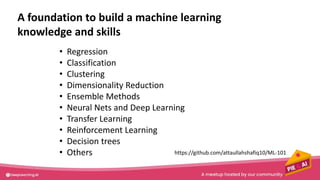
A foundation to build a machine learning
knowledge and skills
• Regression
• Classification
• Clustering
• Dimensionality Reduction
• Ensemble Methods
• Neural Nets and Deep Learning
• Transfer Learning
• Reinforcement Learning
• Decision trees
• Others https://github.com/attaullahshafiq10/ML-101
https://github.com/attaullahshafiq10/ML-101
Examples & Resources….!
https://forms.gle/sMsuAYrcA3aBb7wA7
Feedback form:

Machine Learning 101 | Essential Tools for Machine Learning

  • 1.
    Machine Learning-101 Hafiz M.Attaullah Shafiq (Deeplearning.Ai) Email: attaullahshafiq10@gmail.com Webpage: attaullahshafiq10.github.io LinkedIn: www.linkedin.com/in/attaullahshafiq10 /attaullahshafiq10
  • 2.
  • 3.
    Questions to ConsiderBefore You Start…! Every machine learning workflow begins with three questions: • What kind of data are you working with? • What insights do you want to get from it? • How and where will those insights be applied?
  • 4.
    • Data processingcapabilities • Specialized machine learning • Programmatic workflows • Tools for scaling the machine learning workflow • Automatic code generation tools for rapidly deploying your analytics • To embedded targets Essential things for a ML tool
  • 5.
    Machine Learning Tools& Languages • MATLAB • Python • R • Java-family/C-family • Jupyter notebook • Other concerns
  • 6.
  • 7.
    • Data input,output, preprocessing and postprocessing - Python • Pre-built algorithms – R, Python • Novel algorithms - R • Plotting - Python, MATLAB, R • Exploration – Python, MATLAB, R • Teaching - MATLAB • Sharing and dissemination - Python • Performance - ????
  • 8.
    Pros and Consof Each Language for ML
  • 9.
    • MATLAB Advantage: • Manywonderful libraries and the number one choice in signal processing, communication system, and control theory. • Simulink: One of the best toolboxes in MATLAB is used extensively in control and dynamical system applications. • Lots of available and robust packages for optimization, control, and numerical analysis. • Nice toolbox for graphical work (Lets you plot beautiful looking graphs) and inherent support for matrix and vector manipulation. • Easy to learn and has a user-friendly interface. Disadvantage: • Proprietary and not free or open-source, which makes it very hard for collaboration. • Lack of good packages and libraries for machine learning, AI, time series analysis, and causal inference. • Limited in terms of functionality: cannot be used for web development and app design. • Not object-oriented language. • Smaller user community compared to Python.
  • 10.
    Advantage: • Many wonderfullibraries in machine learning, AI, web development, and optimization. • Number one language for deep learning and machine learning in general. • Open-source and free. • A large community of users across GitHub, Stackoverflow, and … • It can be used for other applications besides engineering, unlike MATLAB. For example, GUI (Graphical User Interface) development using Tkinter and PyQt. • Object-oriented language. • Easy to learn and user-friendly syntax. Disadvantage: • Lack of good packages for signal processing and communication (still behind for engineering applications). • Steeper learning curve than MATLAB since it is an object-oriented programming(OOP) language and is harder to master. • Requires more time and expertise to setup and install the working environment. • Python
  • 11.
    Advantage: • So manywonderful libraries in statistics and machine learning. • Open-source and free. • Number one language for time series analysis, causal inference, and PGM. • A large community of researchers, especially in academia. • Ability to create web applications, for example, through the Shiney app. Disadvantage: • Slower compared to Python and Matlab. • More limited scope in terms of applications compared to Python. (Cannot be used for game development or cannot be as a backend for web developments) • Not object-oriented language. • Lack of good packages for signal processing and communication (still behind for engineering applications). • Smaller user communities compared to Python. • Harder and not user-friendly compared to Python and Matlab. • R
  • 12.
    A foundation tobuild a machine learning knowledge and skills • Regression • Classification • Clustering • Dimensionality Reduction • Ensemble Methods • Neural Nets and Deep Learning • Transfer Learning • Reinforcement Learning • Decision trees • Others https://github.com/attaullahshafiq10/ML-101
  • 13.

Editor's Notes

  • #4 Your answers to these questions help you decide whether to use supervised or unsupervised learning.