Evaluation Question 1:
In what ways does your media
product use, develop or
challenge forms and conventions
of real media products?
• In many ways, my magazine follows the
conventions of classic rock magazines, such as
MOJO and NME.
• However, I decided to challenge some of the
conventions to make my final product stand
out from the rest.
One of the conventions that many classic
rock music magazines follow is the colour
scheme:
• The genre of Rock is commonly associated with a
specified selection of colours including black, red,
brown and yellow.
• This colour scheme is regularly used in rock-
oriented music magazines, and is a convention I
decided to follow, as I think it brings out the
character of he genre.
• To support my argument, I have researched
classic rock music magazines, and added a
selection onto my presentation.
• These resources include MOJO, NME and Melody
Maker front covers, contents pages and DPSs.
MOJO Music Magazine
Black and
white/brown/red
NME Music Magazine
Black/brown
Black and white/red
Melody Maker
Black and
white/red
Black/yellow
• Another convention I decided to follow is the
type of shot used in the front cover of my music
magazine.
• I feel this is a convention that cannot be broken
successfully, as an off-focus shot, tilted angle
shot, long shot or extreme close-up, to name a
few, would distract the viewer from the
information the magazine is selling.
• As well as this, I think that audiences are used to
seeing specific types of shots, and a photo that
breaks this important convention would result in
the magazine´s cover being ‘uncomfortable’ to
look at.
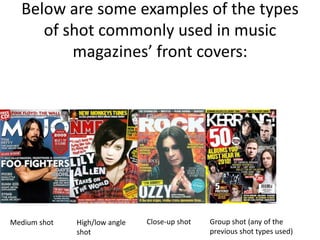
Below are some examples of the types
of shot commonly used in music
magazines’ front covers:
Medium shot High/low angle
shot
Close-up shot Group shot (any of the
previous shot types used)
For example, an image like this could
not be on the cover of a respected
music magazine:
• A convention that I believe can be broken is the
use of the same fonts throughout the whole
magazine (in this case front cover, contents page
and DPS).
• I think that using a large variety of fonts adds
character to the magazine, as well as makes it
interesting to the viewer.
• However, this has to be done with care not to end
up using a different font for every paragraph, as
this would make the read a tiring task for the
eyes.
• To ensure that I wouldn’t have this problem, I
limited my font selection to <10.
• Lastly, I have compared my final product to an
official classic rock music magazine, trying to
be objective in all my findings.
Front Cover
Wide range of
fonts (including
two in the
masthead)
Smiling person
(contrasting with
the serious/stern
expressions we are
used to seeing on
rock stars’ faces)
Off-centered
photograph
Tilted titles. E.g.
Exclusive
interview!
Follows Challenges
Use of genre colour
scheme
Clear Plug (stands
out)
Medium shot
Person looking at
the camera
Black and
white/sepia
Photograph
(conveys it’s old)
Person is in front of
masthead
Sell lines in front of
person
Use of words or
phrases like ‘Plus!’,
‘Sex’ ‘The real/true
story’.
Double Page Spread
Use of red, two columns, person is looking at the camera,
quote from the article, use of a black/white image.

Evaluation q1

  • 1.
    Evaluation Question 1: Inwhat ways does your media product use, develop or challenge forms and conventions of real media products?
  • 2.
    • In manyways, my magazine follows the conventions of classic rock magazines, such as MOJO and NME. • However, I decided to challenge some of the conventions to make my final product stand out from the rest.
  • 3.
    One of theconventions that many classic rock music magazines follow is the colour scheme: • The genre of Rock is commonly associated with a specified selection of colours including black, red, brown and yellow. • This colour scheme is regularly used in rock- oriented music magazines, and is a convention I decided to follow, as I think it brings out the character of he genre. • To support my argument, I have researched classic rock music magazines, and added a selection onto my presentation. • These resources include MOJO, NME and Melody Maker front covers, contents pages and DPSs.
  • 4.
    MOJO Music Magazine Blackand white/brown/red
  • 5.
  • 6.
  • 7.
    • Another conventionI decided to follow is the type of shot used in the front cover of my music magazine. • I feel this is a convention that cannot be broken successfully, as an off-focus shot, tilted angle shot, long shot or extreme close-up, to name a few, would distract the viewer from the information the magazine is selling. • As well as this, I think that audiences are used to seeing specific types of shots, and a photo that breaks this important convention would result in the magazine´s cover being ‘uncomfortable’ to look at.
  • 8.
    Below are someexamples of the types of shot commonly used in music magazines’ front covers: Medium shot High/low angle shot Close-up shot Group shot (any of the previous shot types used)
  • 9.
    For example, animage like this could not be on the cover of a respected music magazine:
  • 10.
    • A conventionthat I believe can be broken is the use of the same fonts throughout the whole magazine (in this case front cover, contents page and DPS). • I think that using a large variety of fonts adds character to the magazine, as well as makes it interesting to the viewer. • However, this has to be done with care not to end up using a different font for every paragraph, as this would make the read a tiring task for the eyes. • To ensure that I wouldn’t have this problem, I limited my font selection to <10.
  • 11.
    • Lastly, Ihave compared my final product to an official classic rock music magazine, trying to be objective in all my findings.
  • 12.
    Front Cover Wide rangeof fonts (including two in the masthead) Smiling person (contrasting with the serious/stern expressions we are used to seeing on rock stars’ faces) Off-centered photograph Tilted titles. E.g. Exclusive interview! Follows Challenges Use of genre colour scheme Clear Plug (stands out) Medium shot Person looking at the camera Black and white/sepia Photograph (conveys it’s old) Person is in front of masthead Sell lines in front of person Use of words or phrases like ‘Plus!’, ‘Sex’ ‘The real/true story’.
  • 13.
    Double Page Spread Useof red, two columns, person is looking at the camera, quote from the article, use of a black/white image.