Evaluation 
Section 1: Filming Progress- 
What went well? 
Considering we had to change our preliminary completely due to casting difficulties, I feel like the 
whole process came together in our filming. With the equipment we used, our camera shots were 
steady when they needed to be, and jerky to represent running at the appropriate times. We 
managed to use the correct camera angles to represent either reactions, emotions or conversation. 
We also managed to cast this video correctly (even though it took many takes) to achieve the 
emotions and reactions to create the correct atmosphere. 
What mistakes did you make? 
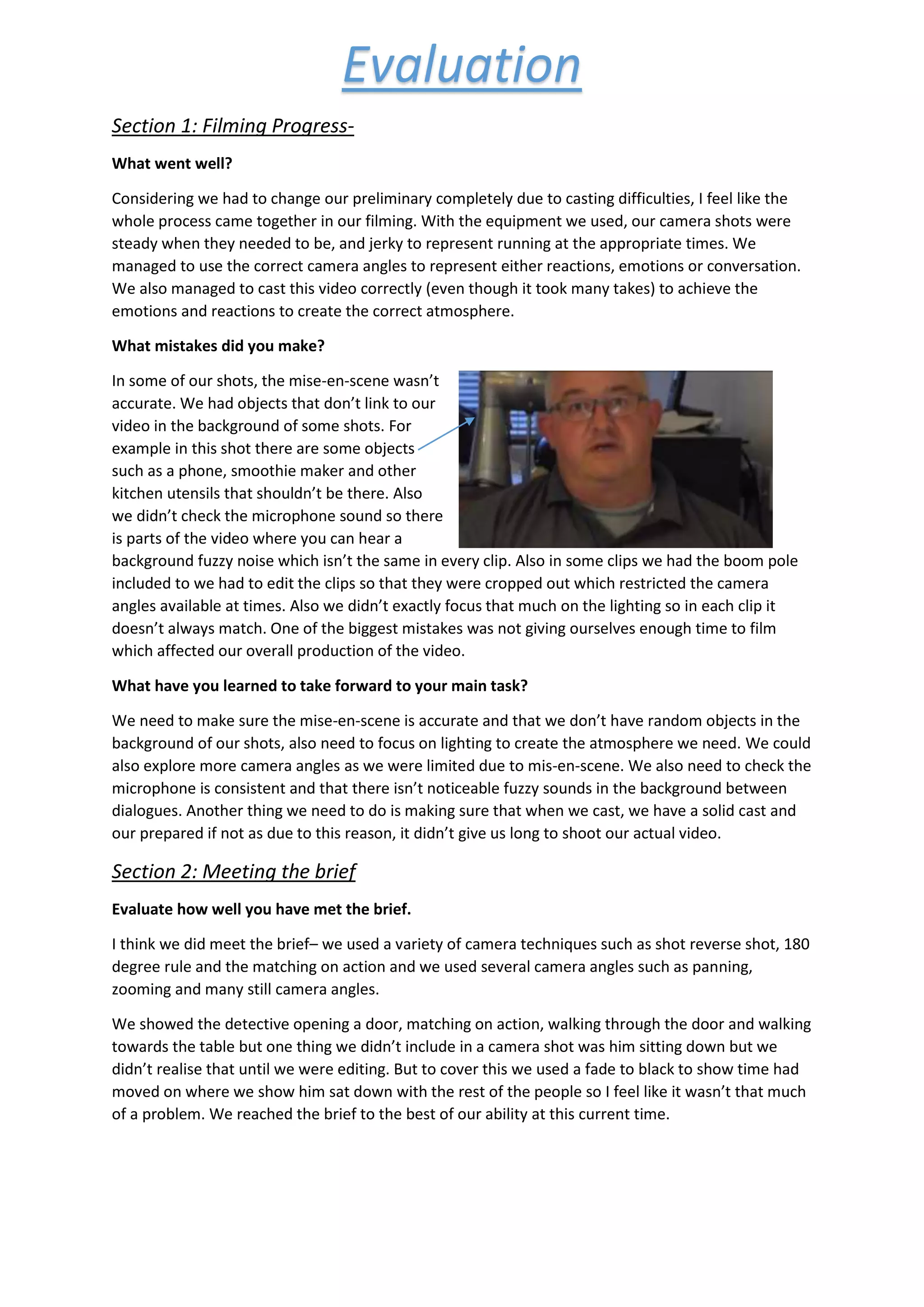
In some of our shots, the mise-en-scene wasn’t 
accurate. We had objects that don’t link to our 
video in the background of some shots. For 
example in this shot there are some objects 
such as a phone, smoothie maker and other 
kitchen utensils that shouldn’t be there. Also 
we didn’t check the microphone sound so there 
is parts of the video where you can hear a 
background fuzzy noise which isn’t the same in every clip. Also in some clips we had the boom pole 
included to we had to edit the clips so that they were cropped out which restricted the camera 
angles available at times. Also we didn’t exactly focus that much on the lighting so in each clip it 
doesn’t always match. One of the biggest mistakes was not giving ourselves enough time to film 
which affected our overall production of the video. 
What have you learned to take forward to your main task? 
We need to make sure the mise-en-scene is accurate and that we don’t have random objects in the 
background of our shots, also need to focus on lighting to create the atmosphere we need. We could 
also explore more camera angles as we were limited due to mis-en-scene. We also need to check the 
microphone is consistent and that there isn’t noticeable fuzzy sounds in the background between 
dialogues. Another thing we need to do is making sure that when we cast, we have a solid cast and 
our prepared if not as due to this reason, it didn’t give us long to shoot our actual video. 
Section 2: Meeting the brief 
Evaluate how well you have met the brief. 
I think we did meet the brief– we used a variety of camera techniques such as shot reverse shot, 180 
degree rule and the matching on action and we used several camera angles such as panning, 
zooming and many still camera angles. 
We showed the detective opening a door, matching on action, walking through the door and walking 
towards the table but one thing we didn’t include in a camera shot was him sitting down but we 
didn’t realise that until we were editing. But to cover this we used a fade to black to show time had 
moved on where we show him sat down with the rest of the people so I feel like it wasn’t that much 
of a problem. We reached the brief to the best of our ability at this current time.
Section 3: Technical Skills 
 Using titles appropriately according to institutional conventions 
We firstly planned to put the title at the beginning of our video but we believed to achieve 
the tone we wanted and due to the two different settings, it would look more effective in 
between both settings to suggest that they are in different places but we still stuck to the 
institutional conventions. 
 Using sound with images and editing appropriately for the task set 
Due to us talking throughout shots, a lot of sound editing had to be done to achieve a decent 
video. We didn’t realise about us talking throughout shots, in order for the video to work we 
had to add sound effects which were meant to be diegetic. Firstly, the opening of the door 
handle, we had to add a sound effect perfectly for this to work. During the running of the 
dog walker, we had to cut a lot of the footage due to talking but luckily we didn’t have to 
add sound effects for the footsteps. Finding suitable non-diegetic music for our video took a 
long amount of time because many of the music clips had too much of a beat to it whereas 
we wanted it to slowly increase in pace to create tension to match the action included in our 
video. 
 Shooting material appropriate to the task set, including controlled use of the camera, 
attention to framing, variety of shot distance and close attention to mise-en-scene 
Some of our shots had shaky footage to fit the purpose of the shot we were taking so this 
could look like unsteady filming but hopefully in our main task, if we need that footage we 
could make it less shaky. Our framing was consistently good during filming but we had a 
problem with the boom pole being in some shots and due to editing this out of the shot, it 
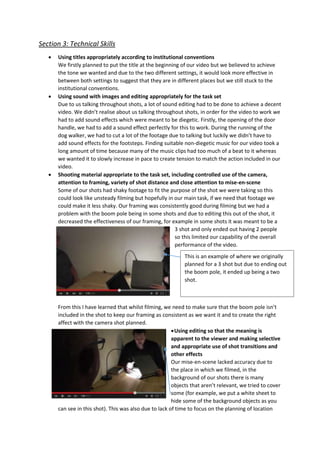
decreased the effectiveness of our framing, for example in some shots it was meant to be a 
3 shot and only ended out having 2 people 
so this limited our capability of the overall 
performance of the video. 
This is an example of where we originally 
planned for a 3 shot but due to ending out 
the boom pole, it ended up being a two 
shot. 
From this I have learned that whilst filming, we need to make sure that the boom pole isn’t 
included in the shot to keep our framing as consistent as we want it and to create the right 
affect with the camera shot planned. 
 Using editing so that the meaning is 
apparent to the viewer and making selective 
and appropriate use of shot transitions and 
other effects 
Our mise-en-scene lacked accuracy due to 
the place in which we filmed, in the 
background of our shots there is many 
objects that aren’t relevant, we tried to cover 
some (for example, we put a white sheet to 
hide some of the background objects as you 
can see in this shot). This was also due to lack of time to focus on the planning of location
and we will think about it more next time. In the main task we will need to focus more on 
mise-en-scene and props to create the accurate setting in which we will film at. Editing was a 
huge process in our production due to cropping shots, zooming in to avoid showing as much 
inaccurate mise-en-scene (mostly the boom pole), speeding shots up to increase the 
constant pace we needed in our video and slowing them down to keep a link with the non-diegetic 
music (added during editing). 
Our shot transitions were relevant to our video, even though many of our transitions were 
cuts, this was to keep a constant pace to keep the audience interested and to match the 
storyline. We used a couple of fades to make sure of a smooth viewing when appropriate 
such as linking the scenes in the forest to show the dog walkers POV to make it more 
realistic. 
Overall I believe that our preliminary task went well, especially due to the setbacks during 
the process. We have many things to improve on for the main task such as mise-en-scene, 
lighting and a wider variety of camera angles.

Evaluation of Preliminary Task - The Interrogation

  • 1.
    Evaluation Section 1:Filming Progress- What went well? Considering we had to change our preliminary completely due to casting difficulties, I feel like the whole process came together in our filming. With the equipment we used, our camera shots were steady when they needed to be, and jerky to represent running at the appropriate times. We managed to use the correct camera angles to represent either reactions, emotions or conversation. We also managed to cast this video correctly (even though it took many takes) to achieve the emotions and reactions to create the correct atmosphere. What mistakes did you make? In some of our shots, the mise-en-scene wasn’t accurate. We had objects that don’t link to our video in the background of some shots. For example in this shot there are some objects such as a phone, smoothie maker and other kitchen utensils that shouldn’t be there. Also we didn’t check the microphone sound so there is parts of the video where you can hear a background fuzzy noise which isn’t the same in every clip. Also in some clips we had the boom pole included to we had to edit the clips so that they were cropped out which restricted the camera angles available at times. Also we didn’t exactly focus that much on the lighting so in each clip it doesn’t always match. One of the biggest mistakes was not giving ourselves enough time to film which affected our overall production of the video. What have you learned to take forward to your main task? We need to make sure the mise-en-scene is accurate and that we don’t have random objects in the background of our shots, also need to focus on lighting to create the atmosphere we need. We could also explore more camera angles as we were limited due to mis-en-scene. We also need to check the microphone is consistent and that there isn’t noticeable fuzzy sounds in the background between dialogues. Another thing we need to do is making sure that when we cast, we have a solid cast and our prepared if not as due to this reason, it didn’t give us long to shoot our actual video. Section 2: Meeting the brief Evaluate how well you have met the brief. I think we did meet the brief– we used a variety of camera techniques such as shot reverse shot, 180 degree rule and the matching on action and we used several camera angles such as panning, zooming and many still camera angles. We showed the detective opening a door, matching on action, walking through the door and walking towards the table but one thing we didn’t include in a camera shot was him sitting down but we didn’t realise that until we were editing. But to cover this we used a fade to black to show time had moved on where we show him sat down with the rest of the people so I feel like it wasn’t that much of a problem. We reached the brief to the best of our ability at this current time.
  • 2.
    Section 3: TechnicalSkills  Using titles appropriately according to institutional conventions We firstly planned to put the title at the beginning of our video but we believed to achieve the tone we wanted and due to the two different settings, it would look more effective in between both settings to suggest that they are in different places but we still stuck to the institutional conventions.  Using sound with images and editing appropriately for the task set Due to us talking throughout shots, a lot of sound editing had to be done to achieve a decent video. We didn’t realise about us talking throughout shots, in order for the video to work we had to add sound effects which were meant to be diegetic. Firstly, the opening of the door handle, we had to add a sound effect perfectly for this to work. During the running of the dog walker, we had to cut a lot of the footage due to talking but luckily we didn’t have to add sound effects for the footsteps. Finding suitable non-diegetic music for our video took a long amount of time because many of the music clips had too much of a beat to it whereas we wanted it to slowly increase in pace to create tension to match the action included in our video.  Shooting material appropriate to the task set, including controlled use of the camera, attention to framing, variety of shot distance and close attention to mise-en-scene Some of our shots had shaky footage to fit the purpose of the shot we were taking so this could look like unsteady filming but hopefully in our main task, if we need that footage we could make it less shaky. Our framing was consistently good during filming but we had a problem with the boom pole being in some shots and due to editing this out of the shot, it decreased the effectiveness of our framing, for example in some shots it was meant to be a 3 shot and only ended out having 2 people so this limited our capability of the overall performance of the video. This is an example of where we originally planned for a 3 shot but due to ending out the boom pole, it ended up being a two shot. From this I have learned that whilst filming, we need to make sure that the boom pole isn’t included in the shot to keep our framing as consistent as we want it and to create the right affect with the camera shot planned.  Using editing so that the meaning is apparent to the viewer and making selective and appropriate use of shot transitions and other effects Our mise-en-scene lacked accuracy due to the place in which we filmed, in the background of our shots there is many objects that aren’t relevant, we tried to cover some (for example, we put a white sheet to hide some of the background objects as you can see in this shot). This was also due to lack of time to focus on the planning of location
  • 3.
    and we willthink about it more next time. In the main task we will need to focus more on mise-en-scene and props to create the accurate setting in which we will film at. Editing was a huge process in our production due to cropping shots, zooming in to avoid showing as much inaccurate mise-en-scene (mostly the boom pole), speeding shots up to increase the constant pace we needed in our video and slowing them down to keep a link with the non-diegetic music (added during editing). Our shot transitions were relevant to our video, even though many of our transitions were cuts, this was to keep a constant pace to keep the audience interested and to match the storyline. We used a couple of fades to make sure of a smooth viewing when appropriate such as linking the scenes in the forest to show the dog walkers POV to make it more realistic. Overall I believe that our preliminary task went well, especially due to the setbacks during the process. We have many things to improve on for the main task such as mise-en-scene, lighting and a wider variety of camera angles.