CHANGES TO EVALUATION AND MANAGEMENT CODES IN 2021
As of January 1, 2021, there will be significant changes to the office and outpatient Evaluation and Management (E&M) services (CPT ® codes
99202-99215) for both new and established patients. Practices, physicians, and staff must be aware of the modifications to ensure a successful
transition next year and avoid any disruption in reimbursement.
CPT ® code 99201 (new patient, level 1) will be deleted
CPT ® code 99201 is rarely reported by oncologists, and therefore it’s deletion will have a relatively minimal impact on oncology practices. CPT
code 99211 (established patient, level 1) will remain as a reportable service.
History and examination will be removed as key components for selecting the level of E&M service. Currently, history and exam are two of the
three components used to select the appropriate E&M service. In 2021, history and exam will no longer be used to select an E&M service, but
still must be performed in order to report CPT ® codes 99202-99215.
Criteria for code selection
In 2021, E&M code selection will be based on either
1) The level of medical decision making (MDM)
2) The time performing the service on the day of the encounter.
Definition of time
The definition of time associated with CPT ® codes 99202-99215 has been revised from the typical face-to-face time to total time spent on the
day of the encounter. The total time corresponding to CPT ® codes 99202-99215 have been defined as specific intervals.
For example, in order to report 99215, 40-54 minutes of total time must be spent on the date of the encounter. Currently, the time requirement
for 99215 is “typically” 40 minutes.
Medical decision-making elements.
The medical decision-making elements associated with codes 99202-99215 will consist of three components:
1) The number and complexity of problems addressed
2) Amount and/or complexity of data to be reviewed and analyzed
3) Risk of complications and or morbidity or mortality of patient management. In order to select a level of E&M service, two of the three
elements must be met or exceeded. A new medical decision-making table further outlines the criteria for the E&M code level selection.
Code
Level of MDM
(Based on 2
out of 3
Elements of
MDM)
Elements of Medical Decision Making
Number and Complexity of
Problems
Addressed
Amount and/or Complexity of Data to be Reviewed and Analyzed
*Each unique test, order, or document contributes to the combination of
2 or combination of 3 in Category 1 below.
Risk of Complications and/or Morbidity or
Mortality of Patient Management
99211 N/A N/A N/A N/A
99202
99212
Straightforward Minimal
 1 self-limited or minor problem
Minimal or none Minimal risk of morbidity from additional
diagnostic testing or treatment
99203
99213
Low Low
 2 or more self-limited or
minor problems;
or
 1 stable chronic illness;
or
 1 acute, uncomplicated
illnessor injury
Limited
(Must meet the requirements of at least 1 of the 2 categories)
Category 1: Tests and documents
 Any combination of 2 from the following:
 Review of prior external note(s) from each unique source*;
 review of the result(s) of each unique test*;
 ordering of each unique test*
or
Category 2: Assessment requiring an independent historian(s)
(For the categories of independent interpretation of tests and discussion of
management or test interpretation, see moderate or high)
Low risk of morbidity from additional
diagnostic testing or treatment
99204
99214
Moderate Moderate
 1 or more chronic illnesses
with exacerbation,
progression, or side effects
of treatment;
or
 2 or more stable chronic
illnesses;
or
 1 undiagnosed new
problem with uncertain
prognosis;
or
 1 acute illness with
systemic symptoms;
Or 1 acute complicated injury
Moderate(Must meet the requirements of at least 1 out of 3 categories)
Category 1: Tests, documents, or independent historian(s)
 Any combination of 3 from the following:
 Review of prior external note(s) from each unique source*;
 Review of the result(s) of each unique test*;
 Ordering of each unique test*;
 Assessment requiring an independent historian(s)
or
Category 2: Independent interpretation of tests
 Independent interpretation of a test performed by another physician/other
qualified health care professional (not separately reported); or
Category 3: Discussion of management or test interpretation
 Discussion of management or test interpretation with external
physician/other qualified health care professionalappropriate source
(not separately reported)
Moderate risk of morbidity from
additional diagnostic testing or
treatment
Examples only:
 Prescription drug management
 Decision regarding minor surgery with
identified patient or procedure risk
factors
 Decision regarding elective major
surgery without identified patient
or procedure risk factors
 Diagnosis or treatment significantly
limited by social determinants of
health
99205
99215
High High
 1 or more chronic
illnesses with severe
exacerbation,
progression, or side
effects of treatment;
or
 1 acute or chronic
illness or injury that
poses a threat to life
or bodily function
Extensive
(Must meet the requirements of at least 2 out of 3 categories)
Category 1: Tests, documents, or independent historian(s)
 Any combination of 3 from the following:
 Review of prior external note(s) from each unique source*;
 Review of the result(s) of each unique test*;
 Ordering of each unique test*;
 Assessment requiring an independent historian(s)
or
Category 2: Independent interpretation of tests
 Independent interpretation of a test performed by another
physician/other qualified health care professional (not separately
reported);
or
Category 3: Discussion of management or test interpretation
 Discussion of management or test interpretation with external
physician/other qualified health care professional/appropriate source
(not separately reported)
High risk of morbidity from
additional diagnostic testing or
treatment
Examples only:
 Drug therapy requiring intensive
monitoring for toxicity
 Decision regarding elective major
surgery with identified patient or
procedure risk factors
 Decision regarding emergency major
surgery
 Decision regarding hospitalization
 Decision not to resuscitate or to de-
escalate care because of poor
prognosis
Office or Other Outpatient Services
New Patient
(99201 has been deleted. To report, use 99202)
99202: Office or other outpatient visit for the evaluation and management of a new patient, which requires a medically appropriate history
and/or examination and straightforward medical decision making.
When using time for code selection, 15-29 minutes of total time is spent on the date of the encounter.
99203: Office or other outpatient visit for the evaluation and management of a new patient, which requires a medically appropriate history
and/or examination and low level of medical decision making.
When using time for code selection, 30-44 minutes of total time is spent on the date of the encounter.
99204: Office or other outpatient visit for the evaluation and management of a new patient, which requires a medically appropriate history
and/or examination and moderate level of medical decision making.
When using time for code selection, 45-59 minutes of total time is spent on the date of the encounter.
99205: Office or other outpatient visit for the evaluation and management of a new patient, which requires a medically appropriate history
and/or examination and high level of medical decision making.
When using time for code selection, 60-74 minutes of total time is spent on the date of the encounter.
(For services 75 minutes or longer, see Prolonged Services 99XXX)
Established Patient
99211: Office or other outpatient visit for the evaluation and management of an established patient, that may not require the presence of a
physician or other qualified health care professional. Usually, the presenting problem(s) are minimal.
99212: Office or other outpatient visit for the evaluation and management of an established patient, which requires a medically appropriate
history and/or examination and straightforward medical decision making.
When using time for code selection, 10-19 minutes of total time is spent on the date of the encounter.
99213: Office or other outpatient visit for the evaluation and management of an established patient, which requires a medically appropriate
history and/or examination and low level of medical decision making.
When using time for code selection, 20-29 minutes of total time is spent on the date of the encounter.
99214: Office or other outpatient visit for the evaluation and management of an established patient, which requires a medically appropriate
history and/or examination and moderate level of medical decision making.
When using time for code selection, 30-39 minutes of total time is spent on the date of the encounter.
99215: Office or other outpatient visit for the evaluation and management of an established patient, which requires a medically appropriate
history and/or examination and high level of medical decision making.
When using time for code selection, 40-54 minutes of total time is spent on the date of the encounter.
(For services 55 minutes or longer, see Prolonged Services 99XXX)
NEW PROLONGED SERVICES CPT CODE
A new prolonged services code (with or without direct patient contact) has been created to describe a prolonged office and outpatient E&M
service of 15 minutes beyond the total time of the primary E&M procedure (either CPT ® code 99205 or 99215). It can only be reported when
the E&M service has been selected based on time alone (not medical decision making) AND only after the total time of a level 5 service (either
99205 or 99215) has been exceeded.
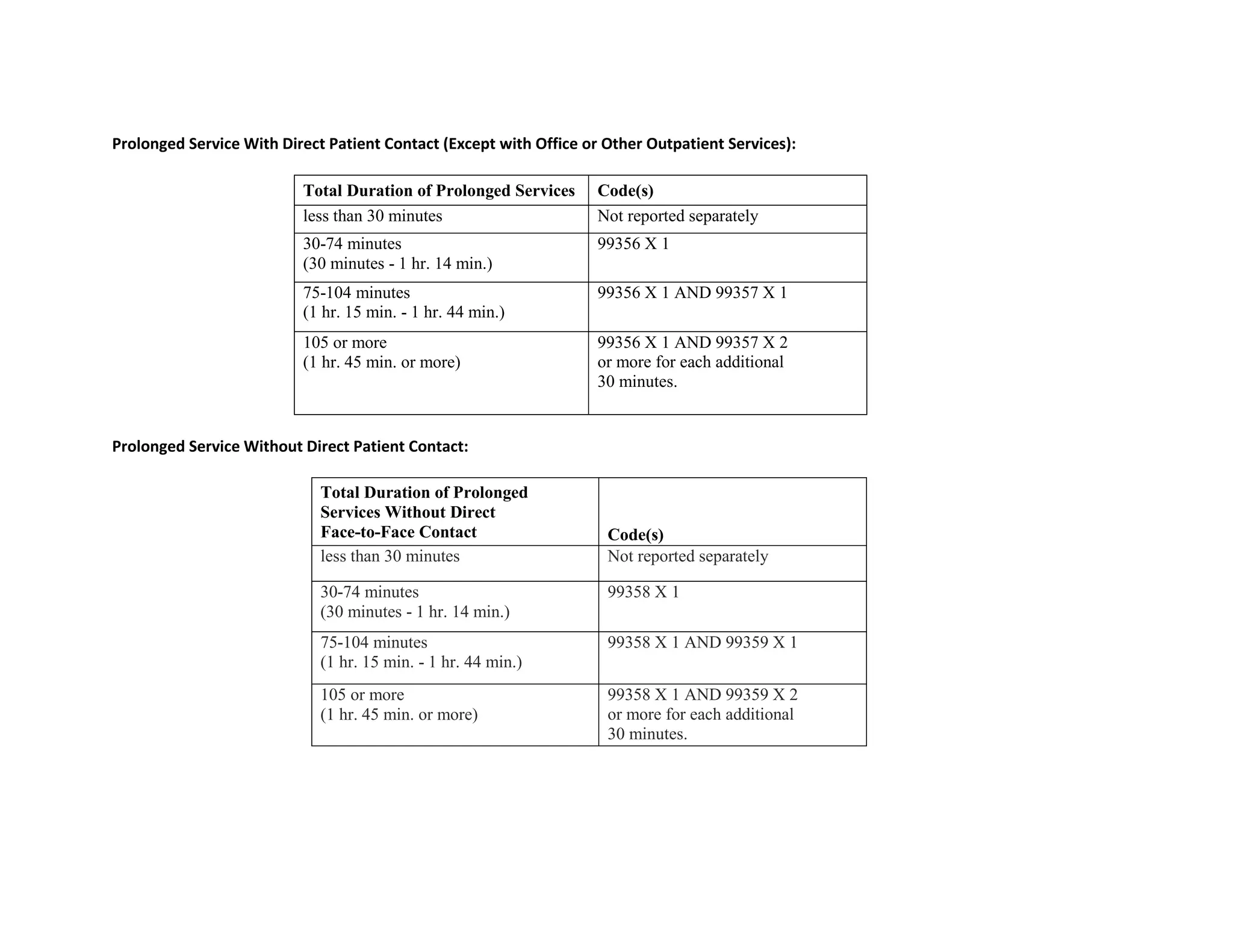
Prolonged Service With Direct Patient Contact (Except with Office or Other Outpatient Services):
Total Duration of Prolonged Services Code(s)
less than 30 minutes Not reported separately
30-74 minutes
(30 minutes - 1 hr. 14 min.)
99356 X 1
75-104 minutes
(1 hr. 15 min. - 1 hr. 44 min.)
99356 X 1 AND 99357 X 1
105 or more
(1 hr. 45 min. or more)
99356 X 1 AND 99357 X 2
or more for each additional
30 minutes.
Prolonged Service Without Direct Patient Contact:
Total Duration of Prolonged
Services Without Direct
Face-to-Face Contact Code(s)
less than 30 minutes Not reported separately
30-74 minutes
(30 minutes - 1 hr. 14 min.)
99358 X 1
75-104 minutes
(1 hr. 15 min. - 1 hr. 44 min.)
99358 X 1 AND 99359 X 1
105 or more
(1 hr. 45 min. or more)
99358 X 1 AND 99359 X 2
or more for each additional
30 minutes.

Evaluation and Management Updates 2021.docx

  • 1.
    CHANGES TO EVALUATIONAND MANAGEMENT CODES IN 2021 As of January 1, 2021, there will be significant changes to the office and outpatient Evaluation and Management (E&M) services (CPT ® codes 99202-99215) for both new and established patients. Practices, physicians, and staff must be aware of the modifications to ensure a successful transition next year and avoid any disruption in reimbursement. CPT ® code 99201 (new patient, level 1) will be deleted CPT ® code 99201 is rarely reported by oncologists, and therefore it’s deletion will have a relatively minimal impact on oncology practices. CPT code 99211 (established patient, level 1) will remain as a reportable service. History and examination will be removed as key components for selecting the level of E&M service. Currently, history and exam are two of the three components used to select the appropriate E&M service. In 2021, history and exam will no longer be used to select an E&M service, but still must be performed in order to report CPT ® codes 99202-99215. Criteria for code selection In 2021, E&M code selection will be based on either 1) The level of medical decision making (MDM) 2) The time performing the service on the day of the encounter. Definition of time The definition of time associated with CPT ® codes 99202-99215 has been revised from the typical face-to-face time to total time spent on the day of the encounter. The total time corresponding to CPT ® codes 99202-99215 have been defined as specific intervals. For example, in order to report 99215, 40-54 minutes of total time must be spent on the date of the encounter. Currently, the time requirement for 99215 is “typically” 40 minutes. Medical decision-making elements. The medical decision-making elements associated with codes 99202-99215 will consist of three components: 1) The number and complexity of problems addressed 2) Amount and/or complexity of data to be reviewed and analyzed 3) Risk of complications and or morbidity or mortality of patient management. In order to select a level of E&M service, two of the three elements must be met or exceeded. A new medical decision-making table further outlines the criteria for the E&M code level selection.
  • 2.
    Code Level of MDM (Basedon 2 out of 3 Elements of MDM) Elements of Medical Decision Making Number and Complexity of Problems Addressed Amount and/or Complexity of Data to be Reviewed and Analyzed *Each unique test, order, or document contributes to the combination of 2 or combination of 3 in Category 1 below. Risk of Complications and/or Morbidity or Mortality of Patient Management 99211 N/A N/A N/A N/A 99202 99212 Straightforward Minimal  1 self-limited or minor problem Minimal or none Minimal risk of morbidity from additional diagnostic testing or treatment 99203 99213 Low Low  2 or more self-limited or minor problems; or  1 stable chronic illness; or  1 acute, uncomplicated illnessor injury Limited (Must meet the requirements of at least 1 of the 2 categories) Category 1: Tests and documents  Any combination of 2 from the following:  Review of prior external note(s) from each unique source*;  review of the result(s) of each unique test*;  ordering of each unique test* or Category 2: Assessment requiring an independent historian(s) (For the categories of independent interpretation of tests and discussion of management or test interpretation, see moderate or high) Low risk of morbidity from additional diagnostic testing or treatment 99204 99214 Moderate Moderate  1 or more chronic illnesses with exacerbation, progression, or side effects of treatment; or  2 or more stable chronic illnesses; or  1 undiagnosed new problem with uncertain prognosis; or  1 acute illness with systemic symptoms; Or 1 acute complicated injury Moderate(Must meet the requirements of at least 1 out of 3 categories) Category 1: Tests, documents, or independent historian(s)  Any combination of 3 from the following:  Review of prior external note(s) from each unique source*;  Review of the result(s) of each unique test*;  Ordering of each unique test*;  Assessment requiring an independent historian(s) or Category 2: Independent interpretation of tests  Independent interpretation of a test performed by another physician/other qualified health care professional (not separately reported); or Category 3: Discussion of management or test interpretation  Discussion of management or test interpretation with external physician/other qualified health care professionalappropriate source (not separately reported) Moderate risk of morbidity from additional diagnostic testing or treatment Examples only:  Prescription drug management  Decision regarding minor surgery with identified patient or procedure risk factors  Decision regarding elective major surgery without identified patient or procedure risk factors  Diagnosis or treatment significantly limited by social determinants of health
  • 3.
    99205 99215 High High  1or more chronic illnesses with severe exacerbation, progression, or side effects of treatment; or  1 acute or chronic illness or injury that poses a threat to life or bodily function Extensive (Must meet the requirements of at least 2 out of 3 categories) Category 1: Tests, documents, or independent historian(s)  Any combination of 3 from the following:  Review of prior external note(s) from each unique source*;  Review of the result(s) of each unique test*;  Ordering of each unique test*;  Assessment requiring an independent historian(s) or Category 2: Independent interpretation of tests  Independent interpretation of a test performed by another physician/other qualified health care professional (not separately reported); or Category 3: Discussion of management or test interpretation  Discussion of management or test interpretation with external physician/other qualified health care professional/appropriate source (not separately reported) High risk of morbidity from additional diagnostic testing or treatment Examples only:  Drug therapy requiring intensive monitoring for toxicity  Decision regarding elective major surgery with identified patient or procedure risk factors  Decision regarding emergency major surgery  Decision regarding hospitalization  Decision not to resuscitate or to de- escalate care because of poor prognosis Office or Other Outpatient Services New Patient (99201 has been deleted. To report, use 99202) 99202: Office or other outpatient visit for the evaluation and management of a new patient, which requires a medically appropriate history and/or examination and straightforward medical decision making. When using time for code selection, 15-29 minutes of total time is spent on the date of the encounter. 99203: Office or other outpatient visit for the evaluation and management of a new patient, which requires a medically appropriate history and/or examination and low level of medical decision making. When using time for code selection, 30-44 minutes of total time is spent on the date of the encounter. 99204: Office or other outpatient visit for the evaluation and management of a new patient, which requires a medically appropriate history and/or examination and moderate level of medical decision making. When using time for code selection, 45-59 minutes of total time is spent on the date of the encounter. 99205: Office or other outpatient visit for the evaluation and management of a new patient, which requires a medically appropriate history and/or examination and high level of medical decision making.
  • 4.
    When using timefor code selection, 60-74 minutes of total time is spent on the date of the encounter. (For services 75 minutes or longer, see Prolonged Services 99XXX) Established Patient 99211: Office or other outpatient visit for the evaluation and management of an established patient, that may not require the presence of a physician or other qualified health care professional. Usually, the presenting problem(s) are minimal. 99212: Office or other outpatient visit for the evaluation and management of an established patient, which requires a medically appropriate history and/or examination and straightforward medical decision making. When using time for code selection, 10-19 minutes of total time is spent on the date of the encounter. 99213: Office or other outpatient visit for the evaluation and management of an established patient, which requires a medically appropriate history and/or examination and low level of medical decision making. When using time for code selection, 20-29 minutes of total time is spent on the date of the encounter. 99214: Office or other outpatient visit for the evaluation and management of an established patient, which requires a medically appropriate history and/or examination and moderate level of medical decision making. When using time for code selection, 30-39 minutes of total time is spent on the date of the encounter. 99215: Office or other outpatient visit for the evaluation and management of an established patient, which requires a medically appropriate history and/or examination and high level of medical decision making. When using time for code selection, 40-54 minutes of total time is spent on the date of the encounter. (For services 55 minutes or longer, see Prolonged Services 99XXX) NEW PROLONGED SERVICES CPT CODE A new prolonged services code (with or without direct patient contact) has been created to describe a prolonged office and outpatient E&M service of 15 minutes beyond the total time of the primary E&M procedure (either CPT ® code 99205 or 99215). It can only be reported when the E&M service has been selected based on time alone (not medical decision making) AND only after the total time of a level 5 service (either 99205 or 99215) has been exceeded.
  • 5.
    Prolonged Service WithDirect Patient Contact (Except with Office or Other Outpatient Services): Total Duration of Prolonged Services Code(s) less than 30 minutes Not reported separately 30-74 minutes (30 minutes - 1 hr. 14 min.) 99356 X 1 75-104 minutes (1 hr. 15 min. - 1 hr. 44 min.) 99356 X 1 AND 99357 X 1 105 or more (1 hr. 45 min. or more) 99356 X 1 AND 99357 X 2 or more for each additional 30 minutes. Prolonged Service Without Direct Patient Contact: Total Duration of Prolonged Services Without Direct Face-to-Face Contact Code(s) less than 30 minutes Not reported separately 30-74 minutes (30 minutes - 1 hr. 14 min.) 99358 X 1 75-104 minutes (1 hr. 15 min. - 1 hr. 44 min.) 99358 X 1 AND 99359 X 1 105 or more (1 hr. 45 min. or more) 99358 X 1 AND 99359 X 2 or more for each additional 30 minutes.