





 Define E&M Services
 Know the E&M Documentation Components
 Review E&M documentation criteria
 Common patient/physician encounters
 Clinic visit
 H&P
 Does not include tests or procedures
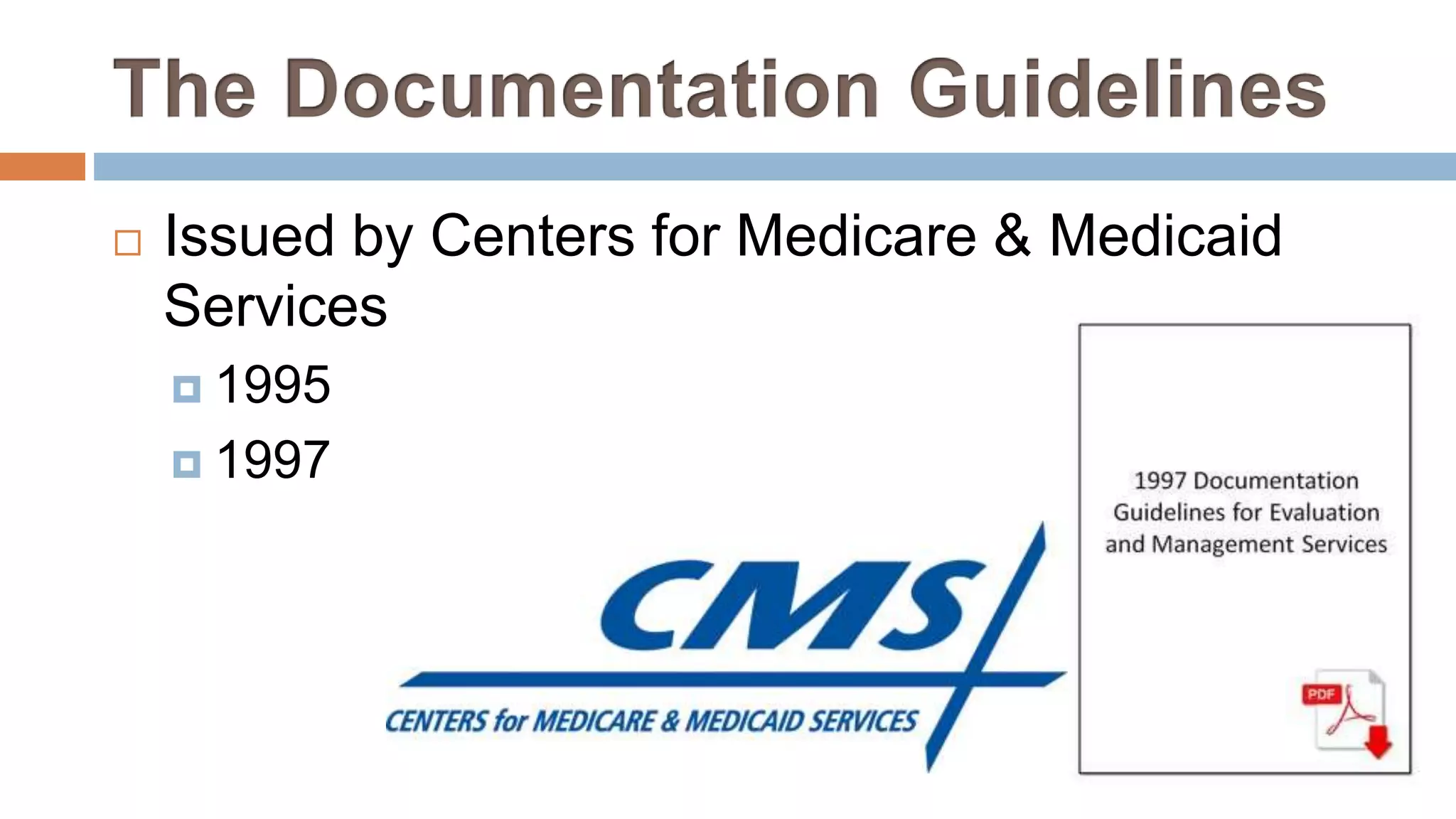
 Issued by Centers for Medicare & Medicaid
Services
 1995
 1997
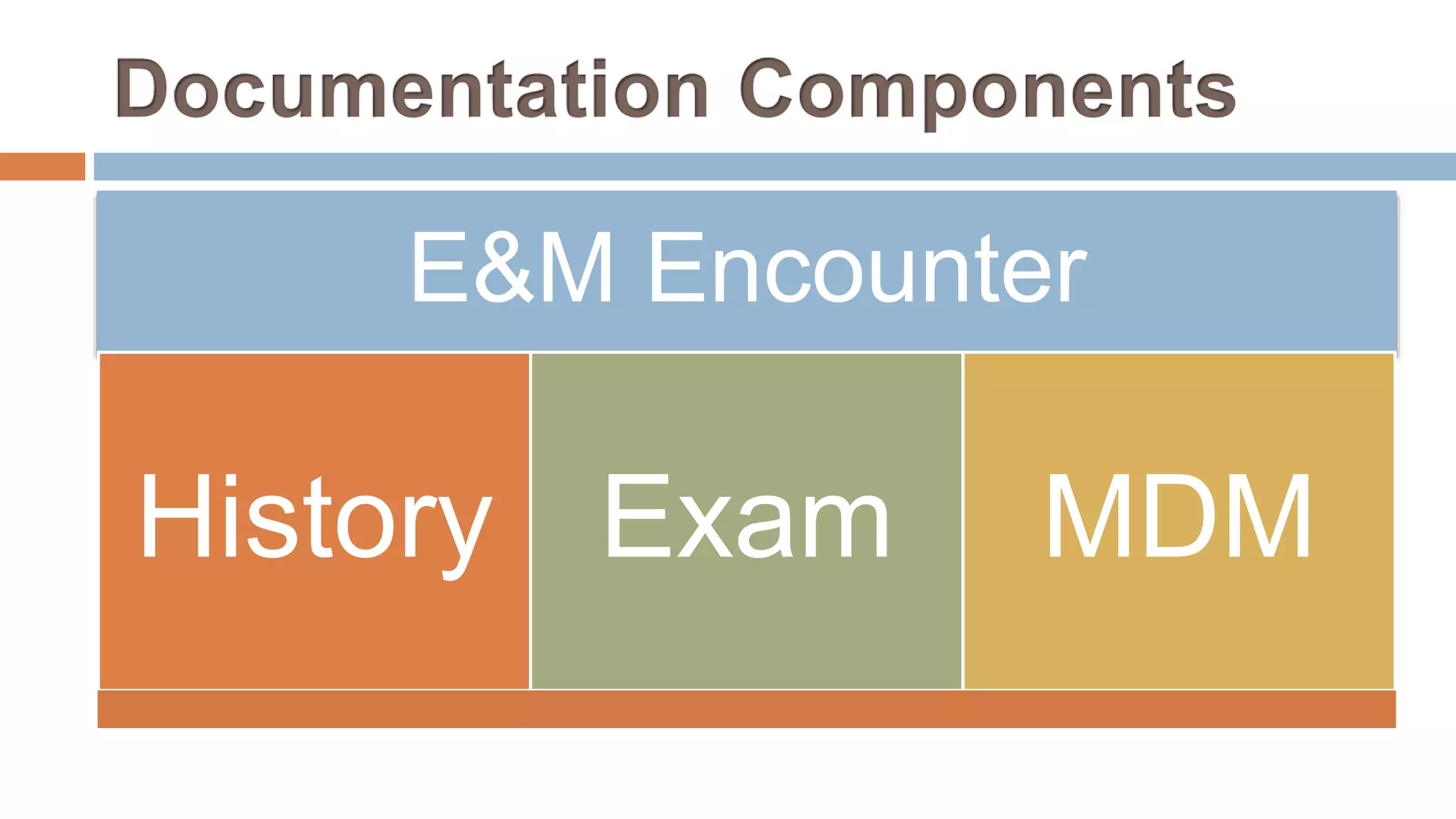
E&M Encounter
History Exam MDM
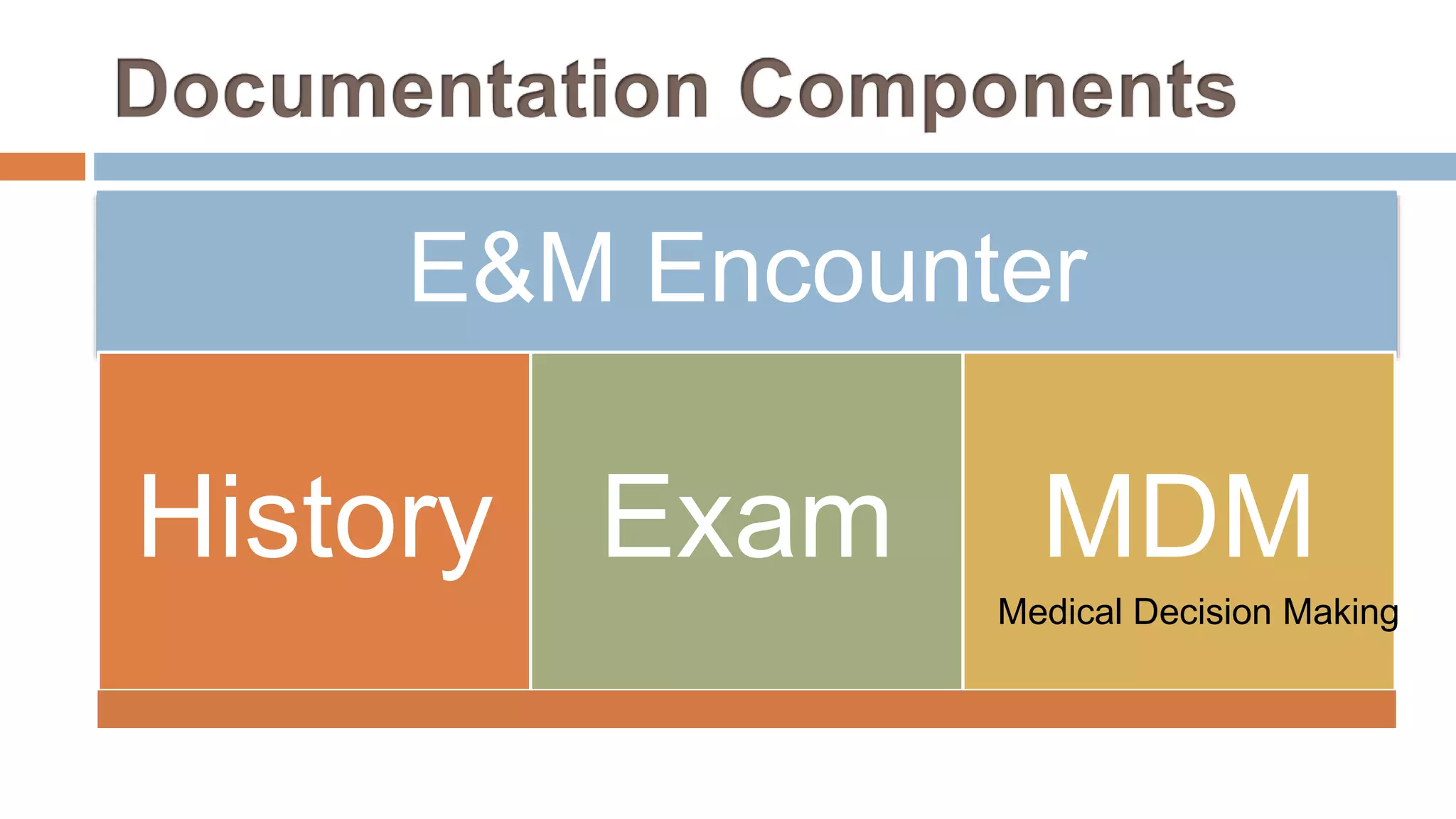
E&M Encounter
History Exam MDM
Medical Decision Making
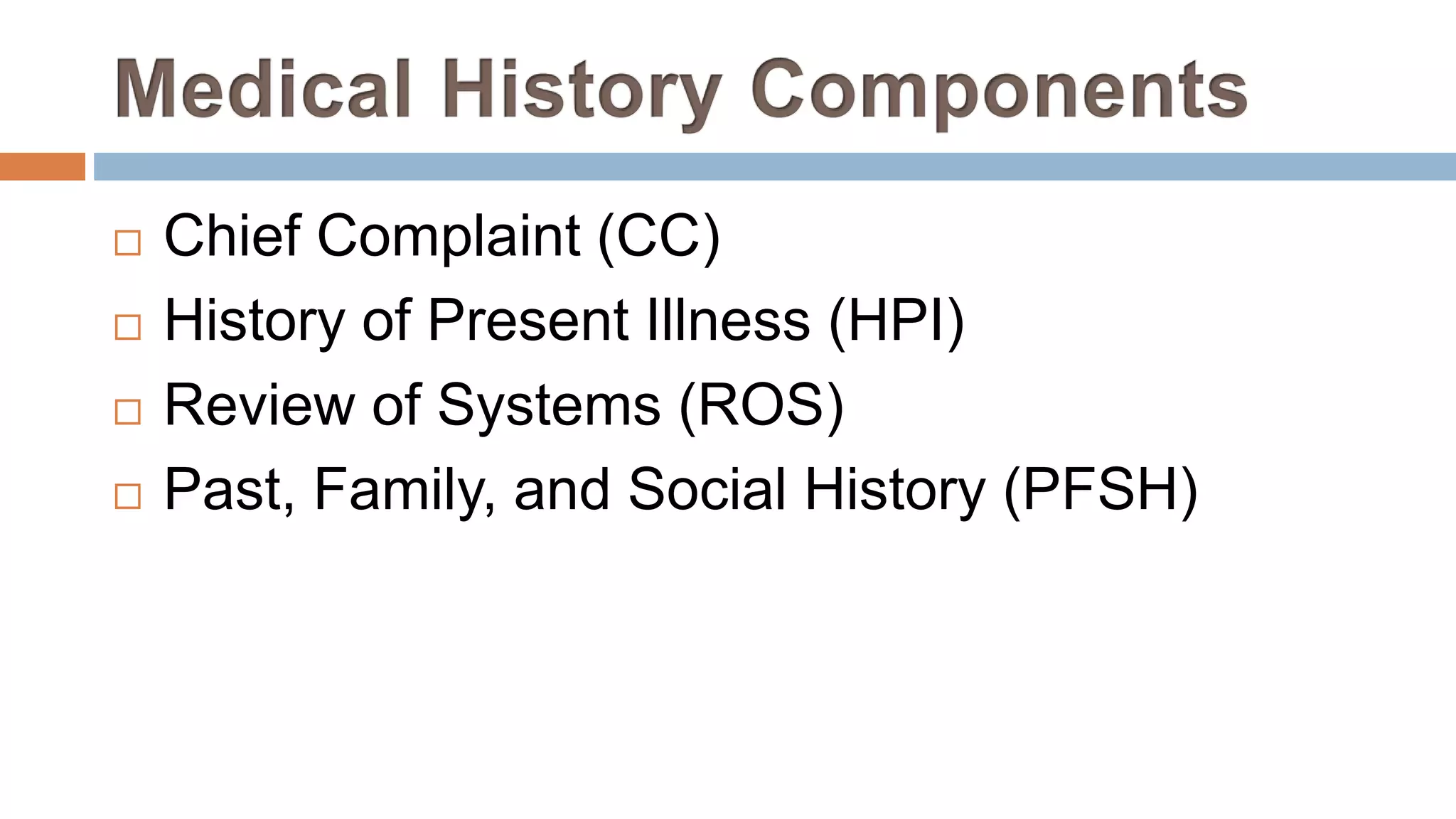
 Chief Complaint (CC)
 History of Present Illness (HPI)
 Review of Systems (ROS)
 Past, Family, and Social History (PFSH)
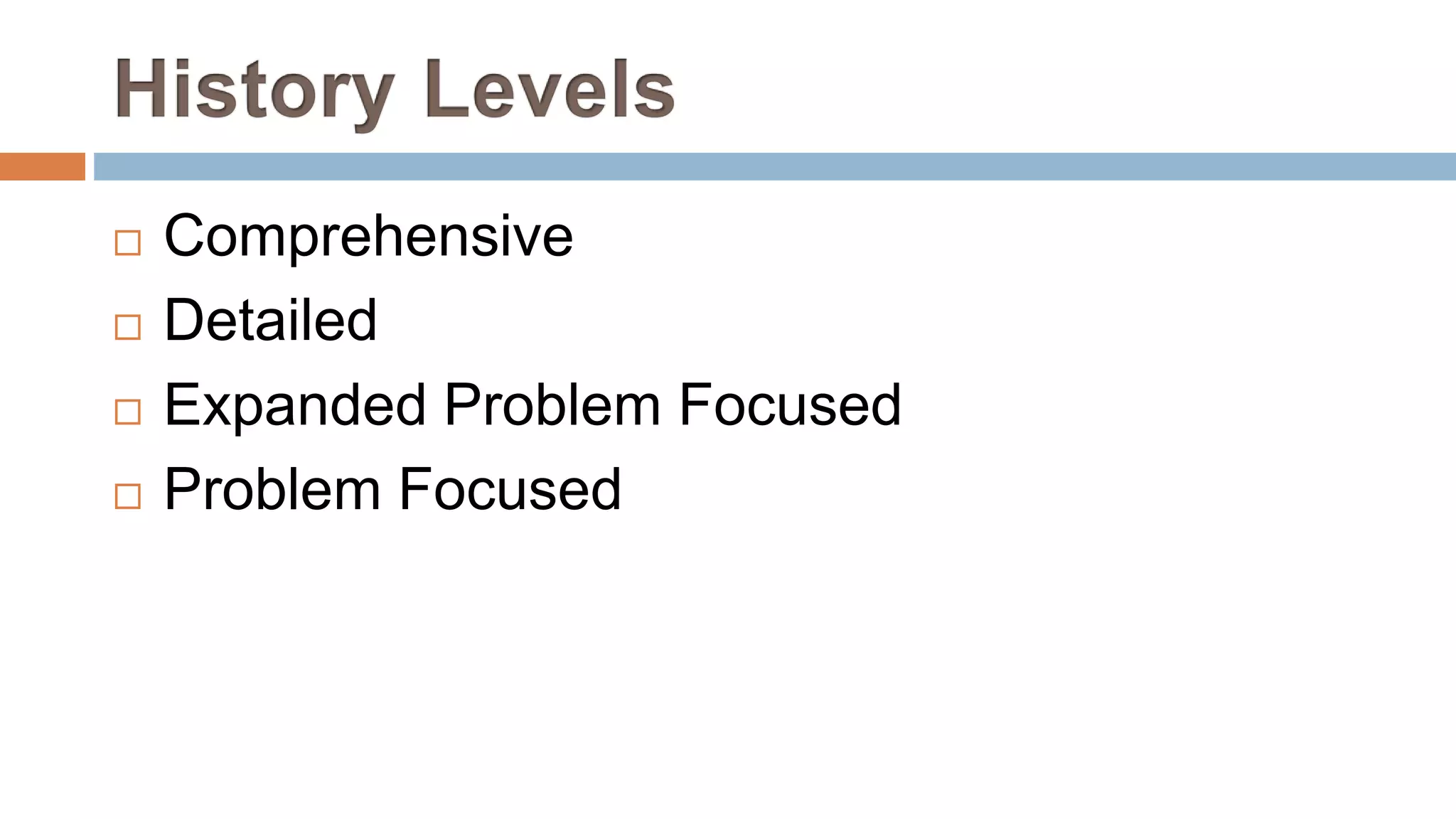
 Comprehensive
 Detailed
 Expanded Problem Focused
 Problem Focused
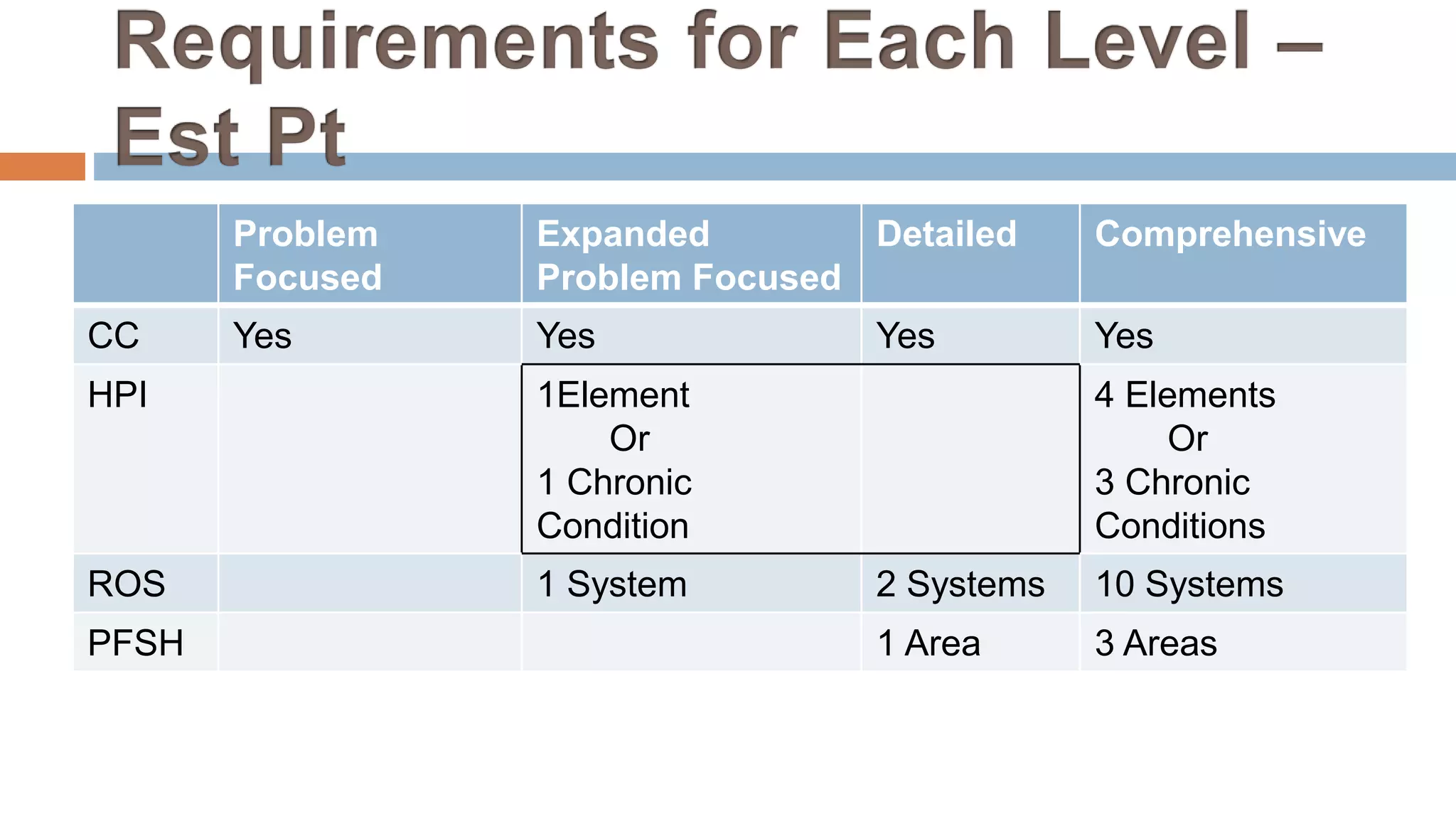
Problem
Focused
Expanded
Problem Focused
Detailed Comprehensive
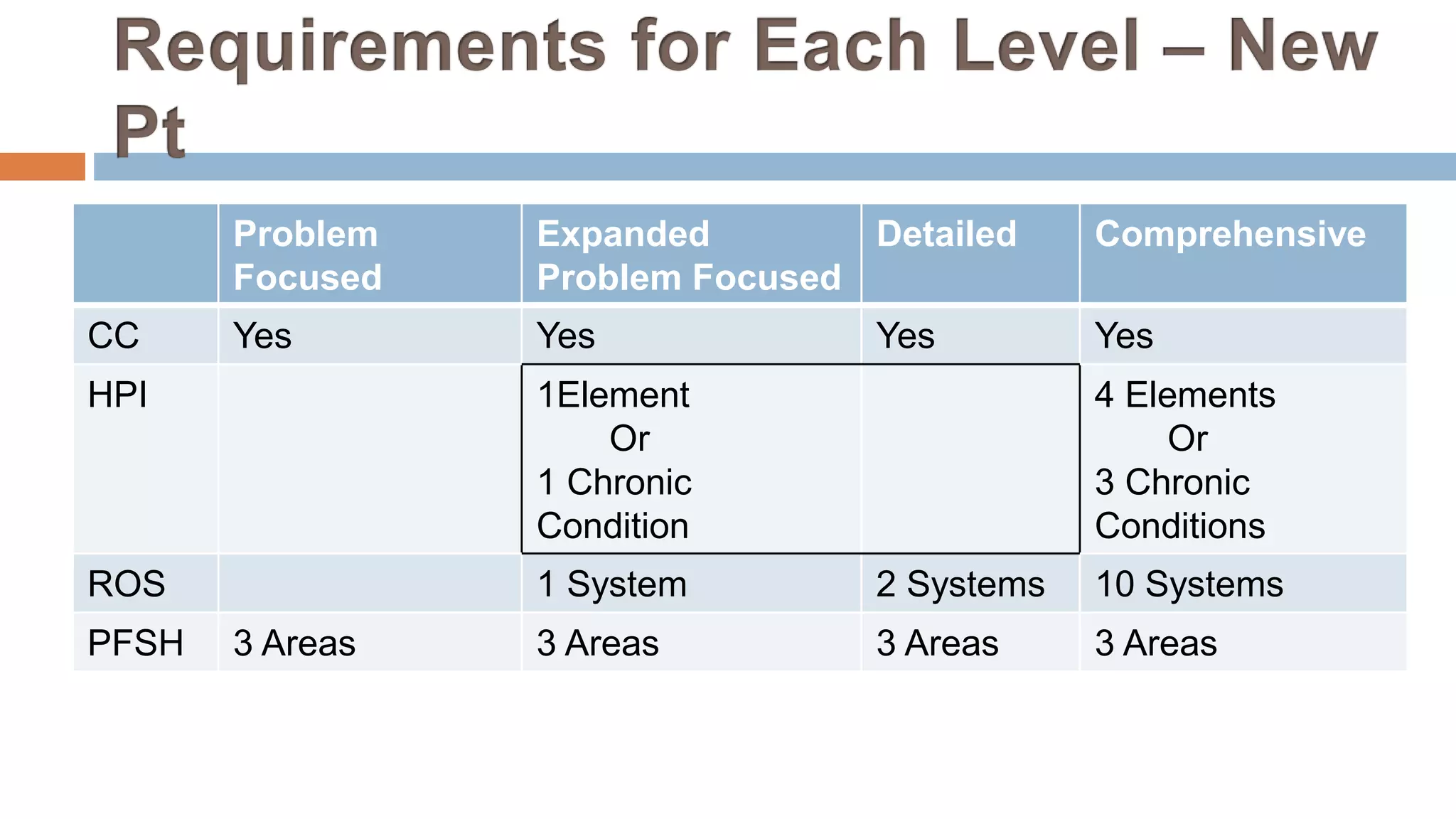
CC Yes Yes Yes Yes
HPI 1Element
Or
1 Chronic
Condition
4 Elements
Or
3 Chronic
Conditions
ROS 1 System 2 Systems 10 Systems
PFSH 3 Areas 3 Areas 3 Areas 3 Areas
Problem
Focused
Expanded
Problem Focused
Detailed Comprehensive
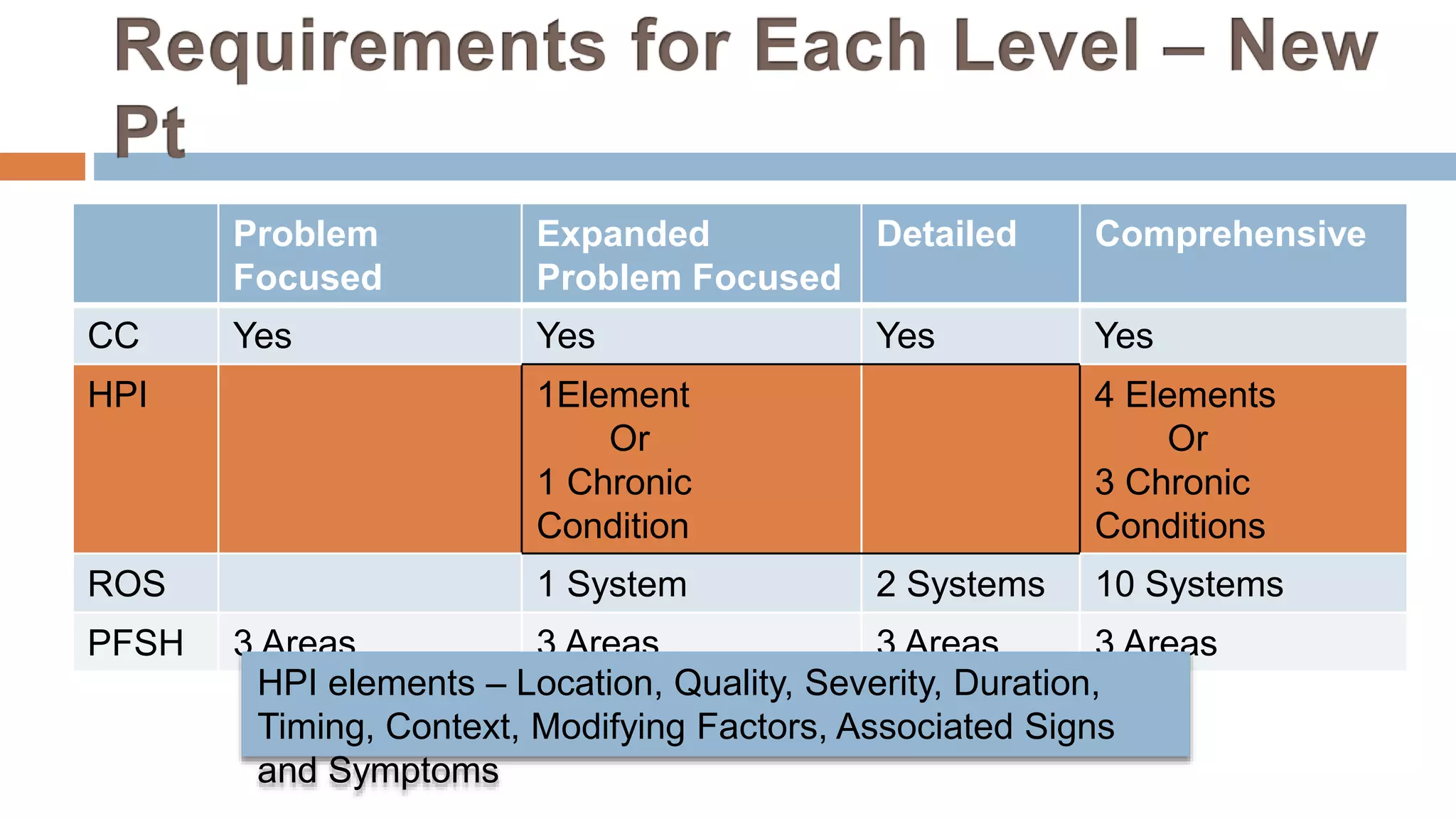
CC Yes Yes Yes Yes
HPI 1Element
Or
1 Chronic
Condition
4 Elements
Or
3 Chronic
Conditions
ROS 1 System 2 Systems 10 Systems
PFSH 3 Areas 3 Areas 3 Areas 3 Areas
HPI elements – Location, Quality, Severity, Duration,
Timing, Context, Modifying Factors, Associated Signs
and Symptoms
Problem
Focused
Expanded
Problem Focused
Detailed Comprehensive
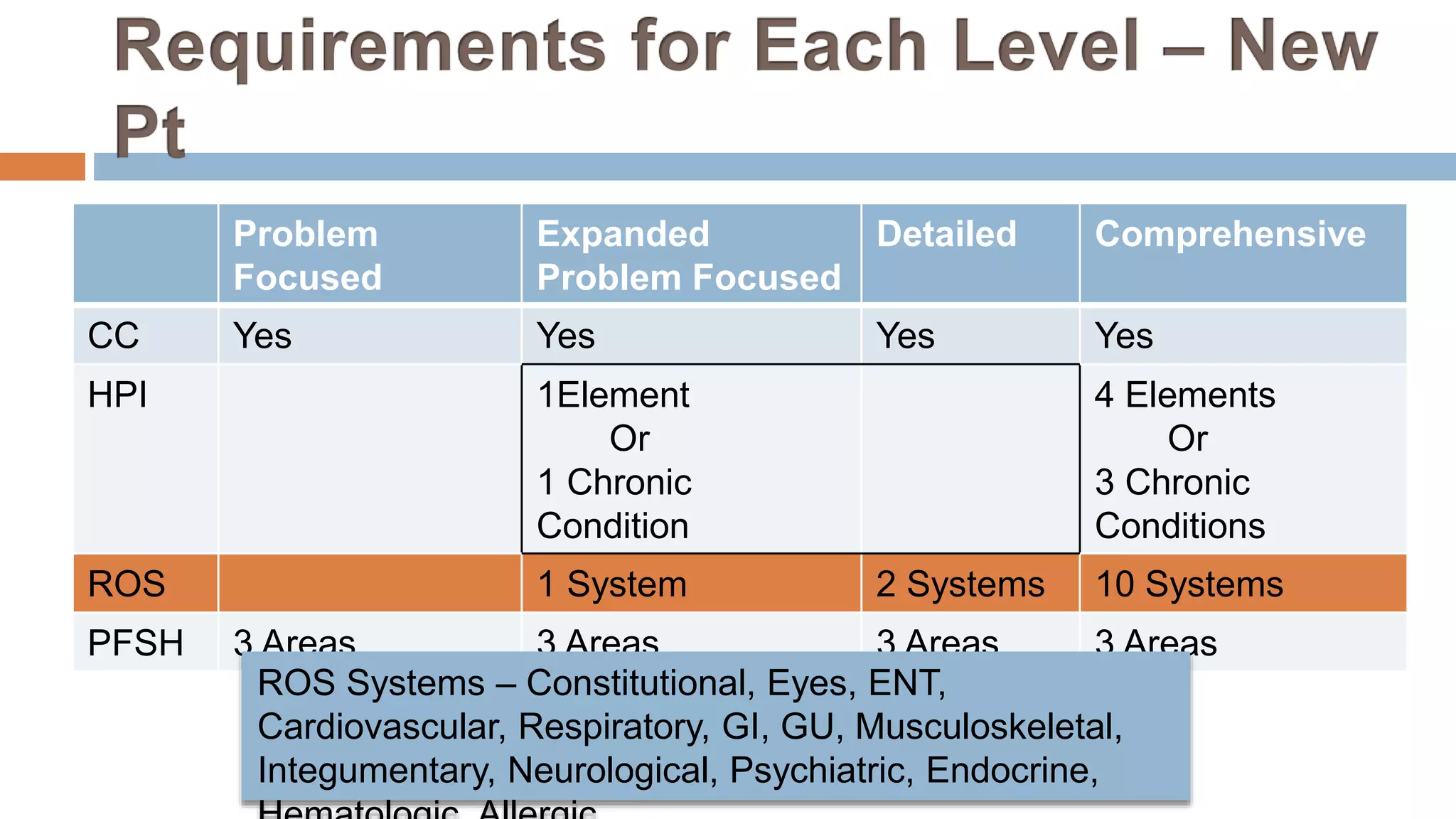
CC Yes Yes Yes Yes
HPI 1Element
Or
1 Chronic
Condition
4 Elements
Or
3 Chronic
Conditions
ROS 1 System 2 Systems 10 Systems
PFSH 3 Areas 3 Areas 3 Areas 3 Areas
ROS Systems – Constitutional, Eyes, ENT,
Cardiovascular, Respiratory, GI, GU, Musculoskeletal,
Integumentary, Neurological, Psychiatric, Endocrine,
Problem
Focused
Expanded
Problem Focused
Detailed Comprehensive
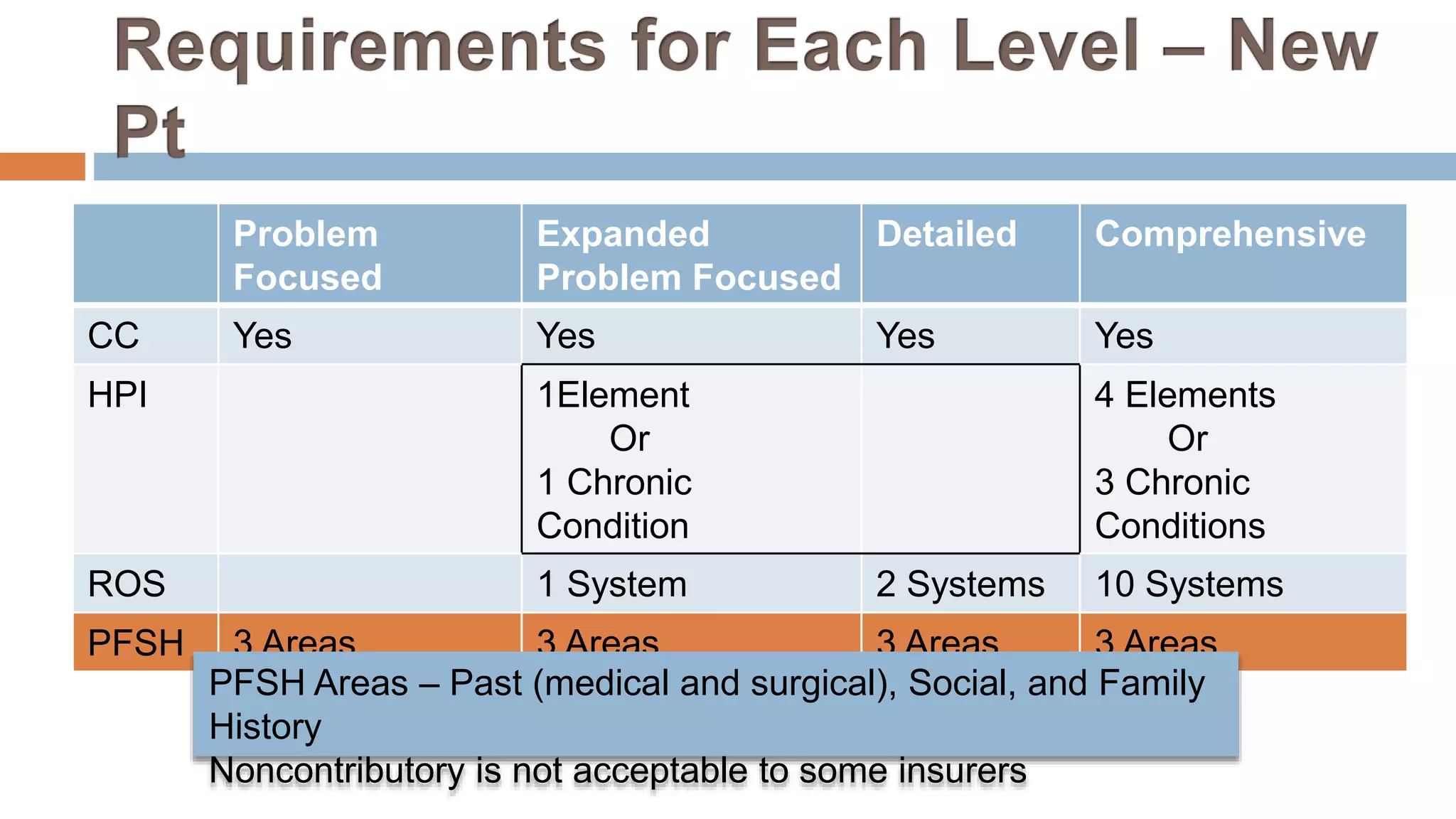
CC Yes Yes Yes Yes
HPI 1Element
Or
1 Chronic
Condition
4 Elements
Or
3 Chronic
Conditions
ROS 1 System 2 Systems 10 Systems
PFSH 3 Areas 3 Areas 3 Areas 3 Areas
PFSH Areas – Past (medical and surgical), Social, and Family
History
Noncontributory is not acceptable to some insurers
Problem
Focused
Expanded
Problem Focused
Detailed Comprehensive
CC Yes Yes Yes Yes
HPI 1Element
Or
1 Chronic
Condition
4 Elements
Or
3 Chronic
Conditions
ROS 1 System 2 Systems 10 Systems
PFSH 1 Area 3 Areas
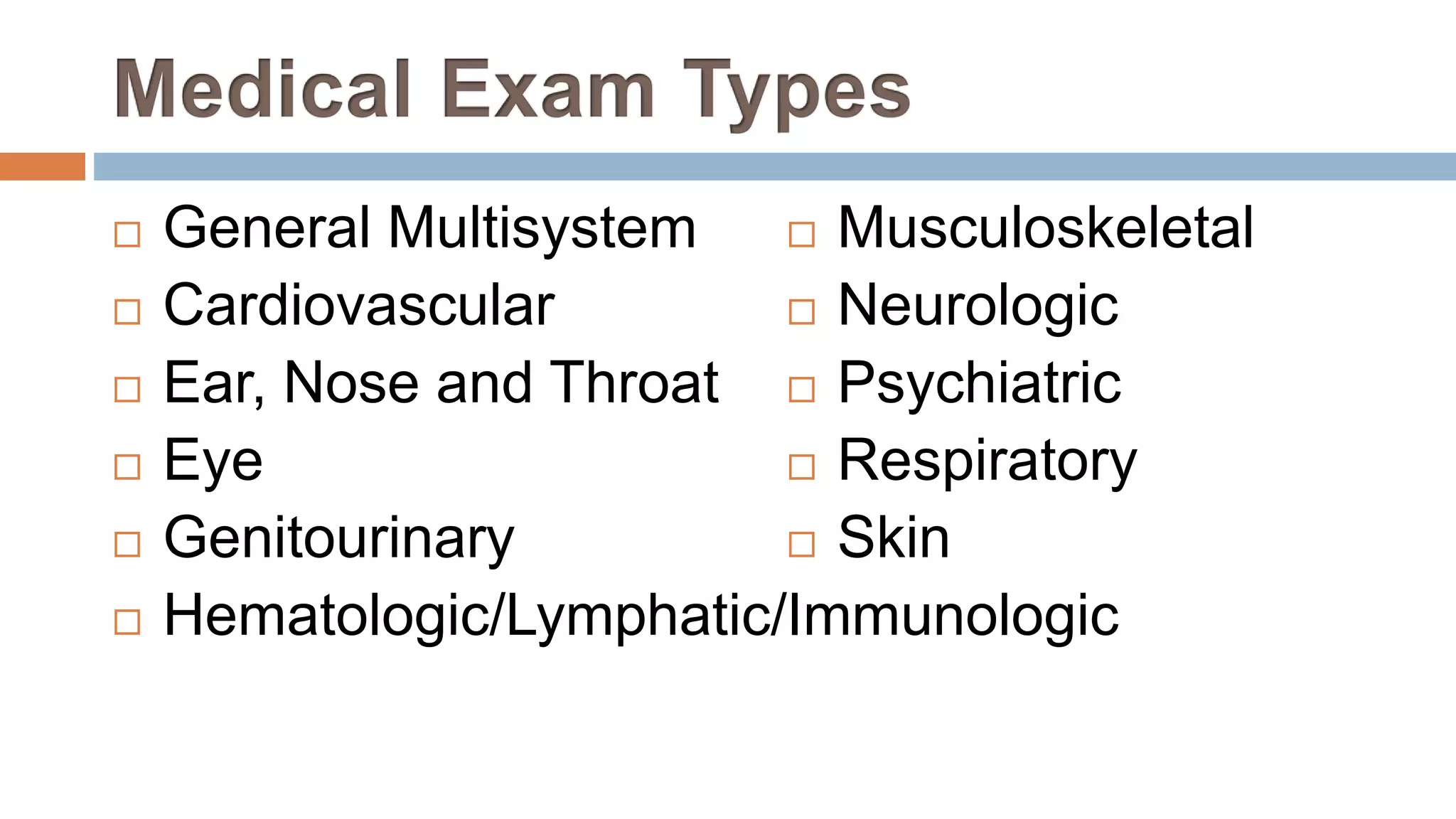
 General Multisystem
 Cardiovascular
 Ear, Nose and Throat
 Eye
 Genitourinary
 Hematologic/Lymphatic/Immunologic
 Musculoskeletal
 Neurologic
 Psychiatric
 Respiratory
 Skin
 Comprehensive
 Detailed
 Expanded Problem Focused
 Problem Focused
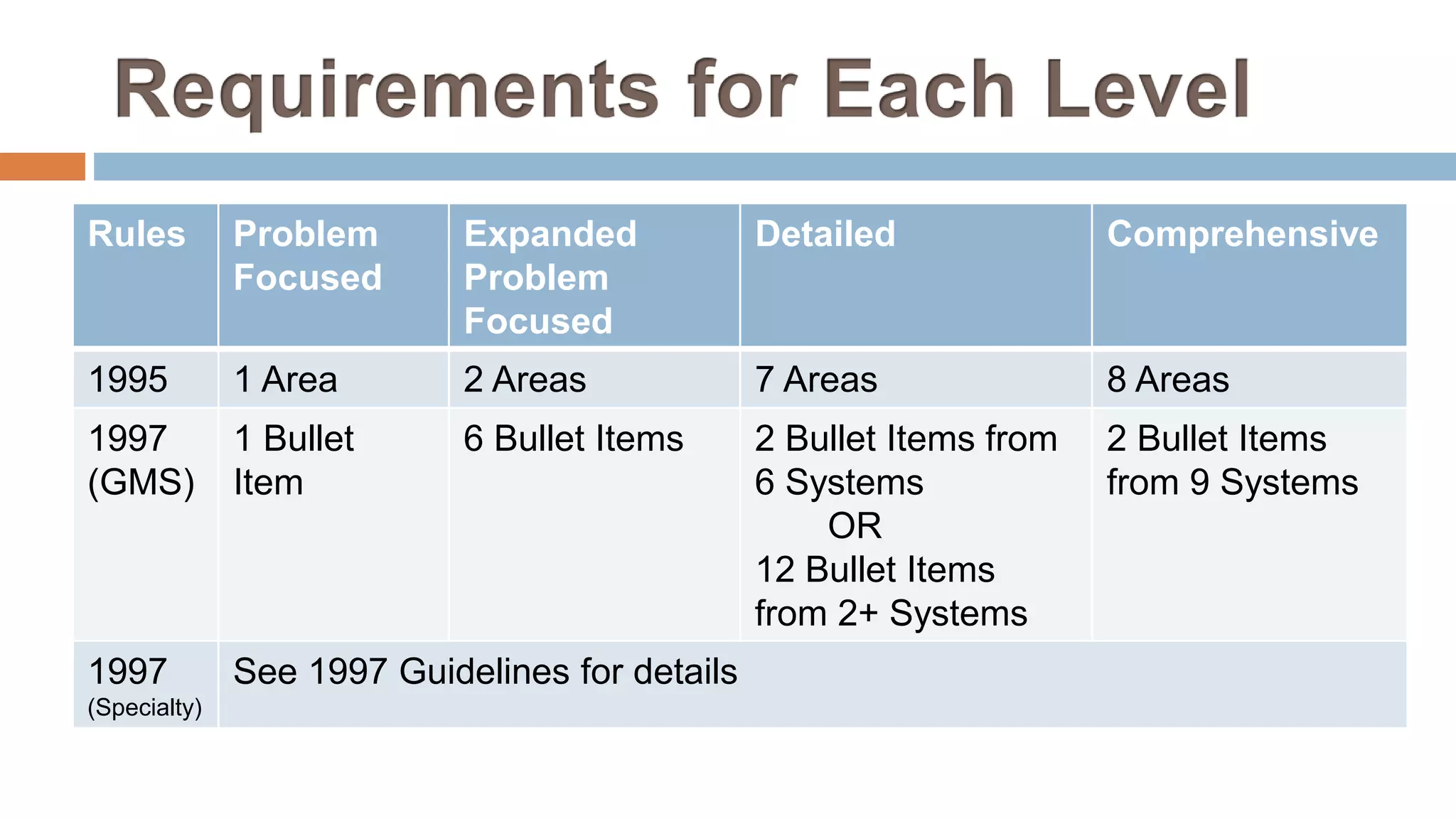
Rules Problem
Focused
Expanded
Problem
Focused
Detailed Comprehensive
1995 1 Area 2 Areas 7 Areas 8 Areas
1997
(GMS)
1 Bullet
Item
6 Bullet Items 2 Bullet Items from
6 Systems
OR
12 Bullet Items
from 2+ Systems
2 Bullet Items
from 9 Systems
1997
(Specialty)
See 1997 Guidelines for details
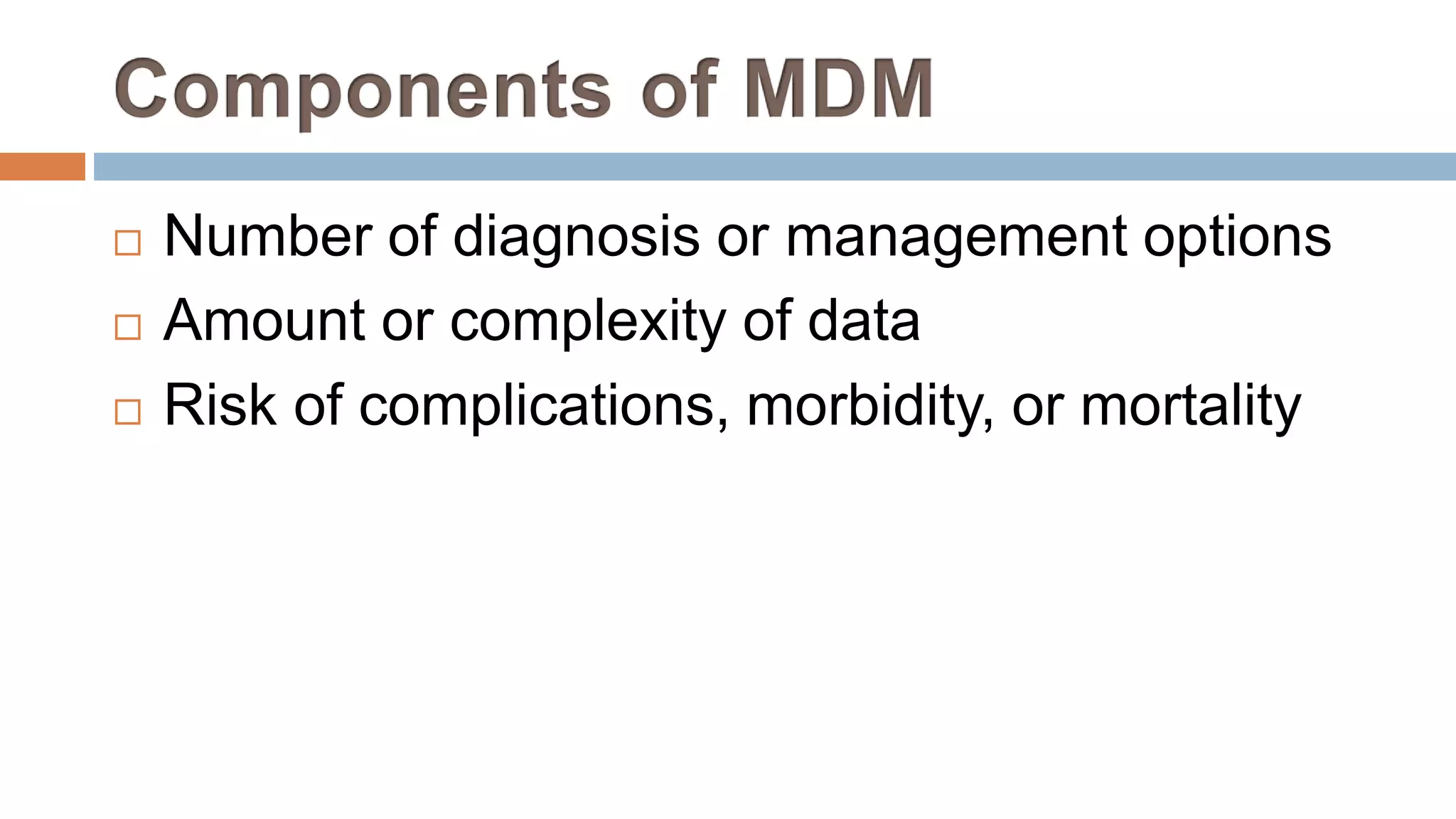
 Number of diagnosis or management options
 Amount or complexity of data
 Risk of complications, morbidity, or mortality
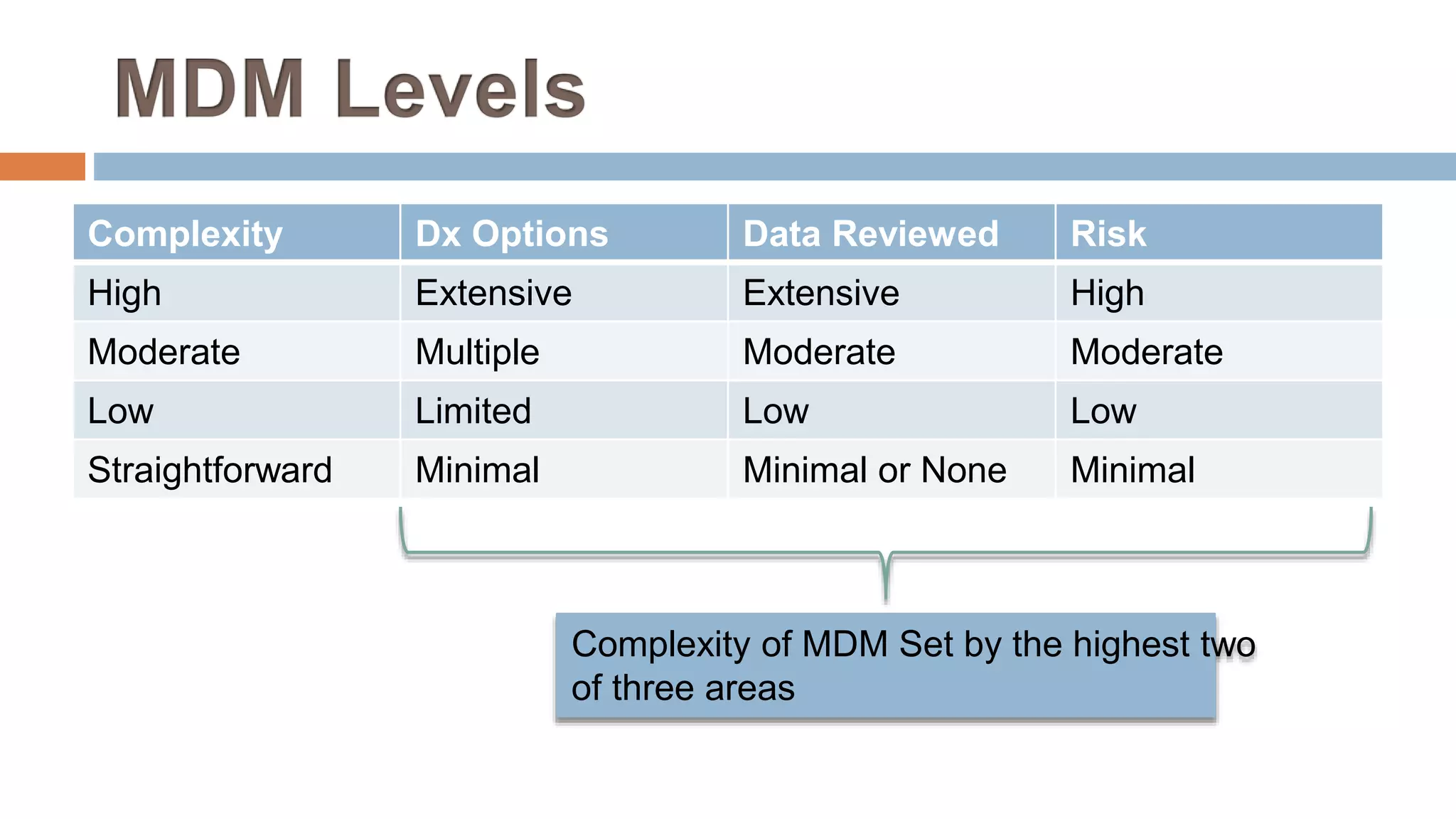
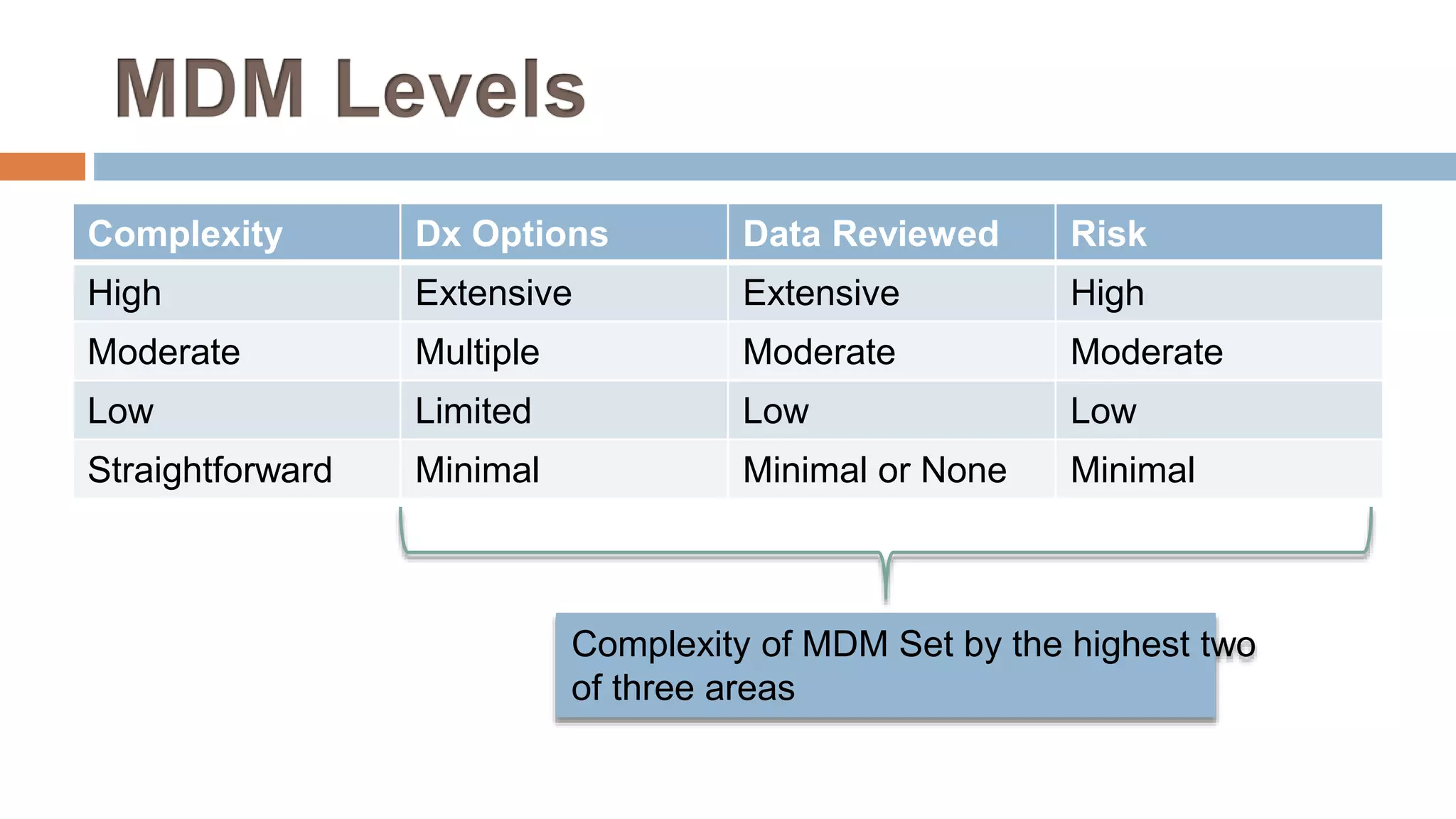
Complexity Dx Options Data Reviewed Risk
High Extensive Extensive High
Moderate Multiple Moderate Moderate
Low Limited Low Low
Straightforward Minimal Minimal or None Minimal
Complexity of MDM Set by the highest two
of three areas
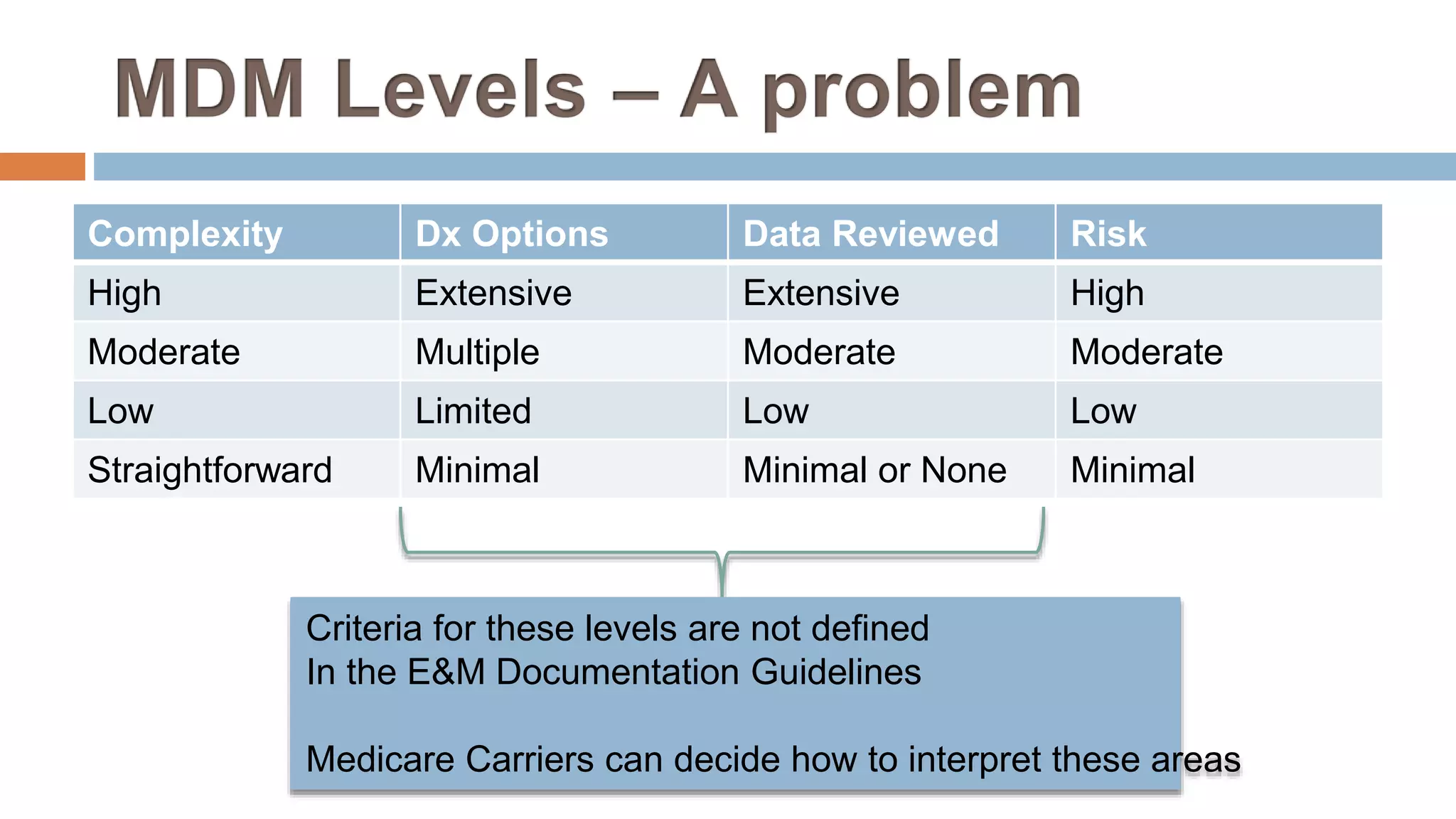
Complexity Dx Options Data Reviewed Risk
High Extensive Extensive High
Moderate Multiple Moderate Moderate
Low Limited Low Low
Straightforward Minimal Minimal or None Minimal
Criteria for these levels are not defined
In the E&M Documentation Guidelines
Medicare Carriers can decide how to interpret these areas
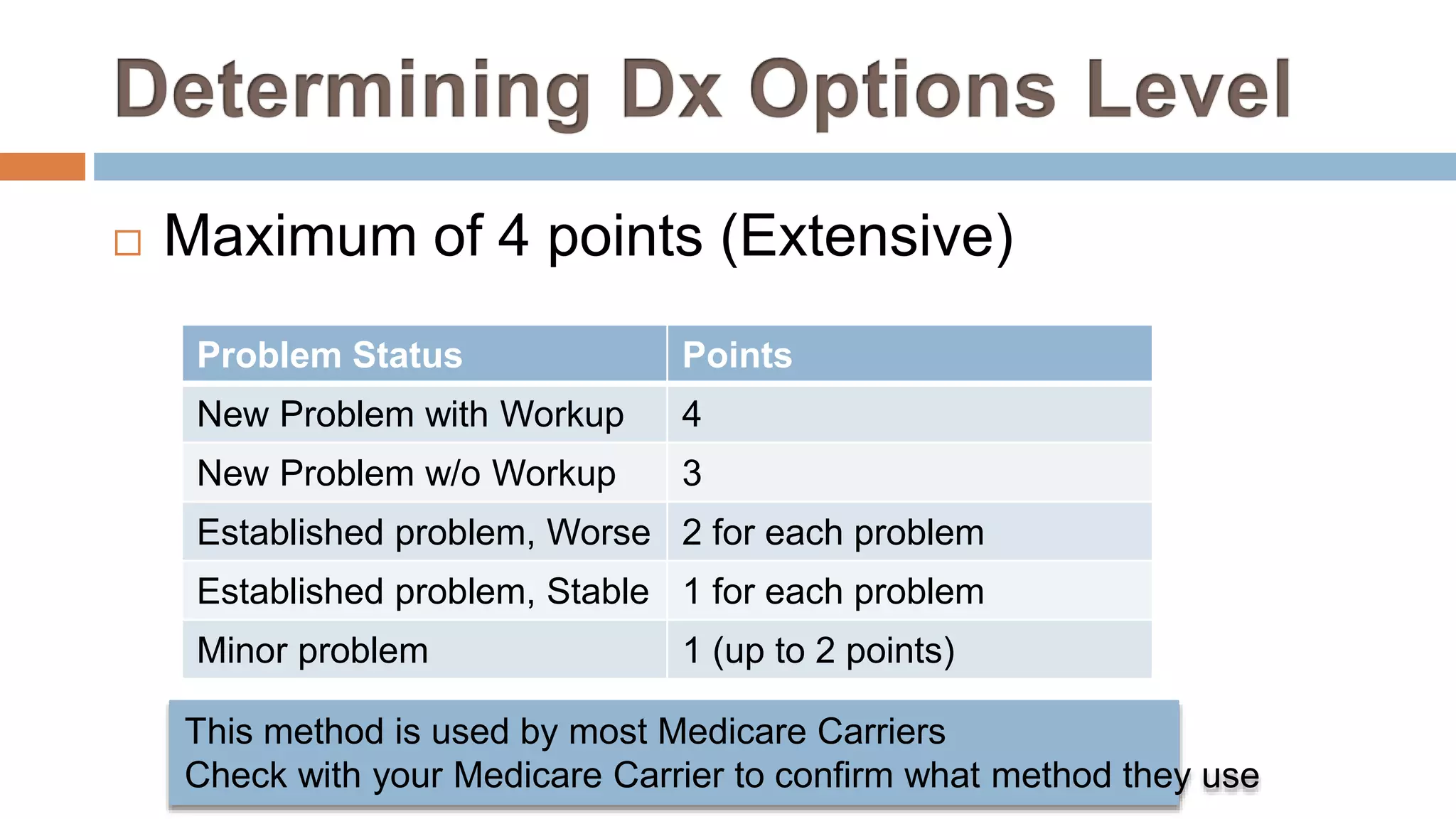
 Maximum of 4 points (Extensive)
Problem Status Points
New Problem with Workup 4
New Problem w/o Workup 3
Established problem, Worse 2 for each problem
Established problem, Stable 1 for each problem
Minor problem 1 (up to 2 points)
This method is used by most Medicare Carriers
Check with your Medicare Carrier to confirm what method they use
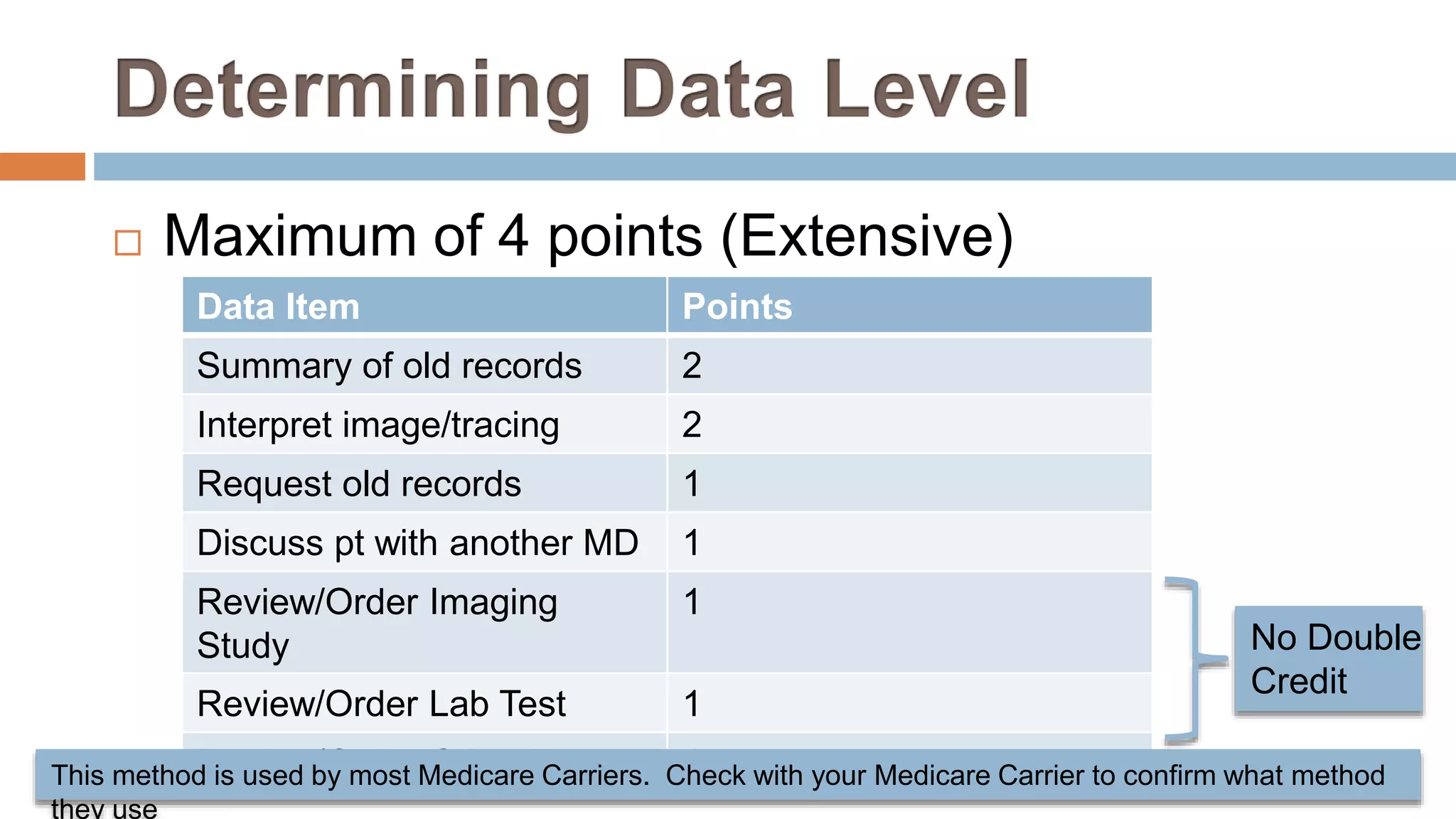
 Maximum of 4 points (Extensive)
Data Item Points
Summary of old records 2
Interpret image/tracing 2
Request old records 1
Discuss pt with another MD 1
Review/Order Imaging
Study
1
Review/Order Lab Test 1
Review/Order Other Test 1This method is used by most Medicare Carriers. Check with your Medicare Carrier to confirm what method
they use
No Double
Credit
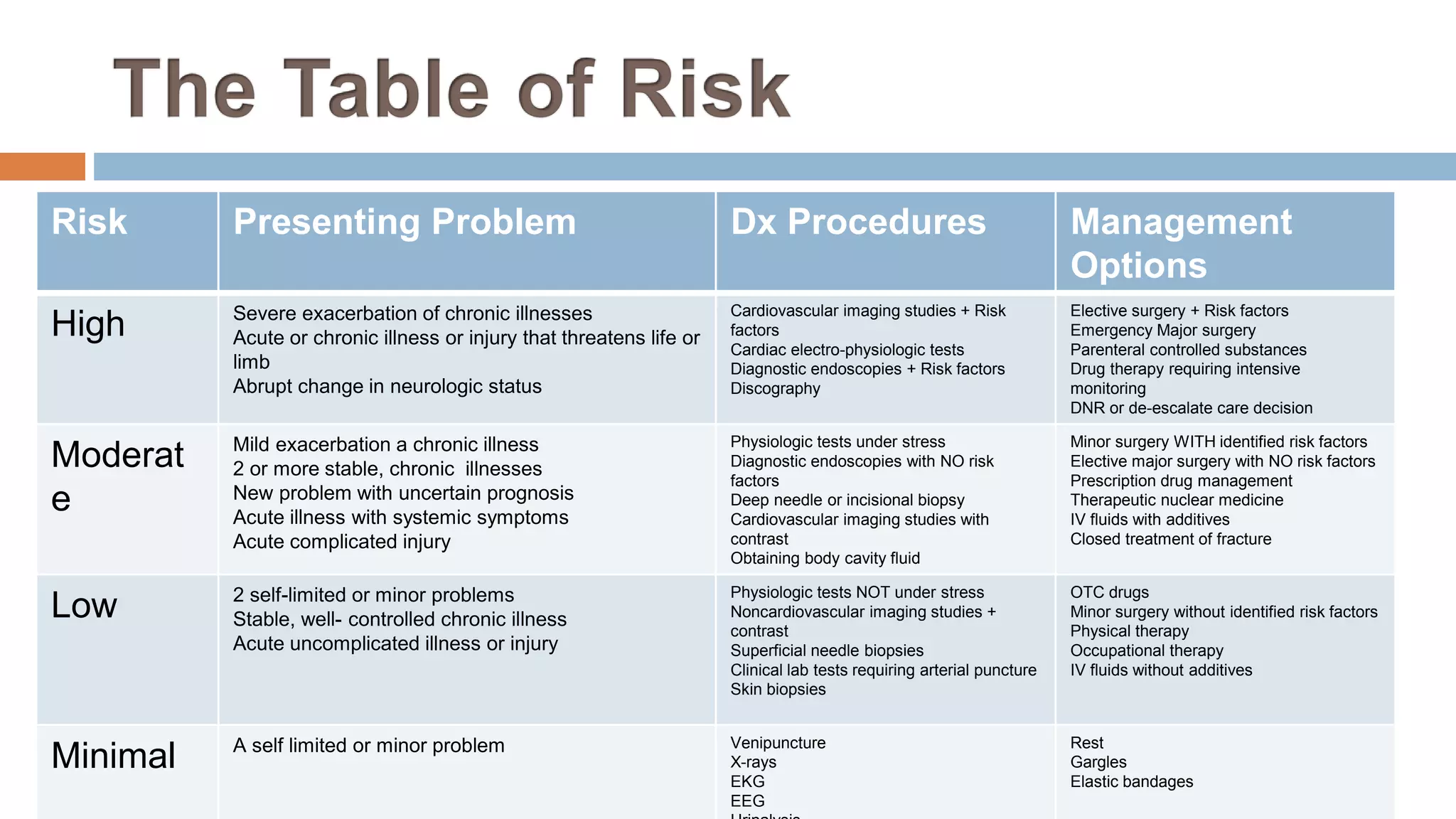
Risk Presenting Problem Dx Procedures Management
Options
High Severe exacerbation of chronic illnesses
Acute or chronic illness or injury that threatens life or
limb
Abrupt change in neurologic status
Cardiovascular imaging studies + Risk
factors
Cardiac electro-physiologic tests
Diagnostic endoscopies + Risk factors
Discography
Elective surgery + Risk factors
Emergency Major surgery
Parenteral controlled substances
Drug therapy requiring intensive
monitoring
DNR or de-escalate care decision
Moderat
e
Mild exacerbation a chronic illness
2 or more stable, chronic illnesses
New problem with uncertain prognosis
Acute illness with systemic symptoms
Acute complicated injury
Physiologic tests under stress
Diagnostic endoscopies with NO risk
factors
Deep needle or incisional biopsy
Cardiovascular imaging studies with
contrast
Obtaining body cavity fluid
Minor surgery WITH identified risk factors
Elective major surgery with NO risk factors
Prescription drug management
Therapeutic nuclear medicine
IV fluids with additives
Closed treatment of fracture
Low 2 self-limited or minor problems
Stable, well- controlled chronic illness
Acute uncomplicated illness or injury
Physiologic tests NOT under stress
Noncardiovascular imaging studies +
contrast
Superficial needle biopsies
Clinical lab tests requiring arterial puncture
Skin biopsies
OTC drugs
Minor surgery without identified risk factors
Physical therapy
Occupational therapy
IV fluids without additives
Minimal A self limited or minor problem Venipuncture
X-rays
EKG
EEG
Rest
Gargles
Elastic bandages
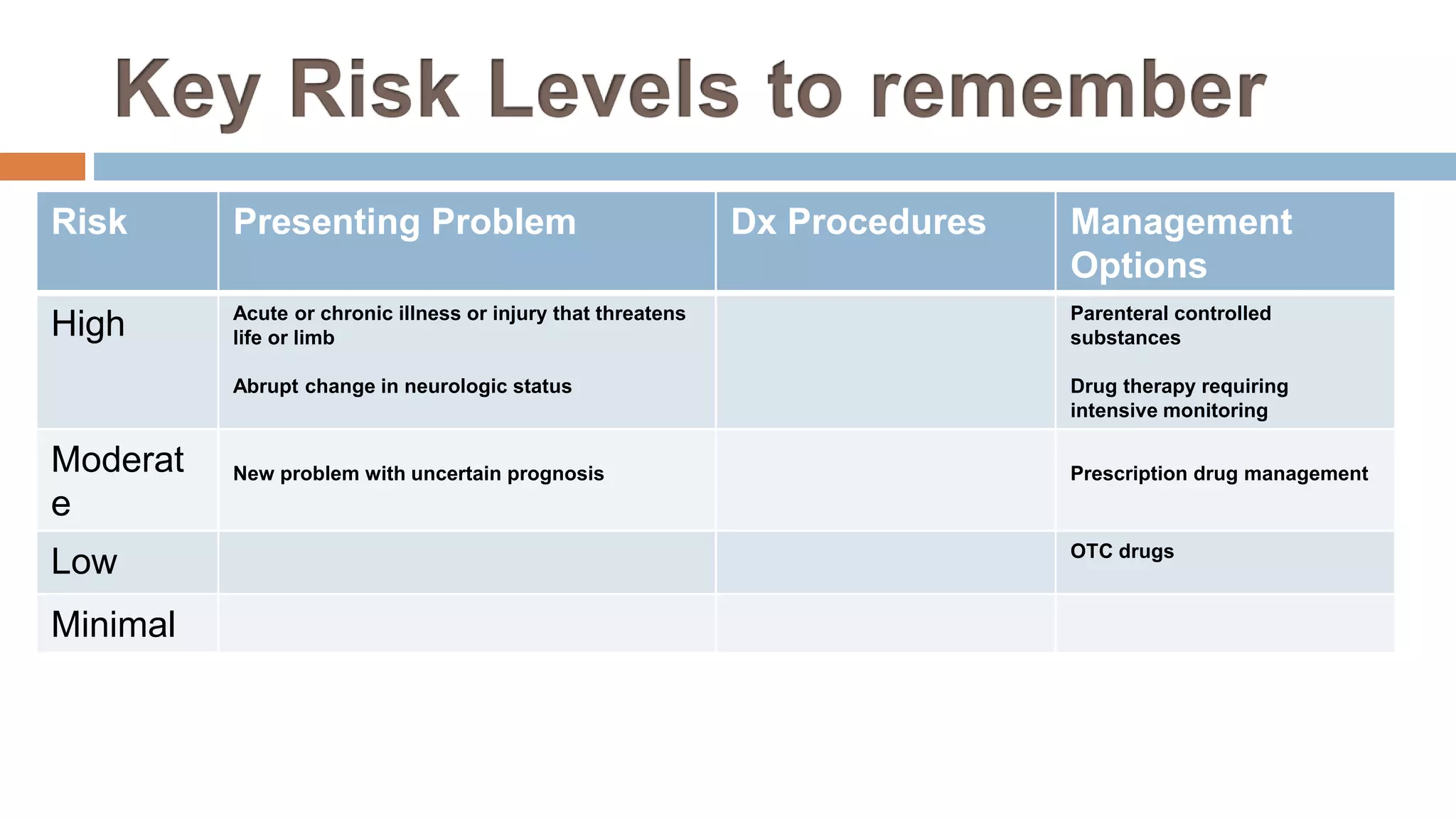
Risk Presenting Problem Dx Procedures Management
Options
High Acute or chronic illness or injury that threatens
life or limb
Abrupt change in neurologic status
Parenteral controlled
substances
Drug therapy requiring
intensive monitoring
Moderat
e
New problem with uncertain prognosis Prescription drug management
Low OTC drugs
Minimal
Complexity Dx Options Data Reviewed Risk
High Extensive Extensive High
Moderate Multiple Moderate Moderate
Low Limited Low Low
Straightforward Minimal Minimal or None Minimal
Complexity of MDM Set by the highest two
of three areas
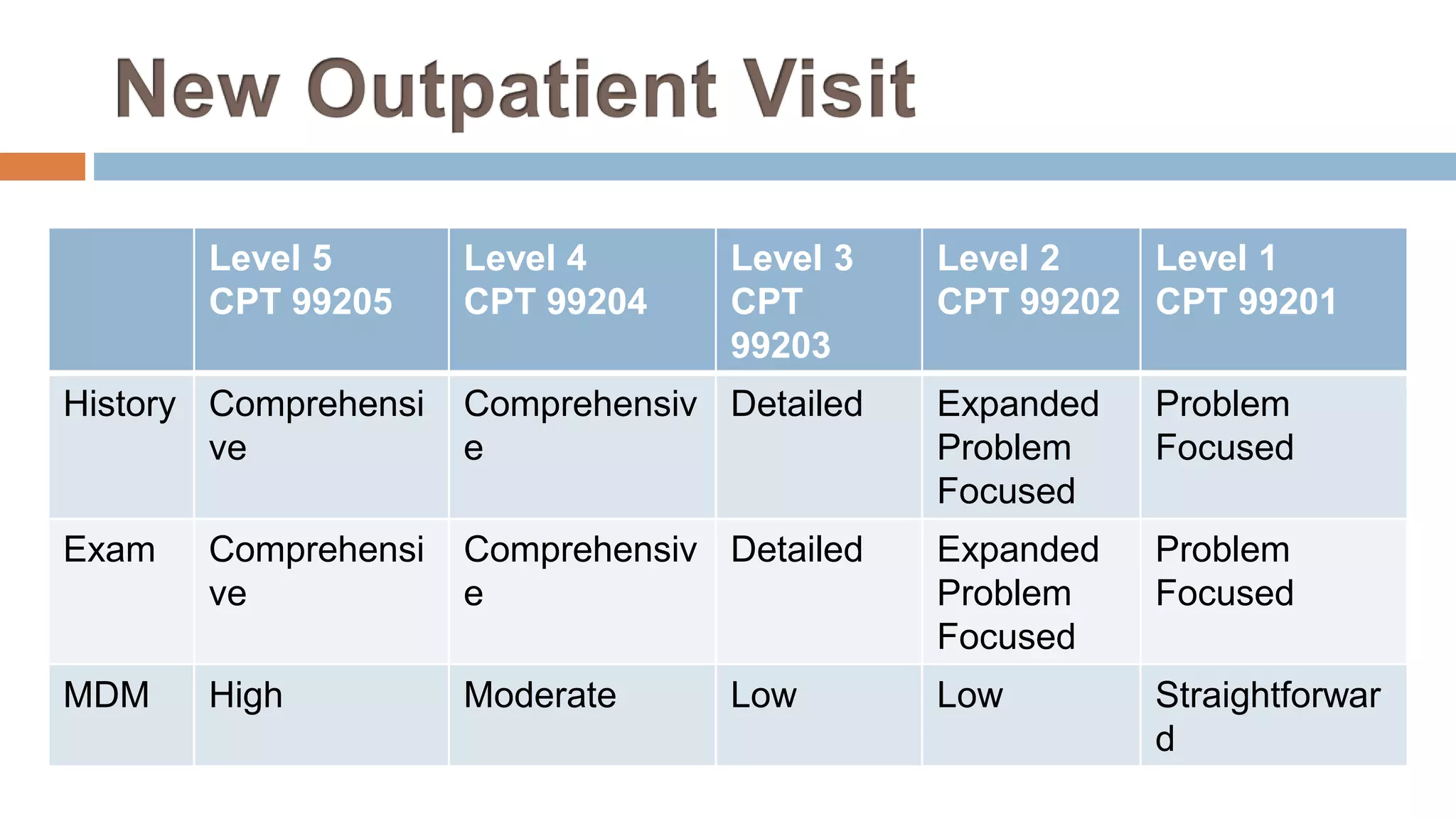
Level 5
CPT 99205
Level 4
CPT 99204
Level 3
CPT
99203
Level 2
CPT 99202
Level 1
CPT 99201
History Comprehensi
ve
Comprehensiv
e
Detailed Expanded
Problem
Focused
Problem
Focused
Exam Comprehensi
ve
Comprehensiv
e
Detailed Expanded
Problem
Focused
Problem
Focused
MDM High Moderate Low Low Straightforwar
d
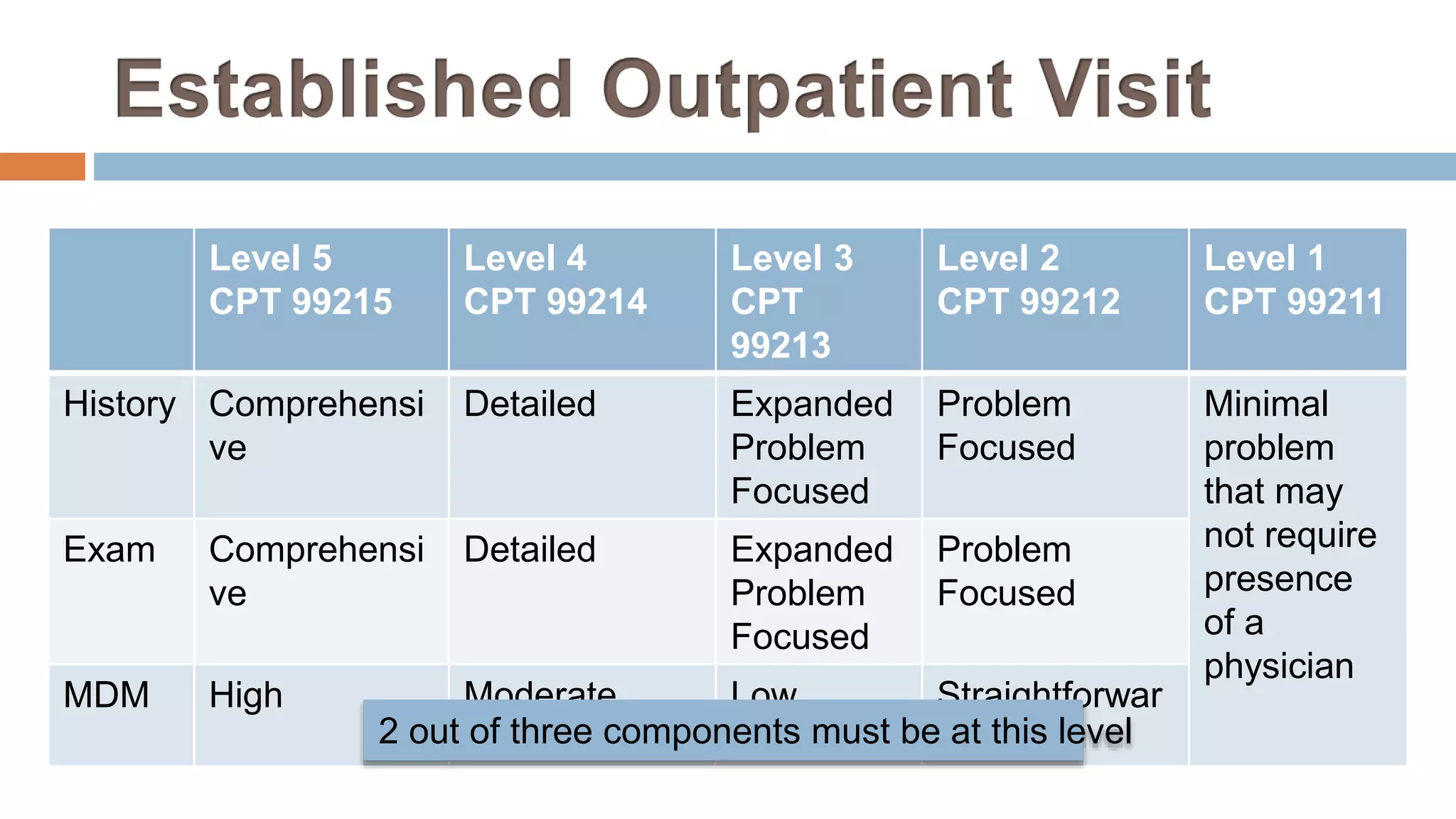
Level 5
CPT 99215
Level 4
CPT 99214
Level 3
CPT
99213
Level 2
CPT 99212
Level 1
CPT 99211
History Comprehensi
ve
Detailed Expanded
Problem
Focused
Problem
Focused
Minimal
problem
that may
not require
presence
of a
physician
Exam Comprehensi
ve
Detailed Expanded
Problem
Focused
Problem
Focused
MDM High Moderate Low Straightforwar
d2 out of three components must be at this level
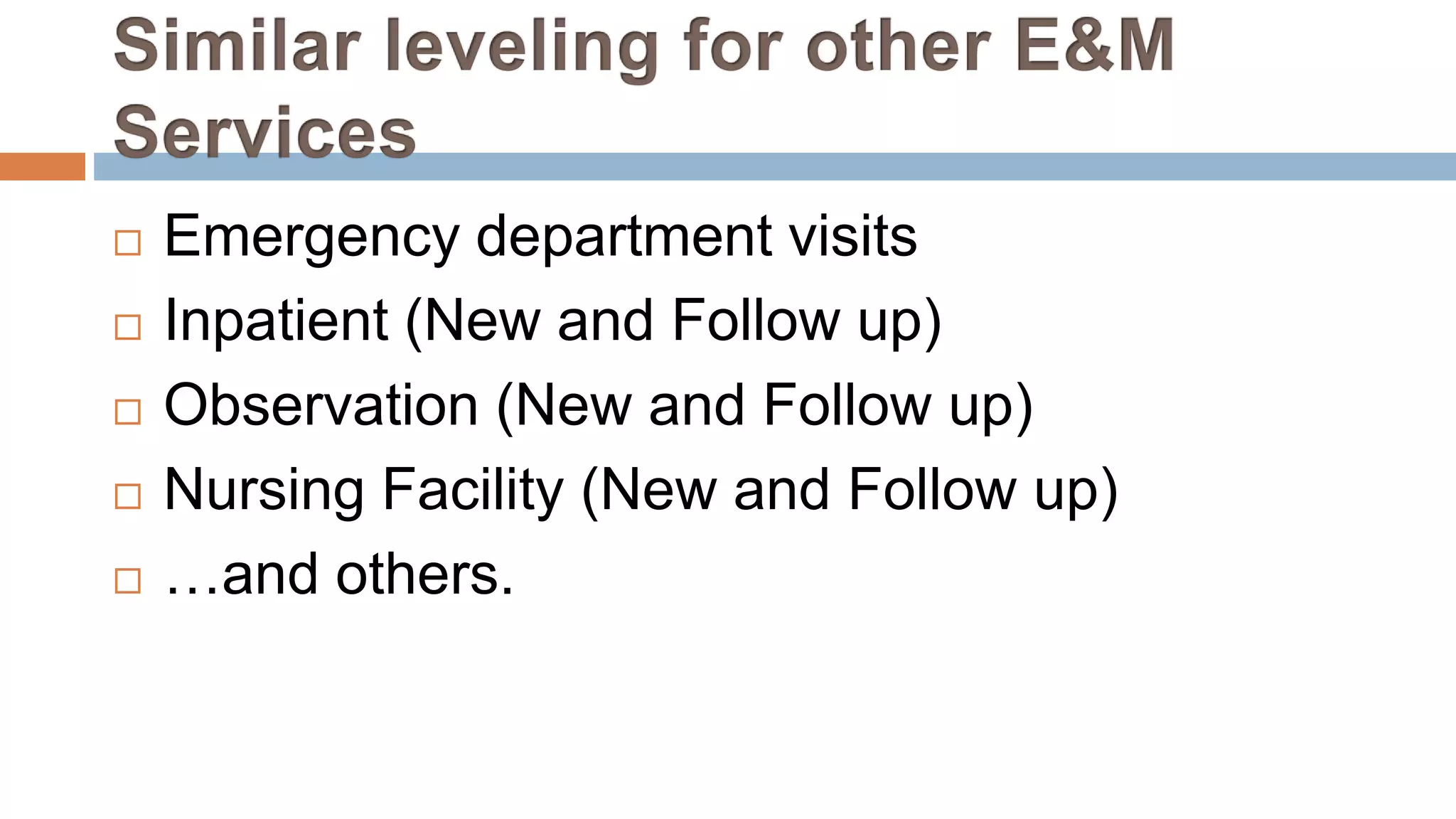
 Emergency department visits
 Inpatient (New and Follow up)
 Observation (New and Follow up)
 Nursing Facility (New and Follow up)
 …and others.
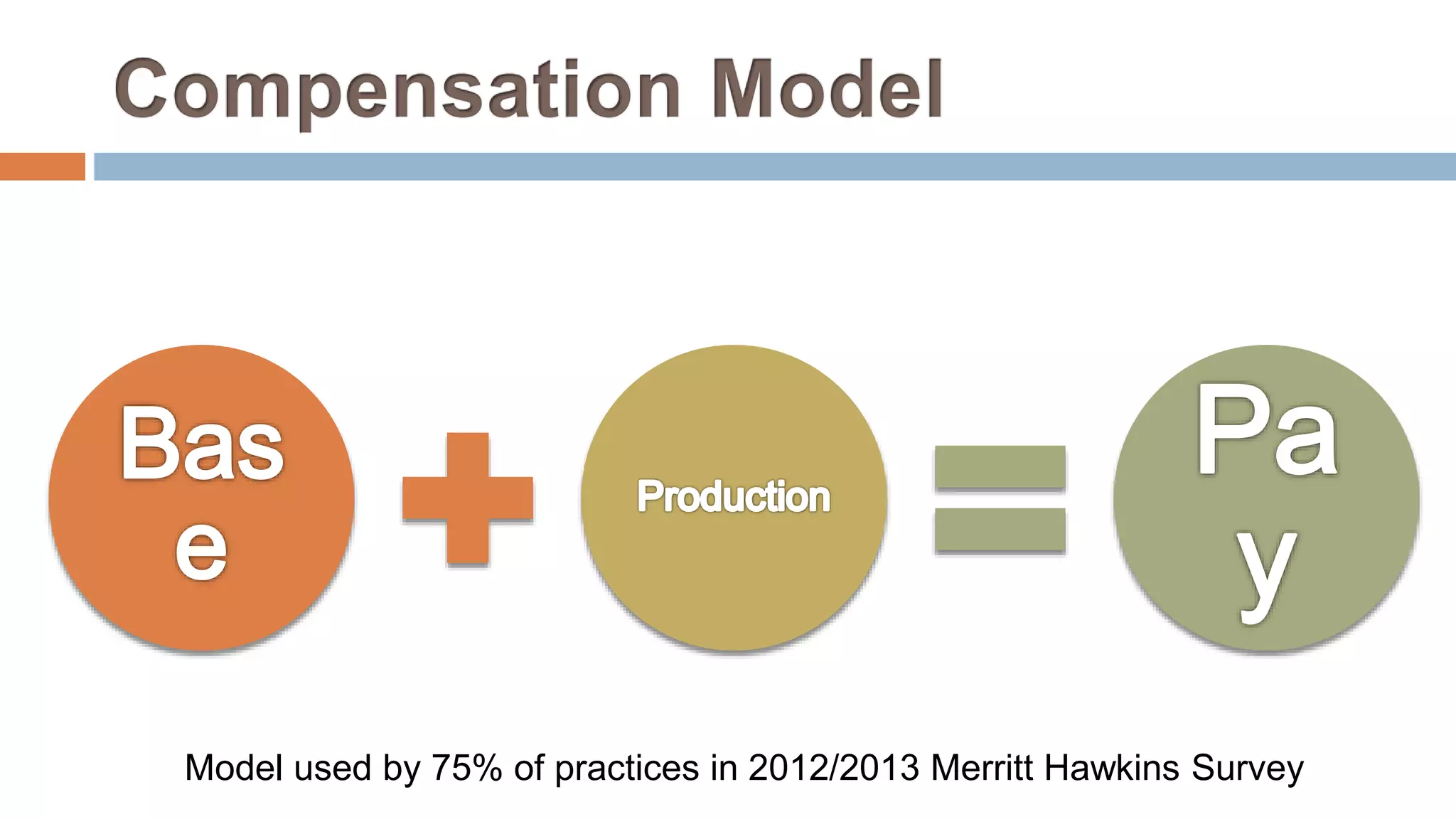
Model used by 75% of practices in 2012/2013 Merritt Hawkins Survey
 Complex Rules
 Mastery of the rules relevant to your practice is
essential for financial success

Medical Documentation for E&M Coding

  • 2.
     Define E&MServices  Know the E&M Documentation Components  Review E&M documentation criteria
  • 3.
     Common patient/physicianencounters  Clinic visit  H&P  Does not include tests or procedures
  • 4.
     Issued byCenters for Medicare & Medicaid Services  1995  1997
  • 5.
  • 6.
    E&M Encounter History ExamMDM Medical Decision Making
  • 8.
     Chief Complaint(CC)  History of Present Illness (HPI)  Review of Systems (ROS)  Past, Family, and Social History (PFSH)
  • 9.
     Comprehensive  Detailed Expanded Problem Focused  Problem Focused
  • 10.
    Problem Focused Expanded Problem Focused Detailed Comprehensive CCYes Yes Yes Yes HPI 1Element Or 1 Chronic Condition 4 Elements Or 3 Chronic Conditions ROS 1 System 2 Systems 10 Systems PFSH 3 Areas 3 Areas 3 Areas 3 Areas
  • 11.
    Problem Focused Expanded Problem Focused Detailed Comprehensive CCYes Yes Yes Yes HPI 1Element Or 1 Chronic Condition 4 Elements Or 3 Chronic Conditions ROS 1 System 2 Systems 10 Systems PFSH 3 Areas 3 Areas 3 Areas 3 Areas HPI elements – Location, Quality, Severity, Duration, Timing, Context, Modifying Factors, Associated Signs and Symptoms
  • 12.
    Problem Focused Expanded Problem Focused Detailed Comprehensive CCYes Yes Yes Yes HPI 1Element Or 1 Chronic Condition 4 Elements Or 3 Chronic Conditions ROS 1 System 2 Systems 10 Systems PFSH 3 Areas 3 Areas 3 Areas 3 Areas ROS Systems – Constitutional, Eyes, ENT, Cardiovascular, Respiratory, GI, GU, Musculoskeletal, Integumentary, Neurological, Psychiatric, Endocrine,
  • 13.
    Problem Focused Expanded Problem Focused Detailed Comprehensive CCYes Yes Yes Yes HPI 1Element Or 1 Chronic Condition 4 Elements Or 3 Chronic Conditions ROS 1 System 2 Systems 10 Systems PFSH 3 Areas 3 Areas 3 Areas 3 Areas PFSH Areas – Past (medical and surgical), Social, and Family History Noncontributory is not acceptable to some insurers
  • 14.
    Problem Focused Expanded Problem Focused Detailed Comprehensive CCYes Yes Yes Yes HPI 1Element Or 1 Chronic Condition 4 Elements Or 3 Chronic Conditions ROS 1 System 2 Systems 10 Systems PFSH 1 Area 3 Areas
  • 16.
     General Multisystem Cardiovascular  Ear, Nose and Throat  Eye  Genitourinary  Hematologic/Lymphatic/Immunologic  Musculoskeletal  Neurologic  Psychiatric  Respiratory  Skin
  • 17.
     Comprehensive  Detailed Expanded Problem Focused  Problem Focused
  • 18.
    Rules Problem Focused Expanded Problem Focused Detailed Comprehensive 19951 Area 2 Areas 7 Areas 8 Areas 1997 (GMS) 1 Bullet Item 6 Bullet Items 2 Bullet Items from 6 Systems OR 12 Bullet Items from 2+ Systems 2 Bullet Items from 9 Systems 1997 (Specialty) See 1997 Guidelines for details
  • 20.
     Number ofdiagnosis or management options  Amount or complexity of data  Risk of complications, morbidity, or mortality
  • 21.
    Complexity Dx OptionsData Reviewed Risk High Extensive Extensive High Moderate Multiple Moderate Moderate Low Limited Low Low Straightforward Minimal Minimal or None Minimal Complexity of MDM Set by the highest two of three areas
  • 22.
    Complexity Dx OptionsData Reviewed Risk High Extensive Extensive High Moderate Multiple Moderate Moderate Low Limited Low Low Straightforward Minimal Minimal or None Minimal Criteria for these levels are not defined In the E&M Documentation Guidelines Medicare Carriers can decide how to interpret these areas
  • 23.
     Maximum of4 points (Extensive) Problem Status Points New Problem with Workup 4 New Problem w/o Workup 3 Established problem, Worse 2 for each problem Established problem, Stable 1 for each problem Minor problem 1 (up to 2 points) This method is used by most Medicare Carriers Check with your Medicare Carrier to confirm what method they use
  • 24.
     Maximum of4 points (Extensive) Data Item Points Summary of old records 2 Interpret image/tracing 2 Request old records 1 Discuss pt with another MD 1 Review/Order Imaging Study 1 Review/Order Lab Test 1 Review/Order Other Test 1This method is used by most Medicare Carriers. Check with your Medicare Carrier to confirm what method they use No Double Credit
  • 25.
    Risk Presenting ProblemDx Procedures Management Options High Severe exacerbation of chronic illnesses Acute or chronic illness or injury that threatens life or limb Abrupt change in neurologic status Cardiovascular imaging studies + Risk factors Cardiac electro-physiologic tests Diagnostic endoscopies + Risk factors Discography Elective surgery + Risk factors Emergency Major surgery Parenteral controlled substances Drug therapy requiring intensive monitoring DNR or de-escalate care decision Moderat e Mild exacerbation a chronic illness 2 or more stable, chronic illnesses New problem with uncertain prognosis Acute illness with systemic symptoms Acute complicated injury Physiologic tests under stress Diagnostic endoscopies with NO risk factors Deep needle or incisional biopsy Cardiovascular imaging studies with contrast Obtaining body cavity fluid Minor surgery WITH identified risk factors Elective major surgery with NO risk factors Prescription drug management Therapeutic nuclear medicine IV fluids with additives Closed treatment of fracture Low 2 self-limited or minor problems Stable, well- controlled chronic illness Acute uncomplicated illness or injury Physiologic tests NOT under stress Noncardiovascular imaging studies + contrast Superficial needle biopsies Clinical lab tests requiring arterial puncture Skin biopsies OTC drugs Minor surgery without identified risk factors Physical therapy Occupational therapy IV fluids without additives Minimal A self limited or minor problem Venipuncture X-rays EKG EEG Rest Gargles Elastic bandages
  • 26.
    Risk Presenting ProblemDx Procedures Management Options High Acute or chronic illness or injury that threatens life or limb Abrupt change in neurologic status Parenteral controlled substances Drug therapy requiring intensive monitoring Moderat e New problem with uncertain prognosis Prescription drug management Low OTC drugs Minimal
  • 27.
    Complexity Dx OptionsData Reviewed Risk High Extensive Extensive High Moderate Multiple Moderate Moderate Low Limited Low Low Straightforward Minimal Minimal or None Minimal Complexity of MDM Set by the highest two of three areas
  • 29.
    Level 5 CPT 99205 Level4 CPT 99204 Level 3 CPT 99203 Level 2 CPT 99202 Level 1 CPT 99201 History Comprehensi ve Comprehensiv e Detailed Expanded Problem Focused Problem Focused Exam Comprehensi ve Comprehensiv e Detailed Expanded Problem Focused Problem Focused MDM High Moderate Low Low Straightforwar d
  • 30.
    Level 5 CPT 99215 Level4 CPT 99214 Level 3 CPT 99213 Level 2 CPT 99212 Level 1 CPT 99211 History Comprehensi ve Detailed Expanded Problem Focused Problem Focused Minimal problem that may not require presence of a physician Exam Comprehensi ve Detailed Expanded Problem Focused Problem Focused MDM High Moderate Low Straightforwar d2 out of three components must be at this level
  • 31.
     Emergency departmentvisits  Inpatient (New and Follow up)  Observation (New and Follow up)  Nursing Facility (New and Follow up)  …and others.
  • 33.
    Model used by75% of practices in 2012/2013 Merritt Hawkins Survey
  • 34.
     Complex Rules Mastery of the rules relevant to your practice is essential for financial success