Evaluation of my music
magazine PRESTIGE
Amber Davies
Q1. In what way does your media product
use, develop or challenge forms and
conventions of real media products?
I related my music magazine conventions to mainly VIBE magazine covers. In particular I
focused on the general conventions for a music magazine cover such as the masthead,
cover-lines, date, issue number, price, sub-heading, headline, selling line and the cover
image. The genre of my magazine is R&B so it was logical to relate it to VIBE magazine
which is very hip hop based mag. To keep to the conventions of an R&B magazine I chose
the photo where my model had the most serious straight face showing attitude and style.
Furthermore, I added in hip hop artists, colour and language which relate to my genre.
Cover conventions
Masthead
Sparkly text and bold font with a crown
on the ‘i’ because R&B artists often
think they are royal. Also, the name of
my magazine ‘Prestige’ is a very
suitable word and meaning in this
genre which I’m very happy with.
Date
The date sits under the masthead
which is quite conventional, however I
have changed the date to a
modernised R&B style by putting
‘2K16’.
Selling line
My selling line relates to the genre
and follows conventions by being
above the masthead at the top of the
page.
Cover-lines
My cover-lines are right
aligned with larger font
as the names of important
stories in my magazine with
a little insight underneath.
Price
The price isn’t usually so visual
and placed where I have put it
however I wanted it to look like a
good deal to make customers want
to read it.
Cover photo
The cover photo follows
conventions by being straight in
the middle of the page with a mid
shot photo in focus and with eye
contact from the artist to make the
audience feel closer to the model
and like they are going to find out
personal details due to feeling
comfortable. Also, the artist is
dressed to suit the genre which is
appropriate and following
conventions.
Headline,
Sub-heading
The headline follows conventions being
centre alligned and at the bottom of
the page with the main artist/story and
an eye catching sub heading on.
At the very bottom of the page here it
is sometimes conventional its not
always there but I think it’s a good
asset as it lets the audience know what
things there is inside of what they want
to read about.
Cover-lines
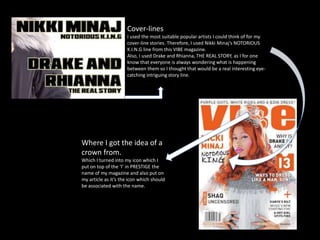
I used the most suitable popular artists I could think of for my
cover-line stories. Therefore, I used Nikki Minaj’s NOTORIOUS
K.I.N.G line from this VIBE magazine.
Also, I used Drake and Rhianna, THE REAL STORY, as I for one
know that everyone is always wondering what is happening
between them so I thought that would be a real interesting eye-
catching intriguing story line.
Where I got the idea of a
crown from.
Which I turned into my icon which I
put on top of the ‘I’ in PRESTIGE the
name of my magazine and also put on
my article as it’s the icon which should
be associated with the name.
Cover forms
Colours –The whole colour scheme on my front cover relates the same throughout my entire magazine. The
colours are red, gold, black and white and feature very royal respected colours.
Images-I became a photographer for my photo shoot and organised a model to come in for a shoot which I then
put into photo shop and then made and edited to be able to put onto my cover conventionally in the centre of the
page in-front of the title covering part of it up.
Text-I used a range of sizes for my text on my cover with the larger and bolder parts being the ones I want to stand
out the most, for example the title. The large text is the main events and cover-lines with the smaller more detailed
text underneath going into that little bit more detail.
Font- I used what I thought was a very R&B font throughout my magazine and on the cover with the most thought
going into the personally produced title which I feel is really accurate but fun and bouncy with an iconic crown on to
capture attention and the vibe.
Relating mine to a real
magazine cover
This is a real magazine cover which
has a big masthead of one single word
summarising the genre like mine does
and more than one colour. Also, cover-
lines mostly right aligned mentioning
real big artists within this genre
names. A selling line above the
masthead containing words relating to
the genre. Furthermore, a photograph
of the artist in the centre og the page
from the bottom, covering part of the
masthead by putting the artist in-front
looking straight ahead with eye contact
for the audience with suitable jewellery
and styled look for the genre. Finally, a
suitable colour scheme similar to mine
except from mine has gold instead of
grey.
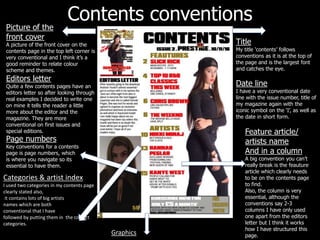
Contents conventions
Title
My title ‘contents’ follows
conventions as it is at the top of
the page and is the largest font
and catches the eye.
Date line
I have a very conventional date
line with the issue number, title of
my magazine again with the
iconic symbol on the ‘I’, as well as
the date in short form.
Picture of the
front cover
A picture of the front cover on the
contents page in the top left corner is
very conventional and I think it’s a
good reminder to relate colour
scheme and themes.
Editors letter
Quite a few contents pages have an
editors letter so after looking through
real examples I decided to write one
on mine it tells the reader a little
more about the editor and the
magazine. They are more
conventional on first issues and
special editions. Feature article/
artists name
And in a column
A big convention you can’t
really break is the feauture
article which clearly needs
to be on the contents page
to find.
Also, the column is very
essential, although the
conventions say 2-3
columns I have only used
one apart from the editors
letter but I think it works
how I have structured this
page.
Page numbers
Key conventions for a contents
page is page numbers, which
is where you navigate so its
essential to have them.
Categories & artist index
I used two categories in my contents page
clearly stated also,
it contains lots of big artists
names which are both
conventional that I have
followed by putting them in the correct
categories.
Graphics
Contents forms
My contents forms allows it to stand out and for usual R&B audiences to see
the conventional forms they are used to seeing.
Colours- I have picked the colour scheme of a white background, black bold title and black text in general apart
from the gold page numbers and category names and the bright red article names and artists to attract the audiences
eyes to the most important engaging things. Also, these royal colours produce the respected vibe which R&B fans are
used to.
Images- There is a range of sized images on my contents from small to large. The images I have used are the
little version of the front cover to accompany associations and to support the editors letter. As well as, the large
photograph of the main artist of this issue on the right hand side to produce more engagement as she is all over the
magazine with her conventionl R&B clothes/ accessories on to fit the genre. Finally, I have the photo of a screenshot of
a poster page in the magazine of another artist to make people want to buy the magazine to have this unique
exclusive pop-star poster! By using these images it makes the page more visual and busy which attracts readers rather
than a page full of just writing.
Text-The text I used relates mostly to the front cover and photos because people who generally read this sort of
magazine tend to like linking images to text and finding out as much information out about the story as they can and
find shortened to their liking to simplify things making it easy and clear to read.
Related mine to a real contents
These examples of contents pages are
where I got my ideas from however I
changed them up a bit. To start, the image
on the right of my contents is similar to the
one of 50 CENT as they are both turned
sideways on this shot with a hat on and
serious look. Also, like all three examples
here, my contents page has the categories
such as ‘features’ in it with underlying page
numbers to navigate with next to the article
headlines or page titles of artists and so on
which follows conventions. The font size,
colours and maybe even type of font style
are the same with the 50 CENT magazine in
particular, as my one which shows my forms
are conventional. All of our magazines have
the date, magazine name and issue numbers
and colour schemes on the contents page as
well which shows I follow conventions.
Article conventions
I aimed for my article layout to be very structured and accurate but also have a interesting simple twist to it. I
related my article or got my inspiration for it from a magazine article on Nikki Minaj, which had a question and
answer article with quotes in. My magazine article follows the conventions of a title, a sub-heading, images,
questions, quotes, page number and the same colour scheme artist representing my magazine.
Questions
and
answers
Containing
quotes, question
numbers,
questions
Title
My title goes
across the top
with a sub-
heading
underneath all
associated to my
main story.
Images
Photographs I
took myself in
the photo-shoot
of my model
artist displayed
on both sides of
the double page
on different
angles which
isn’t very
conventional but
is unique and
works.
Page
number,
magazine
name and
issue
number
All conventional,
Small in gold at
the bottom
left of the page.
Article forms
My article forms are similar to the ones in my cover and contents page. By doing this the colour scheme and forms I
have chosen to use throughout can appeal and give the same eye catching fonts to the correct audience to appeal to
them.
Text
The main thing for this page is the text as its an article which is more writing to read about the story or information
rather than being so visual therefore, I chose a really clear easy to read handwriting tahoma sort of font in black on a
white background. The text size for the page varies with the head-title being the largest as it’s the first thing I want to
be noticed on the page which is conventional. And the question numbers being relatively bigger than the question then
the answers as the smallest. The text includes the suitable language and type of questions and answers for the R&B
genre. Finally, its set out in columns starting from the left hand page left aligned traditionally.
Images
Usually one main image is conventional for a music magazine article however I think where I used two it worked well.
The images are placed on the far left and the far right with the text positioned around the photos.
Relating mine to a real article
I got my inspiration for my article to this article on Nikki Minaj who is a R&B/ Hip-hop/ Rap very well known artist.
This inspired me to structure my article as a question and answer structure as I realised it was the easiest to get
all the information I wanted my readers to find out about my newly found artist and the event she performed at
which is my main story. I used the same big numbers of each question in a different colour to my question and
smaller answers as well. Mine has two images rather than one but its of the same artist and easy for the eyes to
see. Both our titles are the biggest text on the page as it’s the most eye catching thing you should first see on the
page and I got the idea to use the suitable language from this article so I have the same conventions all over
apart from the image.
Challenging conventions
The factors which make up my cover, contents and article pages are made to mostly follow conventions of other R&B
styled music magazines. This includes following the prestige, respectful, full of attitude, fun and happy royally treated
vibe you tend to find in this genre. However, some aspects of my magazine have challenged conventions of a music
magazine.
For example:
• The portrait barcode on the cover isn’t very conventional but looked better on my magazine.
• The price isn’t usually so big and standing out but the audience for this genre are looking for decent deals and
offers and opportunities to read a magazine interesting them.
• There is not usually a background pattern like mine filling the Masthead but mine does but I think it makes it
stand out even more!
• My contents only has one column when usually there is two or three however I think it works because some R&B
magazines have only one column plus mine has an editors letter as well and more photos than usual.
• My article has two photographs on whereas usually its one big one.
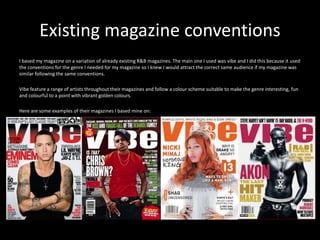
Existing magazine conventions
I based my magazine on a variation of already existing R&B magazines. The main one I used was vibe and I did this because it used
the conventions for the genre I needed for my magazine so I knew I would attract the correct same audience if my magazine was
similar following the same conventions.
Vibe feature a range of artists throughout their magazines and follow a colour scheme suitable to make the genre interesting, fun
and colourful to a point with vibrant golden colours.
Here are some examples of their magazines I based mine on:

Evaluation

  • 1.
    Evaluation of mymusic magazine PRESTIGE Amber Davies
  • 2.
    Q1. In whatway does your media product use, develop or challenge forms and conventions of real media products?
  • 3.
    I related mymusic magazine conventions to mainly VIBE magazine covers. In particular I focused on the general conventions for a music magazine cover such as the masthead, cover-lines, date, issue number, price, sub-heading, headline, selling line and the cover image. The genre of my magazine is R&B so it was logical to relate it to VIBE magazine which is very hip hop based mag. To keep to the conventions of an R&B magazine I chose the photo where my model had the most serious straight face showing attitude and style. Furthermore, I added in hip hop artists, colour and language which relate to my genre.
  • 4.
    Cover conventions Masthead Sparkly textand bold font with a crown on the ‘i’ because R&B artists often think they are royal. Also, the name of my magazine ‘Prestige’ is a very suitable word and meaning in this genre which I’m very happy with. Date The date sits under the masthead which is quite conventional, however I have changed the date to a modernised R&B style by putting ‘2K16’. Selling line My selling line relates to the genre and follows conventions by being above the masthead at the top of the page. Cover-lines My cover-lines are right aligned with larger font as the names of important stories in my magazine with a little insight underneath. Price The price isn’t usually so visual and placed where I have put it however I wanted it to look like a good deal to make customers want to read it. Cover photo The cover photo follows conventions by being straight in the middle of the page with a mid shot photo in focus and with eye contact from the artist to make the audience feel closer to the model and like they are going to find out personal details due to feeling comfortable. Also, the artist is dressed to suit the genre which is appropriate and following conventions. Headline, Sub-heading The headline follows conventions being centre alligned and at the bottom of the page with the main artist/story and an eye catching sub heading on. At the very bottom of the page here it is sometimes conventional its not always there but I think it’s a good asset as it lets the audience know what things there is inside of what they want to read about.
  • 5.
    Cover-lines I used themost suitable popular artists I could think of for my cover-line stories. Therefore, I used Nikki Minaj’s NOTORIOUS K.I.N.G line from this VIBE magazine. Also, I used Drake and Rhianna, THE REAL STORY, as I for one know that everyone is always wondering what is happening between them so I thought that would be a real interesting eye- catching intriguing story line. Where I got the idea of a crown from. Which I turned into my icon which I put on top of the ‘I’ in PRESTIGE the name of my magazine and also put on my article as it’s the icon which should be associated with the name.
  • 6.
    Cover forms Colours –Thewhole colour scheme on my front cover relates the same throughout my entire magazine. The colours are red, gold, black and white and feature very royal respected colours. Images-I became a photographer for my photo shoot and organised a model to come in for a shoot which I then put into photo shop and then made and edited to be able to put onto my cover conventionally in the centre of the page in-front of the title covering part of it up. Text-I used a range of sizes for my text on my cover with the larger and bolder parts being the ones I want to stand out the most, for example the title. The large text is the main events and cover-lines with the smaller more detailed text underneath going into that little bit more detail. Font- I used what I thought was a very R&B font throughout my magazine and on the cover with the most thought going into the personally produced title which I feel is really accurate but fun and bouncy with an iconic crown on to capture attention and the vibe.
  • 7.
    Relating mine toa real magazine cover This is a real magazine cover which has a big masthead of one single word summarising the genre like mine does and more than one colour. Also, cover- lines mostly right aligned mentioning real big artists within this genre names. A selling line above the masthead containing words relating to the genre. Furthermore, a photograph of the artist in the centre og the page from the bottom, covering part of the masthead by putting the artist in-front looking straight ahead with eye contact for the audience with suitable jewellery and styled look for the genre. Finally, a suitable colour scheme similar to mine except from mine has gold instead of grey.
  • 8.
    Contents conventions Title My title‘contents’ follows conventions as it is at the top of the page and is the largest font and catches the eye. Date line I have a very conventional date line with the issue number, title of my magazine again with the iconic symbol on the ‘I’, as well as the date in short form. Picture of the front cover A picture of the front cover on the contents page in the top left corner is very conventional and I think it’s a good reminder to relate colour scheme and themes. Editors letter Quite a few contents pages have an editors letter so after looking through real examples I decided to write one on mine it tells the reader a little more about the editor and the magazine. They are more conventional on first issues and special editions. Feature article/ artists name And in a column A big convention you can’t really break is the feauture article which clearly needs to be on the contents page to find. Also, the column is very essential, although the conventions say 2-3 columns I have only used one apart from the editors letter but I think it works how I have structured this page. Page numbers Key conventions for a contents page is page numbers, which is where you navigate so its essential to have them. Categories & artist index I used two categories in my contents page clearly stated also, it contains lots of big artists names which are both conventional that I have followed by putting them in the correct categories. Graphics
  • 9.
    Contents forms My contentsforms allows it to stand out and for usual R&B audiences to see the conventional forms they are used to seeing. Colours- I have picked the colour scheme of a white background, black bold title and black text in general apart from the gold page numbers and category names and the bright red article names and artists to attract the audiences eyes to the most important engaging things. Also, these royal colours produce the respected vibe which R&B fans are used to. Images- There is a range of sized images on my contents from small to large. The images I have used are the little version of the front cover to accompany associations and to support the editors letter. As well as, the large photograph of the main artist of this issue on the right hand side to produce more engagement as she is all over the magazine with her conventionl R&B clothes/ accessories on to fit the genre. Finally, I have the photo of a screenshot of a poster page in the magazine of another artist to make people want to buy the magazine to have this unique exclusive pop-star poster! By using these images it makes the page more visual and busy which attracts readers rather than a page full of just writing. Text-The text I used relates mostly to the front cover and photos because people who generally read this sort of magazine tend to like linking images to text and finding out as much information out about the story as they can and find shortened to their liking to simplify things making it easy and clear to read.
  • 10.
    Related mine toa real contents These examples of contents pages are where I got my ideas from however I changed them up a bit. To start, the image on the right of my contents is similar to the one of 50 CENT as they are both turned sideways on this shot with a hat on and serious look. Also, like all three examples here, my contents page has the categories such as ‘features’ in it with underlying page numbers to navigate with next to the article headlines or page titles of artists and so on which follows conventions. The font size, colours and maybe even type of font style are the same with the 50 CENT magazine in particular, as my one which shows my forms are conventional. All of our magazines have the date, magazine name and issue numbers and colour schemes on the contents page as well which shows I follow conventions.
  • 11.
    Article conventions I aimedfor my article layout to be very structured and accurate but also have a interesting simple twist to it. I related my article or got my inspiration for it from a magazine article on Nikki Minaj, which had a question and answer article with quotes in. My magazine article follows the conventions of a title, a sub-heading, images, questions, quotes, page number and the same colour scheme artist representing my magazine. Questions and answers Containing quotes, question numbers, questions Title My title goes across the top with a sub- heading underneath all associated to my main story. Images Photographs I took myself in the photo-shoot of my model artist displayed on both sides of the double page on different angles which isn’t very conventional but is unique and works. Page number, magazine name and issue number All conventional, Small in gold at the bottom left of the page.
  • 12.
    Article forms My articleforms are similar to the ones in my cover and contents page. By doing this the colour scheme and forms I have chosen to use throughout can appeal and give the same eye catching fonts to the correct audience to appeal to them. Text The main thing for this page is the text as its an article which is more writing to read about the story or information rather than being so visual therefore, I chose a really clear easy to read handwriting tahoma sort of font in black on a white background. The text size for the page varies with the head-title being the largest as it’s the first thing I want to be noticed on the page which is conventional. And the question numbers being relatively bigger than the question then the answers as the smallest. The text includes the suitable language and type of questions and answers for the R&B genre. Finally, its set out in columns starting from the left hand page left aligned traditionally. Images Usually one main image is conventional for a music magazine article however I think where I used two it worked well. The images are placed on the far left and the far right with the text positioned around the photos.
  • 13.
    Relating mine toa real article I got my inspiration for my article to this article on Nikki Minaj who is a R&B/ Hip-hop/ Rap very well known artist. This inspired me to structure my article as a question and answer structure as I realised it was the easiest to get all the information I wanted my readers to find out about my newly found artist and the event she performed at which is my main story. I used the same big numbers of each question in a different colour to my question and smaller answers as well. Mine has two images rather than one but its of the same artist and easy for the eyes to see. Both our titles are the biggest text on the page as it’s the most eye catching thing you should first see on the page and I got the idea to use the suitable language from this article so I have the same conventions all over apart from the image.
  • 14.
    Challenging conventions The factorswhich make up my cover, contents and article pages are made to mostly follow conventions of other R&B styled music magazines. This includes following the prestige, respectful, full of attitude, fun and happy royally treated vibe you tend to find in this genre. However, some aspects of my magazine have challenged conventions of a music magazine. For example: • The portrait barcode on the cover isn’t very conventional but looked better on my magazine. • The price isn’t usually so big and standing out but the audience for this genre are looking for decent deals and offers and opportunities to read a magazine interesting them. • There is not usually a background pattern like mine filling the Masthead but mine does but I think it makes it stand out even more! • My contents only has one column when usually there is two or three however I think it works because some R&B magazines have only one column plus mine has an editors letter as well and more photos than usual. • My article has two photographs on whereas usually its one big one.
  • 15.
    Existing magazine conventions Ibased my magazine on a variation of already existing R&B magazines. The main one I used was vibe and I did this because it used the conventions for the genre I needed for my magazine so I knew I would attract the correct same audience if my magazine was similar following the same conventions. Vibe feature a range of artists throughout their magazines and follow a colour scheme suitable to make the genre interesting, fun and colourful to a point with vibrant golden colours. Here are some examples of their magazines I based mine on: