Evaluation
+ Reflective Journal
Contextual
Positives
• Rationale – When writing my rationale, I had the intention of explaining the overall context behind my project and justifying it using both societal and personal experience, as well as
justifying my choice of medium. I believe one of the strongest aspect of my rationale was when I explained my reasoning behind wanting to make a video, as I covered multiple aspects,
including audience impact and audio, and made sure to fully explain my thought process when deciding. Furthermore, I laid it out in a way that was comprehendible, and made sure to
clearly express my points for a broad rationale while keeping medium and theme justification separate. I also provided multiple angles for the justification behind my choice in topic,
touching briefly on how different audiences may interpret it and how I will achieve this desired effect. Finally, due to my chosen topic being considered very serious, I made sure to keep
my rationale as focused and socially correct as possible, in order to explain my feelings surrounding the topic and explaining the upsides of choosing this topic while also not
downplaying the severity. This was a key focus for me, as one of my main goals is to not fall into the glorification of abuse like a lot of popular media.
• Context Examples – To begin with, I discussed Kesha Rose Sebert, as her music was one of the driving forces behind me wanting to chose this topic to begin with. I made sure to go very
in depth with my research, including looking at her childhood and traumatic experiences which shaped her recent music and involvement in the MeToo movement. Though some of it
was a difficult read, it helped provide context for her own projects, and hence helped me rationalise my own experiences and begin to shape how I would convert them into art for this
project. For my next example, I looked into Taylor Swift. Like Kesha, she has been a constant victim of misogyny in the media, and often ‘slut-shamed’ due to her personal life. Despite
this, she kept her head high and hence has always been an inspiration to me and had a big influence on me growing up, hence why I believe it was vital and a good decision to include
her in the context. I also believe I tied her and Kesha together well, and including both of them emphasised each other’s role in influencing my project. The most influential aspect in
terms of context would be the MeToo movement which I then went on to discuss. I covered multiple aspects of the movement, ranging from media, history and the impacts it had. It
was a positive to look into multiple angles as the metoo movement is a large part of society and feminism, and this meant I could explore the movement as a whole and then apply the
areas that were the most relevant to me. Looking into the music meant I could successfully get an idea of how I can translate the movement into forms of media, which I was then able
to expand further upon in research. Furthermore, by looking at the impacts of the movement, I could back up my rationale of the desired impact I want on my audience. To expand
further on metoo and link the influences together, I decided to discuss a film I had watched recently, Bombshell (2019). This worked as a good overall influence as it expanded
further on the idea of sexual abuse/misconduct at work, which ties together Kesha’s experiences and the metoo movement, as well as discussing misogyny and providing a good,
realistic example of what it’s like for women in work places. This meant it was also helpful in terms of my rationale goal of making my project as realistic as possible. For example,
though in Bombshell the women do get ‘justice’, they go through so much to get there and lose their careers anyway, showing that even these situations can’t really have a ‘happy
ending’. This impacted my decision on the ending of my film, and how I’d show a ‘grey ending’, with a happy arc but darker consequences.
• Media/Personal Rationale – For my final pieces of justification, I decided I wanted to give my project a personal rationale, due to the fact that one of the biggest driving forces behind
creating this project was a personal experience. However, I decided it would be best to combine this rationale in with a piece of context discussing the idea of ‘friend-zoning’ and how
rejection is demonised in the media, as not only would this provide more overall context, my own personal experience is to do with rejection and harassment. I believe my most well-
done aspect of the examples in this section was looking into the popular sit-com ‘The Big Bang Theory’. I explained each point clearly and made sure to back-up each statement with
evidence from the show, including quotes and statistics. This not only made my work easy to comprehend, but also left no room for ‘devil’s advocate’ and made the moments of the
show I discussed indisputably an issue. This meant it worked as a good example on how problematic themes have become so normalised, and pointed out exactly what I want my own
film to combat. Additionally, I had spoken about this issue before by using The Big Bang Theory as an example in a previous essay, so I already had an idea of what to write which made
the process easier. One of my biggest worries about bringing up personal justification was the fact I may not be able to articulate the experience correctly and lead to irrelevancy, or
perhaps become too emotional due to the split from societal to personal examples. However, due to using existing media, such as shows and songs, to provide context behind why my
own experience was so detrimental and explaining it from an outside perspective beforehand, I believe I was able to provide a good personal outlook without seeming too ‘off-topic’ or
informal. Finally, I believe that using a range of examples for the issue of demonization of rejection in media (music and TV), I was able to get multiple different angles and provide more
evidence of the issue in terms of justification. This range inspired me to look into music when it came to research, and made me decide to make my video use music as a primary aspect.
Negatives
• Rationale – Though I do believe my rationale was quite strong in terms of explaining certain points and providing justification, I do believe I could have gone into more detail in terms of
theme, genre, style, etc. and expanded further. Upon re-reading my rationale, I’ve noticed in hindsight that I hadn’t noted down my entire thought process in terms of style and genre,
and left a lot to be inferred from the topic and medium. Though in some ways these can be implied, I should have been more explicit in order to have given myself the best possible
outline in terms of what I was making. This would have further aided my research as it most likely would have been more precise. And though it is important to have a range of
examples and not become to trapped in one idea right from the start, my research could have potentially been even more focused and relevant if I had expanded on my rationale.
• Context Examples – Upon reflection, my biggest downfall in terms of context examples overall was not using more of a variety of sources. Though I tried to use a range online, such as a
mix of websites, blogs, videos, etc., I didn’t use many physical sources like books. Though I do believe I did an adequate amount of research and managed to gain a detailed
understanding of each example, I regret not using more of a variety of sources as I could have found information that’s not widely known, and hence could have changed an entire
perspective and given a different angle to certain aspects of each example. When looking more in depth, I believe I could have improved Kesha’s segment by focusing more on her
career in the present and future rather than just her past, as though her past provides context, her present career and the impacts she has had would help justify my choice in topic.
Furthermore, looking into audience reactions for both her and Taylor Swift would have been very helpful as they are both considered to be quite controversial in their ‘outspoken’
opinions on women's rights, and seeing how an audience took this would have aided my audience research. Furthering this, I should have looked further into Taylor Swift’s political
movements as mentioned in the Netflix Documentary ‘Miss Americana’. Swift going against her PR’s advice and posting political statements and releasing songs surrounding activism
(‘The Man, ‘You Need To Calm Down’) was a big inspiration to me, and partly influenced my project. Hence, I believe it’s a negative that I only touched upon this, and didn’t use further
sources to expand on these points. In terms of the metoo segment, I don’t see many negatives/downsides in my research. However, one thing I believe would have been useful is to
expand on how the metoo movement affected normal lives instead of prioritising celebrities in my research. This would have contextualised both mine and my potential audience’s
experiences more, and would have touched on the idea of normalisation and realism for my film. By mostly looking into celebrities, I mostly provided context from a celebrity
standpoint, which isn’t as relevant to my short film as a ‘normal’ person’s perspective. During my contextual research for Bombshell (2019), I looked thoroughly into the backstory
behind the film. I researched into the people, primarily the women, featured in the film and discussed how the events had not only impacted them, but affected their work and societal
beliefs. Despite this research being to a good quality, I believe it could have been even more helpful to research further into the audience impact of this film, and discuss the widespread
impacts in order to intertwine this film with the metoo movement. This would have provided more context for the audience impact section of my rationale, and perhaps given me a
wider range of perspectives to influence and justify my initial ideas for this project.
• Media/Personal Rationale – To provide context for my rationale, I provided both pop culture and personal examples of the demonization of rejection, and hence harassment and
potential abuse. Though I used a lot of auditory examples to contextualise my thoughts, in hindsight it would have been incredibly helpful to include another film/TV example. First of
all, these examples would be more relevant to my chosen medium, as I wasn’t completely sure if I was even using music yet. By looking further into video context and perhaps using an
example that opposes The Big Bang Theory, such as Anne With an E, I would have been able to contextualise my personal rationale from two different perspectives. Additionally, though
including the use of social media’s influence as context was helpful, I should have perhaps expanded on this further and linked it to my rationale. I could have done this by perhaps
stating ‘these messages on social media affect me personally, and can cause angry and upsetting emotions. I believe a lot of women, and perhaps my potential audience, would feel the
same, which is why I want to try address these harmful messages.’ This extra bit of information would have made it explicitly clear why I included this contextual information, and would
have wrapped up the justification.
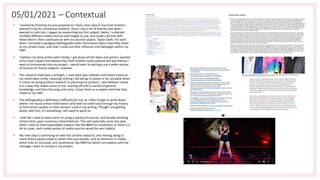
• I started by finishing my pre-proposal so I had a clear idea in my mind of what I
wanted to do for contextual research. Once I had a list of themes and ideas I
wanted to look into, I began by researching my first subject, Kesha. I collected
multiple different media sources and images to use, and made a format with
these which I then continued on with my second subject, Taylor Swift. For each
them I included a background/biography with information about how they relate
to my chosen topic, and how I could use their influence and ideologies within my
FMP.
• I believe I've done pretty well initially, I got down all the ideas and points I wanted
to for each subject and believe they both related nicely towards the key themes I
want to incorporate into my project. I would want to perhaps use a wider variety
of sources for future subjects, however.
• The research itself was a strength, I used what was relevant and linked it back to
my initial ideas nicely, meaning nothing I did will go to waste or be unusable when
it comes to doing product research or planning my product. I also believe I wrote
it in a way that makes sense to me, starting off with a variety of general
knowledge, and then focusing onto why I chose them as a subject and how they
relate to my FMP.
• The bibliography is definitely a difficulty for me, as I often forget to write down
where I've found certain information and need to comb back through my history
to find certain quotes or time stamps I used in my writing. Though I am getting
better with this, it's something I still need to work on.
• I feel like I need to work more on using a variety of sources, and double checking
certain facts upon numerous sites/mediums. This will especially come into play
when I look at more expandable subjects like the #MeToo movement as there is a
lot to cover, and a wide variety of media sources would be very helpful.
• My next step is continuing on with the context research, and moving along to
more theory based subjects rather than just people, such as feminism in media,
which links to my essay, and movements like #MeToo which correspond with the
message I want to convey in my project.
05/01/2021 – Contextual
07/01/2021 – Contextual
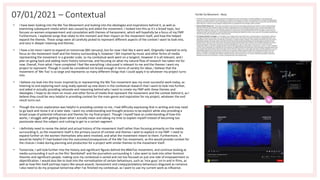
• I have been looking into the Me Too Movement and looking into the ideologies and inspirations behind it, as well as
examining subsequent media which was caused by and aided the movement. I looked into this as it's a broad topic, but
focuses on women empowerment and consolation with themes of harassment, which will hopefully be a focus of my FMP.
Furthermore, I explored songs that relate to this moment and their impact on the movement itself, and how the helped
expand the themes. These songs were all carefully picked to represent different aspects of the context I want to look into,
and vary in deeper meaning and themes.
• I have a lot more I want to expand on tomorrow (8th January), but for now I feel like it went well. Originally I wanted to only
focus on the movement itself and the history surrounding it, however I felt inspired by music and other forms of media
representing the movement in a grander scale, so my contextual work went on a tangent. However it is all relevant, and I
plan on going back and adding more history tomorrow, and focusing on what my natural flow of research has taken me for
now. Overall, from what I have completed I feel like everything I discussed is relevant to me and the themes I want my
project to represent. Though it could be considered not broad enough in terms of variety for ideas, I believe that the
movement of 'Me Too' is so large and represents so many different things that I could apply it to whatever my project turns
into.
• I believe my look into the music inspired by or representing the Me Too movement was my most successful work today, as
listening to and exploring each song really opened up new doors in the contextual research that I want to look into further,
and aided in actually providing rationale and reasoning behind why I want to create my FMP with these themes and
ideologies. I hope to do more on music and other forms of media that represent the movement and the context behind it, as I
believe they could be very helpful in providing context for the main genre and inspiration for my project, whatever the end
result turns out.
• Though the music exploration was helpful in providing context to me, I had difficulty expressing that in writing and may need
to go back and revise it at a later date. I want my understanding and thought process to be explicit while also providing a
broad scope of potential influences and themes for my final project. Though I myself have an understanding of how this
works, I struggle with getting down what I actually mean and taking my time to explain myself instead of becoming too
passionate about the subject and rushing to get to a certain segment.
• I definitely need to revise the detail and actual history of the movement itself rather than focusing primarily on the media
surrounding it, as the movement itself is the primary source of context and themes I wish to explore in my FMP. I need to
expand further on the women themselves who were involved, and what the movement meant to them. Furthermore, it
would be helpful if I had looked into the outcomes/consequences of the Me Too movement, as this would provide context for
the choices I make during planning and production for a project with similar themes to the movement itself.
• Tomorrow, I will look further into the history and significant figures behind the #MeToo movement, and continue looking at
media surrounding it such as the film 'Bombshell' and the journalism surrounding it. I also want to look into other feminist
theories and significant people, making sure my contextual is varied and not too focused on just one side of empowerment vs
objectification. I would also like to look into the normalisation of certain behaviours, such as 'nice guys' on tv and in films, as
well as how film itself portrays topics like sexual assault, harassment and creepy/predatory behaviours disguised as romance.
I also need to do my proposal tomorrow after I've finished my contextual, as I want to use my current work as influence.
08/01/2021 – Contextual
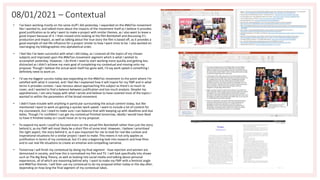
• I've been working mostly on the same stuff I did yesterday. I expanded on the #MeToo movement
like I wanted to, and talked more about the impacts of the movement itself as I believe it provides
good justification as to why I want to make a project with similar themes, as I also want to leave a
good impact because of it. I then moved onto looking at the film Bombshell and discussing it's
production and impact, as well as talking about the true story the film is based off, as it provides a
good example of real life influence for a project similar to how I want mine to be. I also worked on
rearranging my bibliographies into alphabetical order.
• I feel like I've been successful with what I did today, as I covered all the topics of my chosen
subjects and improved upon the #MeToo movement segment which is what I wished to
accomplish yesterday. However, I do think I need to start working more quickly and getting less
distracted as I didn't achieve my main goal of completing my contextual and moving onto my
proposal. Though I believe the actual work itself has gone well, I'd say work speed is something I
definitely need to work on.
• I'd say my biggest success today was expanding on the #MeToo movement to the point where I'm
satisfied with what it covered, and I feel like I explained how it will inspire for my FMP and in what
terms it provides context. I was nervous about approaching this subject as there's so much to
cover, and I wanted to find a balance between justification and too much analysis. Despite my
apprehension, I am very happy with what I wrote and believe to have covered most of the topics I
wanted to within the parameters of the broad movement.
• I didn't have trouble with anything in particular surrounding the actual content today, but like
mentioned I want to work on gaining a quicker work speed. I want to include a lot of content for
my coursework, but I need to make sure I can balance that with keeping up with deadlines and due
dates. Though I'm confident I can get my contextual finished tomorrow, ideally I would have liked
to have it finished today so I could move on to my proposal.
• To expand my work I could've focused more on the actual film Bombshell rather than just the story
behind it, as my FMP will most likely be a short film of some kind. However, I believe I prioritised
the right aspect, the story behind it, as it was important for me to look for real like context and
inspirational situations for a similar project I want to make. This means it not only applies as
justification in terms of my contextual, but it's also a beginning look into research and how films
and tv use real life situations to create an emotive and compelling narrative.
• Tomorrow I will finish my contextual by doing my final segment - how rejection and women are
demonised in society, and how this is normalised my film and TV. I will look specifically into shows
such as The Big Bang Theory, as well as looking into social media and talking about personal
experiences, all of which are reasoning behind why I want to make my FMP with a feminist angle
and #MeToo themes. I will then use my contextual to do my proposal either today or the day after,
depending on how long the final segment of my contextual takes.
12/01/2021 – Contextual
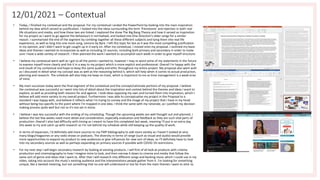
• Today, I finished my contextual and the proposal. For my contextual I ended the PowerPoint by looking into the main inspiration
behind my idea which served as justification. I looked into the ideas surrounding the term 'friendzone' and rejection in both real
life situations and media, and how these two are linked. I explored the show The Big Bang Theory and how it served as inspiration
for my project as I want to go against the behaviours it normalised, and looked into One Direction's older songs for a similar
reason. I summarised the end of the segment by combing together all these different subjects and tying them into real life
experience, as well as long into one more song, Lemons by Byre. I left this topic for last as it was the most compelling justification
in my opinion, and I didn't want to get caught up in it early on. After my contextual, I moved onto my proposal. I outlined my basic
ideas and themes I wanted to incorporate as well as including 15 sources, including both primary and secondary in order to make
sure I have a wide variety of research. I then planned the work I wanted to accomplish each week in order to give myself structure.
• I believe my contextual went well as I got to all the points I wanted to, however I may re word some of my statements in the future
to express myself more clearly and link it in a way to my project which is more explicit and professional. Overall I'm happy with the
end result of my contextual and hope to keep the same quality and ethic throughout my entire project. My proposal also went well
as I discussed in detail what my concept was as well as the reasoning behind it, which will help when it comes to actual production,
planning and research. The schedule will also help me keep on track, which is important to me as time management is a weak area
of mine.
• My main successes today were the final segment of the contextual and the concept/rationale portions of my proposal. I believe
the contextual was successful as I went into lots of detail about the inspiration and context behind the themes and ideas I want to
explore, as well as providing both reasons for and against. I took ideas opposing my own and turned them into inspiration, which I
believe will add more variety to my overall project. Furthermore I was able to conceptualise my project in the Proposal to a
standard I was happy with, and believe it reflects what I'm trying to convey and the image of my project that I have in my head
without being too specific to the point where I'm trapped in one idea. I think the same with my rationale, as I justified my decision
making process quite well but not so it's too set in stone.
• I believe I was less successful with the ending of my scheduling. Though the upcoming weeks are well thought out and planned, I
believe the last few weeks need more detail and consideration, especially evaluation and feedback as they are such vital parts of
production. Overall I also had difficulty with timing as I meant to have this completed last week, meaning I'll put in an extra day
this week to try and catch up with research so I'm not behind my schedule while still keeping up the quality of work.
• In terms of expansion, I'd definitely add more sources to my FMP bibliography to add more variety as I haven't looked at very
many blogs/magazines or any radio shows or podcasts. The diversity in terms of range (such as visual and audio) would provide
more opportunities to expand my product to new audiences or give influences for new sort of ideas, so I'll definitely have to look
into my secondary sources as well as perhaps expanding on primary sources if possible with COVID-19 restrictions.
• For my next step I will begin secondary research by looking at existing products. I will first of all look at products with cinema
production and cinematography to how I imagine mine to look, and then narrow it down to cinema and media that follow the
same sort of genre and ideas that I want to. After that I will research into different songs and backing music which I could use in my
video, taking into account the music's existing audience and the interpretations people gather from it. I'm looking for something
unique, like a twisted meaning, but not something that no one will understand or too far from the main themes I want to stick to.
Research
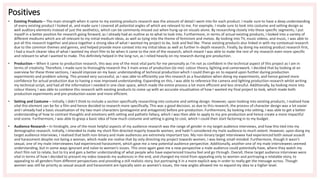
Positives
• Existing Products – The main strength when it came to my existing products research was the amount of detail I went into for each product. I made sure to have a deep understanding
of every existing product I looked at, and made sure I covered all potential angles of which are relevant to me. For example, I made sure to look into costume and setting design as
well auditory elements instead of just the aesthetics, which can be commonly missed out when hung up on visuals alone. By researching closely into these specific segments, I put
myself in a better position for research going forward, as I already had an outline as to what to look into. Furthermore, in terms of actual existing products, I looked into a variety of
different mediums which are all relevant to my initial medium ideas, as well as tying into the theme of feminism and metoo. By looking into TV, music videos, and music, I was able to
put all this research together and piece together a strong idea of what I wanted my project to be, look and feel like. These existing products also linked in with my contextual research
due to the common themes and genres, and helped provide more context into my initial ideas as well as further in-depth research. Finally, by doing my existing product research first,
I had a much clearer idea of what I wanted my short film to be when it came to the rest of the research, which meant I was able to make the rest of my research even more specific
and relevant to what I wanted to make. This definitely helped in the long run, as I relied heavily on my research during pre-production.
• Production – When it came to production research, this was one of the most vital parts for me personally as I’m not as confident in the technical aspect of this project as I am in
terms of creativity. Therefore, I made sure to thoroughly research the 3 main areas of production (to me): colour theory, lighting and camerawork. I decided that by looking at an
overview for these three sections, I would improve on my basic understanding of technical production which I could then go on to expand upon further during production
experiments and problem solving. This proved very successful, as I was able to efficiently use this research as a foundation when doing my experiments, and hence gained more
confidence for actual production due to having a now improved understanding. Expanding on this, I was able to reference the camera and lighting production research whilst writing
my technical script, and had all the information I needed in one clear space, which made the entire process a lot more efficient and less stressful. Additionally, by looking more into
colour theory, I was able to combine this research with existing products to come up with an accurate visualisation of how I wanted my final project to look, which made both
production experiments and pre-production easier and more efficient.
• Setting and Costume – Initially, I didn’t think to include a section specifically researching into costume and setting design. However, upon looking into existing products, I realised how
vital this element can be for a film and hence decided to research more specifically. This was a good decision, as due to this research, the process of character design was a lot easier
and I already had a basic visualisation of my two main characters (protagonist and antagonist) before pre-production. Furthermore, by looking into setting, I was able to get a better
understanding of how to contrast thoughts and emotions with setting and pathetic fallacy, which I was then able to apply to my pre-production and hence create a more impactful
end scene. Furthermore, I was able to grasp a basic idea of how much costume and setting is going to cost, which I could then start factoring in to my budget.
• Audience Research – In hindsight, one of the most helpful aspects of my audience research was the range of gender in my target audience interviews, and how this tied into my
demographic research. Initially, I intended to make my short film directed majorly towards women, and hadn’t considered my male audience to much extent. However, upon doing my
target audience interviews, I realised that both non-binary and male audiences are extremely important too. My non-binary target interviewee had experienced both sexual assault
and harassment despite not being a woman, which made me realise that by only directing my project towards women, I was being small-minded. Furthermore, though it wasn’t
sexual, one of my male interviewees had experienced harassment, which gave me a new potential audience perspective. Additionally, another one of my male interviewees seemed
understanding, but in some ways ignorant and naïve to women’s issues. This once again gave me a new perspective a male audience could potentially have, where they watch my
short film not to relate, but to try and gain a better understanding of what people who have experienced trauma feel and go through. Overall, these target audience interviews were
vital in terms of how I decided to present my video towards my audiences in the end, and changed my mind from appealing only to women and portraying a relatable story, to
appealing to all genders from different perspectives and providing a still realistic story, but portraying it in a more explicit way in order to really get the message across. Though
women was still be priority as sexual assault and harassment are typically seen as women’s issues, the new angles allowed me to expand my idea to a higher level.
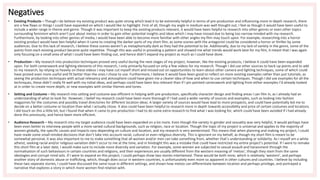
Negatives
• Existing Products – Though I do believe my existing product was quite strong which lead it to be extremely helpful in terms of pre-production and influencing more in-depth research, there
are a few flaws or things I could have expanded on which I would like to highlight. First of all, though my angle in medium was well thought out, I feel as though it would have been useful to
include a wider range in theme and genre. Though it was important to keep the existing products relevant, it would have been helpful to research into other genres or even other topics
surrounding feminism which aren’t just about metoo in order to gain other potential insights and ideas which I may have missed due to being too narrow minded with my research.
Furthermore, by looking into other genres of media, I would have been able to become more familiar with other angles my film may touch upon. For example, researching into a horror
existing product would have ben helpful when it came to creating the darker parts of my short film, as some scenes with the antagonist could be considered a horror or thriller by some
audiences. Due to this lack of research, I believe these scenes weren’t as metaphorically dark as they had the potential to be. Additionally, due to my lack of variety in the genre, some of the
points from each existing product became quite repetitive. Though this was useful in providing a pattern and showed me what trends would work best for my film, it meant that I was again
only focusing on a small area of what I could have been finding out, and hence didn’t expand my project as much as I could have done.
• Production – My research into production techniques proved very useful during the next stages of my project, however, like the existing products, I believe it could have been expanded
upon. For both camerawork and lighting elements of this research, I only primarily focused on only a few videos for my research. Though I did use other sources to back-up points and to add
to my research, by relying so heavily on these videos I may have cut myself short and missed out on opportunities to learn about other camera and lighting techniques, some of which could
have proved even more useful and fit better than the ones I chose to use. Furthermore, I believe it would have been good to reflect on more existing examples rather than just tutorials, as
seeing the production techniques with actual relevancy and atmosphere could have given me a clearer idea of how and when to use certain techniques. Though I did use examples for all the
techniques, these didn’t really fit well with my initial ideas, and perhaps could have been less relevant than if I pin-pointed camerawork and lighting from either examples I’d already looked
at in order to create more depth, or new examples with similar themes and tones.
• Setting and Costume – My research into setting and costume was efficient in helping with pre-production, specifically character design and finding areas I can film in, as I already had an
understanding of what to look for. However, I belief my research could have been more thorough if I had used a wider variety of sources and examples, such as looking into fashion
magazines for the costumes and possibly travel directories for different location ideas. A larger variety of sources would have lead to more prospects, and could have potentially led me to
decide on a better costume or location than what I actually chose. It also could have been helpful to research more in depth towards accessibility and price of certain costumes and locations.
I did touch on this a little bit, but I found that when it came to pre-production I had to do some extra research to find what I was looking for, which could have been avoided if I had already
done this previously, and hence been more efficient.
• Audience Research – My research into my target audience could have been expanded on a lot more. Even though the variety in gender and sexuality was very helpful, it would perhaps have
been even better to interview people with a more varied cultural backgrounds, such as religion, race or location. Though the topic of my project is universal and applies to the majority of
women globally, the specific causes and impacts vary depending on culture and location, and my research is very westernised. This means that when planning and making my project, I could
have made some small minded decisions that don’t take into account racial, cultural or even religious diversity. This is ignorant on my behalf, as though my short film is meant to be
somewhat personal, it was also important to me to make something that all women and/or men can take something from, whether that’s understanding or solidarity. As I myself am a white
atheist, seeking racial and/or religious variation didn’t occur to me at the time, and in hindsight this was a mistake that could have restricted my entire project’s potential. If I were to remake
this short film at a later date, I would make sure to include more diversity and variation. For example, some women are subjected to sexual assault and harassment through the
normalisation of such behaviours in certain countries and religions, and their experiences are usually different from the western meaning of ‘metoo’, though they stem from the same
ideologies and corrupt mind sets. If I were to expand on this project, I could perhaps show two stories intertwined. These would be both mine, which is relatively ‘western’, and perhaps
another story of domestic abuse or trafficking, which, though does occur in western countries, is unfortunately even more so apparent in other cultures and countries. I believe by including
these two separate stories, I could have discussed the same issue in different settings, and shown how metoo can differentiate between location and perhaps privilege, and portrayed a
narrative that explores a story in which more women find relation with.
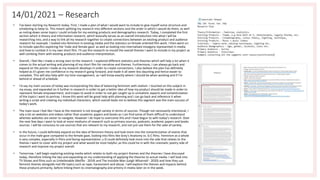
• I've been starting my Research today. First, I made a plan of what I would want to include to give myself some structure and
scheduling to keep to. This meant splitting my research into different sections and the order in which I would do them, as well
as noting down some topics I could include for my existing products and demographics research. Today, I completed the first
section which is theory and information research, which basically serves as an overall introduction into what I will be
researching into, and a way to link all my research together to create connections between an existing product and audience
research for example. I looked into feminism in existing media and the statistics on female oriented film work. I then went on
to include specifics exploring the 'male and female gaze' as well as looking into internalised misogyny represented in media
and how to combat it in my own short film. I'll use this research to mould the overall themes I want to include in my project as
well combing them with existing products and audience interpretation.
• Overall, I feel like I made a strong start to the research. I explored different statistics and theories which will help a lot when it
comes to the actual writing and planning of my short film for narrative and themes. Furthermore, I can always go back and
expand on the points I made as my research develops in order to create connections. I also believe the plan has definitely
helped as it's given me confidence in my research going forward, and made it all seem less daunting and hence easier to
complete. This will also help with my time management, as I will know exactly where I should be when working and if I'm
behind or ahead of schedule.
• I'd say my main success of today was incorporating the idea of balancing feminism with realism. I touched on this subject in
my essay, and expanded on it further in research in order to get a better idea of how my product should be made in order to
represent female empowerment, and tropes to avoid in order to not get caught up in unrealistic aspects and romanticisation
of the topics I want to portray. I know this work will be great help with planning and I can go back and reference it when
writing a script and creating my individual characters, which overall leads me to believe this segment was the main success of
today's work.
• The main issue I feel like I have at the moment is not enough variety in terms of sources. Though not necessarily intentional, I
rely a lot on websites and videos rather than academic papers and books as I can find some of them difficult to understand
whereas websites are easier to navigate. However I do hope to overcome this and I have begun to with today's research. Over
the next few days I want to look at more mediums of research such as primary sources, podcasts, academic papers and books
sources. I will be conscious to use sources that are relevant to my research, and not just use them for the sake of variety.
• In the future, I could definitely expand on the idea of feminism theory and look more into the romanticisation of events that
occur in the male gaze compared to the female gaze, looking into films like Grey's Anatomy vs. D.C films. Feminism as a whole
is very complex, especially in films and facing representation ,s O could definitely look more into the side that relates to the
themes I want to cover with my project and what would be most helpful ,as this could tie in with the cinematic poetry side of
research and improve my project overall.
• Tomorrow, I will begin exploring existing media which relates to both my project themes and the theories I have discussed
today, therefore linking the two and expanding on my understanding of applying the theories to actual media. I will look into
TV Shows and films such as Unbelievable (Netflix - 2019) and The Invisible Man (Leigh Whannell - 2020) and how they use
feminist themes alongside real life topics such as rape, harassment and abuse. I will explore the themes and impacts behind
these products primarily, before linking them to cinematography and artistry in media later on in the week.
14/01/2021 – Research
15/01/2021 – Research
• Today, I have been looking at existing products in depth. I looked into Reign first, specifically the last few season in 2x09
episode 'Acts of War'. I made sure to cover: Content, Themes, Cinematography, Characters. Setting + Costume, Audio,
Audience Reaction and Summary by writing down a little checklist before I started. I went into depth in each other these
points and linked them to my previous research as well as contextual. I also made sure to note how I would use this research
in my project and why I chose it, as well as including images that are relevant to the points I made in writing. I then repeated
this with Unbelievable, though I tried not to repeat myself and focus on different aspects of each point when researching. I
completed a biography for both, reviewing and researching a variety of sources as I went along.
• Overall, I feel like today's work has gone very well. I got a lot done and pushed myself to complete research for both Reign and
Unbelievable to keep on schedule, and I feel confident with the research I completed. I made sure I linked every point back to
my product and why I did certain research/how I will apply it. Specifically, I feel like my analysis of Reign was strong and
compelling, and I now have deeper understanding of the tone and themes I want to involve in my short film ,and how I will
accomplish them. I feel like my research into Unbelievable was also very valuable, as not only did it add to the techniques I
could use, it allowed me to get more of an idea of how an audience would react to media that covers sensitive topics like my
short film will.
• In terms of main success, I'd say my structure and planning of my research was the biggest success, as though it was very
simple, having that little bit of planning made the task of looking into an existing product seem less daunting, and I also had
the reassurance that I had covered the main aspects I need to for my project. I do intend on going back and expanding on
certain areas in terms of specifics (such as setting and costume), but for now all my point work well together as a collective. I
also feel like I did a good job at linking my images to what I was discussing, as in past work I have made the mistake of using
random screenshots from the existing product, instead of using specific images to help enhance my research. This extra bit of
effort really help clarify some points I made, especially with cinematography, and will give me a good reference for planning
and production.
• One thing I felt I could improve is being really conscious of what I'm writing, and being sure that I'm only including relevant
information and not repeating myself, as when looking at existing products with similar themes and tones this can become an
issue. However, I felt like I tackled this well by linking both Reign and Unbelievable together when I noticed similarities, and
using these consistencies throughout the products as rationale and inspiration behind my production, as they must be
symbolic of the genre. I also made sure to look at two products that though both have a similar overall theme, have very
different specific plots and genres in order to avoid discussing too many things twice and to make everything I've written uniq
• To expand, I'd definitely focus more on the audience side of things, as well as go more into how I would accomplish certain
cinematography techniques instead of just stating why I'd use them. I will cover this in another section of my research in order
to go into more detail, and be more specific to my project instead of just existing products. Furthermore, I still need to work
on yesterday's goal of expanding my variety of sources, which I'm hoping too as I delve into different types of existing
products, as well as looking at certain topics in more detail.
• Next, I will continue my existing products. I aim to do one or two more with a theme of assault and/or harassment, such as Sex
Education (2x03) or Brooklyn 99 (6x08). After this I will move onto products more to do with the poetic visual style I'm aiming
for to focus more on production than theme. This will be short films, music videos, dance videos etc.
19/01/2021 – Research
• Today, I finished up my general research existing products and moved onto looking at music and music videos. For
my existing product, I covered episode 8 of series 6 in Brooklyn 99, 'He Said, She Said'. I covered all the different
areas that I thought were significant about the episode. I chose this because the mix of serious topics and comedy
can be difficult to achieve, but this episode, as said by critics, accomplished it perfectly. The mix of genre was not
something I'd previously looked into, so I used this opportunity to explore that and the audience response to it.
After this, I moved onto existing products - music. I first planned out what I wanted to look at in this category to
give myself some structure, which will be both music videos and songs themselves that I could use in my project.
For my first existing product, I looked into Bea Miller's 'Yes Girl' music video. I focused primarily on the context,
cinematography and how the video reflects the song. The main reason I chose this was because I felt the themes
were very similar to what I want my video to represent, and I wanted to research into how the creators
accomplished that. I also planned out the rest of my research in more detail by adding titles and subheadings,
which have my work even more structure and allowed me to see a realistic time frame.
• I feel like overall my work has been successful, however I need to work faster and stay focused more as I am behind
the schedule I had originally planned. In terms of content though, I am happy with the quality of work and feel that
if I pick up the pace and get it all done to a good quality and in detail, this research will set the rest of my project up
nicely and lead me to create a well thought out video.
• The main success to me was the analysis of the music video, 'Yes Girl'. I felt like the video itself was very inspiring to
my project and what I want it to be, which resulted in all the research I did being extremely relevant and useful
towards my end project. I also think adding a structure to my future PowerPoint and planning out ahead what I
wanted to do in more detail is really useful as I have a better idea of what I need to do and how long I have to do it.
However, I do wish that I'd done this at the start, as I believe I could have been more efficient this past week if I'd
have done that.
• I struggled to stay relevant during the Brooklyn 99 research. I knew I needed to include it as it had some very useful
information for my project, particularly in terms of audience research, I just think the mix of the comedy genre
threw me off as it was very different from other existing products I had researched or what I want to include in my
film. I may go back and edit down my research at a later date to make sure it's all useful and relevant to my project.
• To expand my work, I could perhaps look more into colour theory as this is something I feel like I've been forgetting
about in my research. Going forward, especially during future examples that focus on cinematography rather than
theme, I will make sure to pay more attention to colours and how they effect the over all product, as they are a key
part in poetic cinema and the artistic genre I want to make my project in. I also need to go back over my contextual
and spell check, as I forgot to do that.
• Next, I will expand further on music by covering another music video, this time more focused on narrative than
symbolism, and then look into a scene from episode 10 of 'The Bold Type', and how it uses music in it's final scene
for effect with similar themes to my video. After, for the rest of the music section I will research into potential
songs I could use for my video, looking into the meaning and lyrics of the songs, and how I could use and/or twist
them to fit my narrative.
21/01/2021 – Research
• Today, I finished up the music section of my research by finishing my analysis of the 'Carry You' music video, and then
researching into different songs I could potentially use as the backing track for my video, researching into meaning, style,
audience impact and how I could apply it to my video. After this, I skipped my cinematography section for now and went
straight to costume and setting design to refresh my mind with something new and to avoid becoming to repetitive. I
planned what content I wanted to include in my analysis before writing to give myself some structure. researched into 2
potential costumes I could use for my protagonist, as well as how accessible these costumes would be and how I'd go
about getting them in a sustainable, ethical way as I personally believe this is very important, and I don't want my video to
indirectly support anything that could cause a negative audience impact. I did the same for a costume for my antagonist,
and then moved onto settings where I researched into examples and expanded on the cinematics of each potential
setting. Similarly to the costumes, I also evaluated how accessible these would be and researched potential filming
locations near me using google maps. I made notes as I went along for my bibliography, which I added at the end of the
section.
• I feel that today has been very successful as I covered everything I wanted to do today and achieved all the goals I set for
myself to a standard I'm happy with, as well as some extra aspects, which means I'm back on schedule of what I wanted to
have done by now. I also think skipping the cinematography for now was a good decision, as the change in analysis
allowed me to be quite creative in terms of setting and costume, which gave me the motivation to complete that entire
section.
• I'd say the main success today was definitely the costume and setting section. I completed this section in detail and did
some really helpful as well as gathered a list of inspirational outfits/locations I could use when it comes to planning and
production, as well as looking in depth at availability and accessibility which will make the planning process a lot easier.
The fact that I have a short list of products and idea locations already will definitely benefit me in the long run, as well as
the fact I based them on existing products and designs so I know what impact they'll have at what atmosphere I'll be able
to create in my short film.
• I feel like I could have focused a lot more on my audience impact while analysing the music video existing products, as that
aspect will be very important when planning. Though I've done sufficient audience research throughout my other sections
and research, I would like to perhaps go back at some point and adjust it in order to make it more relevant and in depth.
• I'd like to be able to link my different areas of research a lot more, as it's important to find consistencies and patterns to
help with my planning. Though I do include connections occasionally, I need to be more active with it to show a deeper
understanding, and possibly come up with new things that I hadn't noticed before, like possibly connecting femininity and
feminism throughout all my existing products and see how they each represent that, if they do at all, as these two themes
are very relevant to my project.
• Tomorrow, I will go back to the cinematography section now I've had a bit of variety and focus on the key aspects of
production. This will include colour theory, lighting, camera work, technique and anything else that I decide is relevant. I
will do this by looking at video essays, books and articles as well as tutorials for specific techniques, as well as looking at
ways to accomplish the look I want at home or with less supplies than I'd have access to in college in order to make my
project as best as it can be despite COVID-19 restrictions and make it's production as efficient as possible.
Problem Solving
Positives
• Contingency – When setting out to do my contingency planning, I wanted to make sure I made it as thorough and detailed as possible. This is due to the fact I was nervous about production, due to
my lack of experience and uncertainty of what would be possible due to potential COVID-19 restrictions. I achieved this goal, and my contingency planning proved very useful during production, as
well as allowing me to plan more confidently and have a clear idea of what I want to make, and what my potential limitations would be. Furthermore, the specific issues that I discussed where very
relevant to genuine issues I did encounter, hence when issues came up during pre-production and production, I already had a plan and it didn’t cause any setback. Expanding on this point, I made sure
to include both a solution and back-up solution in order to be extra secure, which again proved useful when certain issues did come up, most specifically when filming scene 7. For example, one of my
solutions was to film outside to avoid COVID-19 restrictions, so I planned to film scene 7 outside with just one other person, which meant I could get exactly what I wanted without breaking any rules
and keeping safe.
• Experiment 1 + 2 + 6 – Experiment 1 was one of the most important, due to the fact lighting was an aspect that I was not very confident in, and it was important to me to learn how to get it right for
production. Hence, I made experiment 1 very detailed and made sure to practice multiple lighting techniques in which I had referenced from research. This decision meant I was able to test and
experiment with every lighting technique I planned to use, and knew exactly how to do it when moving into pre-production and production. This also made writing a technical script efficient, as I
already knew what lighting techniques would look best for each scene when referencing my physical experiment photos. This experiment also meant I could test my suggested lighting solutions,
which made me even more confident in my contingency planning. For experiments 2 + 6, I was able to play around with colour correction and test that I can adjust my locations to my ideal
colouring/lighting in post-production. This was vital, as I didn’t want to end up with raw footage that I couldn’t edit to look like how I pictured it originally.
• Experiment 3 – The camerawork experiment’s positives are similar to the lighting experiment. I completed these experiments in order to test out different camera angles for myself, and practice with
how to position the camera as well as learn what angles worked best and were most achievable. I was able to see what camera angles would be easiest and most efficient, as well as how this would
effect quality, based on how close or far the camera was from the main subject in frame. This was very useful when it came to writing my technical script in pre-production, as I had visual ideas of
each camera angle to reference, as well as having a clear idea of which angles to use the least due to potentially difficulty. For example, I found high angles would be difficult to achieve without a
tripod (which I may have not had due to COVID-19), so I tried to avoid using too many in my script.
• Experiment 4 + 5 – Having high quality footage was a significant aspect to me, but I had doubts surrounding this as I was unsure if I would have access to professional equipment due to COVID-19
restrictions. Therefore, I decided to experiment with multiple different methods I could use in order to ensure quality and make my film look sleek and professional. Though ultimately I was able to
use a 4k camera and didn’t need to use any of the methods I tested, it was still really useful in terms of pre-production, as I felt like I could plan for a sleek, cinematic, professional film instead of a
‘home-made’ style film, as I knew I had back-up solutions even without the camera. Furthermore, I justified my ranking of each potential method and made sure to be clear about what methods I
could use and how I could use the, which meant I had a lot to reference when planning visuals in pre-production.
• Experiment 7 – Experiment 7 ended up being the most useful experiment due to my change in medium, from majority live action to majority animation. By previously practicing different styles of
animation/storyboarding, I had a good idea of what to make when working my storyboard/animatic (now film). This made the animatic itself a lot higher quality, which then led to the idea to make
the animatic itself my short film. This was ultimately the best decision, as the combination of mediums not only worked on a visual level, but also metaphorically. Therefore, in hindsight, this
experiment was extremely significant and had very positive outcomes. Additionally, by practicing different styles, I was able to find one that allowed an adequate amount of detail while also not
taking too much time, which meant I was able to make my animatic efficiently and to a high quality.
• Experiment 8 – Testing a ‘teaser’ of my short film was a good decision, as it allowed me to combine all the components I had previously tested and learn how to put them together, as well as see a
physical visualisation of what my short film would look like. This meant that when it came to pre-production, I had a focused and specific design concept in mind and knew exactly how to plan for
colour, lighting, cinematography, etc. Furthermore, I was able to once again test and learn how to use different camera angles in a conjoined way, and work out how best to combine different angles
for one shot to make the scene look visually pleasing as well as keeping the appropriate phase. Finally, I was also able to begin some audio experiments, such as combining music and sound effects
throughout the timeline, to an appropriate volume, in a way that sounds good for the audience and is realistic.
Negatives
• Contingency – A key area I missed out when doing contingency planning was looking into potential health and safety hazards, aside from just COVID-19 risks. This meant that when
starting pre-production work, I didn’t have any sense of limitations when planning certain scenes which may have occurred due to safety risks. Though I then decided to add a health
and safety contingency plan in the pre-production segment of my work, if I had done it earlier with the rest of my problem solving, it could have improved my pre-production work as
well as be potentially more detailed. Furthermore, due to the change in medium a lot of my planned contingency issues were no longer relevant. Though this wasn’t the intent, it
meant that in some cases, the contingency planning wasn’t as helpful as expected, and only really applied to one of seven scenes. Additionally, due to the heavy focus on COVID-19
restrictions, I feel like my contingency planning became a little repetitive in some places, and could be condensed upon revision.
• Experiment 1 + 2 + 6 – Though I believe these experiments proved very successful, in hindsight, I would’ve liked to focus more on the colour aspect of the experiments, specifically
intertwining it with the practical lighting. Though I did touch on experimenting practical coloured lighting effects, I believe it would have been better to go more in depth, such as by
using LED’s or thin coloured paper over lights, as I discussed these methods in my research and it would have been a good connection. Furthermore, I should have also experimented
with outdoor lighting techniques for scene 7, as this would have made both pre-production technical planning and filming a lot easier. Due to not experimenting with natural outdoor
lighting, when it came to actual production, I had no prior experience and hence the final product could have been to a much higher quality in terms of both colour and lighting.
• Experiment 3 – Experiment 3 in itself was very useful, however I do believe it could have been expanded on a lot more. I only used a minimal amount of angles that I had mentioned
in research, meaning I could have perhaps limited myself by not testing out of camera angles that may have potentially worked better for certain scenes. Furthermore, it may have
been helpful to get multiple versions of each camera angle, potentially in different settings, in order to get a broader idea of what they could potentially look like depending on the
scene and location. Additionally`, I should have spent more time figuring out how to get a good high shot without a tripod, as I wouldn’t have had access to one for scenes 1-6 if they
had stayed live action, and this could have potentially caused problems when following the technical script.
• Experiment 4 + 5 – A flaw in experiment 4 was the fact the image I used for the ‘sharpening’ test wasn’t as ideal as it could have been, and wasn’t the best set-up for showing how the
sharpening tool could be used effectively. The image itself is quite dark, and though this relates to the idea some of my scenes will be dark, it may have been better to use an image
taken of one of my desired locations with accurate lighting, in order to test how this method would work in a low light setting I actually plan to use. Furthering this, it would have been
useful to focus more on working methods of quality control rather than ‘work-arounds’ (purposeful low quality, blur etc.). This is due to the fact I was unlikely to want to make my film
purposefully low quality, and hence focusing on keeping a high level of quality would have been more relevant to my project.
• Experiment 7 – Experiment 7 ended up being the most important experiment due to my change in medium, so in hindsight there are definitely a few things I would have done better,
and added more detail to. For example, a wider range of drawing and animation styles would have been very helpful. Though the styles I tested were helpful when it came to creating
my animatic, perhaps more variation in terms of colour and shading would have been helpful, as this could have ended up adding more depth and detail to my final drawings if I had
done these previous experiments. Additionally, from a presentation stand-point, I should have increased the brightness of some of the animation style examples and the test
animatic, as they can be difficult to see even with the viewing device’s brightness all the way up.
• Experiment 8 – Upon reviewing experiment 8, I don’t see any negatives with this experiment, as it completed it’s purpose very successfully, though there are some things I would
expand on. First of all, it would have been helpful to test out an addition to the scene that is similar to the then expected style of scene 7, as experiment 8 doesn’t give a visualisation
for the whole short film, only the majority. Furthermore, though I did include the sound effect of running water, including sound effects I’d perhaps sourced instead of used foley for
may have been useful, as this would have allowed me to experiment with how to edit and adjust sourced audio to fit in with the visuals and sound cohesive in the short film. Similarly
to this, I could have made it so the jump cuts in the experiment were aligned with the music, in order to see what it would look like in my final music video.
22/01/2021 – Research and Problem Solving
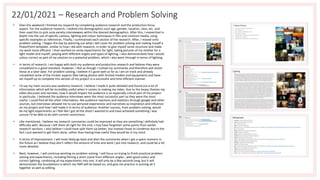
• Over the weekend I finished my research by completing audience research and the production focus
aspect. For the audience research, I looked into demographics such age, gender, location, class, etc. and
then used this to pick outa variety interviewees within the desired demographics. After this, I researched in
depth into the use of specific camera, lighting and colour techniques in film and common media, using
specific examples as references. Finally, I summarised each section of the research. After, I moved onto
problem solving. I began the day by planning out what I will cover for problem solving and making myself a
PowerPoint template, similar to how I did with research, in order to give myself some structure and make
my work more efficient. I then worked on some experiments for light, taking pictures of my mother for a
light model and myself, playing with different angles and types of lighting. I also demonstrated how I would
colour correct as part of my solution to a potential problem, which I also went through in terms of lighting.
• In terms of research, I am happy with both my audience and production research and believe they were
completed to a good standard. However, I feel as though I rushed my summaries and therefore will revisit
these at a later date. For problem solving, I believe it's gone well so far as I am on track and already
completed some of the trickier aspects (like taking photos with limited models and equipment) and have
set myself up to complete this section of my project in a successful and time efficient manner.
• I'd say my main success was audience research. I believe I made it quite detailed and found out a lot of
information which will be incredibly useful when it comes to making my video. Due to the heavy themes my
video discusses and narrates, how it would impact the audience is an especially critical part of my project.
In particular, I believed the audience interviews were the most successful part as they were the most
useful. I could find all the other information, like audience reactions and statistics through google and other
sources, but interviews allowed me to use personal experiences and narratives as inspiration and influence
on my project and how I will make it in terms of audience. Another success, from problem solving, would
be my light experiments as I feel like I got all the shots I wanted to and have achieved something I was
unsure I'd be able to do with current restrictions.
• Like mentioned, I believe my research summaries could be improved as they are something I definitely had
difficulty with. Because I left them all right for the end, I may have forgotten some points from earlier
research sections. I also believe I could have split them up better, but instead chose to condense due to the
fact I just wanted to get them done, rather than having how useful they would be in my mind.
• It terms of improvement, I will most likely go back and alter the summaries when I get a spare moment in
the future as I believe they don't reflect the amount of time and work I put into research, and could be a lot
more detailed.
• Next, however, I will continue working on problem solving. I will focus on trying to finish practical problem
solving and experiments, including filming a short scene from different angles , with good colour and
correct lighting, combining all my experiments into one. It will only be a few seconds long, but it will
demonstrate the foundations in which my FMP will be based on, and give me practice in putting all 3
together as well as editing.
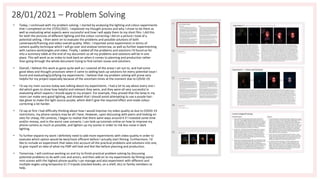
• Today, I continued with my problem solving. I started by analysing the lighting and colour experiments
that I completed on the 27/01/2021. I explained my thought process and why I chose to do them as
well as evaluating what aspects were successful and how I will apply them to my short film. I did this
for both the pictures of different lighting and the colour correcting I did on a picture I took of a
potential setting. I then went on to evaluate the problems and possible solutions of both
camerawork/framing and video overall quality. After, I imported some experiments in terms of
camera quality technique which I will go over and analyse tomorrow, as well as further experimenting
with camera work/angles and video. Finally, I added all the problems and solutions I'd found so far
into a summary table at the end of my document so all my problems and solutions will be in one
place. This will work as an index to look back on when it comes to planning and production rather
than going through the whole document trying to find certain issues and solutions.
• Overall, I believe this work as gone quite well as I covered all the areas I set out to, and had some
good ideas and thought processes when it came to adding back up solutions for every potential issue I
found and evaluating/justifying my experiments. I believe that my problem solving will prove very
helpful for my project especially because of the uncertain times at the moment due to COVID-19.
• I'd say my main success today was talking about my experiments. I had a lot to say about every one I
did which goes to show how helpful and relevant they were, and they were all very successful in
evaluating which aspects I should apply to my project. For example, they proved that the lamp in my
room can make very good lighting, and showed that I should avoid attempting to use a purple hair-
dye glove to make the light source purple, which didn't give the required effect and made colour
correcting a lot harder.
• I'd say at first I had difficulty thinking about how I would improve my video quality as due to COVID-19
restrictions, my phone camera may be all I have. However, upon discussing with peers and looking on
sites for cheap, HD cameras, I began to realise that there were ways around it if I invested some time
and/or money, and in the worst case scenario, I can look up tutorials online on how to improve my
phone camera as much as possible, and lighten up my scenes in order to risk less noise in dark
lighting.
• To further expand my work I definitely need to add more experiments with video quality in order to
evaluate which option would be best/most efficient before I actually start filming. Furthermore, I'd
like to include an experiment that takes into account all the practical problems and solutions into one,
to give myself an idea of what my FMP will look and feel like before planning and production.
• Tomorrow, I will continue working on and try to finish practical problem solving by discussing
potential problems to do with cost and actors, and then add on to my experiments by filming some
mini scenes with the highest phone quality I can manage and also experiment with different and
multiple angles using temporary D.I.Y tripods (stacked books, on a shelf, etc) or family members to
help.
28/01/2021 – Problem Solving
02/02/2021 – Problem Solving
• Today, I worked more on solving potential issues with my project, both practical and theoretical. For me, my
main goal was the combat the areas that could be compromised due to COVID-19, and come up with multiple
solutions for each. This included looking more in depth at issues surrounding restrictions, and coming up with
multiple ways to get around these potential problems, such as using editing to combine clips filmed separately
(due to COVID-19 lockdown), and potentially adjusting the short film itself in order to film within restrictions,
such as filming outside at a safe distance of 6 feet with masks. Furthermore, I expanded on the idea of
equipment and ways around lack of quality, such as adjusting my video to be in a 'home-made' style, or by using
post-production to sharpen my image slightly, though not too much as this could add unnecessary noise to the
film.
• I believe this work has gone well, and I have achieved the goals I set out to do. For every big issue I came across I
had multiple different solutions as well as back up solutions I could use during planning and production, and I
noted them all down in detail which I will be able to reference easily in the future. Furthermore, I also included a
table summary of each potential issue which will allow me to find a solution for a specific problem very quickly
and easily both during pre-production and production, which will make the overall project a lot more efficient.
• I believe today's work was very helpful when it comes to planning and production, as I have multiple solutions
for my biggest issue, which is crew, capture and maintain quality. These were my main concerns when it came to
the practical element of my project, so having these solutions will prove very useful. Furthermore, these
solutions can work for multiple different types of scenes, and it gives me a lot to work with when it comes to
planning specific scenes and shots in pre-production. Additionally, I will be able to experiment these solutions in
the near future which will allow me to feel more confident when going into planning and actual production, as I
will know what works, what doesn't and how much I can achieve within my limitations.
• I feel like I could definitely improve the way I handled the problems and solutions when it comes to equipment
other than cameras, as I feel as though I focus majorly on the camera rather than other useful assets, like lights
and a tripod. Though video quality is very important, camera angles and lighting are also incredibly important
and other equipment plays a major role in this, so in hindsight I should have made sure to balance the focus
between all potential equipment I may use, and perhaps include an in-depth risk assessment for each.
• In terms of expanding the work, I could definitely cover more problems revolving around location, as currently I
have minimal problems and solutions regarding that and upon further thinking, there's a lot more variables,
especially when filming outside that could potentially be an issue that I missed. Furthermore, I want to discuss
my previous quality experiments and link them to the problem solving I completed today, as well as expanding
more in terms of actual experimentation as I believe it's incredibly important.
• Tomorrow, I want to focus more on experimentation in terms of quality. I will do this by discussing previous
experiments that are mostly ways around bad quality (like different styles of video) as well as completing more
experiments by researching into different techniques involving both camera work and post production to
achieve a higher quality image. I will also look further into location problems and solutions, as I believe I haven't
covered enough angles and this is an important aspect to production.
04/02/2021 – Problem Solving
• My main focus today was completing experiments surrounding video quality, and discussing previous experiments. First, I
discussed the experiments I had already completed. These were surrounding the idea fo changing my video style in order to
embrace the lower quality of my phone camera, and I tested different methods such as purposeful blur, and adding noise and
deliberate film damage in order to portray the style of a home video, which not only adds a personal touch to my video which
I'd want to achive either way, but covers up any bad video quality and makes it deliberate and meaningful instead of an issue.
After this, I then went on to include more experiments surrounding quality. I researched into methods of including quality
post production, such as a way to find the best balance in terms of sharpness and noise, as well as looking into other methods
like the app 'Remini' which is praised for it's usefulness at improving both image and video quality. I also tested different
quality control techniques, such as manual focus and the difference between a high and low quality camera, and then
discussed the pros and cons of each, and how detrimental a non-professional camera would be. I did this so I'd have a clear
view of my limitations when starting pre-production if I only have access to a phone camera, in order to make the best
possible video with minimal equipment. I also went back and added more to my location theoretical problems in order to
cover all possible angles.
• Overall, I believe this work has gone well and was something I enjoyed doing. I explained my thought process with each
experiment clearly and always linked it back to a problem and/or solution I'd looked at previously, making sure they were
both relevant to my project as well as useful to me. In additional, going back and adding more indepth research into potential
problems with location will prove very useful and make sure my prudction process on set will be as efficient as possible.
• In terms of main successes, I'd say my experiment with Remini and practical techniques were the most successful. This is due
to the fact that without this testing I wouldn't have come across Remini,which has proved to be a vlaubale tool in terms of
enhancing video quality, and could make a big difference to my final product. Furthermore, experimenting with the
difference between a professional, high quality camera and my phone camera really helped me visualise what my project
could look like, and will help a lot when it comes to planning for both access to professional equipment/lighting/crew etc. and
only having a phone camera.
• I'd say the most difficult part of this experiments was having to film on my own for some of it. This mad eit incredibly difficult
to focus on small details as I didn't have anyone behind the camera, which meant that if it went out of focus due to
movement, lighting changes, etc. I wouldn't know until after filming, and made it especially difficult to get certain shots.
Ideally, I'd like to re-do this experiment when I have access to help in order to get more accurate results, though this did
serve as a good test for what my project could look like if I have no access to a cast and/or crew.
• In order to expand the work in the future, I need to look at incorporating the majority of my experiments into one scene/clip
in order to see how they will all combine and get a rough visualisation of what my project will look like. I should also perhaps
go into more detail of the process for my experiments rather than just the end results, as documenting how I got certain
colours/effects would be good to reference in the future.
• Next, I want to work on camerawork experiments, so testing angles, framing, different styles, etc. and discussing these in
detail, which will lead to evluating which would be the easiest/most possibe without professional equipment. I also want to
go back and expand on my contextual work, as I feel like I could expand on the context and justification of why I'm chosing
this medium.
05/02/2021 – Problem Solving + Contextual
• For today, I focused mostly on experiments surrounding camera angles of my film, as one of my weaknesses in previous
projects was not using a variety of camera work, and not using them to effect. Due to these reasons, I felt it was
important to test and experiment with them beforehand. I did this by first looking at my research, and by using my
camerawork slides, deciding what angles and techniques would be best to work on. To start, I experimented with the
Dutch tilt, and how I could achieve it at home. I took all the images in my bathroom as it has the brightest lighting at night
(it was night when completing these experiments), and used items I had to prop up the camera. I then proceeded to use
similar techniques to get tight, detail, low and high camera angles. After doing the actual experiments, I explained the
process and evaluated the effect of each shot and how easy or difficult it would be to get each one. I then summarised
like with my other experiments. Once this was done, I then expanded on my contextual work and added a rationale, as it
is something I hadn't included previously and is very important for my overall project.
• Overall, I believe this work has gone pretty well. I achieved all the shots I discussed in my research and hence wanted to
test, and was able to get a good overall idea of how I could film my actual project, as well as being able to test the success
using equipment I have at home, as it's likely I won't have access to professional equipment from college due to the
COVID-19 lockdown. Furthermore, I believe adding to my rationale definitely improved the justification aspect of my
overall project, and added a solid base for my context work.
• To me, the main success would be the analysis and evaluations of each camera experiment, as it was incredibly helpful to
think through each process and be able to not only visualise, but have supporting evidence for how plausible each shot
would be for my actual project, as well as being able to see the outcomes and the effect they could have on my audience.
I also believe the rationale was quite successful, as though I added it late, I believe I now personally have a more solid
justification for my project and hence am able to write it down a lot easier, as before I may have not ben able to think of
the words to describe and explain what I was going for.
• In terms of difficulty I'd say the practical side of experimentation was the most challenging. Personally, I've always found
written work easier and more successful, as though I can be very creative and passionate surrounding projects and
production, in terms of skill I definitely have a bias towards written. So when it comes to practical aspects such as
experiments, I sometimes struggle with getting across what I want to portray, as well as working with technical aspects
like equipment. However, I believe that since doing these experiments, I've become a lot more proficient in the practical
side of production, and have confidence that my end product will hold the same standard as the pre-production
beforehand.
• Surrounding expansion, I think it would have been good of me to experiment further with actual video rather than just
images, as though the images do accurately portray the angles that a video would, using an actual video would allow the
experiments to be more accurate and closely related to what my actual final project would look like. In order to achieve
this and expand on current experiments, I should do more than involve video instead of just images.
• I believe my next step should be to create a 'summary experiment', which involves the majority of experiments already
completed in one scene, such as colour correcting, lighting, camera, quality etc. This would be incredibly helpful in getting
a visual idea of what my actual short film would look like, an inspiring confidence that it will be possible to create
something of high quality even in a lockdown due to COVID-19.
09/02/2021 – Problem Solving
• Today, I decided it would be a good idea to create a final experiment which involves the majority of
experiments I'd previously completed, in order to see how they look combined and in an actual clip rather
than just image format. I decided to go with a scene that I would most likely see in my actual film in order
to get the best accurate visual representation and experimentation of what a final result would look like. I
started this process by filming multiple different clips in my bathroom of me washing my hands. I got a low
shot, tight shot and a detail shot in order to practice camerawork form previous experiments again, and
test out angles with actual video rather than just footage. After filming, I compiled the footage into Sony
Vegas and edited it, before exporting the video in both a final copy and a before vs after format. I made
sure to take screenshots of the entire process, and used those to then discuss the process in detail, and
then evaluated what went well and what I could improve in a final summary. To finish, I simply uploaded
the two clips to YouTube and linked them on the final slide of my problem solving.
• I feel that overall this work was very successful as I am happy with the outcome as well as now knowing
where I stand in terms of production. The filming went a lot better than I anticipated and I managed to get
all the shots and angles I wanted to. Furthermore, the editing proved very successful and allowed me to
practice and give myself a future guide on how to get the exact colouring and lighting I want for my short
film.
• I'd say the main success of this work was the overall final product, and the evaluation summary that came
with it. Due to being able to clearly find out what worked in the process and what I need to improve on, I
will now be able to apply this experimentation to my planning when deciding what to focus on and
prioritise in order to make my project the best it can be. Furthermore, the outcome of the project itself
was something I'm very happy with, and inspired confidence for the actual production of my film, and gave
me a clearer visual of what I want to produce in the end.
• In terms of difficulty, I'd say the biggest issue came down to video quality. I used my phone camera which
isn't the best, and despite the bright lighting there was still some noise in the final product. Furthermore,
though I sharpened my video which did make it look a lot better, it was quite obviously edited and didn't
have that clean, artistic effect I'm going for. Hopefully this can be remedied by COVID-19 restrictions
allowing me to either borrow a peer or college's equipment in order to get the video quality, but if not it
was a still a good test, and now I know that though sharpness can't fix everything in terms of quality, it can
definitely provide an improvement.
• To expand my project, I should actually record work in the future using a screen recorder, such as OBS, in
order to provide a more in depth and accurate process to go back and analyse. Though screenshots can still
get the gist of the process across, using video would definitely help future evaluations and improvements.
• Over the next few days I will make small improvements to my problem solving and potentially expand on
some potential problems and/or experimentation. This will also include spell checks and overall quality
control. Furthermore, I will look further into more experiments I could complete that could be useful
specifically for me.
12/02/2021 – Problem Solving
• In order to finish my problem solving, I decided to add a final experiment. This experiment focused on
the storyboarding aspect of planning, as I believe this is one of the most critical parts of pre-
production, as I can struggle to visualise a story in my head and need to physically see it. First, I
experimented with different styles of storyboarding that I could do, and tested how long each slide
took me to evaluate which style would be the most helpful and time efficient. I also experimented
with creating a quick animation, as I want to make an animatic as well as a storyboard for my short
film in order to get the best possible visualisation. I explained the process of this animation and
concluded that one of this detail would be too time consuming to accomplish, but I could do it with a
more simplified animation.
• Overall, I believe this work went well and that it helped me a lot in terms of preparing for planning. I
now have a better understanding of how long my planning will take, and what my overall storyboard
and/or animation will look like. When going into pre-production after problem solving, I will now feel
a lot more confident that I will be able to accomplish what I want in the allotted time and stay on
schedule. Furthermore, this experiment helped me realise my limitations in terms of animation, and
made me realise that I should switch my focus to an animatic rather than an animation as it will be a
lot less time consuming and can be made using the storyboard.
• I'd say the main success was experimenting with different styles of storyboard that I can use. This is
because I can sometimes be very indecisive and change my mind half way through, which could have
lead to my storyboard looking incohesive and messy, as well as potentially difficult to understand.
Now, however, I have a better understanding of what style I want to use and have already tested
multiple others, which means I am a lot less likely to change my mind and cause delays.
• In terms of difficulty, the animation was quite tedious and I had some trouble when it came to
exporting. Originally, my editing programme kept crashing and could export the video. I googled the
issue and tried changing around my export settings, but it didn't work. However, I then tried changing
the save file directory to my hard drive with more space, and it exported like normal. This is
something I will remember for future projects including my short film, as hard drive space isn't
something I'd previously considered.
• For expansion, I could have gone back and experimented more with the animation, and practiced an
animatic style. This would have made sure I was completely confident my animatic idea would work,
instead of just going off estimations from my animation experiment. However, though I could go back
and add this if necessary, I believe these two experimentations were enough to get an understanding
of how to storyboard and visualise my short film properly in pre-production.
• The next step in my project will be move onto pre-production. To do this, I will initially create a
template for my planning in order to have a clear idea of what I need to accomplish, and to begin
writing my script as in my opinion this is the most important part of planning and works as a
foundation for the rest, such as technical and design.
Pre-Production
Positives
• Script/Storyboard – My script was overall very detailed, and covered many different areas. I followed my contingency plan from problem solving when creating my script, as I made specific note to
provide 'back-ups' for each scene which may be halted by COVID-19 restrictions. Despite not being affected by these in the end, having the additional potential guidance there definitely inspired
confidence throughout planning, and made it so I felt more comfortable in creating bigger decisions, such as visual and technical aspects. The script also worked as a good foundation for my then
storyboard/animatic and now final video. I was able to do a drawing for every shot described in my script to very specific accuracy, which led to the animatic running smoothly and covering every area
of the script/narrative in a clear but concise way. This also aided me in a similar way during live action filming. Though I didn't follow it as closely as I had ruing my animatic, it provided a decent
foundation when it came to choosing what to film, and helped me when I became unsure and indecisive about the technical aspect of filming when on set.
• Technical – My technical planning was a very significant part of my pre-production. As mentioned in problem solving, the technical aspect of this project was expected to not be my strongest due my
inexperience with filming live action work. Though this was made into less of an issue by switching to majority animation, it was still incredibly important that I planned my technical aspects well in
order to complete scene 7 to a high standard. To accomplish this, I covered multiple different potential angles, such as camerawork, framing and lighting. I explained my in-depth thought process and
planning with these separate aspects, and made sure to include every little detail in order to give myself the best possible chance at filming something of high quality despite my inexperience.
Furthermore, I made sure to include both written and visually aided planning, as I find it useful to have physical visuals and examples of projects before I begin production. Despite the fact in the end,
I did the majority of my project in animation, I was still able to apply multiple of these technical aspects through art rather than live action.
• Visual – My visual planning was one of the strongest aspects of my overall pre-production. I covered a broad range of visual ideas surrounding colour theory, typography, motif, etc., while also looking
more in depth at specific scenes and how the visuals provide both meaning and context. I justified every decision, and planned the colour scheme well for each scene. Furthermore, I tied my visual
planning in with my narrative and symbolism in order to keep a balance between the story and metaphorical side to my short film. Additionally, when planning for the broader, general colour
scheme, I referenced my research on colour theory, making sure to back up each point made and provide justification This not only expanded my ideas when deciding on colour through inspiration,
but made sue I felt confident in my choices and what they represented for my entire short film.
• Audio – During pre-production, I made sure to plan audio thouroughly. As my short film also ties in a music video, I knew that planning audio was just as significant as planning the
visuals. For audio, I decided to focus on both music for the actual short film and credits, as well as potential sound effects I planned on using, planning both foley and sourced
materials. This planning was very in-depth and would ave ben extremely helpful if I had stuck to doing a live action short film. In terms of music, I planned both the song I was going to
use, and how I was going to edit to make it unqieu and to further the story. For example, I planned how I was going to edit 'Where's My Love – Alternate Version' to be lower in pitch and
slower. Due to this, when it came to drawing the animations and then editing/post-production, I already had a clear idea in mind of how the audio was going to sound like, and hence
didn't have to waste any time trying to make the audio fit with the animatic frames. I did the same thing for the music I was going to use for credits, however this became irrelevant due to
the fact I did not think credits were necessary in the end.
• Character/Costume/Setting - I believe overall that my planning for character, costume and setting was very successful, specifically character. I went very in depth with my character planning, and
covered all multiple areas and different perspectives of my characters, in order to make them feel as real as possible and enhance immersion for my audience. Additionally, by going into a lot of detail
about my two main characters, it meant that my actors had the best possible chance of portraying them how I imagined, as the more they know, the more material they have to go off of when
bringing them to life. The successes with location planning were very similar to technical. For example, I used both visual planning alongside written, which gave me a very clear plan of how to use
each location in terms of camerawork and lighting. This influenced my animatic as I knew the layout of each setting, meaning the drawings were consistent despite taking place in a fictional location.
• Management – My management planning was concise and to the point, and laid out in a way that was easy to understand. I organised each section, such as schedule and safety planning, in a table,
and included well thought out points in each, especially when it came to safety planning as this is extremely important for live action filming. Due to the detail but clear organisation, all my
management planning was very easy to reference and look back to during production, which allowed the production process itself to be as efficient as possible.
Negatives
• Script/Storyboard – Though the script was a strong aspect of my pre-production planning, the storyboard ended up not being very detailed and slightly rushed, despite the fact I made it clear that a
good storyboard would be a vital part of my planning. This is due to the fact that my original storyboard became an animatic which then became my actual short film, leaving me with only an outline
for my storyboard in planning. Furthermore, the written description isn't that detailed either, which means overall, this section of my planning wasn't the best quality. However, my script is extremely
detailed as it makes up for the lack in storyboard, furthermore, this didn't impact my production at all due to the fact the majority of my production was done using frames I had already drawn, and
was based mostly off of the narrative and technical script.
• Technical – Though I covered multiple technical areas in terms of what I could actually include in my short film, I didn't look too in-depth into actual technique and tutorials on how to do these.
Tutorials would not have only expanded on my research, but would have been very helpful during production as I struggled in filming scene 7 and hence didn't produce the best version of this scene
that I could have done. If I had planned more in depth in terms of 'how-to' rather than just what I will do, I would've been able to improve my film and counter a lot of the feedback I got of the fact
scene 7 is a lower quality to the rest of the short film, and not consistent. However, my crew member, Luke Headland, was very experienced in filming live action, and did end up helping a lot. This
meant that not including tutorials wasn't as detrimental as it could have been, but I still not regret doing more as it could have made my project better than it was. Additionally, in technical planning, I
only discussed basic equipment I may use rather than more advanced equipment. This limited my filming as I didn't plan to use any higher end equipment, such as a shoulder mount, which may have
improved my short film. Furthermore, I didn't plan specifically for the equipment that I did mention, such as research in depth into the capabilities of the specific cameras I planned to use, and lay out
how I can use these different attributes to my advantage while filming.
• Visual – When planning for my visuals, I'd say the biggest downsides were the moodboard for scene 7, and the planning for a font. For the moodboard, as mentioned in my production journal, I
believe that it didn't fully imitate what I imagined scene 7 to be like in my head, and didn't provide enough variety in visuals to be a very helpful foundation when it came to actually making the scene
in production. More specifically, scene 7 was intended to be about finding a balance between feeling hopeful for a fresh start and the beginning of the healing process, while also acknowledging that
healing is not linear, and a segment of the 'dark' will always remain. However, in planning and then production, I lost track of this, and ended up planning for a scene in which there was only happy
tones. Though this enhanced the contrast I was also intending for, I believe I leaned on this one theme too heavily, and briefly lost that aspect of realism near the end of the film. When it comes to the
font, though this planning was solid and would have been a good foundation, I ended up using a different font anyway for my actual project, making this planning irrelevant.
• Audio – When it came to planning my audio, I focused mainly on where I would collect audio from rather than how I would apply it, or how I would change it in post production to
make it unique and fit my film. Though I touched on this briefly when mentioning the music side of my audio planning, it would have been helpful to expand on this further, especially
when it came to sound effects. In the end, I ended up not using sound effects because I decided that they would feel out of place and perhaps ruin the tone of the film. However if I had
planned effects I could have used, such as the 'smooth' FX in Sony Vegas Pro 14, I would have realised that I could make different sounds match, whether collected through foley or
different internet sources, and perhaps made a different decision about adding them to my short film. This could have improved the entire film, and made it even more immersive and
emotive.
• Character/Costume/Setting - Though my planning for character, costume and setting was mostly very successful, there were definitely a few things I could have expanded on. First of all, it perhaps
would have been helpful to go more in depth with my side characters, as in the end they were included due to the fact I could animate them instead of having to use actors. If I had planned them in
more detail, I could have perhaps given them more personality in my film ,and overall make the narrative more immersive and realistic for the audience. Secondly, I should have provided more than
one source for where I could get clothing, as a back-up solution is always necessary just in case something goes wrong. Though I did have a dress I was able to use for scene 7, it's not what I initially
had visioned and therefore didn't look as good as I had wanted, again furthering the below average quality of scene 7.
• Management – Management was in general completed to a good standard, and my planning didn't cause any issues with schedules. This is mostly due to the fact I greatly reduced the amount of live-
action filming actually needed, but this planning also meant scene 7 production was able to run smoothly in terms of times and schedules.
23/02/2021 – Pre-Production
• My inital plan for today was to get set up for pre-production, and to begin script writing. To begin with, I made
a layout for my entire pre-production, making sure to include everything I'm going to need to explore, such as
location, character, technical aspects, etc. I also included bullet points for each section in order to give myself a
basic idea of what to include in the future. Once I'd done this, I then proceeded to begin writing my script, as
well as writing my introduction on the story and themes of my video. I made sure to discuss how the plot of
the story would incorporate the metaphorical themes, as well as expanding on the themes I need to
incorporate throughout and how/why this will impact my short film. I believe that these aspects will be the
basic foundations for my entire project, and hence they took the priority.
• I think today's work went well, but believe I could have gotten more done. Though it was incredibly helpful for
me to set up my entire powerpoint as I like to have a clear idea of what I'm doing before I start a project, I feel
like I could have gotten the whole script finished if I had spent more time on it which then would have allowed
me to start my storyboard in my free time, as I enjoy drawing and can do this while relaxing. Furthermore, I
should have prioritised my script over my introduction as I already had a badic idea of themes and story from
my rearch and contextual, so I believe I could have written a compelling script even before the introduction.
• Today was quite challenging in terms of content, but I believe a big success was definitely the planning of my
pre-production, and the laying out of all the different sections that I want to include as it gave me a good
overall visual of my pre-production, and also helped me estimate how long each section would take and hence
where to allocate my time to make it the most efficient. It also means I can now switch between dfferent
sections instead of doing it all in chronological order to avoid it becoming tedious and repetitive.
• The most challenging aspect of today's work was the script writing. I had many ideas and knew what I wanted
to represent by using my contextual and research, but I struggled to actually get it into words and visualise
how I wanted my story to go. This caused me to feel quite frustrated as previously I had multiple ideas, but
when it came to actually writing them down my mind went blank. To combat this, I left the work for a while
and took my mind off it, as I believed going back later with a fresh perspective would be helpful. In the end,
this proved successful as I was able to begin writing my script to a standard I am happy with upon returning to
the work and feeling freshly inspired.
• In terms of expansion, I believe I should work towards putting more detail into the script, and perhaps adding
more tehcnical direction in order to get a better idea of what to design and create when making my
sotryboard, as I want my storyboard to follow what my short film will look like almost exactly, rather than jsut a
representation. Furthermore, I should make sure to incorporate a 'back up script' for scenes which would
involve other people, as COVID-19 restricitons are unpredictable and if we go back into lockdown, I don't want
to be left without a plan.
• Next, I will expand my script like previously mentioned. I will add technical directions in order to get started on
creating my storyboard as accurate as possible. I also want to begi nworking on the technical and design
aspects of my short film, such as looking at lighting and camera techniques as well as designing and analysing
moodboards for each of my scenes.
25/02/2021 – Pre-Production
• I started by working on my script and adding more detail. In order to make it more useful and overall more
impactful for production, I decided to add some technical notes for each shot, and to clearly state where the
camera would be, how it would move, and what the lighting would be. I also made notes on how I'd do this, in
order to make production as easy as possible. Furthermore, I added back up shots for scenes which required
other people, just in case the country went into another national lockdown and the originally planned scenes
wouldn't be possible. After this, I started on design planning, including looking at overall colour theory,
typography and style of the video. To further expand on this, I decided to do a mood board and overview for
each scene, in order to have a very clear idea of what the scene would look like and incorporate during
production. I completed the mood boards for scenes 1-4, and decided to do the last 3 next week. To finish for
the day, I expanded more on the storyboard, as I am currently trying to do a little bit each day in order to make
the large task as time efficient as possible.
• I believe this work has gone well. I got a lot done, and completed everything I set out to do as well as doing
more storyboard slides. I do think that the mood boards could have been completed more efficiently in order
to get them all done in this lot of work instead of splitting them up, but this isn't a big issue and they can
always be completed at a later date.
• I'd say the main success of the work was the script, as I now have a much clearer idea of what my overall
project will look like thanks to the very specific and clear technical instructions for each shot throughout the
short film. Furthermore, this provides very clear guidelines for my storyboard, which will mean that the
production of the storyboard and animatic will from now on go a lot smoother. This will mean production will
be a lot easier as I will have an exact reference to go off of, and the animatic will be overall more successful
and accurate to how I want my final video to look.
• With this work I didn't really have any difficulty. The only thing that comes to mind would be the typography as
it took me some time to decide want font to use and I may still go back and change it, depending on how my
video's style develops in production. However, after a while of deciding I do believe I now have at least a very
good idea of the overall style of the font, and more than likely an exact font I will use for the credits and title
card of the film.
• In terms of expansion, I'd say I need to finish the mood boards as soon as possible in order to preserve
consistency, and this is something that I will aim to do next. Furthermore, in order to improve this work I could
expand more on the style of the video, as I feel like I kept it quite condensed due to the fact I have a clear idea
in my head, and didn't feel the need to explain it further. This could be problematic for multiple reasons, such
as if I forget certain aspects or if someone else needs a better idea of the video other than me. Hence, I will
expand on this section in the future.
• Next, I will finish the last 3 mood boards and begin looking at technical aspects of pre-production, such as
lighting, camera and framing, as well as audio. Furthermore, I will look at expanding the design section of my
pre-production, though I will prioritise technical for now as in some ways being clear in terms of technical is
more important to me as a film maker, as that's what I'm less confident in.
02/03/2021 – Pre-Production
• At this point in pre-production, I wanted to focus on the technical aspects, as well as finish the remaining mouldboards for
my short film. To do this, I began by taking pictures of some of the locations I would use in order to provide context when
explaining my technical approach. I then used a combination of these and some of my animatic frames in order to explain
how I would use different camera angles and framing work. After this, I then decided to plan how I was going to use the
available lighting to my advantage in the indoor filming locations. I started this by creating a top-view map of each room I
would use, and show where each light source would be. I then pinpointed each location in my writing, and planned more
specifically how the lighting would work for each individual shot. Where necessary, I went back and edited my technical
script to fit the further technical planning. After planning for the technical side of my short film, I then went on to expand on
the storyboards and finish them for scenes 5-7. This process was the same for the previous mood boards. Finally, I decided
to add more to my introduction in terms of context in order to tie my pre-production to my contextual and research.
• Overall, I believe this work went well and I managed to complete all that I set out to do. I also managed to get a lot of work
done which contrasts my previous session, and makes it so I feel like I am on track to meet my deadline and to be able to
start production work when initially expected. Every aspect of today's work was completed to a good quality, though I see
the technical aspect as the biggest success.
• Like mentioned, I believe the main success today was the technical aspect. As the technical aspects have been an on-going
worry of mine due to lack of experience, this planning was vital to the outcome of the product. Due to this, I went into a lot
of detail, both written and visually. This means that when it comes to production, I will have a better idea of how to make
my film, and hence it will come out higher quality than previously expected. Furthermore, this level of detail meant I could
add to and change my technical script in a way that ensures me it will be accurate to potential restrictions and easy to
follow. it is my belief that this will make the process of filming very efficient, as I have a very clear plan in mind of not only
how each scene will be filmed, but of how each individual shot will be filmed too.
• Despite having done mood boards previously, I found these to be the most difficult aspect of today's work. This was due to
the fact that scene 7 is very different to the previous scenes, and hence going from focusing on dark/depressing themes to
brighter ones was a difficult transition. Furthermore, scene 7 is about finding a balance between hope and gritty realism,
which can be difficult to express. I believe I perhaps focused too much on the more hopeful side of scene 7, and neglected
the fact it's meant to link back to the darkness, and reflect that healing is not a linear process. If time allows me to, I will
change this before production in order to ensure scene 7 is as accurate to how I initially planned as possible.
• For expansions, I'd say that the introduction could be more varied, rather than quite targeted on a consistent theme.
Though the context is incredibly important and hence why it is the focus, I believe that by expanding the introduction to also
including some perhaps visual and technical aspects, I will have a better foundation for both the rest of pre-production and
actual production.
• Next, I would like to focus on location as well as in-depth character planning. These specifics will help outline my entire
project. For example, by looking at potential locations and analysing them further, this will again help aid technical planning
and make it even more clear. Additionally, character and costume design will not only help in terms of management, but it
will allow my actors to become more familiar with their characters before production starts, and will lead to a better and
more accurate performance.
04/03/2021 – Pre-Production
• For today, my main focus was location, character and costume design. These three aspects of planning were very important, for
the narrative, visuals and technical aspects of the film. Hence, I wanted to take my time for each segment and go into the
necessary amount of detail. I decided to start with character and costume, as I believed these two would be the easiest for me,
and could cause for potential script changes due to character development. To begin, I drew my protagonist using the app
ibispaint x on my phone. I drew her in both a front view and side view for a full reference. Once I had done this, I then went on
to develop her in writing, expanding on her appearance, costume, personality and impact on the narrative. I believe these 4
angles were the most important when creating a well thought out, rounded character that is portrayed as real. After further
planning her costume, I decided to add a 3rd piece of artwork which shows how I picture her costume in scene 7 in order to
have a reference to use when putting together the character's outfits during production. I repeated the same process with my
antagonist. Due to my side characters having very minimal roles, I decided a simple table would be enough planning for them,
especially due to the fact it was likely I may not be able to have side characters due to COVID-19. I then moved on to location.
For this, I used a similar method to my previous technical planning. I took multiple pictures of the locations I planned to use,
and then analysed them (such as marking out the rule of 3, recognising light sources, etc.). I also expanded on these locations in
writing, and pinpointed the desirable aspects to each location, and planned how to use them to my advantage during
production. Finally, just like the previous few days, I worked on more storyboard frames too.
• I believe this work, in general, went well. Every aspect was completed to a quality I am happy with, especially the character
planning, as well as the picture analysis for location. As my pre-production progresses, I believe it is shaping up to be very useful
and will be a very efficient foundation for production.
• In this work, my main success were in location and character design. For location, my analysis of images rather than just using
written planning provided a lot more insight, and I believe will prove very helpful when it comes to filming in each location. This
planning gives me the best possible chance of being able to use every available aspect of each location in a successful way for
filming, as well as giving me confidence that the locations I have chosen are the most ideal for my project. In terms of character
design, I believe the fact that I explained my character's backstories and impact on the narrative will greatly help the immersion
and will make each character feel real, as well as helping the actors portray them accurately due to knowing them well.
• I didn't really have difficulty with any aspect today's work, though some of the location images were hard to obtain. For
example, I wanted to go out and get my own images of every outdoor location, but ended up not being able to due to the
weather not being ideal for what I had imagined, and having difficulty in finding the time. However, this issue was quickly
resolved by using photos that worked just as well from google maps.
• In terms of expansion, I definitely could have talked more about the costume, and perhaps gone into more detail about not
only how I would obtain the costume, but also potential prices and in what scenes each would be used. This means that I
would've had an accurate estimation of what percentage of my budget costumes would take up, as well as an overall more
detailed plan for costumes in general.
• The next step for my pre-production would definitely be focusing on the management side of planning, as this is something I've
mostly neglected up to this point. Furthermore, I would like to touch upon planning credits for my video, as though I am unsure
of including them yet, it'd be helpful to have a plan just in case. Additionally, I need to plan my audio and editing aspects, as
these are quite significant.
09/03/2021 – Pre-Production
• Today, I decided to focus on the management side of pre-production, as well as expanding on the technical
planning. First, I began by planning facilities and personnel that I will use throughout production, focusing on
equipment, props, costume, crew and finance. For each of these, I set it out in a clear and concise table, and
listed every piece of information I need to know for production, such as the availability of my cast/crew, prices
for costume/props/equipment, etc. And made sure to make it easy to reference back to during production.
Once I had completed these, I moved onto further management planning, such as creating a schedule, looking
into potential safety hazards and discussing storage for production. I did these in a similar way to the previous
points by putting them in clear and organised tables. After management, I moved back to technical, and decided
to expand upon it. I added a section for audio, focusing on both the music choices and potential sound effects,
listing specifically which ones I would use for both, and even providing links to download them for production. I
also planned my editing process in a table, listing potential effects and transitions I may be able to use, and how
I would apply them. I decided to also add a section for planning the credits, as I was still unsure on whether to
include them and believed that it was best to plan for them just in case. Finally, I went over my entire pre-
production and made sure to spellcheck everything and correct any points if needed.
• In general, I'd say that this work went well. I achieved everything I set out to do in a clear and efficient manner,
and was even able to add more, e.g. the credits section. Furthermore, I was able to get my entire pre-
production wrapped up, and was able to check that it was of a good quality and a good foundation for
production.
• Today's main success would definitely be the management section of planning. I including everything that is
significant to the project, and feel confident that this section will allow production to run smoothly without any
interference. Furthermore, this gives me an outline to how production will go in terms of a timeline, and I now
have a clear idea of how much time I will have for certain sections. For example, I believe I will have plenty of
time in post-production, meaning I'll get the chance to do multiple revisions, if necessary, without having to
worry about time. Furthermore, the layout of this section of pre-production is overall extremely clear to read
and understand, which means it will be easy to look back to and reference quickly during production.
• At first, the editing section of today's work was quite difficult to do as I was doing this work at college and away
from my editing programme. This meant I couldn't see what effects were available to use, and had to use my
memory to try and think about what I have available, and what would be good to apply to my short film.
However, this was quickly resolved when I was able to work from home, and no longer an issue.
• For exapnsion, I believe I should have gone more in-depth with my credits planning. This is due to the fact I
didn't talk much about what sourced footage/behind the scenes footage I would use, and instead only focused
on the fact I would use them rather thatn going into specifics. This may cause some issues if I do decide to add
credits to my prject, as I will have no plan on what to actually include for some of the visuals, and will either
have to leave them out which isn't ideal, or think of something during production which reduces efficiency.
• The next step is to begin production. I will do this by first collecting everything together, such as cast, crew,
props and equipment. This is why it was important I got the management aspect completed today.
Production
Animation
Positives
• The overall process was very effcient and easy to do, as I used an app on my phone called ibispaint x to draw
each frame. Due to the fact it was on my phone, it meant I could draw frames every time I had a spare
moment, and didn’t have to restrict myself only to when I have access to a graphics tablet and computer. This
meant that time wasn’t an issue, and I could get 80+ frames drawn in just a few weeks.
• The app itself is very easy to use, and I was able to navigate it without issue. Furthermore, I have been using
this app for a few years and know multiple tircks and methods to not only make the drawing process as
effiecient as possible, but also to make the art itself look as good as possible. For example, I used an overlay
layer to add a blue tone to every drawing rather than colouring them indiviudually, which ended up making
the process a lot quicker, as well as using overlays to shade consistently throughout
• I was also able to keep the brushes consistent throughout every drawing due to the detailed customisation,
and my ability to navigate it. Expanding on consistency, the app has the ability to combine layers through
folders which is temproary rather than permenant. This means that when I needed to recreate a frame just
with different shading, I was able to simply go back, get the lines layer, and duplicate it, rather than creating a
whole new drawing. This was not only efficient, but made the transition visually more pleasing.
• I was able to do every drawing on the same canvas by using folders for each frame, and hiding them once it
was done. This meant that every drawing had the same canvas size, and I didn’t have to keep exiting out of
the drawing part of the app everytime I was done with a frame, which could have become extremely tedious
and time consuming to the frequent slow loading speeds.
Negatives
• One of the biggest issues with the animation process was the fact my phone didn’t have much sotrage, which
meant that the app would frequently stop working. Though I could easily fix this by clearing my phone’s junk
files everytime the notification came up, it became quite annoying, especially when I had to go through my
phones actual storage when the junk files weren’t enough.
• Furthermore, like mentioned the app had very slow loading times at poitns, especially after I’d reached 50+
frames. Though the app became efficient once the canvas had loaded, at some points it took up to 10 minutes
to load, which could be quite frustrating. However, I usually just did other work while waiting or, as I drew
quite frequently while watching TV, I had other things to focus on while loading.
• Another issue which came up was the fact I lost certain shades between frames as I forgot to save the pallette,
and then couldn’t pick the colour again due to all the shades being blended together. This meant that some of
the shading was uneven throughout the first few frames, however after a while I had memorised all the
different shades I used as well as saved them, so this was only an initial issue. Furthermore, it’s not that
noticable due to the monochromatic colourscheme throughout the drawings.
Filming
Positives
• The lighting was ideal for the majority of shots, and this made filming a lot easier. This was due to the fact
we could use the filming locations I had planned without sacrificing any of the lighting techniques I also
planned. Expanding on this, the lighting was not too harsh in the fact it could cause damage or injury, for
example: looking into the sun, which meant that we could film for extended periods of time without issue.
• The filming location was very isolated, and hence we ran into no issues with the general public getting in
the way of filming. This made the whole process a lot more efficient as we didn't have to keep stopping for
people to pass. Expanding on this, the location was far away from any roads which meant there was no
traffic disturbance. Though, I decided not to use the raw audio in the project anyway as there was a lot of
wind and this caused a lot of noise disturbance in the footage.
• In terms of equipment, we had access to a range of devices which greatly improved both the filming
process and hence the overall footage quality. Due to being back at college, I was able to borrow
equipment where necessary, which was a good solution to quality control. However, this was improved
upon even more by the fact my peer and crew member, Luke Headland, has a personal camera that films in
4k quality, as well as tripod. Due to the fact it's his own camera, he knows his way around it very well and
was extremely helpful in terms of technical skill, and due to this, the process was a lot easier and less
stressful than initially anticipated. Furthermore, due to the fact filming was very efficient, we were able to
film quickly and hence didn't have to worry to much about lighting/weather changes.
Negatives
• The weather was a very big downside to the filming process. We filmed in late March, and it was extremely
cold, especially as we filmed in the evening and the fact it was very windy with little to no shelter. Due to
the protagonist's costume of a dress, I was not dressed appropriately for the either and hence was very
uncomfortable during the entire process of filming. Even my crew member, who was dressed more
appropriately, was very uncomfortable, and even ended up catching a cold due to filming in this weather.
This also potentially restricted filming, as both of us wanted to get home as quickly as possible, which
meant we didn't focus a lot on reshoots which could have improved the final product. Furthermore, near
the end of filming it started snowing, which meant we had no choice but to stop filming.
• Despite the thorough planning I had done, when it came to picking out certain shots and actually filming
them, I became quite indecisive and wasn't exactly sure what to do at first. This wasted quite a bit of time
and was an annoyance to my crew. However, after the first few minutes of filming, I became more
confident in my decisions and ultimately made some good choices in terms of where to film and from what
angle. I also went back and referenced both my pre-production and problem solving while on set, which
helped a lot. Despite this, I still see this as a downside as some of the first shots we got weren't the best
and weren't how I imagined, but due to the weather and temperature restrictions, we didn't refilm them.
Post-Production
Positives
• The editing process was quite straightforward, as I have lots of experience both in editing and with using Sony
Vegas Pro 14 and had a clear idea of what I was doing even before pre-production. This meant that when I was
both filming and drawing the animatic frames, I knew how to do this in a way that would complement my
editing style, and hence would not only work well, but make editing overall more efficient.
• By assembling all the footage on a timeline with simple transitions before adding any effects, I was able to
keep the process very methodical and linear, and was able to divide it into equal, even segments of work
which made the whole process a lot easier. Expanding on the idea of being methodical, Sony Vegas Pro 14
allows you to add markers easily by pressing 'M'. These markers, as shown by the orange lines in the timeline.
These were especially useful when editing to the music, as I was able to simply press 'M' every time I heard a
beat in the audio, and then go back and edit the assembly line to match them.
• After assembly, my main focus was on adding dynamic lighting, movement and any other effects in which I
believed would add to my short film. To begin, I added the lighting using the 'bump map' effect. This effect is
very easy to use once you've learned to navigate it, and very adjustable. I saved a pre-set for every lighting
technique I may use throughout my short film in order to make the process a lot more efficient, labelling them
'light1, light2, light3', etc. A similar technique was used to add the rest of the effects, some in which I
animated using keyframes which aided with adding the illusion movement to still frames. Overall, these
process caused no big issues, and were quite simple to achieve due to already existing knowledge.
Negatives
• In some effects, I found that after rendering, they were actually too intense and caused strain on the eyes.
Due to the preview window in Sony Vegas Pro 14 being quite small, this wasn't noticeable before rendering.
Furthermore, the preview window had to be diminished in quality to only 'good' rather than 'best' as the
project prolonged, due to the fact that the programme was lagging as more effects and footage were added.
This meant that I had to render the project to see what changes needed to be made, which took 20 or so
minutes every time, and was hence very time consuming.
• Furthermore, the programme went through patches of frequent crashes, which meant I sometimes lost some
work. However, Sony Vegas Pro 14 has a well-made auto-save system which means I never lost a lot of work
,and it was easily redone with little hassle. Furthermore, I got in the habit of saving very frequently in order to
combat the issue. However, this was still a big annoyance, and interrupted the editing process multiple times.
• The biggest issue in editing was the fact that when rendered, the film created a glitch in the transition
between two live-action shots in scene 7. This glitch involved flashing black multiple times, and sometimes
distorting the image. I altered my rendering settings multiple times, and even tried rendering the live action
portion seperately in a different file, and then combing them. However, nothing I tried fixed the issue, so
instead I decided to get a render with a glitch that looked intentional, and to use that as my final piece.
Production Week 1 & 2 – Management (22/03/21 - 04/04/21)
• During week 1 and 2, I didn't have access to the equipment I needed for the majority, so I
couldn't start filming. Due to this, I decided it would be best to focus on the management side
of things in order to have the best possible set up for future production, and to not waste this
time despite being restricted. I started by booking out a college camera to collect at the end of
week 2, as well as creating a groupchat with my potential cast and crew to sort out what dates
would be the easiest to work with, and double check to see if my planned schedule is still valid.
Once I had all this sorted, I spent the rest of the time working on my pre-production animatic.
Though I had finished the majority of pre-production, I was still working on my animatic as it
was quite a daunting task, and I had run out of time to finish before production despite being
as efficient as possible.
• The main successes with these past few weeks would be the management process and double
checking the schedule. This is because despite previous conversations, I learned that some of
my expected crew wouldn't be available for production after all, permitting COVID-19
restrictions allowed it in the first place. Though this caused initial worry, due to finding out 2
weeks in advance, I was able to successfully alter the schedule to prioritise scenes that require
less people, and plan to film the 'back-up' script for scenes that would have needed those extra
cast/crew. Therefore, despite this being an initial setback, I consider it a success in the end. The
rest of management went smoothly, and I was able to book equipment for an extended period
of time without any issue, which I was able to pick up at the end of week 2 in preparation for
filming over the next 2 weeks.
• The main negative aspect from these past two weeks of work is the fact that I am still having to
work on the animatic. Initially, I had planned to have had it finished weeks ago. However, even
with practice during problem solving, I severely underestimated the amount of time it would
take to complete. In order to combat this, I will either have to reduce the amount of frames
and hence detail, or spend all my free time focused on finishing it, and only film scenes I
already have done in the animatic until it's all finished. Neither of these options are ideal, but I
believe it would be best to use much less detail as the animatic progresses. Though this will
lead to an obvious quality drop, it will mean that I have more time to focus on production, and
makes the most sense moving forward.
• For the next three weeks, I will be focused on filming and getting all the footage I need for my
short film. Out of all the 3 main segments of production, this one is the most daunting to me
due to my lack of technical experience. However, I have confidence that I planned enough to
make this process as smooth as possible. Furthermore, I will have my cast and crew to aid me
as it seems this will be within COVID-19 restrictions, and will be able to rely on their support if
needed. Having said that, I would prefer to work as independently as possible.
Production Week 3 – Filming (19/04/21 - 25/04/21)
• Week 2 was dedicated to filming. The main goal for this week was to film scene 2, scene 4,
scene 5, and scene 7. These are the scenes that required the antagonist, hence why I wanted to
film them all together in order to make the process as efficient as possible. To do this, I planned
to have cast/crew member Luke Headland stay overnight, meaning we can film scene 7 at
sunset and the rest during the night. This was important, as the darkness will help set the tone
of the film. This had been previously planned, and filming went ahead on schedule. We filmed
scene 7 near All Saints Church in Sherburn just before 7 o'clock, which we had found out was
the best time for sunset shots at this time of year. We got a variety of different shots, combing
both wide, close and detail shots as planned, and headed home around 7:30pm in order to
avoid the cold weather and being out in the dark. Once home, Luke felt sick due to the intense
cold outside, and we decided to post-pone filming the rest of the scenes to another night
because of this. Though this was an unfortunate incident and risked jeopardising the schedule,
it was the best decision in order to follow safety guidelines.
• Despite the mentioned issues, I believe the filming of scene 7 itself was quite successful. Like
stated, we managed to get a variety of different shots in 3 different locations, which I am
confident I will be able to make work with the rest of the footage during post-production.
Furthermore, despite the cold weather, there were no other interruptions during filming,
which meant we could film consistently and in the same lighting. This means we will not have
to go back at a later date, and we won't require any reshoots. On the topic of lighting, by
looking at the sunset time in advance, we were able to time our filming perfectly and got
exceptionally good lighting for the majority of the shots, and I was able to achieve the 'soft
glow' effect I had mentioned in planning naturally without the need of post-production
alterations, which will look better overall.
• Unfortunately, despite the successes, there were a lot of aspects of this week's filming that
went wrong. Like mentioned, my cast/crew member Luke Headland unfortunately fell ill after
filming in the cold. Even for March, the weather was exceptionally harsh, even snowing one the
way home from filming. Due to this, we decided to postpone further filming as he didn't feel up
for it, and we didn't want to risk worsening his condition. Though this was the best and safest
decision, it meant my schedule was pushed back, and I would have to rush to make up lost
time. This means that some of the future filming may not be the quality that it had the
potential to be, though with some re-arranging, I am hoping to fit together the new production
schedule in a way that works for everyone, and is still efficient.
• Over the next few weeks, I will continue filming. First, I hope to get scenes 1 and 3 filmed, as I
can do these two on my own without assistance. By getting these two done, I am hoping that
production can be put roughly back on schedule, and I will no longer be behind.
Production Week 4 + 5 – Animation + Post-Production (26/04/21 - 09/05/21)
• Week 4 was a pivotal moment for my entire project. At this point, I was close to finishing my animatic, but came to the
realisation that the level of detail I had put in so far was high enough quality to work as my final short film rather than
just a plan. Furthermore, I realised this worked really well from a metaphorical standpoint, as the rough art style would
symbolise her depression when 'locked away' inside, and switching the previously filmed live action for scene 7 would
enhance the idea of her 'breaking free'. Additionally, I came to the conclusion that the animation would be much higher
quality than live footage, as I have a lot more experience and hence skill with art and animation rather than filming.
After making this decision, I focused all my effort, in week 4, into finishing the animation frames, and adding more to
previous sections in order to improve the quality even further. I ended up with 80+ frames, some in which included
animations rather than just frames for an animatic. Finally, in week 5 I moved onto post-production and editing. First, I
assembled all the footage and frames to match the audio. I added simple transitions, and then began working through
the timeline and added effects throughout. I did this in order to add more depth to the frames, and make the overall
film more visually interesting and dynamic. I also colour corrected some of the live footage, and attempted to add a
smooth transition between film and animation. Once complete, I rendered the video at 1080p and 60 frames per
second (to cater for the 4k, high quality footage).
• The biggest success from these few weeks was deciding to switch from majority live action to majority animation. This
decision solved the issues of scheduling from the previous week, as it meant I had a lot more done due to the fact I had
been working on my animatic for a while. It also meant I could focus all my time onto getting the animation done
without having to worry about schedules with my cast and crew, and could work whenever I wanted to. It made the
whole process a lot less stressful, and was overall a lot easier and more efficient than filming live action. Due to this, it
left the final product higher quality than I had expected, and made it so I was overall happier with my short film than I
would've been if it was live action. In terms of post-production, the majority of the process ran pretty smoothly, and I
was very confident in my skill when editing. I believe my use of 'bump map' to create dynamic lighting was the strongest
point during editing, and also the most efficient. Once I had saved my pre-sets for each lighting technique, it was very
quick and easy to apply to each frame. It not only looked very visually pleasing, but was a simple task which helped a lot
with timing.
• The only outstanding negative in this entire process came down to rendering the video. When rendering, the live
footage in scene 7 kept glitching during one of the transitions. The screen would flicker black, and occasionally the
image would become distorted. To combat this, I attempted to change the render settings, even following a tutorial
online. However, this didn't work, so I tried to render the live footage separately and then combine this with the
animatic. Despite all this, the glitch still occurred. Due to running out of options, I decided to just render the video
multiple times, and chose the version with the 'least amount of glitch'. Though this wasn't ideal, I was running out of
time and couldn't think of any other options. In the end, it isn't too noticeable and could even be seen as intentional
from an audience's standpoint.
• As of now, my final project is complete. The next step would be to present my project to my target audience, and
getting feedback. Furthermore, I need to evaluate the project myself, and discuss both the positives and negatives.
Final Product
Peer Feedback
• Peer 1 (Ben Dingwall, 17M) - Ben said that he thought this film was very powerful. He stated that he doesn't really understand a lot of what women go through, and he admitted that he
personally didn't pay much attention to previously, but it's something that he can see now is a big issue. As stated, 'your film is clearly very emotional, and you get the sense it's meant to
mean something deeper'. He also spoke about how he believes the song was a good choice, and definitely helped emphasise a sense of loneliness for the main character, and is 'kind of
ominous'. In terms of improvements, he mentioned how some of the transitions between animations can be slightly jarring, and the zooms don't always match up which makes some aspects
'weird to watch'. Furthermore, he thinks some of the effects are a bit too much, 'like in some scenes they work really well like when they fight, but in others it's too much and hurts my eyes'. I
agree with these remarks, and would like to go back and edit both the 'zooms' and the effects to be more smooth/less intense.
• Peer 2 (Lucy Worthington, 18F) - Lucy Worthington participated in the Target Audience Interview for my audience research, so I believed it was important to get her feedback for the final
product. She begun by stating that she 'got quite emotional', and further explained that it made her 'feel heard, as if the story was (her) own'. This was an important piece of feedback to me,
as this impact is something I I had initially set out to do. She then went onto state that she loved the theme of the film, as well as mentioning that she 'adored the art style', and felt it
complemented the overall tone very well. She then went on to mention how though she does believe that the animation is very well made, she thinks I still should have worked to improve
the live action section of my short film, and prioritised that slightly more. I agree completely, as the live action is the part of my short film that I am the least proud of. She also agreed with
what Ben had stated, and believes that the effects are slightly too intense in some places too.
• Peer 3 (Tamasin Allen-Warren, 37F) - Despite my main target audience being teenagers/young adults, decided it would be good to get feedback from someone slightly older, in order to
have a good range and see the audience impacts across different generations. Similar to the other peers, Tamasin stated that the short film was 'incredibly moving, and honestly really sad',
further stating, 'but that's the harsh reality of it'. These piece of feedback stood out to me, as one of my main goals with this project is to keep an accurate sense of realism while telling a
story that is emotive, and I'm glad to have achieved this from my audience's perspective. Tamasin, however, disagreed with my previous feedback of the animation being slightly jarring. She
believed that 'it all ran really smoothly', and felt like the animation and movement was the strongest part of the film. Despite this, she did agree with the fact the live action is definitely the
weakest part of the short film, and looks out of place compared to the animation, which I, again, agree with.
• Peer 4 (Kai Marshall, 16NB) - Like Lucy Worthington, Kai Marshall also participated in my initial Target Audience Interviews, and hence I also believed their feedback to be very important.
Kai emphasised greatly on the fact they 'loved the art style' and felt it worked really well at creating a sense of loneliness and isolation. They believed this had a big impact on how emotive
the piece felt to them, and got quite 'eerie and desolate vibes' from it, 'as if something is just... off'. They also credited the music choice to this feeling, believe the tone of the song
emphasised the ominous tone of the animation. Similarly to my previous feedback participants, he disliked the live action section of the short film and felt like it 'ruined the ambience' and
made the overall experience less immersive. This is something that I would like to change, as immersion and realism are both incredibly important aspects of my short film. To do this, they
suggest perhaps colour correcting the footage to look more consistent with the animation, which is something I agree with and will take into account if revised.
• Peer 5 (Anonymous, 26F) - My last feedback participant wanted to remain anonymous, only wishing to disclose that they are female, and 26 years old. She started by expressing her
admiration for the topic choice, as she believed 'it's not talked about enough, in ways that aren't romanticised anyway'. Like previously mentioned, realism was a very important aspect of
this film to me and something I wanted to accomplish, so this feedback is very important to me. She then went on to state how she related to the narrative in the video, so it meant a lot to
her personally. Though it was sad to hear she related, it was helpful to know that someone who experienced something similar to me likes the film, and doesn't find it distasteful and/or
triggering. She then went on to state how she thinks 'it all ties together really nicely, like the music worked well, but I do think the animation could have been more detailed, like more frames'.
Though I see her point, I personally disagree, as the animation was carefully paced in order to fit the tone, and adding more frames could have jeopardised this.
Animation
• I believe that animation is the strongest part of my film, especially in the later scenes. As it was half way through
animating that it switched from just planning to my actual project, it meant naturally that the later frames were
overall higher quality and kept more focus, as there weren’t as many frames for the opening scenes, hence
longer frames that could be scene as boring, though accurate in terms of pace. However, I did even out this
potential imbalance in editing.
• The style of the animation is quite simple, but very effective for the genre and tone of film that I was going for.
The art style is quite bleak, and gives the film a lonely atmosphere. Furthermore, the ‘messy’ style gives the art
personality, and was used to represent my protagonist’s headspace by using clean lines during ‘happier’ scenes
and messier lines when coming back to the dark. This portrayed a clear divide to my audience without just using
colour in a metaphorical sense. The simple shading also meant that this style was a good balance of visually
pleasing and time efficient, as each frame was drawn well and represented what I wanted it to while also being
able to be drawn quickly due to the simplicity and messiness of the lines. However, the style and drawings do
have some downsides. For example my character design was quite as consistent as originally desired. Though my
protagonist’s long hair makes it obvious they are the same person throughout, their head shape changes a lot, as
well as their facial features. Due to my art style being quite simplistic it’s not too noticeable, but definitely
something that I should have paid more attention to when editing and made sure to keep consistent.
Furthermore, some of the anatomy and poses look slightly off in certain scenes due to my lack of experience with
full body art, as I tend to focus more on detail drawings, such as portraits and eyes. Due to the style choice of
being messy however, this isn’t as big of an issue as if I had gone for realism, which despite being a negative,
further proves that my chosen style was the right choice in hindsight.
• After deciding to make my animatic into my final short film, animating movement in a more fluid and interesting
way became a priority, as I wanted my short film to run smoothly and look similar to how I pictured scenes in live
action. Though I already planned to improve movement/effects in general in post-production, I decided it would
look best to also include some drawn movement. Though these movements ended up working well in my film, it
could have been better to expand on them slightly, such as by adding steam or making the water move when the
shower is turned on rather than just adding an extra layer with dashed lines to simulate the water. This would be
something I would add if remaking this short film, as though it’s a small detail, it would add a lot to the
immersion aspect of my film. An example of drawn movement I believe I did do successfully, however, was the
closing eye. I didn’t want to make the movement too detailed and animated as it would look out of place in the
animatic style of the rest of my short film, but I wanted to portray the eye closing in a smooth way. To balance
both of these expectations, I decided on doing 4 frames. I believe this was the best decision, as this animation
ended up being one of my favourite moments in the final film. The movements flow well while staying consistent
with the animatic style, and the drawings themselves are detailed and visually pleasing, while also fitting
together in a way that accurately simulates a real eye closing. Another style of movement I included was by using
multiple layers to make up one drawing in the short film. This meant that I could show the mirror in scene 6
getting bigger while my protagonist stands still, which reflects the fact her ‘old self’ in the mirror is becoming
more predominant once again, and shifts the viewers focus while also looking visually interesting. Initially, this
was difficult to figure out as I wasn’t sure how to add the overlay colour on both layers without the colour
becoming too intense. However, I was able to figure out that if I added the colour to the top transparent layer, it
still worked as an overlay even after exportation. Though the colour wasn’t perfect, it worked as I intended and
looked good overall.
Live Action
• Overall, the visuals for the live action aspect of my short film were exactly what I had envisioned during pre-production. The
footage itself uses lighting and composition to create a pretty, ethereal aesthetic, using both light, location and imagery to
create a beautiful scene which heavily contrasts the isolated, dark feel of the animation after editing. Furthermore, the
scenes themselves look to be very powerful, especially the clip of the protagonist standing on a wall and watching over the
horizon. ‘She’ standing in the foreground with a wide open space in front of her gives a feeling of freedom and strength, as
this symbolism is commonly used in scenes which represent power, as it’s someone watching over a piece of land as if it’s
their own. Due to the heavy contrast of this compared to the claustrophobic and off-putting feel of the animated scenes, it
creates an emotive effect of happiness and relief from seeing the protagonist ‘free’. However, in some ways I do believe
that this transition could perhaps feel a little rushed, and in hindsight I would have combined both animation and live
action at the end in order to create a still contrasted but more fluid transition.
• The lighting in the first 2 live action shots are the desired effect I had in mind while creating the story and planning. The
protagonist has a soft glow on her due to the sun, which gives the atmosphere a warm glow, despite the fact it was actually
very cold that day. This lighting ends up working well with my desired symbolism, as initially she is running towards the light
and then in the next shot, she’s surrounded by it, as if she’s become the light. Furthermore, through filming I got a natural
lense flare, which adds a further ‘ethereal’ aesthetic to the footage. However, a flaw with this is that it doesn't’t remain
consistent throughout, as in the final few scenes the sky is quite grey and the ‘glow’ is greatly diminished. This as due to the
location not aligning with the sun’s position in the sky, and having to make the choice between desired lighting or
atmosphere through location. Due to already having the previous lighting, I made the decision to use this location despite
the weather, which in hindsight was the best decision. Another negative in terms of lighting was the fact that shot 1 is quite
dark in comparison to the others, and as raw footage was quite difficult to see. However, with post-production, I was able
to brighten up the scene to a level that still emphasises the light’s glow, but makes it easier to see what’s happening for my
audience, as well as looking more consistent with the rest of the footage.
• Though the camerawork ended up working decently for the short film, there are quite a few things I would consider
negatives, and would improve on in hindsight. First of all, the first short had quite a few issues with camerawork. The shot
itself is quite shaky due to using handheld filing instead of a tripod. This makes the footage seem quite ‘amateur’ and
doesn’t match the level of cinematography form the animation, and hence makes the animation to live action transition
slightly unfitting. Furthermore, The footage was filmed on a tilt which ended up not working with the rest of my film, and
again made the transition more jarring and overall looked unnatural. However, I was able to fix this in post production by
cropping the video and tilting it. Though this compromised some of the quality, due to the footage being shot in 4k, the
video quality was still sufficient. Another issue I had to fix in post-production was the fact that in both shot 2 and 3, my
protagonist wasn’t centred. This was an easy fix, and again I was able to keep the video relatively high quality. An aspect of
the camerawork which I believe was completed well was the composition and framing. Like mentioned before, by including
my protagonist in the foreground looking over a wide background, I created an interesting and meaningful scene for my
audience. Furthermore, the combination of wide and close shots work well in creating an immersive experience for my
audience, as well as looking visually compelling. By combining this with the rule of 3, the footage overall looks sophisticated
and pleasing for the viewer, and hence achieves one of my main goals of making a film that looks professional and
cinematic, especially in scene 7 due to the emotion behind the scene.
Editing
• Editing in post production made a big difference to my animatic. The most obvious example of this is lighting, and how
I was able to make the scenes more dynamic and realistic by using the effect ‘bump map’ on Sony Vegas. This
technique made it so I could have a very obvious light source in every scene, which not only added more realism to the
animatic, but made the visuals overall more pleasing and immersive for the audience. Furthermore, this effect
successfully emphasises certain aspects of the frame that I want my audience to focus on, such as the phone in the
frame from scene 2 when my protagonist falls. In hindsight, this effect had no negatives throughout my short film, and
improved the quality of the animation by a lot.
• More commonly used effects throughout the short film are the use of blurs (through gaussian blue or defocus) and
adding noise. The defocus effect was used mostly during transition scenes, which overall worked well and created a
good variety in transitions throughout. The gaussian blur effect was used to create a sense of distortion throughout
some scenes involving the antagonist, and worked really well at making the protagonist seem weak and confused.
However in some cases, I believe the blur effect was too intense and could even cause motion sickness for some
audiences when combined with a shaking movement like it is in some scenes. This effect should be minimised slightly,
to a point where it keeps it’s ‘disorientating’ effect, but isn’t too uncomfortable for audiences to watch, especially as
it’s used more than once. I feel the same way with the noise effect, though it works well in multiple areas, in some I
feel like it seems ‘overused’ and a bit too overwhelming, and again could be too harsh on the eyes. Despite this, the
effect of adding noise really adds to the film overall, and increases the feeling of loneliness and corruption.
• One aspect of the short film that I hadn’t thought about until editing, was combing frames in an overlay, both creating
a flicker effect and/or transition. In terms of a flicker effect, this really helps in splitting up a long frame and keeping
the audience invested, as well as providing more context and adding to the overall story of ‘losing yourself’ and finding
them again. However, in some cases these quick flashes were hard on the eyes and could make someone lose
immersion. To combat this, I simply reduced the opacity of some overlaid frames and it ended up blending them really
well. In terms of transition, I used this during the scene in which the antagonist appears behind the protagonist. This
caused a ‘glitch’ effect, which really added to the atmosphere and created a sense of corruption, which hence
immediately set up the hooded character as the villain. This effect not only worked well in terms of transition, but
added to the story in a visually pleasing way, and hence was one of the most successful effects implemented during
editing.
• Another key aspect of editing/post-production was creating movement within the frames. This not only makes the film
more visually compelling, but further aids the story by helping to create atmosphere and narrative progression. Almost
every frame had some sort of movement, whether that was a simple zoom or a more complex screen shake. This
meant the entire film ran smoothly and the frames connected to each other with fluidity, hence making the visual
experience overall pleasing. However, one thing that could be improved was the quality of the screen shakes. In some
frames, they seem slightly ‘off’ and not as consistent as they should be. Though this is a small detail, it could
potentially throw off an audience.
• The short film was edited well to the music. Each frame lined up with a change in beat and/or lyric, and hence made
the song flow with the animation. This means that the audience are guided along the story both with visuals and audio
aid that work well together and are immersive. The song choice itself worked well with editing and animation style,
due to the slow pace and eerie melody and lyrics.
• Finally, a big issue with editing was the fact the final scene has a glitch when rendering, where two clips flicker
together. No matter how much I changed around the rendering settings, even rendering in a different save file and
then combined them, the glitch still occurred. In the end, I decided to just leave the glitch in. Though it's not
intentional, it doesn't look too out of place and most likely wouldn't cause much of a difference to fresh eyes.
Stills
Final Thoughts
• When starting this project, I set out to make a short film which narrates a woman’s story of abuse, and brings light to situations that
are either not expressed at all in common media, or not portrayed in an accurate manner. In order to accomplish this level of
realism, I decided to base my short film off my own story, and use that as a foundation to create a narrative which can be inclusive
and provide solidarity to all women. When watching my short film with this in mind, I believe I accomplished this goal. I stayed
focused on my original intent and didn’t stray away through planning and production and ended up with a film which I am proud of.
My film tells my story to an accurate degree and narrates a compelling and powerful story of harassment and abuse without being
overly explicit, while also maintaining a high level of quality in terms of technical aspects rather than just creativity.
• In terms of specifics, I have a few scenes/frames in which I feel are the most eye catching and compelling. To start, the shot in scene
2 with my protagonist on the floor does a really good job at creating a sense of disorientation, and introduces the feeling of
loneliness and loss that my antagonist causes. Furthermore, the sequence in scene 3 where my protagonist is in the shower flows
really well visually, and works well with the music in a way which creates a very emotive part of the film, and really drives home the
feeling of my protagonist’s loss of self, and reaching out for who she used to be before the abuse. Another specific segment that I
believe worked really well was the animation of a closing eye in scene 6. The animation itself is very visually pleasing while also
staying consistent with the animatic’s style, and also does a good job at portraying the protagonist's descent back into sadness, and
furthers the symbolism in the film. Overall, I believe the tone of the film is exactly what I had imagined. Throughout scenes 1-6, the
atmosphere is very eerie and even before the antagonist is properly introduced, ‘something feels off’, as a peer phrased. This is a
huge positive, as this means I managed to convey the feeling of isolation and fear that this situation caused me through my art and
managed to translate it in a way that others can understand. This is something I was unsure of being able to accomplish initially as it
seemed very daunting, but I have proved that not only is it possible, it can be done to a high quality and in a way that feels real and
accurate, like how I wanted.
• The main part of my short film that I’m not as happy with is the live action segment. I knew going into this project that the technical
aspect of filming wasn’t my strong point, and though I believe I did create scene 7 to a decent quality and higher than initially
expected, there are still a lot of things I would improve on as mentioned previously. I believe this could have been better if perhaps
I spent more time filming, as scene 7 was filmed in just one evening which led to no time for reshoots. Though this was done to
keep the setting and lighting consistent, if I had planned to film at the same times on days with similar weather, I potentially could
have kept the consistency whilst getting better footage. This weaker aspect of my short film is why in hindsight, I believe switching
to majority animation was the best decision I made for my FMP. By using animation, I wasn’t restricted like I would be filming, and I
had a lot more experience with artwork and animatics than I did with filming. The only downside could have potentially been
animating taking too long, however as I started on the animatic during pre-production for planning purposes, it meant that I was
already half way there by the time production started, and I ended up having plenty of time.
• In conclusion, I am very happy with how my project came out as it not only fulfilled all the initial topical goals I set myself as well as
complying to the genre, it also looks visually compelling and came out mostly high quality technical wise. I believe the animations
ideally fits together with each other, as well as following the music well and creating an environment that feels desolate and lonely,
which is what I intended. Furthermore, the story provides lots of symbolism in a metaphorical sense, while also narrating a story in
which is specific enough to understand, but varied enough that a range of audiences can relate to it. Though scene 7 could have
been improved and isn’t the strongest portrayal of my work, overall I am happy with my short film.

Evaluation

  • 1.
  • 2.
  • 3.
    Positives • Rationale –When writing my rationale, I had the intention of explaining the overall context behind my project and justifying it using both societal and personal experience, as well as justifying my choice of medium. I believe one of the strongest aspect of my rationale was when I explained my reasoning behind wanting to make a video, as I covered multiple aspects, including audience impact and audio, and made sure to fully explain my thought process when deciding. Furthermore, I laid it out in a way that was comprehendible, and made sure to clearly express my points for a broad rationale while keeping medium and theme justification separate. I also provided multiple angles for the justification behind my choice in topic, touching briefly on how different audiences may interpret it and how I will achieve this desired effect. Finally, due to my chosen topic being considered very serious, I made sure to keep my rationale as focused and socially correct as possible, in order to explain my feelings surrounding the topic and explaining the upsides of choosing this topic while also not downplaying the severity. This was a key focus for me, as one of my main goals is to not fall into the glorification of abuse like a lot of popular media. • Context Examples – To begin with, I discussed Kesha Rose Sebert, as her music was one of the driving forces behind me wanting to chose this topic to begin with. I made sure to go very in depth with my research, including looking at her childhood and traumatic experiences which shaped her recent music and involvement in the MeToo movement. Though some of it was a difficult read, it helped provide context for her own projects, and hence helped me rationalise my own experiences and begin to shape how I would convert them into art for this project. For my next example, I looked into Taylor Swift. Like Kesha, she has been a constant victim of misogyny in the media, and often ‘slut-shamed’ due to her personal life. Despite this, she kept her head high and hence has always been an inspiration to me and had a big influence on me growing up, hence why I believe it was vital and a good decision to include her in the context. I also believe I tied her and Kesha together well, and including both of them emphasised each other’s role in influencing my project. The most influential aspect in terms of context would be the MeToo movement which I then went on to discuss. I covered multiple aspects of the movement, ranging from media, history and the impacts it had. It was a positive to look into multiple angles as the metoo movement is a large part of society and feminism, and this meant I could explore the movement as a whole and then apply the areas that were the most relevant to me. Looking into the music meant I could successfully get an idea of how I can translate the movement into forms of media, which I was then able to expand further upon in research. Furthermore, by looking at the impacts of the movement, I could back up my rationale of the desired impact I want on my audience. To expand further on metoo and link the influences together, I decided to discuss a film I had watched recently, Bombshell (2019). This worked as a good overall influence as it expanded further on the idea of sexual abuse/misconduct at work, which ties together Kesha’s experiences and the metoo movement, as well as discussing misogyny and providing a good, realistic example of what it’s like for women in work places. This meant it was also helpful in terms of my rationale goal of making my project as realistic as possible. For example, though in Bombshell the women do get ‘justice’, they go through so much to get there and lose their careers anyway, showing that even these situations can’t really have a ‘happy ending’. This impacted my decision on the ending of my film, and how I’d show a ‘grey ending’, with a happy arc but darker consequences. • Media/Personal Rationale – For my final pieces of justification, I decided I wanted to give my project a personal rationale, due to the fact that one of the biggest driving forces behind creating this project was a personal experience. However, I decided it would be best to combine this rationale in with a piece of context discussing the idea of ‘friend-zoning’ and how rejection is demonised in the media, as not only would this provide more overall context, my own personal experience is to do with rejection and harassment. I believe my most well- done aspect of the examples in this section was looking into the popular sit-com ‘The Big Bang Theory’. I explained each point clearly and made sure to back-up each statement with evidence from the show, including quotes and statistics. This not only made my work easy to comprehend, but also left no room for ‘devil’s advocate’ and made the moments of the show I discussed indisputably an issue. This meant it worked as a good example on how problematic themes have become so normalised, and pointed out exactly what I want my own film to combat. Additionally, I had spoken about this issue before by using The Big Bang Theory as an example in a previous essay, so I already had an idea of what to write which made the process easier. One of my biggest worries about bringing up personal justification was the fact I may not be able to articulate the experience correctly and lead to irrelevancy, or perhaps become too emotional due to the split from societal to personal examples. However, due to using existing media, such as shows and songs, to provide context behind why my own experience was so detrimental and explaining it from an outside perspective beforehand, I believe I was able to provide a good personal outlook without seeming too ‘off-topic’ or informal. Finally, I believe that using a range of examples for the issue of demonization of rejection in media (music and TV), I was able to get multiple different angles and provide more evidence of the issue in terms of justification. This range inspired me to look into music when it came to research, and made me decide to make my video use music as a primary aspect.
  • 4.
    Negatives • Rationale –Though I do believe my rationale was quite strong in terms of explaining certain points and providing justification, I do believe I could have gone into more detail in terms of theme, genre, style, etc. and expanded further. Upon re-reading my rationale, I’ve noticed in hindsight that I hadn’t noted down my entire thought process in terms of style and genre, and left a lot to be inferred from the topic and medium. Though in some ways these can be implied, I should have been more explicit in order to have given myself the best possible outline in terms of what I was making. This would have further aided my research as it most likely would have been more precise. And though it is important to have a range of examples and not become to trapped in one idea right from the start, my research could have potentially been even more focused and relevant if I had expanded on my rationale. • Context Examples – Upon reflection, my biggest downfall in terms of context examples overall was not using more of a variety of sources. Though I tried to use a range online, such as a mix of websites, blogs, videos, etc., I didn’t use many physical sources like books. Though I do believe I did an adequate amount of research and managed to gain a detailed understanding of each example, I regret not using more of a variety of sources as I could have found information that’s not widely known, and hence could have changed an entire perspective and given a different angle to certain aspects of each example. When looking more in depth, I believe I could have improved Kesha’s segment by focusing more on her career in the present and future rather than just her past, as though her past provides context, her present career and the impacts she has had would help justify my choice in topic. Furthermore, looking into audience reactions for both her and Taylor Swift would have been very helpful as they are both considered to be quite controversial in their ‘outspoken’ opinions on women's rights, and seeing how an audience took this would have aided my audience research. Furthering this, I should have looked further into Taylor Swift’s political movements as mentioned in the Netflix Documentary ‘Miss Americana’. Swift going against her PR’s advice and posting political statements and releasing songs surrounding activism (‘The Man, ‘You Need To Calm Down’) was a big inspiration to me, and partly influenced my project. Hence, I believe it’s a negative that I only touched upon this, and didn’t use further sources to expand on these points. In terms of the metoo segment, I don’t see many negatives/downsides in my research. However, one thing I believe would have been useful is to expand on how the metoo movement affected normal lives instead of prioritising celebrities in my research. This would have contextualised both mine and my potential audience’s experiences more, and would have touched on the idea of normalisation and realism for my film. By mostly looking into celebrities, I mostly provided context from a celebrity standpoint, which isn’t as relevant to my short film as a ‘normal’ person’s perspective. During my contextual research for Bombshell (2019), I looked thoroughly into the backstory behind the film. I researched into the people, primarily the women, featured in the film and discussed how the events had not only impacted them, but affected their work and societal beliefs. Despite this research being to a good quality, I believe it could have been even more helpful to research further into the audience impact of this film, and discuss the widespread impacts in order to intertwine this film with the metoo movement. This would have provided more context for the audience impact section of my rationale, and perhaps given me a wider range of perspectives to influence and justify my initial ideas for this project. • Media/Personal Rationale – To provide context for my rationale, I provided both pop culture and personal examples of the demonization of rejection, and hence harassment and potential abuse. Though I used a lot of auditory examples to contextualise my thoughts, in hindsight it would have been incredibly helpful to include another film/TV example. First of all, these examples would be more relevant to my chosen medium, as I wasn’t completely sure if I was even using music yet. By looking further into video context and perhaps using an example that opposes The Big Bang Theory, such as Anne With an E, I would have been able to contextualise my personal rationale from two different perspectives. Additionally, though including the use of social media’s influence as context was helpful, I should have perhaps expanded on this further and linked it to my rationale. I could have done this by perhaps stating ‘these messages on social media affect me personally, and can cause angry and upsetting emotions. I believe a lot of women, and perhaps my potential audience, would feel the same, which is why I want to try address these harmful messages.’ This extra bit of information would have made it explicitly clear why I included this contextual information, and would have wrapped up the justification.
  • 5.
    • I startedby finishing my pre-proposal so I had a clear idea in my mind of what I wanted to do for contextual research. Once I had a list of themes and ideas I wanted to look into, I began by researching my first subject, Kesha. I collected multiple different media sources and images to use, and made a format with these which I then continued on with my second subject, Taylor Swift. For each them I included a background/biography with information about how they relate to my chosen topic, and how I could use their influence and ideologies within my FMP. • I believe I've done pretty well initially, I got down all the ideas and points I wanted to for each subject and believe they both related nicely towards the key themes I want to incorporate into my project. I would want to perhaps use a wider variety of sources for future subjects, however. • The research itself was a strength, I used what was relevant and linked it back to my initial ideas nicely, meaning nothing I did will go to waste or be unusable when it comes to doing product research or planning my product. I also believe I wrote it in a way that makes sense to me, starting off with a variety of general knowledge, and then focusing onto why I chose them as a subject and how they relate to my FMP. • The bibliography is definitely a difficulty for me, as I often forget to write down where I've found certain information and need to comb back through my history to find certain quotes or time stamps I used in my writing. Though I am getting better with this, it's something I still need to work on. • I feel like I need to work more on using a variety of sources, and double checking certain facts upon numerous sites/mediums. This will especially come into play when I look at more expandable subjects like the #MeToo movement as there is a lot to cover, and a wide variety of media sources would be very helpful. • My next step is continuing on with the context research, and moving along to more theory based subjects rather than just people, such as feminism in media, which links to my essay, and movements like #MeToo which correspond with the message I want to convey in my project. 05/01/2021 – Contextual
  • 6.
    07/01/2021 – Contextual •I have been looking into the Me Too Movement and looking into the ideologies and inspirations behind it, as well as examining subsequent media which was caused by and aided the movement. I looked into this as it's a broad topic, but focuses on women empowerment and consolation with themes of harassment, which will hopefully be a focus of my FMP. Furthermore, I explored songs that relate to this moment and their impact on the movement itself, and how the helped expand the themes. These songs were all carefully picked to represent different aspects of the context I want to look into, and vary in deeper meaning and themes. • I have a lot more I want to expand on tomorrow (8th January), but for now I feel like it went well. Originally I wanted to only focus on the movement itself and the history surrounding it, however I felt inspired by music and other forms of media representing the movement in a grander scale, so my contextual work went on a tangent. However it is all relevant, and I plan on going back and adding more history tomorrow, and focusing on what my natural flow of research has taken me for now. Overall, from what I have completed I feel like everything I discussed is relevant to me and the themes I want my project to represent. Though it could be considered not broad enough in terms of variety for ideas, I believe that the movement of 'Me Too' is so large and represents so many different things that I could apply it to whatever my project turns into. • I believe my look into the music inspired by or representing the Me Too movement was my most successful work today, as listening to and exploring each song really opened up new doors in the contextual research that I want to look into further, and aided in actually providing rationale and reasoning behind why I want to create my FMP with these themes and ideologies. I hope to do more on music and other forms of media that represent the movement and the context behind it, as I believe they could be very helpful in providing context for the main genre and inspiration for my project, whatever the end result turns out. • Though the music exploration was helpful in providing context to me, I had difficulty expressing that in writing and may need to go back and revise it at a later date. I want my understanding and thought process to be explicit while also providing a broad scope of potential influences and themes for my final project. Though I myself have an understanding of how this works, I struggle with getting down what I actually mean and taking my time to explain myself instead of becoming too passionate about the subject and rushing to get to a certain segment. • I definitely need to revise the detail and actual history of the movement itself rather than focusing primarily on the media surrounding it, as the movement itself is the primary source of context and themes I wish to explore in my FMP. I need to expand further on the women themselves who were involved, and what the movement meant to them. Furthermore, it would be helpful if I had looked into the outcomes/consequences of the Me Too movement, as this would provide context for the choices I make during planning and production for a project with similar themes to the movement itself. • Tomorrow, I will look further into the history and significant figures behind the #MeToo movement, and continue looking at media surrounding it such as the film 'Bombshell' and the journalism surrounding it. I also want to look into other feminist theories and significant people, making sure my contextual is varied and not too focused on just one side of empowerment vs objectification. I would also like to look into the normalisation of certain behaviours, such as 'nice guys' on tv and in films, as well as how film itself portrays topics like sexual assault, harassment and creepy/predatory behaviours disguised as romance. I also need to do my proposal tomorrow after I've finished my contextual, as I want to use my current work as influence.
  • 7.
    08/01/2021 – Contextual •I've been working mostly on the same stuff I did yesterday. I expanded on the #MeToo movement like I wanted to, and talked more about the impacts of the movement itself as I believe it provides good justification as to why I want to make a project with similar themes, as I also want to leave a good impact because of it. I then moved onto looking at the film Bombshell and discussing it's production and impact, as well as talking about the true story the film is based off, as it provides a good example of real life influence for a project similar to how I want mine to be. I also worked on rearranging my bibliographies into alphabetical order. • I feel like I've been successful with what I did today, as I covered all the topics of my chosen subjects and improved upon the #MeToo movement segment which is what I wished to accomplish yesterday. However, I do think I need to start working more quickly and getting less distracted as I didn't achieve my main goal of completing my contextual and moving onto my proposal. Though I believe the actual work itself has gone well, I'd say work speed is something I definitely need to work on. • I'd say my biggest success today was expanding on the #MeToo movement to the point where I'm satisfied with what it covered, and I feel like I explained how it will inspire for my FMP and in what terms it provides context. I was nervous about approaching this subject as there's so much to cover, and I wanted to find a balance between justification and too much analysis. Despite my apprehension, I am very happy with what I wrote and believe to have covered most of the topics I wanted to within the parameters of the broad movement. • I didn't have trouble with anything in particular surrounding the actual content today, but like mentioned I want to work on gaining a quicker work speed. I want to include a lot of content for my coursework, but I need to make sure I can balance that with keeping up with deadlines and due dates. Though I'm confident I can get my contextual finished tomorrow, ideally I would have liked to have it finished today so I could move on to my proposal. • To expand my work I could've focused more on the actual film Bombshell rather than just the story behind it, as my FMP will most likely be a short film of some kind. However, I believe I prioritised the right aspect, the story behind it, as it was important for me to look for real like context and inspirational situations for a similar project I want to make. This means it not only applies as justification in terms of my contextual, but it's also a beginning look into research and how films and tv use real life situations to create an emotive and compelling narrative. • Tomorrow I will finish my contextual by doing my final segment - how rejection and women are demonised in society, and how this is normalised my film and TV. I will look specifically into shows such as The Big Bang Theory, as well as looking into social media and talking about personal experiences, all of which are reasoning behind why I want to make my FMP with a feminist angle and #MeToo themes. I will then use my contextual to do my proposal either today or the day after, depending on how long the final segment of my contextual takes.
  • 8.
    12/01/2021 – Contextual •Today, I finished my contextual and the proposal. For my contextual I ended the PowerPoint by looking into the main inspiration behind my idea which served as justification. I looked into the ideas surrounding the term 'friendzone' and rejection in both real life situations and media, and how these two are linked. I explored the show The Big Bang Theory and how it served as inspiration for my project as I want to go against the behaviours it normalised, and looked into One Direction's older songs for a similar reason. I summarised the end of the segment by combing together all these different subjects and tying them into real life experience, as well as long into one more song, Lemons by Byre. I left this topic for last as it was the most compelling justification in my opinion, and I didn't want to get caught up in it early on. After my contextual, I moved onto my proposal. I outlined my basic ideas and themes I wanted to incorporate as well as including 15 sources, including both primary and secondary in order to make sure I have a wide variety of research. I then planned the work I wanted to accomplish each week in order to give myself structure. • I believe my contextual went well as I got to all the points I wanted to, however I may re word some of my statements in the future to express myself more clearly and link it in a way to my project which is more explicit and professional. Overall I'm happy with the end result of my contextual and hope to keep the same quality and ethic throughout my entire project. My proposal also went well as I discussed in detail what my concept was as well as the reasoning behind it, which will help when it comes to actual production, planning and research. The schedule will also help me keep on track, which is important to me as time management is a weak area of mine. • My main successes today were the final segment of the contextual and the concept/rationale portions of my proposal. I believe the contextual was successful as I went into lots of detail about the inspiration and context behind the themes and ideas I want to explore, as well as providing both reasons for and against. I took ideas opposing my own and turned them into inspiration, which I believe will add more variety to my overall project. Furthermore I was able to conceptualise my project in the Proposal to a standard I was happy with, and believe it reflects what I'm trying to convey and the image of my project that I have in my head without being too specific to the point where I'm trapped in one idea. I think the same with my rationale, as I justified my decision making process quite well but not so it's too set in stone. • I believe I was less successful with the ending of my scheduling. Though the upcoming weeks are well thought out and planned, I believe the last few weeks need more detail and consideration, especially evaluation and feedback as they are such vital parts of production. Overall I also had difficulty with timing as I meant to have this completed last week, meaning I'll put in an extra day this week to try and catch up with research so I'm not behind my schedule while still keeping up the quality of work. • In terms of expansion, I'd definitely add more sources to my FMP bibliography to add more variety as I haven't looked at very many blogs/magazines or any radio shows or podcasts. The diversity in terms of range (such as visual and audio) would provide more opportunities to expand my product to new audiences or give influences for new sort of ideas, so I'll definitely have to look into my secondary sources as well as perhaps expanding on primary sources if possible with COVID-19 restrictions. • For my next step I will begin secondary research by looking at existing products. I will first of all look at products with cinema production and cinematography to how I imagine mine to look, and then narrow it down to cinema and media that follow the same sort of genre and ideas that I want to. After that I will research into different songs and backing music which I could use in my video, taking into account the music's existing audience and the interpretations people gather from it. I'm looking for something unique, like a twisted meaning, but not something that no one will understand or too far from the main themes I want to stick to.
  • 9.
  • 10.
    Positives • Existing Products– The main strength when it came to my existing products research was the amount of detail I went into for each product. I made sure to have a deep understanding of every existing product I looked at, and made sure I covered all potential angles of which are relevant to me. For example, I made sure to look into costume and setting design as well auditory elements instead of just the aesthetics, which can be commonly missed out when hung up on visuals alone. By researching closely into these specific segments, I put myself in a better position for research going forward, as I already had an outline as to what to look into. Furthermore, in terms of actual existing products, I looked into a variety of different mediums which are all relevant to my initial medium ideas, as well as tying into the theme of feminism and metoo. By looking into TV, music videos, and music, I was able to put all this research together and piece together a strong idea of what I wanted my project to be, look and feel like. These existing products also linked in with my contextual research due to the common themes and genres, and helped provide more context into my initial ideas as well as further in-depth research. Finally, by doing my existing product research first, I had a much clearer idea of what I wanted my short film to be when it came to the rest of the research, which meant I was able to make the rest of my research even more specific and relevant to what I wanted to make. This definitely helped in the long run, as I relied heavily on my research during pre-production. • Production – When it came to production research, this was one of the most vital parts for me personally as I’m not as confident in the technical aspect of this project as I am in terms of creativity. Therefore, I made sure to thoroughly research the 3 main areas of production (to me): colour theory, lighting and camerawork. I decided that by looking at an overview for these three sections, I would improve on my basic understanding of technical production which I could then go on to expand upon further during production experiments and problem solving. This proved very successful, as I was able to efficiently use this research as a foundation when doing my experiments, and hence gained more confidence for actual production due to having a now improved understanding. Expanding on this, I was able to reference the camera and lighting production research whilst writing my technical script, and had all the information I needed in one clear space, which made the entire process a lot more efficient and less stressful. Additionally, by looking more into colour theory, I was able to combine this research with existing products to come up with an accurate visualisation of how I wanted my final project to look, which made both production experiments and pre-production easier and more efficient. • Setting and Costume – Initially, I didn’t think to include a section specifically researching into costume and setting design. However, upon looking into existing products, I realised how vital this element can be for a film and hence decided to research more specifically. This was a good decision, as due to this research, the process of character design was a lot easier and I already had a basic visualisation of my two main characters (protagonist and antagonist) before pre-production. Furthermore, by looking into setting, I was able to get a better understanding of how to contrast thoughts and emotions with setting and pathetic fallacy, which I was then able to apply to my pre-production and hence create a more impactful end scene. Furthermore, I was able to grasp a basic idea of how much costume and setting is going to cost, which I could then start factoring in to my budget. • Audience Research – In hindsight, one of the most helpful aspects of my audience research was the range of gender in my target audience interviews, and how this tied into my demographic research. Initially, I intended to make my short film directed majorly towards women, and hadn’t considered my male audience to much extent. However, upon doing my target audience interviews, I realised that both non-binary and male audiences are extremely important too. My non-binary target interviewee had experienced both sexual assault and harassment despite not being a woman, which made me realise that by only directing my project towards women, I was being small-minded. Furthermore, though it wasn’t sexual, one of my male interviewees had experienced harassment, which gave me a new potential audience perspective. Additionally, another one of my male interviewees seemed understanding, but in some ways ignorant and naïve to women’s issues. This once again gave me a new perspective a male audience could potentially have, where they watch my short film not to relate, but to try and gain a better understanding of what people who have experienced trauma feel and go through. Overall, these target audience interviews were vital in terms of how I decided to present my video towards my audiences in the end, and changed my mind from appealing only to women and portraying a relatable story, to appealing to all genders from different perspectives and providing a still realistic story, but portraying it in a more explicit way in order to really get the message across. Though women was still be priority as sexual assault and harassment are typically seen as women’s issues, the new angles allowed me to expand my idea to a higher level.
  • 11.
    Negatives • Existing Products– Though I do believe my existing product was quite strong which lead it to be extremely helpful in terms of pre-production and influencing more in-depth research, there are a few flaws or things I could have expanded on which I would like to highlight. First of all, though my angle in medium was well thought out, I feel as though it would have been useful to include a wider range in theme and genre. Though it was important to keep the existing products relevant, it would have been helpful to research into other genres or even other topics surrounding feminism which aren’t just about metoo in order to gain other potential insights and ideas which I may have missed due to being too narrow minded with my research. Furthermore, by looking into other genres of media, I would have been able to become more familiar with other angles my film may touch upon. For example, researching into a horror existing product would have ben helpful when it came to creating the darker parts of my short film, as some scenes with the antagonist could be considered a horror or thriller by some audiences. Due to this lack of research, I believe these scenes weren’t as metaphorically dark as they had the potential to be. Additionally, due to my lack of variety in the genre, some of the points from each existing product became quite repetitive. Though this was useful in providing a pattern and showed me what trends would work best for my film, it meant that I was again only focusing on a small area of what I could have been finding out, and hence didn’t expand my project as much as I could have done. • Production – My research into production techniques proved very useful during the next stages of my project, however, like the existing products, I believe it could have been expanded upon. For both camerawork and lighting elements of this research, I only primarily focused on only a few videos for my research. Though I did use other sources to back-up points and to add to my research, by relying so heavily on these videos I may have cut myself short and missed out on opportunities to learn about other camera and lighting techniques, some of which could have proved even more useful and fit better than the ones I chose to use. Furthermore, I believe it would have been good to reflect on more existing examples rather than just tutorials, as seeing the production techniques with actual relevancy and atmosphere could have given me a clearer idea of how and when to use certain techniques. Though I did use examples for all the techniques, these didn’t really fit well with my initial ideas, and perhaps could have been less relevant than if I pin-pointed camerawork and lighting from either examples I’d already looked at in order to create more depth, or new examples with similar themes and tones. • Setting and Costume – My research into setting and costume was efficient in helping with pre-production, specifically character design and finding areas I can film in, as I already had an understanding of what to look for. However, I belief my research could have been more thorough if I had used a wider variety of sources and examples, such as looking into fashion magazines for the costumes and possibly travel directories for different location ideas. A larger variety of sources would have lead to more prospects, and could have potentially led me to decide on a better costume or location than what I actually chose. It also could have been helpful to research more in depth towards accessibility and price of certain costumes and locations. I did touch on this a little bit, but I found that when it came to pre-production I had to do some extra research to find what I was looking for, which could have been avoided if I had already done this previously, and hence been more efficient. • Audience Research – My research into my target audience could have been expanded on a lot more. Even though the variety in gender and sexuality was very helpful, it would perhaps have been even better to interview people with a more varied cultural backgrounds, such as religion, race or location. Though the topic of my project is universal and applies to the majority of women globally, the specific causes and impacts vary depending on culture and location, and my research is very westernised. This means that when planning and making my project, I could have made some small minded decisions that don’t take into account racial, cultural or even religious diversity. This is ignorant on my behalf, as though my short film is meant to be somewhat personal, it was also important to me to make something that all women and/or men can take something from, whether that’s understanding or solidarity. As I myself am a white atheist, seeking racial and/or religious variation didn’t occur to me at the time, and in hindsight this was a mistake that could have restricted my entire project’s potential. If I were to remake this short film at a later date, I would make sure to include more diversity and variation. For example, some women are subjected to sexual assault and harassment through the normalisation of such behaviours in certain countries and religions, and their experiences are usually different from the western meaning of ‘metoo’, though they stem from the same ideologies and corrupt mind sets. If I were to expand on this project, I could perhaps show two stories intertwined. These would be both mine, which is relatively ‘western’, and perhaps another story of domestic abuse or trafficking, which, though does occur in western countries, is unfortunately even more so apparent in other cultures and countries. I believe by including these two separate stories, I could have discussed the same issue in different settings, and shown how metoo can differentiate between location and perhaps privilege, and portrayed a narrative that explores a story in which more women find relation with.
  • 12.
    • I've beenstarting my Research today. First, I made a plan of what I would want to include to give myself some structure and scheduling to keep to. This meant splitting my research into different sections and the order in which I would do them, as well as noting down some topics I could include for my existing products and demographics research. Today, I completed the first section which is theory and information research, which basically serves as an overall introduction into what I will be researching into, and a way to link all my research together to create connections between an existing product and audience research for example. I looked into feminism in existing media and the statistics on female oriented film work. I then went on to include specifics exploring the 'male and female gaze' as well as looking into internalised misogyny represented in media and how to combat it in my own short film. I'll use this research to mould the overall themes I want to include in my project as well combing them with existing products and audience interpretation. • Overall, I feel like I made a strong start to the research. I explored different statistics and theories which will help a lot when it comes to the actual writing and planning of my short film for narrative and themes. Furthermore, I can always go back and expand on the points I made as my research develops in order to create connections. I also believe the plan has definitely helped as it's given me confidence in my research going forward, and made it all seem less daunting and hence easier to complete. This will also help with my time management, as I will know exactly where I should be when working and if I'm behind or ahead of schedule. • I'd say my main success of today was incorporating the idea of balancing feminism with realism. I touched on this subject in my essay, and expanded on it further in research in order to get a better idea of how my product should be made in order to represent female empowerment, and tropes to avoid in order to not get caught up in unrealistic aspects and romanticisation of the topics I want to portray. I know this work will be great help with planning and I can go back and reference it when writing a script and creating my individual characters, which overall leads me to believe this segment was the main success of today's work. • The main issue I feel like I have at the moment is not enough variety in terms of sources. Though not necessarily intentional, I rely a lot on websites and videos rather than academic papers and books as I can find some of them difficult to understand whereas websites are easier to navigate. However I do hope to overcome this and I have begun to with today's research. Over the next few days I want to look at more mediums of research such as primary sources, podcasts, academic papers and books sources. I will be conscious to use sources that are relevant to my research, and not just use them for the sake of variety. • In the future, I could definitely expand on the idea of feminism theory and look more into the romanticisation of events that occur in the male gaze compared to the female gaze, looking into films like Grey's Anatomy vs. D.C films. Feminism as a whole is very complex, especially in films and facing representation ,s O could definitely look more into the side that relates to the themes I want to cover with my project and what would be most helpful ,as this could tie in with the cinematic poetry side of research and improve my project overall. • Tomorrow, I will begin exploring existing media which relates to both my project themes and the theories I have discussed today, therefore linking the two and expanding on my understanding of applying the theories to actual media. I will look into TV Shows and films such as Unbelievable (Netflix - 2019) and The Invisible Man (Leigh Whannell - 2020) and how they use feminist themes alongside real life topics such as rape, harassment and abuse. I will explore the themes and impacts behind these products primarily, before linking them to cinematography and artistry in media later on in the week. 14/01/2021 – Research
  • 13.
    15/01/2021 – Research •Today, I have been looking at existing products in depth. I looked into Reign first, specifically the last few season in 2x09 episode 'Acts of War'. I made sure to cover: Content, Themes, Cinematography, Characters. Setting + Costume, Audio, Audience Reaction and Summary by writing down a little checklist before I started. I went into depth in each other these points and linked them to my previous research as well as contextual. I also made sure to note how I would use this research in my project and why I chose it, as well as including images that are relevant to the points I made in writing. I then repeated this with Unbelievable, though I tried not to repeat myself and focus on different aspects of each point when researching. I completed a biography for both, reviewing and researching a variety of sources as I went along. • Overall, I feel like today's work has gone very well. I got a lot done and pushed myself to complete research for both Reign and Unbelievable to keep on schedule, and I feel confident with the research I completed. I made sure I linked every point back to my product and why I did certain research/how I will apply it. Specifically, I feel like my analysis of Reign was strong and compelling, and I now have deeper understanding of the tone and themes I want to involve in my short film ,and how I will accomplish them. I feel like my research into Unbelievable was also very valuable, as not only did it add to the techniques I could use, it allowed me to get more of an idea of how an audience would react to media that covers sensitive topics like my short film will. • In terms of main success, I'd say my structure and planning of my research was the biggest success, as though it was very simple, having that little bit of planning made the task of looking into an existing product seem less daunting, and I also had the reassurance that I had covered the main aspects I need to for my project. I do intend on going back and expanding on certain areas in terms of specifics (such as setting and costume), but for now all my point work well together as a collective. I also feel like I did a good job at linking my images to what I was discussing, as in past work I have made the mistake of using random screenshots from the existing product, instead of using specific images to help enhance my research. This extra bit of effort really help clarify some points I made, especially with cinematography, and will give me a good reference for planning and production. • One thing I felt I could improve is being really conscious of what I'm writing, and being sure that I'm only including relevant information and not repeating myself, as when looking at existing products with similar themes and tones this can become an issue. However, I felt like I tackled this well by linking both Reign and Unbelievable together when I noticed similarities, and using these consistencies throughout the products as rationale and inspiration behind my production, as they must be symbolic of the genre. I also made sure to look at two products that though both have a similar overall theme, have very different specific plots and genres in order to avoid discussing too many things twice and to make everything I've written uniq • To expand, I'd definitely focus more on the audience side of things, as well as go more into how I would accomplish certain cinematography techniques instead of just stating why I'd use them. I will cover this in another section of my research in order to go into more detail, and be more specific to my project instead of just existing products. Furthermore, I still need to work on yesterday's goal of expanding my variety of sources, which I'm hoping too as I delve into different types of existing products, as well as looking at certain topics in more detail. • Next, I will continue my existing products. I aim to do one or two more with a theme of assault and/or harassment, such as Sex Education (2x03) or Brooklyn 99 (6x08). After this I will move onto products more to do with the poetic visual style I'm aiming for to focus more on production than theme. This will be short films, music videos, dance videos etc.
  • 14.
    19/01/2021 – Research •Today, I finished up my general research existing products and moved onto looking at music and music videos. For my existing product, I covered episode 8 of series 6 in Brooklyn 99, 'He Said, She Said'. I covered all the different areas that I thought were significant about the episode. I chose this because the mix of serious topics and comedy can be difficult to achieve, but this episode, as said by critics, accomplished it perfectly. The mix of genre was not something I'd previously looked into, so I used this opportunity to explore that and the audience response to it. After this, I moved onto existing products - music. I first planned out what I wanted to look at in this category to give myself some structure, which will be both music videos and songs themselves that I could use in my project. For my first existing product, I looked into Bea Miller's 'Yes Girl' music video. I focused primarily on the context, cinematography and how the video reflects the song. The main reason I chose this was because I felt the themes were very similar to what I want my video to represent, and I wanted to research into how the creators accomplished that. I also planned out the rest of my research in more detail by adding titles and subheadings, which have my work even more structure and allowed me to see a realistic time frame. • I feel like overall my work has been successful, however I need to work faster and stay focused more as I am behind the schedule I had originally planned. In terms of content though, I am happy with the quality of work and feel that if I pick up the pace and get it all done to a good quality and in detail, this research will set the rest of my project up nicely and lead me to create a well thought out video. • The main success to me was the analysis of the music video, 'Yes Girl'. I felt like the video itself was very inspiring to my project and what I want it to be, which resulted in all the research I did being extremely relevant and useful towards my end project. I also think adding a structure to my future PowerPoint and planning out ahead what I wanted to do in more detail is really useful as I have a better idea of what I need to do and how long I have to do it. However, I do wish that I'd done this at the start, as I believe I could have been more efficient this past week if I'd have done that. • I struggled to stay relevant during the Brooklyn 99 research. I knew I needed to include it as it had some very useful information for my project, particularly in terms of audience research, I just think the mix of the comedy genre threw me off as it was very different from other existing products I had researched or what I want to include in my film. I may go back and edit down my research at a later date to make sure it's all useful and relevant to my project. • To expand my work, I could perhaps look more into colour theory as this is something I feel like I've been forgetting about in my research. Going forward, especially during future examples that focus on cinematography rather than theme, I will make sure to pay more attention to colours and how they effect the over all product, as they are a key part in poetic cinema and the artistic genre I want to make my project in. I also need to go back over my contextual and spell check, as I forgot to do that. • Next, I will expand further on music by covering another music video, this time more focused on narrative than symbolism, and then look into a scene from episode 10 of 'The Bold Type', and how it uses music in it's final scene for effect with similar themes to my video. After, for the rest of the music section I will research into potential songs I could use for my video, looking into the meaning and lyrics of the songs, and how I could use and/or twist them to fit my narrative.
  • 15.
    21/01/2021 – Research •Today, I finished up the music section of my research by finishing my analysis of the 'Carry You' music video, and then researching into different songs I could potentially use as the backing track for my video, researching into meaning, style, audience impact and how I could apply it to my video. After this, I skipped my cinematography section for now and went straight to costume and setting design to refresh my mind with something new and to avoid becoming to repetitive. I planned what content I wanted to include in my analysis before writing to give myself some structure. researched into 2 potential costumes I could use for my protagonist, as well as how accessible these costumes would be and how I'd go about getting them in a sustainable, ethical way as I personally believe this is very important, and I don't want my video to indirectly support anything that could cause a negative audience impact. I did the same for a costume for my antagonist, and then moved onto settings where I researched into examples and expanded on the cinematics of each potential setting. Similarly to the costumes, I also evaluated how accessible these would be and researched potential filming locations near me using google maps. I made notes as I went along for my bibliography, which I added at the end of the section. • I feel that today has been very successful as I covered everything I wanted to do today and achieved all the goals I set for myself to a standard I'm happy with, as well as some extra aspects, which means I'm back on schedule of what I wanted to have done by now. I also think skipping the cinematography for now was a good decision, as the change in analysis allowed me to be quite creative in terms of setting and costume, which gave me the motivation to complete that entire section. • I'd say the main success today was definitely the costume and setting section. I completed this section in detail and did some really helpful as well as gathered a list of inspirational outfits/locations I could use when it comes to planning and production, as well as looking in depth at availability and accessibility which will make the planning process a lot easier. The fact that I have a short list of products and idea locations already will definitely benefit me in the long run, as well as the fact I based them on existing products and designs so I know what impact they'll have at what atmosphere I'll be able to create in my short film. • I feel like I could have focused a lot more on my audience impact while analysing the music video existing products, as that aspect will be very important when planning. Though I've done sufficient audience research throughout my other sections and research, I would like to perhaps go back at some point and adjust it in order to make it more relevant and in depth. • I'd like to be able to link my different areas of research a lot more, as it's important to find consistencies and patterns to help with my planning. Though I do include connections occasionally, I need to be more active with it to show a deeper understanding, and possibly come up with new things that I hadn't noticed before, like possibly connecting femininity and feminism throughout all my existing products and see how they each represent that, if they do at all, as these two themes are very relevant to my project. • Tomorrow, I will go back to the cinematography section now I've had a bit of variety and focus on the key aspects of production. This will include colour theory, lighting, camera work, technique and anything else that I decide is relevant. I will do this by looking at video essays, books and articles as well as tutorials for specific techniques, as well as looking at ways to accomplish the look I want at home or with less supplies than I'd have access to in college in order to make my project as best as it can be despite COVID-19 restrictions and make it's production as efficient as possible.
  • 16.
  • 17.
    Positives • Contingency –When setting out to do my contingency planning, I wanted to make sure I made it as thorough and detailed as possible. This is due to the fact I was nervous about production, due to my lack of experience and uncertainty of what would be possible due to potential COVID-19 restrictions. I achieved this goal, and my contingency planning proved very useful during production, as well as allowing me to plan more confidently and have a clear idea of what I want to make, and what my potential limitations would be. Furthermore, the specific issues that I discussed where very relevant to genuine issues I did encounter, hence when issues came up during pre-production and production, I already had a plan and it didn’t cause any setback. Expanding on this point, I made sure to include both a solution and back-up solution in order to be extra secure, which again proved useful when certain issues did come up, most specifically when filming scene 7. For example, one of my solutions was to film outside to avoid COVID-19 restrictions, so I planned to film scene 7 outside with just one other person, which meant I could get exactly what I wanted without breaking any rules and keeping safe. • Experiment 1 + 2 + 6 – Experiment 1 was one of the most important, due to the fact lighting was an aspect that I was not very confident in, and it was important to me to learn how to get it right for production. Hence, I made experiment 1 very detailed and made sure to practice multiple lighting techniques in which I had referenced from research. This decision meant I was able to test and experiment with every lighting technique I planned to use, and knew exactly how to do it when moving into pre-production and production. This also made writing a technical script efficient, as I already knew what lighting techniques would look best for each scene when referencing my physical experiment photos. This experiment also meant I could test my suggested lighting solutions, which made me even more confident in my contingency planning. For experiments 2 + 6, I was able to play around with colour correction and test that I can adjust my locations to my ideal colouring/lighting in post-production. This was vital, as I didn’t want to end up with raw footage that I couldn’t edit to look like how I pictured it originally. • Experiment 3 – The camerawork experiment’s positives are similar to the lighting experiment. I completed these experiments in order to test out different camera angles for myself, and practice with how to position the camera as well as learn what angles worked best and were most achievable. I was able to see what camera angles would be easiest and most efficient, as well as how this would effect quality, based on how close or far the camera was from the main subject in frame. This was very useful when it came to writing my technical script in pre-production, as I had visual ideas of each camera angle to reference, as well as having a clear idea of which angles to use the least due to potentially difficulty. For example, I found high angles would be difficult to achieve without a tripod (which I may have not had due to COVID-19), so I tried to avoid using too many in my script. • Experiment 4 + 5 – Having high quality footage was a significant aspect to me, but I had doubts surrounding this as I was unsure if I would have access to professional equipment due to COVID-19 restrictions. Therefore, I decided to experiment with multiple different methods I could use in order to ensure quality and make my film look sleek and professional. Though ultimately I was able to use a 4k camera and didn’t need to use any of the methods I tested, it was still really useful in terms of pre-production, as I felt like I could plan for a sleek, cinematic, professional film instead of a ‘home-made’ style film, as I knew I had back-up solutions even without the camera. Furthermore, I justified my ranking of each potential method and made sure to be clear about what methods I could use and how I could use the, which meant I had a lot to reference when planning visuals in pre-production. • Experiment 7 – Experiment 7 ended up being the most useful experiment due to my change in medium, from majority live action to majority animation. By previously practicing different styles of animation/storyboarding, I had a good idea of what to make when working my storyboard/animatic (now film). This made the animatic itself a lot higher quality, which then led to the idea to make the animatic itself my short film. This was ultimately the best decision, as the combination of mediums not only worked on a visual level, but also metaphorically. Therefore, in hindsight, this experiment was extremely significant and had very positive outcomes. Additionally, by practicing different styles, I was able to find one that allowed an adequate amount of detail while also not taking too much time, which meant I was able to make my animatic efficiently and to a high quality. • Experiment 8 – Testing a ‘teaser’ of my short film was a good decision, as it allowed me to combine all the components I had previously tested and learn how to put them together, as well as see a physical visualisation of what my short film would look like. This meant that when it came to pre-production, I had a focused and specific design concept in mind and knew exactly how to plan for colour, lighting, cinematography, etc. Furthermore, I was able to once again test and learn how to use different camera angles in a conjoined way, and work out how best to combine different angles for one shot to make the scene look visually pleasing as well as keeping the appropriate phase. Finally, I was also able to begin some audio experiments, such as combining music and sound effects throughout the timeline, to an appropriate volume, in a way that sounds good for the audience and is realistic.
  • 18.
    Negatives • Contingency –A key area I missed out when doing contingency planning was looking into potential health and safety hazards, aside from just COVID-19 risks. This meant that when starting pre-production work, I didn’t have any sense of limitations when planning certain scenes which may have occurred due to safety risks. Though I then decided to add a health and safety contingency plan in the pre-production segment of my work, if I had done it earlier with the rest of my problem solving, it could have improved my pre-production work as well as be potentially more detailed. Furthermore, due to the change in medium a lot of my planned contingency issues were no longer relevant. Though this wasn’t the intent, it meant that in some cases, the contingency planning wasn’t as helpful as expected, and only really applied to one of seven scenes. Additionally, due to the heavy focus on COVID-19 restrictions, I feel like my contingency planning became a little repetitive in some places, and could be condensed upon revision. • Experiment 1 + 2 + 6 – Though I believe these experiments proved very successful, in hindsight, I would’ve liked to focus more on the colour aspect of the experiments, specifically intertwining it with the practical lighting. Though I did touch on experimenting practical coloured lighting effects, I believe it would have been better to go more in depth, such as by using LED’s or thin coloured paper over lights, as I discussed these methods in my research and it would have been a good connection. Furthermore, I should have also experimented with outdoor lighting techniques for scene 7, as this would have made both pre-production technical planning and filming a lot easier. Due to not experimenting with natural outdoor lighting, when it came to actual production, I had no prior experience and hence the final product could have been to a much higher quality in terms of both colour and lighting. • Experiment 3 – Experiment 3 in itself was very useful, however I do believe it could have been expanded on a lot more. I only used a minimal amount of angles that I had mentioned in research, meaning I could have perhaps limited myself by not testing out of camera angles that may have potentially worked better for certain scenes. Furthermore, it may have been helpful to get multiple versions of each camera angle, potentially in different settings, in order to get a broader idea of what they could potentially look like depending on the scene and location. Additionally`, I should have spent more time figuring out how to get a good high shot without a tripod, as I wouldn’t have had access to one for scenes 1-6 if they had stayed live action, and this could have potentially caused problems when following the technical script. • Experiment 4 + 5 – A flaw in experiment 4 was the fact the image I used for the ‘sharpening’ test wasn’t as ideal as it could have been, and wasn’t the best set-up for showing how the sharpening tool could be used effectively. The image itself is quite dark, and though this relates to the idea some of my scenes will be dark, it may have been better to use an image taken of one of my desired locations with accurate lighting, in order to test how this method would work in a low light setting I actually plan to use. Furthering this, it would have been useful to focus more on working methods of quality control rather than ‘work-arounds’ (purposeful low quality, blur etc.). This is due to the fact I was unlikely to want to make my film purposefully low quality, and hence focusing on keeping a high level of quality would have been more relevant to my project. • Experiment 7 – Experiment 7 ended up being the most important experiment due to my change in medium, so in hindsight there are definitely a few things I would have done better, and added more detail to. For example, a wider range of drawing and animation styles would have been very helpful. Though the styles I tested were helpful when it came to creating my animatic, perhaps more variation in terms of colour and shading would have been helpful, as this could have ended up adding more depth and detail to my final drawings if I had done these previous experiments. Additionally, from a presentation stand-point, I should have increased the brightness of some of the animation style examples and the test animatic, as they can be difficult to see even with the viewing device’s brightness all the way up. • Experiment 8 – Upon reviewing experiment 8, I don’t see any negatives with this experiment, as it completed it’s purpose very successfully, though there are some things I would expand on. First of all, it would have been helpful to test out an addition to the scene that is similar to the then expected style of scene 7, as experiment 8 doesn’t give a visualisation for the whole short film, only the majority. Furthermore, though I did include the sound effect of running water, including sound effects I’d perhaps sourced instead of used foley for may have been useful, as this would have allowed me to experiment with how to edit and adjust sourced audio to fit in with the visuals and sound cohesive in the short film. Similarly to this, I could have made it so the jump cuts in the experiment were aligned with the music, in order to see what it would look like in my final music video.
  • 19.
    22/01/2021 – Researchand Problem Solving • Over the weekend I finished my research by completing audience research and the production focus aspect. For the audience research, I looked into demographics such age, gender, location, class, etc. and then used this to pick outa variety interviewees within the desired demographics. After this, I researched in depth into the use of specific camera, lighting and colour techniques in film and common media, using specific examples as references. Finally, I summarised each section of the research. After, I moved onto problem solving. I began the day by planning out what I will cover for problem solving and making myself a PowerPoint template, similar to how I did with research, in order to give myself some structure and make my work more efficient. I then worked on some experiments for light, taking pictures of my mother for a light model and myself, playing with different angles and types of lighting. I also demonstrated how I would colour correct as part of my solution to a potential problem, which I also went through in terms of lighting. • In terms of research, I am happy with both my audience and production research and believe they were completed to a good standard. However, I feel as though I rushed my summaries and therefore will revisit these at a later date. For problem solving, I believe it's gone well so far as I am on track and already completed some of the trickier aspects (like taking photos with limited models and equipment) and have set myself up to complete this section of my project in a successful and time efficient manner. • I'd say my main success was audience research. I believe I made it quite detailed and found out a lot of information which will be incredibly useful when it comes to making my video. Due to the heavy themes my video discusses and narrates, how it would impact the audience is an especially critical part of my project. In particular, I believed the audience interviews were the most successful part as they were the most useful. I could find all the other information, like audience reactions and statistics through google and other sources, but interviews allowed me to use personal experiences and narratives as inspiration and influence on my project and how I will make it in terms of audience. Another success, from problem solving, would be my light experiments as I feel like I got all the shots I wanted to and have achieved something I was unsure I'd be able to do with current restrictions. • Like mentioned, I believe my research summaries could be improved as they are something I definitely had difficulty with. Because I left them all right for the end, I may have forgotten some points from earlier research sections. I also believe I could have split them up better, but instead chose to condense due to the fact I just wanted to get them done, rather than having how useful they would be in my mind. • It terms of improvement, I will most likely go back and alter the summaries when I get a spare moment in the future as I believe they don't reflect the amount of time and work I put into research, and could be a lot more detailed. • Next, however, I will continue working on problem solving. I will focus on trying to finish practical problem solving and experiments, including filming a short scene from different angles , with good colour and correct lighting, combining all my experiments into one. It will only be a few seconds long, but it will demonstrate the foundations in which my FMP will be based on, and give me practice in putting all 3 together as well as editing.
  • 20.
    • Today, Icontinued with my problem solving. I started by analysing the lighting and colour experiments that I completed on the 27/01/2021. I explained my thought process and why I chose to do them as well as evaluating what aspects were successful and how I will apply them to my short film. I did this for both the pictures of different lighting and the colour correcting I did on a picture I took of a potential setting. I then went on to evaluate the problems and possible solutions of both camerawork/framing and video overall quality. After, I imported some experiments in terms of camera quality technique which I will go over and analyse tomorrow, as well as further experimenting with camera work/angles and video. Finally, I added all the problems and solutions I'd found so far into a summary table at the end of my document so all my problems and solutions will be in one place. This will work as an index to look back on when it comes to planning and production rather than going through the whole document trying to find certain issues and solutions. • Overall, I believe this work as gone quite well as I covered all the areas I set out to, and had some good ideas and thought processes when it came to adding back up solutions for every potential issue I found and evaluating/justifying my experiments. I believe that my problem solving will prove very helpful for my project especially because of the uncertain times at the moment due to COVID-19. • I'd say my main success today was talking about my experiments. I had a lot to say about every one I did which goes to show how helpful and relevant they were, and they were all very successful in evaluating which aspects I should apply to my project. For example, they proved that the lamp in my room can make very good lighting, and showed that I should avoid attempting to use a purple hair- dye glove to make the light source purple, which didn't give the required effect and made colour correcting a lot harder. • I'd say at first I had difficulty thinking about how I would improve my video quality as due to COVID-19 restrictions, my phone camera may be all I have. However, upon discussing with peers and looking on sites for cheap, HD cameras, I began to realise that there were ways around it if I invested some time and/or money, and in the worst case scenario, I can look up tutorials online on how to improve my phone camera as much as possible, and lighten up my scenes in order to risk less noise in dark lighting. • To further expand my work I definitely need to add more experiments with video quality in order to evaluate which option would be best/most efficient before I actually start filming. Furthermore, I'd like to include an experiment that takes into account all the practical problems and solutions into one, to give myself an idea of what my FMP will look and feel like before planning and production. • Tomorrow, I will continue working on and try to finish practical problem solving by discussing potential problems to do with cost and actors, and then add on to my experiments by filming some mini scenes with the highest phone quality I can manage and also experiment with different and multiple angles using temporary D.I.Y tripods (stacked books, on a shelf, etc) or family members to help. 28/01/2021 – Problem Solving
  • 21.
    02/02/2021 – ProblemSolving • Today, I worked more on solving potential issues with my project, both practical and theoretical. For me, my main goal was the combat the areas that could be compromised due to COVID-19, and come up with multiple solutions for each. This included looking more in depth at issues surrounding restrictions, and coming up with multiple ways to get around these potential problems, such as using editing to combine clips filmed separately (due to COVID-19 lockdown), and potentially adjusting the short film itself in order to film within restrictions, such as filming outside at a safe distance of 6 feet with masks. Furthermore, I expanded on the idea of equipment and ways around lack of quality, such as adjusting my video to be in a 'home-made' style, or by using post-production to sharpen my image slightly, though not too much as this could add unnecessary noise to the film. • I believe this work has gone well, and I have achieved the goals I set out to do. For every big issue I came across I had multiple different solutions as well as back up solutions I could use during planning and production, and I noted them all down in detail which I will be able to reference easily in the future. Furthermore, I also included a table summary of each potential issue which will allow me to find a solution for a specific problem very quickly and easily both during pre-production and production, which will make the overall project a lot more efficient. • I believe today's work was very helpful when it comes to planning and production, as I have multiple solutions for my biggest issue, which is crew, capture and maintain quality. These were my main concerns when it came to the practical element of my project, so having these solutions will prove very useful. Furthermore, these solutions can work for multiple different types of scenes, and it gives me a lot to work with when it comes to planning specific scenes and shots in pre-production. Additionally, I will be able to experiment these solutions in the near future which will allow me to feel more confident when going into planning and actual production, as I will know what works, what doesn't and how much I can achieve within my limitations. • I feel like I could definitely improve the way I handled the problems and solutions when it comes to equipment other than cameras, as I feel as though I focus majorly on the camera rather than other useful assets, like lights and a tripod. Though video quality is very important, camera angles and lighting are also incredibly important and other equipment plays a major role in this, so in hindsight I should have made sure to balance the focus between all potential equipment I may use, and perhaps include an in-depth risk assessment for each. • In terms of expanding the work, I could definitely cover more problems revolving around location, as currently I have minimal problems and solutions regarding that and upon further thinking, there's a lot more variables, especially when filming outside that could potentially be an issue that I missed. Furthermore, I want to discuss my previous quality experiments and link them to the problem solving I completed today, as well as expanding more in terms of actual experimentation as I believe it's incredibly important. • Tomorrow, I want to focus more on experimentation in terms of quality. I will do this by discussing previous experiments that are mostly ways around bad quality (like different styles of video) as well as completing more experiments by researching into different techniques involving both camera work and post production to achieve a higher quality image. I will also look further into location problems and solutions, as I believe I haven't covered enough angles and this is an important aspect to production.
  • 22.
    04/02/2021 – ProblemSolving • My main focus today was completing experiments surrounding video quality, and discussing previous experiments. First, I discussed the experiments I had already completed. These were surrounding the idea fo changing my video style in order to embrace the lower quality of my phone camera, and I tested different methods such as purposeful blur, and adding noise and deliberate film damage in order to portray the style of a home video, which not only adds a personal touch to my video which I'd want to achive either way, but covers up any bad video quality and makes it deliberate and meaningful instead of an issue. After this, I then went on to include more experiments surrounding quality. I researched into methods of including quality post production, such as a way to find the best balance in terms of sharpness and noise, as well as looking into other methods like the app 'Remini' which is praised for it's usefulness at improving both image and video quality. I also tested different quality control techniques, such as manual focus and the difference between a high and low quality camera, and then discussed the pros and cons of each, and how detrimental a non-professional camera would be. I did this so I'd have a clear view of my limitations when starting pre-production if I only have access to a phone camera, in order to make the best possible video with minimal equipment. I also went back and added more to my location theoretical problems in order to cover all possible angles. • Overall, I believe this work has gone well and was something I enjoyed doing. I explained my thought process with each experiment clearly and always linked it back to a problem and/or solution I'd looked at previously, making sure they were both relevant to my project as well as useful to me. In additional, going back and adding more indepth research into potential problems with location will prove very useful and make sure my prudction process on set will be as efficient as possible. • In terms of main successes, I'd say my experiment with Remini and practical techniques were the most successful. This is due to the fact that without this testing I wouldn't have come across Remini,which has proved to be a vlaubale tool in terms of enhancing video quality, and could make a big difference to my final product. Furthermore, experimenting with the difference between a professional, high quality camera and my phone camera really helped me visualise what my project could look like, and will help a lot when it comes to planning for both access to professional equipment/lighting/crew etc. and only having a phone camera. • I'd say the most difficult part of this experiments was having to film on my own for some of it. This mad eit incredibly difficult to focus on small details as I didn't have anyone behind the camera, which meant that if it went out of focus due to movement, lighting changes, etc. I wouldn't know until after filming, and made it especially difficult to get certain shots. Ideally, I'd like to re-do this experiment when I have access to help in order to get more accurate results, though this did serve as a good test for what my project could look like if I have no access to a cast and/or crew. • In order to expand the work in the future, I need to look at incorporating the majority of my experiments into one scene/clip in order to see how they will all combine and get a rough visualisation of what my project will look like. I should also perhaps go into more detail of the process for my experiments rather than just the end results, as documenting how I got certain colours/effects would be good to reference in the future. • Next, I want to work on camerawork experiments, so testing angles, framing, different styles, etc. and discussing these in detail, which will lead to evluating which would be the easiest/most possibe without professional equipment. I also want to go back and expand on my contextual work, as I feel like I could expand on the context and justification of why I'm chosing this medium.
  • 23.
    05/02/2021 – ProblemSolving + Contextual • For today, I focused mostly on experiments surrounding camera angles of my film, as one of my weaknesses in previous projects was not using a variety of camera work, and not using them to effect. Due to these reasons, I felt it was important to test and experiment with them beforehand. I did this by first looking at my research, and by using my camerawork slides, deciding what angles and techniques would be best to work on. To start, I experimented with the Dutch tilt, and how I could achieve it at home. I took all the images in my bathroom as it has the brightest lighting at night (it was night when completing these experiments), and used items I had to prop up the camera. I then proceeded to use similar techniques to get tight, detail, low and high camera angles. After doing the actual experiments, I explained the process and evaluated the effect of each shot and how easy or difficult it would be to get each one. I then summarised like with my other experiments. Once this was done, I then expanded on my contextual work and added a rationale, as it is something I hadn't included previously and is very important for my overall project. • Overall, I believe this work has gone pretty well. I achieved all the shots I discussed in my research and hence wanted to test, and was able to get a good overall idea of how I could film my actual project, as well as being able to test the success using equipment I have at home, as it's likely I won't have access to professional equipment from college due to the COVID-19 lockdown. Furthermore, I believe adding to my rationale definitely improved the justification aspect of my overall project, and added a solid base for my context work. • To me, the main success would be the analysis and evaluations of each camera experiment, as it was incredibly helpful to think through each process and be able to not only visualise, but have supporting evidence for how plausible each shot would be for my actual project, as well as being able to see the outcomes and the effect they could have on my audience. I also believe the rationale was quite successful, as though I added it late, I believe I now personally have a more solid justification for my project and hence am able to write it down a lot easier, as before I may have not ben able to think of the words to describe and explain what I was going for. • In terms of difficulty I'd say the practical side of experimentation was the most challenging. Personally, I've always found written work easier and more successful, as though I can be very creative and passionate surrounding projects and production, in terms of skill I definitely have a bias towards written. So when it comes to practical aspects such as experiments, I sometimes struggle with getting across what I want to portray, as well as working with technical aspects like equipment. However, I believe that since doing these experiments, I've become a lot more proficient in the practical side of production, and have confidence that my end product will hold the same standard as the pre-production beforehand. • Surrounding expansion, I think it would have been good of me to experiment further with actual video rather than just images, as though the images do accurately portray the angles that a video would, using an actual video would allow the experiments to be more accurate and closely related to what my actual final project would look like. In order to achieve this and expand on current experiments, I should do more than involve video instead of just images. • I believe my next step should be to create a 'summary experiment', which involves the majority of experiments already completed in one scene, such as colour correcting, lighting, camera, quality etc. This would be incredibly helpful in getting a visual idea of what my actual short film would look like, an inspiring confidence that it will be possible to create something of high quality even in a lockdown due to COVID-19.
  • 24.
    09/02/2021 – ProblemSolving • Today, I decided it would be a good idea to create a final experiment which involves the majority of experiments I'd previously completed, in order to see how they look combined and in an actual clip rather than just image format. I decided to go with a scene that I would most likely see in my actual film in order to get the best accurate visual representation and experimentation of what a final result would look like. I started this process by filming multiple different clips in my bathroom of me washing my hands. I got a low shot, tight shot and a detail shot in order to practice camerawork form previous experiments again, and test out angles with actual video rather than just footage. After filming, I compiled the footage into Sony Vegas and edited it, before exporting the video in both a final copy and a before vs after format. I made sure to take screenshots of the entire process, and used those to then discuss the process in detail, and then evaluated what went well and what I could improve in a final summary. To finish, I simply uploaded the two clips to YouTube and linked them on the final slide of my problem solving. • I feel that overall this work was very successful as I am happy with the outcome as well as now knowing where I stand in terms of production. The filming went a lot better than I anticipated and I managed to get all the shots and angles I wanted to. Furthermore, the editing proved very successful and allowed me to practice and give myself a future guide on how to get the exact colouring and lighting I want for my short film. • I'd say the main success of this work was the overall final product, and the evaluation summary that came with it. Due to being able to clearly find out what worked in the process and what I need to improve on, I will now be able to apply this experimentation to my planning when deciding what to focus on and prioritise in order to make my project the best it can be. Furthermore, the outcome of the project itself was something I'm very happy with, and inspired confidence for the actual production of my film, and gave me a clearer visual of what I want to produce in the end. • In terms of difficulty, I'd say the biggest issue came down to video quality. I used my phone camera which isn't the best, and despite the bright lighting there was still some noise in the final product. Furthermore, though I sharpened my video which did make it look a lot better, it was quite obviously edited and didn't have that clean, artistic effect I'm going for. Hopefully this can be remedied by COVID-19 restrictions allowing me to either borrow a peer or college's equipment in order to get the video quality, but if not it was a still a good test, and now I know that though sharpness can't fix everything in terms of quality, it can definitely provide an improvement. • To expand my project, I should actually record work in the future using a screen recorder, such as OBS, in order to provide a more in depth and accurate process to go back and analyse. Though screenshots can still get the gist of the process across, using video would definitely help future evaluations and improvements. • Over the next few days I will make small improvements to my problem solving and potentially expand on some potential problems and/or experimentation. This will also include spell checks and overall quality control. Furthermore, I will look further into more experiments I could complete that could be useful specifically for me.
  • 25.
    12/02/2021 – ProblemSolving • In order to finish my problem solving, I decided to add a final experiment. This experiment focused on the storyboarding aspect of planning, as I believe this is one of the most critical parts of pre- production, as I can struggle to visualise a story in my head and need to physically see it. First, I experimented with different styles of storyboarding that I could do, and tested how long each slide took me to evaluate which style would be the most helpful and time efficient. I also experimented with creating a quick animation, as I want to make an animatic as well as a storyboard for my short film in order to get the best possible visualisation. I explained the process of this animation and concluded that one of this detail would be too time consuming to accomplish, but I could do it with a more simplified animation. • Overall, I believe this work went well and that it helped me a lot in terms of preparing for planning. I now have a better understanding of how long my planning will take, and what my overall storyboard and/or animation will look like. When going into pre-production after problem solving, I will now feel a lot more confident that I will be able to accomplish what I want in the allotted time and stay on schedule. Furthermore, this experiment helped me realise my limitations in terms of animation, and made me realise that I should switch my focus to an animatic rather than an animation as it will be a lot less time consuming and can be made using the storyboard. • I'd say the main success was experimenting with different styles of storyboard that I can use. This is because I can sometimes be very indecisive and change my mind half way through, which could have lead to my storyboard looking incohesive and messy, as well as potentially difficult to understand. Now, however, I have a better understanding of what style I want to use and have already tested multiple others, which means I am a lot less likely to change my mind and cause delays. • In terms of difficulty, the animation was quite tedious and I had some trouble when it came to exporting. Originally, my editing programme kept crashing and could export the video. I googled the issue and tried changing around my export settings, but it didn't work. However, I then tried changing the save file directory to my hard drive with more space, and it exported like normal. This is something I will remember for future projects including my short film, as hard drive space isn't something I'd previously considered. • For expansion, I could have gone back and experimented more with the animation, and practiced an animatic style. This would have made sure I was completely confident my animatic idea would work, instead of just going off estimations from my animation experiment. However, though I could go back and add this if necessary, I believe these two experimentations were enough to get an understanding of how to storyboard and visualise my short film properly in pre-production. • The next step in my project will be move onto pre-production. To do this, I will initially create a template for my planning in order to have a clear idea of what I need to accomplish, and to begin writing my script as in my opinion this is the most important part of planning and works as a foundation for the rest, such as technical and design.
  • 26.
  • 27.
    Positives • Script/Storyboard –My script was overall very detailed, and covered many different areas. I followed my contingency plan from problem solving when creating my script, as I made specific note to provide 'back-ups' for each scene which may be halted by COVID-19 restrictions. Despite not being affected by these in the end, having the additional potential guidance there definitely inspired confidence throughout planning, and made it so I felt more comfortable in creating bigger decisions, such as visual and technical aspects. The script also worked as a good foundation for my then storyboard/animatic and now final video. I was able to do a drawing for every shot described in my script to very specific accuracy, which led to the animatic running smoothly and covering every area of the script/narrative in a clear but concise way. This also aided me in a similar way during live action filming. Though I didn't follow it as closely as I had ruing my animatic, it provided a decent foundation when it came to choosing what to film, and helped me when I became unsure and indecisive about the technical aspect of filming when on set. • Technical – My technical planning was a very significant part of my pre-production. As mentioned in problem solving, the technical aspect of this project was expected to not be my strongest due my inexperience with filming live action work. Though this was made into less of an issue by switching to majority animation, it was still incredibly important that I planned my technical aspects well in order to complete scene 7 to a high standard. To accomplish this, I covered multiple different potential angles, such as camerawork, framing and lighting. I explained my in-depth thought process and planning with these separate aspects, and made sure to include every little detail in order to give myself the best possible chance at filming something of high quality despite my inexperience. Furthermore, I made sure to include both written and visually aided planning, as I find it useful to have physical visuals and examples of projects before I begin production. Despite the fact in the end, I did the majority of my project in animation, I was still able to apply multiple of these technical aspects through art rather than live action. • Visual – My visual planning was one of the strongest aspects of my overall pre-production. I covered a broad range of visual ideas surrounding colour theory, typography, motif, etc., while also looking more in depth at specific scenes and how the visuals provide both meaning and context. I justified every decision, and planned the colour scheme well for each scene. Furthermore, I tied my visual planning in with my narrative and symbolism in order to keep a balance between the story and metaphorical side to my short film. Additionally, when planning for the broader, general colour scheme, I referenced my research on colour theory, making sure to back up each point made and provide justification This not only expanded my ideas when deciding on colour through inspiration, but made sue I felt confident in my choices and what they represented for my entire short film. • Audio – During pre-production, I made sure to plan audio thouroughly. As my short film also ties in a music video, I knew that planning audio was just as significant as planning the visuals. For audio, I decided to focus on both music for the actual short film and credits, as well as potential sound effects I planned on using, planning both foley and sourced materials. This planning was very in-depth and would ave ben extremely helpful if I had stuck to doing a live action short film. In terms of music, I planned both the song I was going to use, and how I was going to edit to make it unqieu and to further the story. For example, I planned how I was going to edit 'Where's My Love – Alternate Version' to be lower in pitch and slower. Due to this, when it came to drawing the animations and then editing/post-production, I already had a clear idea in mind of how the audio was going to sound like, and hence didn't have to waste any time trying to make the audio fit with the animatic frames. I did the same thing for the music I was going to use for credits, however this became irrelevant due to the fact I did not think credits were necessary in the end. • Character/Costume/Setting - I believe overall that my planning for character, costume and setting was very successful, specifically character. I went very in depth with my character planning, and covered all multiple areas and different perspectives of my characters, in order to make them feel as real as possible and enhance immersion for my audience. Additionally, by going into a lot of detail about my two main characters, it meant that my actors had the best possible chance of portraying them how I imagined, as the more they know, the more material they have to go off of when bringing them to life. The successes with location planning were very similar to technical. For example, I used both visual planning alongside written, which gave me a very clear plan of how to use each location in terms of camerawork and lighting. This influenced my animatic as I knew the layout of each setting, meaning the drawings were consistent despite taking place in a fictional location. • Management – My management planning was concise and to the point, and laid out in a way that was easy to understand. I organised each section, such as schedule and safety planning, in a table, and included well thought out points in each, especially when it came to safety planning as this is extremely important for live action filming. Due to the detail but clear organisation, all my management planning was very easy to reference and look back to during production, which allowed the production process itself to be as efficient as possible.
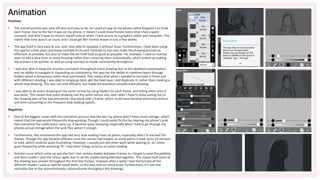
  • 28.
    Negatives • Script/Storyboard –Though the script was a strong aspect of my pre-production planning, the storyboard ended up not being very detailed and slightly rushed, despite the fact I made it clear that a good storyboard would be a vital part of my planning. This is due to the fact that my original storyboard became an animatic which then became my actual short film, leaving me with only an outline for my storyboard in planning. Furthermore, the written description isn't that detailed either, which means overall, this section of my planning wasn't the best quality. However, my script is extremely detailed as it makes up for the lack in storyboard, furthermore, this didn't impact my production at all due to the fact the majority of my production was done using frames I had already drawn, and was based mostly off of the narrative and technical script. • Technical – Though I covered multiple technical areas in terms of what I could actually include in my short film, I didn't look too in-depth into actual technique and tutorials on how to do these. Tutorials would not have only expanded on my research, but would have been very helpful during production as I struggled in filming scene 7 and hence didn't produce the best version of this scene that I could have done. If I had planned more in depth in terms of 'how-to' rather than just what I will do, I would've been able to improve my film and counter a lot of the feedback I got of the fact scene 7 is a lower quality to the rest of the short film, and not consistent. However, my crew member, Luke Headland, was very experienced in filming live action, and did end up helping a lot. This meant that not including tutorials wasn't as detrimental as it could have been, but I still not regret doing more as it could have made my project better than it was. Additionally, in technical planning, I only discussed basic equipment I may use rather than more advanced equipment. This limited my filming as I didn't plan to use any higher end equipment, such as a shoulder mount, which may have improved my short film. Furthermore, I didn't plan specifically for the equipment that I did mention, such as research in depth into the capabilities of the specific cameras I planned to use, and lay out how I can use these different attributes to my advantage while filming. • Visual – When planning for my visuals, I'd say the biggest downsides were the moodboard for scene 7, and the planning for a font. For the moodboard, as mentioned in my production journal, I believe that it didn't fully imitate what I imagined scene 7 to be like in my head, and didn't provide enough variety in visuals to be a very helpful foundation when it came to actually making the scene in production. More specifically, scene 7 was intended to be about finding a balance between feeling hopeful for a fresh start and the beginning of the healing process, while also acknowledging that healing is not linear, and a segment of the 'dark' will always remain. However, in planning and then production, I lost track of this, and ended up planning for a scene in which there was only happy tones. Though this enhanced the contrast I was also intending for, I believe I leaned on this one theme too heavily, and briefly lost that aspect of realism near the end of the film. When it comes to the font, though this planning was solid and would have been a good foundation, I ended up using a different font anyway for my actual project, making this planning irrelevant. • Audio – When it came to planning my audio, I focused mainly on where I would collect audio from rather than how I would apply it, or how I would change it in post production to make it unique and fit my film. Though I touched on this briefly when mentioning the music side of my audio planning, it would have been helpful to expand on this further, especially when it came to sound effects. In the end, I ended up not using sound effects because I decided that they would feel out of place and perhaps ruin the tone of the film. However if I had planned effects I could have used, such as the 'smooth' FX in Sony Vegas Pro 14, I would have realised that I could make different sounds match, whether collected through foley or different internet sources, and perhaps made a different decision about adding them to my short film. This could have improved the entire film, and made it even more immersive and emotive. • Character/Costume/Setting - Though my planning for character, costume and setting was mostly very successful, there were definitely a few things I could have expanded on. First of all, it perhaps would have been helpful to go more in depth with my side characters, as in the end they were included due to the fact I could animate them instead of having to use actors. If I had planned them in more detail, I could have perhaps given them more personality in my film ,and overall make the narrative more immersive and realistic for the audience. Secondly, I should have provided more than one source for where I could get clothing, as a back-up solution is always necessary just in case something goes wrong. Though I did have a dress I was able to use for scene 7, it's not what I initially had visioned and therefore didn't look as good as I had wanted, again furthering the below average quality of scene 7. • Management – Management was in general completed to a good standard, and my planning didn't cause any issues with schedules. This is mostly due to the fact I greatly reduced the amount of live- action filming actually needed, but this planning also meant scene 7 production was able to run smoothly in terms of times and schedules.
  • 29.
    23/02/2021 – Pre-Production •My inital plan for today was to get set up for pre-production, and to begin script writing. To begin with, I made a layout for my entire pre-production, making sure to include everything I'm going to need to explore, such as location, character, technical aspects, etc. I also included bullet points for each section in order to give myself a basic idea of what to include in the future. Once I'd done this, I then proceeded to begin writing my script, as well as writing my introduction on the story and themes of my video. I made sure to discuss how the plot of the story would incorporate the metaphorical themes, as well as expanding on the themes I need to incorporate throughout and how/why this will impact my short film. I believe that these aspects will be the basic foundations for my entire project, and hence they took the priority. • I think today's work went well, but believe I could have gotten more done. Though it was incredibly helpful for me to set up my entire powerpoint as I like to have a clear idea of what I'm doing before I start a project, I feel like I could have gotten the whole script finished if I had spent more time on it which then would have allowed me to start my storyboard in my free time, as I enjoy drawing and can do this while relaxing. Furthermore, I should have prioritised my script over my introduction as I already had a badic idea of themes and story from my rearch and contextual, so I believe I could have written a compelling script even before the introduction. • Today was quite challenging in terms of content, but I believe a big success was definitely the planning of my pre-production, and the laying out of all the different sections that I want to include as it gave me a good overall visual of my pre-production, and also helped me estimate how long each section would take and hence where to allocate my time to make it the most efficient. It also means I can now switch between dfferent sections instead of doing it all in chronological order to avoid it becoming tedious and repetitive. • The most challenging aspect of today's work was the script writing. I had many ideas and knew what I wanted to represent by using my contextual and research, but I struggled to actually get it into words and visualise how I wanted my story to go. This caused me to feel quite frustrated as previously I had multiple ideas, but when it came to actually writing them down my mind went blank. To combat this, I left the work for a while and took my mind off it, as I believed going back later with a fresh perspective would be helpful. In the end, this proved successful as I was able to begin writing my script to a standard I am happy with upon returning to the work and feeling freshly inspired. • In terms of expansion, I believe I should work towards putting more detail into the script, and perhaps adding more tehcnical direction in order to get a better idea of what to design and create when making my sotryboard, as I want my storyboard to follow what my short film will look like almost exactly, rather than jsut a representation. Furthermore, I should make sure to incorporate a 'back up script' for scenes which would involve other people, as COVID-19 restricitons are unpredictable and if we go back into lockdown, I don't want to be left without a plan. • Next, I will expand my script like previously mentioned. I will add technical directions in order to get started on creating my storyboard as accurate as possible. I also want to begi nworking on the technical and design aspects of my short film, such as looking at lighting and camera techniques as well as designing and analysing moodboards for each of my scenes.
  • 30.
    25/02/2021 – Pre-Production •I started by working on my script and adding more detail. In order to make it more useful and overall more impactful for production, I decided to add some technical notes for each shot, and to clearly state where the camera would be, how it would move, and what the lighting would be. I also made notes on how I'd do this, in order to make production as easy as possible. Furthermore, I added back up shots for scenes which required other people, just in case the country went into another national lockdown and the originally planned scenes wouldn't be possible. After this, I started on design planning, including looking at overall colour theory, typography and style of the video. To further expand on this, I decided to do a mood board and overview for each scene, in order to have a very clear idea of what the scene would look like and incorporate during production. I completed the mood boards for scenes 1-4, and decided to do the last 3 next week. To finish for the day, I expanded more on the storyboard, as I am currently trying to do a little bit each day in order to make the large task as time efficient as possible. • I believe this work has gone well. I got a lot done, and completed everything I set out to do as well as doing more storyboard slides. I do think that the mood boards could have been completed more efficiently in order to get them all done in this lot of work instead of splitting them up, but this isn't a big issue and they can always be completed at a later date. • I'd say the main success of the work was the script, as I now have a much clearer idea of what my overall project will look like thanks to the very specific and clear technical instructions for each shot throughout the short film. Furthermore, this provides very clear guidelines for my storyboard, which will mean that the production of the storyboard and animatic will from now on go a lot smoother. This will mean production will be a lot easier as I will have an exact reference to go off of, and the animatic will be overall more successful and accurate to how I want my final video to look. • With this work I didn't really have any difficulty. The only thing that comes to mind would be the typography as it took me some time to decide want font to use and I may still go back and change it, depending on how my video's style develops in production. However, after a while of deciding I do believe I now have at least a very good idea of the overall style of the font, and more than likely an exact font I will use for the credits and title card of the film. • In terms of expansion, I'd say I need to finish the mood boards as soon as possible in order to preserve consistency, and this is something that I will aim to do next. Furthermore, in order to improve this work I could expand more on the style of the video, as I feel like I kept it quite condensed due to the fact I have a clear idea in my head, and didn't feel the need to explain it further. This could be problematic for multiple reasons, such as if I forget certain aspects or if someone else needs a better idea of the video other than me. Hence, I will expand on this section in the future. • Next, I will finish the last 3 mood boards and begin looking at technical aspects of pre-production, such as lighting, camera and framing, as well as audio. Furthermore, I will look at expanding the design section of my pre-production, though I will prioritise technical for now as in some ways being clear in terms of technical is more important to me as a film maker, as that's what I'm less confident in.
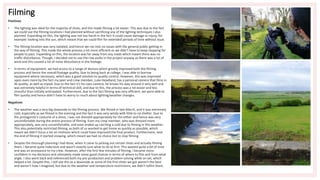
  • 31.
    02/03/2021 – Pre-Production •At this point in pre-production, I wanted to focus on the technical aspects, as well as finish the remaining mouldboards for my short film. To do this, I began by taking pictures of some of the locations I would use in order to provide context when explaining my technical approach. I then used a combination of these and some of my animatic frames in order to explain how I would use different camera angles and framing work. After this, I then decided to plan how I was going to use the available lighting to my advantage in the indoor filming locations. I started this by creating a top-view map of each room I would use, and show where each light source would be. I then pinpointed each location in my writing, and planned more specifically how the lighting would work for each individual shot. Where necessary, I went back and edited my technical script to fit the further technical planning. After planning for the technical side of my short film, I then went on to expand on the storyboards and finish them for scenes 5-7. This process was the same for the previous mood boards. Finally, I decided to add more to my introduction in terms of context in order to tie my pre-production to my contextual and research. • Overall, I believe this work went well and I managed to complete all that I set out to do. I also managed to get a lot of work done which contrasts my previous session, and makes it so I feel like I am on track to meet my deadline and to be able to start production work when initially expected. Every aspect of today's work was completed to a good quality, though I see the technical aspect as the biggest success. • Like mentioned, I believe the main success today was the technical aspect. As the technical aspects have been an on-going worry of mine due to lack of experience, this planning was vital to the outcome of the product. Due to this, I went into a lot of detail, both written and visually. This means that when it comes to production, I will have a better idea of how to make my film, and hence it will come out higher quality than previously expected. Furthermore, this level of detail meant I could add to and change my technical script in a way that ensures me it will be accurate to potential restrictions and easy to follow. it is my belief that this will make the process of filming very efficient, as I have a very clear plan in mind of not only how each scene will be filmed, but of how each individual shot will be filmed too. • Despite having done mood boards previously, I found these to be the most difficult aspect of today's work. This was due to the fact that scene 7 is very different to the previous scenes, and hence going from focusing on dark/depressing themes to brighter ones was a difficult transition. Furthermore, scene 7 is about finding a balance between hope and gritty realism, which can be difficult to express. I believe I perhaps focused too much on the more hopeful side of scene 7, and neglected the fact it's meant to link back to the darkness, and reflect that healing is not a linear process. If time allows me to, I will change this before production in order to ensure scene 7 is as accurate to how I initially planned as possible. • For expansions, I'd say that the introduction could be more varied, rather than quite targeted on a consistent theme. Though the context is incredibly important and hence why it is the focus, I believe that by expanding the introduction to also including some perhaps visual and technical aspects, I will have a better foundation for both the rest of pre-production and actual production. • Next, I would like to focus on location as well as in-depth character planning. These specifics will help outline my entire project. For example, by looking at potential locations and analysing them further, this will again help aid technical planning and make it even more clear. Additionally, character and costume design will not only help in terms of management, but it will allow my actors to become more familiar with their characters before production starts, and will lead to a better and more accurate performance.
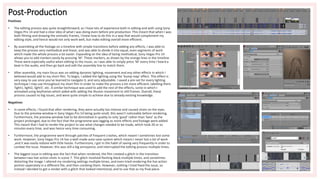
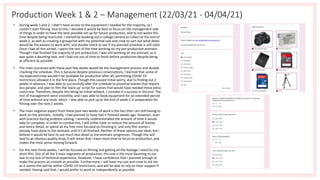
  • 32.
    04/03/2021 – Pre-Production •For today, my main focus was location, character and costume design. These three aspects of planning were very important, for the narrative, visuals and technical aspects of the film. Hence, I wanted to take my time for each segment and go into the necessary amount of detail. I decided to start with character and costume, as I believed these two would be the easiest for me, and could cause for potential script changes due to character development. To begin, I drew my protagonist using the app ibispaint x on my phone. I drew her in both a front view and side view for a full reference. Once I had done this, I then went on to develop her in writing, expanding on her appearance, costume, personality and impact on the narrative. I believe these 4 angles were the most important when creating a well thought out, rounded character that is portrayed as real. After further planning her costume, I decided to add a 3rd piece of artwork which shows how I picture her costume in scene 7 in order to have a reference to use when putting together the character's outfits during production. I repeated the same process with my antagonist. Due to my side characters having very minimal roles, I decided a simple table would be enough planning for them, especially due to the fact it was likely I may not be able to have side characters due to COVID-19. I then moved on to location. For this, I used a similar method to my previous technical planning. I took multiple pictures of the locations I planned to use, and then analysed them (such as marking out the rule of 3, recognising light sources, etc.). I also expanded on these locations in writing, and pinpointed the desirable aspects to each location, and planned how to use them to my advantage during production. Finally, just like the previous few days, I worked on more storyboard frames too. • I believe this work, in general, went well. Every aspect was completed to a quality I am happy with, especially the character planning, as well as the picture analysis for location. As my pre-production progresses, I believe it is shaping up to be very useful and will be a very efficient foundation for production. • In this work, my main success were in location and character design. For location, my analysis of images rather than just using written planning provided a lot more insight, and I believe will prove very helpful when it comes to filming in each location. This planning gives me the best possible chance of being able to use every available aspect of each location in a successful way for filming, as well as giving me confidence that the locations I have chosen are the most ideal for my project. In terms of character design, I believe the fact that I explained my character's backstories and impact on the narrative will greatly help the immersion and will make each character feel real, as well as helping the actors portray them accurately due to knowing them well. • I didn't really have difficulty with any aspect today's work, though some of the location images were hard to obtain. For example, I wanted to go out and get my own images of every outdoor location, but ended up not being able to due to the weather not being ideal for what I had imagined, and having difficulty in finding the time. However, this issue was quickly resolved by using photos that worked just as well from google maps. • In terms of expansion, I definitely could have talked more about the costume, and perhaps gone into more detail about not only how I would obtain the costume, but also potential prices and in what scenes each would be used. This means that I would've had an accurate estimation of what percentage of my budget costumes would take up, as well as an overall more detailed plan for costumes in general. • The next step for my pre-production would definitely be focusing on the management side of planning, as this is something I've mostly neglected up to this point. Furthermore, I would like to touch upon planning credits for my video, as though I am unsure of including them yet, it'd be helpful to have a plan just in case. Additionally, I need to plan my audio and editing aspects, as these are quite significant.
  • 33.
    09/03/2021 – Pre-Production •Today, I decided to focus on the management side of pre-production, as well as expanding on the technical planning. First, I began by planning facilities and personnel that I will use throughout production, focusing on equipment, props, costume, crew and finance. For each of these, I set it out in a clear and concise table, and listed every piece of information I need to know for production, such as the availability of my cast/crew, prices for costume/props/equipment, etc. And made sure to make it easy to reference back to during production. Once I had completed these, I moved onto further management planning, such as creating a schedule, looking into potential safety hazards and discussing storage for production. I did these in a similar way to the previous points by putting them in clear and organised tables. After management, I moved back to technical, and decided to expand upon it. I added a section for audio, focusing on both the music choices and potential sound effects, listing specifically which ones I would use for both, and even providing links to download them for production. I also planned my editing process in a table, listing potential effects and transitions I may be able to use, and how I would apply them. I decided to also add a section for planning the credits, as I was still unsure on whether to include them and believed that it was best to plan for them just in case. Finally, I went over my entire pre- production and made sure to spellcheck everything and correct any points if needed. • In general, I'd say that this work went well. I achieved everything I set out to do in a clear and efficient manner, and was even able to add more, e.g. the credits section. Furthermore, I was able to get my entire pre- production wrapped up, and was able to check that it was of a good quality and a good foundation for production. • Today's main success would definitely be the management section of planning. I including everything that is significant to the project, and feel confident that this section will allow production to run smoothly without any interference. Furthermore, this gives me an outline to how production will go in terms of a timeline, and I now have a clear idea of how much time I will have for certain sections. For example, I believe I will have plenty of time in post-production, meaning I'll get the chance to do multiple revisions, if necessary, without having to worry about time. Furthermore, the layout of this section of pre-production is overall extremely clear to read and understand, which means it will be easy to look back to and reference quickly during production. • At first, the editing section of today's work was quite difficult to do as I was doing this work at college and away from my editing programme. This meant I couldn't see what effects were available to use, and had to use my memory to try and think about what I have available, and what would be good to apply to my short film. However, this was quickly resolved when I was able to work from home, and no longer an issue. • For exapnsion, I believe I should have gone more in-depth with my credits planning. This is due to the fact I didn't talk much about what sourced footage/behind the scenes footage I would use, and instead only focused on the fact I would use them rather thatn going into specifics. This may cause some issues if I do decide to add credits to my prject, as I will have no plan on what to actually include for some of the visuals, and will either have to leave them out which isn't ideal, or think of something during production which reduces efficiency. • The next step is to begin production. I will do this by first collecting everything together, such as cast, crew, props and equipment. This is why it was important I got the management aspect completed today.
  • 34.
  • 35.
    Animation Positives • The overallprocess was very effcient and easy to do, as I used an app on my phone called ibispaint x to draw each frame. Due to the fact it was on my phone, it meant I could draw frames every time I had a spare moment, and didn’t have to restrict myself only to when I have access to a graphics tablet and computer. This meant that time wasn’t an issue, and I could get 80+ frames drawn in just a few weeks. • The app itself is very easy to use, and I was able to navigate it without issue. Furthermore, I have been using this app for a few years and know multiple tircks and methods to not only make the drawing process as effiecient as possible, but also to make the art itself look as good as possible. For example, I used an overlay layer to add a blue tone to every drawing rather than colouring them indiviudually, which ended up making the process a lot quicker, as well as using overlays to shade consistently throughout • I was also able to keep the brushes consistent throughout every drawing due to the detailed customisation, and my ability to navigate it. Expanding on consistency, the app has the ability to combine layers through folders which is temproary rather than permenant. This means that when I needed to recreate a frame just with different shading, I was able to simply go back, get the lines layer, and duplicate it, rather than creating a whole new drawing. This was not only efficient, but made the transition visually more pleasing. • I was able to do every drawing on the same canvas by using folders for each frame, and hiding them once it was done. This meant that every drawing had the same canvas size, and I didn’t have to keep exiting out of the drawing part of the app everytime I was done with a frame, which could have become extremely tedious and time consuming to the frequent slow loading speeds. Negatives • One of the biggest issues with the animation process was the fact my phone didn’t have much sotrage, which meant that the app would frequently stop working. Though I could easily fix this by clearing my phone’s junk files everytime the notification came up, it became quite annoying, especially when I had to go through my phones actual storage when the junk files weren’t enough. • Furthermore, like mentioned the app had very slow loading times at poitns, especially after I’d reached 50+ frames. Though the app became efficient once the canvas had loaded, at some points it took up to 10 minutes to load, which could be quite frustrating. However, I usually just did other work while waiting or, as I drew quite frequently while watching TV, I had other things to focus on while loading. • Another issue which came up was the fact I lost certain shades between frames as I forgot to save the pallette, and then couldn’t pick the colour again due to all the shades being blended together. This meant that some of the shading was uneven throughout the first few frames, however after a while I had memorised all the different shades I used as well as saved them, so this was only an initial issue. Furthermore, it’s not that noticable due to the monochromatic colourscheme throughout the drawings.
  • 36.
    Filming Positives • The lightingwas ideal for the majority of shots, and this made filming a lot easier. This was due to the fact we could use the filming locations I had planned without sacrificing any of the lighting techniques I also planned. Expanding on this, the lighting was not too harsh in the fact it could cause damage or injury, for example: looking into the sun, which meant that we could film for extended periods of time without issue. • The filming location was very isolated, and hence we ran into no issues with the general public getting in the way of filming. This made the whole process a lot more efficient as we didn't have to keep stopping for people to pass. Expanding on this, the location was far away from any roads which meant there was no traffic disturbance. Though, I decided not to use the raw audio in the project anyway as there was a lot of wind and this caused a lot of noise disturbance in the footage. • In terms of equipment, we had access to a range of devices which greatly improved both the filming process and hence the overall footage quality. Due to being back at college, I was able to borrow equipment where necessary, which was a good solution to quality control. However, this was improved upon even more by the fact my peer and crew member, Luke Headland, has a personal camera that films in 4k quality, as well as tripod. Due to the fact it's his own camera, he knows his way around it very well and was extremely helpful in terms of technical skill, and due to this, the process was a lot easier and less stressful than initially anticipated. Furthermore, due to the fact filming was very efficient, we were able to film quickly and hence didn't have to worry to much about lighting/weather changes. Negatives • The weather was a very big downside to the filming process. We filmed in late March, and it was extremely cold, especially as we filmed in the evening and the fact it was very windy with little to no shelter. Due to the protagonist's costume of a dress, I was not dressed appropriately for the either and hence was very uncomfortable during the entire process of filming. Even my crew member, who was dressed more appropriately, was very uncomfortable, and even ended up catching a cold due to filming in this weather. This also potentially restricted filming, as both of us wanted to get home as quickly as possible, which meant we didn't focus a lot on reshoots which could have improved the final product. Furthermore, near the end of filming it started snowing, which meant we had no choice but to stop filming. • Despite the thorough planning I had done, when it came to picking out certain shots and actually filming them, I became quite indecisive and wasn't exactly sure what to do at first. This wasted quite a bit of time and was an annoyance to my crew. However, after the first few minutes of filming, I became more confident in my decisions and ultimately made some good choices in terms of where to film and from what angle. I also went back and referenced both my pre-production and problem solving while on set, which helped a lot. Despite this, I still see this as a downside as some of the first shots we got weren't the best and weren't how I imagined, but due to the weather and temperature restrictions, we didn't refilm them.
  • 37.
    Post-Production Positives • The editingprocess was quite straightforward, as I have lots of experience both in editing and with using Sony Vegas Pro 14 and had a clear idea of what I was doing even before pre-production. This meant that when I was both filming and drawing the animatic frames, I knew how to do this in a way that would complement my editing style, and hence would not only work well, but make editing overall more efficient. • By assembling all the footage on a timeline with simple transitions before adding any effects, I was able to keep the process very methodical and linear, and was able to divide it into equal, even segments of work which made the whole process a lot easier. Expanding on the idea of being methodical, Sony Vegas Pro 14 allows you to add markers easily by pressing 'M'. These markers, as shown by the orange lines in the timeline. These were especially useful when editing to the music, as I was able to simply press 'M' every time I heard a beat in the audio, and then go back and edit the assembly line to match them. • After assembly, my main focus was on adding dynamic lighting, movement and any other effects in which I believed would add to my short film. To begin, I added the lighting using the 'bump map' effect. This effect is very easy to use once you've learned to navigate it, and very adjustable. I saved a pre-set for every lighting technique I may use throughout my short film in order to make the process a lot more efficient, labelling them 'light1, light2, light3', etc. A similar technique was used to add the rest of the effects, some in which I animated using keyframes which aided with adding the illusion movement to still frames. Overall, these process caused no big issues, and were quite simple to achieve due to already existing knowledge. Negatives • In some effects, I found that after rendering, they were actually too intense and caused strain on the eyes. Due to the preview window in Sony Vegas Pro 14 being quite small, this wasn't noticeable before rendering. Furthermore, the preview window had to be diminished in quality to only 'good' rather than 'best' as the project prolonged, due to the fact that the programme was lagging as more effects and footage were added. This meant that I had to render the project to see what changes needed to be made, which took 20 or so minutes every time, and was hence very time consuming. • Furthermore, the programme went through patches of frequent crashes, which meant I sometimes lost some work. However, Sony Vegas Pro 14 has a well-made auto-save system which means I never lost a lot of work ,and it was easily redone with little hassle. Furthermore, I got in the habit of saving very frequently in order to combat the issue. However, this was still a big annoyance, and interrupted the editing process multiple times. • The biggest issue in editing was the fact that when rendered, the film created a glitch in the transition between two live-action shots in scene 7. This glitch involved flashing black multiple times, and sometimes distorting the image. I altered my rendering settings multiple times, and even tried rendering the live action portion seperately in a different file, and then combing them. However, nothing I tried fixed the issue, so instead I decided to get a render with a glitch that looked intentional, and to use that as my final piece.
  • 38.
    Production Week 1& 2 – Management (22/03/21 - 04/04/21) • During week 1 and 2, I didn't have access to the equipment I needed for the majority, so I couldn't start filming. Due to this, I decided it would be best to focus on the management side of things in order to have the best possible set up for future production, and to not waste this time despite being restricted. I started by booking out a college camera to collect at the end of week 2, as well as creating a groupchat with my potential cast and crew to sort out what dates would be the easiest to work with, and double check to see if my planned schedule is still valid. Once I had all this sorted, I spent the rest of the time working on my pre-production animatic. Though I had finished the majority of pre-production, I was still working on my animatic as it was quite a daunting task, and I had run out of time to finish before production despite being as efficient as possible. • The main successes with these past few weeks would be the management process and double checking the schedule. This is because despite previous conversations, I learned that some of my expected crew wouldn't be available for production after all, permitting COVID-19 restrictions allowed it in the first place. Though this caused initial worry, due to finding out 2 weeks in advance, I was able to successfully alter the schedule to prioritise scenes that require less people, and plan to film the 'back-up' script for scenes that would have needed those extra cast/crew. Therefore, despite this being an initial setback, I consider it a success in the end. The rest of management went smoothly, and I was able to book equipment for an extended period of time without any issue, which I was able to pick up at the end of week 2 in preparation for filming over the next 2 weeks. • The main negative aspect from these past two weeks of work is the fact that I am still having to work on the animatic. Initially, I had planned to have had it finished weeks ago. However, even with practice during problem solving, I severely underestimated the amount of time it would take to complete. In order to combat this, I will either have to reduce the amount of frames and hence detail, or spend all my free time focused on finishing it, and only film scenes I already have done in the animatic until it's all finished. Neither of these options are ideal, but I believe it would be best to use much less detail as the animatic progresses. Though this will lead to an obvious quality drop, it will mean that I have more time to focus on production, and makes the most sense moving forward. • For the next three weeks, I will be focused on filming and getting all the footage I need for my short film. Out of all the 3 main segments of production, this one is the most daunting to me due to my lack of technical experience. However, I have confidence that I planned enough to make this process as smooth as possible. Furthermore, I will have my cast and crew to aid me as it seems this will be within COVID-19 restrictions, and will be able to rely on their support if needed. Having said that, I would prefer to work as independently as possible.
  • 39.
    Production Week 3– Filming (19/04/21 - 25/04/21) • Week 2 was dedicated to filming. The main goal for this week was to film scene 2, scene 4, scene 5, and scene 7. These are the scenes that required the antagonist, hence why I wanted to film them all together in order to make the process as efficient as possible. To do this, I planned to have cast/crew member Luke Headland stay overnight, meaning we can film scene 7 at sunset and the rest during the night. This was important, as the darkness will help set the tone of the film. This had been previously planned, and filming went ahead on schedule. We filmed scene 7 near All Saints Church in Sherburn just before 7 o'clock, which we had found out was the best time for sunset shots at this time of year. We got a variety of different shots, combing both wide, close and detail shots as planned, and headed home around 7:30pm in order to avoid the cold weather and being out in the dark. Once home, Luke felt sick due to the intense cold outside, and we decided to post-pone filming the rest of the scenes to another night because of this. Though this was an unfortunate incident and risked jeopardising the schedule, it was the best decision in order to follow safety guidelines. • Despite the mentioned issues, I believe the filming of scene 7 itself was quite successful. Like stated, we managed to get a variety of different shots in 3 different locations, which I am confident I will be able to make work with the rest of the footage during post-production. Furthermore, despite the cold weather, there were no other interruptions during filming, which meant we could film consistently and in the same lighting. This means we will not have to go back at a later date, and we won't require any reshoots. On the topic of lighting, by looking at the sunset time in advance, we were able to time our filming perfectly and got exceptionally good lighting for the majority of the shots, and I was able to achieve the 'soft glow' effect I had mentioned in planning naturally without the need of post-production alterations, which will look better overall. • Unfortunately, despite the successes, there were a lot of aspects of this week's filming that went wrong. Like mentioned, my cast/crew member Luke Headland unfortunately fell ill after filming in the cold. Even for March, the weather was exceptionally harsh, even snowing one the way home from filming. Due to this, we decided to postpone further filming as he didn't feel up for it, and we didn't want to risk worsening his condition. Though this was the best and safest decision, it meant my schedule was pushed back, and I would have to rush to make up lost time. This means that some of the future filming may not be the quality that it had the potential to be, though with some re-arranging, I am hoping to fit together the new production schedule in a way that works for everyone, and is still efficient. • Over the next few weeks, I will continue filming. First, I hope to get scenes 1 and 3 filmed, as I can do these two on my own without assistance. By getting these two done, I am hoping that production can be put roughly back on schedule, and I will no longer be behind.
  • 40.
    Production Week 4+ 5 – Animation + Post-Production (26/04/21 - 09/05/21) • Week 4 was a pivotal moment for my entire project. At this point, I was close to finishing my animatic, but came to the realisation that the level of detail I had put in so far was high enough quality to work as my final short film rather than just a plan. Furthermore, I realised this worked really well from a metaphorical standpoint, as the rough art style would symbolise her depression when 'locked away' inside, and switching the previously filmed live action for scene 7 would enhance the idea of her 'breaking free'. Additionally, I came to the conclusion that the animation would be much higher quality than live footage, as I have a lot more experience and hence skill with art and animation rather than filming. After making this decision, I focused all my effort, in week 4, into finishing the animation frames, and adding more to previous sections in order to improve the quality even further. I ended up with 80+ frames, some in which included animations rather than just frames for an animatic. Finally, in week 5 I moved onto post-production and editing. First, I assembled all the footage and frames to match the audio. I added simple transitions, and then began working through the timeline and added effects throughout. I did this in order to add more depth to the frames, and make the overall film more visually interesting and dynamic. I also colour corrected some of the live footage, and attempted to add a smooth transition between film and animation. Once complete, I rendered the video at 1080p and 60 frames per second (to cater for the 4k, high quality footage). • The biggest success from these few weeks was deciding to switch from majority live action to majority animation. This decision solved the issues of scheduling from the previous week, as it meant I had a lot more done due to the fact I had been working on my animatic for a while. It also meant I could focus all my time onto getting the animation done without having to worry about schedules with my cast and crew, and could work whenever I wanted to. It made the whole process a lot less stressful, and was overall a lot easier and more efficient than filming live action. Due to this, it left the final product higher quality than I had expected, and made it so I was overall happier with my short film than I would've been if it was live action. In terms of post-production, the majority of the process ran pretty smoothly, and I was very confident in my skill when editing. I believe my use of 'bump map' to create dynamic lighting was the strongest point during editing, and also the most efficient. Once I had saved my pre-sets for each lighting technique, it was very quick and easy to apply to each frame. It not only looked very visually pleasing, but was a simple task which helped a lot with timing. • The only outstanding negative in this entire process came down to rendering the video. When rendering, the live footage in scene 7 kept glitching during one of the transitions. The screen would flicker black, and occasionally the image would become distorted. To combat this, I attempted to change the render settings, even following a tutorial online. However, this didn't work, so I tried to render the live footage separately and then combine this with the animatic. Despite all this, the glitch still occurred. Due to running out of options, I decided to just render the video multiple times, and chose the version with the 'least amount of glitch'. Though this wasn't ideal, I was running out of time and couldn't think of any other options. In the end, it isn't too noticeable and could even be seen as intentional from an audience's standpoint. • As of now, my final project is complete. The next step would be to present my project to my target audience, and getting feedback. Furthermore, I need to evaluate the project myself, and discuss both the positives and negatives.
  • 41.
  • 42.
    Peer Feedback • Peer1 (Ben Dingwall, 17M) - Ben said that he thought this film was very powerful. He stated that he doesn't really understand a lot of what women go through, and he admitted that he personally didn't pay much attention to previously, but it's something that he can see now is a big issue. As stated, 'your film is clearly very emotional, and you get the sense it's meant to mean something deeper'. He also spoke about how he believes the song was a good choice, and definitely helped emphasise a sense of loneliness for the main character, and is 'kind of ominous'. In terms of improvements, he mentioned how some of the transitions between animations can be slightly jarring, and the zooms don't always match up which makes some aspects 'weird to watch'. Furthermore, he thinks some of the effects are a bit too much, 'like in some scenes they work really well like when they fight, but in others it's too much and hurts my eyes'. I agree with these remarks, and would like to go back and edit both the 'zooms' and the effects to be more smooth/less intense. • Peer 2 (Lucy Worthington, 18F) - Lucy Worthington participated in the Target Audience Interview for my audience research, so I believed it was important to get her feedback for the final product. She begun by stating that she 'got quite emotional', and further explained that it made her 'feel heard, as if the story was (her) own'. This was an important piece of feedback to me, as this impact is something I I had initially set out to do. She then went onto state that she loved the theme of the film, as well as mentioning that she 'adored the art style', and felt it complemented the overall tone very well. She then went on to mention how though she does believe that the animation is very well made, she thinks I still should have worked to improve the live action section of my short film, and prioritised that slightly more. I agree completely, as the live action is the part of my short film that I am the least proud of. She also agreed with what Ben had stated, and believes that the effects are slightly too intense in some places too. • Peer 3 (Tamasin Allen-Warren, 37F) - Despite my main target audience being teenagers/young adults, decided it would be good to get feedback from someone slightly older, in order to have a good range and see the audience impacts across different generations. Similar to the other peers, Tamasin stated that the short film was 'incredibly moving, and honestly really sad', further stating, 'but that's the harsh reality of it'. These piece of feedback stood out to me, as one of my main goals with this project is to keep an accurate sense of realism while telling a story that is emotive, and I'm glad to have achieved this from my audience's perspective. Tamasin, however, disagreed with my previous feedback of the animation being slightly jarring. She believed that 'it all ran really smoothly', and felt like the animation and movement was the strongest part of the film. Despite this, she did agree with the fact the live action is definitely the weakest part of the short film, and looks out of place compared to the animation, which I, again, agree with. • Peer 4 (Kai Marshall, 16NB) - Like Lucy Worthington, Kai Marshall also participated in my initial Target Audience Interviews, and hence I also believed their feedback to be very important. Kai emphasised greatly on the fact they 'loved the art style' and felt it worked really well at creating a sense of loneliness and isolation. They believed this had a big impact on how emotive the piece felt to them, and got quite 'eerie and desolate vibes' from it, 'as if something is just... off'. They also credited the music choice to this feeling, believe the tone of the song emphasised the ominous tone of the animation. Similarly to my previous feedback participants, he disliked the live action section of the short film and felt like it 'ruined the ambience' and made the overall experience less immersive. This is something that I would like to change, as immersion and realism are both incredibly important aspects of my short film. To do this, they suggest perhaps colour correcting the footage to look more consistent with the animation, which is something I agree with and will take into account if revised. • Peer 5 (Anonymous, 26F) - My last feedback participant wanted to remain anonymous, only wishing to disclose that they are female, and 26 years old. She started by expressing her admiration for the topic choice, as she believed 'it's not talked about enough, in ways that aren't romanticised anyway'. Like previously mentioned, realism was a very important aspect of this film to me and something I wanted to accomplish, so this feedback is very important to me. She then went on to state how she related to the narrative in the video, so it meant a lot to her personally. Though it was sad to hear she related, it was helpful to know that someone who experienced something similar to me likes the film, and doesn't find it distasteful and/or triggering. She then went on to state how she thinks 'it all ties together really nicely, like the music worked well, but I do think the animation could have been more detailed, like more frames'. Though I see her point, I personally disagree, as the animation was carefully paced in order to fit the tone, and adding more frames could have jeopardised this.
  • 43.
    Animation • I believethat animation is the strongest part of my film, especially in the later scenes. As it was half way through animating that it switched from just planning to my actual project, it meant naturally that the later frames were overall higher quality and kept more focus, as there weren’t as many frames for the opening scenes, hence longer frames that could be scene as boring, though accurate in terms of pace. However, I did even out this potential imbalance in editing. • The style of the animation is quite simple, but very effective for the genre and tone of film that I was going for. The art style is quite bleak, and gives the film a lonely atmosphere. Furthermore, the ‘messy’ style gives the art personality, and was used to represent my protagonist’s headspace by using clean lines during ‘happier’ scenes and messier lines when coming back to the dark. This portrayed a clear divide to my audience without just using colour in a metaphorical sense. The simple shading also meant that this style was a good balance of visually pleasing and time efficient, as each frame was drawn well and represented what I wanted it to while also being able to be drawn quickly due to the simplicity and messiness of the lines. However, the style and drawings do have some downsides. For example my character design was quite as consistent as originally desired. Though my protagonist’s long hair makes it obvious they are the same person throughout, their head shape changes a lot, as well as their facial features. Due to my art style being quite simplistic it’s not too noticeable, but definitely something that I should have paid more attention to when editing and made sure to keep consistent. Furthermore, some of the anatomy and poses look slightly off in certain scenes due to my lack of experience with full body art, as I tend to focus more on detail drawings, such as portraits and eyes. Due to the style choice of being messy however, this isn’t as big of an issue as if I had gone for realism, which despite being a negative, further proves that my chosen style was the right choice in hindsight. • After deciding to make my animatic into my final short film, animating movement in a more fluid and interesting way became a priority, as I wanted my short film to run smoothly and look similar to how I pictured scenes in live action. Though I already planned to improve movement/effects in general in post-production, I decided it would look best to also include some drawn movement. Though these movements ended up working well in my film, it could have been better to expand on them slightly, such as by adding steam or making the water move when the shower is turned on rather than just adding an extra layer with dashed lines to simulate the water. This would be something I would add if remaking this short film, as though it’s a small detail, it would add a lot to the immersion aspect of my film. An example of drawn movement I believe I did do successfully, however, was the closing eye. I didn’t want to make the movement too detailed and animated as it would look out of place in the animatic style of the rest of my short film, but I wanted to portray the eye closing in a smooth way. To balance both of these expectations, I decided on doing 4 frames. I believe this was the best decision, as this animation ended up being one of my favourite moments in the final film. The movements flow well while staying consistent with the animatic style, and the drawings themselves are detailed and visually pleasing, while also fitting together in a way that accurately simulates a real eye closing. Another style of movement I included was by using multiple layers to make up one drawing in the short film. This meant that I could show the mirror in scene 6 getting bigger while my protagonist stands still, which reflects the fact her ‘old self’ in the mirror is becoming more predominant once again, and shifts the viewers focus while also looking visually interesting. Initially, this was difficult to figure out as I wasn’t sure how to add the overlay colour on both layers without the colour becoming too intense. However, I was able to figure out that if I added the colour to the top transparent layer, it still worked as an overlay even after exportation. Though the colour wasn’t perfect, it worked as I intended and looked good overall.
  • 44.
    Live Action • Overall,the visuals for the live action aspect of my short film were exactly what I had envisioned during pre-production. The footage itself uses lighting and composition to create a pretty, ethereal aesthetic, using both light, location and imagery to create a beautiful scene which heavily contrasts the isolated, dark feel of the animation after editing. Furthermore, the scenes themselves look to be very powerful, especially the clip of the protagonist standing on a wall and watching over the horizon. ‘She’ standing in the foreground with a wide open space in front of her gives a feeling of freedom and strength, as this symbolism is commonly used in scenes which represent power, as it’s someone watching over a piece of land as if it’s their own. Due to the heavy contrast of this compared to the claustrophobic and off-putting feel of the animated scenes, it creates an emotive effect of happiness and relief from seeing the protagonist ‘free’. However, in some ways I do believe that this transition could perhaps feel a little rushed, and in hindsight I would have combined both animation and live action at the end in order to create a still contrasted but more fluid transition. • The lighting in the first 2 live action shots are the desired effect I had in mind while creating the story and planning. The protagonist has a soft glow on her due to the sun, which gives the atmosphere a warm glow, despite the fact it was actually very cold that day. This lighting ends up working well with my desired symbolism, as initially she is running towards the light and then in the next shot, she’s surrounded by it, as if she’s become the light. Furthermore, through filming I got a natural lense flare, which adds a further ‘ethereal’ aesthetic to the footage. However, a flaw with this is that it doesn't’t remain consistent throughout, as in the final few scenes the sky is quite grey and the ‘glow’ is greatly diminished. This as due to the location not aligning with the sun’s position in the sky, and having to make the choice between desired lighting or atmosphere through location. Due to already having the previous lighting, I made the decision to use this location despite the weather, which in hindsight was the best decision. Another negative in terms of lighting was the fact that shot 1 is quite dark in comparison to the others, and as raw footage was quite difficult to see. However, with post-production, I was able to brighten up the scene to a level that still emphasises the light’s glow, but makes it easier to see what’s happening for my audience, as well as looking more consistent with the rest of the footage. • Though the camerawork ended up working decently for the short film, there are quite a few things I would consider negatives, and would improve on in hindsight. First of all, the first short had quite a few issues with camerawork. The shot itself is quite shaky due to using handheld filing instead of a tripod. This makes the footage seem quite ‘amateur’ and doesn’t match the level of cinematography form the animation, and hence makes the animation to live action transition slightly unfitting. Furthermore, The footage was filmed on a tilt which ended up not working with the rest of my film, and again made the transition more jarring and overall looked unnatural. However, I was able to fix this in post production by cropping the video and tilting it. Though this compromised some of the quality, due to the footage being shot in 4k, the video quality was still sufficient. Another issue I had to fix in post-production was the fact that in both shot 2 and 3, my protagonist wasn’t centred. This was an easy fix, and again I was able to keep the video relatively high quality. An aspect of the camerawork which I believe was completed well was the composition and framing. Like mentioned before, by including my protagonist in the foreground looking over a wide background, I created an interesting and meaningful scene for my audience. Furthermore, the combination of wide and close shots work well in creating an immersive experience for my audience, as well as looking visually compelling. By combining this with the rule of 3, the footage overall looks sophisticated and pleasing for the viewer, and hence achieves one of my main goals of making a film that looks professional and cinematic, especially in scene 7 due to the emotion behind the scene.
  • 45.
    Editing • Editing inpost production made a big difference to my animatic. The most obvious example of this is lighting, and how I was able to make the scenes more dynamic and realistic by using the effect ‘bump map’ on Sony Vegas. This technique made it so I could have a very obvious light source in every scene, which not only added more realism to the animatic, but made the visuals overall more pleasing and immersive for the audience. Furthermore, this effect successfully emphasises certain aspects of the frame that I want my audience to focus on, such as the phone in the frame from scene 2 when my protagonist falls. In hindsight, this effect had no negatives throughout my short film, and improved the quality of the animation by a lot. • More commonly used effects throughout the short film are the use of blurs (through gaussian blue or defocus) and adding noise. The defocus effect was used mostly during transition scenes, which overall worked well and created a good variety in transitions throughout. The gaussian blur effect was used to create a sense of distortion throughout some scenes involving the antagonist, and worked really well at making the protagonist seem weak and confused. However in some cases, I believe the blur effect was too intense and could even cause motion sickness for some audiences when combined with a shaking movement like it is in some scenes. This effect should be minimised slightly, to a point where it keeps it’s ‘disorientating’ effect, but isn’t too uncomfortable for audiences to watch, especially as it’s used more than once. I feel the same way with the noise effect, though it works well in multiple areas, in some I feel like it seems ‘overused’ and a bit too overwhelming, and again could be too harsh on the eyes. Despite this, the effect of adding noise really adds to the film overall, and increases the feeling of loneliness and corruption. • One aspect of the short film that I hadn’t thought about until editing, was combing frames in an overlay, both creating a flicker effect and/or transition. In terms of a flicker effect, this really helps in splitting up a long frame and keeping the audience invested, as well as providing more context and adding to the overall story of ‘losing yourself’ and finding them again. However, in some cases these quick flashes were hard on the eyes and could make someone lose immersion. To combat this, I simply reduced the opacity of some overlaid frames and it ended up blending them really well. In terms of transition, I used this during the scene in which the antagonist appears behind the protagonist. This caused a ‘glitch’ effect, which really added to the atmosphere and created a sense of corruption, which hence immediately set up the hooded character as the villain. This effect not only worked well in terms of transition, but added to the story in a visually pleasing way, and hence was one of the most successful effects implemented during editing. • Another key aspect of editing/post-production was creating movement within the frames. This not only makes the film more visually compelling, but further aids the story by helping to create atmosphere and narrative progression. Almost every frame had some sort of movement, whether that was a simple zoom or a more complex screen shake. This meant the entire film ran smoothly and the frames connected to each other with fluidity, hence making the visual experience overall pleasing. However, one thing that could be improved was the quality of the screen shakes. In some frames, they seem slightly ‘off’ and not as consistent as they should be. Though this is a small detail, it could potentially throw off an audience. • The short film was edited well to the music. Each frame lined up with a change in beat and/or lyric, and hence made the song flow with the animation. This means that the audience are guided along the story both with visuals and audio aid that work well together and are immersive. The song choice itself worked well with editing and animation style, due to the slow pace and eerie melody and lyrics. • Finally, a big issue with editing was the fact the final scene has a glitch when rendering, where two clips flicker together. No matter how much I changed around the rendering settings, even rendering in a different save file and then combined them, the glitch still occurred. In the end, I decided to just leave the glitch in. Though it's not intentional, it doesn't look too out of place and most likely wouldn't cause much of a difference to fresh eyes.
  • 46.
  • 47.
    Final Thoughts • Whenstarting this project, I set out to make a short film which narrates a woman’s story of abuse, and brings light to situations that are either not expressed at all in common media, or not portrayed in an accurate manner. In order to accomplish this level of realism, I decided to base my short film off my own story, and use that as a foundation to create a narrative which can be inclusive and provide solidarity to all women. When watching my short film with this in mind, I believe I accomplished this goal. I stayed focused on my original intent and didn’t stray away through planning and production and ended up with a film which I am proud of. My film tells my story to an accurate degree and narrates a compelling and powerful story of harassment and abuse without being overly explicit, while also maintaining a high level of quality in terms of technical aspects rather than just creativity. • In terms of specifics, I have a few scenes/frames in which I feel are the most eye catching and compelling. To start, the shot in scene 2 with my protagonist on the floor does a really good job at creating a sense of disorientation, and introduces the feeling of loneliness and loss that my antagonist causes. Furthermore, the sequence in scene 3 where my protagonist is in the shower flows really well visually, and works well with the music in a way which creates a very emotive part of the film, and really drives home the feeling of my protagonist’s loss of self, and reaching out for who she used to be before the abuse. Another specific segment that I believe worked really well was the animation of a closing eye in scene 6. The animation itself is very visually pleasing while also staying consistent with the animatic’s style, and also does a good job at portraying the protagonist's descent back into sadness, and furthers the symbolism in the film. Overall, I believe the tone of the film is exactly what I had imagined. Throughout scenes 1-6, the atmosphere is very eerie and even before the antagonist is properly introduced, ‘something feels off’, as a peer phrased. This is a huge positive, as this means I managed to convey the feeling of isolation and fear that this situation caused me through my art and managed to translate it in a way that others can understand. This is something I was unsure of being able to accomplish initially as it seemed very daunting, but I have proved that not only is it possible, it can be done to a high quality and in a way that feels real and accurate, like how I wanted. • The main part of my short film that I’m not as happy with is the live action segment. I knew going into this project that the technical aspect of filming wasn’t my strong point, and though I believe I did create scene 7 to a decent quality and higher than initially expected, there are still a lot of things I would improve on as mentioned previously. I believe this could have been better if perhaps I spent more time filming, as scene 7 was filmed in just one evening which led to no time for reshoots. Though this was done to keep the setting and lighting consistent, if I had planned to film at the same times on days with similar weather, I potentially could have kept the consistency whilst getting better footage. This weaker aspect of my short film is why in hindsight, I believe switching to majority animation was the best decision I made for my FMP. By using animation, I wasn’t restricted like I would be filming, and I had a lot more experience with artwork and animatics than I did with filming. The only downside could have potentially been animating taking too long, however as I started on the animatic during pre-production for planning purposes, it meant that I was already half way there by the time production started, and I ended up having plenty of time. • In conclusion, I am very happy with how my project came out as it not only fulfilled all the initial topical goals I set myself as well as complying to the genre, it also looks visually compelling and came out mostly high quality technical wise. I believe the animations ideally fits together with each other, as well as following the music well and creating an environment that feels desolate and lonely, which is what I intended. Furthermore, the story provides lots of symbolism in a metaphorical sense, while also narrating a story in which is specific enough to understand, but varied enough that a range of audiences can relate to it. Though scene 7 could have been improved and isn’t the strongest portrayal of my work, overall I am happy with my short film.