Click anywhere to continue.
Now you know a little more about how to
find sources, both from the library catalog
and the GALILEO databases.
The next step is to be sure that the
sources you find are appropriate for the
kind of research you’re trying to do.
Why do you need the
information?
Why do you need the
information?

Is it for…
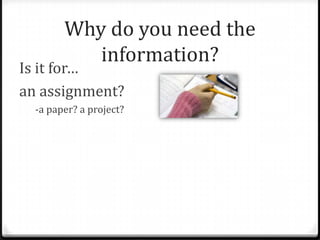
an assignment?
-a paper? a project?
Why do you need the
information?

Is it for…
an assignment?
-a paper? a project?

a project outside of class?
-career help? a personal research project?
Why do you need the
information?

Is it for …
an assignment?
-a paper? a project?

a project outside of class?
-career help? a personal research project?

personal entertainment?
-a recipe, the latest Hollywood gossip, your favorite
meme?
Regardless of the purpose for researching
the information, it’s important to make
sure that the information is reliable and
trustworthy.
To get an idea of the appropriateness and
credibility of a source, ask yourself these
questions:
Who?
Who?
What?
Who?
What?
When?
Who?
What?
When?
Where?
Who?
What?
When?
Where?
Why?
Let’s look at an example …
Surge needs to write a paper for English class
about effective student study skills.
He has already searched the library catalog
and the GALILEO databases and is now
looking for some sources on the Internet. He
found an Internet source he might want to
use, but first he wants to evaluate it.
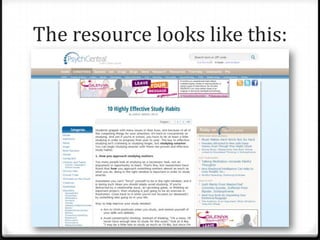
The resource looks like this:
First, Surge needs to know …
Who?
Who wrote or presented this
information?
Does the person have the qualifications to
be presenting this information?
Is he or she trustworthy?
Clues

0Check for authority of the author by

asking:
Clues

0Check for authority of the author by

asking:

0Does the writer have a degree in the

subject? What are his or her affiliations
(where does the author work)?
Clues

0Check for authority of the author by

asking:

0Does the writer have a degree in the

subject? What are his or her affiliations
(where does the author work)?
0What do others in the field think about
this person?
Clues

0Check for authority of the author by

asking:

0Does the writer have a degree in the

subject? What are his or her affiliations
(where does the author work)?
0What do others in the field think about
this person?
0What else has this person written about
the topic? Is he or she an expert?
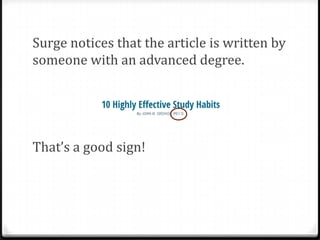
Surge notices that the article is written by
someone with an advanced degree.

That’s a good sign!
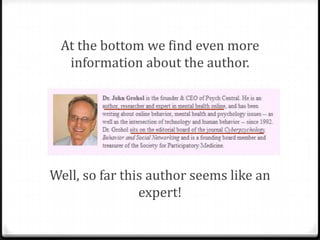
At the bottom we find even more
information about the author.

Well, so far this author seems like an
expert!
Next, Surge needs to know …
What?
What is the content in the source?
Is it relevant to his topic of study?
Clues
0Check for relevance in:
Clues
0Check for relevance in:
0 The title
Clues
0Check for relevance in:
0 The title
0 An abstract if there is one
Clues
0Check for relevance in:
0 The title
0 An abstract if there is one
0 Subject headings or table of contents if they
are present
Clues
0Check for relevance in:
0 The title
0 An abstract if there is one
0 Subject headings or table of contents if they
are present
0 A scan of the article
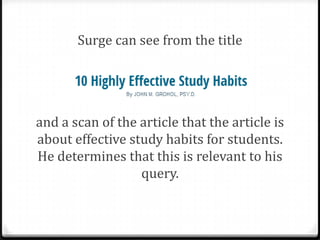
Surge can see from the title

and a scan of the article that the article is
about effective study habits for students.
He determines that this is relevant to his
query.
Next, Surge asks …
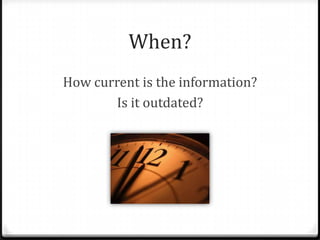
When?
How current is the information?
Is it outdated?
Clues
0Check for currency by looking:
Clues
0Check for currency by looking:
0 For a date in the citation if you’re looking at
a journal article in a database
Clues
0Check for currency by looking:
0 For a date in the citation if you’re looking at
a journal article in a database
0 After the title or at the bottom of the article
from a website
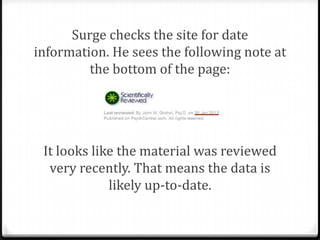
Surge checks the site for date
information. He sees the following note at
the bottom of the page:

It looks like the material was reviewed
very recently. That means the data is
likely up-to-date.
The next question for Surge to ask is …
Where?
Where did this information come from?
Is it cited?
Is it sponsored by an organization with a
bias?
Is the information trustworthy?
Clues
0To check for accuracy and bias, ask
Clues
0To check for accuracy and bias, ask
0 Is this a controversial topic?
Clues
0To check for accuracy and bias, ask
0 Is this a controversial topic?
0 Is the language of this article trying to lead
me to believe something?
Clues
0To check for accuracy and bias, ask
0 Is this a controversial topic?
0 Is the language of this article trying to lead
me to believe something?

0 Is the data sound? Could another conclusion
be made based on the data? Is there data
missing?
Clues
0To check for accuracy and bias, ask
0 Is this a controversial topic?
0 Is the language of this article trying to lead
me to believe something?

0 Is the data sound? Could another conclusion
be made based on the data? Is there data
missing?
0 Are there many grammatical errors? Is the
article well-structured and organized?
Surge can see that this article is on a
website sponsored by Psych Central.
What is Psych Central? He clicks on the
About link at the bottom of the page.
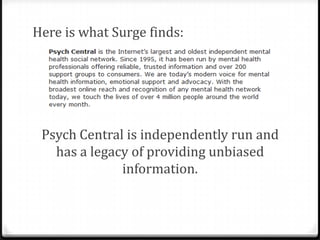
Here is what Surge finds:

Psych Central is independently run and
has a legacy of providing unbiased
information.
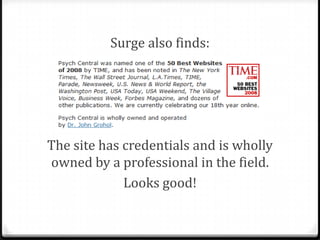
Surge also finds:

The site has credentials and is wholly
owned by a professional in the field.
Looks good!
One more question for Surge to answer …
Why?
For what purpose is this information
being offered?
Does the purpose match his own?
Clues
0To determine the purpose of a source, ask:
Clues
0To determine the purpose of a source, ask:
0 What vocabulary and language is used? Is it for
the general public or an expert scholar?
Clues
0To determine the purpose of a source, ask:
0 What vocabulary and language is used? Is it for
the general public or an expert scholar?
0 Is the platform of the information flashy and
exciting, or simple? Is the source trying to
entertain or inform?
Clues
0To determine the purpose of a source, ask:
0 What vocabulary and language is used? Is it for
the general public or an expert scholar?
0 Is the platform of the information flashy and
exciting, or simple? Is the source trying to
entertain or inform?

0 Are there advertisements?
Clues
0To determine the purpose of a source, ask:
0 What vocabulary and language is used? Is it for
the general public or an expert scholar?
0 Is the platform of the information flashy and
exciting, or simple? Is the source trying to
entertain or inform?

0 Are there advertisements?
0 Can you see where the author is getting his or
her information? Are there citations or a works

cited list?
Why does Surge need information? He
needs it for an assignment.
In general, when you need information
for an assignment, you should start
your search in the library catalog and
GALILEO, not the Internet.
However, if an Internet source passes all
your standards, you might be able to use
it for your research.
However, if an Internet source passes all
your standards, you might be able to use
it for your research.
What is the purpose of Surge’s source? It
isn’t necessarily for scholarly research—
the site is available to provide medical
advice to the public.
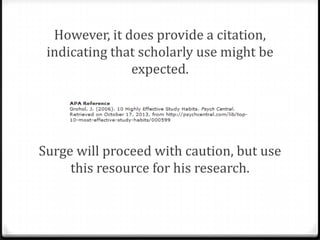
However, it does provide a
citation, indicating that scholarly use
might be expected.

Surge will proceed with caution, but use
this resource for his research.
Remember, evaluation of sources
continues after you have chosen to read a
source in-depth.
Remember, evaluation of sources
continues after you have chosen to read a
source in-depth.
Read critically and watch for authority
and trustworthiness.
If you have questions, you can always ask
a librarian! Email us at libref@gsw.edu

Evaluating Sources

  • 1.
  • 2.
    Now you knowa little more about how to find sources, both from the library catalog and the GALILEO databases.
  • 3.
    The next stepis to be sure that the sources you find are appropriate for the kind of research you’re trying to do.
  • 4.
    Why do youneed the information?
  • 5.
    Why do youneed the information? Is it for… an assignment? -a paper? a project?
  • 6.
    Why do youneed the information? Is it for… an assignment? -a paper? a project? a project outside of class? -career help? a personal research project?
  • 7.
    Why do youneed the information? Is it for … an assignment? -a paper? a project? a project outside of class? -career help? a personal research project? personal entertainment? -a recipe, the latest Hollywood gossip, your favorite meme?
  • 8.
    Regardless of thepurpose for researching the information, it’s important to make sure that the information is reliable and trustworthy.
  • 9.
    To get anidea of the appropriateness and credibility of a source, ask yourself these questions:
  • 10.
  • 11.
  • 12.
  • 13.
  • 14.
  • 15.
    Let’s look atan example …
  • 16.
    Surge needs towrite a paper for English class about effective student study skills.
  • 17.
    He has alreadysearched the library catalog and the GALILEO databases and is now looking for some sources on the Internet. He found an Internet source he might want to use, but first he wants to evaluate it.
  • 18.
  • 19.
    First, Surge needsto know …
  • 20.
    Who? Who wrote orpresented this information? Does the person have the qualifications to be presenting this information? Is he or she trustworthy?
  • 21.
    Clues 0Check for authorityof the author by asking:
  • 22.
    Clues 0Check for authorityof the author by asking: 0Does the writer have a degree in the subject? What are his or her affiliations (where does the author work)?
  • 23.
    Clues 0Check for authorityof the author by asking: 0Does the writer have a degree in the subject? What are his or her affiliations (where does the author work)? 0What do others in the field think about this person?
  • 24.
    Clues 0Check for authorityof the author by asking: 0Does the writer have a degree in the subject? What are his or her affiliations (where does the author work)? 0What do others in the field think about this person? 0What else has this person written about the topic? Is he or she an expert?
  • 25.
    Surge notices thatthe article is written by someone with an advanced degree. That’s a good sign!
  • 26.
    At the bottomwe find even more information about the author. Well, so far this author seems like an expert!
  • 27.
    Next, Surge needsto know …
  • 28.
    What? What is thecontent in the source? Is it relevant to his topic of study?
  • 29.
  • 30.
  • 31.
    Clues 0Check for relevancein: 0 The title 0 An abstract if there is one
  • 32.
    Clues 0Check for relevancein: 0 The title 0 An abstract if there is one 0 Subject headings or table of contents if they are present
  • 33.
    Clues 0Check for relevancein: 0 The title 0 An abstract if there is one 0 Subject headings or table of contents if they are present 0 A scan of the article
  • 34.
    Surge can seefrom the title and a scan of the article that the article is about effective study habits for students. He determines that this is relevant to his query.
  • 35.
  • 36.
    When? How current isthe information? Is it outdated?
  • 37.
  • 38.
    Clues 0Check for currencyby looking: 0 For a date in the citation if you’re looking at a journal article in a database
  • 39.
    Clues 0Check for currencyby looking: 0 For a date in the citation if you’re looking at a journal article in a database 0 After the title or at the bottom of the article from a website
  • 40.
    Surge checks thesite for date information. He sees the following note at the bottom of the page: It looks like the material was reviewed very recently. That means the data is likely up-to-date.
  • 41.
    The next questionfor Surge to ask is …
  • 42.
    Where? Where did thisinformation come from? Is it cited? Is it sponsored by an organization with a bias? Is the information trustworthy?
  • 43.
    Clues 0To check foraccuracy and bias, ask
  • 44.
    Clues 0To check foraccuracy and bias, ask 0 Is this a controversial topic?
  • 45.
    Clues 0To check foraccuracy and bias, ask 0 Is this a controversial topic? 0 Is the language of this article trying to lead me to believe something?
  • 46.
    Clues 0To check foraccuracy and bias, ask 0 Is this a controversial topic? 0 Is the language of this article trying to lead me to believe something? 0 Is the data sound? Could another conclusion be made based on the data? Is there data missing?
  • 47.
    Clues 0To check foraccuracy and bias, ask 0 Is this a controversial topic? 0 Is the language of this article trying to lead me to believe something? 0 Is the data sound? Could another conclusion be made based on the data? Is there data missing? 0 Are there many grammatical errors? Is the article well-structured and organized?
  • 48.
    Surge can seethat this article is on a website sponsored by Psych Central. What is Psych Central? He clicks on the About link at the bottom of the page.
  • 49.
    Here is whatSurge finds: Psych Central is independently run and has a legacy of providing unbiased information.
  • 50.
    Surge also finds: Thesite has credentials and is wholly owned by a professional in the field. Looks good!
  • 51.
    One more questionfor Surge to answer …
  • 52.
    Why? For what purposeis this information being offered? Does the purpose match his own?
  • 53.
    Clues 0To determine thepurpose of a source, ask:
  • 54.
    Clues 0To determine thepurpose of a source, ask: 0 What vocabulary and language is used? Is it for the general public or an expert scholar?
  • 55.
    Clues 0To determine thepurpose of a source, ask: 0 What vocabulary and language is used? Is it for the general public or an expert scholar? 0 Is the platform of the information flashy and exciting, or simple? Is the source trying to entertain or inform?
  • 56.
    Clues 0To determine thepurpose of a source, ask: 0 What vocabulary and language is used? Is it for the general public or an expert scholar? 0 Is the platform of the information flashy and exciting, or simple? Is the source trying to entertain or inform? 0 Are there advertisements?
  • 57.
    Clues 0To determine thepurpose of a source, ask: 0 What vocabulary and language is used? Is it for the general public or an expert scholar? 0 Is the platform of the information flashy and exciting, or simple? Is the source trying to entertain or inform? 0 Are there advertisements? 0 Can you see where the author is getting his or her information? Are there citations or a works cited list?
  • 58.
    Why does Surgeneed information? He needs it for an assignment. In general, when you need information for an assignment, you should start your search in the library catalog and GALILEO, not the Internet.
  • 59.
    However, if anInternet source passes all your standards, you might be able to use it for your research.
  • 60.
    However, if anInternet source passes all your standards, you might be able to use it for your research. What is the purpose of Surge’s source? It isn’t necessarily for scholarly research— the site is available to provide medical advice to the public.
  • 61.
    However, it doesprovide a citation, indicating that scholarly use might be expected. Surge will proceed with caution, but use this resource for his research.
  • 62.
    Remember, evaluation ofsources continues after you have chosen to read a source in-depth.
  • 63.
    Remember, evaluation ofsources continues after you have chosen to read a source in-depth. Read critically and watch for authority and trustworthiness.
  • 64.
    If you havequestions, you can always ask a librarian! Email us at libref@gsw.edu

Editor's Notes

  • #19 http://psychcentral.com/lib/top-10-most-effective-study-habits/000599