Determining the Credibility
of Sources
By
Dean Berry, Ed. D.
www.commoncorecurriculum.info
•Free PowerPoint Version at
•Slideshare.com
•Type PPT title or dean r berry
Conducting research is a critical
activity, but…
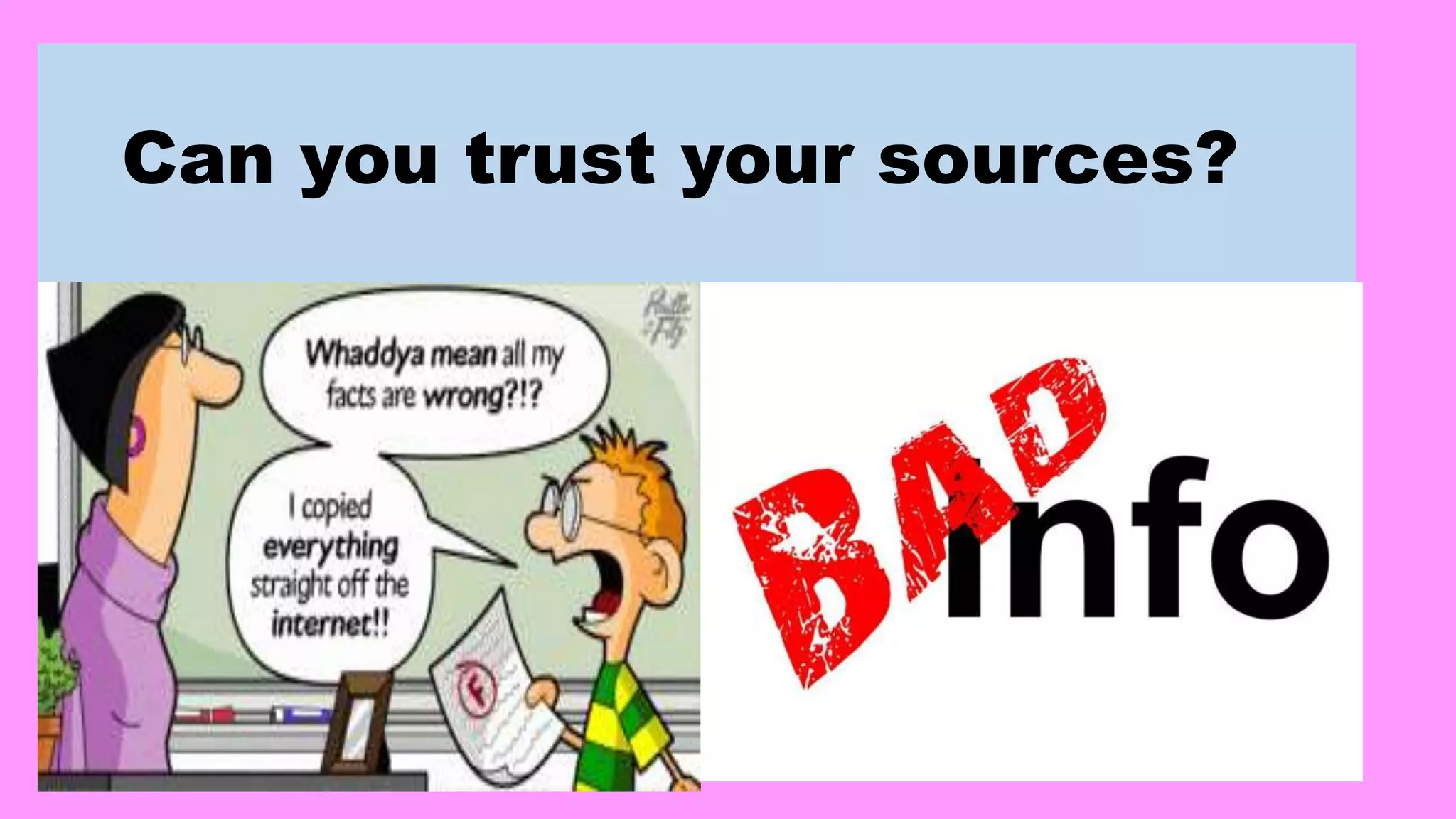
Can you trust your sources?
Surfing the internet can be
a wild and crazy ride.
Has this ever happened to you?
If you are unsure about the credibility of
information from a certain website or
article, what should you do?
You are browsing on your phone and go to a commonly
used website that reports high interest and sometimes
shocking events. A story is posted that captures your
attention. It is so bizarre that you tweet it to your friends.
Your friends send the information to their friends. Within
minutes the story gets legs of its own and runs around
the globe becoming a believed event by millions of people.
Because so many people are talking about the event, it is
now perceived as factual by most people.
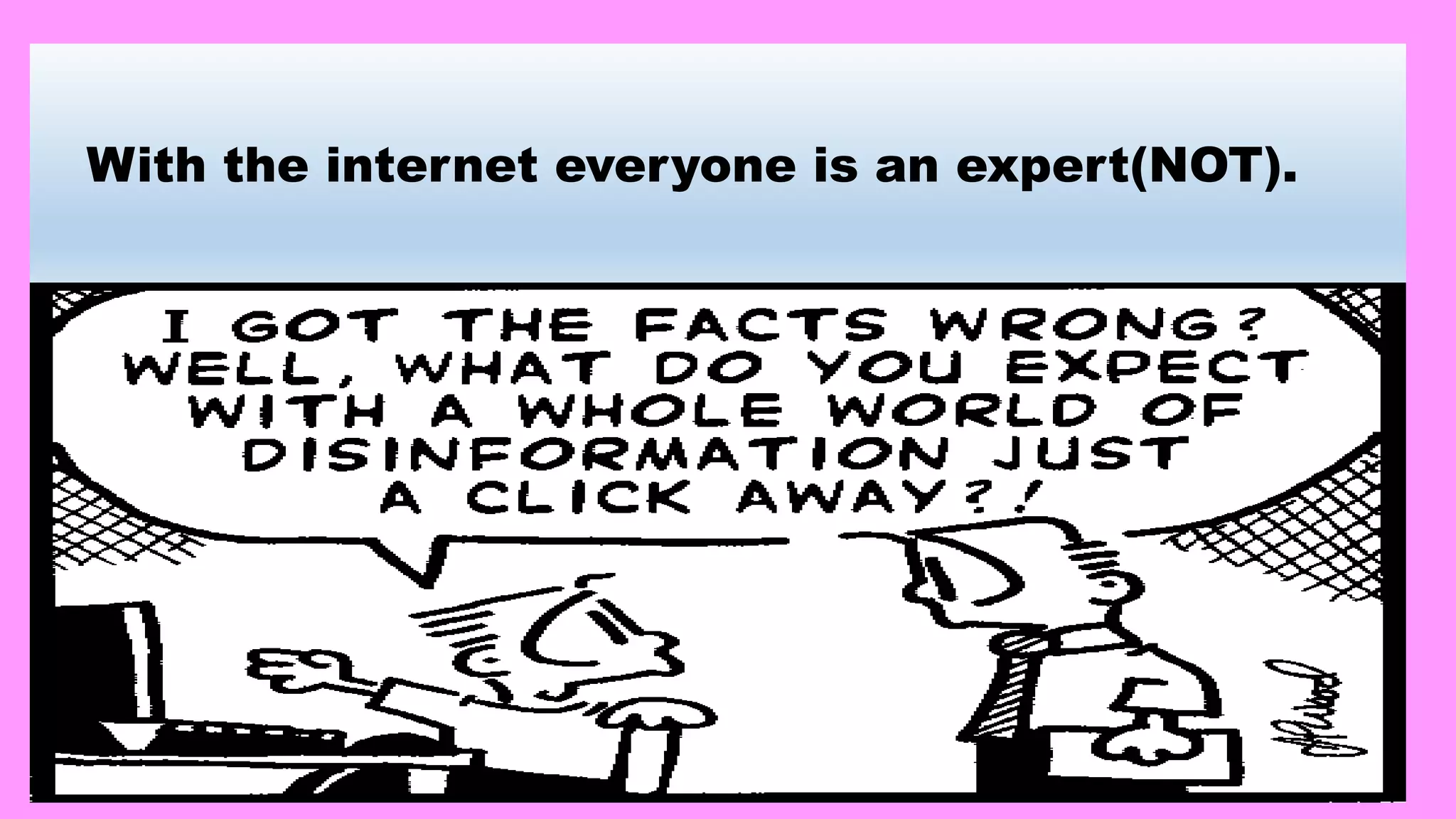
With the internet everyone is an expert(NOT).
How Important is the Truth?
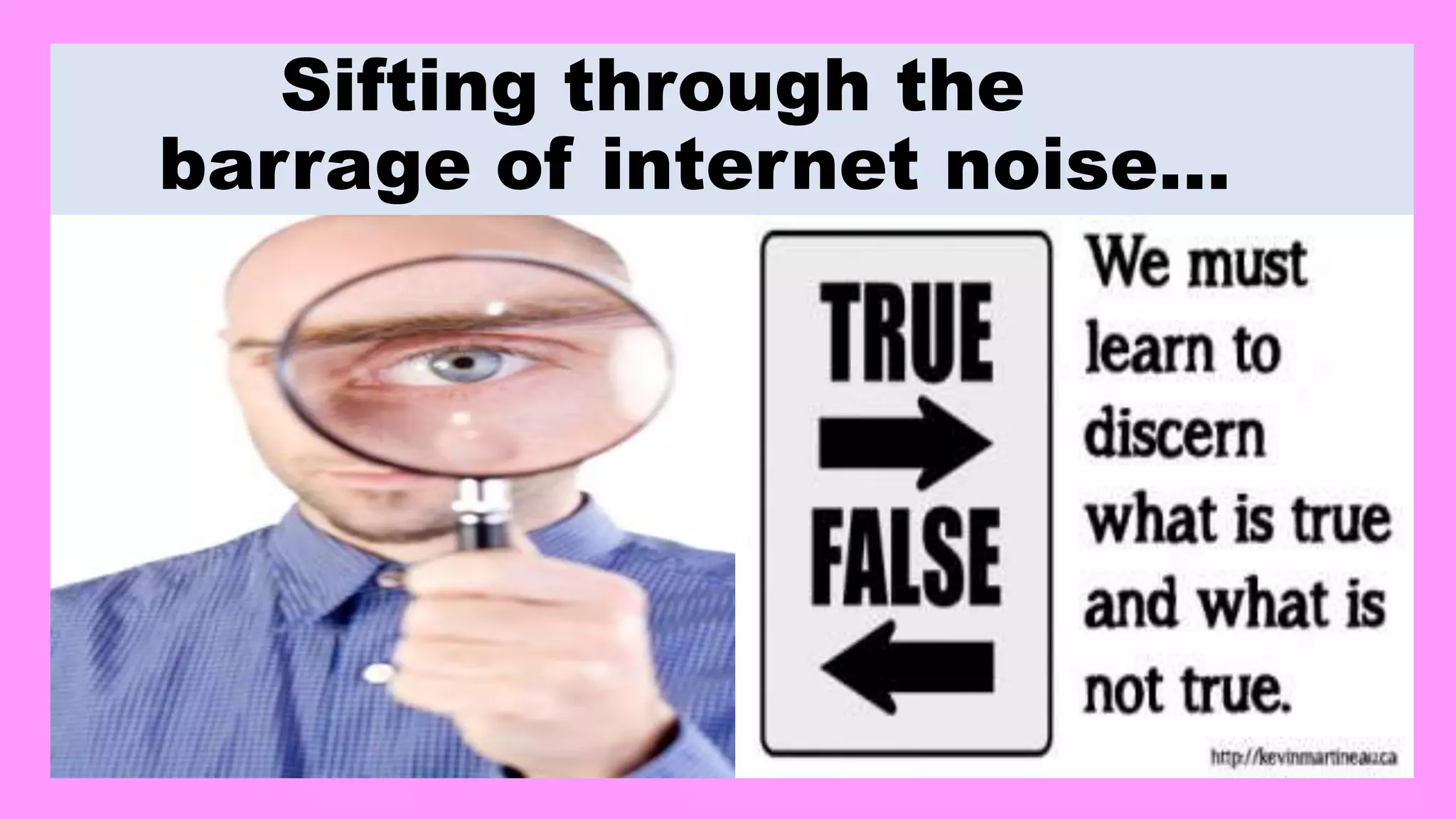
Sifting through the
barrage of internet noise…
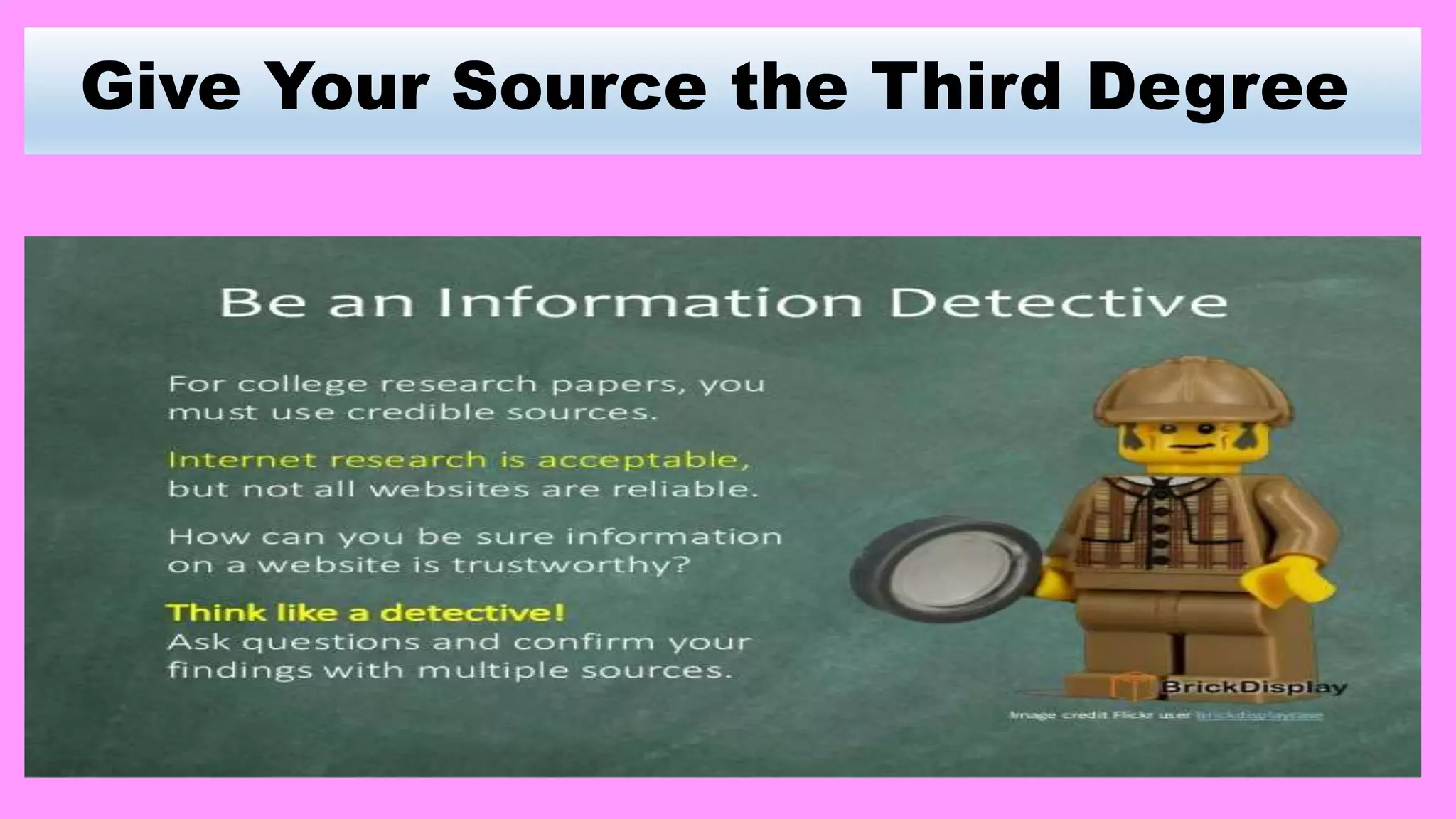
Give Your Source the Third Degree
Use these questions to determine
the credibility of sources.
Open a Word file and type these questions.
•Is the author a recognized expert on the
topic?
•Is the author’s purpose to persuade us or to
provide unbiased information?
•Is the website a mainstream, well
established site that is recognized by other
experts in the field?
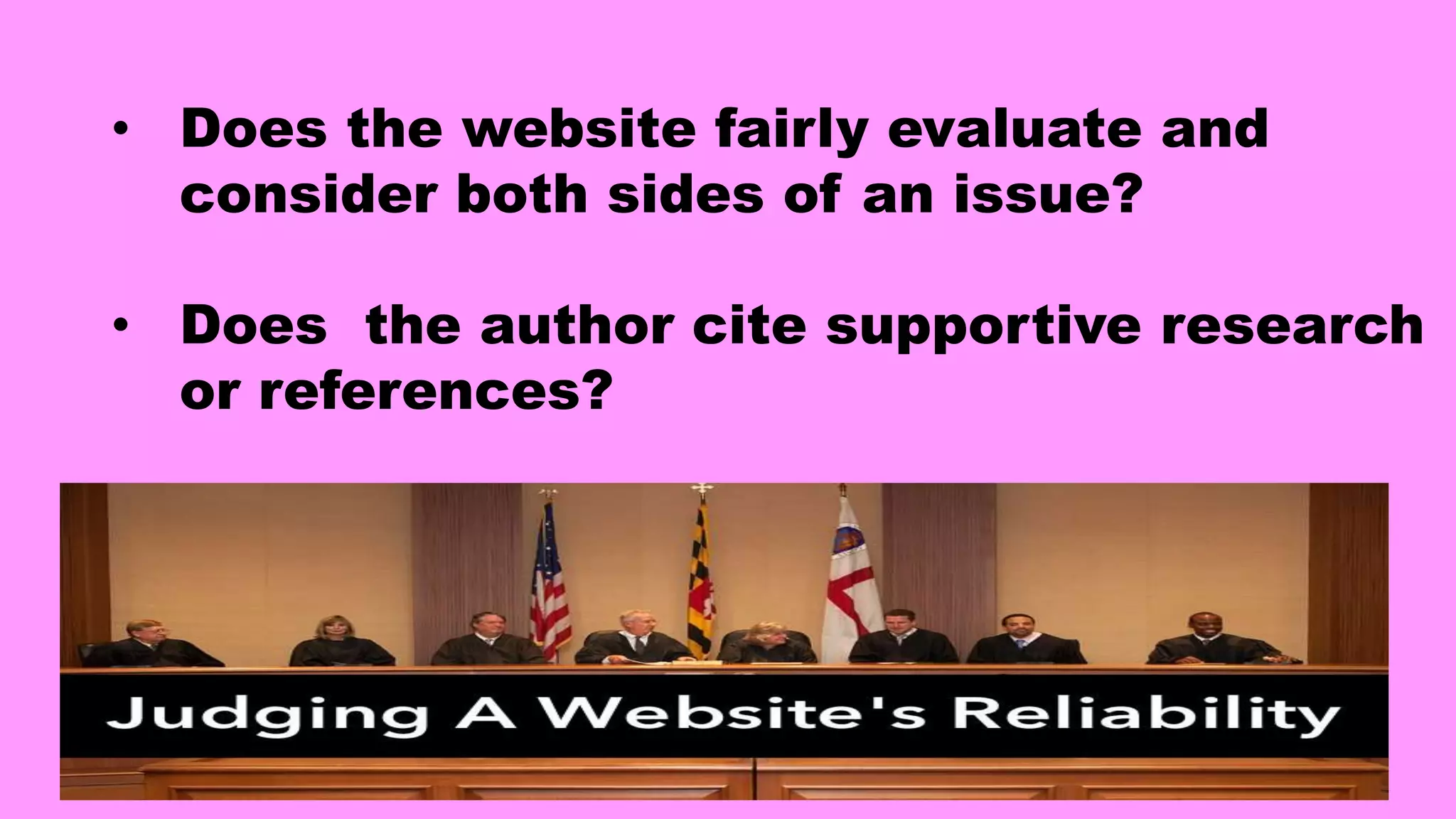
• Does the website fairly evaluate and
consider both sides of an issue?
• Does the author cite supportive research
or references?
Trusting Your Sources Checklist
Open a Word file and type this checklist•
___Have you checked multiple sources that confirm the information?
___Does the article only present one point of view?
___Does the website or author have a connection to a group or organization that will
benefit by presenting a certain viewpoint?
___Does this website or author have a good track record of presenting reliable
information?
___Does this internet site use sensational headlines to increase viewership and
attention that enhances the value of their advertising?
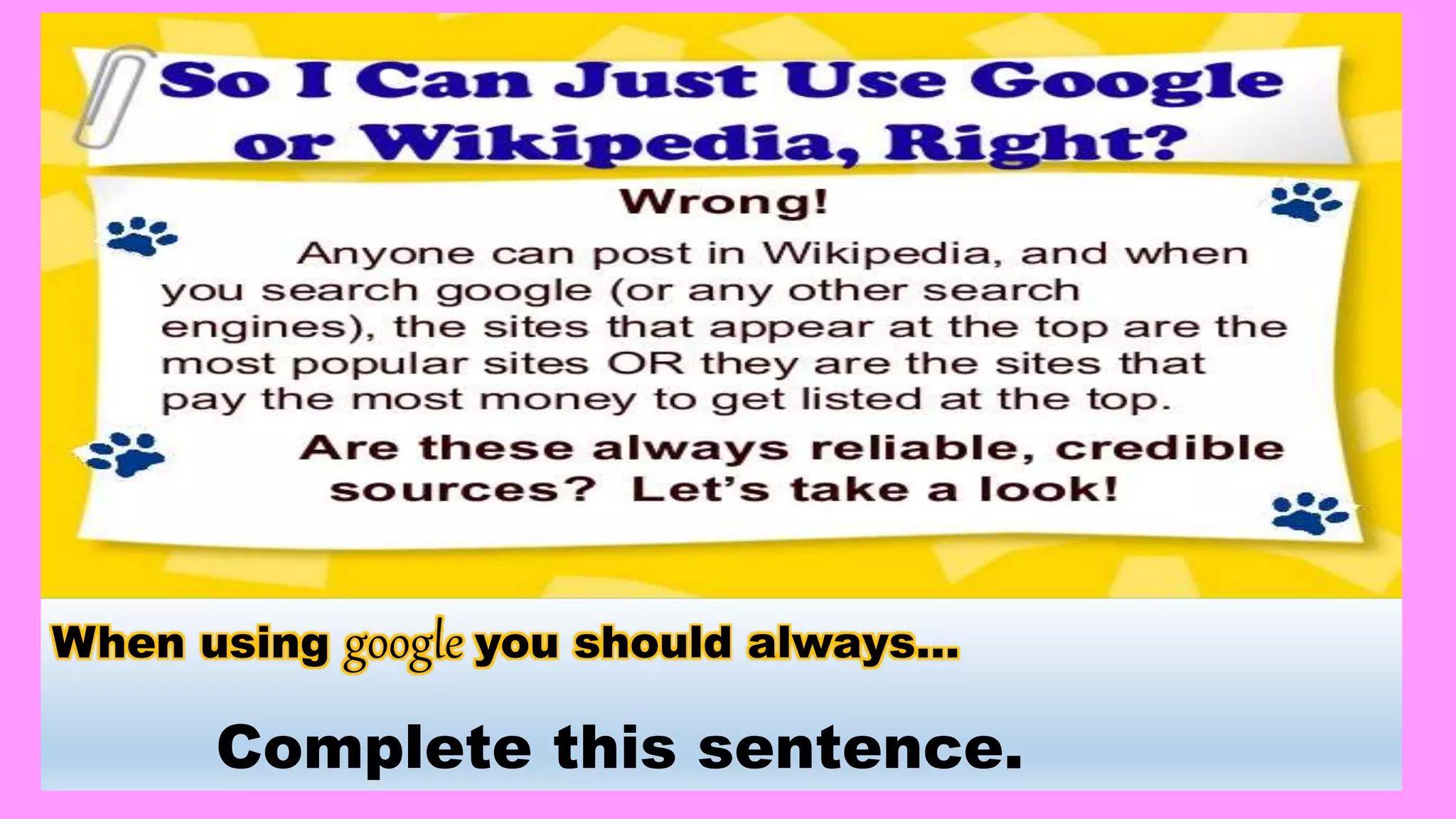
When using google you should always…
Complete this sentence.
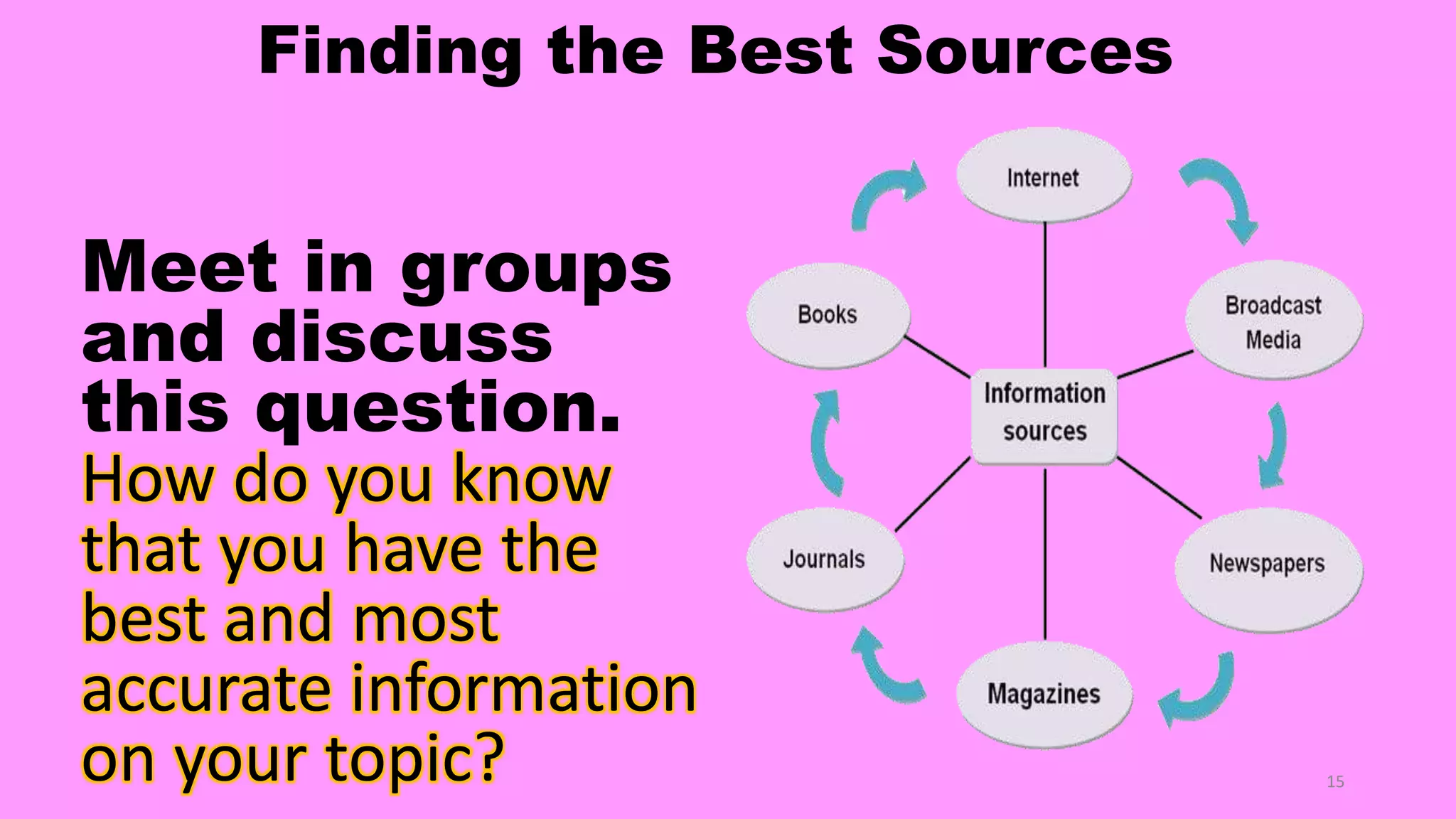
Finding the Best Sources
Meet in groups
and discuss
this question.
How do you know
that you have the
best and most
accurate information
on your topic? 15
Selecting a reliable search engine is a critical part of
beginning your research on a topic.
Commercial search engines such as google, bing, or yahoo have
many built-in biases. However, they do operate special news search
engines that are very different from their regular search engines. These
search engines target newspaper articles only and are very reliable.
Discuss These Questions
• Do the best websites come up first when you use one of these well
known search engines?
• What determines which web sites show up first on these commercial
search engines?
• What are the advantages of finding a specialized search engine that is
considered reliable?
Accessing Newspaper Articles About a Topic
• Newspapers are expected to report factually correct
information. If they knowingly report false information
they are violating the law.
• This doesn’t mean that newspapers are always correct.
However, you can expect well regarded, mainstream
newspapers to report accurate information in their
stories and articles. The exception is when stories are
labeled as editorials or op-ed articles which represent
opinions. The popular search engines(google, yahoo, and
bing) offer specialized search engines that
list only newspaper articles by respected news agencies.
Are you searching for factual
information about a specific topic?
If so, you are in luck! The following frames
include three excellent search engines that
will send you to reliable and trusted
newspaper articles. These search engines
are the best kept secrets on the internet.
Students looking for credible sources of
information should include these search
engines as they conduct research.
Use news.yahoo to find
newspaper articles on any topic
http://news.yahoo.com/world/
Search news.google for
newspaper articles on any topic.
https://news.google.com/
Search Newspaper Articles on
bing.com/ news for Any Topic.
https://www.bing.com/news
The Most Reliable Search Engines
in the World
Fortunately, you can learn how to bypass the wild west of
lies and embellishment, known as the internet. Smart
students use the most reliable and trusted search
engines to access a large bank of information sources.
Experts and major organizations such as the National
Education Association have endorsed
www.findingdulcinea.com and www.sweetsearch.com .
http://www.sweetsearch.com/
Use your chromebook and access this site. Search for a controversial
topic such as global warming or gun control. What did you find?
How do we know that sweetsearch.com
is a reliable search engine?
Commonsense media.org Rates the Sweet Search Site
• SweetSearch provides middle and high school students with a search engine
that suggests safe, relevant site options. Research experts, librarians, and teachers
have proactively reviewed the 35,000 sites that may appear in search results to
ensure they're a reliable information source. Another option is the search
engine findingDulcinea, which was created with a similar goal; others are
reputable sites from organizations like the University of Colorado, the New York
Times, and the U.S. Securities and Exchange Commission.
• Though sites are pre-screened, students can still encounter opinion pieces and less
credible articles. Students should continue to use critical thinking skills while
gathering research with www.Sweetsearch.com .
Endorsed by the National Education Association
Librarian on the Internet
http://www.findingdulcinea.com/info/m
ain/Our-Mission.html
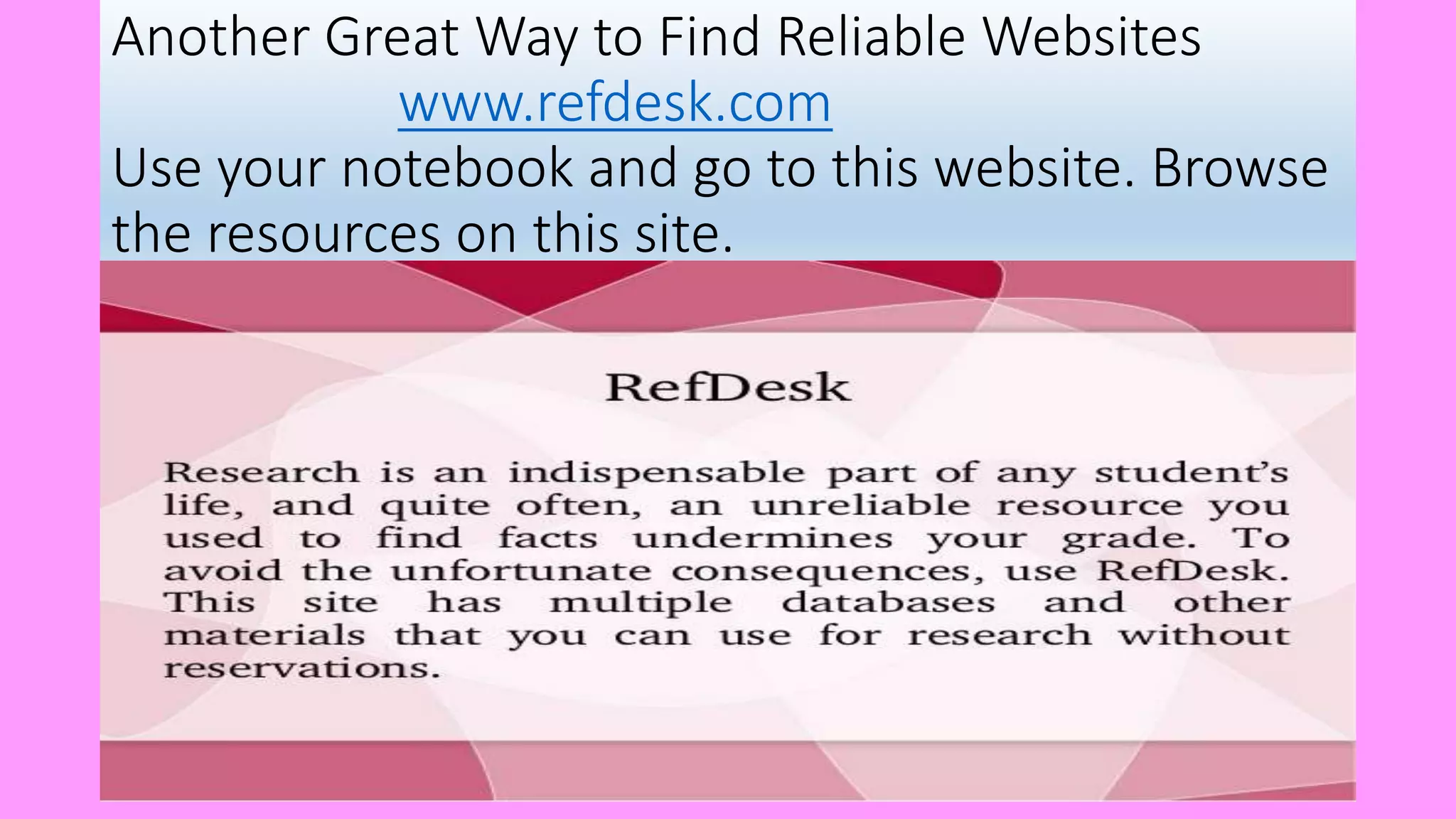
Another Great Way to Find Reliable Websites
www.refdesk.com
Use your notebook and go to this website. Browse
the resources on this site.
Websites with Good Reputations
for Certain Subjects
There are many established websites that
have good reputations among experts in the
field. For example, the Mayo Clinic website
is a very credible site for health
information. Nololaw.com is free and
reliable site for legal information. Check out
the following websites and search engines.
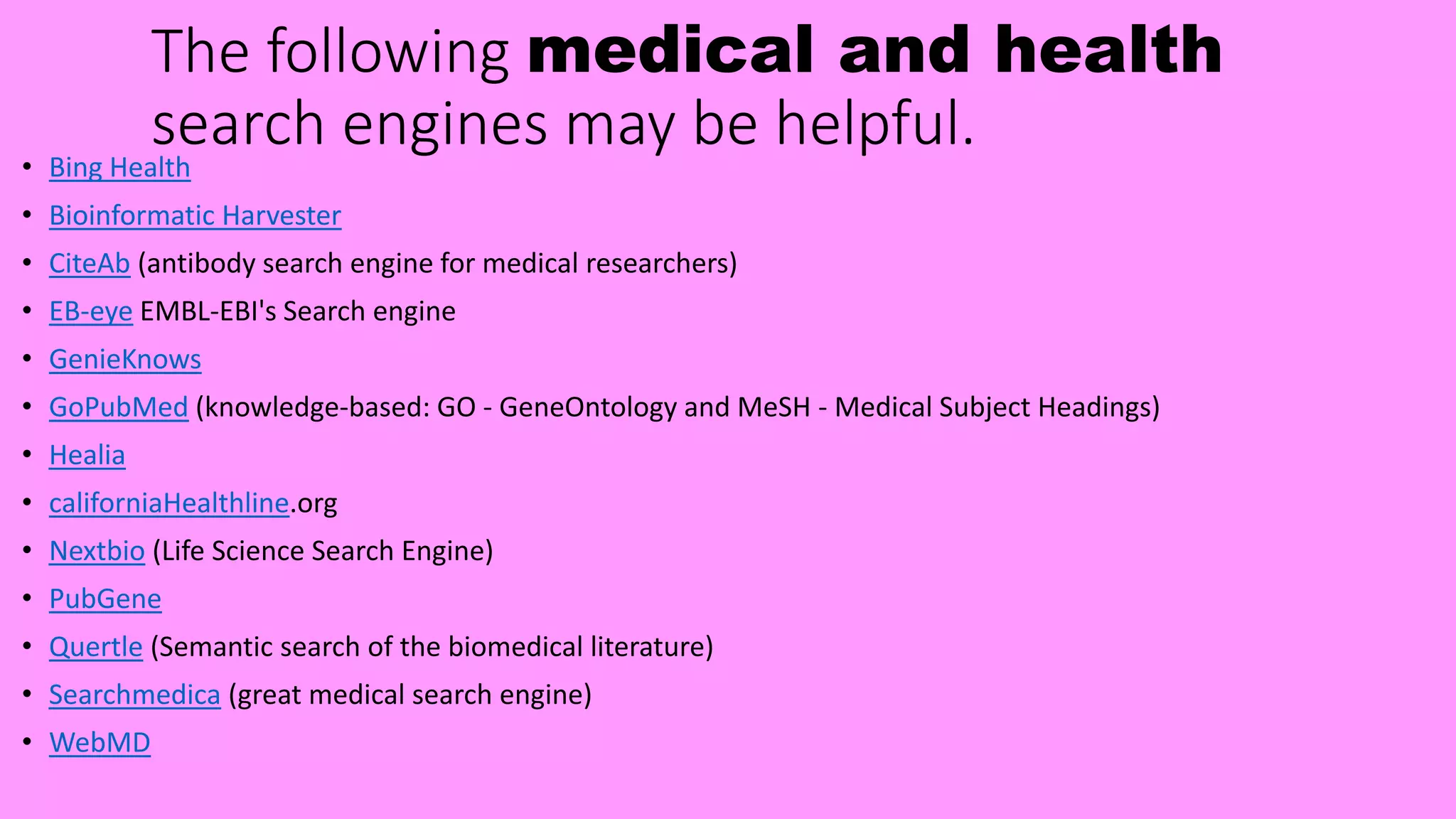
The following medical and health
search engines may be helpful.• Bing Health
• Bioinformatic Harvester
• CiteAb (antibody search engine for medical researchers)
• EB-eye EMBL-EBI's Search engine
• GenieKnows
• GoPubMed (knowledge-based: GO - GeneOntology and MeSH - Medical Subject Headings)
• Healia
• californiaHealthline.org
• Nextbio (Life Science Search Engine)
• PubGene
• Quertle (Semantic search of the biomedical literature)
• Searchmedica (great medical search engine)
• WebMD
If you are looking for a job, you might visit
one of these search engines….
• Job
• Main article: Job search engine
• Adzuna (UK)
• Bixee.com (India)
• CareerBuilder.com (USA)
• Craigslist (by city)
• Dice.com (USA)
• Eluta.ca (Canada)
• Hotjobs.com (USA)
• JobStreet.com (Southeast Asia, Japan and India)
• Incruit (Korea)
• Indeed.com (USA)
• Glassdoor.com (USA)
• LinkUp.com (USA)
• Monster.com (USA), (India)
• Naukri.com (India)
• Yahoo! HotJobs (Countrywise subdomains, International)
If you are looking for legal advice, you
might check out these search engines…
• Legal
• Google Scholar
• Lexis (Lexis Nexis)
• Quicklaw
• WestLaw
• Nolo.com
News Services
If you are looking for news stories and
articles on a specific topic, these search
engines may help.
• News
• Bing News
• Daylife
• Google News
• MagPortal
• Newslookup
• Nexis (Lexis Nexis)
• Topix.net
• Trapit
• Yahoo! News
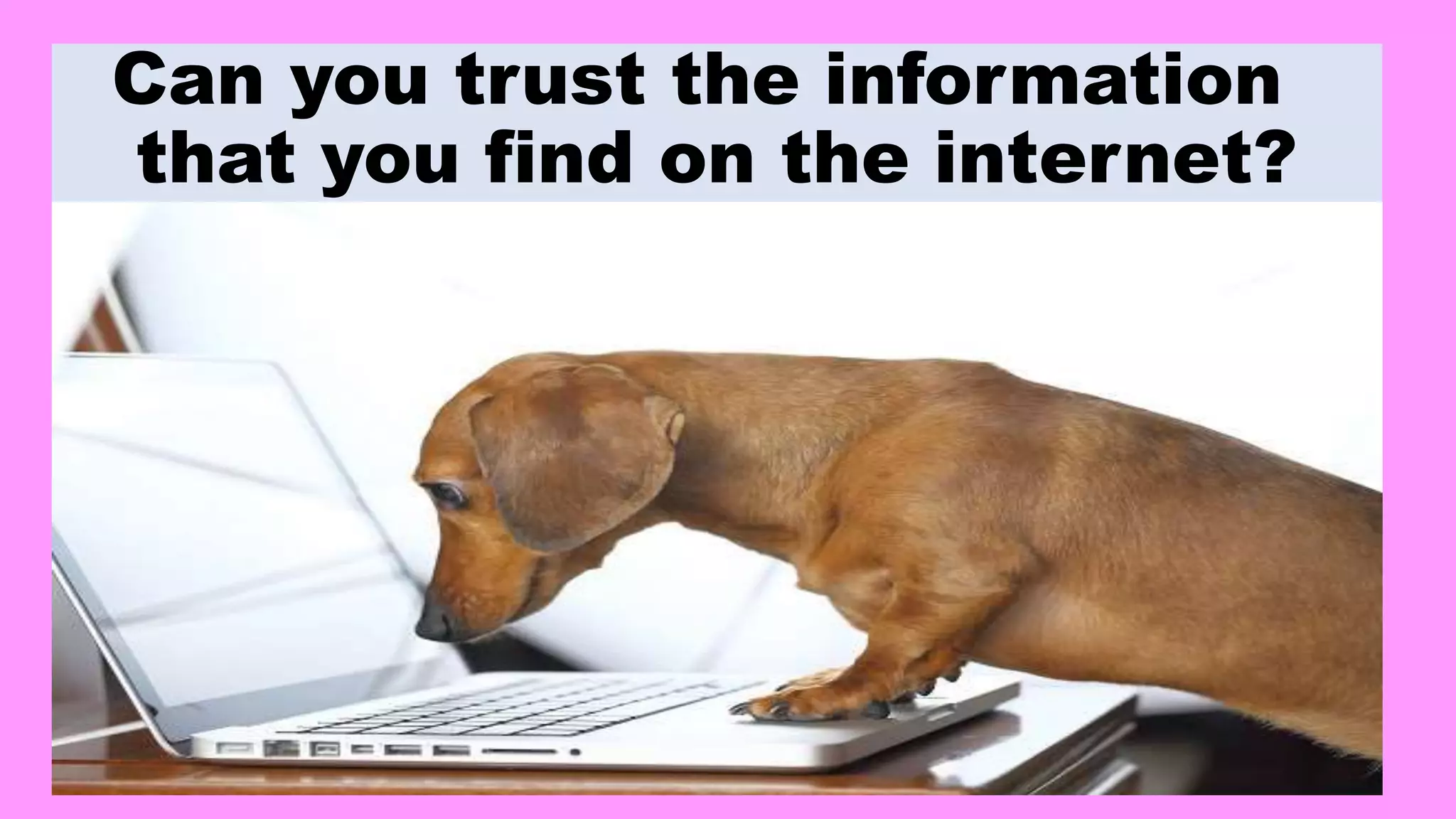
Can you trust the information
that you find on the internet?
Evaluate and Verify Research Sources
• Internet sources will vary greatly
in accuracy and reliability
• Consider the expertise and
reputation of each website
• Compare facts and information of
different internet sources
• Select information that is
supported on several reliable
websites
• Question or refute information
that lacks consistent support
Discuss
• What are URL’s?
• Are some URL’s more
likely to offer
credible sources of
information?
Discuss
Understanding Domains
Explain how these URLs are different.
•edu
.gov
.org
.com
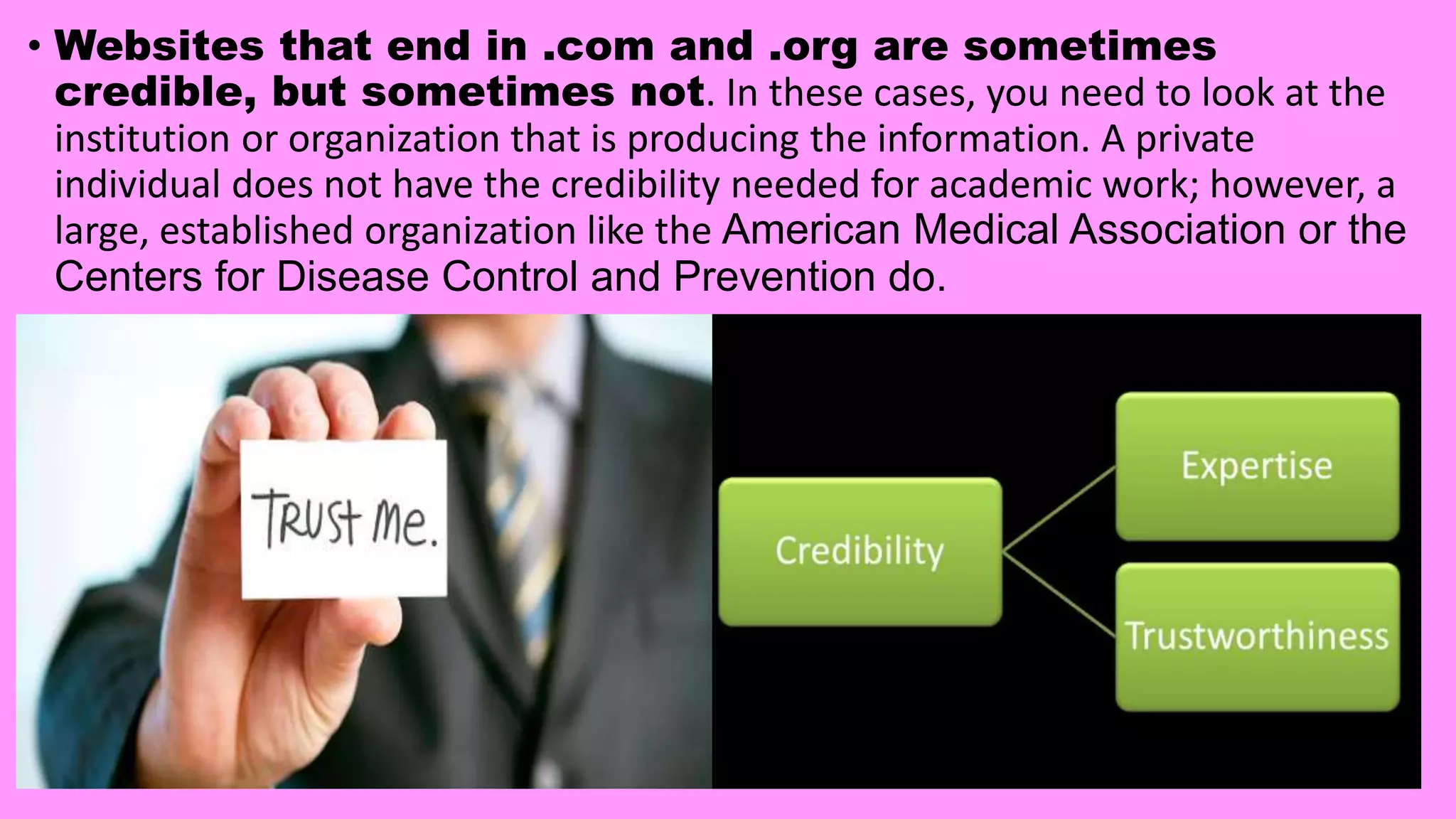
• Websites that end in .com and .org are sometimes
credible, but sometimes not. In these cases, you need to look at the
institution or organization that is producing the information. A private
individual does not have the credibility needed for academic work; however, a
large, established organization like the American Medical Association or the
Centers for Disease Control and Prevention do.
Why are .edu sites not always
reliable sources of information?
• Websites that end in .edu also fall into the category of “usually,
but not always, credible.” Individual faculty often provide
course websites that include information pertinent to classes they
teach. These sites may include lecture materials and interpretation
of sources. While faculty at a university are reputable, this
information does not go through the “peer-review” process
discussed earlier. As such, you should be more cautious with it.
• If at all possible, look for that same information from a peer-
reviewed source, rather than a professor’s personal .edu source.
Which websites are the most reliable?
Use discretion with all websites. If you are using any
online source other than a scholarly university database,
you should exercise caution because anyone can publish
their thoughts on the internet, regardless of the merit of
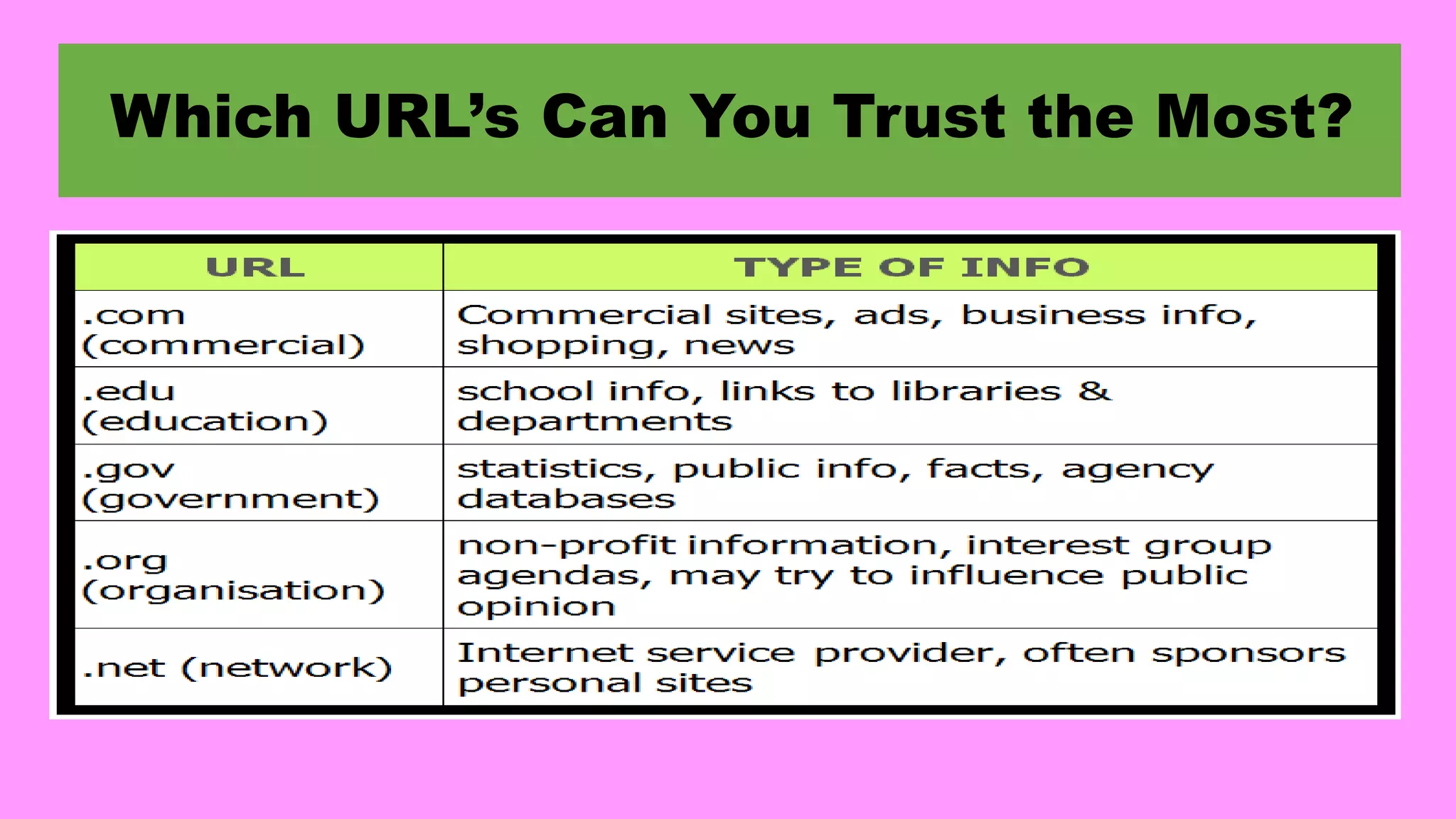
those thoughts. As a general rule, all .gov websites
are credible because they have the weight of
governmental institutions behind them.
Which URL’s Can You Trust the Most?
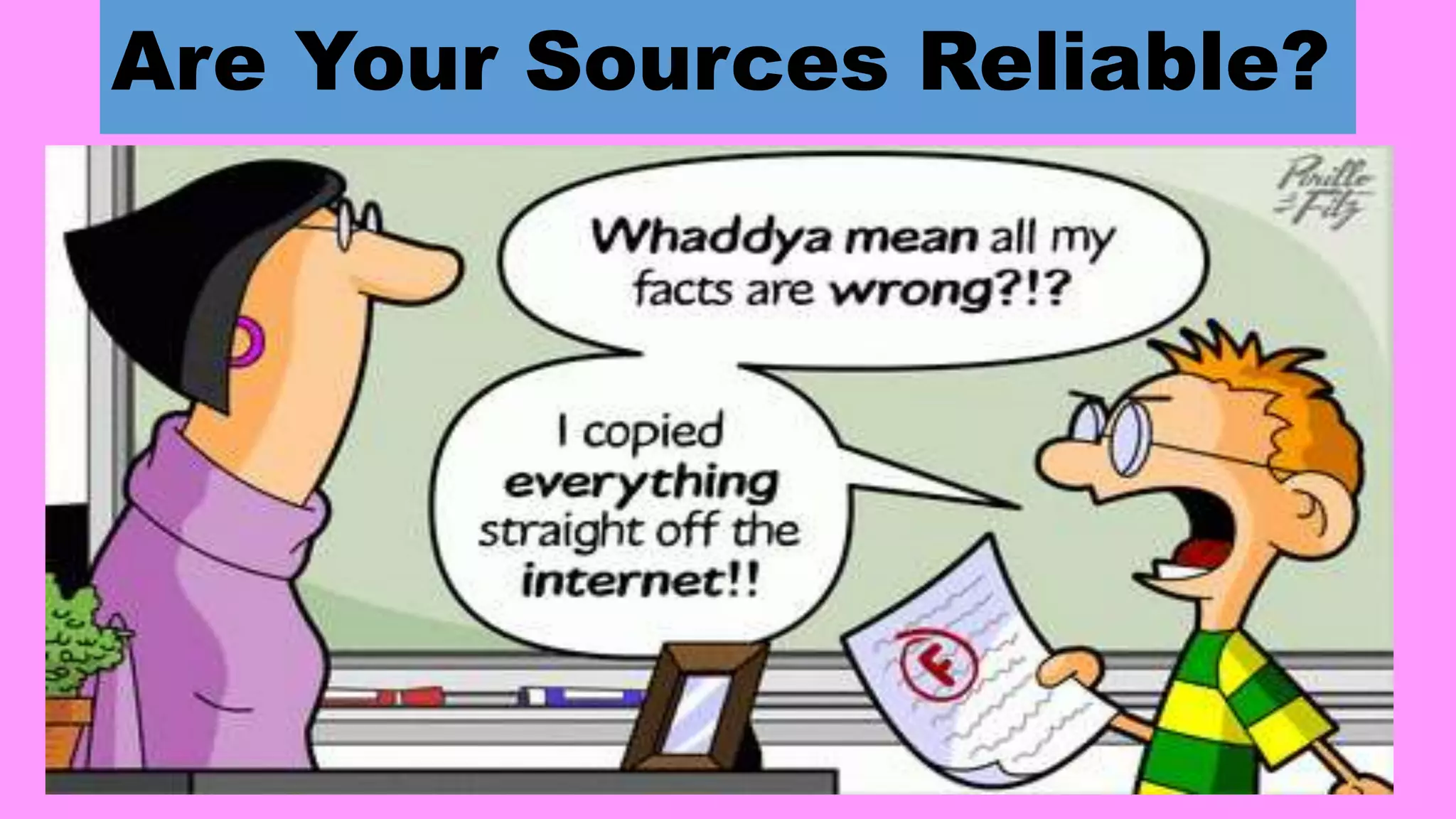
Are Your Sources Reliable?
Is the publisher recognized as reliable
and trustworthy by experts in the field?
Investigate the publisher. The institution housing the information can often tell
you a great deal about how credible that information is. For example, you
should feel more comfortable trusting information found in The New York Times
or The Washington Post — two newspapers with proven track records of
journalistic integrity and public retraction of errors — than that found in a
source like Infowars, which has a wide readership, but often publishes
misleading or blatantly incorrect information.[9]
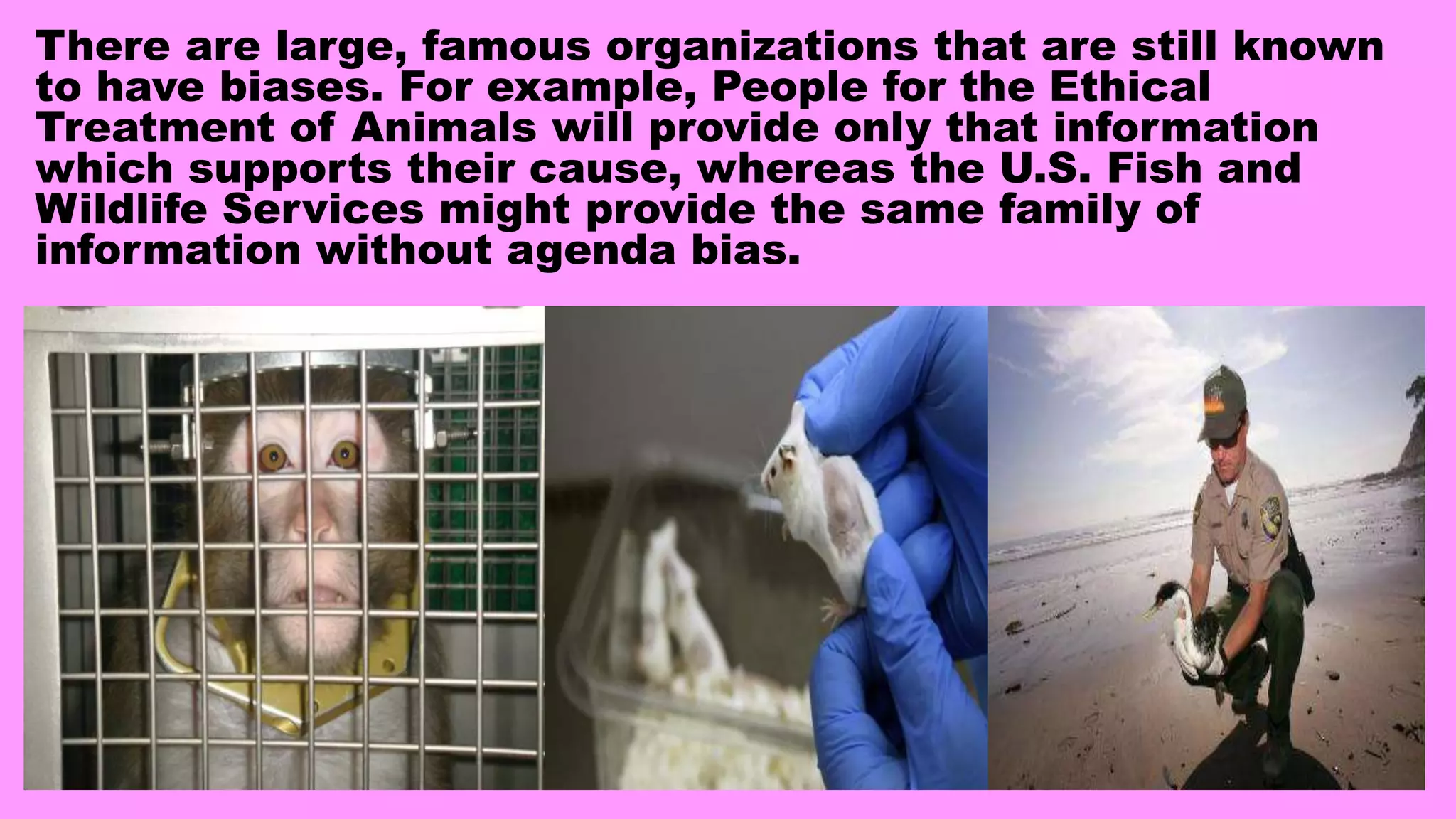
There are large, famous organizations that are still known
to have biases. For example, People for the Ethical
Treatment of Animals will provide only that information
which supports their cause, whereas the U.S. Fish and
Wildlife Services might provide the same family of
information without agenda bias.
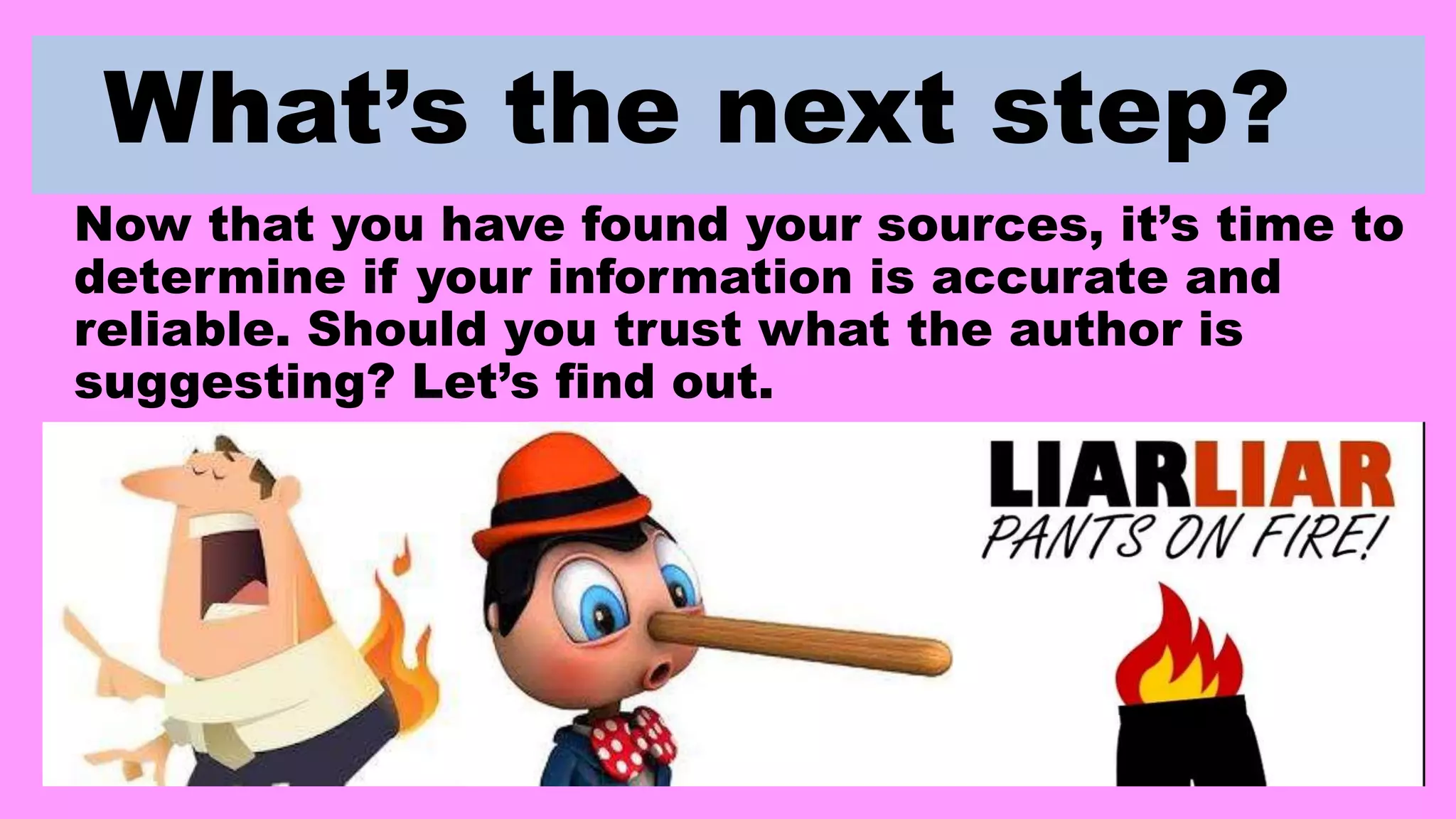
What’s the next step?
Now that you have found your sources, it’s time to
determine if your information is accurate and
reliable. Should you trust what the author is
suggesting? Let’s find out.
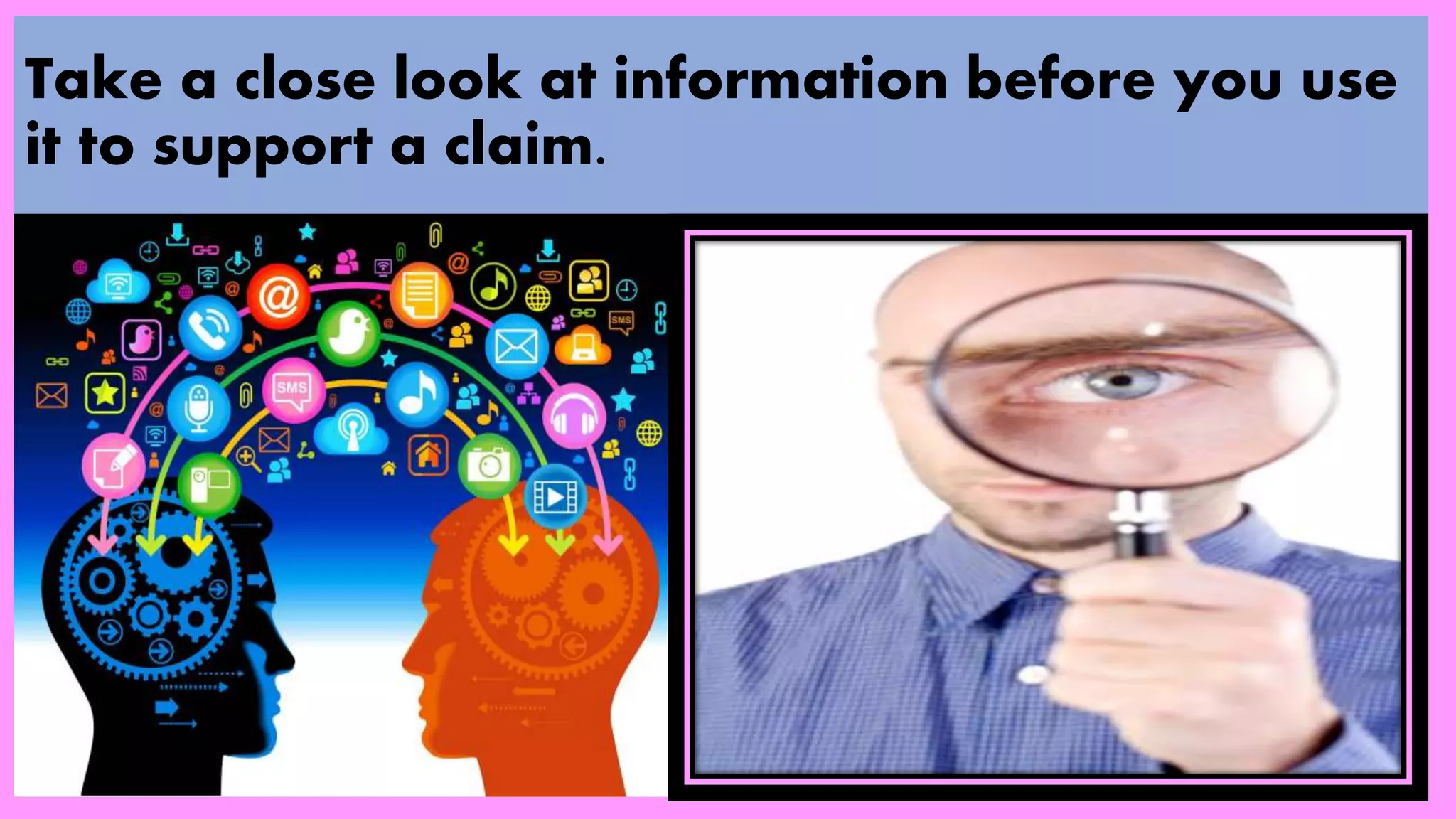
Take a close look at information before you use
it to support a claim.
What is the author up to?
• Is the author presenting information that is clearly
supported by credible evidence?
• What does the author want us to believe?
• Does the author have an agenda or motive for
presenting the information?
• Does the author use logical fallacies to convince
readers?
• Does the tone used by the author give us
important clues to all of these questions?
Discuss the importance of
these questions.
What is the author’s purpose in writing the selection?
How do you know?
Can you give some examples of the different purposes
authors have when they present information?
How might the tone used in a selection provide clues to
these questions?
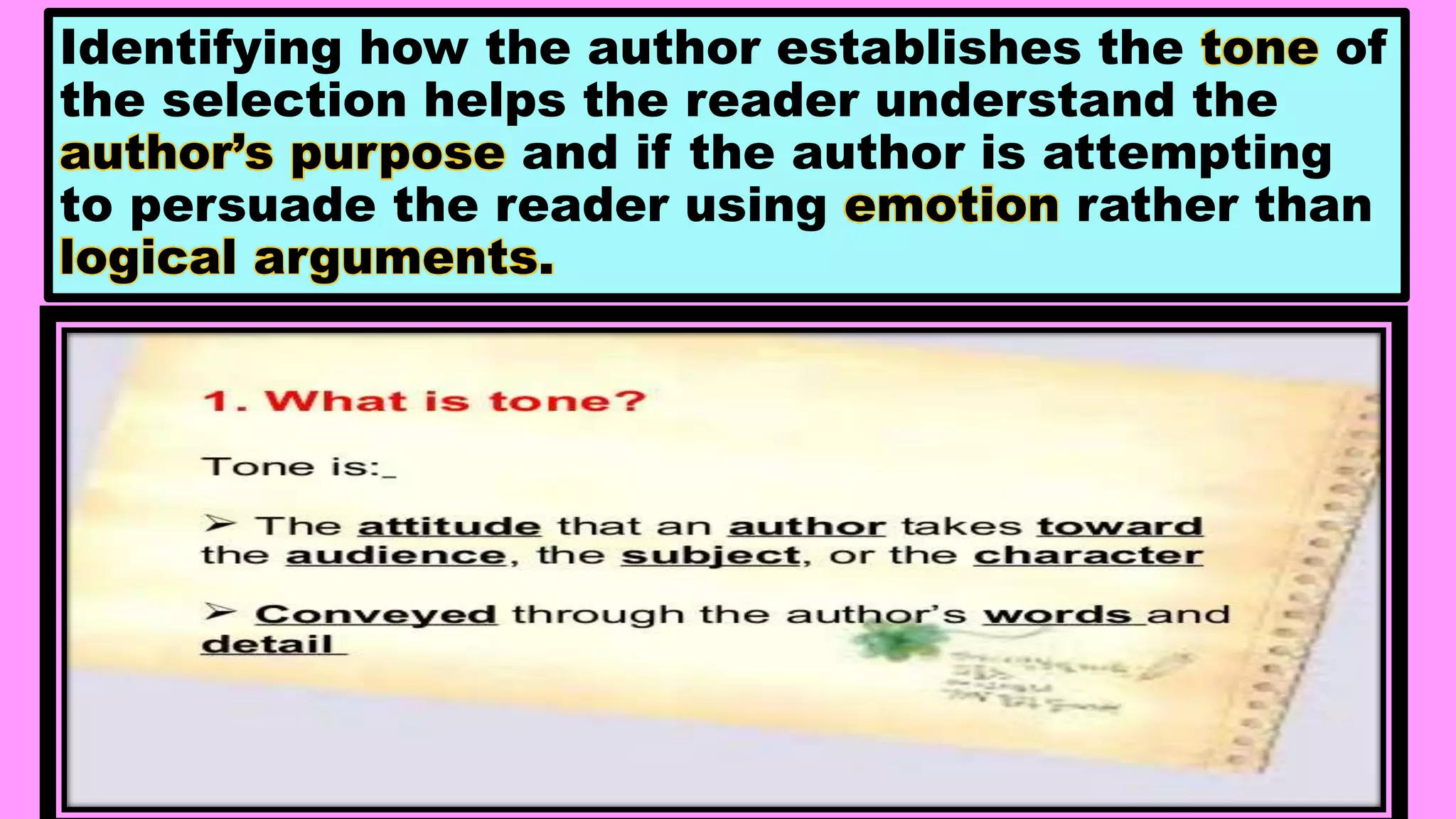
Identifying how the author establishes the tone of
the selection helps the reader understand the
author’s purpose and if the author is attempting
to persuade the reader using emotion rather than
logical arguments.
The tone may be very thoughtful with a presentation
of facts on both sides of the issue or…
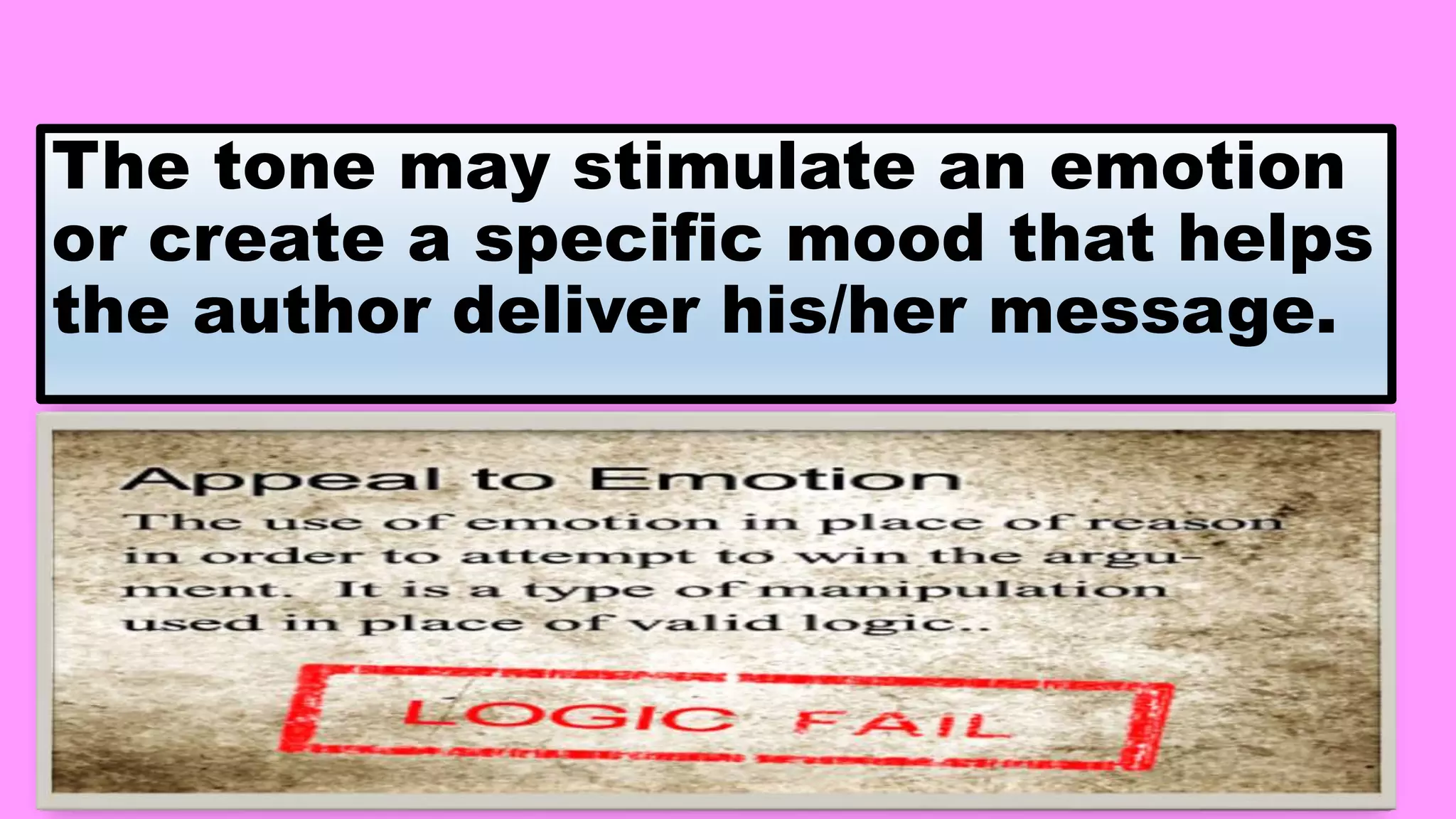
The tone may stimulate an emotion
or create a specific mood that helps
the author deliver his/her message.
Discuss
•What are some of the different
tones that authors use to get their
point across?
•How might a specific tone help an
author develop his/her purpose?
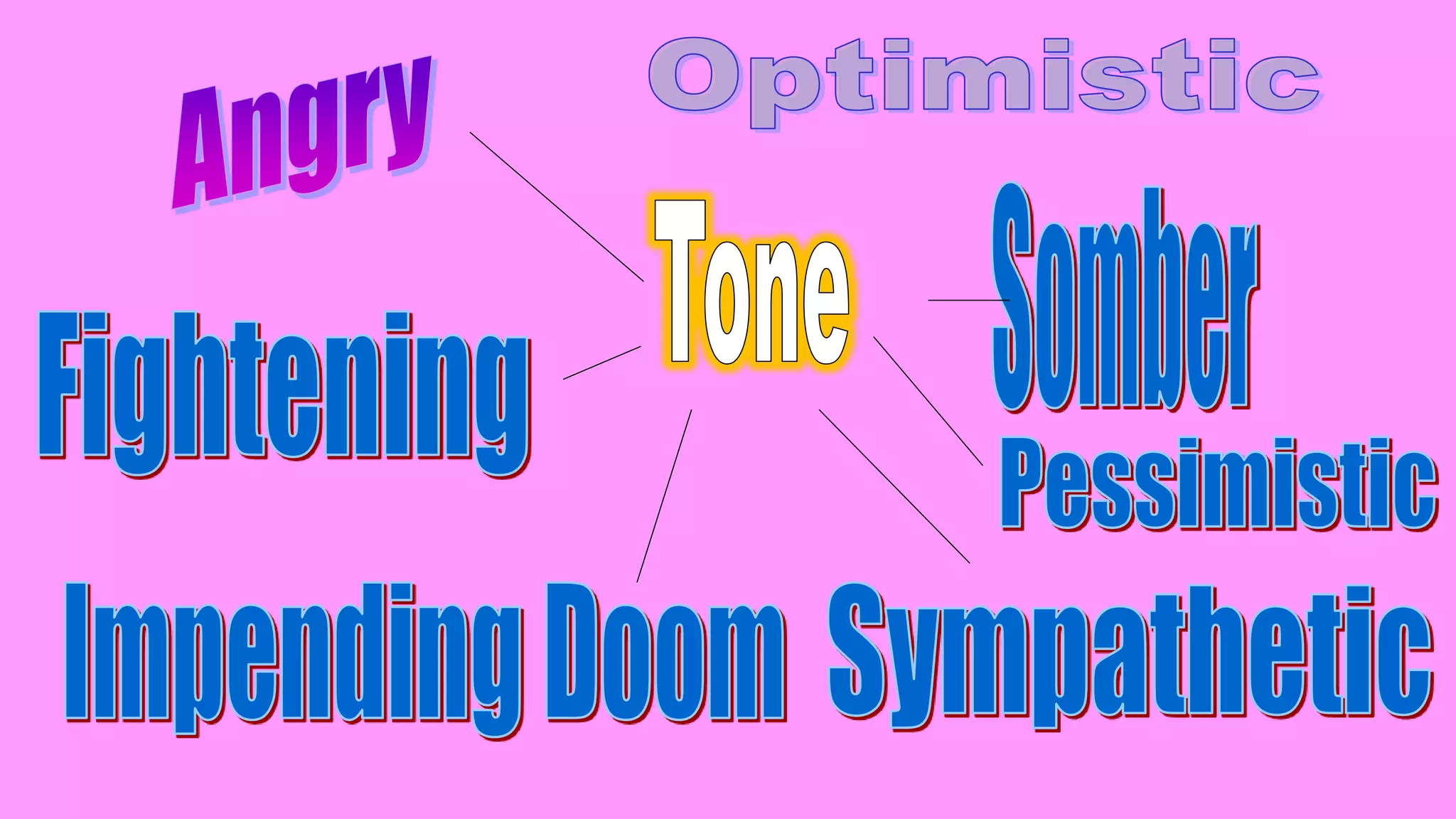
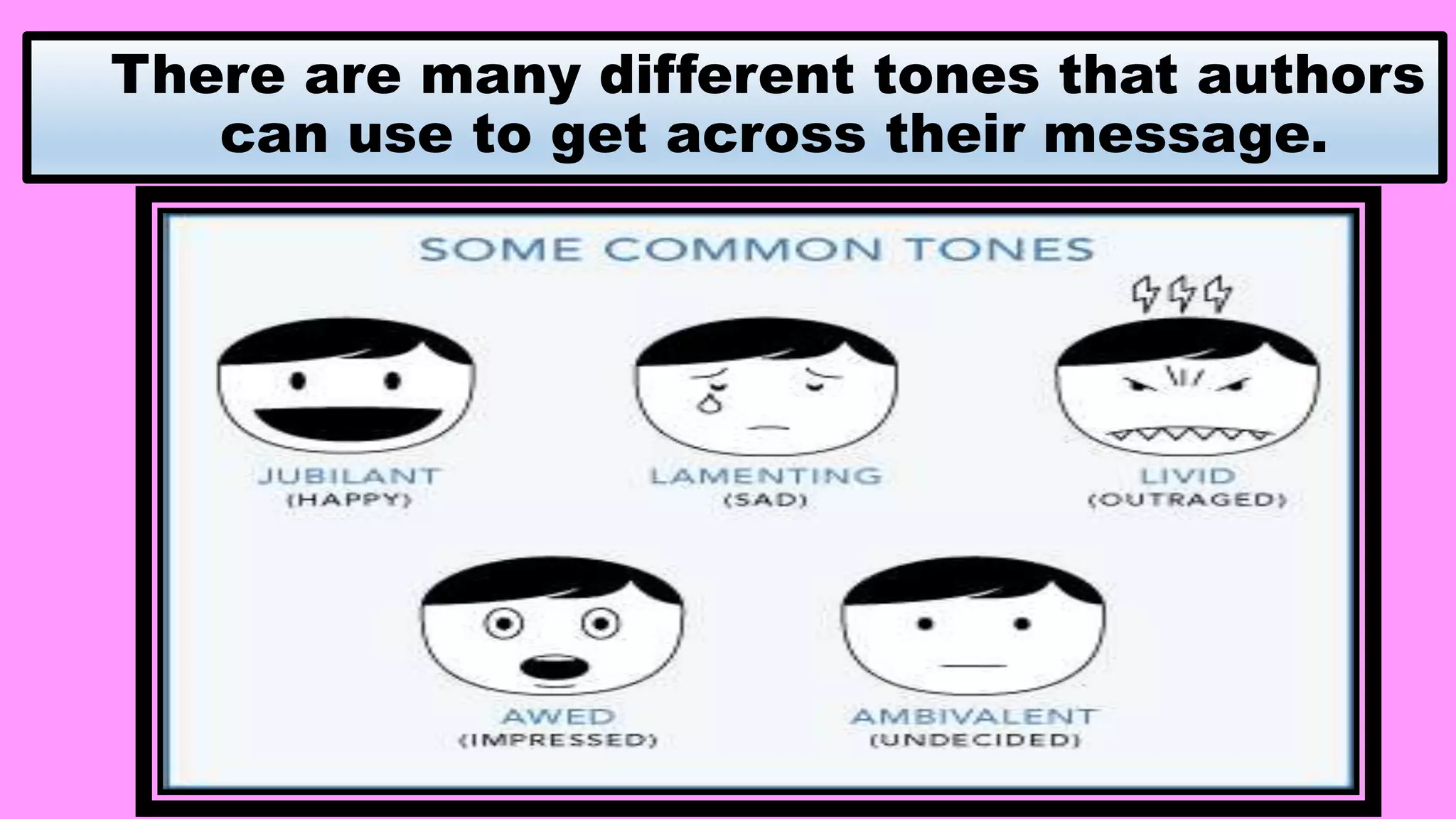
There are many different tones that authors
can use to get across their message.
The tone of the text may be created to evoke
intense emotion. Creating fear, pity or anger
is a common way for an author to manipulate
the reader into accepting a spurious
argument that is seriously lacking in
supporting evidence and clear logic.
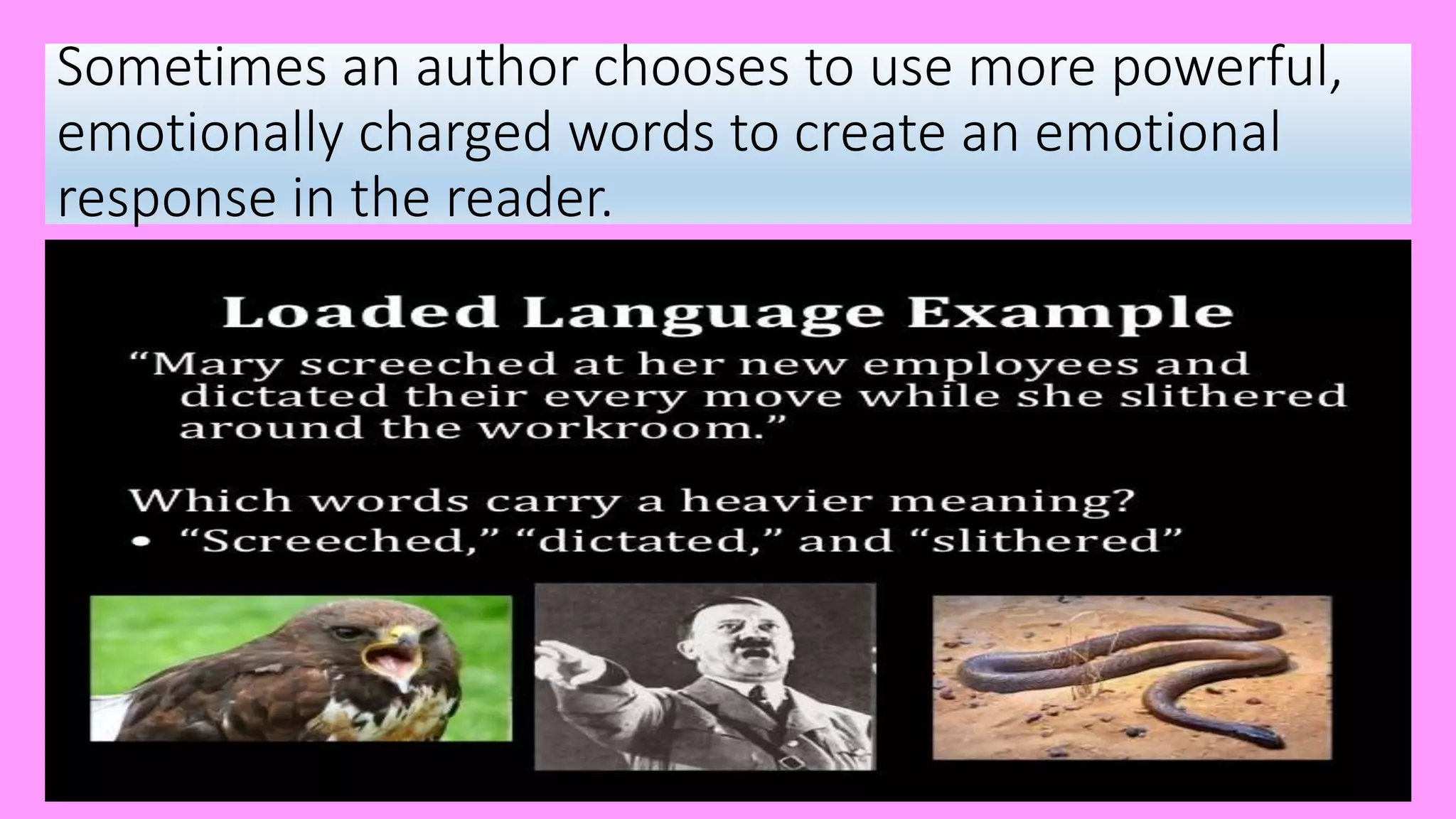
Sometimes an author chooses to use more powerful,
emotionally charged words to create an emotional
response in the reader.
Loaded words pack a lot of power and emotion.
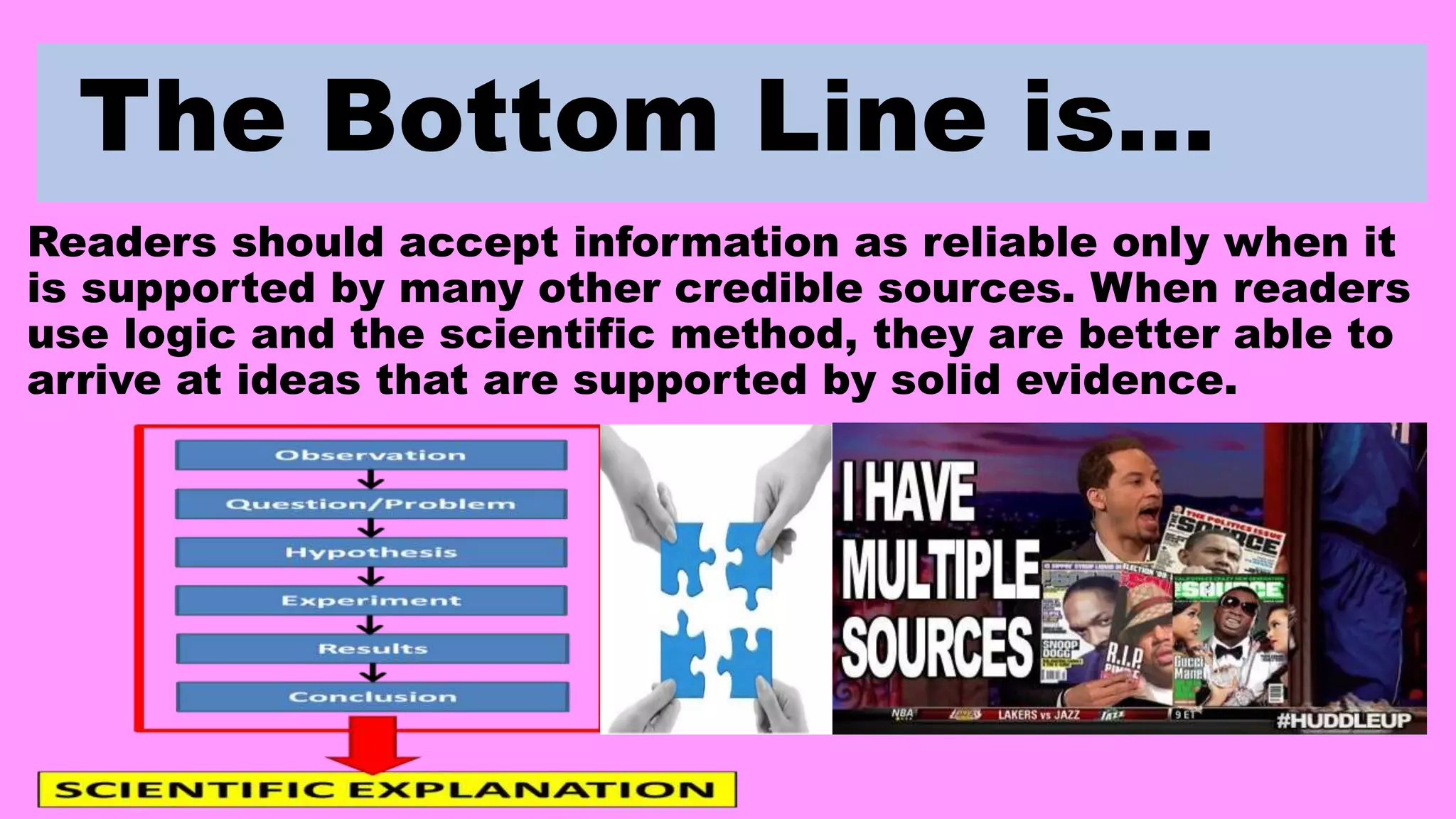
The Bottom Line is…
Readers should accept information as reliable only when it
is supported by many other credible sources. When readers
use logic and the scientific method, they are better able to
arrive at ideas that are supported by solid evidence.
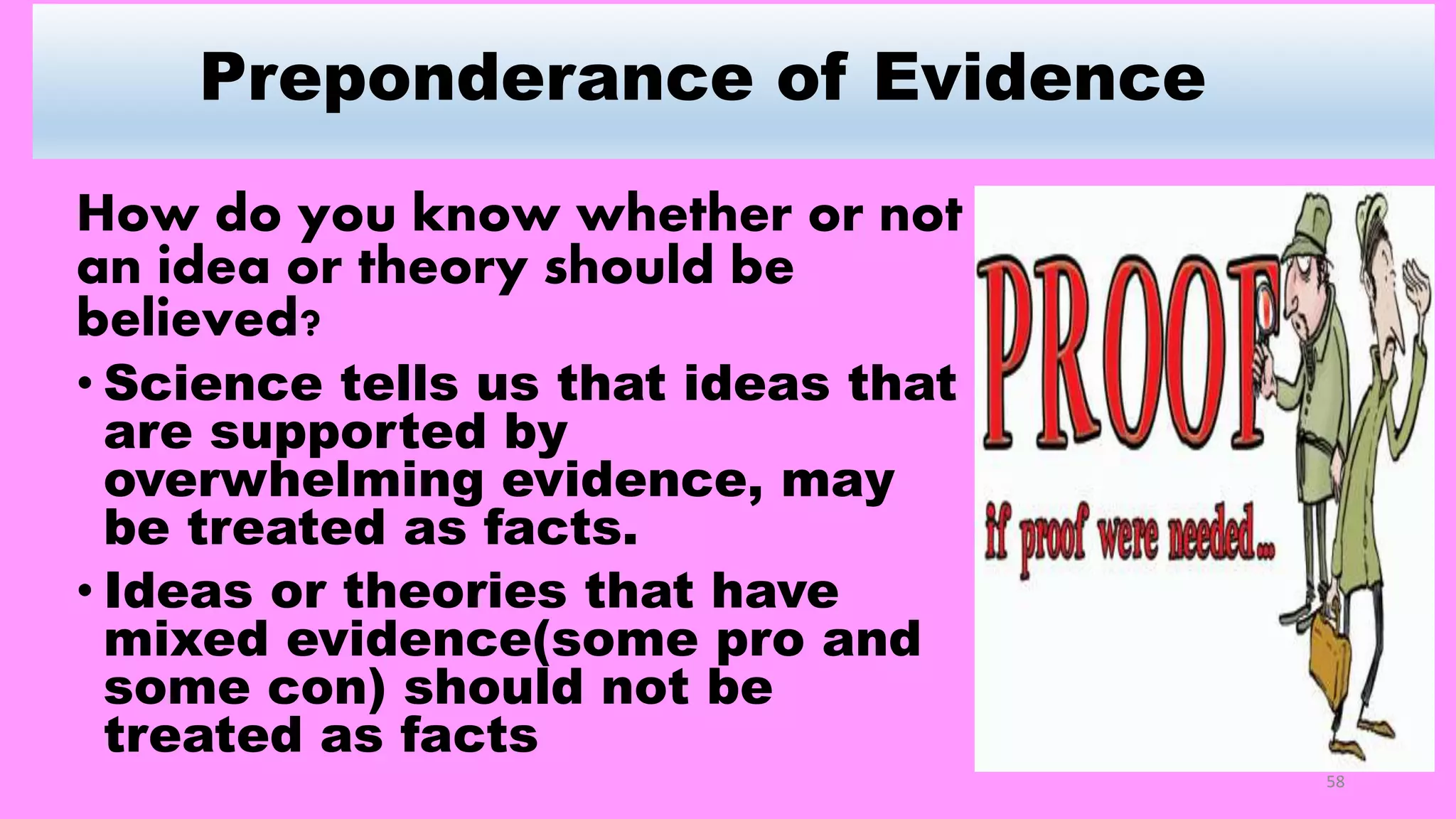
Preponderance of Evidence
How do you know whether or not
an idea or theory should be
believed?
• Science tells us that ideas that
are supported by
overwhelming evidence, may
be treated as facts.
• Ideas or theories that have
mixed evidence(some pro and
some con) should not be
treated as facts
58
Appendix of Resources
The following hyperlinks
provide quick and easy
access to reliable websites
America’s Library of History Resources
• http://www.americaslibrary.gov/jb/index.php
Research Hyperlinks
1. http://about.com
2. http://learn.genetics.Utah.edu
3. http://virtualmedicalcentre.com
4. http://cnn.com/health
5 . http://zmescience.com
6. http://pbs.org
7. http://brittanica.com
Research hyperlinks
8. http://dailyscience.com
9. http://dnaftb.org
10. http://genome.gov
11.
http://scienceline.ucsb.edu
12. http://cellsalive.com
13. http://genengnews.com
14. http://ghr.nim.nih.gov
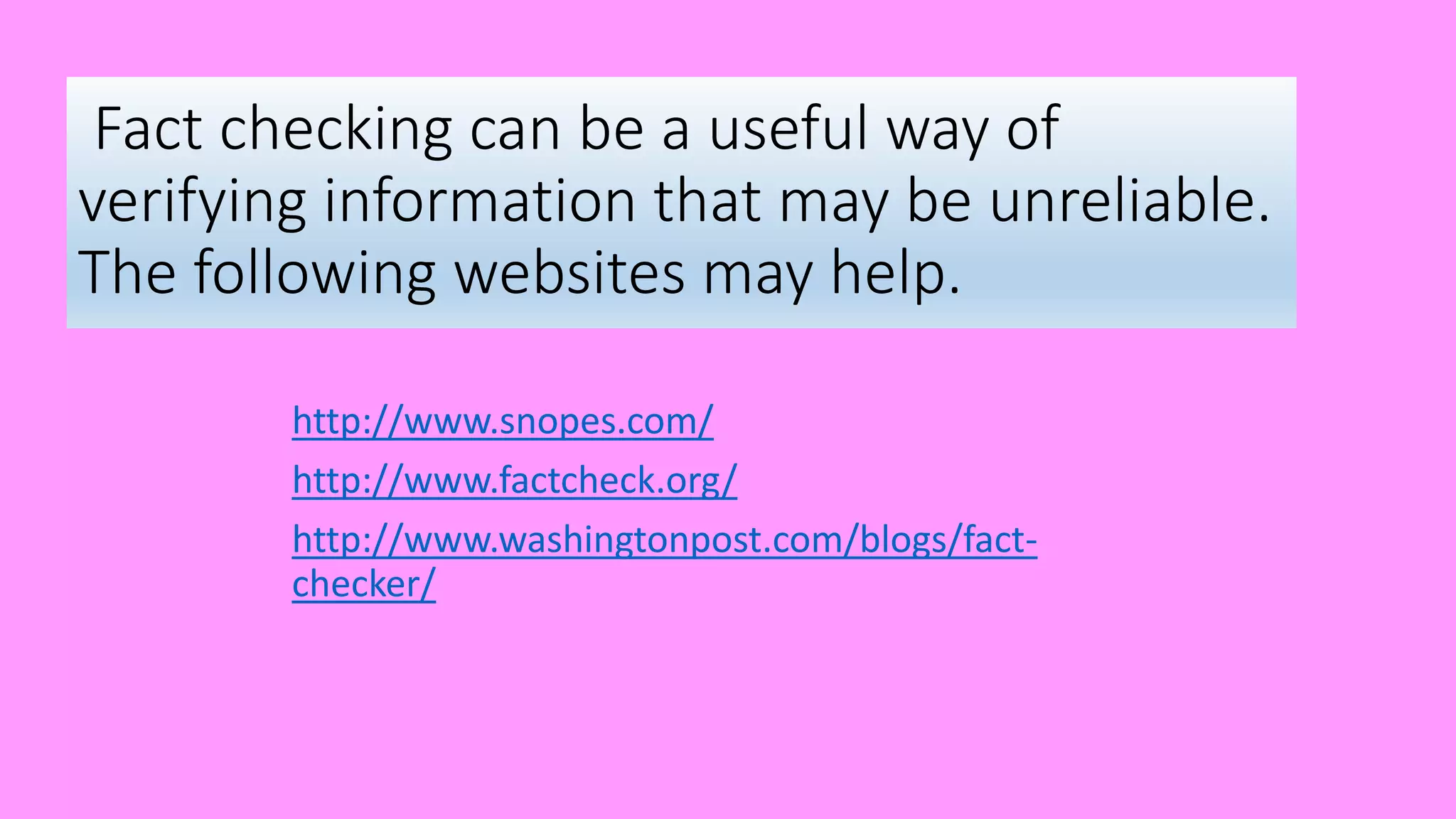
Fact checking can be a useful way of
verifying information that may be unreliable.
The following websites may help.
http://www.snopes.com/
http://www.factcheck.org/
http://www.washingtonpost.com/blogs/fact-
checker/
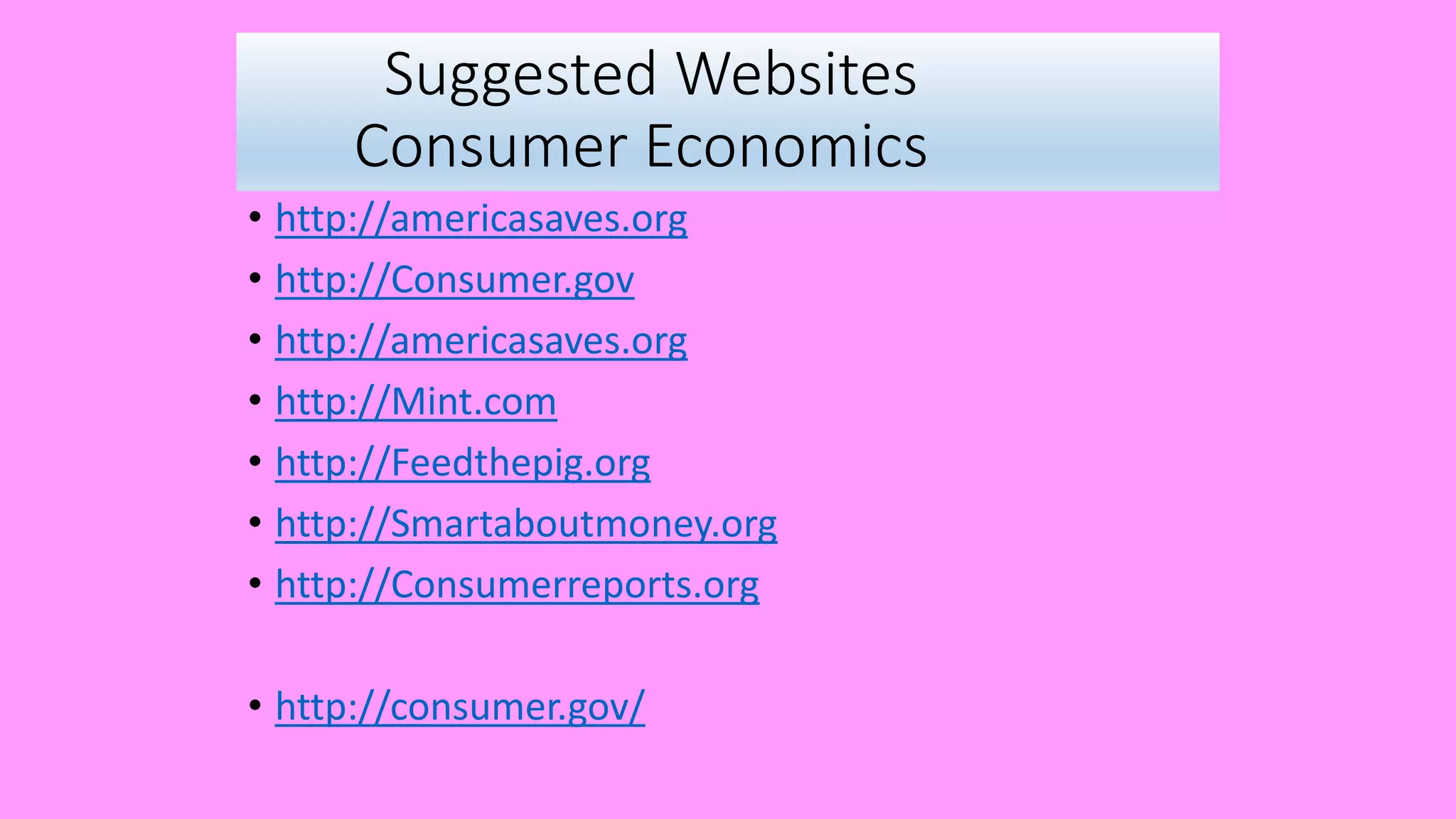
Suggested Websites
Consumer Economics
• http://americasaves.org
• http://Consumer.gov
• http://americasaves.org
• http://Mint.com
• http://Feedthepig.org
• http://Smartaboutmoney.org
• http://Consumerreports.org
• http://consumer.gov/
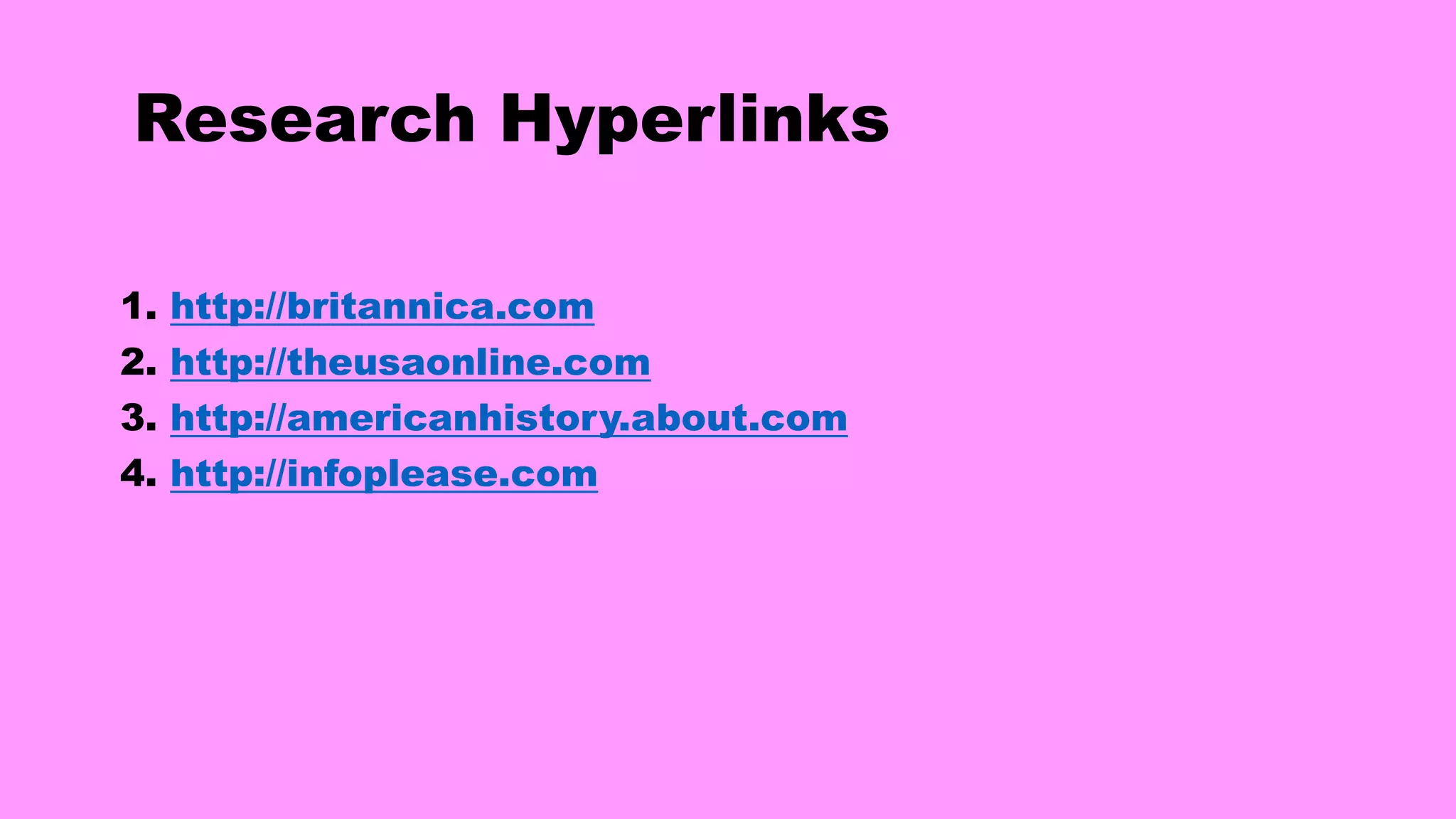
Research Hyperlinks
1. http://britannica.com
2. http://theusaonline.com
3. http://americanhistory.about.com
4. http://infoplease.com
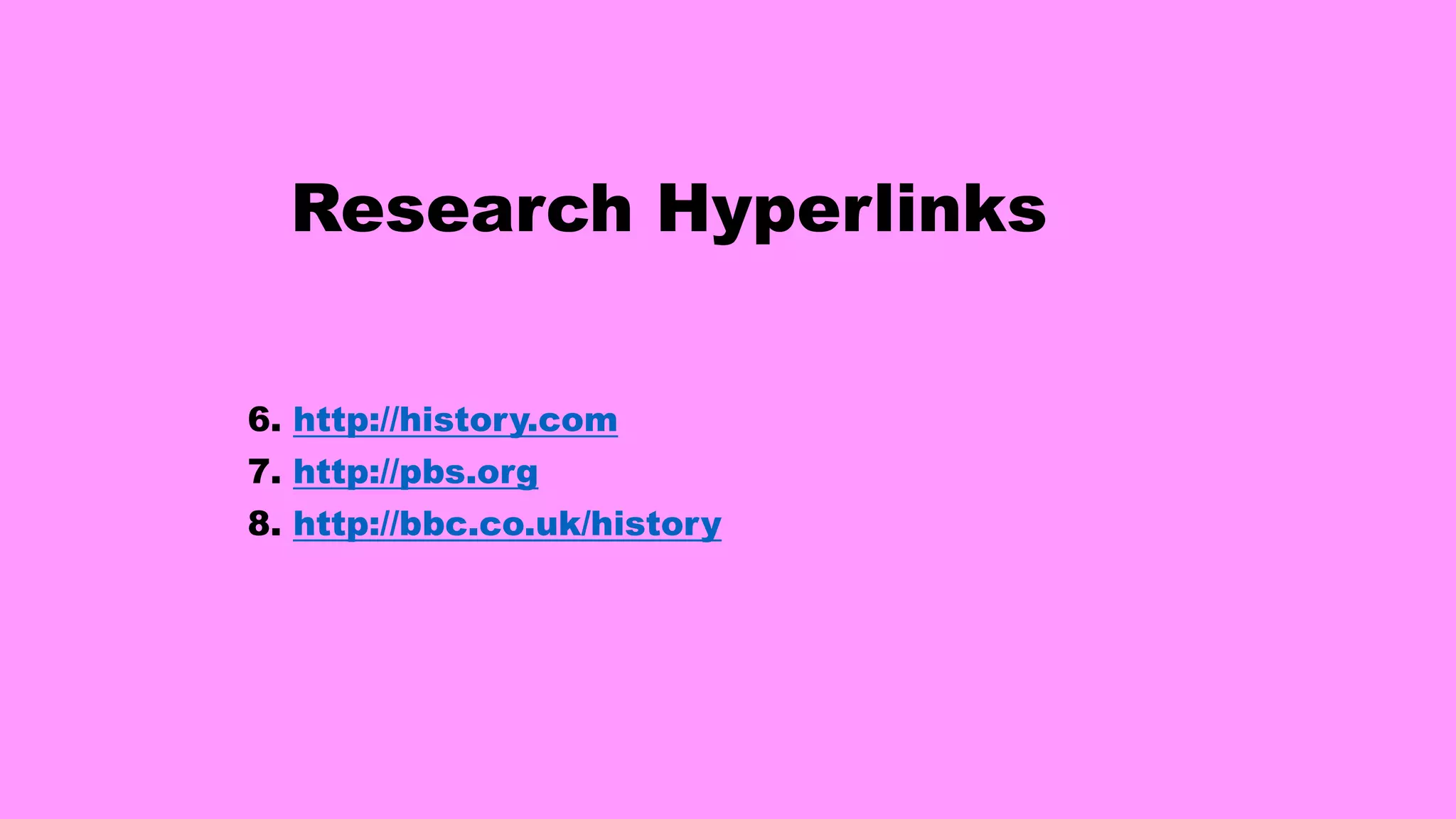
Research Hyperlinks
6. http://history.com
7. http://pbs.org
8. http://bbc.co.uk/history
How Do We Know if the Information is
Reliable? 5 min Illustrated Excellent!!!
• https://www.youtube.com/watch?v=m_EAxomGhNY

Dean r berry Determining the Credibility of Sources

  • 1.
    Determining the Credibility ofSources By Dean Berry, Ed. D. www.commoncorecurriculum.info
  • 2.
    •Free PowerPoint Versionat •Slideshare.com •Type PPT title or dean r berry
  • 3.
    Conducting research isa critical activity, but…
  • 4.
    Can you trustyour sources?
  • 5.
    Surfing the internetcan be a wild and crazy ride.
  • 6.
    Has this everhappened to you? If you are unsure about the credibility of information from a certain website or article, what should you do? You are browsing on your phone and go to a commonly used website that reports high interest and sometimes shocking events. A story is posted that captures your attention. It is so bizarre that you tweet it to your friends. Your friends send the information to their friends. Within minutes the story gets legs of its own and runs around the globe becoming a believed event by millions of people. Because so many people are talking about the event, it is now perceived as factual by most people.
  • 7.
    With the interneteveryone is an expert(NOT).
  • 8.
    How Important isthe Truth?
  • 9.
    Sifting through the barrageof internet noise…
  • 10.
    Give Your Sourcethe Third Degree
  • 11.
    Use these questionsto determine the credibility of sources. Open a Word file and type these questions. •Is the author a recognized expert on the topic? •Is the author’s purpose to persuade us or to provide unbiased information? •Is the website a mainstream, well established site that is recognized by other experts in the field?
  • 12.
    • Does thewebsite fairly evaluate and consider both sides of an issue? • Does the author cite supportive research or references?
  • 13.
    Trusting Your SourcesChecklist Open a Word file and type this checklist• ___Have you checked multiple sources that confirm the information? ___Does the article only present one point of view? ___Does the website or author have a connection to a group or organization that will benefit by presenting a certain viewpoint? ___Does this website or author have a good track record of presenting reliable information? ___Does this internet site use sensational headlines to increase viewership and attention that enhances the value of their advertising?
  • 14.
    When using googleyou should always… Complete this sentence.
  • 15.
    Finding the BestSources Meet in groups and discuss this question. How do you know that you have the best and most accurate information on your topic? 15
  • 16.
    Selecting a reliablesearch engine is a critical part of beginning your research on a topic. Commercial search engines such as google, bing, or yahoo have many built-in biases. However, they do operate special news search engines that are very different from their regular search engines. These search engines target newspaper articles only and are very reliable. Discuss These Questions • Do the best websites come up first when you use one of these well known search engines? • What determines which web sites show up first on these commercial search engines? • What are the advantages of finding a specialized search engine that is considered reliable?
  • 17.
    Accessing Newspaper ArticlesAbout a Topic • Newspapers are expected to report factually correct information. If they knowingly report false information they are violating the law. • This doesn’t mean that newspapers are always correct. However, you can expect well regarded, mainstream newspapers to report accurate information in their stories and articles. The exception is when stories are labeled as editorials or op-ed articles which represent opinions. The popular search engines(google, yahoo, and bing) offer specialized search engines that list only newspaper articles by respected news agencies.
  • 18.
    Are you searchingfor factual information about a specific topic? If so, you are in luck! The following frames include three excellent search engines that will send you to reliable and trusted newspaper articles. These search engines are the best kept secrets on the internet. Students looking for credible sources of information should include these search engines as they conduct research.
  • 19.
    Use news.yahoo tofind newspaper articles on any topic http://news.yahoo.com/world/
  • 20.
    Search news.google for newspaperarticles on any topic. https://news.google.com/
  • 21.
    Search Newspaper Articleson bing.com/ news for Any Topic. https://www.bing.com/news
  • 22.
    The Most ReliableSearch Engines in the World Fortunately, you can learn how to bypass the wild west of lies and embellishment, known as the internet. Smart students use the most reliable and trusted search engines to access a large bank of information sources. Experts and major organizations such as the National Education Association have endorsed www.findingdulcinea.com and www.sweetsearch.com .
  • 23.
    http://www.sweetsearch.com/ Use your chromebookand access this site. Search for a controversial topic such as global warming or gun control. What did you find?
  • 24.
    How do weknow that sweetsearch.com is a reliable search engine? Commonsense media.org Rates the Sweet Search Site • SweetSearch provides middle and high school students with a search engine that suggests safe, relevant site options. Research experts, librarians, and teachers have proactively reviewed the 35,000 sites that may appear in search results to ensure they're a reliable information source. Another option is the search engine findingDulcinea, which was created with a similar goal; others are reputable sites from organizations like the University of Colorado, the New York Times, and the U.S. Securities and Exchange Commission. • Though sites are pre-screened, students can still encounter opinion pieces and less credible articles. Students should continue to use critical thinking skills while gathering research with www.Sweetsearch.com .
  • 25.
    Endorsed by theNational Education Association Librarian on the Internet http://www.findingdulcinea.com/info/m ain/Our-Mission.html
  • 26.
    Another Great Wayto Find Reliable Websites www.refdesk.com Use your notebook and go to this website. Browse the resources on this site.
  • 27.
    Websites with GoodReputations for Certain Subjects There are many established websites that have good reputations among experts in the field. For example, the Mayo Clinic website is a very credible site for health information. Nololaw.com is free and reliable site for legal information. Check out the following websites and search engines.
  • 28.
    The following medicaland health search engines may be helpful.• Bing Health • Bioinformatic Harvester • CiteAb (antibody search engine for medical researchers) • EB-eye EMBL-EBI's Search engine • GenieKnows • GoPubMed (knowledge-based: GO - GeneOntology and MeSH - Medical Subject Headings) • Healia • californiaHealthline.org • Nextbio (Life Science Search Engine) • PubGene • Quertle (Semantic search of the biomedical literature) • Searchmedica (great medical search engine) • WebMD
  • 29.
    If you arelooking for a job, you might visit one of these search engines…. • Job • Main article: Job search engine • Adzuna (UK) • Bixee.com (India) • CareerBuilder.com (USA) • Craigslist (by city) • Dice.com (USA) • Eluta.ca (Canada) • Hotjobs.com (USA) • JobStreet.com (Southeast Asia, Japan and India) • Incruit (Korea) • Indeed.com (USA) • Glassdoor.com (USA) • LinkUp.com (USA) • Monster.com (USA), (India) • Naukri.com (India) • Yahoo! HotJobs (Countrywise subdomains, International)
  • 30.
    If you arelooking for legal advice, you might check out these search engines… • Legal • Google Scholar • Lexis (Lexis Nexis) • Quicklaw • WestLaw • Nolo.com
  • 31.
    News Services If youare looking for news stories and articles on a specific topic, these search engines may help. • News • Bing News • Daylife • Google News • MagPortal • Newslookup • Nexis (Lexis Nexis) • Topix.net • Trapit • Yahoo! News
  • 32.
    Can you trustthe information that you find on the internet?
  • 33.
    Evaluate and VerifyResearch Sources • Internet sources will vary greatly in accuracy and reliability • Consider the expertise and reputation of each website • Compare facts and information of different internet sources • Select information that is supported on several reliable websites • Question or refute information that lacks consistent support
  • 34.
    Discuss • What areURL’s? • Are some URL’s more likely to offer credible sources of information?
  • 35.
    Discuss Understanding Domains Explain howthese URLs are different. •edu .gov .org .com
  • 36.
    • Websites thatend in .com and .org are sometimes credible, but sometimes not. In these cases, you need to look at the institution or organization that is producing the information. A private individual does not have the credibility needed for academic work; however, a large, established organization like the American Medical Association or the Centers for Disease Control and Prevention do.
  • 37.
    Why are .edusites not always reliable sources of information? • Websites that end in .edu also fall into the category of “usually, but not always, credible.” Individual faculty often provide course websites that include information pertinent to classes they teach. These sites may include lecture materials and interpretation of sources. While faculty at a university are reputable, this information does not go through the “peer-review” process discussed earlier. As such, you should be more cautious with it. • If at all possible, look for that same information from a peer- reviewed source, rather than a professor’s personal .edu source.
  • 38.
    Which websites arethe most reliable? Use discretion with all websites. If you are using any online source other than a scholarly university database, you should exercise caution because anyone can publish their thoughts on the internet, regardless of the merit of those thoughts. As a general rule, all .gov websites are credible because they have the weight of governmental institutions behind them.
  • 39.
    Which URL’s CanYou Trust the Most?
  • 40.
  • 42.
    Is the publisherrecognized as reliable and trustworthy by experts in the field? Investigate the publisher. The institution housing the information can often tell you a great deal about how credible that information is. For example, you should feel more comfortable trusting information found in The New York Times or The Washington Post — two newspapers with proven track records of journalistic integrity and public retraction of errors — than that found in a source like Infowars, which has a wide readership, but often publishes misleading or blatantly incorrect information.[9]
  • 43.
    There are large,famous organizations that are still known to have biases. For example, People for the Ethical Treatment of Animals will provide only that information which supports their cause, whereas the U.S. Fish and Wildlife Services might provide the same family of information without agenda bias.
  • 44.
    What’s the nextstep? Now that you have found your sources, it’s time to determine if your information is accurate and reliable. Should you trust what the author is suggesting? Let’s find out.
  • 45.
    Take a closelook at information before you use it to support a claim.
  • 46.
    What is theauthor up to? • Is the author presenting information that is clearly supported by credible evidence? • What does the author want us to believe? • Does the author have an agenda or motive for presenting the information? • Does the author use logical fallacies to convince readers? • Does the tone used by the author give us important clues to all of these questions?
  • 47.
    Discuss the importanceof these questions. What is the author’s purpose in writing the selection? How do you know? Can you give some examples of the different purposes authors have when they present information? How might the tone used in a selection provide clues to these questions?
  • 48.
    Identifying how theauthor establishes the tone of the selection helps the reader understand the author’s purpose and if the author is attempting to persuade the reader using emotion rather than logical arguments.
  • 49.
    The tone maybe very thoughtful with a presentation of facts on both sides of the issue or…
  • 50.
    The tone maystimulate an emotion or create a specific mood that helps the author deliver his/her message.
  • 51.
    Discuss •What are someof the different tones that authors use to get their point across? •How might a specific tone help an author develop his/her purpose?
  • 53.
    There are manydifferent tones that authors can use to get across their message.
  • 54.
    The tone ofthe text may be created to evoke intense emotion. Creating fear, pity or anger is a common way for an author to manipulate the reader into accepting a spurious argument that is seriously lacking in supporting evidence and clear logic.
  • 55.
    Sometimes an authorchooses to use more powerful, emotionally charged words to create an emotional response in the reader.
  • 56.
    Loaded words packa lot of power and emotion.
  • 57.
    The Bottom Lineis… Readers should accept information as reliable only when it is supported by many other credible sources. When readers use logic and the scientific method, they are better able to arrive at ideas that are supported by solid evidence.
  • 58.
    Preponderance of Evidence Howdo you know whether or not an idea or theory should be believed? • Science tells us that ideas that are supported by overwhelming evidence, may be treated as facts. • Ideas or theories that have mixed evidence(some pro and some con) should not be treated as facts 58
  • 59.
    Appendix of Resources Thefollowing hyperlinks provide quick and easy access to reliable websites
  • 60.
    America’s Library ofHistory Resources • http://www.americaslibrary.gov/jb/index.php
  • 61.
    Research Hyperlinks 1. http://about.com 2.http://learn.genetics.Utah.edu 3. http://virtualmedicalcentre.com 4. http://cnn.com/health 5 . http://zmescience.com 6. http://pbs.org 7. http://brittanica.com
  • 62.
    Research hyperlinks 8. http://dailyscience.com 9.http://dnaftb.org 10. http://genome.gov 11. http://scienceline.ucsb.edu 12. http://cellsalive.com 13. http://genengnews.com 14. http://ghr.nim.nih.gov
  • 63.
    Fact checking canbe a useful way of verifying information that may be unreliable. The following websites may help. http://www.snopes.com/ http://www.factcheck.org/ http://www.washingtonpost.com/blogs/fact- checker/
  • 64.
    Suggested Websites Consumer Economics •http://americasaves.org • http://Consumer.gov • http://americasaves.org • http://Mint.com • http://Feedthepig.org • http://Smartaboutmoney.org • http://Consumerreports.org • http://consumer.gov/
  • 65.
    Research Hyperlinks 1. http://britannica.com 2.http://theusaonline.com 3. http://americanhistory.about.com 4. http://infoplease.com
  • 66.
    Research Hyperlinks 6. http://history.com 7.http://pbs.org 8. http://bbc.co.uk/history
  • 67.
    How Do WeKnow if the Information is Reliable? 5 min Illustrated Excellent!!! • https://www.youtube.com/watch?v=m_EAxomGhNY