Evaluating Business Partnerships –
Reflections & Questions | 4 May 2017
Contents
2
Context
Our global partnerships – GSK &
RB
Reflections and on-going questions
A bit of background on us…
3
• Global INGO, founded 1919
• 120 countries;
• 2015 revenue of $2.1 billion
• 2015 Total Reach: 62 million children
• Horizontal federation: 29 member organisations + Save the
Children International
• Programming focal areas: health & nutrition, education, child
protection, poverty and humanitarian response
Save the Children
Save the Children UK
• 35 focal countries;
• 2015 revenue of £390 million
• 2015 Total Reach: 17.5 million children (28%)
10 global private sector partnerships
What is Save the Children?
… & on the sector
4
Call for the private sector to play a stronger, more integrated role in
developing, including efforts to achieve the SDGs….
…. and business mind-sets are evolving, from focusing primarily on
compliance and philanthropy, to seeing shared value opportunities.
Shared value requires partnership, and business is increasing
willing to move away from a traditional donor relationship to
partnering …
…however, partnering with business can still present risks.
New attitudes towards the role of the private sector in
development
Contents
5
Context
Our global partnerships – GSK &
RB
Reflections and on-going questions
Focus on 2 current global partnerships:
6
GSK
7
10 workstreams
37 countries, 55+ projects
Reached 4.6 million people
(2.6 million children)
3 domains of impact:
• Results for children
• Organisational systems and
capacities
• Influencing the sector
GSK partnership – the challenge
8
 10 workstreams – diverse approaches, not all
programmatic
 37 countries, 55+ projects – variable data quality &
indicators
 Data hungry partner
 Impact evaluation not always appropriate/ possible (e.g
humanitarian work, advocacy, work in conflict zones)
 Changing M&E system halfway through the partnership
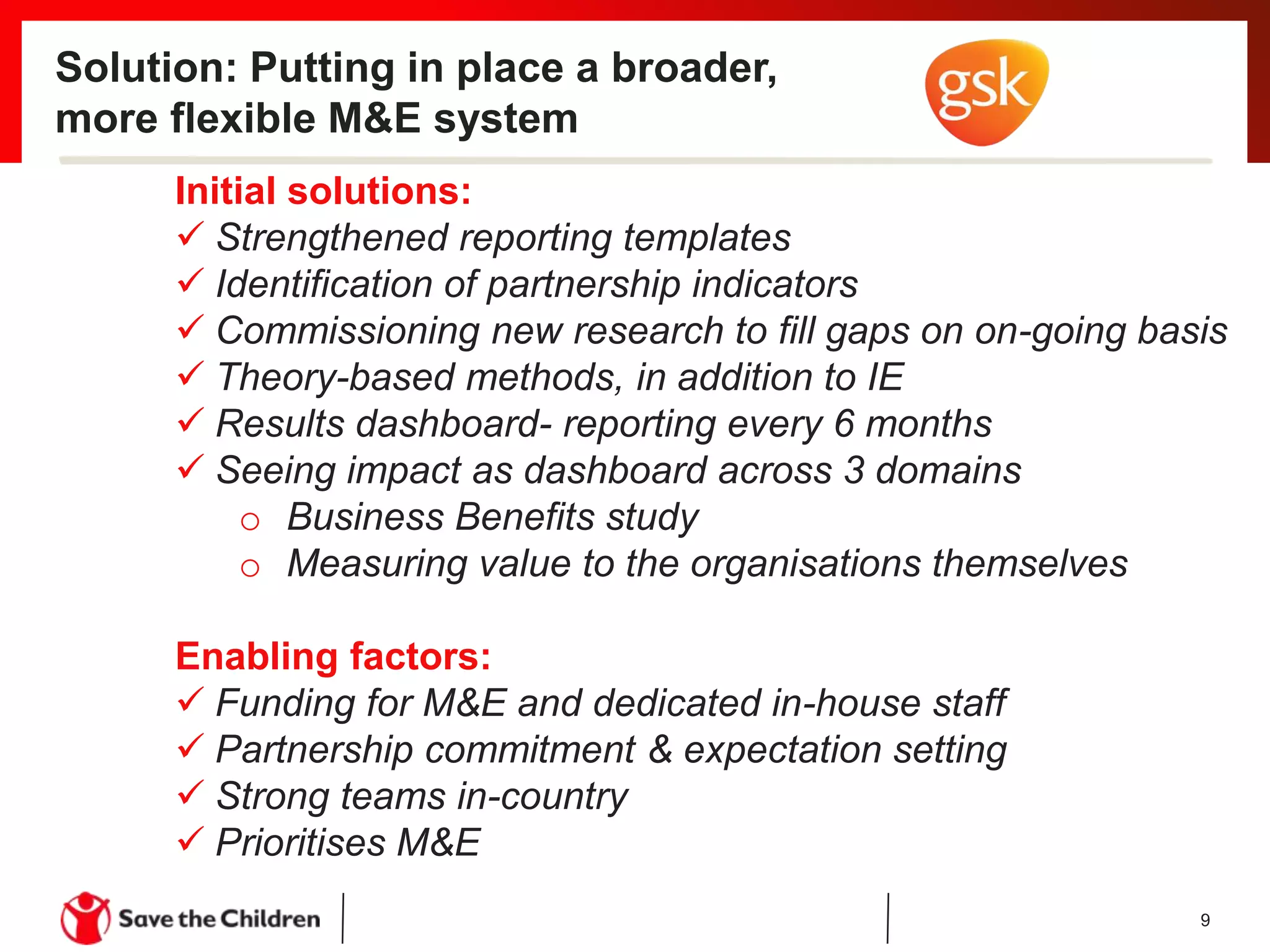
Solution: Putting in place a broader,
more flexible M&E system
9
Initial solutions:
 Strengthened reporting templates
 Identification of partnership indicators
 Commissioning new research to fill gaps on on-going basis
 Theory-based methods, in addition to IE
 Results dashboard- reporting every 6 months
 Seeing impact as dashboard across 3 domains
o Business Benefits study
o Measuring value to the organisations themselves
Enabling factors:
 Funding for M&E and dedicated in-house staff
 Partnership commitment & expectation setting
 Strong teams in-country
 Prioritises M&E
RB
10
“Stop Diarrhoea Initiative”
3 countries
WHO 7-point plan
Reached 840,000 people
Key targets
• 50% reduction diarrhoea incidence
• 50% reduction diarrhoea
prevalence
• 80% reduction diarrhoea-related
under-5 mortality
RB partnership – the challenge
11
 High expectations for M&E; require rigorous impact
evaluation
 Evaluation design changed after inception phase;
so putting in place evaluation design after project
start
 Projects aiming to implement highly ambitious
design consistently across 3 countries
 Partner is target-oriented; eager to see results and
course-correct
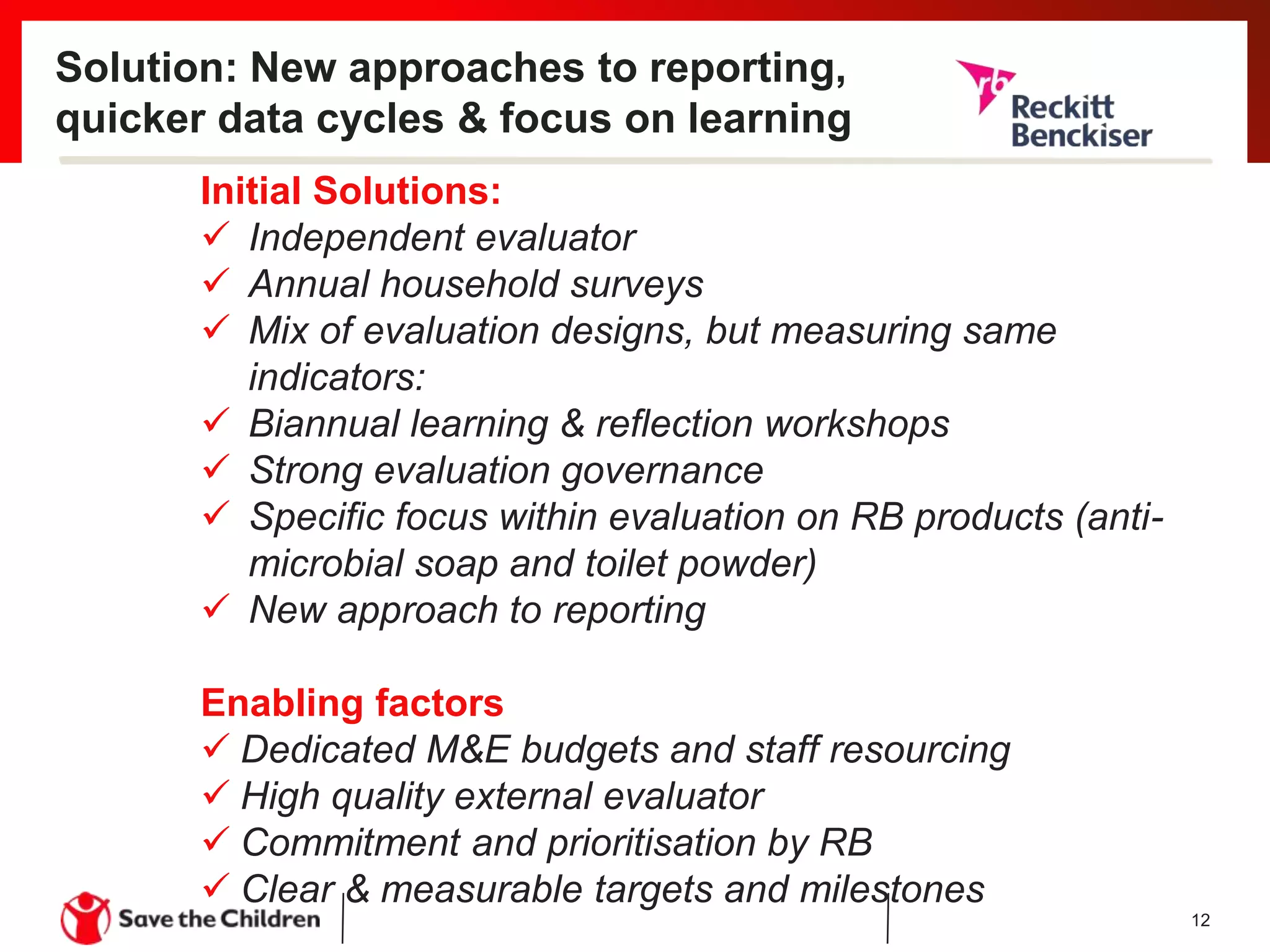
Solution: New approaches to reporting,
quicker data cycles & focus on learning
12
Initial Solutions:
 Independent evaluator
 Annual household surveys
 Mix of evaluation designs, but measuring same
indicators:
 Biannual learning & reflection workshops
 Strong evaluation governance
 Specific focus within evaluation on RB products (anti-
microbial soap and toilet powder)
 New approach to reporting
Enabling factors
 Dedicated M&E budgets and staff resourcing
 High quality external evaluator
 Commitment and prioritisation by RB
 Clear & measurable targets and milestones
Contents
13
Context
Our global partnerships – GSK &
RB
Reflections and on-going questions
Key Reflections
14
Businesses have different data
expectations compared to traditional
donors (& are less constrained in
terms of internal processes and
requirements)
1
They want [reliable]
results early and
often…..
2
3
.. so that data can be used
for course correction &
[radical] adaptation if
needed
Business Partnerships provide an opening for new
approaches to monitoring, evaluation & learning….
15
Businesses approach development challenges with different
assumptions and norms, which provides us with an
opportunity to work differently:
 Flexibility around processes,
reporting & evaluation
methods.
 Appetite for innovation
 Emphasis on data: only
measure what’s important
 Open to course- correction and
adaptation midstream
 Assessing impact of the
partnership as a whole– business
value as well as social value
 Desire for close working
relationships and collaboration;
want to be part of the process
…. they also throw up challenges
16
Expect hard target setting and
forecasting (both financial and
results)
Variable understanding of
evidence; resistance to
caveats and uncertainty
Evolving needs and
understanding of development
context
Delivering business value creates different requirements and
needs, which we cannot meet if we conduct ‘business as
usual’ M&E:
Evolving needs over project
lifespan
Desire for quick wins and
early results
Prioritisation of hard figures
over qualitative data /
understanding ‘how’ or ‘why’
Questions we are asking ourselves:
17
Methodological rigour (vs? ) flexibility?
What is the right balance of reporting?
Adaptive programming vs target-setting and
measurable impact?
Right balance of adaptation and real-time data, while
respecting time and capacity of team on the ground?
Right resourcing within SCUK?
Use of technology?
…. Realistic & feasible?
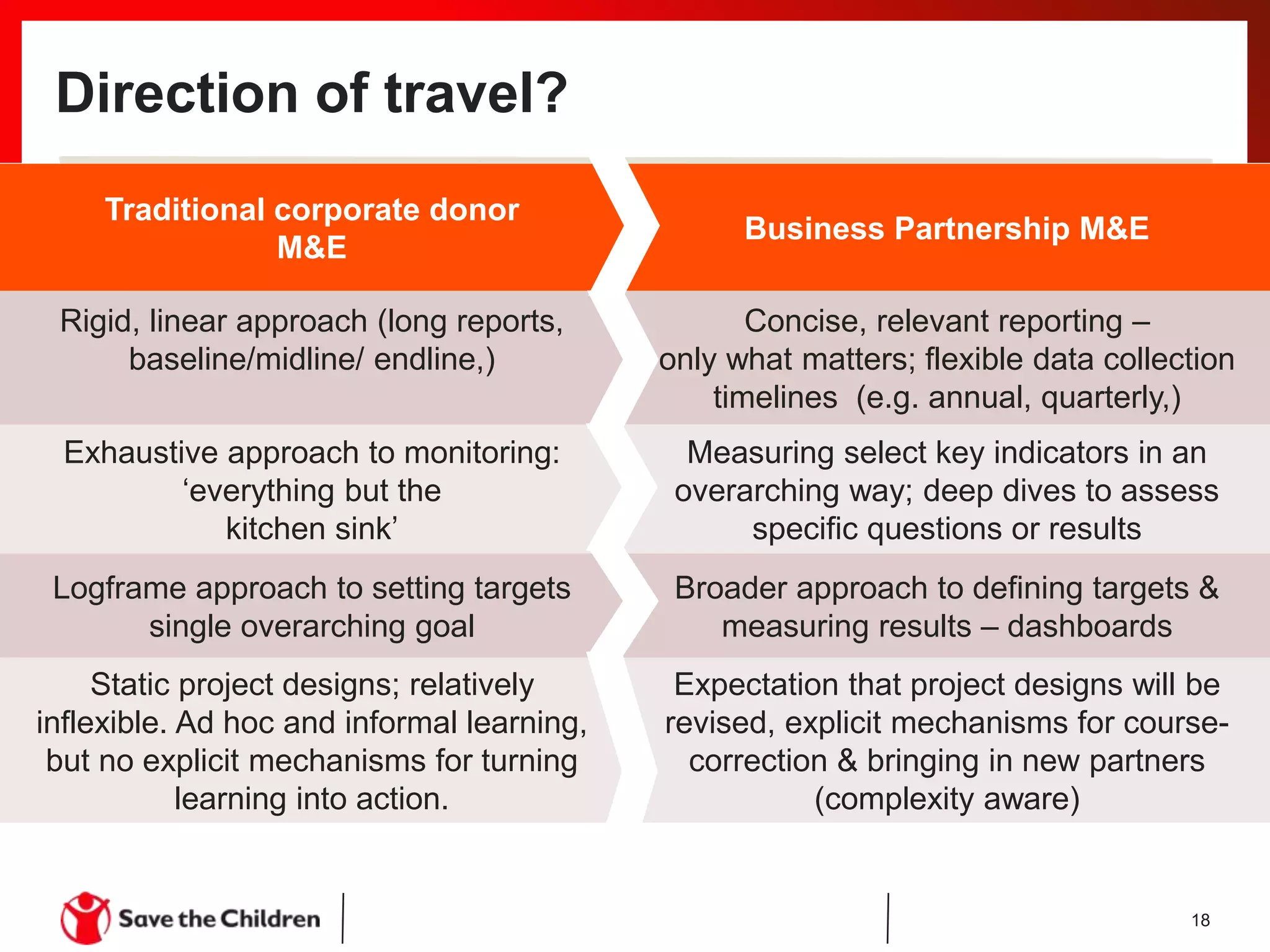
Traditional corporate donor
M&E
Business Partnership M&E
Rigid, linear approach (long reports,
baseline/midline/ endline,)
Concise, relevant reporting –
only what matters; flexible data collection
timelines (e.g. annual, quarterly,)
Exhaustive approach to monitoring:
‘everything but the
kitchen sink’
Measuring select key indicators in an
overarching way; deep dives to assess
specific questions or results
Logframe approach to setting targets
single overarching goal
Broader approach to defining targets &
measuring results – dashboards
Static project designs; relatively
inflexible. Ad hoc and informal learning,
but no explicit mechanisms for turning
learning into action.
Expectation that project designs will be
revised, explicit mechanisms for course-
correction & bringing in new partners
(complexity aware)
Direction of travel?
18

Evaluating impact of business partnerships

  • 1.
    Evaluating Business Partnerships– Reflections & Questions | 4 May 2017
  • 2.
    Contents 2 Context Our global partnerships– GSK & RB Reflections and on-going questions
  • 3.
    A bit ofbackground on us… 3 • Global INGO, founded 1919 • 120 countries; • 2015 revenue of $2.1 billion • 2015 Total Reach: 62 million children • Horizontal federation: 29 member organisations + Save the Children International • Programming focal areas: health & nutrition, education, child protection, poverty and humanitarian response Save the Children Save the Children UK • 35 focal countries; • 2015 revenue of £390 million • 2015 Total Reach: 17.5 million children (28%) 10 global private sector partnerships What is Save the Children?
  • 4.
    … & onthe sector 4 Call for the private sector to play a stronger, more integrated role in developing, including efforts to achieve the SDGs…. …. and business mind-sets are evolving, from focusing primarily on compliance and philanthropy, to seeing shared value opportunities. Shared value requires partnership, and business is increasing willing to move away from a traditional donor relationship to partnering … …however, partnering with business can still present risks. New attitudes towards the role of the private sector in development
  • 5.
    Contents 5 Context Our global partnerships– GSK & RB Reflections and on-going questions
  • 6.
    Focus on 2current global partnerships: 6
  • 7.
    GSK 7 10 workstreams 37 countries,55+ projects Reached 4.6 million people (2.6 million children) 3 domains of impact: • Results for children • Organisational systems and capacities • Influencing the sector
  • 8.
    GSK partnership –the challenge 8  10 workstreams – diverse approaches, not all programmatic  37 countries, 55+ projects – variable data quality & indicators  Data hungry partner  Impact evaluation not always appropriate/ possible (e.g humanitarian work, advocacy, work in conflict zones)  Changing M&E system halfway through the partnership
  • 9.
    Solution: Putting inplace a broader, more flexible M&E system 9 Initial solutions:  Strengthened reporting templates  Identification of partnership indicators  Commissioning new research to fill gaps on on-going basis  Theory-based methods, in addition to IE  Results dashboard- reporting every 6 months  Seeing impact as dashboard across 3 domains o Business Benefits study o Measuring value to the organisations themselves Enabling factors:  Funding for M&E and dedicated in-house staff  Partnership commitment & expectation setting  Strong teams in-country  Prioritises M&E
  • 10.
    RB 10 “Stop Diarrhoea Initiative” 3countries WHO 7-point plan Reached 840,000 people Key targets • 50% reduction diarrhoea incidence • 50% reduction diarrhoea prevalence • 80% reduction diarrhoea-related under-5 mortality
  • 11.
    RB partnership –the challenge 11  High expectations for M&E; require rigorous impact evaluation  Evaluation design changed after inception phase; so putting in place evaluation design after project start  Projects aiming to implement highly ambitious design consistently across 3 countries  Partner is target-oriented; eager to see results and course-correct
  • 12.
    Solution: New approachesto reporting, quicker data cycles & focus on learning 12 Initial Solutions:  Independent evaluator  Annual household surveys  Mix of evaluation designs, but measuring same indicators:  Biannual learning & reflection workshops  Strong evaluation governance  Specific focus within evaluation on RB products (anti- microbial soap and toilet powder)  New approach to reporting Enabling factors  Dedicated M&E budgets and staff resourcing  High quality external evaluator  Commitment and prioritisation by RB  Clear & measurable targets and milestones
  • 13.
    Contents 13 Context Our global partnerships– GSK & RB Reflections and on-going questions
  • 14.
    Key Reflections 14 Businesses havedifferent data expectations compared to traditional donors (& are less constrained in terms of internal processes and requirements) 1 They want [reliable] results early and often….. 2 3 .. so that data can be used for course correction & [radical] adaptation if needed
  • 15.
    Business Partnerships providean opening for new approaches to monitoring, evaluation & learning…. 15 Businesses approach development challenges with different assumptions and norms, which provides us with an opportunity to work differently:  Flexibility around processes, reporting & evaluation methods.  Appetite for innovation  Emphasis on data: only measure what’s important  Open to course- correction and adaptation midstream  Assessing impact of the partnership as a whole– business value as well as social value  Desire for close working relationships and collaboration; want to be part of the process
  • 16.
    …. they alsothrow up challenges 16 Expect hard target setting and forecasting (both financial and results) Variable understanding of evidence; resistance to caveats and uncertainty Evolving needs and understanding of development context Delivering business value creates different requirements and needs, which we cannot meet if we conduct ‘business as usual’ M&E: Evolving needs over project lifespan Desire for quick wins and early results Prioritisation of hard figures over qualitative data / understanding ‘how’ or ‘why’
  • 17.
    Questions we areasking ourselves: 17 Methodological rigour (vs? ) flexibility? What is the right balance of reporting? Adaptive programming vs target-setting and measurable impact? Right balance of adaptation and real-time data, while respecting time and capacity of team on the ground? Right resourcing within SCUK? Use of technology? …. Realistic & feasible?
  • 18.
    Traditional corporate donor M&E BusinessPartnership M&E Rigid, linear approach (long reports, baseline/midline/ endline,) Concise, relevant reporting – only what matters; flexible data collection timelines (e.g. annual, quarterly,) Exhaustive approach to monitoring: ‘everything but the kitchen sink’ Measuring select key indicators in an overarching way; deep dives to assess specific questions or results Logframe approach to setting targets single overarching goal Broader approach to defining targets & measuring results – dashboards Static project designs; relatively inflexible. Ad hoc and informal learning, but no explicit mechanisms for turning learning into action. Expectation that project designs will be revised, explicit mechanisms for course- correction & bringing in new partners (complexity aware) Direction of travel? 18

Editor's Notes

  • #12 Changes as a result of the evaluation: Focus on ORS/Zinc supply chain – co-packs, and liquid zinc (India); increased focus on men in health messaging and CHW outreach, realising the influence they have on home health behaviours (Nigeria).
  • #13 Changes as a result of the evaluation: Focus on ORS/Zinc supply chain – co-packs, and liquid zinc (India); increased focus on men in health messaging and CHW outreach, realising the influence they have on home health behaviours (Nigeria).