
Benefits and Better Business
Cases
Alan Brown
Stefan Sanchez
Presentation:
•The business case and benefits in practice
•Are we being too scientific about benefits
management?
•What is the relationship between the business
case process and programme/project
management?
What is a Better Business Case?
• A flexible, pragmatic and common sense approach for supporting
business decisions in a wide range of contexts
• The Better Business ‘Five Case Model’ jointly developed by HM
Treasury and Welsh Government
• Investments £5m+ a Three stage process
• Strategic outline case (SOC)
• Outline Business Case (OBC)
• Full Business Case (FBC)
• Provides decision makers with confidence and assurance that they
are making the right decisions (business assurance) and in the
correct way (programme and project assurance)
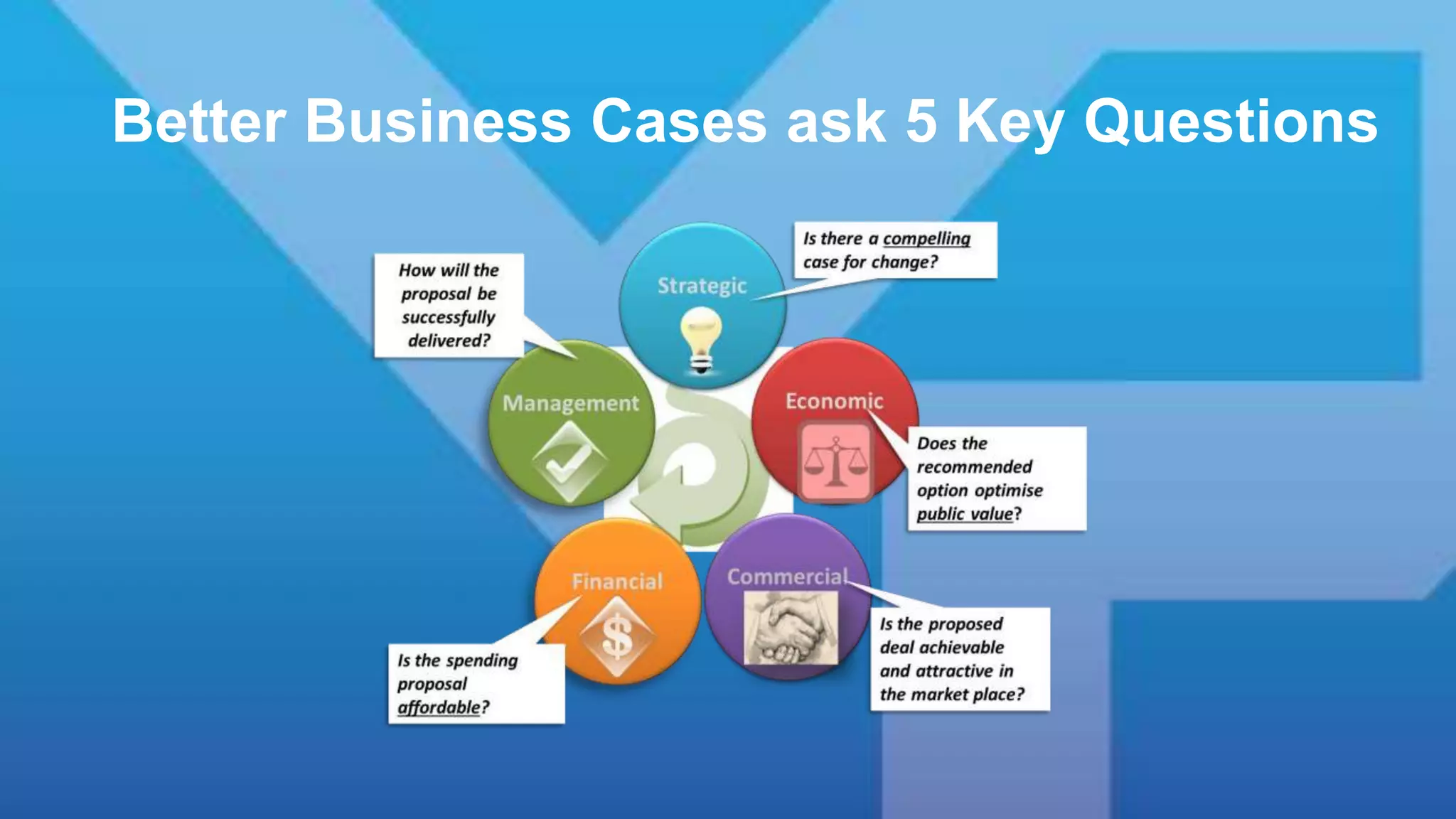
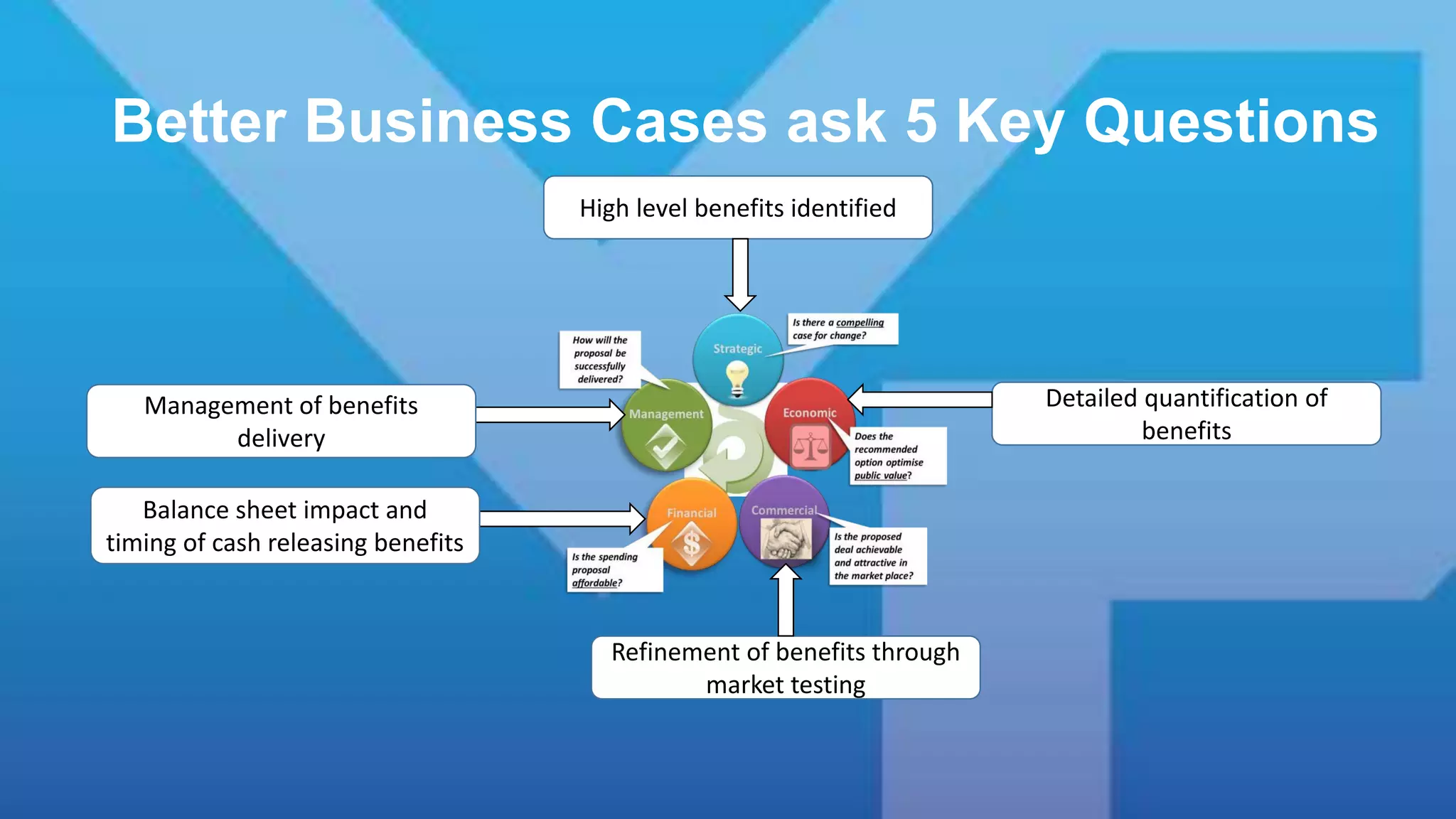
Better Business Cases ask 5 Key Questions
High level benefits identified
Detailed quantification of
benefits
Refinement of benefits through
market testing
Balance sheet impact and
timing of cash releasing benefits
Management of benefits
delivery
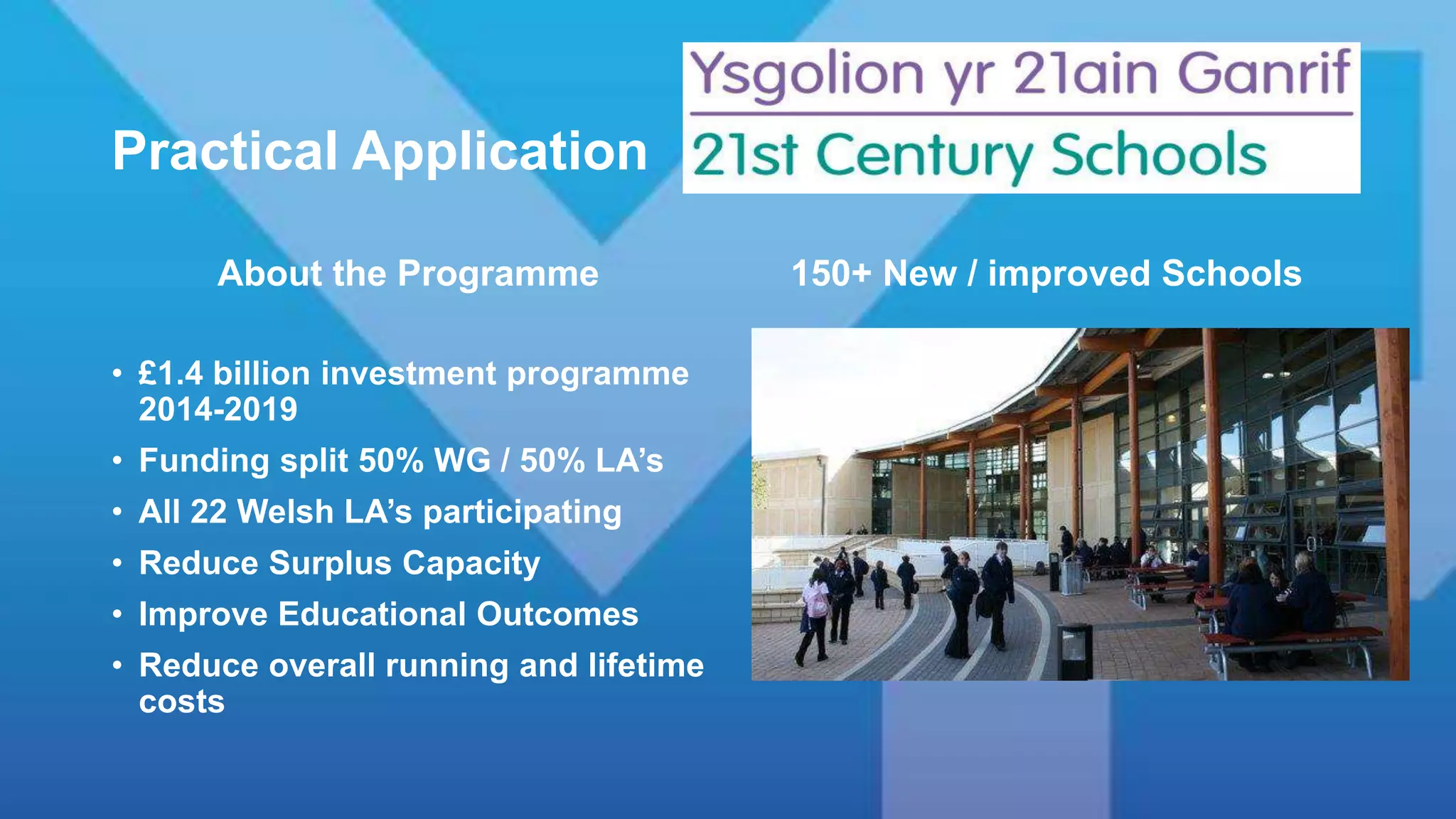
Practical Application
About the Programme
• £1.4 billion investment programme
2014-2019
• Funding split 50% WG / 50% LA’s
• All 22 Welsh LA’s participating
• Reduce Surplus Capacity
• Improve Educational Outcomes
• Reduce overall running and lifetime
costs
150+ New / improved Schools
The business case and benefits
in practice
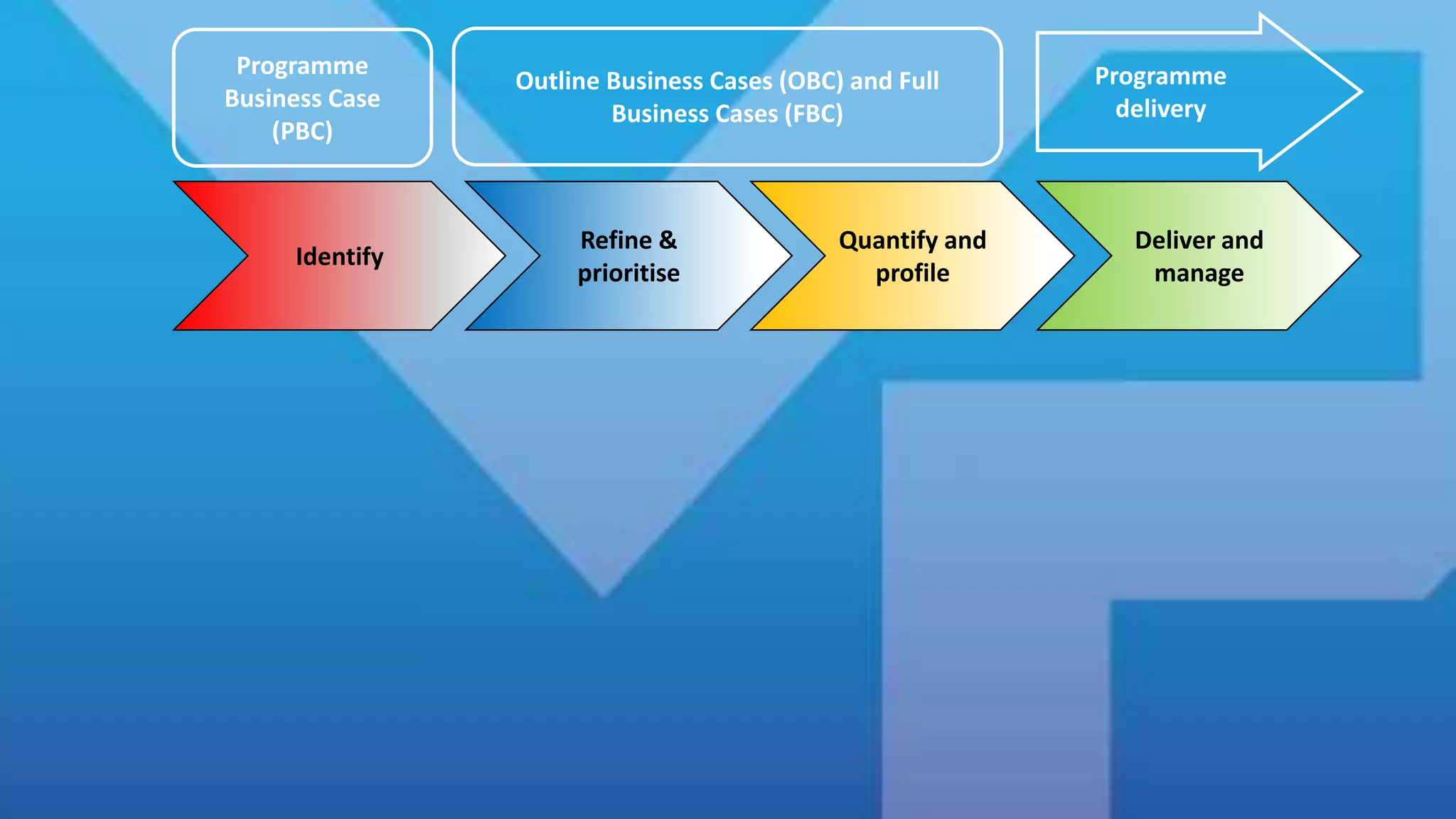
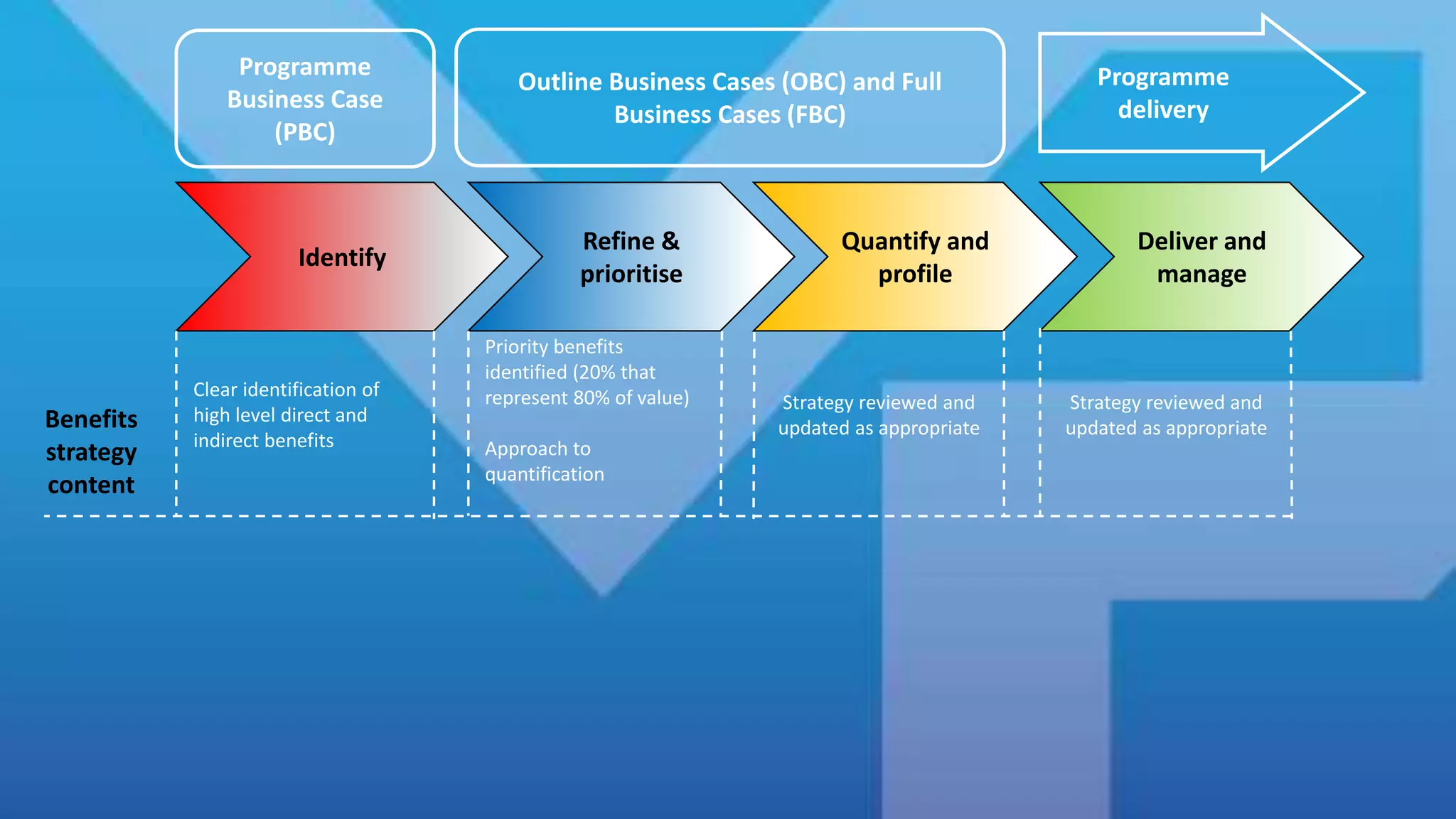
Programme
Business Case
(PBC)
Outline Business Cases (OBC) and Full
Business Cases (FBC)
Programme
delivery
Identify
Refine &
prioritise
Quantify and
profile
Deliver and
manage
Programme
Business Case
(PBC)
Outline Business Cases (OBC) and Full
Business Cases (FBC)
Programme
delivery
Identify
Refine &
prioritise
Quantify and
profile
Deliver and
manage
Clear identification of
high level direct and
indirect benefits
Priority benefits
identified (20% that
represent 80% of value)
Approach to
quantification
Benefits
strategy
content
Strategy reviewed and
updated as appropriate
Strategy reviewed and
updated as appropriate
Programme
Business Case
(PBC)
Outline Business Cases (OBC) and Full
Business Cases (FBC)
Programme
delivery
Identify
Refine &
prioritise
Quantify and
profile
Deliver and
manage
Clear identification of
high level direct and
indirect benefits
Priority benefits
identified (20% that
represent 80% of value)
Approach to
quantification
Benefits
strategy
content
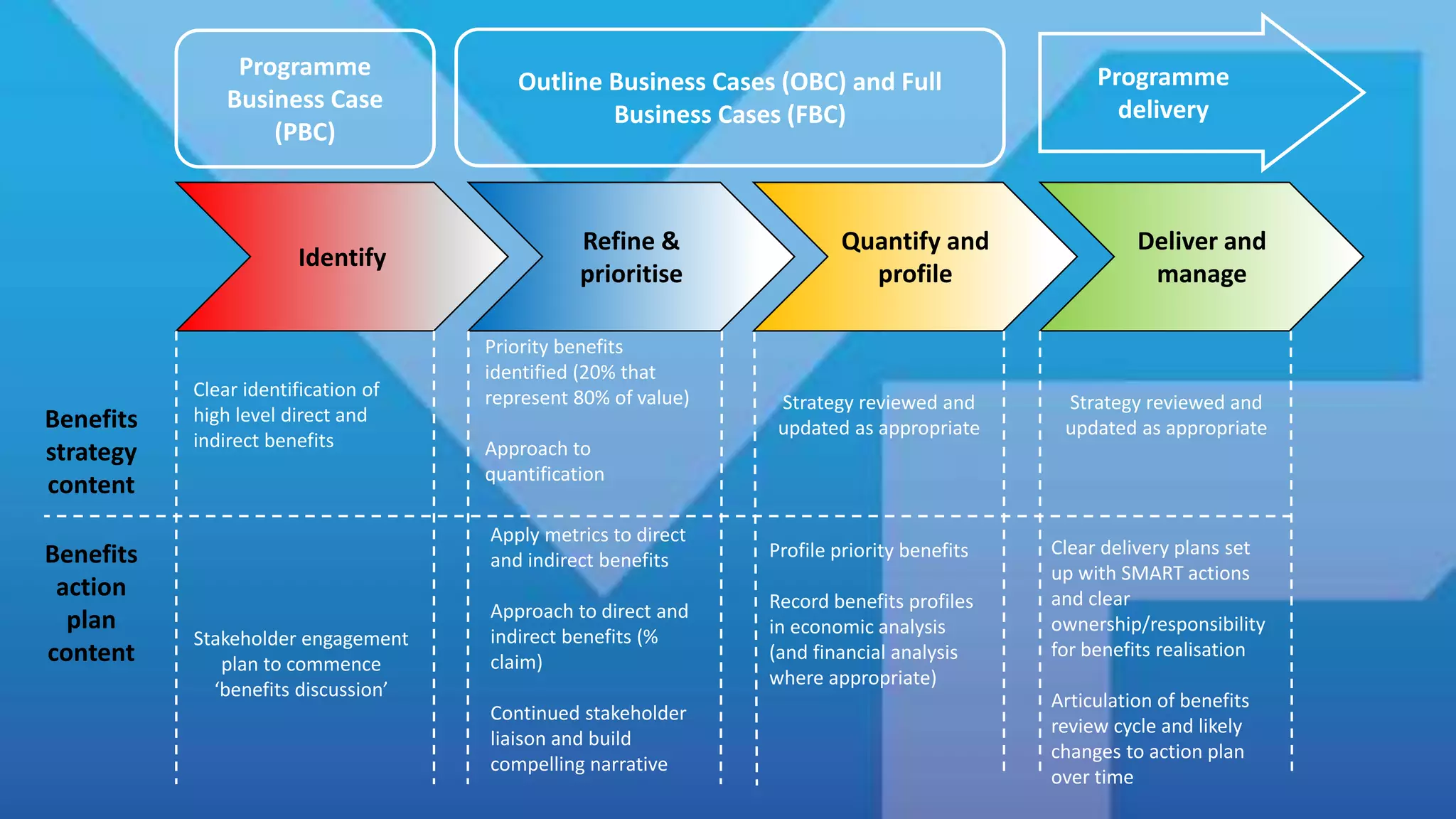
Benefits
action
plan
content
Stakeholder engagement
plan to commence
‘benefits discussion’
Apply metrics to direct
and indirect benefits
Approach to direct and
indirect benefits (%
claim)
Continued stakeholder
liaison and build
compelling narrative
Profile priority benefits
Record benefits profiles
in economic analysis
(and financial analysis
where appropriate)
Clear delivery plans set
up with SMART actions
and clear
ownership/responsibility
for benefits realisation
Articulation of benefits
review cycle and likely
changes to action plan
over time
Strategy reviewed and
updated as appropriate
Strategy reviewed and
updated as appropriate
Programme
Business Case
(PBC)
Outline Business Cases (OBC) and Full
Business Cases (FBC)
Programme
delivery
Identify
Refine &
prioritise
Quantify and
profile
Deliver and
manage
Clear identification of
high level direct and
indirect benefits
Priority benefits
identified (20% that
represent 80% of value)
Approach to
quantification
Benefits
strategy
content
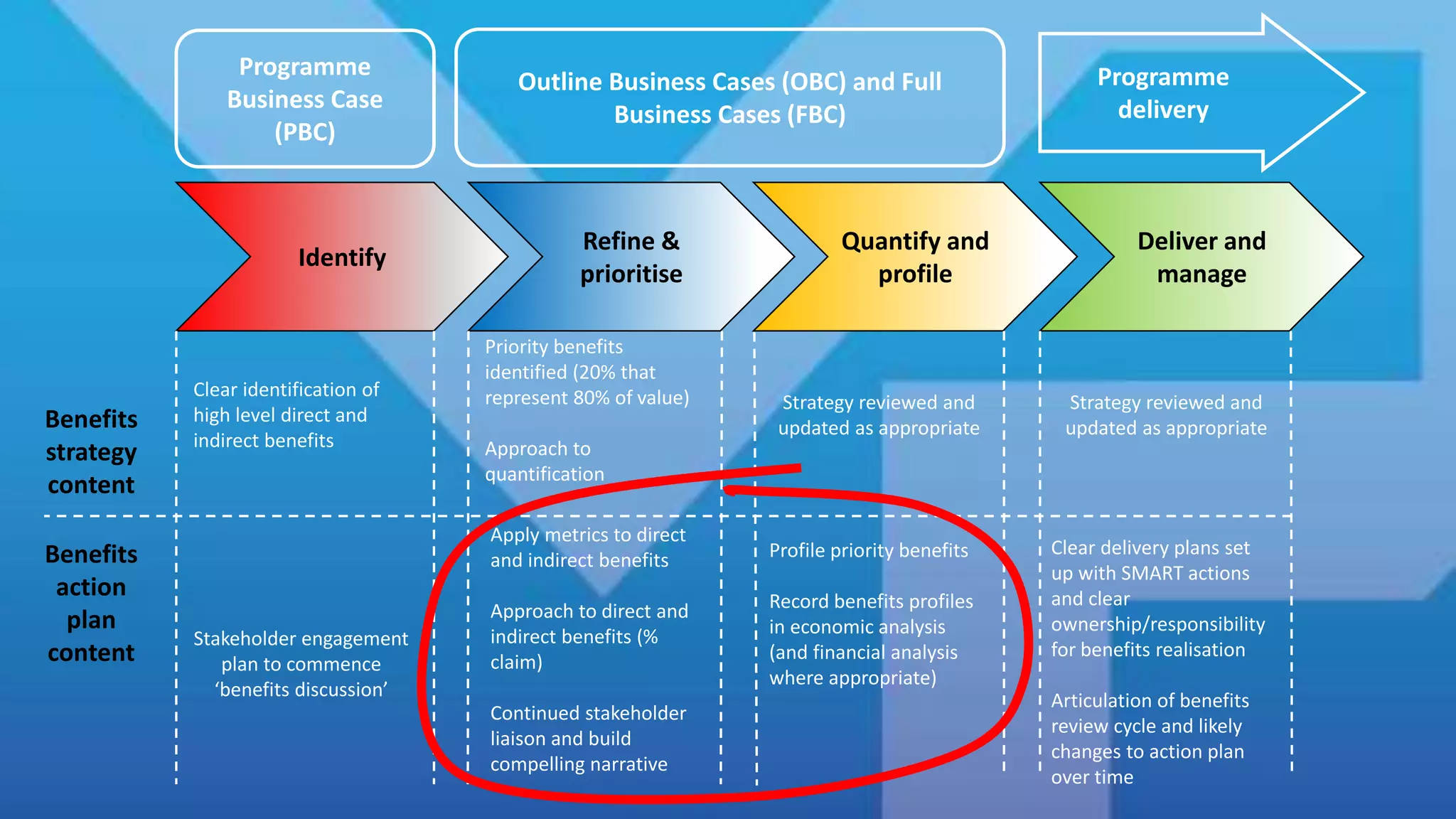
Benefits
action
plan
content
Stakeholder engagement
plan to commence
‘benefits discussion’
Apply metrics to direct
and indirect benefits
Approach to direct and
indirect benefits (%
claim)
Continued stakeholder
liaison and build
compelling narrative
Profile priority benefits
Record benefits profiles
in economic analysis
(and financial analysis
where appropriate)
Clear delivery plans set
up with SMART actions
and clear
ownership/responsibility
for benefits realisation
Articulation of benefits
review cycle and likely
changes to action plan
over time
Strategy reviewed and
updated as appropriate
Strategy reviewed and
updated as appropriate
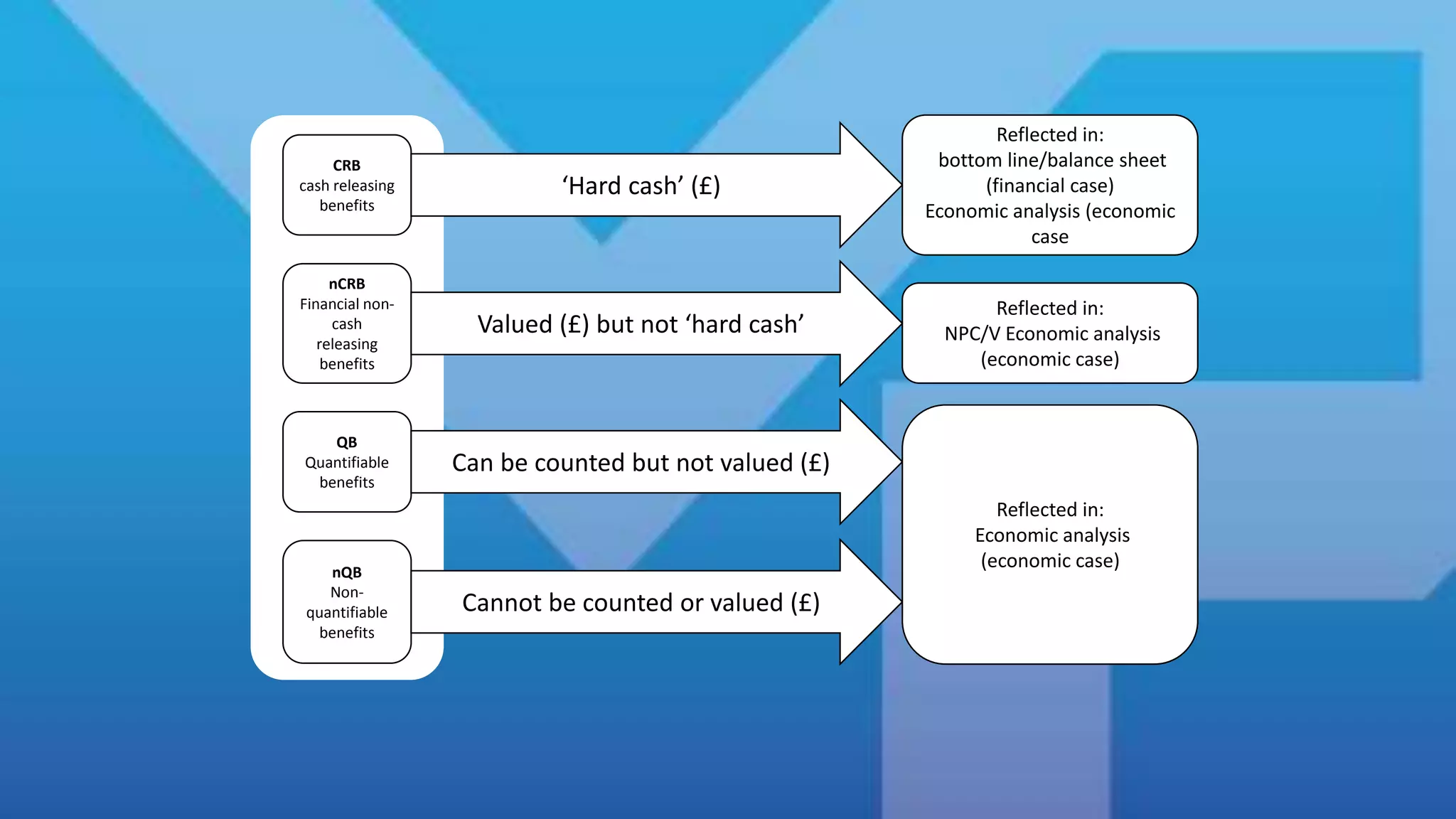
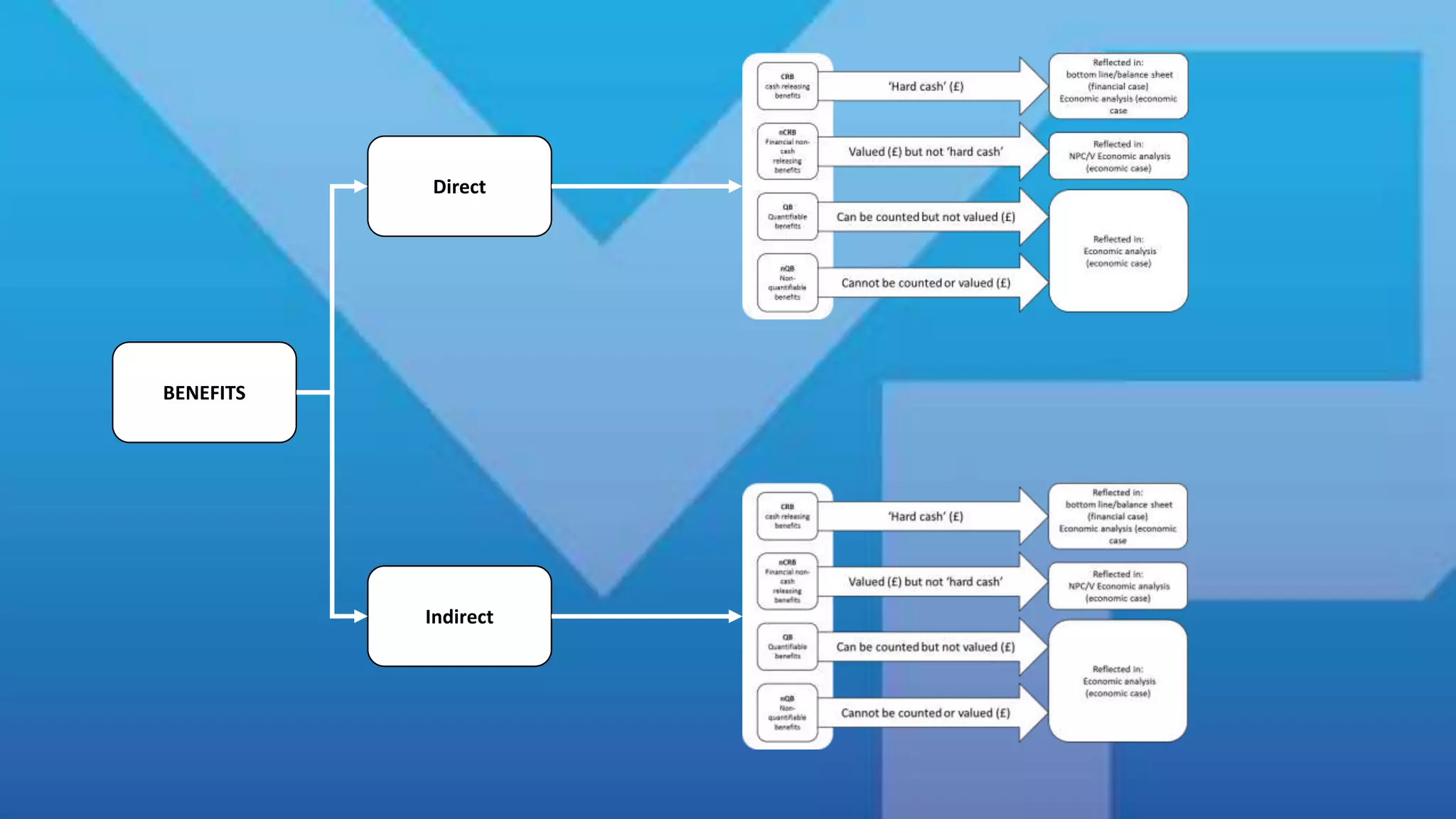
CRB
cash releasing
benefits
nCRB
Financial non-
cash
releasing
benefits
QB
Quantifiable
benefits
nQB
Non-
quantifiable
benefits
Cannot be counted or valued (£)
Valued (£) but not ‘hard cash’
Can be counted but not valued (£)
‘Hard cash’ (£)
Reflected in:
bottom line/balance sheet
(financial case)
Economic analysis (economic
case
Reflected in:
NPC/V Economic analysis
(economic case)
Reflected in:
Economic analysis
(economic case)
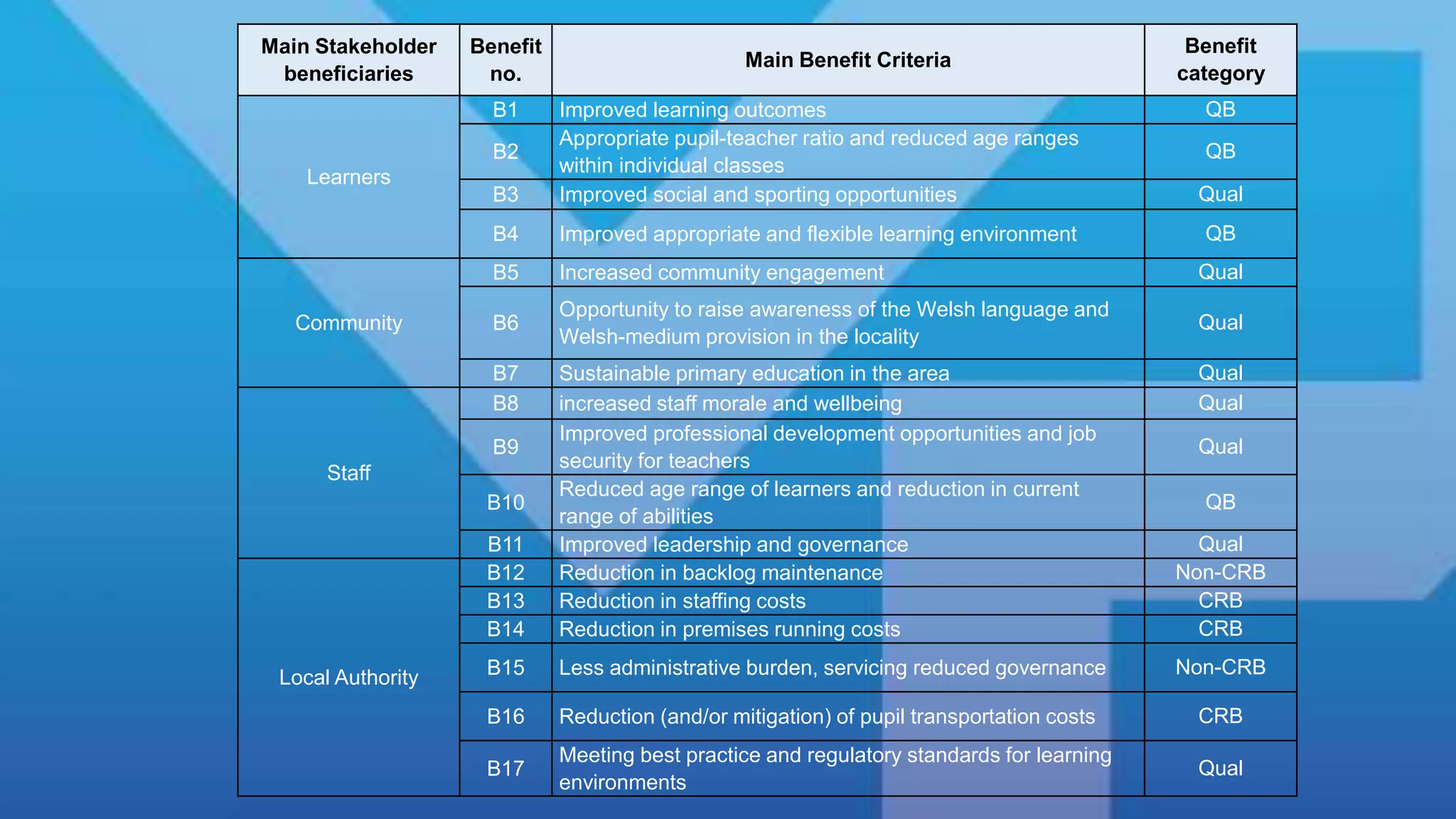
Main Stakeholder
beneficiaries
Benefit
no.
Main Benefit Criteria
Benefit
category
Learners
B1 Improved learning outcomes QB
B2
Appropriate pupil-teacher ratio and reduced age ranges
within individual classes
QB
B3 Improved social and sporting opportunities Qual
B4 Improved appropriate and flexible learning environment QB
Community
B5 Increased community engagement Qual
B6
Opportunity to raise awareness of the Welsh language and
Welsh-medium provision in the locality
Qual
B7 Sustainable primary education in the area Qual
Staff
B8 increased staff morale and wellbeing Qual
B9
Improved professional development opportunities and job
security for teachers
Qual
B10
Reduced age range of learners and reduction in current
range of abilities
QB
B11 Improved leadership and governance Qual
Local Authority
B12 Reduction in backlog maintenance Non-CRB
B13 Reduction in staffing costs CRB
B14 Reduction in premises running costs CRB
B15 Less administrative burden, servicing reduced governance Non-CRB
B16 Reduction (and/or mitigation) of pupil transportation costs CRB
B17
Meeting best practice and regulatory standards for learning
environments
Qual
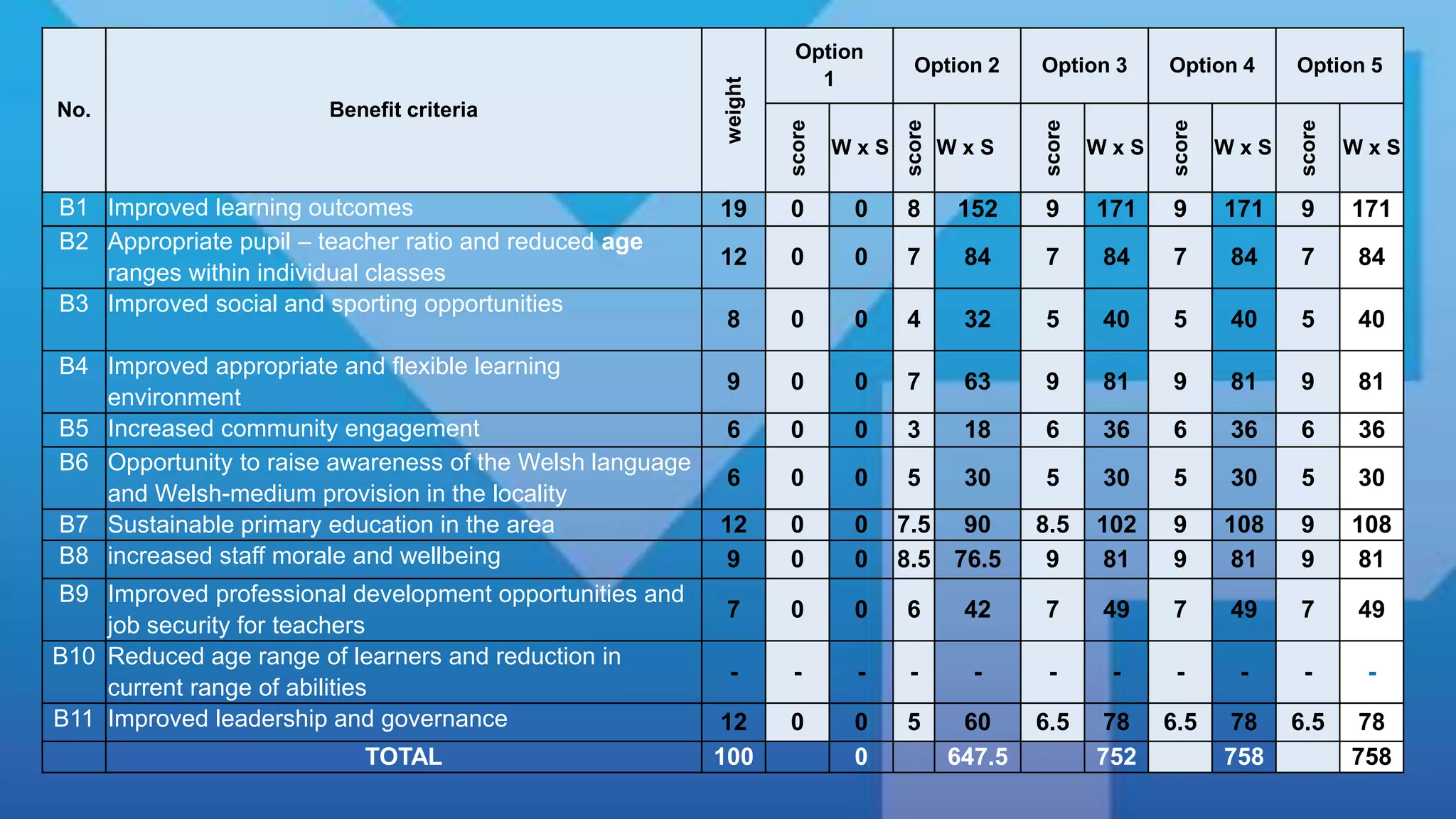
No. Benefit criteria
weight
Option
1
Option 2 Option 3 Option 4 Option 5
score
W x S
score
W x S
score
W x S
score
W x S
score
W x S
B1 Improved learning outcomes 19 0 0 8 152 9 171 9 171 9 171
B2 Appropriate pupil – teacher ratio and reduced age
ranges within individual classes
12 0 0 7 84 7 84 7 84 7 84
B3 Improved social and sporting opportunities
8 0 0 4 32 5 40 5 40 5 40
B4 Improved appropriate and flexible learning
environment
9 0 0 7 63 9 81 9 81 9 81
B5 Increased community engagement 6 0 0 3 18 6 36 6 36 6 36
B6 Opportunity to raise awareness of the Welsh language
and Welsh-medium provision in the locality
6 0 0 5 30 5 30 5 30 5 30
B7 Sustainable primary education in the area 12 0 0 7.5 90 8.5 102 9 108 9 108
B8 increased staff morale and wellbeing 9 0 0 8.5 76.5 9 81 9 81 9 81
B9 Improved professional development opportunities and
job security for teachers
7 0 0 6 42 7 49 7 49 7 49
B10 Reduced age range of learners and reduction in
current range of abilities
- - - - - - - - - - -
B11 Improved leadership and governance 12 0 0 5 60 6.5 78 6.5 78 6.5 78
TOTAL 100 0 647.5 752 758 758
BENEFITS
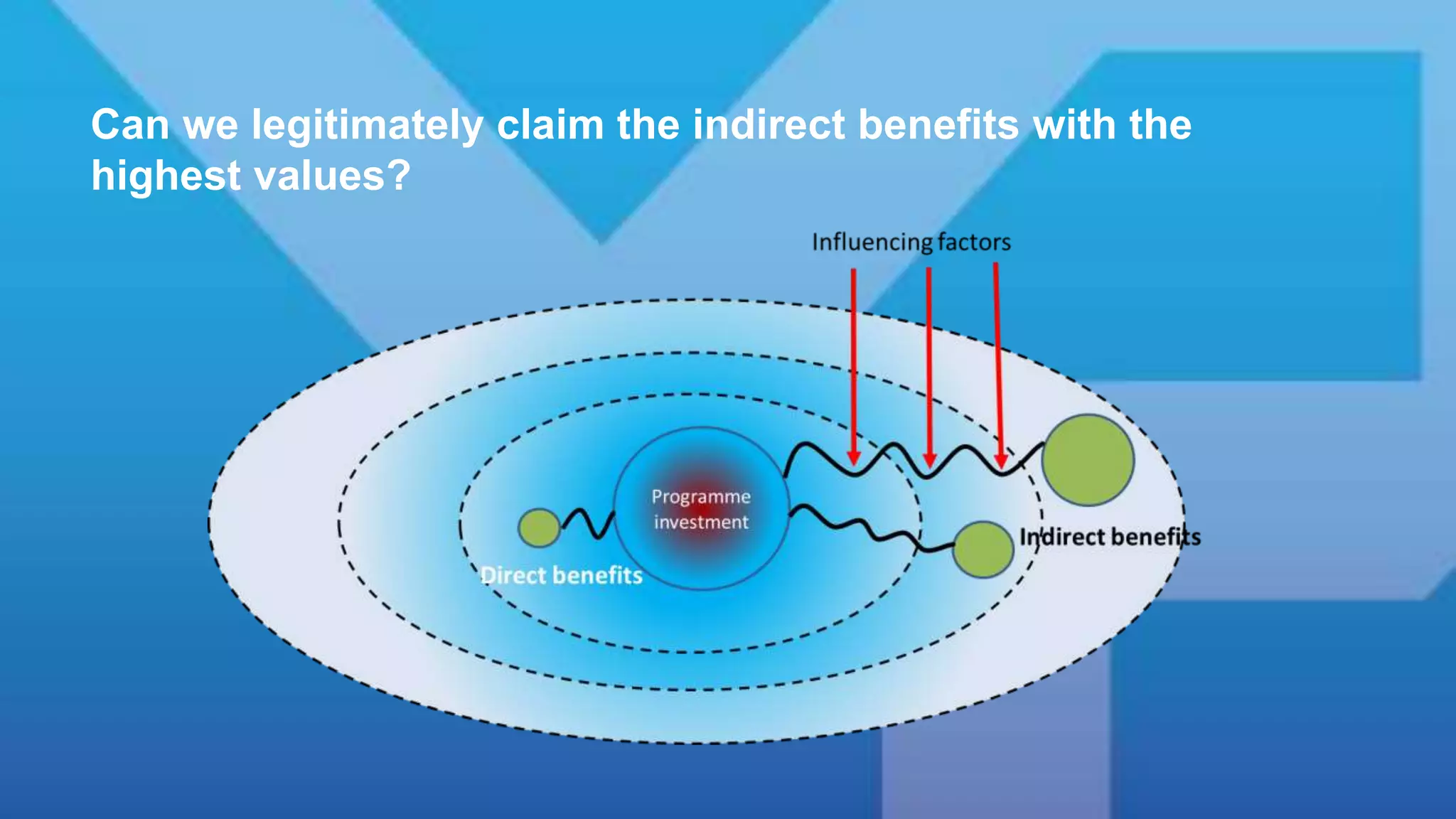
Direct
Indirect
Are we being too scientific about
benefits management?
• Quantify and claim the 20% of benefits that represent 80% of
the value
• Is this the right approach?
Can we legitimately claim the indirect benefits with the
highest values?
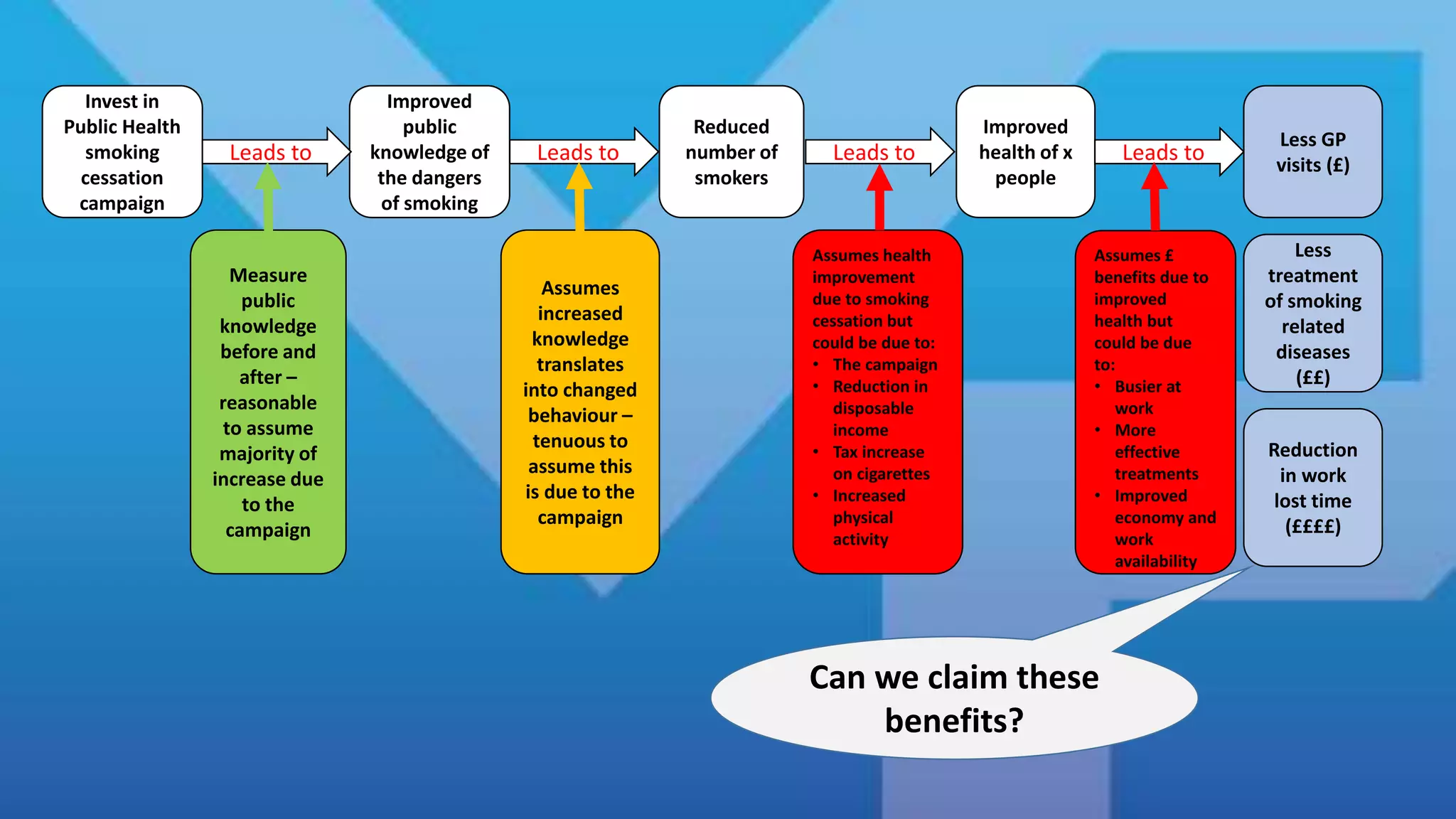
Invest in
Public Health
smoking
cessation
campaign
Reduced
number of
smokers
Leads to Leads to
Improved
health of x
people
Leads to
Less GP
visits (£)
Less
treatment
of smoking
related
diseases
(££)
Improved
public
knowledge of
the dangers
of smoking
Leads to
Reduction
in work
lost time
(££££)
Can we claim these
benefits?
Measure
public
knowledge
before and
after –
reasonable
to assume
majority of
increase due
to the
campaign
Assumes
increased
knowledge
translates
into changed
behaviour –
tenuous to
assume this
is due to the
campaign
Assumes health
improvement
due to smoking
cessation but
could be due to:
• The campaign
• Reduction in
disposable
income
• Tax increase
on cigarettes
• Increased
physical
activity
Assumes £
benefits due to
improved
health but
could be due
to:
• Busier at
work
• More
effective
treatments
• Improved
economy and
work
availability
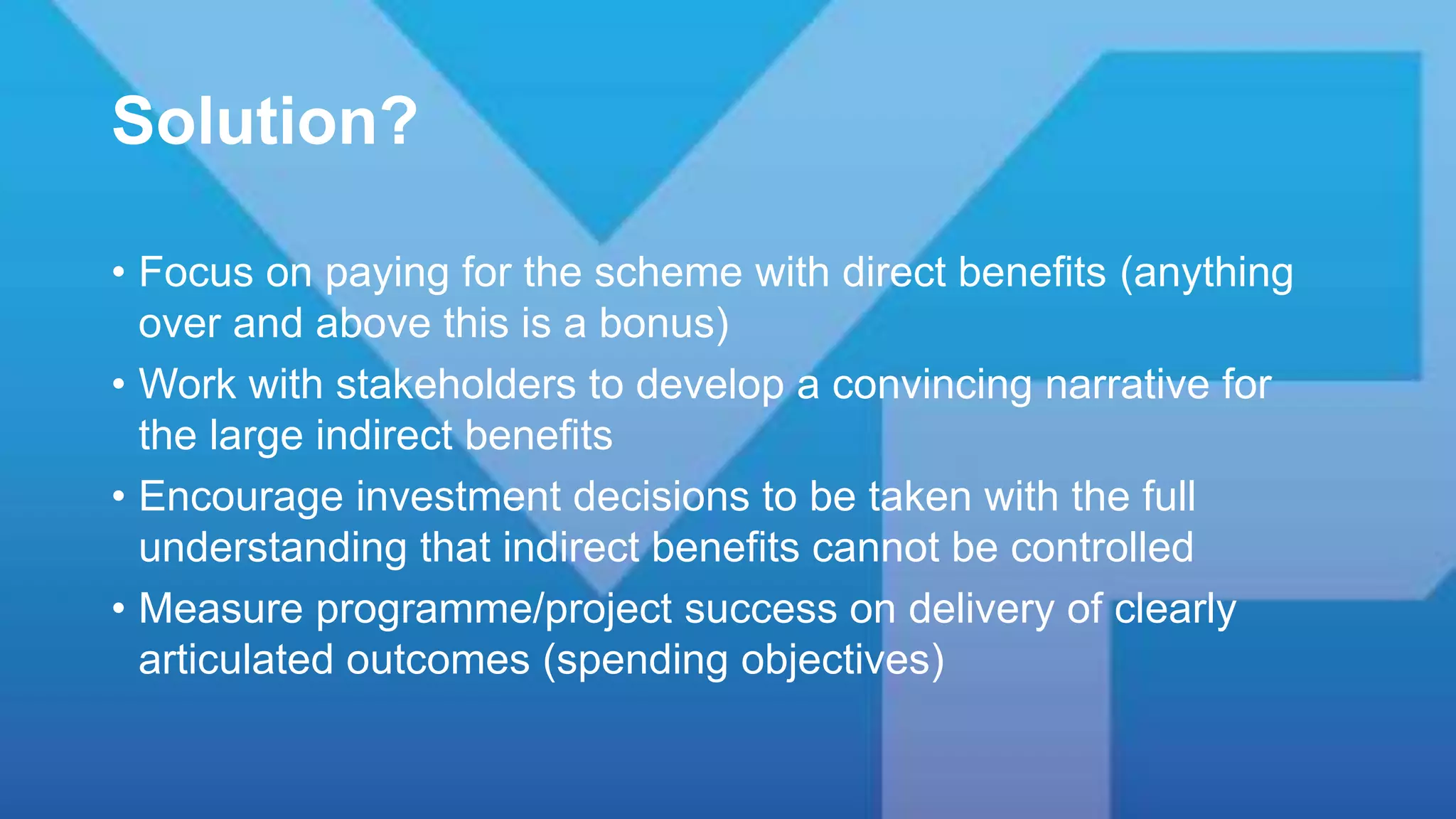
Solution?
• Focus on paying for the scheme with direct benefits (anything
over and above this is a bonus)
• Work with stakeholders to develop a convincing narrative for
the large indirect benefits
• Encourage investment decisions to be taken with the full
understanding that indirect benefits cannot be controlled
• Measure programme/project success on delivery of clearly
articulated outcomes (spending objectives)
Thank you
Questions?

Benefits and better business cases_Alan Brown and Stefan Sanchez

  • 1.
    Benefits and BetterBusiness Cases Alan Brown Stefan Sanchez
  • 2.
    Presentation: •The business caseand benefits in practice •Are we being too scientific about benefits management? •What is the relationship between the business case process and programme/project management?
  • 3.
    What is aBetter Business Case? • A flexible, pragmatic and common sense approach for supporting business decisions in a wide range of contexts • The Better Business ‘Five Case Model’ jointly developed by HM Treasury and Welsh Government • Investments £5m+ a Three stage process • Strategic outline case (SOC) • Outline Business Case (OBC) • Full Business Case (FBC) • Provides decision makers with confidence and assurance that they are making the right decisions (business assurance) and in the correct way (programme and project assurance)
  • 4.
    Better Business Casesask 5 Key Questions
  • 5.
    Better Business Casesask 5 Key Questions High level benefits identified Detailed quantification of benefits Refinement of benefits through market testing Balance sheet impact and timing of cash releasing benefits Management of benefits delivery
  • 6.
    Practical Application About theProgramme • £1.4 billion investment programme 2014-2019 • Funding split 50% WG / 50% LA’s • All 22 Welsh LA’s participating • Reduce Surplus Capacity • Improve Educational Outcomes • Reduce overall running and lifetime costs 150+ New / improved Schools
  • 7.
    The business caseand benefits in practice
  • 8.
    Programme Business Case (PBC) Outline BusinessCases (OBC) and Full Business Cases (FBC) Programme delivery Identify Refine & prioritise Quantify and profile Deliver and manage
  • 9.
    Programme Business Case (PBC) Outline BusinessCases (OBC) and Full Business Cases (FBC) Programme delivery Identify Refine & prioritise Quantify and profile Deliver and manage Clear identification of high level direct and indirect benefits Priority benefits identified (20% that represent 80% of value) Approach to quantification Benefits strategy content Strategy reviewed and updated as appropriate Strategy reviewed and updated as appropriate
  • 10.
    Programme Business Case (PBC) Outline BusinessCases (OBC) and Full Business Cases (FBC) Programme delivery Identify Refine & prioritise Quantify and profile Deliver and manage Clear identification of high level direct and indirect benefits Priority benefits identified (20% that represent 80% of value) Approach to quantification Benefits strategy content Benefits action plan content Stakeholder engagement plan to commence ‘benefits discussion’ Apply metrics to direct and indirect benefits Approach to direct and indirect benefits (% claim) Continued stakeholder liaison and build compelling narrative Profile priority benefits Record benefits profiles in economic analysis (and financial analysis where appropriate) Clear delivery plans set up with SMART actions and clear ownership/responsibility for benefits realisation Articulation of benefits review cycle and likely changes to action plan over time Strategy reviewed and updated as appropriate Strategy reviewed and updated as appropriate
  • 11.
    Programme Business Case (PBC) Outline BusinessCases (OBC) and Full Business Cases (FBC) Programme delivery Identify Refine & prioritise Quantify and profile Deliver and manage Clear identification of high level direct and indirect benefits Priority benefits identified (20% that represent 80% of value) Approach to quantification Benefits strategy content Benefits action plan content Stakeholder engagement plan to commence ‘benefits discussion’ Apply metrics to direct and indirect benefits Approach to direct and indirect benefits (% claim) Continued stakeholder liaison and build compelling narrative Profile priority benefits Record benefits profiles in economic analysis (and financial analysis where appropriate) Clear delivery plans set up with SMART actions and clear ownership/responsibility for benefits realisation Articulation of benefits review cycle and likely changes to action plan over time Strategy reviewed and updated as appropriate Strategy reviewed and updated as appropriate
  • 12.
    CRB cash releasing benefits nCRB Financial non- cash releasing benefits QB Quantifiable benefits nQB Non- quantifiable benefits Cannotbe counted or valued (£) Valued (£) but not ‘hard cash’ Can be counted but not valued (£) ‘Hard cash’ (£) Reflected in: bottom line/balance sheet (financial case) Economic analysis (economic case Reflected in: NPC/V Economic analysis (economic case) Reflected in: Economic analysis (economic case)
  • 13.
    Main Stakeholder beneficiaries Benefit no. Main BenefitCriteria Benefit category Learners B1 Improved learning outcomes QB B2 Appropriate pupil-teacher ratio and reduced age ranges within individual classes QB B3 Improved social and sporting opportunities Qual B4 Improved appropriate and flexible learning environment QB Community B5 Increased community engagement Qual B6 Opportunity to raise awareness of the Welsh language and Welsh-medium provision in the locality Qual B7 Sustainable primary education in the area Qual Staff B8 increased staff morale and wellbeing Qual B9 Improved professional development opportunities and job security for teachers Qual B10 Reduced age range of learners and reduction in current range of abilities QB B11 Improved leadership and governance Qual Local Authority B12 Reduction in backlog maintenance Non-CRB B13 Reduction in staffing costs CRB B14 Reduction in premises running costs CRB B15 Less administrative burden, servicing reduced governance Non-CRB B16 Reduction (and/or mitigation) of pupil transportation costs CRB B17 Meeting best practice and regulatory standards for learning environments Qual
  • 14.
    No. Benefit criteria weight Option 1 Option2 Option 3 Option 4 Option 5 score W x S score W x S score W x S score W x S score W x S B1 Improved learning outcomes 19 0 0 8 152 9 171 9 171 9 171 B2 Appropriate pupil – teacher ratio and reduced age ranges within individual classes 12 0 0 7 84 7 84 7 84 7 84 B3 Improved social and sporting opportunities 8 0 0 4 32 5 40 5 40 5 40 B4 Improved appropriate and flexible learning environment 9 0 0 7 63 9 81 9 81 9 81 B5 Increased community engagement 6 0 0 3 18 6 36 6 36 6 36 B6 Opportunity to raise awareness of the Welsh language and Welsh-medium provision in the locality 6 0 0 5 30 5 30 5 30 5 30 B7 Sustainable primary education in the area 12 0 0 7.5 90 8.5 102 9 108 9 108 B8 increased staff morale and wellbeing 9 0 0 8.5 76.5 9 81 9 81 9 81 B9 Improved professional development opportunities and job security for teachers 7 0 0 6 42 7 49 7 49 7 49 B10 Reduced age range of learners and reduction in current range of abilities - - - - - - - - - - - B11 Improved leadership and governance 12 0 0 5 60 6.5 78 6.5 78 6.5 78 TOTAL 100 0 647.5 752 758 758
  • 15.
  • 16.
    Are we beingtoo scientific about benefits management? • Quantify and claim the 20% of benefits that represent 80% of the value • Is this the right approach?
  • 17.
    Can we legitimatelyclaim the indirect benefits with the highest values?
  • 18.
    Invest in Public Health smoking cessation campaign Reduced numberof smokers Leads to Leads to Improved health of x people Leads to Less GP visits (£) Less treatment of smoking related diseases (££) Improved public knowledge of the dangers of smoking Leads to Reduction in work lost time (££££) Can we claim these benefits? Measure public knowledge before and after – reasonable to assume majority of increase due to the campaign Assumes increased knowledge translates into changed behaviour – tenuous to assume this is due to the campaign Assumes health improvement due to smoking cessation but could be due to: • The campaign • Reduction in disposable income • Tax increase on cigarettes • Increased physical activity Assumes £ benefits due to improved health but could be due to: • Busier at work • More effective treatments • Improved economy and work availability
  • 19.
    Solution? • Focus onpaying for the scheme with direct benefits (anything over and above this is a bonus) • Work with stakeholders to develop a convincing narrative for the large indirect benefits • Encourage investment decisions to be taken with the full understanding that indirect benefits cannot be controlled • Measure programme/project success on delivery of clearly articulated outcomes (spending objectives)
  • 20.