EVALUATING
FUNCTIONS
9/3/20XX Presentation Title 2
9/3/20XX Presentation Title 3
9/3/20XX Presentation Title 4
9/3/20XX Presentation Title 5
9/3/20XX Presentation Title 6
9/3/20XX Presentation Title 7
9/3/20XX Presentation Title 8
9/3/20XX Presentation Title 9
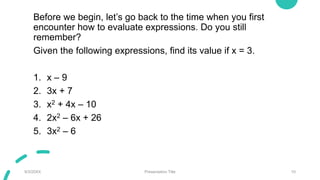
Before we begin, let’s go back to the time when you first
encounter how to evaluate expressions. Do you still
remember?
Given the following expressions, find its value if x = 3.
1. x – 9
2. 3x + 7
3. x2 + 4x – 10
4. 2x2 – 6x + 26
5. 3x2 – 6
9/3/20XX Presentation Title 10
Types of Function
Type of Function Description Example
Constant Function A constant function is a
function that has the same
output value no matter what
your input value is. Because
of this, a constant function
has the form f (x) = b, where b
is a constant (a single value
that does not change).
y = 7
Identity Function The identity function is a
function which returns the
same value, which was used
as its argument. In other
words, the identity function is
the function f (x) = x , for all
values of x.
f(2) = 2
9/3/20XX Presentation Title 11
9/3/20XX Presentation Title 12
Polynomial Function A polynomial function is defined
by y = a0 + a1x + a2x +...+ an xn ,
where n is a non-negative integer
and a0 , a1 , a2 ,…, n ∈ R.
Rational Function A rational function is any function
which can be represented by a
rational fraction say,
𝑝(𝑥)
𝑞(𝑥)
in which
numerator, p(x) and denominator,
q(x) are polynomial functions of x,
where q(x) ≠ 0.
𝑓 𝑥 =
𝑥2 − 3𝑥 + 2
𝑥2 − 4
Power Function A power function is a function in the
form b y = axb where b is any real
constant number. Many of our
parent functions such as linear
functions and quadratic functions are
in fact power functions.
f (x) = 8x5
9/3/20XX Presentation Title 13
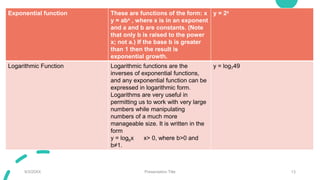
Exponential function These are functions of the form: x
y = abx , where x is in an exponent
and a and b are constants. (Note
that only b is raised to the power
x; not a.) If the base b is greater
than 1 then the result is
exponential growth.
y = 2x
Logarithmic Function Logarithmic functions are the
inverses of exponential functions,
and any exponential function can be
expressed in logarithmic form.
Logarithms are very useful in
permitting us to work with very large
numbers while manipulating
numbers of a much more
manageable size. It is written in the
form
y = logbx x> 0, where b>0 and
b≠1.
y = log749
9/3/20XX Presentation Title 14
Absolute Value Function
Greatest Integer Function If a function f: R→ R is defined by
f(x) = [x], x ∈ X. It round-off to the
real number to the integer less than
the number. Suppose, the given
interval is in the form of (k, k+1), the
value of greatest integer function is
k which is an integer.
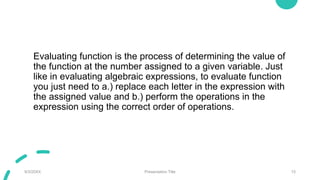
Evaluating function is the process of determining the value of
the function at the number assigned to a given variable. Just
like in evaluating algebraic expressions, to evaluate function
you just need to a.) replace each letter in the expression with
the assigned value and b.) perform the operations in the
expression using the correct order of operations.
9/3/20XX Presentation Title 15
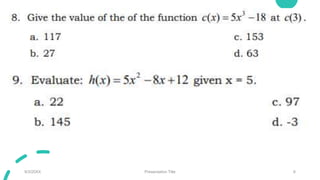
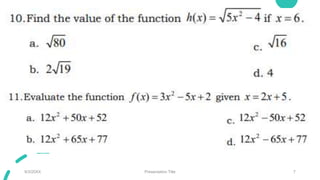
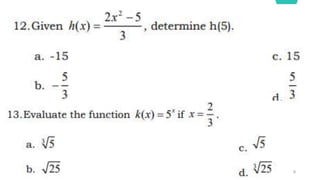
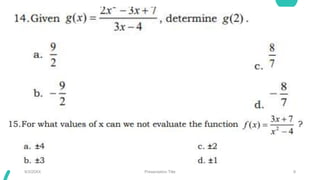
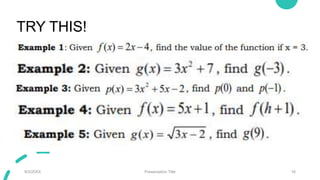
TRY THIS!
9/3/20XX Presentation Title 16
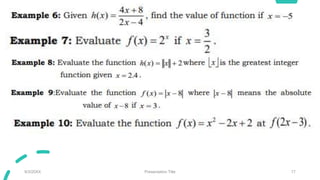
9/3/20XX Presentation Title 17

Evaluating Functions.pptx

  • 1.
  • 2.
  • 3.
  • 4.
  • 5.
  • 6.
  • 7.
  • 8.
  • 9.
  • 10.
    Before we begin,let’s go back to the time when you first encounter how to evaluate expressions. Do you still remember? Given the following expressions, find its value if x = 3. 1. x – 9 2. 3x + 7 3. x2 + 4x – 10 4. 2x2 – 6x + 26 5. 3x2 – 6 9/3/20XX Presentation Title 10
  • 11.
    Types of Function Typeof Function Description Example Constant Function A constant function is a function that has the same output value no matter what your input value is. Because of this, a constant function has the form f (x) = b, where b is a constant (a single value that does not change). y = 7 Identity Function The identity function is a function which returns the same value, which was used as its argument. In other words, the identity function is the function f (x) = x , for all values of x. f(2) = 2 9/3/20XX Presentation Title 11
  • 12.
    9/3/20XX Presentation Title12 Polynomial Function A polynomial function is defined by y = a0 + a1x + a2x +...+ an xn , where n is a non-negative integer and a0 , a1 , a2 ,…, n ∈ R. Rational Function A rational function is any function which can be represented by a rational fraction say, 𝑝(𝑥) 𝑞(𝑥) in which numerator, p(x) and denominator, q(x) are polynomial functions of x, where q(x) ≠ 0. 𝑓 𝑥 = 𝑥2 − 3𝑥 + 2 𝑥2 − 4 Power Function A power function is a function in the form b y = axb where b is any real constant number. Many of our parent functions such as linear functions and quadratic functions are in fact power functions. f (x) = 8x5
  • 13.
    9/3/20XX Presentation Title13 Exponential function These are functions of the form: x y = abx , where x is in an exponent and a and b are constants. (Note that only b is raised to the power x; not a.) If the base b is greater than 1 then the result is exponential growth. y = 2x Logarithmic Function Logarithmic functions are the inverses of exponential functions, and any exponential function can be expressed in logarithmic form. Logarithms are very useful in permitting us to work with very large numbers while manipulating numbers of a much more manageable size. It is written in the form y = logbx x> 0, where b>0 and b≠1. y = log749
  • 14.
    9/3/20XX Presentation Title14 Absolute Value Function Greatest Integer Function If a function f: R→ R is defined by f(x) = [x], x ∈ X. It round-off to the real number to the integer less than the number. Suppose, the given interval is in the form of (k, k+1), the value of greatest integer function is k which is an integer.
  • 15.
    Evaluating function isthe process of determining the value of the function at the number assigned to a given variable. Just like in evaluating algebraic expressions, to evaluate function you just need to a.) replace each letter in the expression with the assigned value and b.) perform the operations in the expression using the correct order of operations. 9/3/20XX Presentation Title 15
  • 16.
  • 17.