Effective Evaluations

    Silvana Wasitova DTM
 Division E Governor - D59, 2012-2013
           Krakow, July 2012
When you received an evaluation,
what made it good?
When you received an evaluation,
what made it not so good?
One Technique


                The Sandwich


                               4
Discussion
1. For a 30-minute advanced-manual speech,
   how long should be the evaluation?
2. An advanced speech needs to be evaluated by
   an advanced speaker.
3. A beginner’s speech should be evaluated by
   another beginner.
4. I disagree with the speaker’s topic!!!
The Atkins Sandwich : No Carbs!


                 Good for:
                 Experienced speakers
                 Those who ask for it


                                   6
Who benefits from a TM Evaluation?

The Speaker
The Evaluator
The Audience!
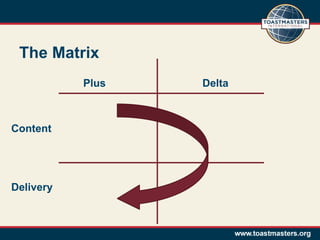
The Matrix
           Plus   Delta


Content


Delivery
 CONTENT
  Organization (Opening/Body/Conclusion, main points/subpoints),
  Message Clarity, Purpose,
  Transitions Ideas, Logic,
  Stories, examples, anecdotes,
  Entertainment (humor, interest)

 DELIVERY
  Eye Contact
  Body Language (appearance, gestures, use of space)
  Facial Expression
  Vocal Variety (volume, pitch, rate, pauses)
  Choice of Words (vivid, descriptive, poetic)
  Visual Aids (props, projections)
  Filler Words(ahs, ums, repeats, frequently used words/phrases)
  Grammar
  Pronunciation
  Manner (directness, assurance, enthusiasm)
From Andrew Dugan
The Sensory Matrix
         Plus        Delta
What I
Saw


What I
Heard


What I
Felt
Steps by steps:
 Before the meeting:
  contact speaker, ask for the speech objectives and
  personal objectives: what areas they would like to get
  feedback on; check their speaking frequency record on
  EasySpeak
 Before meeting starts:
  read the project and past evaluations; confirm focus areas
 During the speech:
  be attentive to the speaker; take notes
 After the meeting: explain any specific points you could
  not elaborate on during the oral evaluation
Summary
1. Check speech objectives, speaker’s goals & past records
2. Listen actively, with ears and eyes; show that you care
3. Personalize to the speaker, their experience & level
4. Avoid generalizations, e.g. “Everyone felt…”
5. Nourish their self esteem,
   provide positive reinforcement & direction,
   help the speaker stay motivated,
   remind their speaker that their goals are attainable
6. Evaluate the speech delivery, not the speech content,
   nor the speaker’s views/positions
7. Extrapolate the lessons for the audience to learn
Evaluations
amazing learning tool
a safe & nurturing environment
Silvana Wasitova, DTM
Division E Governor - D59, 2012-2013
SilvanaDTM@yahoo.com
+41 79 558 0509
@wasitova
Effective Evaluations

Effective Evaluations

  • 1.
    Effective Evaluations Silvana Wasitova DTM Division E Governor - D59, 2012-2013 Krakow, July 2012
  • 2.
    When you receivedan evaluation, what made it good?
  • 3.
    When you receivedan evaluation, what made it not so good?
  • 4.
    One Technique The Sandwich 4
  • 5.
    Discussion 1. For a30-minute advanced-manual speech, how long should be the evaluation? 2. An advanced speech needs to be evaluated by an advanced speaker. 3. A beginner’s speech should be evaluated by another beginner. 4. I disagree with the speaker’s topic!!!
  • 6.
    The Atkins Sandwich: No Carbs! Good for: Experienced speakers Those who ask for it 6
  • 7.
    Who benefits froma TM Evaluation? The Speaker The Evaluator The Audience!
  • 8.
    The Matrix Plus Delta Content Delivery
  • 9.
     CONTENT Organization (Opening/Body/Conclusion, main points/subpoints), Message Clarity, Purpose, Transitions Ideas, Logic, Stories, examples, anecdotes, Entertainment (humor, interest)  DELIVERY Eye Contact Body Language (appearance, gestures, use of space) Facial Expression Vocal Variety (volume, pitch, rate, pauses) Choice of Words (vivid, descriptive, poetic) Visual Aids (props, projections) Filler Words(ahs, ums, repeats, frequently used words/phrases) Grammar Pronunciation Manner (directness, assurance, enthusiasm)
  • 10.
  • 11.
    The Sensory Matrix Plus Delta What I Saw What I Heard What I Felt
  • 12.
    Steps by steps: Before the meeting: contact speaker, ask for the speech objectives and personal objectives: what areas they would like to get feedback on; check their speaking frequency record on EasySpeak  Before meeting starts: read the project and past evaluations; confirm focus areas  During the speech: be attentive to the speaker; take notes  After the meeting: explain any specific points you could not elaborate on during the oral evaluation
  • 13.
    Summary 1. Check speechobjectives, speaker’s goals & past records 2. Listen actively, with ears and eyes; show that you care 3. Personalize to the speaker, their experience & level 4. Avoid generalizations, e.g. “Everyone felt…” 5. Nourish their self esteem, provide positive reinforcement & direction, help the speaker stay motivated, remind their speaker that their goals are attainable 6. Evaluate the speech delivery, not the speech content, nor the speaker’s views/positions 7. Extrapolate the lessons for the audience to learn
  • 14.
    Evaluations amazing learning tool asafe & nurturing environment
  • 17.
    Silvana Wasitova, DTM DivisionE Governor - D59, 2012-2013 SilvanaDTM@yahoo.com +41 79 558 0509 @wasitova

Editor's Notes

  • #3 Good EvaluationsHas suggestions for improvementReinforces the speakers’ strengthsSpecific & adjusted to the speakerMakes speaker feel “I can improve”Analyzes the speech: meaning & impact of elements of the deliveryThorough (80-20 rule)StructuredBalanced & truthfulSummary: ONE MAIN POINT
  • #4 Not so Good EvaluationsToo many details, too many suggestions, overwhelmingOnly good points, only bad pointsGeneralized (speak in the name of audience)Takes it too seriously, esp. beginnersEvaluates the speech contentPersonal biasEvaluator showing offMaking public feedback best left private
  • #14 What is “the right amount”?ASK THE SPEAKER!Address the Speaker *and* the AudienceGive the speaker “the right amount” of feedback. What is “the right amount”?End with the strongest positive feedback