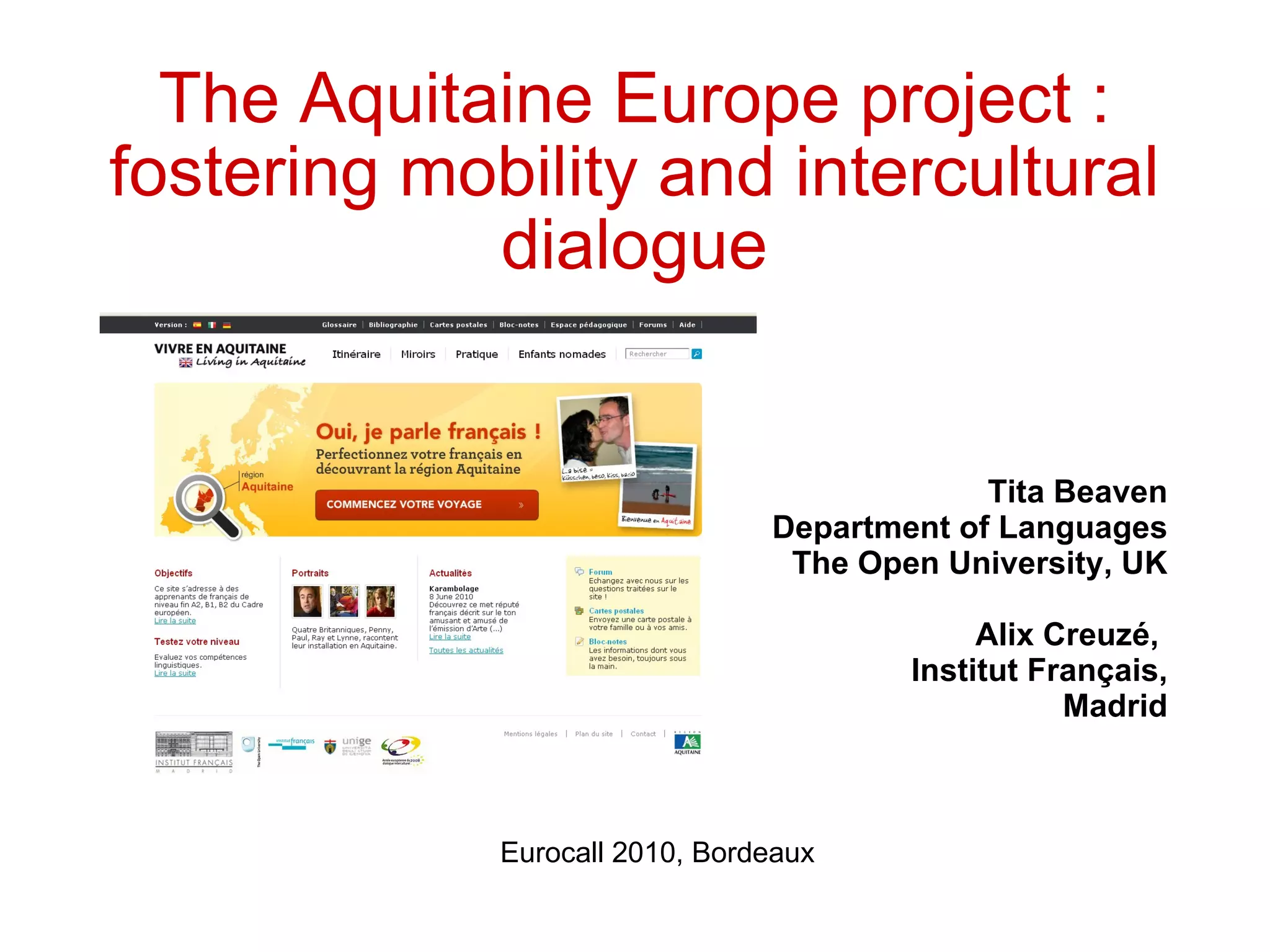
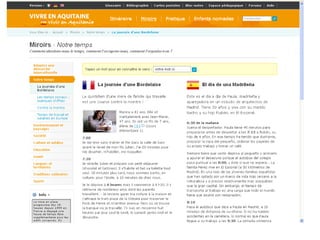
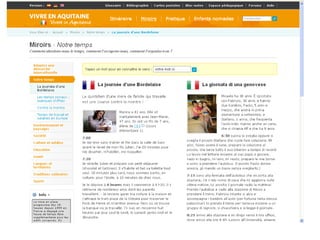
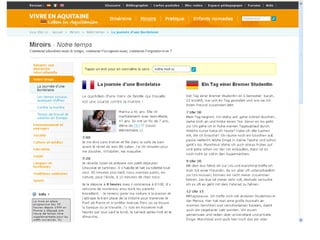
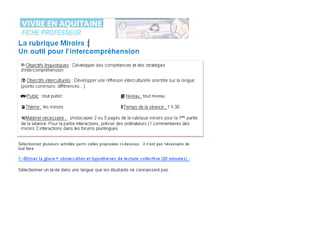
The Aquitaine Europe project : fostering mobility and intercultural dialogue Tita Beaven Department of Languages The Open University, UK Alix Creuzé,  Institut Français, Madrid Eurocall 2010, Bordeaux
 
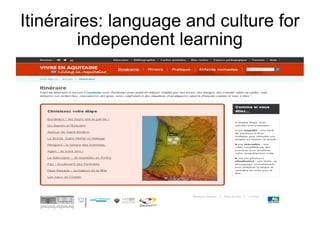
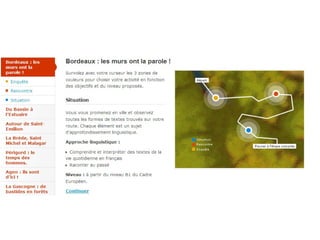
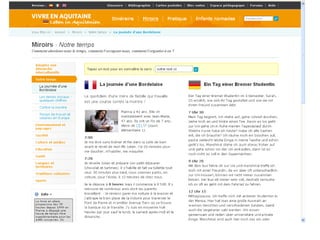
Itin é raires: language and culture for independent learning
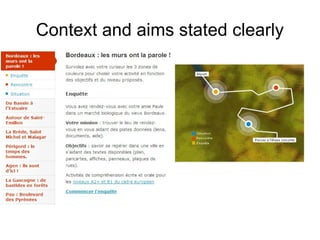
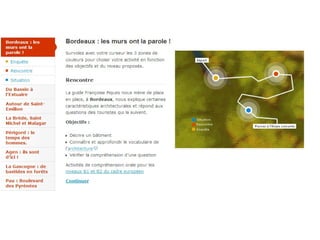
Context and aims stated clearly
Context


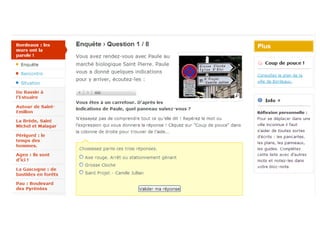
Miroirs: Intercultural competence Texts in L1 and L2: reflection, mediation. But also exploring ways in which “strategies used in the reading and decoding of  […] texts in the readers’ own native languages can facilitate the processing of similar texts in a foreign language  (Carter-Thomas 2009, reviewing  Lundquist: navigating in Foreign Language Texts, 2008)


Users? Flexibility in the design, and flexibility in the use of the materials: monolingual, multilingual and plurilingual students and teachers. Monolingual classes Multilingual classes Plurilingual classes - Independent learners
Plurilingualism …” The Council of Europe and the European Commission promote plurilingualism and intercomprehension as  central to European citizenship  (Beacco & Byram, 2003; Council of Europe, 2001;European Commission, 1995). The concept of  plurilingualism  reaches beyond its primary and immediate aim of allowing for communication in multilingual environments: it comprehends the  acknowledgement and positive appreciation of linguistic and cultural diversity . Plurilingual and pluricultural competences are defined by the Common European Framework of Reference as complex and composite competences, which allow  individuals to participate as social agents in intercultural communicative interactions  (Council of Europe, 2001: 168).” Alves and Mendes (2006)
Plurilingualism and intercomprehension Intercomprehesion: “A form of communication in which each person uses his or her own language and understands that of the other.”  Peter Doy é , Intercomprehension, 2005
Intercomprehension Intercomprehension is defined as the process of developing the  ability to coconstruct meaning  in the context of the  encounter of different languages , and to make pragmatic use of this in a concrete communicative situation (Capucho, 2004), thus involving the  transfer of strategies and knowledge from known to unknown languages . This process is supported by  awareness of cultural features . Activating and training intercomprehension strategies comprises three levels: (1) the human ability to communicate meanings, (2) language learning (in a conscious or unconscious manner) as a process of strategies acquisition, and (3) the ongoing development of intercomprehension abilities and strategies (both in interpreting and producing discourse). Alves and Mendes (2006)
Language learners as social agents Language users can, therefore, be defined as  social intermediaries or social agents  (Zarate, 2002: 218219), with the capacity to  overcome barriers and construct bridges  and boundaries in plurilingual and pluricultural contexts. Social intermediaries/agents, capable of constructing successful socio-communicative interactions based on intercomprehension,  value the importance of otherness, manage knowledge, and are prepared to co-construct and define complex identitie s. Refusing monolingualism, they resist linguistic and cultural ethnocentrism and homogeneity.   Alves and Mendes (2006)
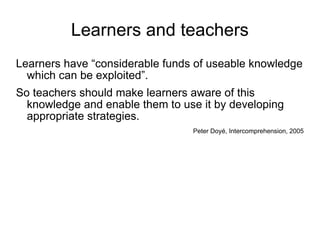
Learners and teachers Learners have “considerable funds of useable knowledge which can be exploited”.  So teachers should make learners aware of this knowledge and enable them to use it by developing appropriate strategies.  Peter Doy é , Intercomprehension, 2005


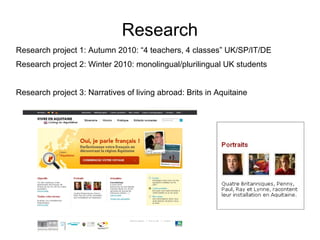
Research Research project 1: Autumn 2010: “4 teachers, 4 classes” UK/SP/IT/DE Research project 2: Winter 2010: monolingual/plurilingual UK students  Research project 3: Narratives of living abroad: Brits in Aquitaine
Gracias, Merci, Thanks! [email_address]

Vivre en Aquitaine - Eurocall 2011

  • 1.
    The Aquitaine Europeproject : fostering mobility and intercultural dialogue Tita Beaven Department of Languages The Open University, UK Alix Creuzé, Institut Français, Madrid Eurocall 2010, Bordeaux
  • 2.
  • 3.
    Itin é raires:language and culture for independent learning
  • 4.
    Context and aimsstated clearly
  • 5.
  • 6.
  • 7.
  • 8.
  • 9.
  • 10.
  • 11.
  • 12.
  • 13.
    Miroirs: Intercultural competenceTexts in L1 and L2: reflection, mediation. But also exploring ways in which “strategies used in the reading and decoding of […] texts in the readers’ own native languages can facilitate the processing of similar texts in a foreign language (Carter-Thomas 2009, reviewing Lundquist: navigating in Foreign Language Texts, 2008)
  • 14.
  • 15.
  • 16.
  • 17.
  • 18.
    Users? Flexibility inthe design, and flexibility in the use of the materials: monolingual, multilingual and plurilingual students and teachers. Monolingual classes Multilingual classes Plurilingual classes - Independent learners
  • 19.
    Plurilingualism …” TheCouncil of Europe and the European Commission promote plurilingualism and intercomprehension as central to European citizenship (Beacco & Byram, 2003; Council of Europe, 2001;European Commission, 1995). The concept of plurilingualism reaches beyond its primary and immediate aim of allowing for communication in multilingual environments: it comprehends the acknowledgement and positive appreciation of linguistic and cultural diversity . Plurilingual and pluricultural competences are defined by the Common European Framework of Reference as complex and composite competences, which allow individuals to participate as social agents in intercultural communicative interactions (Council of Europe, 2001: 168).” Alves and Mendes (2006)
  • 20.
    Plurilingualism and intercomprehensionIntercomprehesion: “A form of communication in which each person uses his or her own language and understands that of the other.” Peter Doy é , Intercomprehension, 2005
  • 21.
    Intercomprehension Intercomprehension isdefined as the process of developing the ability to coconstruct meaning in the context of the encounter of different languages , and to make pragmatic use of this in a concrete communicative situation (Capucho, 2004), thus involving the transfer of strategies and knowledge from known to unknown languages . This process is supported by awareness of cultural features . Activating and training intercomprehension strategies comprises three levels: (1) the human ability to communicate meanings, (2) language learning (in a conscious or unconscious manner) as a process of strategies acquisition, and (3) the ongoing development of intercomprehension abilities and strategies (both in interpreting and producing discourse). Alves and Mendes (2006)
  • 22.
    Language learners associal agents Language users can, therefore, be defined as social intermediaries or social agents (Zarate, 2002: 218219), with the capacity to overcome barriers and construct bridges and boundaries in plurilingual and pluricultural contexts. Social intermediaries/agents, capable of constructing successful socio-communicative interactions based on intercomprehension, value the importance of otherness, manage knowledge, and are prepared to co-construct and define complex identitie s. Refusing monolingualism, they resist linguistic and cultural ethnocentrism and homogeneity. Alves and Mendes (2006)
  • 23.
    Learners and teachersLearners have “considerable funds of useable knowledge which can be exploited”. So teachers should make learners aware of this knowledge and enable them to use it by developing appropriate strategies. Peter Doy é , Intercomprehension, 2005
  • 24.
  • 25.
  • 26.
  • 27.
  • 28.
  • 29.
  • 30.
  • 31.
  • 32.
    Research Research project1: Autumn 2010: “4 teachers, 4 classes” UK/SP/IT/DE Research project 2: Winter 2010: monolingual/plurilingual UK students Research project 3: Narratives of living abroad: Brits in Aquitaine
  • 33.
    Gracias, Merci, Thanks![email_address]