The OWASP Foundation
http://www.owasp.org

OWASP
Zed Attack Proxy

Hackathon
Simon Bennetts
OWASP ZAP Project Lead
Mozilla Security Team
psiinon@gmail.com

Copyright © The OWASP Foundation
Permission is granted to copy, distribute and/or modify this document under the terms of the OWASP License.
The Plan
•
•
•
•
•

Overview of how to extend ZAP
Describe the topics I could talk about
Find out what you really want to know ;)
Agree topics to cover
For each topic:
– Talk for a bit, hack for a bit

• But its all up for grabs, so we can change anything
• And feel free to do your own thing!
• I'll help out during the hacking sections
2
How you can extend ZAP
• Without a dev environment:
– 3rd party tools
– Scripts
– Translations
– Documentation

• With a development environment
– Active & passive scan rules
– 'Full' extensions
What can you plug in?
•
•
•
•

Scripts
Script types
Active and Passive rules
UI elements – tabs, popups, toolbar buttons,
menus, right click options...

• API calls
• Request / Response views
• Breaking, Fuzzing, Searching
Topics I could talk about
•
•
•
•
•
•
•
•

The ZAP project structure
Setting up a ZAP development environment
ZAP documentation and internationalization
Implementing 'standard' scripts
Implementing Zest scripts
Implementing active and passive scan rules
Implementing Add-ons and extensions
Features and fixes to work on
More topics I could talk about
•
•
•
•
•
•
•
•

Key classes
Accessing core functionality and extensions
Internal events
The user interface
The API
The database
Request / Response views
Breaking, fuzzing, searching
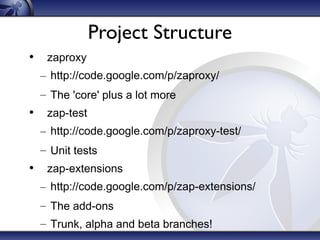
Project Structure
• zaproxy
– http://code.google.com/p/zaproxy/
– The 'core' plus a lot more

• zap-test
– http://code.google.com/p/zaproxy-test/
– Unit tests

• zap-extensions
– http://code.google.com/p/zap-extensions/
– The add-ons
– Trunk, alpha and beta branches!
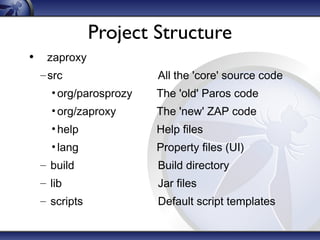
Project Structure
• zaproxy
– src

All the 'core' source code

• org/parosprozy

The 'old' Paros code

• org/zaproxy

The 'new' ZAP code

• help

Help files

• lang

Property files (UI)

– build

Build directory

– lib

Jar files

– scripts

Default script templates
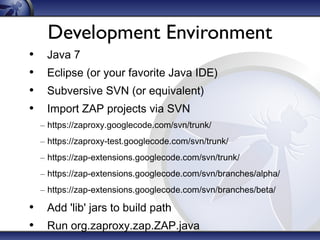
Development Environment
•
•
•
•

Java 7
Eclipse (or your favorite Java IDE)
Subversive SVN (or equivalent)
Import ZAP projects via SVN
– https://zaproxy.googlecode.com/svn/trunk/
– https://zaproxy-test.googlecode.com/svn/trunk/
– https://zap-extensions.googlecode.com/svn/trunk/
– https://zap-extensions.googlecode.com/svn/branches/alpha/
– https://zap-extensions.googlecode.com/svn/branches/beta/

• Add 'lib' jars to build path
• Run org.zaproxy.zap.ZAP.java
Creating the Projects
•
•
•
•
•
•
•
•

File / New / Other...
SVN / Project from SVN
Create a new repository location
URL, e.g. https://zaproxy.googlecode.com/svn/
Select Resource, e.g. trunk
Check out .. using the New Project Wizard
Select a wizard: Java / Java Project
Add all lib/*.jar files to the build path
Dev Rules and Guidelines
•

http://code.google.com/p/zaproxy/wiki/DevGuidelines

•
•
•
•
•
•
•
•

Ease of use and consistency are key
All UI string must in internationalized
Comment all changes to orp.parosproxy.paros
All functionality should have help pages
Keep a clean split between functionality and UI
Check in code cleaner that you checked out
Write unit tests
Extensions should expose functionality, not UI
elements (older ones still do)
Documentation and i18n
• ZAP Help file
– src/help
– {addon}/resource/help
– http://code.google.com/p/zaproxy/wiki/HelpIntro

• Home pages
– https://www.owasp.org/index.php/ZAP
• 'Official' home page, 'outward' facing?
– http://code.google.com/p/zaproxy/
• More details, 'internal' facing?

• http://crowdin.net/project/owasp-zap
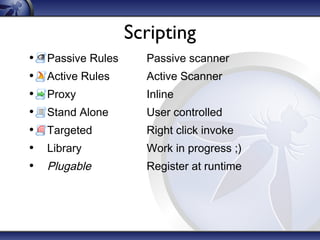
Scripting
•
•
•
•
•
•
•

Passive Rules

Passive scanner

Active Rules

Active Scanner

Proxy

Inline

Stand Alone

User controlled

Targeted

Right click invoke

Library

Work in progress ;)

Plugable

Register at runtime
'Standard' Scripts
•
•
•
•

No IDE required :)
JavaScript (and Zest) built in
Python and Ruby download from Marketplace
All other JSR 223 scripts supported with no
templates

• Templates give basic structure
• But you still need some idea of ZAP internals
– http://code.google.com/p/zaproxy/wiki/InternalDetails
– http://code.google.com/p/zaproxy/wiki/JavaDocs
Zest Scripts
•
•
•
•
•
•
•

Built in, same script types
But they are graphical
Implement JSR 223
And very new
Effectively ZAP's macro language
Right click everywhere!
https://developer.mozilla.org/en-US/docs/zest
Add-ons
•
•
•
•

Available from the ZAP Marketplace
Name format: id-status-version.zap
Status: alpha, beta, release
Standard ZIP file, containing:
– ZapAddOn.xml
– Active scan rules
– Passive scan rules
– Extensions
– Files
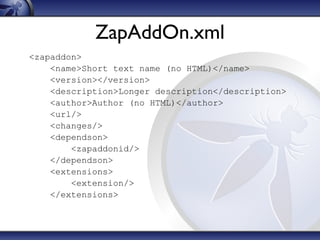
ZapAddOn.xml
<zapaddon>
<name>Short text name (no HTML)</name>
<version></version>
<description>Longer description</description>
<author>Author (no HTML)</author>
<url/>
<changes/>
<dependson>
<zapaddonid/>
</dependson>
<extensions>
<extension/>
</extensions>
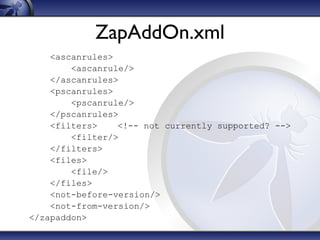
ZapAddOn.xml
<ascanrules>
<ascanrule/>
</ascanrules>
<pscanrules>
<pscanrule/>
</pscanrules>
<filters>
<!-- not currently supported? -->
<filter/>
</filters>
<files>
<file/>
</files>
<not-before-version/>
<not-from-version/>
</zapaddon>
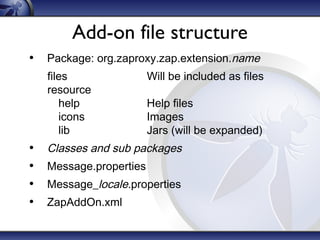
Add-on file structure
• Package: org.zaproxy.zap.extension.name
files
resource
help
icons
lib

•
•
•
•

Will be included as files
Help files
Images
Jars (will be expanded)

Classes and sub packages
Message.properties
Message_locale.properties
ZapAddOn.xml
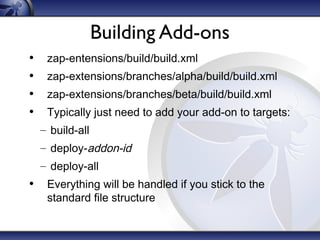
Building Add-ons
•
•
•
•

zap-entensions/build/build.xml
zap-extensions/branches/alpha/build/build.xml
zap-extensions/branches/beta/build/build.xml
Typically just need to add your add-on to targets:
– build-all
– deploy-addon-id
– deploy-all

• Everything will be handled if you stick to the
standard file structure
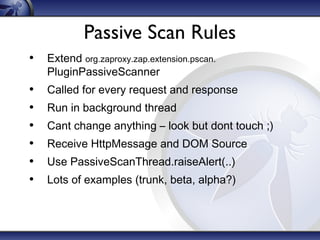
Passive Scan Rules
• Extend org.zaproxy.zap.extension.pscan.
PluginPassiveScanner

•
•
•
•
•
•

Called for every request and response
Run in background thread
Cant change anything – look but dont touch ;)
Receive HttpMessage and DOM Source
Use PassiveScanThread.raiseAlert(..)
Lots of examples (trunk, beta, alpha?)
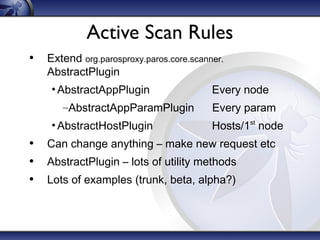
Active Scan Rules
• Extend org.parosproxy.paros.core.scanner.
AbstractPlugin

• AbstractAppPlugin
–AbstractAppParamPlugin
• AbstractHostPlugin

Every node
Every param
Hosts/1 node
st

• Can change anything – make new request etc
• AbstractPlugin – lots of utility methods
• Lots of examples (trunk, beta, alpha?)
Extensions
• Extend org.parosproxy.paros.extension.Extension
• Can do anything – much of the 'core' is really
extensions

• Should have their own language files
• Lots of examples – pick one that does something
vaguely similar?
Features and Fixes
•
•
•
•
•
•
•
•

Scripts, in Javascript, Python, Ruby, Zest
New script templates – Groovy, Scala ...
Active and passive scan rules
http://code.google.com/p/zaproxy/wiki/Projects
http://code.google.com/p/zaproxy/issues/list
'IdealFirstBug' tag
Wrap / port another tool (retire.js, ..)
Whatever you want to do!
Extension Hooks
•
•
•
•
•
•
•
•

OptionsChangedListener
ProxyListener
SessionChangedListener
SiteMapListener
PersistentConnectionListener
AddonFilesChangedListener
CommandLineListener
Key Classes
•
•
•
•
•
•
•
•
•
•

ZAP

main class

Model

singleton

View

singleton

Control

singleton

Session

access via Model

SiteMap

access via Session

SiteNode

a SiteMap node

HttpMessage

full request/response

HistoryReference

subset of HttpMessage

Alert

a vulnerability
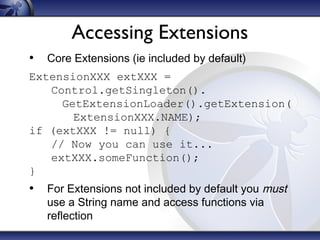
Accessing Extensions
• Core Extensions (ie included by default)
ExtensionXXX extXXX =
Control.getSingleton().
GetExtensionLoader().getExtension(
ExtensionXXX.NAME);
if (extXXX != null) {
// Now you can use it...
extXXX.someFunction();
}

• For Extensions not included by default you must
use a String name and access functions via
reflection
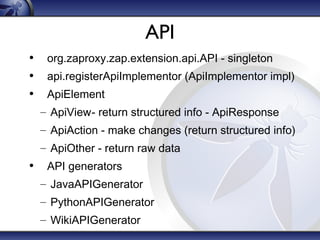
API
• org.zaproxy.zap.extension.api.API - singleton
• api.registerApiImplementor (ApiImplementor impl)
• ApiElement
– ApiView- return structured info - ApiResponse
– ApiAction - make changes (return structured info)
– ApiOther - return raw data

• API generators
– JavaAPIGenerator
– PythonAPIGenerator
– WikiAPIGenerator
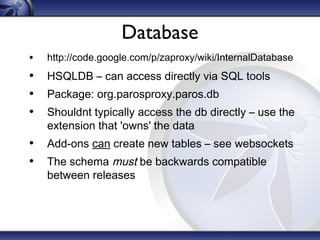
Database
•

http://code.google.com/p/zaproxy/wiki/InternalDatabase

• HSQLDB – can access directly via SQL tools
• Package: org.parosproxy.paros.db
• Shouldnt typically access the db directly – use the
extension that 'owns' the data

• Add-ons can create new tables – see websockets
• The schema must be backwards compatible
between releases
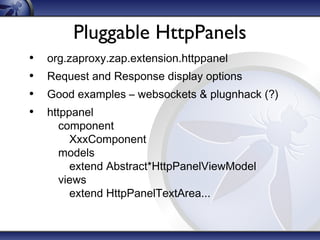
Pluggable HttpPanels
•
•
•
•

org.zaproxy.zap.extension.httppanel
Request and Response display options
Good examples – websockets & plugnhack (?)
httppanel
component
XxxComponent
models
extend Abstract*HttpPanelViewModel
views
extend HttpPanelTextArea...
Feedback?

OWASP 2013 APPSEC USA ZAP Hackathon

  • 1.
    The OWASP Foundation http://www.owasp.org OWASP ZedAttack Proxy Hackathon Simon Bennetts OWASP ZAP Project Lead Mozilla Security Team psiinon@gmail.com Copyright © The OWASP Foundation Permission is granted to copy, distribute and/or modify this document under the terms of the OWASP License.
  • 2.
    The Plan • • • • • Overview ofhow to extend ZAP Describe the topics I could talk about Find out what you really want to know ;) Agree topics to cover For each topic: – Talk for a bit, hack for a bit • But its all up for grabs, so we can change anything • And feel free to do your own thing! • I'll help out during the hacking sections 2
  • 3.
    How you canextend ZAP • Without a dev environment: – 3rd party tools – Scripts – Translations – Documentation • With a development environment – Active & passive scan rules – 'Full' extensions
  • 4.
    What can youplug in? • • • • Scripts Script types Active and Passive rules UI elements – tabs, popups, toolbar buttons, menus, right click options... • API calls • Request / Response views • Breaking, Fuzzing, Searching
  • 5.
    Topics I couldtalk about • • • • • • • • The ZAP project structure Setting up a ZAP development environment ZAP documentation and internationalization Implementing 'standard' scripts Implementing Zest scripts Implementing active and passive scan rules Implementing Add-ons and extensions Features and fixes to work on
  • 6.
    More topics Icould talk about • • • • • • • • Key classes Accessing core functionality and extensions Internal events The user interface The API The database Request / Response views Breaking, fuzzing, searching
  • 7.
    Project Structure • zaproxy –http://code.google.com/p/zaproxy/ – The 'core' plus a lot more • zap-test – http://code.google.com/p/zaproxy-test/ – Unit tests • zap-extensions – http://code.google.com/p/zap-extensions/ – The add-ons – Trunk, alpha and beta branches!
  • 8.
    Project Structure • zaproxy –src All the 'core' source code • org/parosprozy The 'old' Paros code • org/zaproxy The 'new' ZAP code • help Help files • lang Property files (UI) – build Build directory – lib Jar files – scripts Default script templates
  • 9.
    Development Environment • • • • Java 7 Eclipse(or your favorite Java IDE) Subversive SVN (or equivalent) Import ZAP projects via SVN – https://zaproxy.googlecode.com/svn/trunk/ – https://zaproxy-test.googlecode.com/svn/trunk/ – https://zap-extensions.googlecode.com/svn/trunk/ – https://zap-extensions.googlecode.com/svn/branches/alpha/ – https://zap-extensions.googlecode.com/svn/branches/beta/ • Add 'lib' jars to build path • Run org.zaproxy.zap.ZAP.java
  • 10.
    Creating the Projects • • • • • • • • File/ New / Other... SVN / Project from SVN Create a new repository location URL, e.g. https://zaproxy.googlecode.com/svn/ Select Resource, e.g. trunk Check out .. using the New Project Wizard Select a wizard: Java / Java Project Add all lib/*.jar files to the build path
  • 11.
    Dev Rules andGuidelines • http://code.google.com/p/zaproxy/wiki/DevGuidelines • • • • • • • • Ease of use and consistency are key All UI string must in internationalized Comment all changes to orp.parosproxy.paros All functionality should have help pages Keep a clean split between functionality and UI Check in code cleaner that you checked out Write unit tests Extensions should expose functionality, not UI elements (older ones still do)
  • 12.
    Documentation and i18n •ZAP Help file – src/help – {addon}/resource/help – http://code.google.com/p/zaproxy/wiki/HelpIntro • Home pages – https://www.owasp.org/index.php/ZAP • 'Official' home page, 'outward' facing? – http://code.google.com/p/zaproxy/ • More details, 'internal' facing? • http://crowdin.net/project/owasp-zap
  • 13.
    Scripting • • • • • • • Passive Rules Passive scanner ActiveRules Active Scanner Proxy Inline Stand Alone User controlled Targeted Right click invoke Library Work in progress ;) Plugable Register at runtime
  • 14.
    'Standard' Scripts • • • • No IDErequired :) JavaScript (and Zest) built in Python and Ruby download from Marketplace All other JSR 223 scripts supported with no templates • Templates give basic structure • But you still need some idea of ZAP internals – http://code.google.com/p/zaproxy/wiki/InternalDetails – http://code.google.com/p/zaproxy/wiki/JavaDocs
  • 15.
    Zest Scripts • • • • • • • Built in,same script types But they are graphical Implement JSR 223 And very new Effectively ZAP's macro language Right click everywhere! https://developer.mozilla.org/en-US/docs/zest
  • 16.
    Add-ons • • • • Available from theZAP Marketplace Name format: id-status-version.zap Status: alpha, beta, release Standard ZIP file, containing: – ZapAddOn.xml – Active scan rules – Passive scan rules – Extensions – Files
  • 17.
    ZapAddOn.xml <zapaddon> <name>Short text name(no HTML)</name> <version></version> <description>Longer description</description> <author>Author (no HTML)</author> <url/> <changes/> <dependson> <zapaddonid/> </dependson> <extensions> <extension/> </extensions>
  • 18.
    ZapAddOn.xml <ascanrules> <ascanrule/> </ascanrules> <pscanrules> <pscanrule/> </pscanrules> <filters> <!-- not currentlysupported? --> <filter/> </filters> <files> <file/> </files> <not-before-version/> <not-from-version/> </zapaddon>
  • 19.
    Add-on file structure •Package: org.zaproxy.zap.extension.name files resource help icons lib • • • • Will be included as files Help files Images Jars (will be expanded) Classes and sub packages Message.properties Message_locale.properties ZapAddOn.xml
  • 20.
    Building Add-ons • • • • zap-entensions/build/build.xml zap-extensions/branches/alpha/build/build.xml zap-extensions/branches/beta/build/build.xml Typically justneed to add your add-on to targets: – build-all – deploy-addon-id – deploy-all • Everything will be handled if you stick to the standard file structure
  • 21.
    Passive Scan Rules •Extend org.zaproxy.zap.extension.pscan. PluginPassiveScanner • • • • • • Called for every request and response Run in background thread Cant change anything – look but dont touch ;) Receive HttpMessage and DOM Source Use PassiveScanThread.raiseAlert(..) Lots of examples (trunk, beta, alpha?)
  • 22.
    Active Scan Rules •Extend org.parosproxy.paros.core.scanner. AbstractPlugin • AbstractAppPlugin –AbstractAppParamPlugin • AbstractHostPlugin Every node Every param Hosts/1 node st • Can change anything – make new request etc • AbstractPlugin – lots of utility methods • Lots of examples (trunk, beta, alpha?)
  • 23.
    Extensions • Extend org.parosproxy.paros.extension.Extension •Can do anything – much of the 'core' is really extensions • Should have their own language files • Lots of examples – pick one that does something vaguely similar?
  • 24.
    Features and Fixes • • • • • • • • Scripts,in Javascript, Python, Ruby, Zest New script templates – Groovy, Scala ... Active and passive scan rules http://code.google.com/p/zaproxy/wiki/Projects http://code.google.com/p/zaproxy/issues/list 'IdealFirstBug' tag Wrap / port another tool (retire.js, ..) Whatever you want to do!
  • 25.
  • 26.
    Key Classes • • • • • • • • • • ZAP main class Model singleton View singleton Control singleton Session accessvia Model SiteMap access via Session SiteNode a SiteMap node HttpMessage full request/response HistoryReference subset of HttpMessage Alert a vulnerability
  • 27.
    Accessing Extensions • CoreExtensions (ie included by default) ExtensionXXX extXXX = Control.getSingleton(). GetExtensionLoader().getExtension( ExtensionXXX.NAME); if (extXXX != null) { // Now you can use it... extXXX.someFunction(); } • For Extensions not included by default you must use a String name and access functions via reflection
  • 28.
    API • org.zaproxy.zap.extension.api.API -singleton • api.registerApiImplementor (ApiImplementor impl) • ApiElement – ApiView- return structured info - ApiResponse – ApiAction - make changes (return structured info) – ApiOther - return raw data • API generators – JavaAPIGenerator – PythonAPIGenerator – WikiAPIGenerator
  • 29.
    Database • http://code.google.com/p/zaproxy/wiki/InternalDatabase • HSQLDB –can access directly via SQL tools • Package: org.parosproxy.paros.db • Shouldnt typically access the db directly – use the extension that 'owns' the data • Add-ons can create new tables – see websockets • The schema must be backwards compatible between releases
  • 30.
    Pluggable HttpPanels • • • • org.zaproxy.zap.extension.httppanel Request andResponse display options Good examples – websockets & plugnhack (?) httppanel component XxxComponent models extend Abstract*HttpPanelViewModel views extend HttpPanelTextArea...
  • 31.