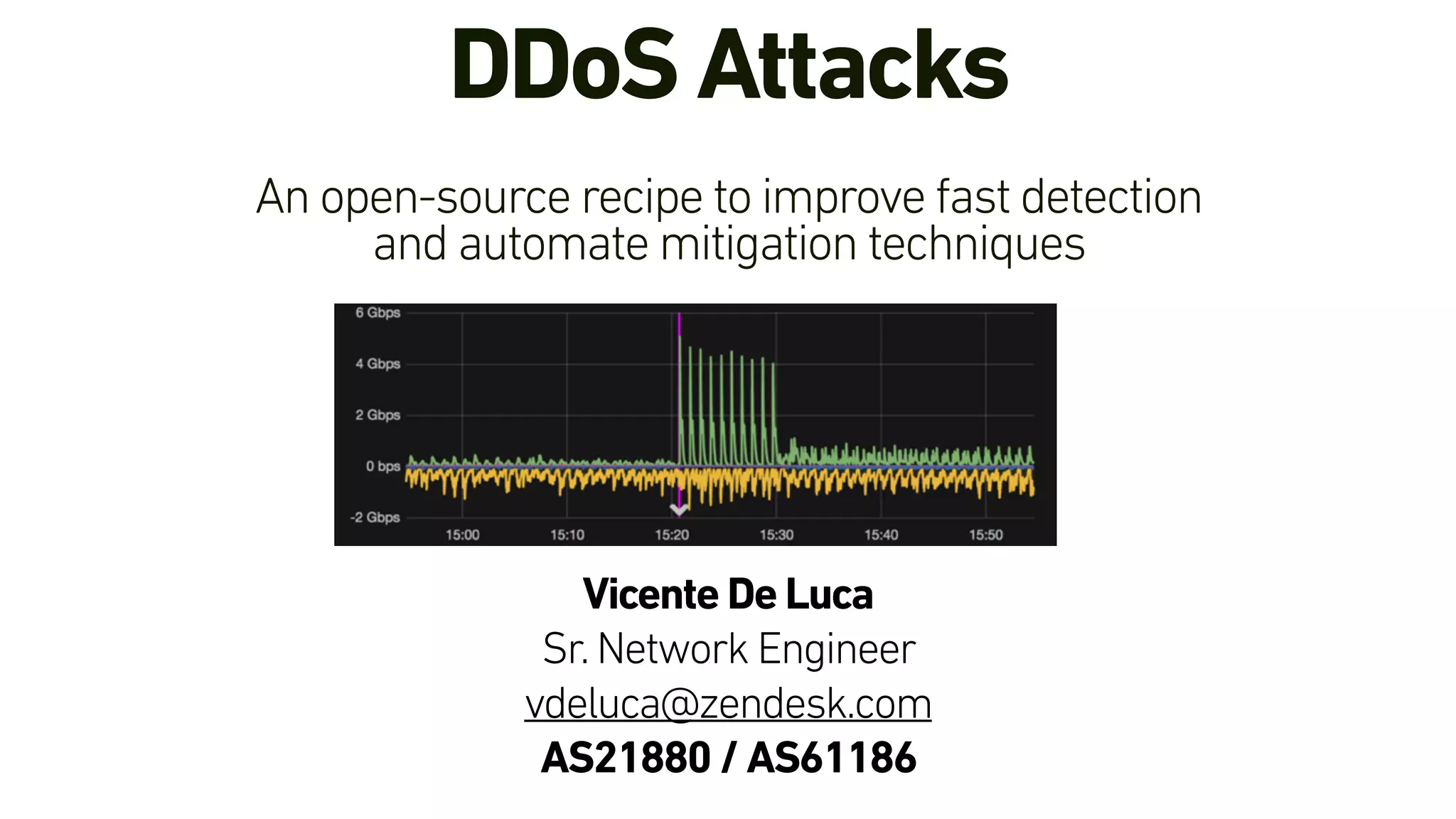
DDoS Attacks


An open-source recipe to improve fast detection
and automate mitigation techniques


Vicente De Luca
Sr.Network Engineer

vdeluca@zendesk.com
AS21880 / AS61186

Introduction
Tentative to solve:

#1 DDoS fast detection and better monitoring

#2 Improve response time on mitigation triggering
Opensource recipe
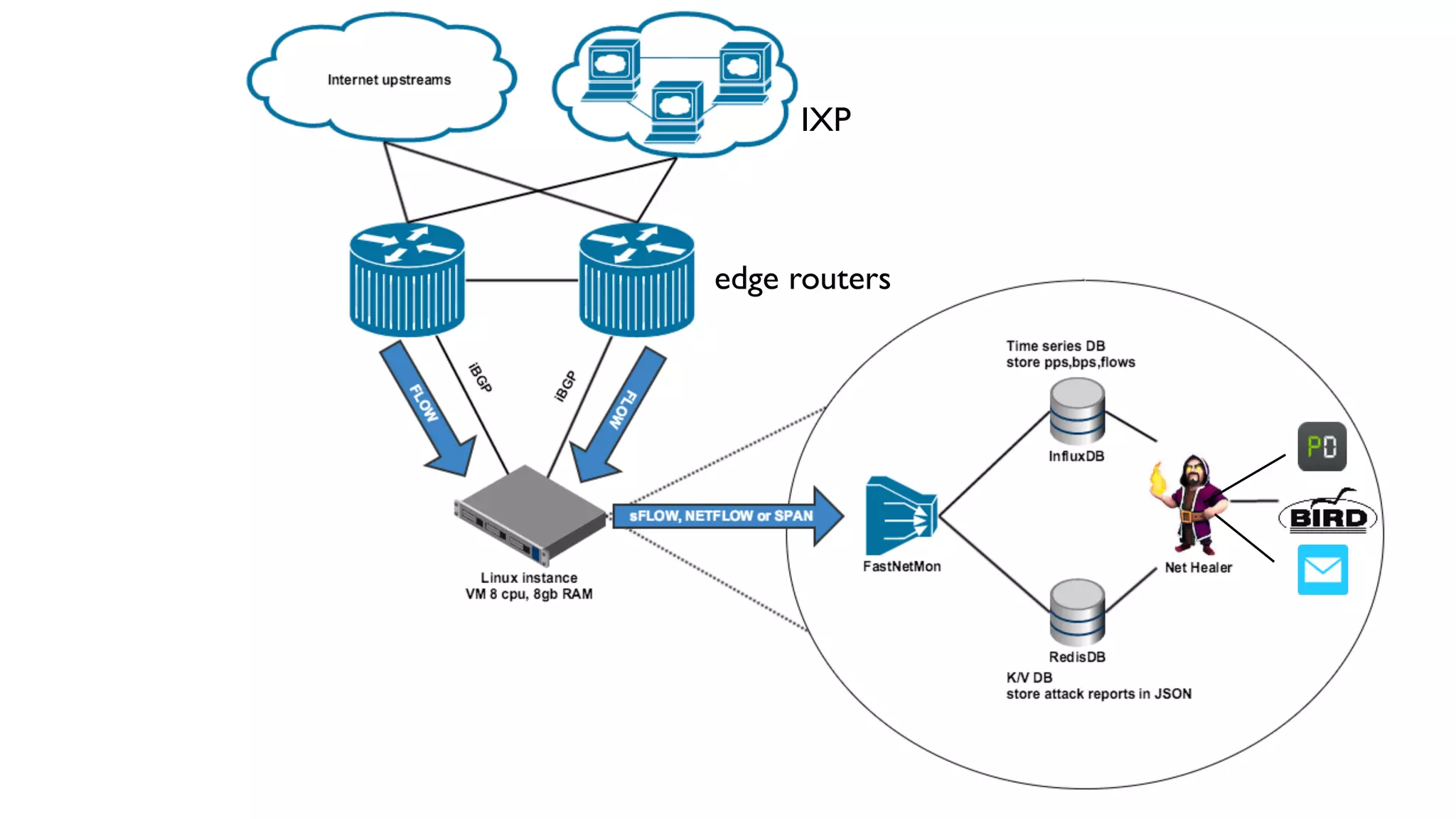
- FastNetMon: main core of our solution.DDoS analyzer with sflow/netflow/mirror support
- InfluxDB: Scalable data store for metrics,events,and real-time analytics
- Grafana:Gorgeous metric viz,dashboards & editors
- Redis: An in-memory database that persists on disk
- Morgoth: Metric anomaly detection for Influx databases
- BIRD: a fully functional dynamic IP routing daemon
- Net Healer: experimental code to "glue" all moving parts,trigger actions and provide API queries
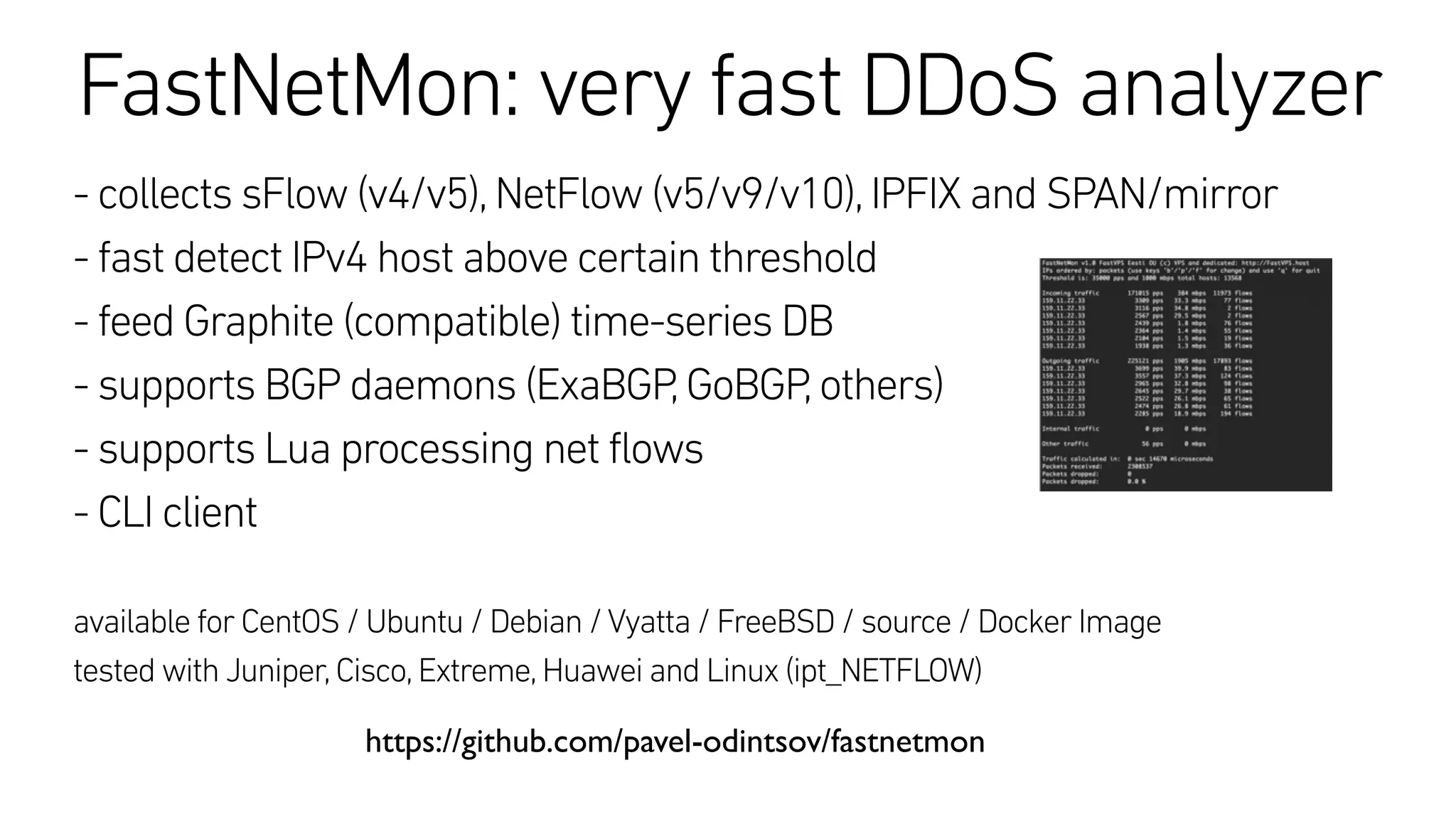
FastNetMon: very fast DDoS analyzer
- collects sFlow (v4/v5),NetFlow (v5/v9/v10),IPFIX and SPAN/mirror
- fast detect IPv4 host above certain threshold
- feed Graphite (compatible) time-series DB
- supports BGP daemons (ExaBGP,GoBGP,others)
- supports Lua processing net flows
- CLI client
available for CentOS / Ubuntu / Debian /Vyatta / FreeBSD / source / Docker Image
tested with Juniper,Cisco,Extreme,Huawei and Linux (ipt_NETFLOW)
https://github.com/pavel-odintsov/fastnetmon
FastNetMon
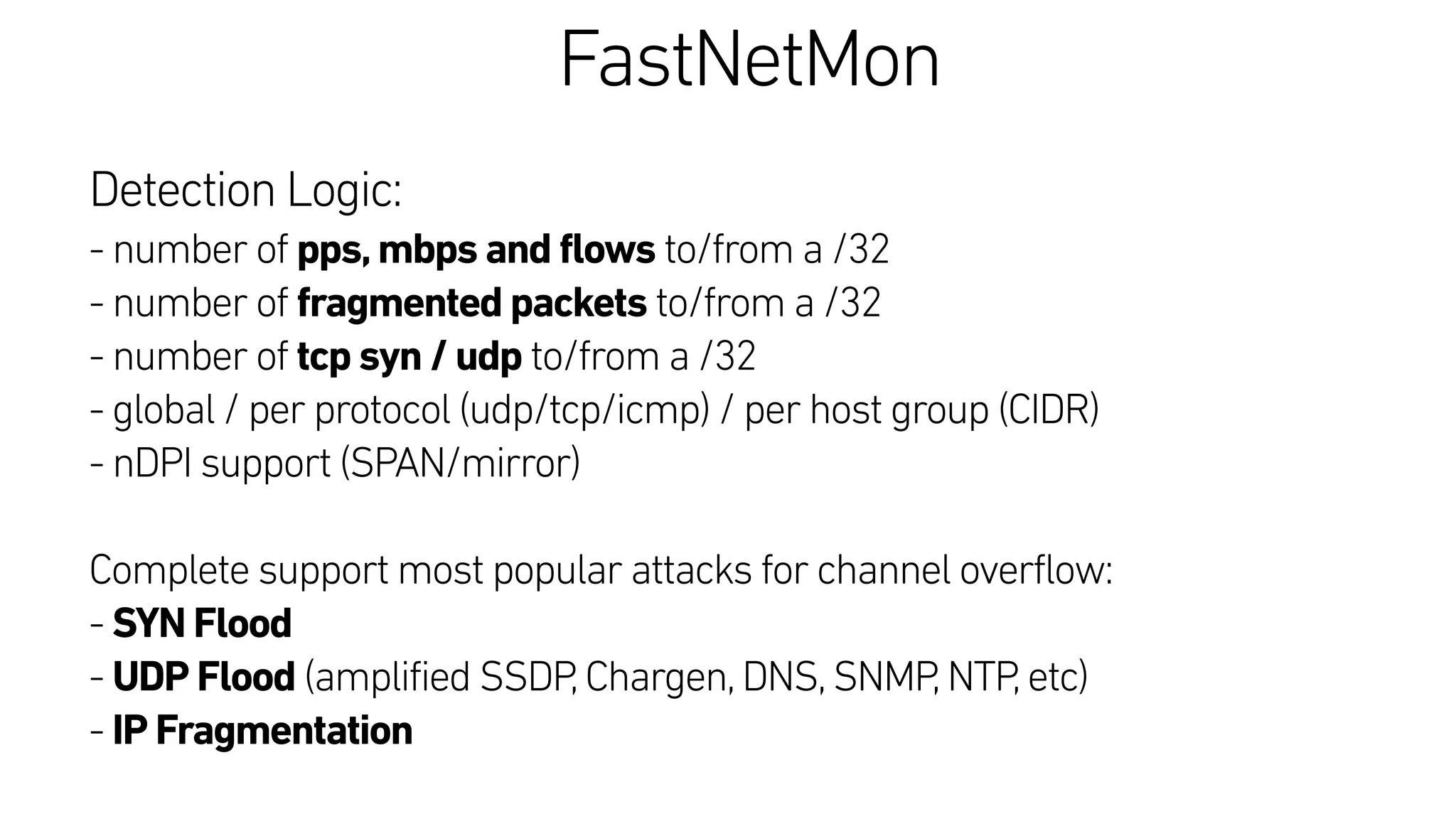
Detection Logic:
- number of pps,mbps and flows to/from a /32
- number of fragmented packets to/from a /32
- number of tcp syn / udp to/from a /32
- global / per protocol (udp/tcp/icmp) / per host group (CIDR)
- nDPI support (SPAN/mirror)
Complete support most popular attacks for channel overflow:
- SYN Flood
- UDP Flood (amplified SSDP,Chargen,DNS,SNMP,NTP,etc)
- IP Fragmentation
FastNetMon
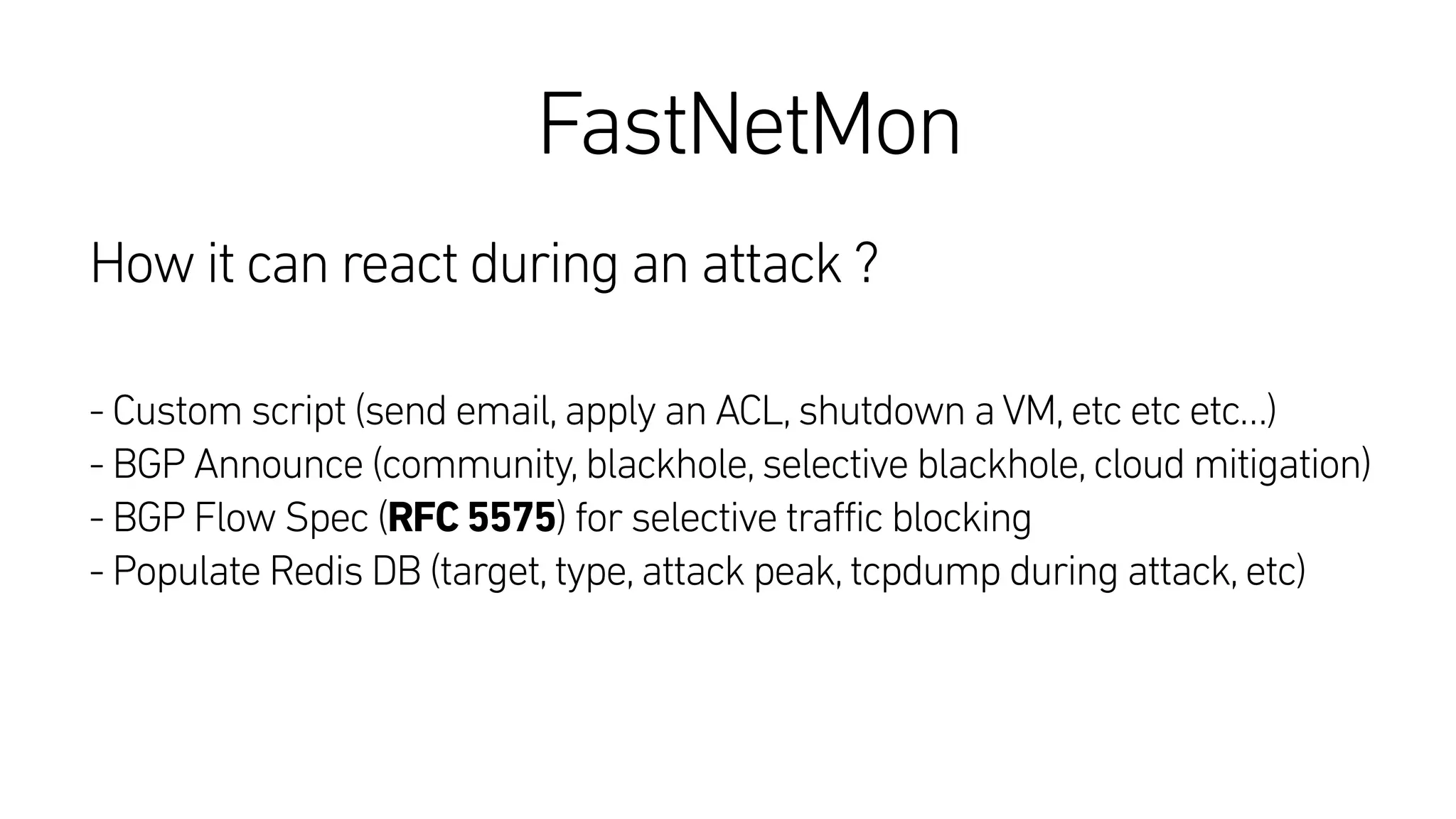
How it can react during an attack ?
- Custom script (send email,apply an ACL,shutdown aVM,etc etc etc…)
- BGP Announce (community,blackhole,selective blackhole,cloud mitigation)
- BGP Flow Spec (RFC 5575) for selective traffic blocking
- Populate Redis DB (target,type,attack peak,tcpdump during attack,etc)
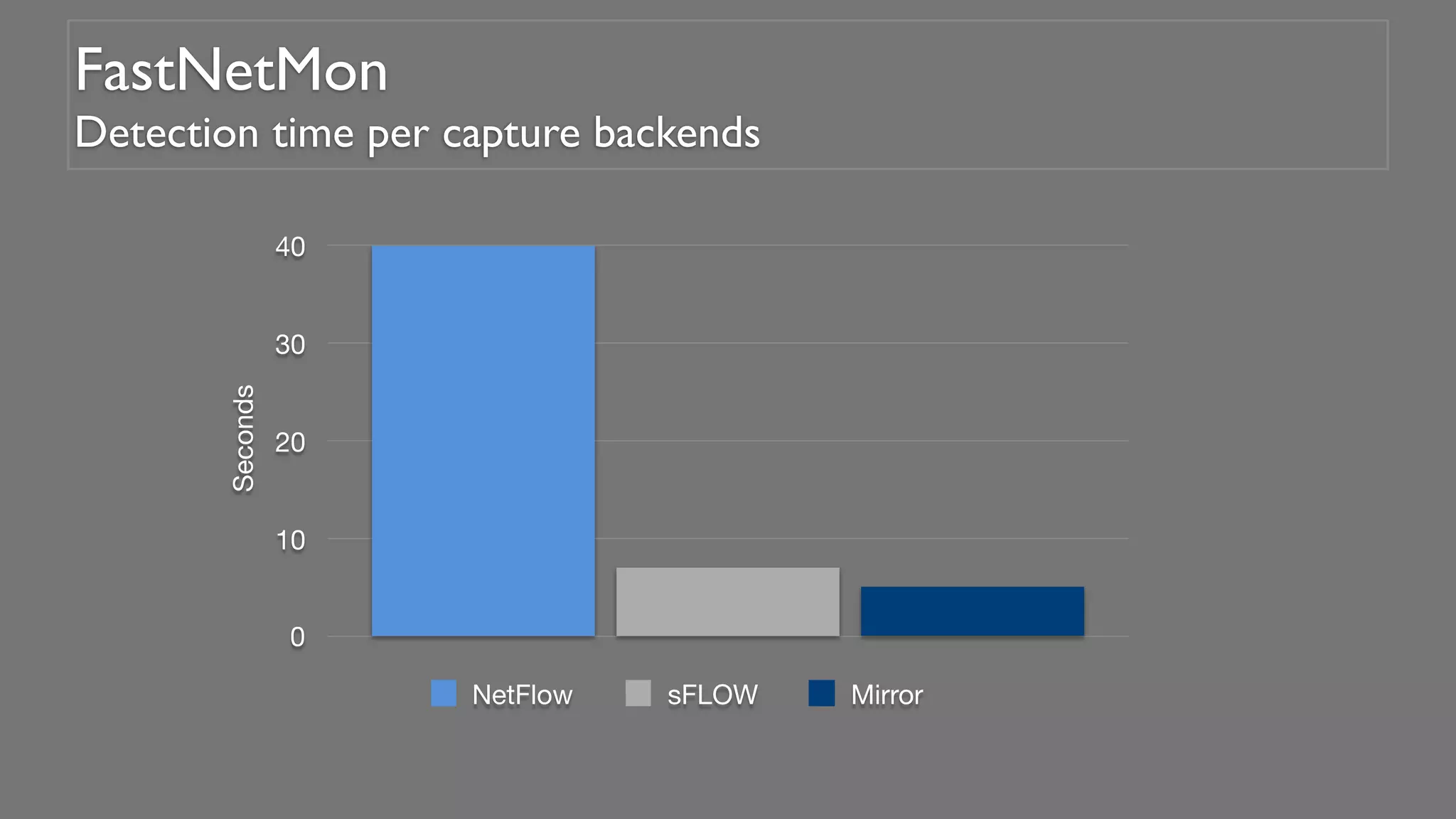
Seconds
0
10
20
30
40
NetFlow sFLOW Mirror
FastNetMon
Detection time per capture backends
our proof-of-concept
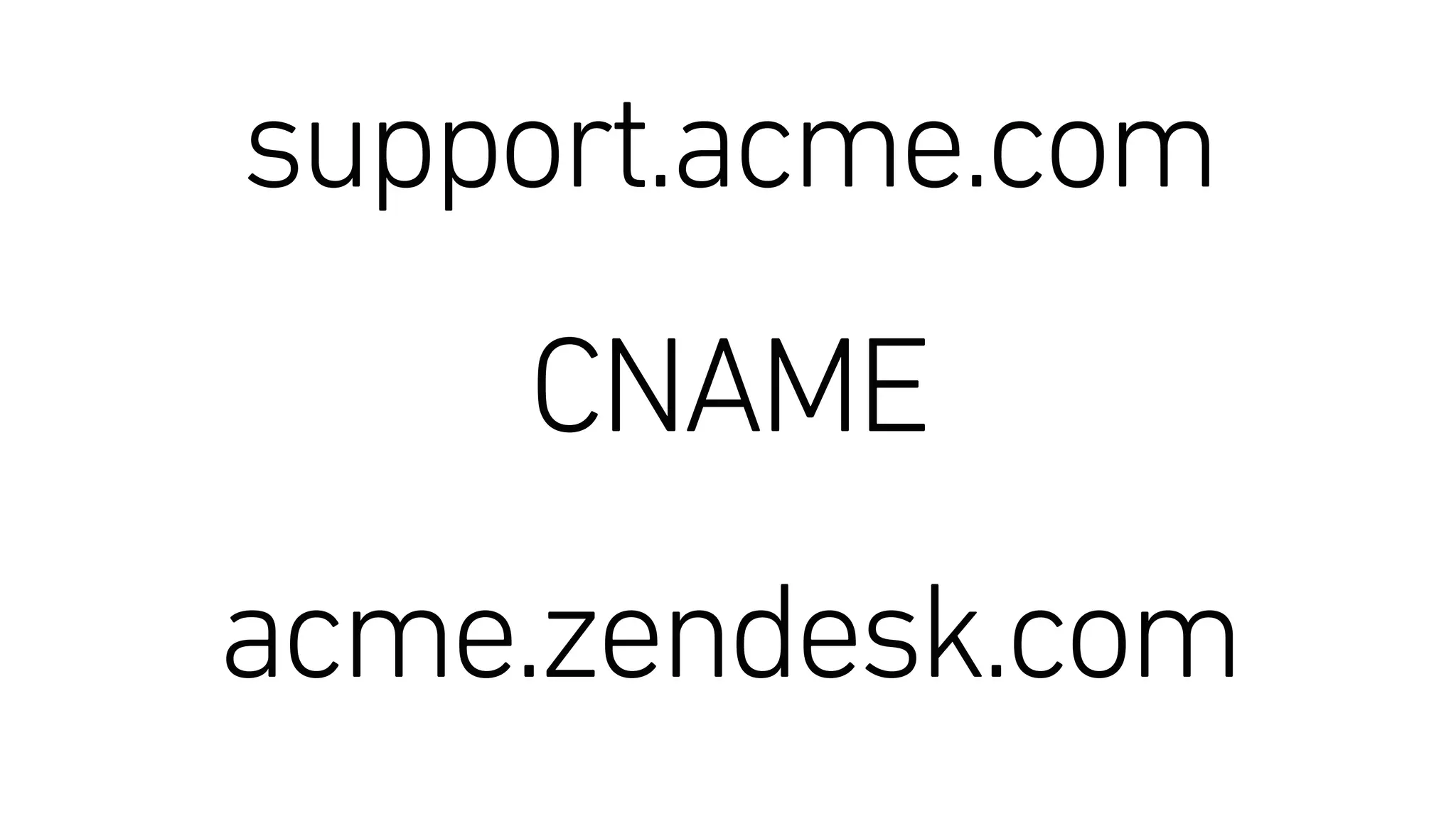
Are we targets?
support.acme.com


CNAME

acme.zendesk.com
The good,the bad
and the ugly
The good: mitigation
via cloud provider (BGP)

- multiple scrubbing centers across the globe
- Lots of Tbps of mitigation bandwidth capacity

- presence in IXPs - GRE tunnel established in a safer circuit
some cons:
- Reaction time: Internet route convergence (BGP) —not that bad
- mitigation occurs on incoming only
- always on = $$$
The bad
NOC paged with a site-down alert :(
Troubleshoot to identify an ongoing attack
The ugly
detecting takes "too long”,dependent on humans :(

trigger mitigation also needs manual config change
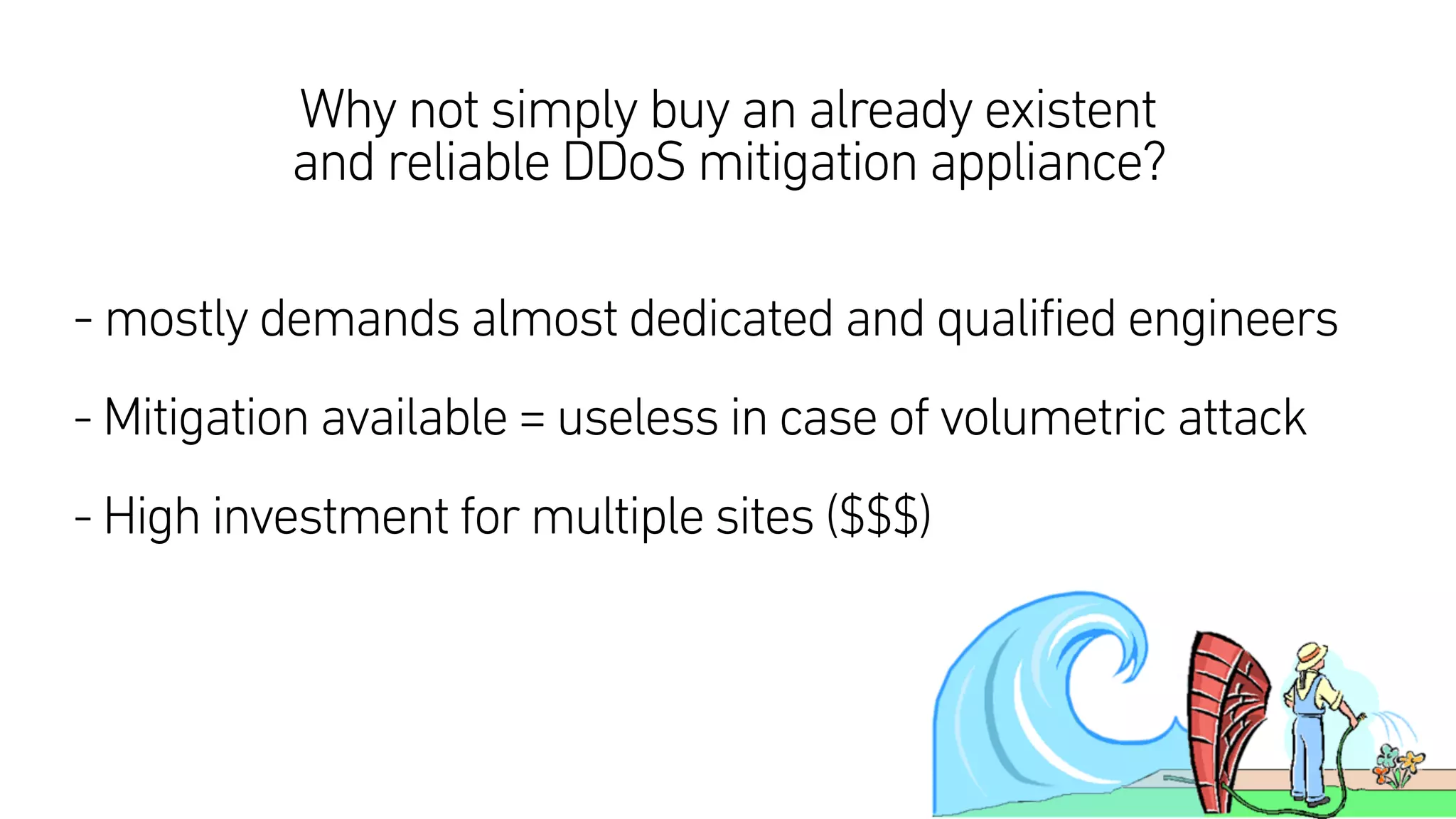
Why not simply buy an already existent
and reliable DDoS mitigation appliance?
- mostly demands almost dedicated and qualified engineers
- Mitigation available = useless in case of volumetric attack 

- High investment for multiple sites ($$$)
Architecture Diagram
IXP
edge routers
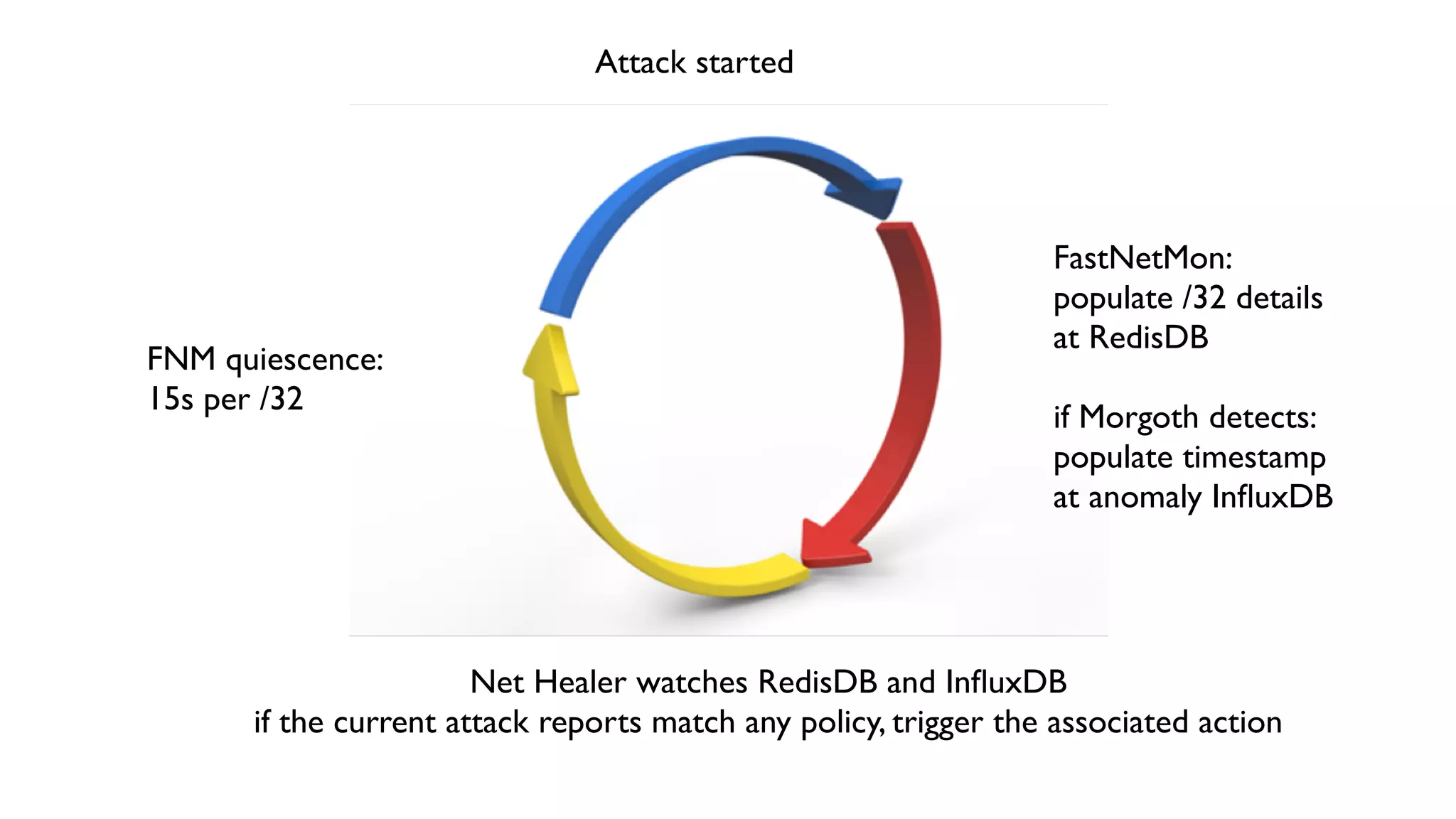
DDoS Attack cycle
Net Healer watches RedisDB and InfluxDB

if the current attack reports match any policy, trigger the associated action
FNM quiescence:
15s per /32
Attack started
FastNetMon:

populate /32 details
at RedisDB
if Morgoth detects:

populate timestamp

at anomaly InfluxDB
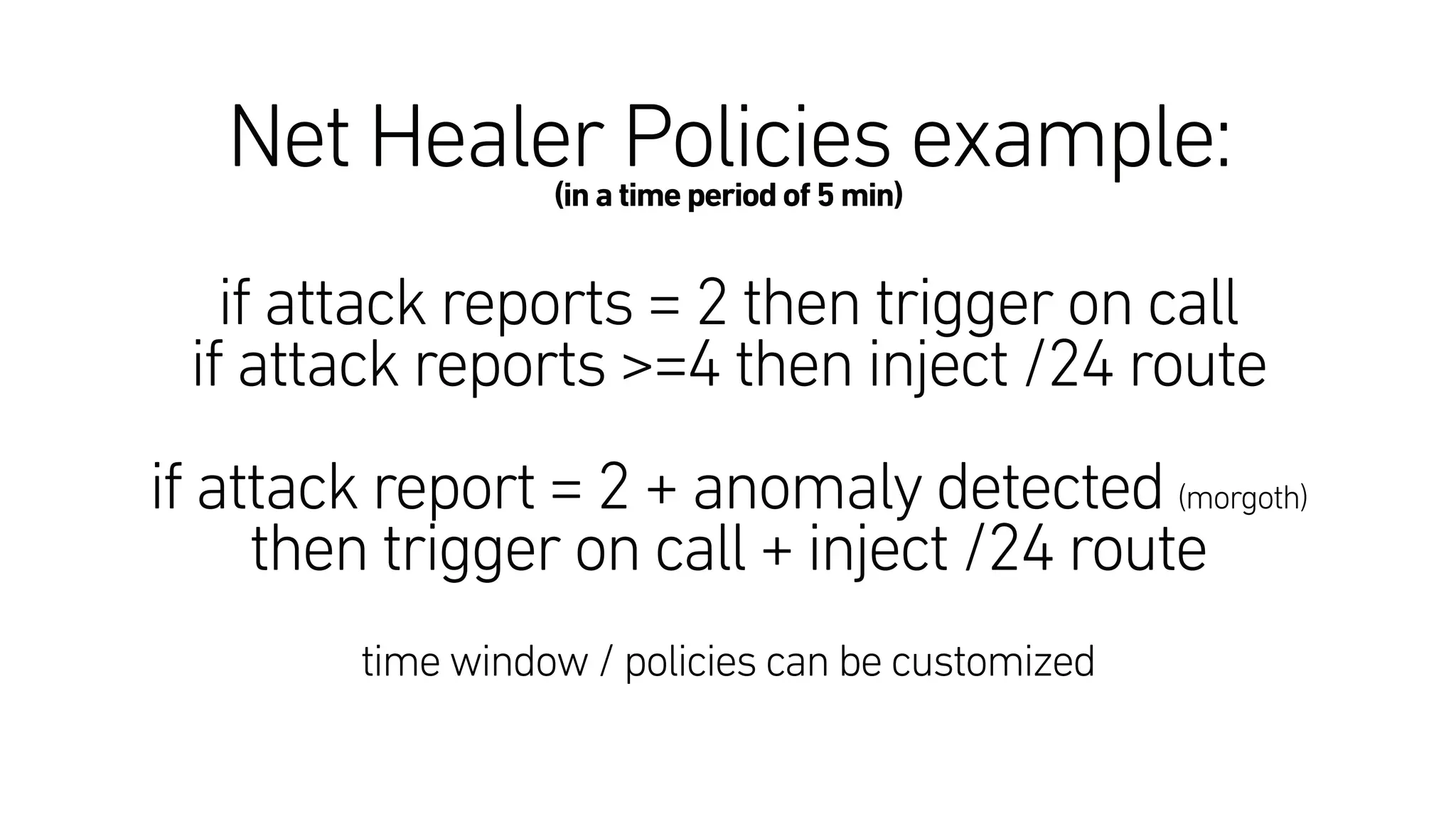
Net Healer Policies example:(in a time period of 5 min)
if attack reports = 2 then trigger on call
if attack reports >=4 then inject /24 route
if attack report = 2 + anomaly detected (morgoth)

then trigger on call + inject /24 route
time window / policies can be customized
Why Net Healer ?


- FastNetMon supports all I need,but relies on pre-configured thresholds
- Hard to predict realistic thresholds since our traffic is influenced by our
customers activity (out of our control)
- To avoid false positives we prefer to trigger different actions based on
each attack cycle phase
- Allow quick integrations like Morgoth x FNM consensus,or API calls such
as Pagerduty,etc
Why InfluxDB ?
- Speaks graphite protocol (compatible with FastNetMon)
- Drop in binary - simple install
- Supports cluster mode - easy to scale
Note: Use version >=0.9.6.1 - with tsm1 engine with no batching
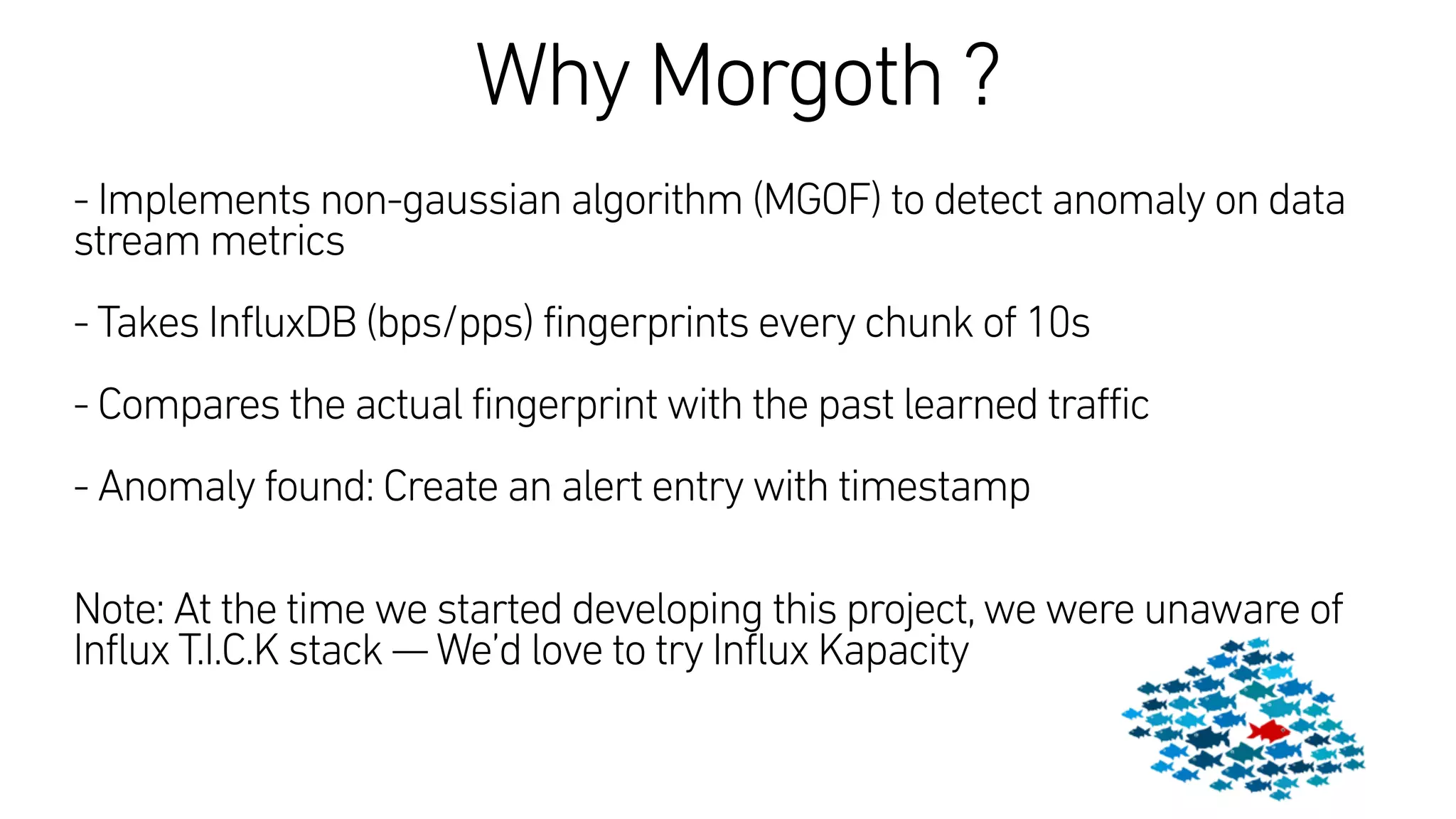
Why Morgoth ?


- Implements non-gaussian algorithm (MGOF) to detect anomaly on data
stream metrics
- Takes InfluxDB (bps/pps) fingerprints every chunk of 10s
- Compares the actual fingerprint with the past learned traffic
- Anomaly found: Create an alert entry with timestamp
Note: At the time we started developing this project,we were unaware of
Influx T.I.C.K stack —We’d love to try Influx Kapacity
Why BIRD ?


- syncing with kernel routing tables (blackhole,mitigate)
- iBGP with edge routers
- Routing policies will decide if RTBH or Advertise to mitigation provider
- friendly to Network Engineers (birdc)
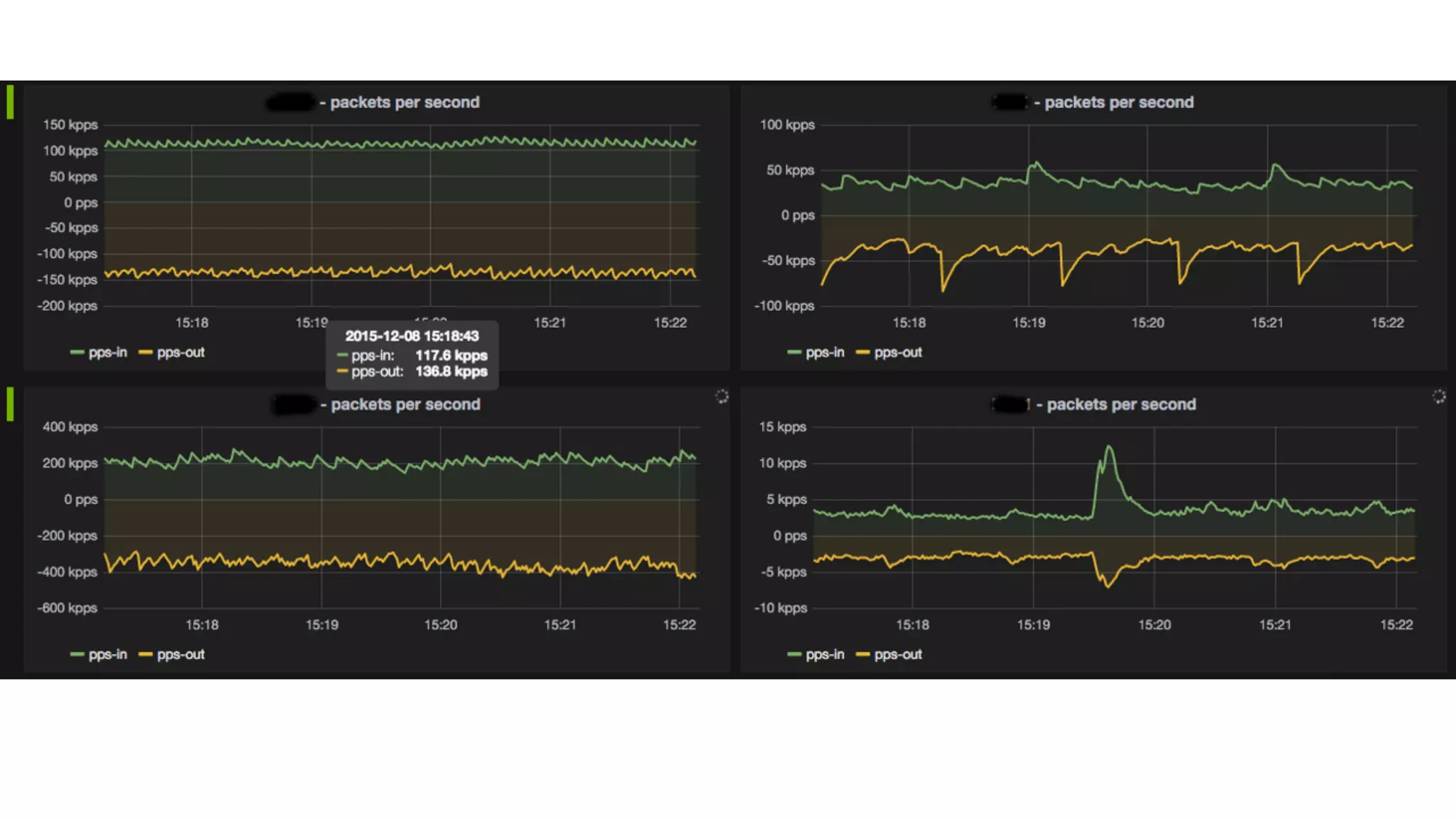
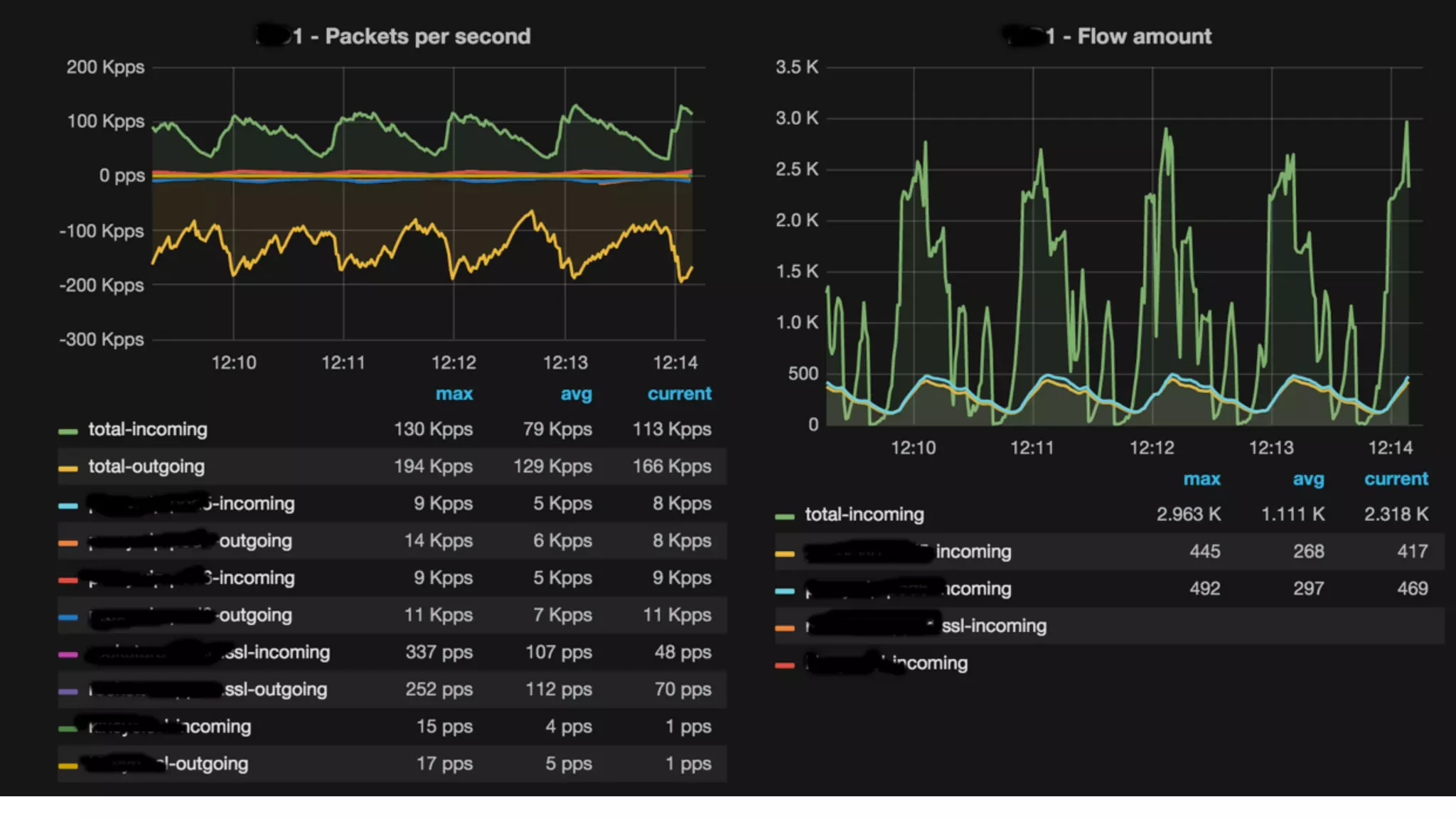
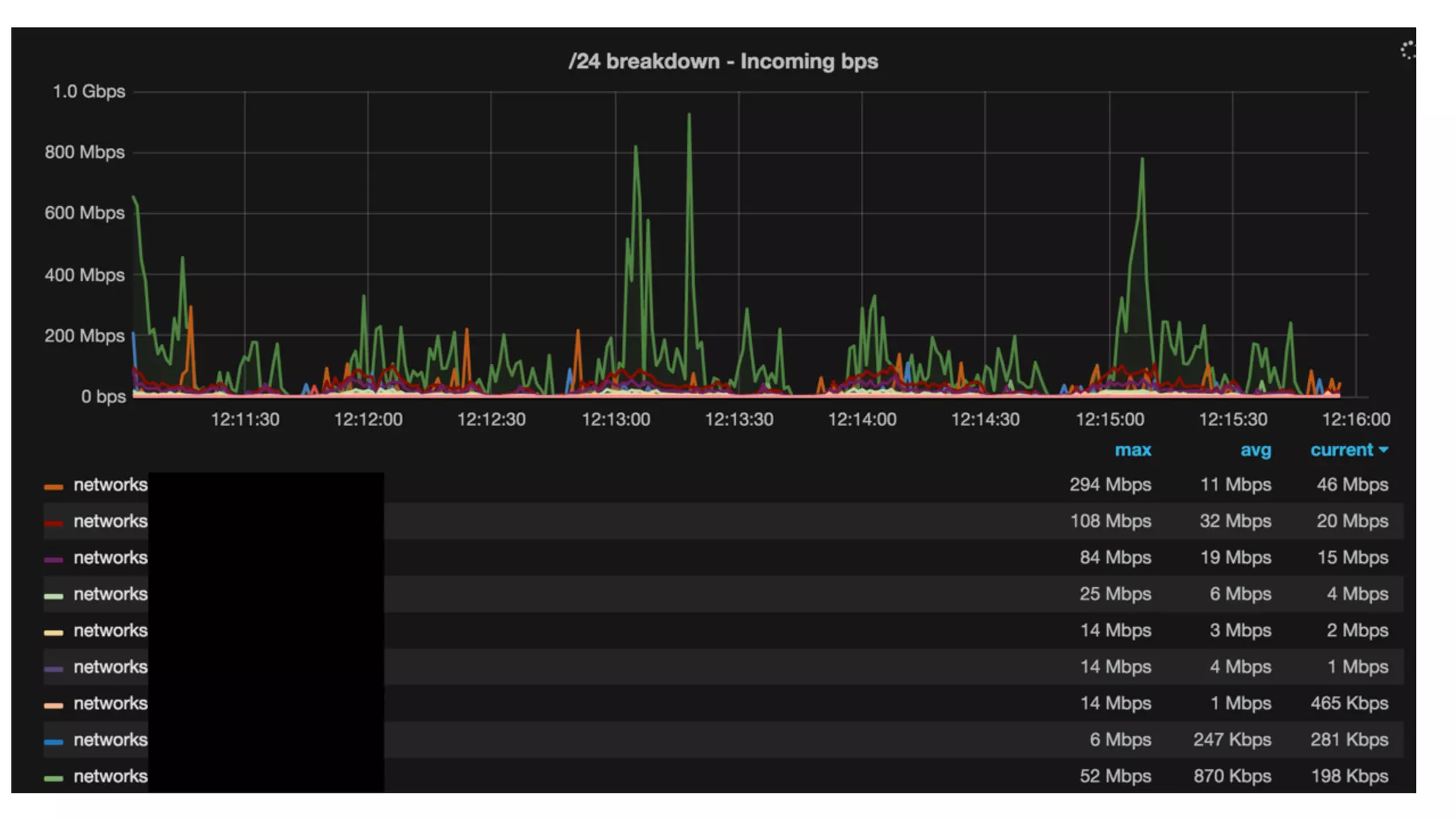
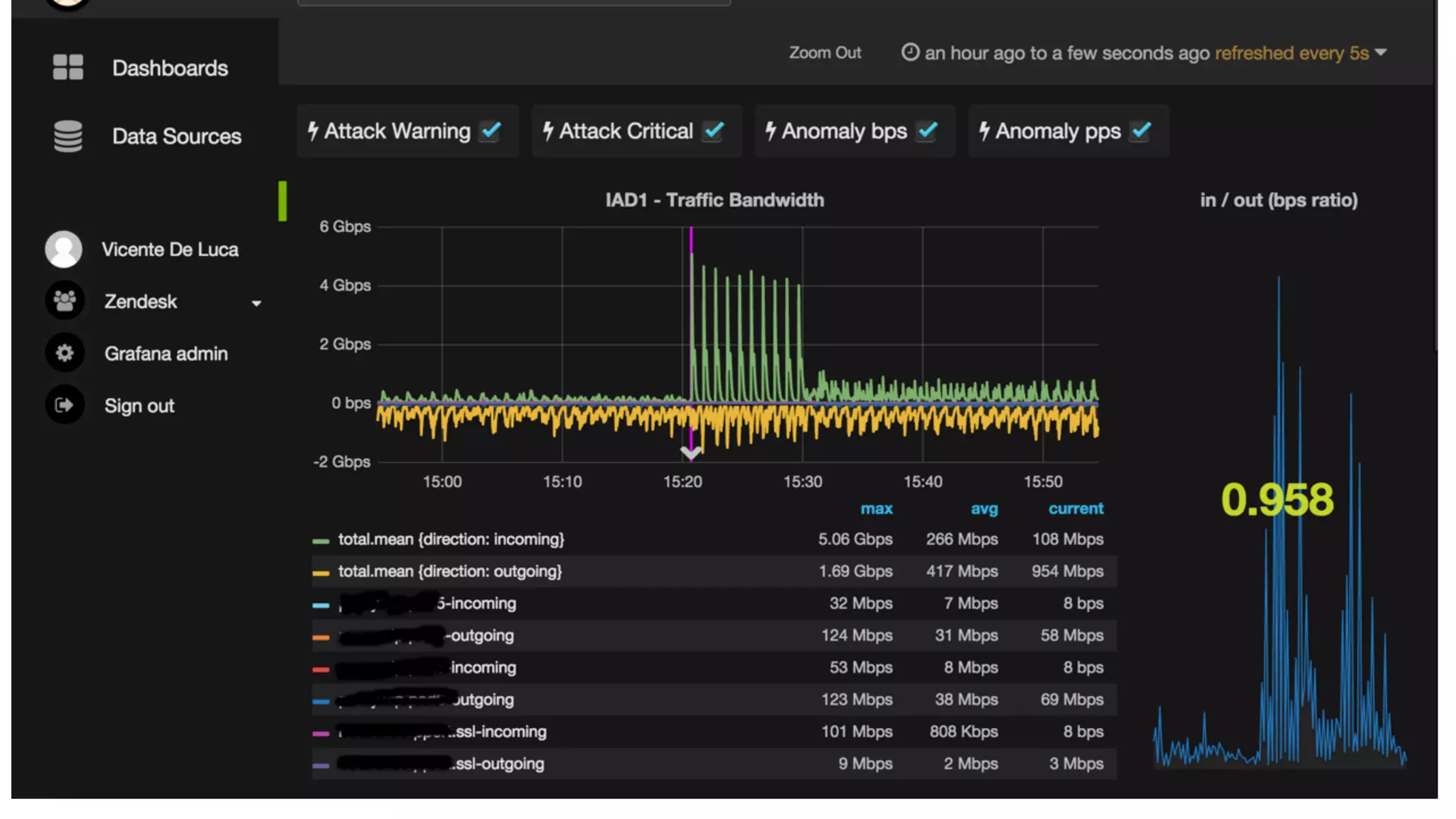
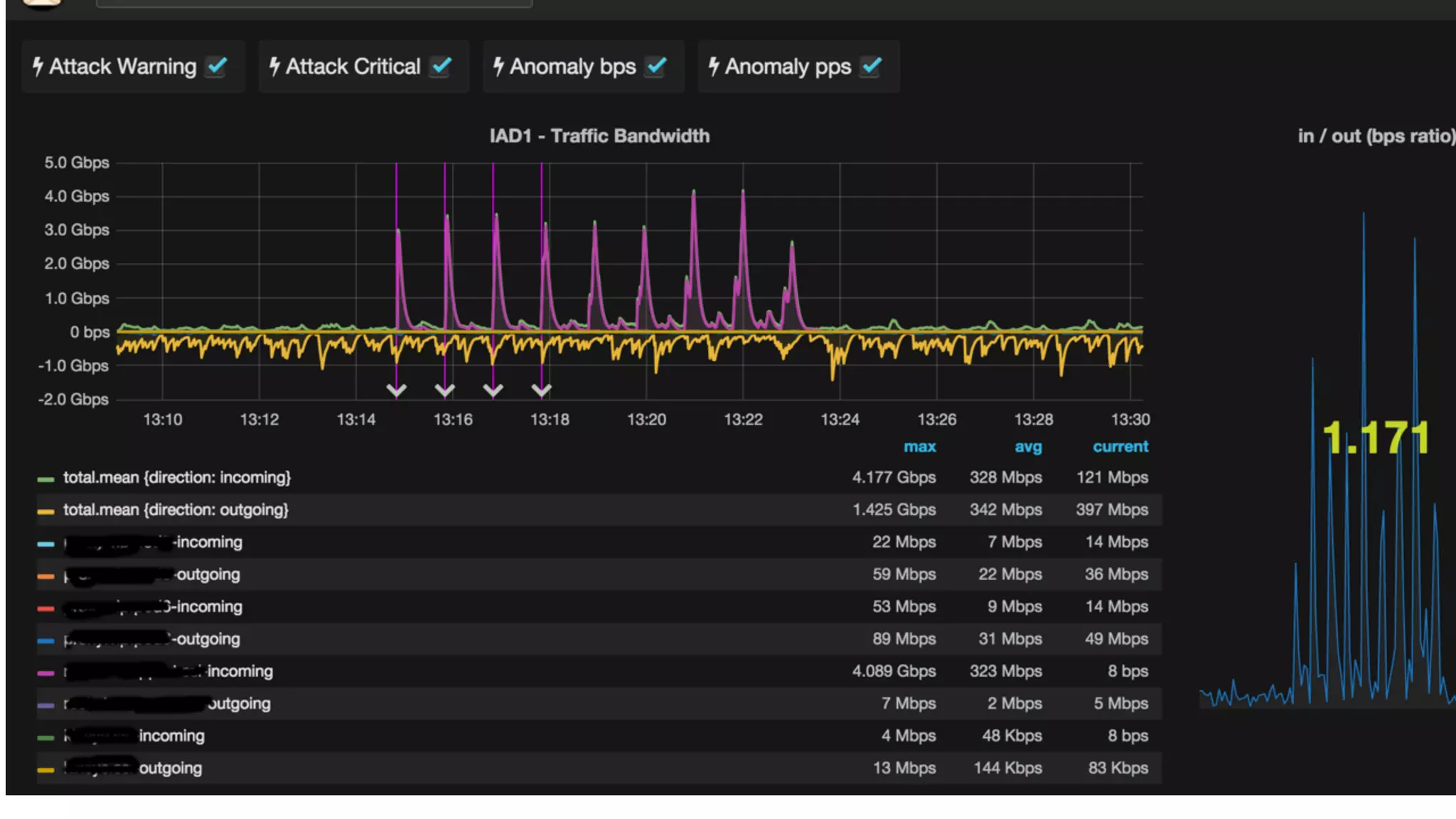
How does it look ?
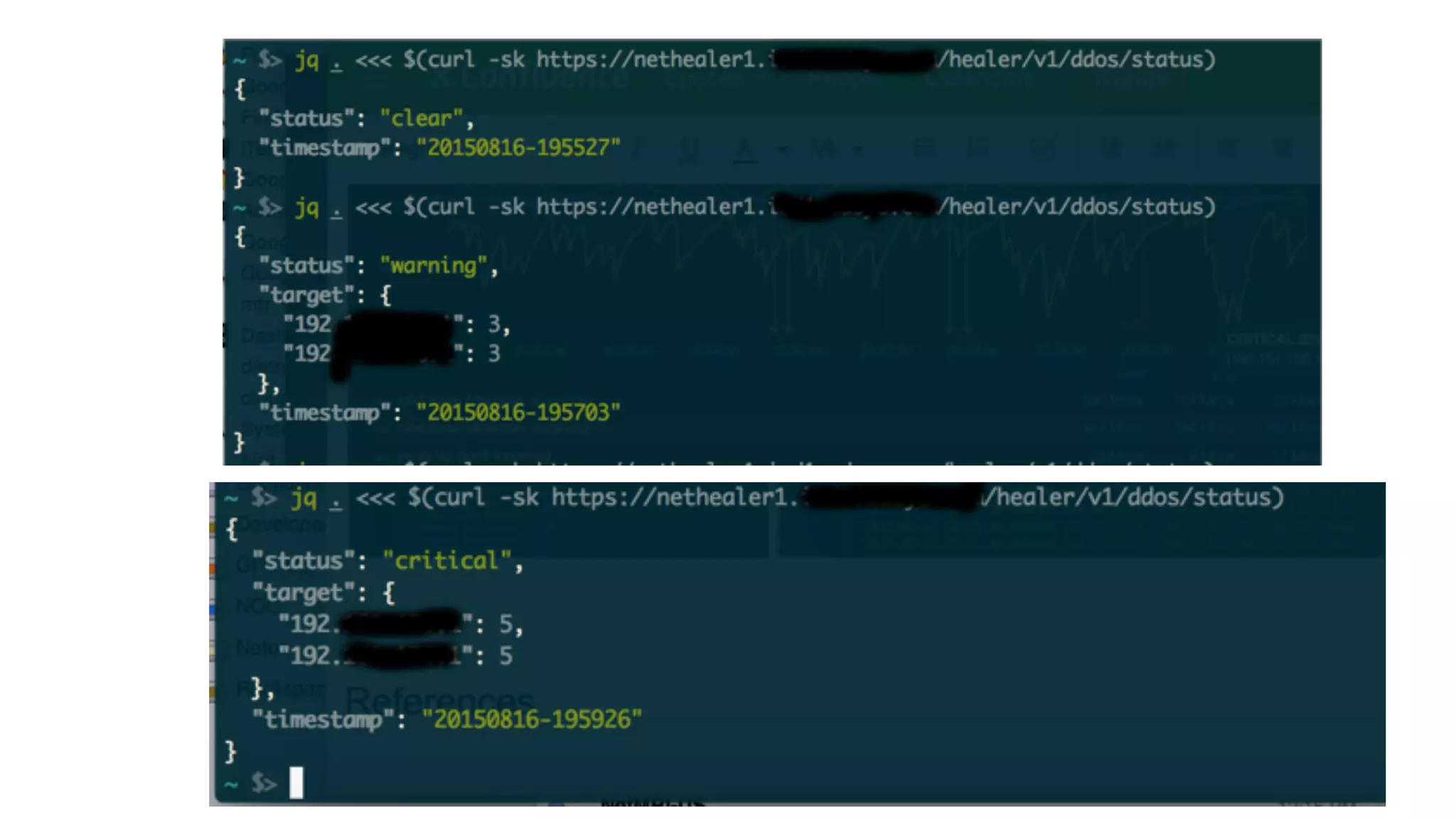
REST API queries
Work in progress
** all the ingredients used on this recipe are open source **
** how to build yourself **
Read Documentation https://github.com/pavel-odintsov/fastnetmon/tree/master/docs
Download https://github.com/pavel-odintsov/fastnetmon
Join mail list https://groups.google.com/forum/#!forum/fastnetmon
About FastNetMon: 

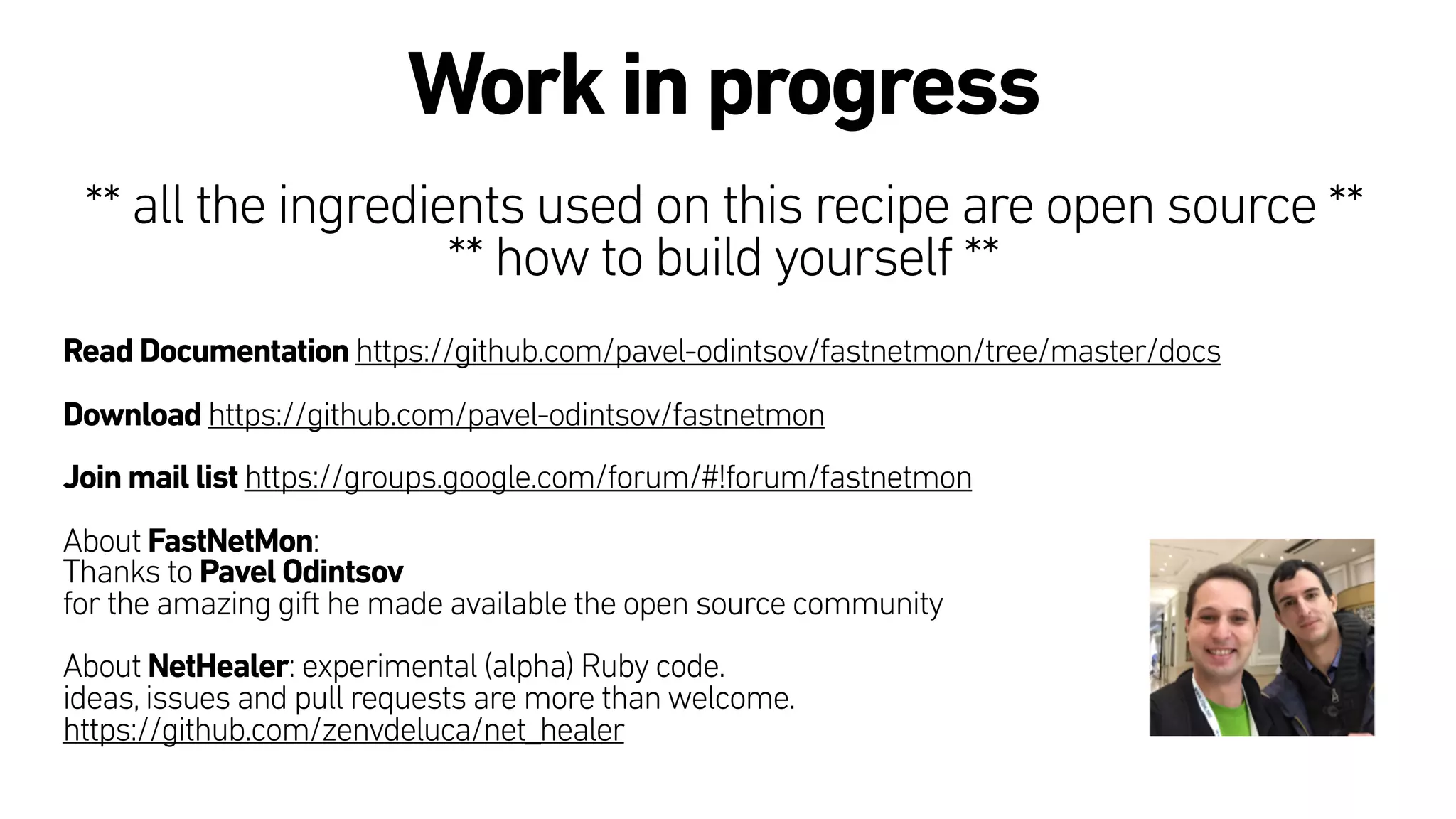
Thanks to Pavel Odintsov
for the amazing gift he made available the open source community


About NetHealer: experimental (alpha) Ruby code.

ideas,issues and pull requests are more than welcome.
https://github.com/zenvdeluca/net_healer
Thank you!
Questions?
vdeluca@zendesk.comvdeluca@zendesk.com

Nanog66 vicente de luca fast netmon

  • 1.
    DDoS Attacks 
 An open-sourcerecipe to improve fast detection and automate mitigation techniques 
 Vicente De Luca Sr.Network Engineer
 vdeluca@zendesk.com AS21880 / AS61186

  • 2.
  • 3.
    Tentative to solve:
 #1DDoS fast detection and better monitoring
 #2 Improve response time on mitigation triggering
  • 4.
    Opensource recipe - FastNetMon:main core of our solution.DDoS analyzer with sflow/netflow/mirror support - InfluxDB: Scalable data store for metrics,events,and real-time analytics - Grafana:Gorgeous metric viz,dashboards & editors - Redis: An in-memory database that persists on disk - Morgoth: Metric anomaly detection for Influx databases - BIRD: a fully functional dynamic IP routing daemon - Net Healer: experimental code to "glue" all moving parts,trigger actions and provide API queries
  • 5.
    FastNetMon: very fastDDoS analyzer - collects sFlow (v4/v5),NetFlow (v5/v9/v10),IPFIX and SPAN/mirror - fast detect IPv4 host above certain threshold - feed Graphite (compatible) time-series DB - supports BGP daemons (ExaBGP,GoBGP,others) - supports Lua processing net flows - CLI client available for CentOS / Ubuntu / Debian /Vyatta / FreeBSD / source / Docker Image tested with Juniper,Cisco,Extreme,Huawei and Linux (ipt_NETFLOW) https://github.com/pavel-odintsov/fastnetmon
  • 6.
    FastNetMon Detection Logic: - numberof pps,mbps and flows to/from a /32 - number of fragmented packets to/from a /32 - number of tcp syn / udp to/from a /32 - global / per protocol (udp/tcp/icmp) / per host group (CIDR) - nDPI support (SPAN/mirror) Complete support most popular attacks for channel overflow: - SYN Flood - UDP Flood (amplified SSDP,Chargen,DNS,SNMP,NTP,etc) - IP Fragmentation
  • 7.
    FastNetMon How it canreact during an attack ? - Custom script (send email,apply an ACL,shutdown aVM,etc etc etc…) - BGP Announce (community,blackhole,selective blackhole,cloud mitigation) - BGP Flow Spec (RFC 5575) for selective traffic blocking - Populate Redis DB (target,type,attack peak,tcpdump during attack,etc)
  • 8.
  • 9.
  • 11.
  • 12.
  • 13.
  • 14.
    The good: mitigation viacloud provider (BGP)
 - multiple scrubbing centers across the globe - Lots of Tbps of mitigation bandwidth capacity
 - presence in IXPs - GRE tunnel established in a safer circuit some cons: - Reaction time: Internet route convergence (BGP) —not that bad - mitigation occurs on incoming only - always on = $$$
  • 15.
    The bad NOC pagedwith a site-down alert :( Troubleshoot to identify an ongoing attack
  • 16.
    The ugly detecting takes"too long”,dependent on humans :(
 trigger mitigation also needs manual config change
  • 17.
    Why not simplybuy an already existent and reliable DDoS mitigation appliance? - mostly demands almost dedicated and qualified engineers - Mitigation available = useless in case of volumetric attack 
 - High investment for multiple sites ($$$)
  • 18.
  • 19.
  • 20.
  • 21.
    Net Healer watchesRedisDB and InfluxDB
 if the current attack reports match any policy, trigger the associated action FNM quiescence: 15s per /32 Attack started FastNetMon:
 populate /32 details at RedisDB if Morgoth detects:
 populate timestamp
 at anomaly InfluxDB
  • 22.
    Net Healer Policiesexample:(in a time period of 5 min) if attack reports = 2 then trigger on call if attack reports >=4 then inject /24 route if attack report = 2 + anomaly detected (morgoth)
 then trigger on call + inject /24 route time window / policies can be customized
  • 23.
    Why Net Healer? 
 - FastNetMon supports all I need,but relies on pre-configured thresholds - Hard to predict realistic thresholds since our traffic is influenced by our customers activity (out of our control) - To avoid false positives we prefer to trigger different actions based on each attack cycle phase - Allow quick integrations like Morgoth x FNM consensus,or API calls such as Pagerduty,etc
  • 24.
    Why InfluxDB ? -Speaks graphite protocol (compatible with FastNetMon) - Drop in binary - simple install - Supports cluster mode - easy to scale Note: Use version >=0.9.6.1 - with tsm1 engine with no batching
  • 25.
    Why Morgoth ? 
 -Implements non-gaussian algorithm (MGOF) to detect anomaly on data stream metrics - Takes InfluxDB (bps/pps) fingerprints every chunk of 10s - Compares the actual fingerprint with the past learned traffic - Anomaly found: Create an alert entry with timestamp Note: At the time we started developing this project,we were unaware of Influx T.I.C.K stack —We’d love to try Influx Kapacity
  • 26.
    Why BIRD ? 
 -syncing with kernel routing tables (blackhole,mitigate) - iBGP with edge routers - Routing policies will decide if RTBH or Advertise to mitigation provider - friendly to Network Engineers (birdc)
  • 27.
  • 33.
  • 36.
    Work in progress **all the ingredients used on this recipe are open source ** ** how to build yourself ** Read Documentation https://github.com/pavel-odintsov/fastnetmon/tree/master/docs Download https://github.com/pavel-odintsov/fastnetmon Join mail list https://groups.google.com/forum/#!forum/fastnetmon About FastNetMon: 
 Thanks to Pavel Odintsov for the amazing gift he made available the open source community 
 About NetHealer: experimental (alpha) Ruby code.
 ideas,issues and pull requests are more than welcome. https://github.com/zenvdeluca/net_healer
  • 37.