WebGoat.SDWAN.Net
in Depth
Denis Kolegov / @dnkolegov
Oleg Broslavsky / @yalegko
Power of Community - November 8th 2018
SD-WAN New Hope
● Sergey Gordeychik
● Alex Timorin
● Denis Kolegov
● Oleg Broslavsky
● Max Gorbunov
● Nikita Oleksov
● Nikolay Tkachenko
● Anton Nikolaev
● SD-WAN Repository
● SD-WAN Internet Census
● SD-WAN Harvester
● SD-WAN Infiltrator
● SD-WAN Threats (WIP)
https://github.com/sdnewhop/
Disclaimer (1/2)
● Please note, that this talk is by Oleg and Denis
● We don't speak for our employers
● All the opinions and information here are of our responsibility. So,
mistakes and bad jokes are all OUR responsibilities
● Actually no one has seen the slides before
Disclaimer (2/2)
● Unfortunately, this talk is not about sophisticated hacking techniques
● The one is about the current state of SD-WAN product security and typical
vulnerabilities you can meet as pentesters or security researchers
Intro @Oleg
● Post graduate student at Tomsk State University
● Ex…
○ Security developer at VDOM Research
○ WAF developer, Positive Technologies
○ SiBears CTF team captain
Intro @Denis
● PhD, associate professor at Tomsk State University
● Security researcher at Frozy.io
● Ex…
○ Security researcher, Positive Technologies
○ Security engineer, F5 Networks
Why WebGOAT.SDWAN.Net?
● WebGoat is an insecure web application maintained by OWASP designed
to teach web application security lessons
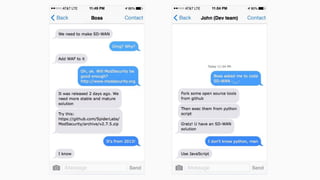
● It seems that current SD-WAN vendors develop the same thing
Questions
● How many SD-WAN nodes are on the Internet?
● Common security level of SD-WAN products
● Is SD-WAN low-hanging fruit and how low it is?
● How to hack SD-WAN via traditional vulnerabilities?
● Security of SD-WAN specific mechanisms
Agenda
● SD-WAN Essence
● SD-WAN Internet Census
● SD-WAN Vulnerabilities in Practice
SD-WAN Essence
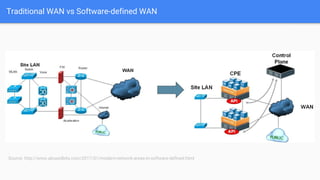
Traditional WAN vs Software-defined WAN
Source: http://www.abusedbits.com/2017/01/modern-network-areas-in-software-defined.html
Are SD-WANs secure?
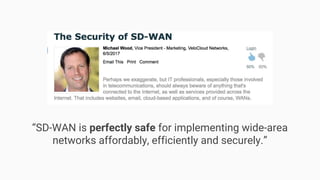
“SD-WAN is perfectly safe for implementing wide-area
networks affordably, efficiently and securely.”
Perfectly safe?
Not exactly...
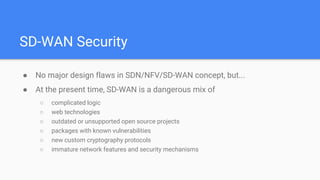
SD-WAN Security
● No major design flaws in SDN/NFV/SD-WAN concept, but...
● At the present time, SD-WAN is a dangerous mix of
○ complicated logic
○ web technologies
○ outdated or unsupported open source projects
○ packages with known vulnerabilities
○ new custom cryptography protocols
○ immature network features and security mechanisms
SD-WAN Internet Census
● Best effort approach
● Crafted Shodan and Censys queries
● Found version disclosure patterns
● Developed tools
○ SD-WAN Harvester
○ SD-WAN Infiltrator
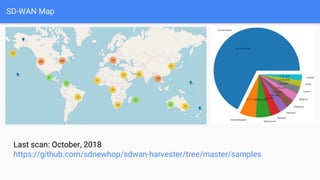
SD-WAN Map
Last scan: October, 2018
https://github.com/sdnewhop/sdwan-harvester/tree/master/samples
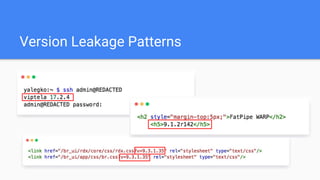
Version Leakage Patterns
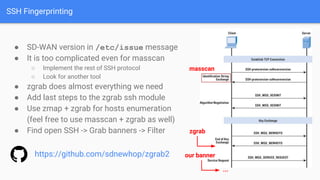
SSH Fingerprinting
● SD-WAN version in /etc/issue message
● It is too complicated even for masscan
○ Implement the rest of SSH protocol
○ Look for another tool
● zgrab does almost everything we need
● Add last steps to the zgrab ssh module
● Use zmap + zgrab for hosts enumeration
(feel free to use masscan + zgrab as well)
● Find open SSH -> Grab banners -> Filter
masscan
our banner
...
zgrab
https://github.com/sdnewhop/zgrab2
Occasional Findings
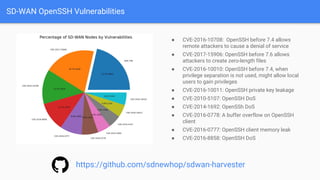
SD-WAN OpenSSH Vulnerabilities
● CVE-2016-10708: OpenSSH before 7.4 allows
remote attackers to cause a denial of service
● CVE-2017-15906: OpenSSH before 7.6 allows
attackers to create zero-length files
● CVE-2016-10010: OpenSSH before 7.4, when
privilege separation is not used, might allow local
users to gain privileges
● CVE-2016-10011: OpenSSH private key leakage
● CVE-2010-5107: OpenSSH DoS
● CVE-2014-1692: OpenSSh DoS
● CVE-2016-0778: A buffer overflow on OpenSSH
client
● CVE-2016-0777: OpenSSH client memory leak
● CVE-2016-8858: OpenSSH DoS
https://github.com/sdnewhop/sdwan-harvester
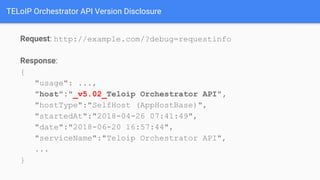
TELoIP Orchestrator API Version Disclosure
Request: http://example.com/?debug=requestinfo
Response:
{
"usage": ...,
"host":"_v5.02_Teloip Orchestrator API",
"hostType":"SelfHost (AppHostBase)",
"startedAt":"2018-04-26 07:41:49",
"date":"2018-06-20 16:57:44",
"serviceName":"Teloip Orchestrator API",
...
}
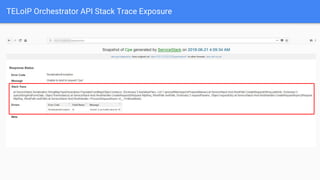
TELoIP Orchestrator API Stack Trace Exposure
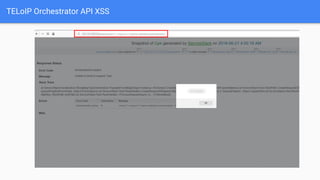
TELoIP Orchestrator API XSS
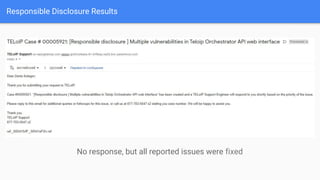
Responsible Disclosure Results
No response, but all reported issues were fixed
SD-WAN Vulnerabilities
in Practice
Viprinet Stored XSS
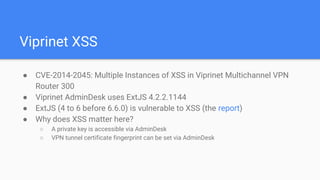
Viprinet XSS
● CVE-2014-2045: Multiple Instances of XSS in Viprinet Multichannel VPN
Router 300
● Viprinet AdminDesk uses ExtJS 4.2.2.1144
● ExtJS (4 to 6 before 6.6.0) is vulnerable to XSS (the report)
● Why does XSS matter here?
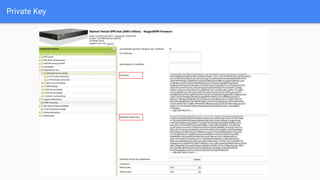
○ A private key is accessible via AdminDesk
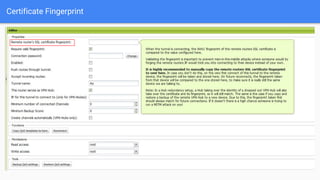
○ VPN tunnel certificate fingerprint can be set via AdminDesk
Private Key
Certificate Fingerprint
Viprinet CVE-2014-2045
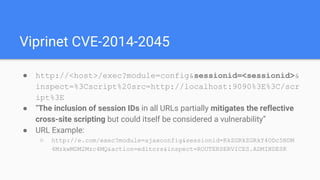
● http://<host>/exec?module=config&sessionid=<sessionid>&
inspect=%3Cscript%20src=http://localhost:9090%3E%3C/scr
ipt%3E
● “The inclusion of session IDs in all URLs partially mitigates the reflective
cross-site scripting but could itself be considered a vulnerability”
● URL Example:
○ http://e.com/exec?module=ajaxconfig&sessionid=RkZGRkZGRkY4ODc5NDM
4MzkwMDM2Mzc4MQ&action=editors&inspect=ROUTERSERVICES.ADMINDESK
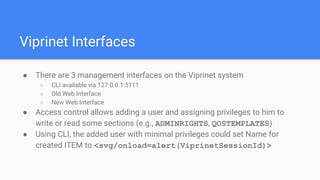
Viprinet Interfaces
● There are 3 management interfaces on the Viprinet system
○ CLI available via 127.0.0.1:5111
○ Old Web Interface
○ New Web Interface
● Access control allows adding a user and assigning privileges to him to
write or read some sections (e.g., ADMINRIGHTS, QOSTEMPLATES)
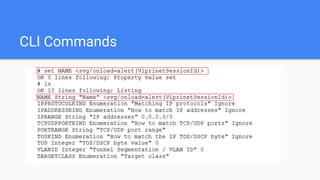
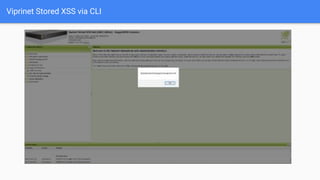
● Using CLI, the added user with minimal privileges could set Name for
created ITEM to <svg/onload=alert(ViprinetSessionId)>
CLI Commands
Viprinet Stored XSS via CLI
Responsible Disclosure Results
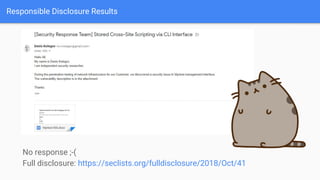
No response ;-(
Full disclosure: https://seclists.org/fulldisclosure/2018/Oct/41
The Good Old Friend CSRF
CSRF Intro
● CSRF is an attack that forces an end user to execute unwanted actions on
a web application in which he was authenticated
● The primary protection method is anti-csrf tokens
● Defense in depth methods
○ Same-site cookies
○ Origin verification
● CSRF prevention misconceptions (NCC Group research)
○ Content-type header
○ Secret cookie
○ Multi-step requests
CSRF in SD-WAN
● SD-WAN webapps don’t implement CSRF protection entirely or do it wrong
● The favorite method is Content-type header check, but…
● There is the SWF-based JSON CSRF exploit that bypasses that check
● Vulnerable systems
○ Citrix NetScaler SD-WAN
○ Viptela REST API
○ SilverPeak EdgeConnect
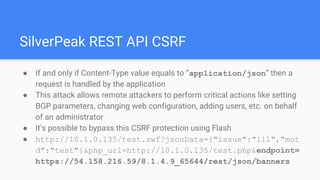
SilverPeak REST API CSRF
● If and only if Content-Type value equals to “application/json” then a
request is handled by the application
● This attack allows remote attackers to perform critical actions like setting
BGP parameters, changing web configuration, adding users, etc. on behalf
of an administrator
● It's possible to bypass this CSRF protection using Flash
● http://10.1.0.135/test.swf?jsonData={"issue":"111","mot
d":"test"}&php_url=http://10.1.0.135/test.php&endpoint=
https://54.158.216.59/8.1.4.9_65644/rest/json/banners
Another Friend:
Host Header Attack
Host Header Attacks
● Described by James Kettle in «Practical HTTP Host header attacks» in 2013
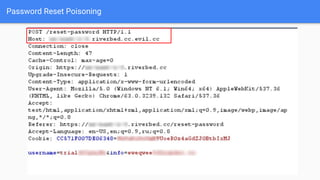
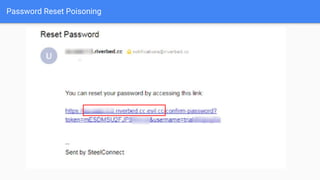
● Riverbed SteelConnect was vulnerable to the password reset poisoning attack
● Host header value was used to build a link for password resetting
● An attacker can send a POST request with an arbitrary Host header value in case of
knowing an admin's username and email
● If the admin clicks on the link the password token will be sent to the attacker's host
Password Reset Poisoning
Responsible Disclosure Results
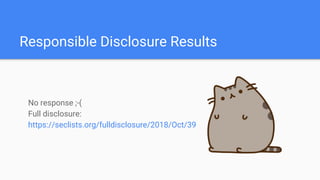
No response ;-(
Full disclosure:
https://seclists.org/fulldisclosure/2018/Oct/39
Insecure Authentication
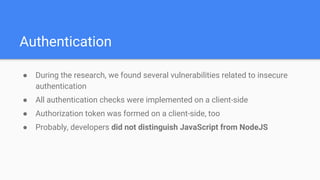
Authentication
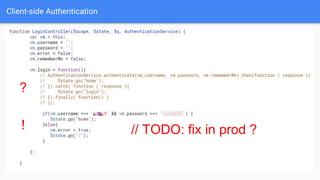
● During the research, we found several vulnerabilities related to insecure
authentication
● All authentication checks were implemented on a client-side
● Authorization token was formed on a client-side, too
● Probably, developers did not distinguish JavaScript from NodeJS
Client-side Authentication
?
! // TODO: fix in prod ?
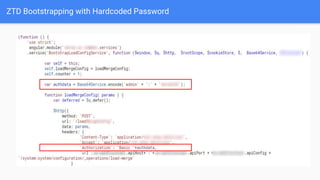
ZTD Bootstrapping with Hardcoded Password
Use of Hard-coded
Cryptographic Certificate
Overview
● A use of hard-coded cryptographic key was found in a one SD-WAN
product (the vulnerability is being fixed now)
● All appliances use the same pre-installed PKC key pair and the
corresponding self-signed certificate
● This certificate is used in Controller - Orchestrator communication protocol
within Northbound API
● An attacker in MitM position can use the certificate and its private key to
perform eavesdropping and spoofing attacks against all nodes
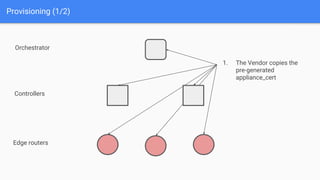
Provisioning (1/2)
1. The Vendor copies the
pre-generated
appliance_cert
Orchestrator
Controllers
Edge routers
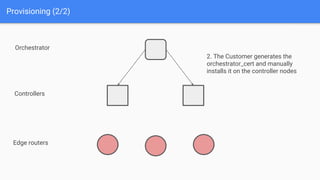
Provisioning (2/2)
2. The Customer generates the
orchestrator_cert and manually
installs it on the controller nodes
Orchestrator
Controllers
Edge routers
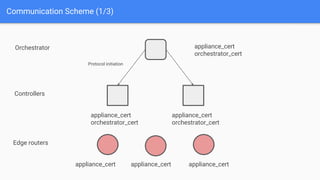
Communication Scheme (1/3)
Orchestrator
Controllers
Edge routers
appliance_cert
orchestrator_cert
appliance_cert
orchestrator_cert
appliance_cert
orchestrator_cert
appliance_cert appliance_cert appliance_cert
Protocol initiation
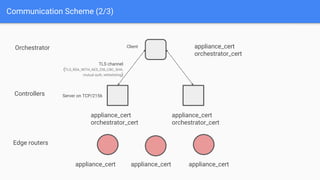
Communication Scheme (2/3)
Orchestrator
Controllers
Edge routers
appliance_cert
orchestrator_cert
appliance_cert
orchestrator_cert
appliance_cert
orchestrator_cert
TLS channel
(TLS_RSA_WITH_AES_256_CBC_SHA,
mutual auth, whitelisting)
Server on TCP/2156
Client
appliance_cert appliance_cert appliance_cert
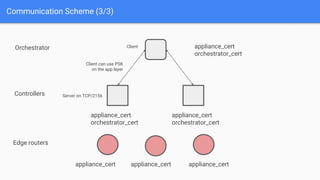
Communication Scheme (3/3)
Orchestrator
Controllers
Edge routers
appliance_cert
orchestrator_cert
appliance_cert
orchestrator_cert
appliance_cert
orchestrator_cert
Client can use PSK
on the app layer
Server on TCP/2156
Client
appliance_cert appliance_cert appliance_cert
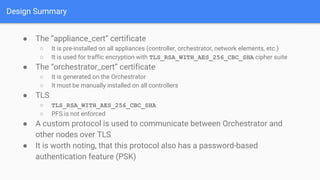
Design Summary
● The “appliance_cert” certificate
○ It is pre-installed on all appliances (controller, orchestrator, network elements, etc.)
○ It is used for traffic encryption with TLS_RSA_WITH_AES_256_CBC_SHA cipher suite
● The “orchestrator_cert” certificate
○ It is generated on the Orchestrator
○ It must be manually installed on all controllers
● TLS
○ TLS_RSA_WITH_AES_256_CBC_SHA
○ PFS is not enforced
● A custom protocol is used to communicate between Orchestrator and
other nodes over TLS
● It is worth noting, that this protocol also has a password-based
authentication feature (PSK)
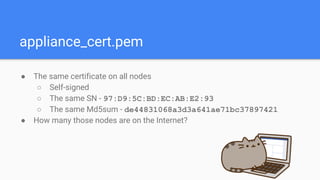
appliance_cert.pem
● The same certificate on all nodes
○ Self-signed
○ The same SN - 97:D9:5C:BD:EC:AB:E2:93
○ The same Md5sum - de44831068a3d3a641ae71bc37897421
● How many those nodes are on the Internet?
TCP 2156
● SSL with hardcoded certificate on 2156/tcp
● Need to fingerprint SSL certificates on uncommon port
○ Shodan gives no results
○ Masscan can detect SSL and grab its certificate
● Implements a “vulncheck” function for grabbed SSL cert
● …
● EZ WIN
https://github.com/sdnewhop/masscan
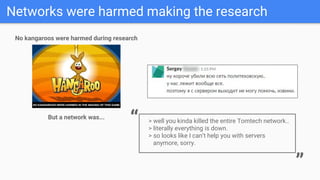
Networks were harmed making the research
No kangaroos were harmed during research
But a network was...
> well you kinda killed the entire Tomtech network..
> literally everything is down.
> so looks like I can’t help you with servers
anymore, sorry.
“
”
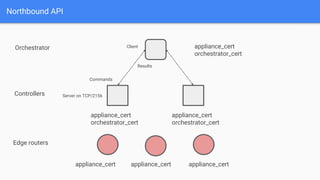
Northbound API
Orchestrator
Controllers
Edge routers
appliance_cert
orchestrator_cert
appliance_cert
orchestrator_cert
appliance_cert
orchestrator_cert
Commands
Server on TCP/2156
Client
appliance_cert appliance_cert appliance_cert
Results
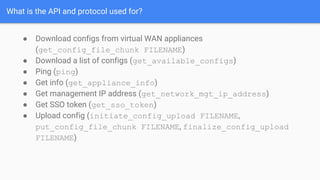
What is the API and protocol used for?
● Download configs from virtual WAN appliances
(get_config_file_chunk FILENAME)
● Download a list of configs (get_available_configs)
● Ping (ping)
● Get info (get_appliance_info)
● Get management IP address (get_network_mgt_ip_address)
● Get SSO token (get_sso_token)
● Upload config (initiate_config_upload FILENAME,
put_config_file_chunk FILENAME, finalize_config_upload
FILENAME)
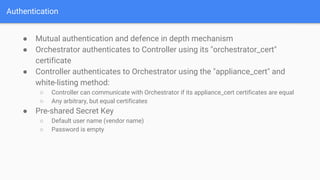
Authentication
● Mutual authentication and defence in depth mechanism
● Orchestrator authenticates to Controller using its "orchestrator_cert"
certificate
● Controller authenticates to Orchestrator using the "appliance_cert" and
white-listing method:
○ Controller can communicate with Orchestrator if its appliance_cert certificates are equal
○ Any arbitrary, but equal certificates
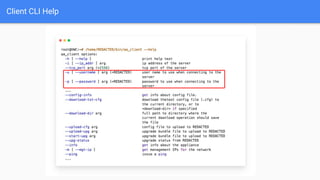
● Pre-shared Secret Key
○ Default user name (vendor name)
○ Password is empty
Client CLI Help
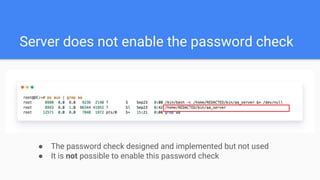
Server does not enable the password check
● The password check designed and implemented but not used
● It is not possible to enable this password check
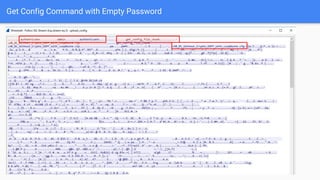
Get Config Command with Empty Password
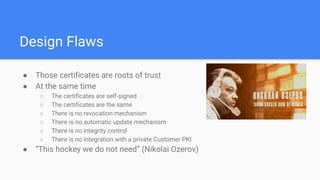
Design Flaws
● Those certificates are roots of trust
● At the same time
○ The certificates are self-signed
○ The certificates are the same
○ There is no revocation mechanism
○ There is no automatic update mechanism
○ There is no integrity control
○ There is no integration with a private Customer PKI
● “This hockey we do not need” (Nikolai Ozerov)
Attacker Capabilities
1. The attacker in passive MitM position can decrypt all communications
2. The attacker in active MitM position can perform active eavesdropping
3. The attacker in the target network can spoof an Controller
4. The attacker that is able to upload an SD-WAN certificate on a Controller
node can get control over this SD-WAN network
How easy to upload a malicious certificate?
● "www-data" user can create files in certificate directory by design
● It is possible to upload any certificate into this directory using
vulnerabilities in the Web UI
● We identified multiple vulnerabilities to OS command injection attack,
allowing us to upload an arbitrary Orchestrator certificate
Responsible Disclosure Results
1. September 24, 2018: Reported
2. September 25, 2018: A bug was created
3. October 17, 2018: “We have reproduced the behavior you described and
are now in the process of identifying the changes required to address it”
Talari’s SNMP Route Learning
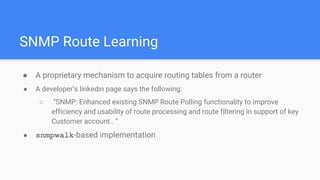
SNMP Route Learning
● A proprietary mechanism to acquire routing tables from a router
● A developer’s linkedin page says the following:
○ “SNMP: Enhanced existing SNMP Route Polling functionality to improve
efficiency and usability of route processing and route filtering in support of key
Customer account.. ”
● snmpwalk-based implementation
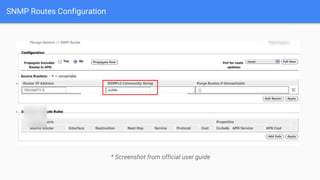
SNMP Routes Configuration
* Screenshot from official user guide
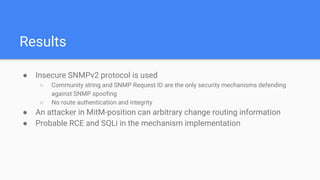
Results
● Insecure SNMPv2 protocol is used
○ Community string and SNMP Request ID are the only security mechanisms defending
against SNMP spoofing
○ No route authentication and integrity
● An attacker in MitM-position can arbitrary change routing information
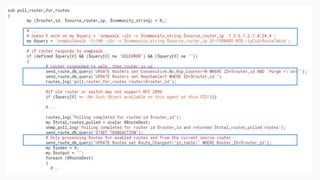
● Probable RCE and SQLi in the mechanism implementation
SQLi-driven Bandwidth Detection
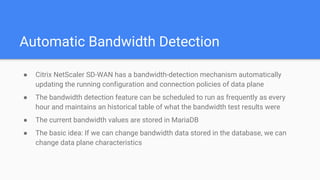
Automatic Bandwidth Detection
● Citrix NetScaler SD-WAN has a bandwidth-detection mechanism automatically
updating the running configuration and connection policies of data plane
● The bandwidth detection feature can be scheduled to run as frequently as every
hour and maintains an historical table of what the bandwidth test results were
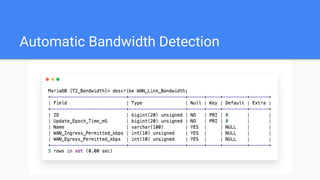
● The current bandwidth values are stored in MariaDB
● The basic idea: If we can change bandwidth data stored in the database, we can
change data plane characteristics
Automatic Bandwidth Detection
Is that System vulnerable to SQLi?
● Log_monitoring_utils.cgi is vulnerable to SQLi
● Events_download.cgi is vulnerable to SQLi
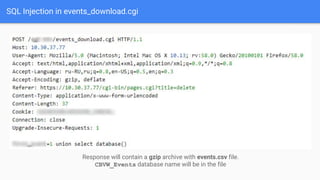
SQL Injection in events_download.cgi
Response will contain a gzip archive with events.csv file.
CBVW_Events database name will be in the file
Does that system have other vulns?
Results
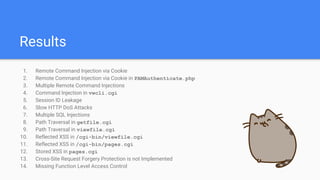
1. Remote Command Injection via Cookie
2. Remote Command Injection via Cookie in PAMAuthenticate.php
3. Multiple Remote Command Injections
4. Command Injection in vwcli.cgi
5. Session ID Leakage
6. Slow HTTP DoS Attacks
7. Multiple SQL Injections
8. Path Traversal in getfile.cgi
9. Path Traversal in viewfile.cgi
10. Reflected XSS in /cgi-bin/viewfile.cgi
11. Reflected XSS in /cgi-bin/pages.cgi
12. Stored XSS in pages.cgi
13. Cross-Site Request Forgery Protection is not Implemented
14. Missing Function Level Access Control
Responsible Disclosure Results
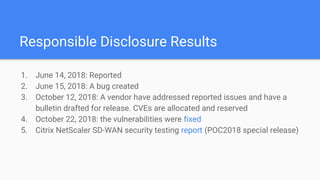
1. June 14, 2018: Reported
2. June 15, 2018: A bug created
3. October 12, 2018: A vendor have addressed reported issues and have a
bulletin drafted for release. CVEs are allocated and reserved
4. October 22, 2018: the vulnerabilities were fixed
5. Citrix NetScaler SD-WAN security testing report (POC2018 special release)
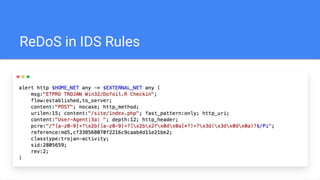
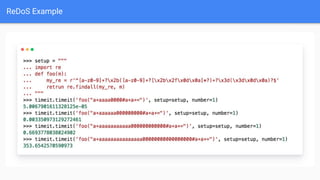
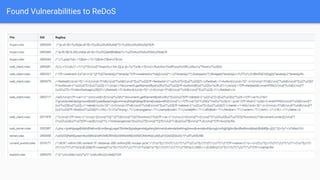
Denial of Service RegEx
ReDoS in IDS Rules
ReDoS Example
Found Vulnerabilities to ReDoS
Are Orchestrators More Secure?
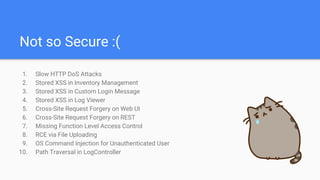
Not so Secure :(
1. Slow HTTP DoS Attacks
2. Stored XSS in Inventory Management
3. Stored XSS in Custom Login Message
4. Stored XSS in Log Viewer
5. Cross-Site Request Forgery on Web UI
6. Cross-Site Request Forgery on REST
7. Missing Function Level Access Control
8. RCE via File Uploading
9. OS Command Injection for Unauthenticated User
10. Path Traversal in LogController
Command Injection
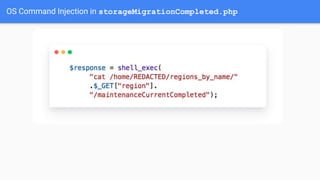
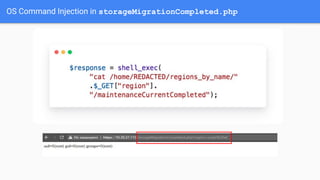
● The vulnerability in
"/app/webroot/storageMigrationCompleted.php" leads to OS
command injection attack
● An attacker without any privileges can perform this attack
● It must have a network connection to the Web Management Interface only
OS Command Injection in storageMigrationCompleted.php
Responsible Disclosure Results
1. June 14, 2018: Reported
2. June 15, 2018: A bug created
3. October 12, 2018: A vendor have addressed reported issues and have a
bulletin drafted for release. CVEs are allocated and reserved
Conclusions
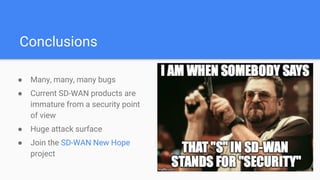
Conclusions
● Many, many, many bugs
● Current SD-WAN products are
immature from a security point
of view
● Huge attack surface
● Join the SD-WAN New Hope
project
Any Questions?
Thanks!
Contact us:
@dnkolegov
@yalegko

WebGoat.SDWAN.Net in Depth: SD-WAN Security Assessment

  • 1.
    WebGoat.SDWAN.Net in Depth Denis Kolegov/ @dnkolegov Oleg Broslavsky / @yalegko Power of Community - November 8th 2018
  • 3.
    SD-WAN New Hope ●Sergey Gordeychik ● Alex Timorin ● Denis Kolegov ● Oleg Broslavsky ● Max Gorbunov ● Nikita Oleksov ● Nikolay Tkachenko ● Anton Nikolaev ● SD-WAN Repository ● SD-WAN Internet Census ● SD-WAN Harvester ● SD-WAN Infiltrator ● SD-WAN Threats (WIP) https://github.com/sdnewhop/
  • 4.
    Disclaimer (1/2) ● Pleasenote, that this talk is by Oleg and Denis ● We don't speak for our employers ● All the opinions and information here are of our responsibility. So, mistakes and bad jokes are all OUR responsibilities ● Actually no one has seen the slides before
  • 5.
    Disclaimer (2/2) ● Unfortunately,this talk is not about sophisticated hacking techniques ● The one is about the current state of SD-WAN product security and typical vulnerabilities you can meet as pentesters or security researchers
  • 6.
    Intro @Oleg ● Postgraduate student at Tomsk State University ● Ex… ○ Security developer at VDOM Research ○ WAF developer, Positive Technologies ○ SiBears CTF team captain
  • 7.
    Intro @Denis ● PhD,associate professor at Tomsk State University ● Security researcher at Frozy.io ● Ex… ○ Security researcher, Positive Technologies ○ Security engineer, F5 Networks
  • 8.
    Why WebGOAT.SDWAN.Net? ● WebGoatis an insecure web application maintained by OWASP designed to teach web application security lessons ● It seems that current SD-WAN vendors develop the same thing
  • 9.
    Questions ● How manySD-WAN nodes are on the Internet? ● Common security level of SD-WAN products ● Is SD-WAN low-hanging fruit and how low it is? ● How to hack SD-WAN via traditional vulnerabilities? ● Security of SD-WAN specific mechanisms
  • 10.
    Agenda ● SD-WAN Essence ●SD-WAN Internet Census ● SD-WAN Vulnerabilities in Practice
  • 11.
  • 14.
    Traditional WAN vsSoftware-defined WAN Source: http://www.abusedbits.com/2017/01/modern-network-areas-in-software-defined.html
  • 15.
  • 17.
    “SD-WAN is perfectlysafe for implementing wide-area networks affordably, efficiently and securely.”
  • 18.
  • 20.
    SD-WAN Security ● Nomajor design flaws in SDN/NFV/SD-WAN concept, but... ● At the present time, SD-WAN is a dangerous mix of ○ complicated logic ○ web technologies ○ outdated or unsupported open source projects ○ packages with known vulnerabilities ○ new custom cryptography protocols ○ immature network features and security mechanisms
  • 21.
  • 22.
    SD-WAN Internet Census ●Best effort approach ● Crafted Shodan and Censys queries ● Found version disclosure patterns ● Developed tools ○ SD-WAN Harvester ○ SD-WAN Infiltrator
  • 23.
    SD-WAN Map Last scan:October, 2018 https://github.com/sdnewhop/sdwan-harvester/tree/master/samples
  • 24.
  • 26.
    SSH Fingerprinting ● SD-WANversion in /etc/issue message ● It is too complicated even for masscan ○ Implement the rest of SSH protocol ○ Look for another tool ● zgrab does almost everything we need ● Add last steps to the zgrab ssh module ● Use zmap + zgrab for hosts enumeration (feel free to use masscan + zgrab as well) ● Find open SSH -> Grab banners -> Filter masscan our banner ... zgrab https://github.com/sdnewhop/zgrab2
  • 27.
  • 28.
    SD-WAN OpenSSH Vulnerabilities ●CVE-2016-10708: OpenSSH before 7.4 allows remote attackers to cause a denial of service ● CVE-2017-15906: OpenSSH before 7.6 allows attackers to create zero-length files ● CVE-2016-10010: OpenSSH before 7.4, when privilege separation is not used, might allow local users to gain privileges ● CVE-2016-10011: OpenSSH private key leakage ● CVE-2010-5107: OpenSSH DoS ● CVE-2014-1692: OpenSSh DoS ● CVE-2016-0778: A buffer overflow on OpenSSH client ● CVE-2016-0777: OpenSSH client memory leak ● CVE-2016-8858: OpenSSH DoS https://github.com/sdnewhop/sdwan-harvester
  • 29.
    TELoIP Orchestrator APIVersion Disclosure Request: http://example.com/?debug=requestinfo Response: { "usage": ..., "host":"_v5.02_Teloip Orchestrator API", "hostType":"SelfHost (AppHostBase)", "startedAt":"2018-04-26 07:41:49", "date":"2018-06-20 16:57:44", "serviceName":"Teloip Orchestrator API", ... }
  • 30.
    TELoIP Orchestrator APIStack Trace Exposure
  • 31.
  • 32.
    Responsible Disclosure Results Noresponse, but all reported issues were fixed
  • 33.
  • 34.
  • 35.
    Viprinet XSS ● CVE-2014-2045:Multiple Instances of XSS in Viprinet Multichannel VPN Router 300 ● Viprinet AdminDesk uses ExtJS 4.2.2.1144 ● ExtJS (4 to 6 before 6.6.0) is vulnerable to XSS (the report) ● Why does XSS matter here? ○ A private key is accessible via AdminDesk ○ VPN tunnel certificate fingerprint can be set via AdminDesk
  • 36.
  • 37.
  • 38.
    Viprinet CVE-2014-2045 ● http://<host>/exec?module=config&sessionid=<sessionid>& inspect=%3Cscript%20src=http://localhost:9090%3E%3C/scr ipt%3E ●“The inclusion of session IDs in all URLs partially mitigates the reflective cross-site scripting but could itself be considered a vulnerability” ● URL Example: ○ http://e.com/exec?module=ajaxconfig&sessionid=RkZGRkZGRkY4ODc5NDM 4MzkwMDM2Mzc4MQ&action=editors&inspect=ROUTERSERVICES.ADMINDESK
  • 39.
    Viprinet Interfaces ● Thereare 3 management interfaces on the Viprinet system ○ CLI available via 127.0.0.1:5111 ○ Old Web Interface ○ New Web Interface ● Access control allows adding a user and assigning privileges to him to write or read some sections (e.g., ADMINRIGHTS, QOSTEMPLATES) ● Using CLI, the added user with minimal privileges could set Name for created ITEM to <svg/onload=alert(ViprinetSessionId)>
  • 40.
  • 41.
  • 42.
    Responsible Disclosure Results Noresponse ;-( Full disclosure: https://seclists.org/fulldisclosure/2018/Oct/41
  • 43.
    The Good OldFriend CSRF
  • 44.
    CSRF Intro ● CSRFis an attack that forces an end user to execute unwanted actions on a web application in which he was authenticated ● The primary protection method is anti-csrf tokens ● Defense in depth methods ○ Same-site cookies ○ Origin verification ● CSRF prevention misconceptions (NCC Group research) ○ Content-type header ○ Secret cookie ○ Multi-step requests
  • 45.
    CSRF in SD-WAN ●SD-WAN webapps don’t implement CSRF protection entirely or do it wrong ● The favorite method is Content-type header check, but… ● There is the SWF-based JSON CSRF exploit that bypasses that check ● Vulnerable systems ○ Citrix NetScaler SD-WAN ○ Viptela REST API ○ SilverPeak EdgeConnect
  • 46.
    SilverPeak REST APICSRF ● If and only if Content-Type value equals to “application/json” then a request is handled by the application ● This attack allows remote attackers to perform critical actions like setting BGP parameters, changing web configuration, adding users, etc. on behalf of an administrator ● It's possible to bypass this CSRF protection using Flash ● http://10.1.0.135/test.swf?jsonData={"issue":"111","mot d":"test"}&php_url=http://10.1.0.135/test.php&endpoint= https://54.158.216.59/8.1.4.9_65644/rest/json/banners
  • 47.
  • 48.
    Host Header Attacks ●Described by James Kettle in «Practical HTTP Host header attacks» in 2013 ● Riverbed SteelConnect was vulnerable to the password reset poisoning attack ● Host header value was used to build a link for password resetting ● An attacker can send a POST request with an arbitrary Host header value in case of knowing an admin's username and email ● If the admin clicks on the link the password token will be sent to the attacker's host
  • 49.
  • 50.
  • 51.
    Responsible Disclosure Results Noresponse ;-( Full disclosure: https://seclists.org/fulldisclosure/2018/Oct/39
  • 52.
  • 53.
    Authentication ● During theresearch, we found several vulnerabilities related to insecure authentication ● All authentication checks were implemented on a client-side ● Authorization token was formed on a client-side, too ● Probably, developers did not distinguish JavaScript from NodeJS
  • 54.
  • 55.
    ZTD Bootstrapping withHardcoded Password
  • 56.
  • 57.
    Overview ● A useof hard-coded cryptographic key was found in a one SD-WAN product (the vulnerability is being fixed now) ● All appliances use the same pre-installed PKC key pair and the corresponding self-signed certificate ● This certificate is used in Controller - Orchestrator communication protocol within Northbound API ● An attacker in MitM position can use the certificate and its private key to perform eavesdropping and spoofing attacks against all nodes
  • 58.
    Provisioning (1/2) 1. TheVendor copies the pre-generated appliance_cert Orchestrator Controllers Edge routers
  • 59.
    Provisioning (2/2) 2. TheCustomer generates the orchestrator_cert and manually installs it on the controller nodes Orchestrator Controllers Edge routers
  • 60.
    Communication Scheme (1/3) Orchestrator Controllers Edgerouters appliance_cert orchestrator_cert appliance_cert orchestrator_cert appliance_cert orchestrator_cert appliance_cert appliance_cert appliance_cert Protocol initiation
  • 61.
    Communication Scheme (2/3) Orchestrator Controllers Edgerouters appliance_cert orchestrator_cert appliance_cert orchestrator_cert appliance_cert orchestrator_cert TLS channel (TLS_RSA_WITH_AES_256_CBC_SHA, mutual auth, whitelisting) Server on TCP/2156 Client appliance_cert appliance_cert appliance_cert
  • 62.
    Communication Scheme (3/3) Orchestrator Controllers Edgerouters appliance_cert orchestrator_cert appliance_cert orchestrator_cert appliance_cert orchestrator_cert Client can use PSK on the app layer Server on TCP/2156 Client appliance_cert appliance_cert appliance_cert
  • 63.
    Design Summary ● The“appliance_cert” certificate ○ It is pre-installed on all appliances (controller, orchestrator, network elements, etc.) ○ It is used for traffic encryption with TLS_RSA_WITH_AES_256_CBC_SHA cipher suite ● The “orchestrator_cert” certificate ○ It is generated on the Orchestrator ○ It must be manually installed on all controllers ● TLS ○ TLS_RSA_WITH_AES_256_CBC_SHA ○ PFS is not enforced ● A custom protocol is used to communicate between Orchestrator and other nodes over TLS ● It is worth noting, that this protocol also has a password-based authentication feature (PSK)
  • 64.
    appliance_cert.pem ● The samecertificate on all nodes ○ Self-signed ○ The same SN - 97:D9:5C:BD:EC:AB:E2:93 ○ The same Md5sum - de44831068a3d3a641ae71bc37897421 ● How many those nodes are on the Internet?
  • 65.
    TCP 2156 ● SSLwith hardcoded certificate on 2156/tcp ● Need to fingerprint SSL certificates on uncommon port ○ Shodan gives no results ○ Masscan can detect SSL and grab its certificate ● Implements a “vulncheck” function for grabbed SSL cert ● … ● EZ WIN https://github.com/sdnewhop/masscan
  • 66.
    Networks were harmedmaking the research No kangaroos were harmed during research But a network was... > well you kinda killed the entire Tomtech network.. > literally everything is down. > so looks like I can’t help you with servers anymore, sorry. “ ”
  • 67.
  • 68.
    What is theAPI and protocol used for? ● Download configs from virtual WAN appliances (get_config_file_chunk FILENAME) ● Download a list of configs (get_available_configs) ● Ping (ping) ● Get info (get_appliance_info) ● Get management IP address (get_network_mgt_ip_address) ● Get SSO token (get_sso_token) ● Upload config (initiate_config_upload FILENAME, put_config_file_chunk FILENAME, finalize_config_upload FILENAME)
  • 69.
    Authentication ● Mutual authenticationand defence in depth mechanism ● Orchestrator authenticates to Controller using its "orchestrator_cert" certificate ● Controller authenticates to Orchestrator using the "appliance_cert" and white-listing method: ○ Controller can communicate with Orchestrator if its appliance_cert certificates are equal ○ Any arbitrary, but equal certificates ● Pre-shared Secret Key ○ Default user name (vendor name) ○ Password is empty
  • 70.
  • 71.
    Server does notenable the password check ● The password check designed and implemented but not used ● It is not possible to enable this password check
  • 72.
    Get Config Commandwith Empty Password
  • 73.
    Design Flaws ● Thosecertificates are roots of trust ● At the same time ○ The certificates are self-signed ○ The certificates are the same ○ There is no revocation mechanism ○ There is no automatic update mechanism ○ There is no integrity control ○ There is no integration with a private Customer PKI ● “This hockey we do not need” (Nikolai Ozerov)
  • 74.
    Attacker Capabilities 1. Theattacker in passive MitM position can decrypt all communications 2. The attacker in active MitM position can perform active eavesdropping 3. The attacker in the target network can spoof an Controller 4. The attacker that is able to upload an SD-WAN certificate on a Controller node can get control over this SD-WAN network
  • 75.
    How easy toupload a malicious certificate? ● "www-data" user can create files in certificate directory by design ● It is possible to upload any certificate into this directory using vulnerabilities in the Web UI ● We identified multiple vulnerabilities to OS command injection attack, allowing us to upload an arbitrary Orchestrator certificate
  • 76.
    Responsible Disclosure Results 1.September 24, 2018: Reported 2. September 25, 2018: A bug was created 3. October 17, 2018: “We have reproduced the behavior you described and are now in the process of identifying the changes required to address it”
  • 77.
  • 79.
    SNMP Route Learning ●A proprietary mechanism to acquire routing tables from a router ● A developer’s linkedin page says the following: ○ “SNMP: Enhanced existing SNMP Route Polling functionality to improve efficiency and usability of route processing and route filtering in support of key Customer account.. ” ● snmpwalk-based implementation
  • 80.
    SNMP Routes Configuration *Screenshot from official user guide
  • 81.
    Results ● Insecure SNMPv2protocol is used ○ Community string and SNMP Request ID are the only security mechanisms defending against SNMP spoofing ○ No route authentication and integrity ● An attacker in MitM-position can arbitrary change routing information ● Probable RCE and SQLi in the mechanism implementation
  • 82.
  • 83.
    Automatic Bandwidth Detection ●Citrix NetScaler SD-WAN has a bandwidth-detection mechanism automatically updating the running configuration and connection policies of data plane ● The bandwidth detection feature can be scheduled to run as frequently as every hour and maintains an historical table of what the bandwidth test results were ● The current bandwidth values are stored in MariaDB ● The basic idea: If we can change bandwidth data stored in the database, we can change data plane characteristics
  • 84.
  • 85.
    Is that Systemvulnerable to SQLi? ● Log_monitoring_utils.cgi is vulnerable to SQLi ● Events_download.cgi is vulnerable to SQLi
  • 86.
    SQL Injection inevents_download.cgi Response will contain a gzip archive with events.csv file. CBVW_Events database name will be in the file
  • 87.
    Does that systemhave other vulns?
  • 88.
    Results 1. Remote CommandInjection via Cookie 2. Remote Command Injection via Cookie in PAMAuthenticate.php 3. Multiple Remote Command Injections 4. Command Injection in vwcli.cgi 5. Session ID Leakage 6. Slow HTTP DoS Attacks 7. Multiple SQL Injections 8. Path Traversal in getfile.cgi 9. Path Traversal in viewfile.cgi 10. Reflected XSS in /cgi-bin/viewfile.cgi 11. Reflected XSS in /cgi-bin/pages.cgi 12. Stored XSS in pages.cgi 13. Cross-Site Request Forgery Protection is not Implemented 14. Missing Function Level Access Control
  • 89.
    Responsible Disclosure Results 1.June 14, 2018: Reported 2. June 15, 2018: A bug created 3. October 12, 2018: A vendor have addressed reported issues and have a bulletin drafted for release. CVEs are allocated and reserved 4. October 22, 2018: the vulnerabilities were fixed 5. Citrix NetScaler SD-WAN security testing report (POC2018 special release)
  • 90.
  • 91.
  • 92.
  • 93.
  • 94.
  • 95.
    Not so Secure:( 1. Slow HTTP DoS Attacks 2. Stored XSS in Inventory Management 3. Stored XSS in Custom Login Message 4. Stored XSS in Log Viewer 5. Cross-Site Request Forgery on Web UI 6. Cross-Site Request Forgery on REST 7. Missing Function Level Access Control 8. RCE via File Uploading 9. OS Command Injection for Unauthenticated User 10. Path Traversal in LogController
  • 96.
    Command Injection ● Thevulnerability in "/app/webroot/storageMigrationCompleted.php" leads to OS command injection attack ● An attacker without any privileges can perform this attack ● It must have a network connection to the Web Management Interface only
  • 97.
    OS Command Injectionin storageMigrationCompleted.php
  • 98.
    OS Command Injectionin storageMigrationCompleted.php
  • 99.
    Responsible Disclosure Results 1.June 14, 2018: Reported 2. June 15, 2018: A bug created 3. October 12, 2018: A vendor have addressed reported issues and have a bulletin drafted for release. CVEs are allocated and reserved
  • 100.
  • 101.
    Conclusions ● Many, many,many bugs ● Current SD-WAN products are immature from a security point of view ● Huge attack surface ● Join the SD-WAN New Hope project
  • 102.
  • 103.