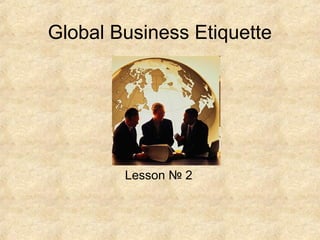
Global Business Etiquette

Lesson № 2
You May Think You’re Polite,
But How Much Do You Really
Know About Global Etiquette?
What is “etiquette”?
Office Etiquette Reebok Commercial
Etiquette is…
ethical and socially acceptable behavior
regarding professional practice or action
among the members of a profession in
their dealings with each other.
But etiquette isn’t recognized
as one uniform set of
standards around the globe…
For example, a hand gesture
in one country may have the
exact opposite meaning in
another culture!
Why are global etiquette and
cultural differences important
to us?
As global business continues to expand, the
critical element of a successful business
outcome may be the appreciation and respect
for cultural differences. You will need to utilize
your knowledge of cultural diversity and
intercultural communication during your
international travels and overseas assignments.
Let’s see how much you
know……

QUIZ TIME!
1. In all but one of the following countries it is
expected that you bring a gift to a business
meeting. In which country is it NOT expected?

•
•
•
•
•

China
Japan
Czech Republic
Denmark
Bolivia
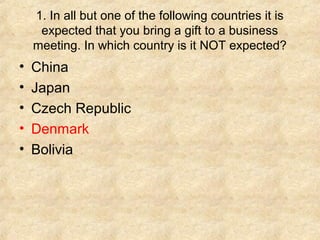
1. In all but one of the following countries it is
expected that you bring a gift to a business
meeting. In which country is it NOT expected?

•
•
•
•
•

China
Japan
Czech Republic
Denmark
Bolivia
2. In Saudi Arabia, which is considered a popular
gesture of friendship between men?

•
•
•
•
•

a high-five
holding hands while walking
a handshake
winking
a hug or kiss on the cheek
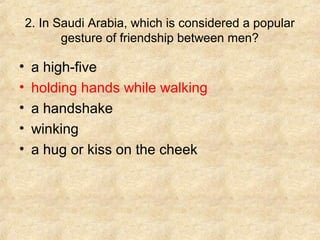
2. In Saudi Arabia, which is considered a popular
gesture of friendship between men?

•
•
•
•
•

a high-five
holding hands while walking
a handshake
winking
a hug or kiss on the cheek
3. In Great Britain, tapping your nose indicates that
something is:

•
•
•
•
•

confidential
smelly
inappropriate
very important
incredibly boring
3. In Great Britain, tapping your nose indicates that
something is:

•
•
•
•
•

confidential
smelly
inappropriate
very important
incredibly boring
4. Which of the following is/are associated with
death and should not be given as gifts in the
Chinese culture?

•
•
•
•
•

clocks
straw sandals
a handkerchief
a stork or a crane
all of the above
4. Which of the following is/are associated with
death and should not be given as gifts in the
Chinese culture?

•
•
•
•
•

clocks
straw sandals
a handkerchief
a stork or a crane
all of the above
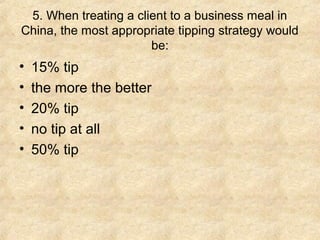
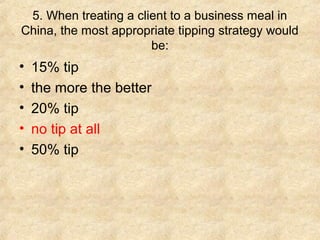
5. When treating a client to a business meal in
China, the most appropriate tipping strategy would
be:

•
•
•
•
•

15% tip
the more the better
20% tip
no tip at all
50% tip
5. When treating a client to a business meal in
China, the most appropriate tipping strategy would
be:

•
•
•
•
•

15% tip
the more the better
20% tip
no tip at all
50% tip
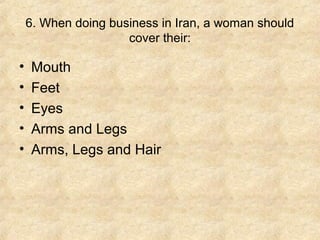
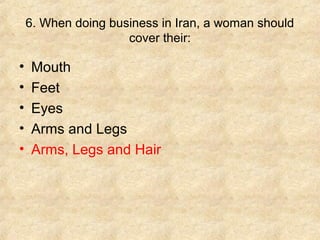
6. When doing business in Iran, a woman should
cover their:

•
•
•
•
•

Mouth
Feet
Eyes
Arms and Legs
Arms, Legs and Hair
6. When doing business in Iran, a woman should
cover their:

•
•
•
•
•

Mouth
Feet
Eyes
Arms and Legs
Arms, Legs and Hair
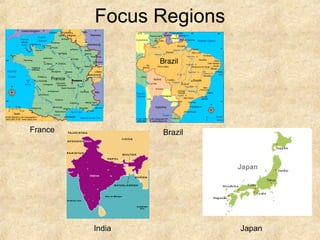
Focus Regions

France

Brazil

India

Japan
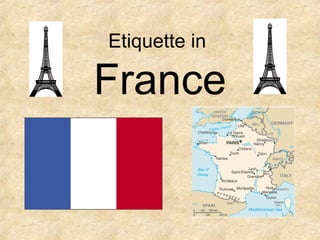
Etiquette in

France
Why Talk About France?
• The English word “etiquette” comes from
the French word “étiquette” meaning
social etiquette or professional protocol…
• France is the largest Western European
country, thus Americans partake in many
business deals with the French.
French Heritage and Culture
• France is known as a world center for culture.
• The French are very proud of their long
history and of their roles in world affairs.
• The French go to great lengths to protect and
maintain their culture.
• For example, the Académie Française was
established in the 1600’s to be the official
authority of the French language.
French Language
• French is the official language
• If you don’t speak French, it is very
important that you apologize for your lack
of knowledge.
• However, most individuals in business do
speak English.
Communication
• The French appreciate conversation as an art
form.
• They frequently interrupt each other, not to be
rude, but because argument is considered
entertaining.
• They complain that Americans often “lecture”
rather than “converse”.
• As an American, you should be sensitive of
the volume of your voice (don’t be too loud!)
• French eye contact is frequent and intense,
don’t be intimidated!
Appearance
• The French are very conscientious of their
appearance.
• One should dress in well-tailored conservative
attire
• Dark colors or patterned fabrics are preferred.
Bright colors and glitzy jewelry should be
avoided.
• French men do not loosen their ties or take off
their jackets. Such behavior is considered
unprofessional.
Other Important
French Cultural Trends
• Punctuality is treated casually
• French meals are to be enjoyed, not rushed
through. Expect for a lunch or dinner to last
anywhere from two to three hours!
• Handshakes are brief and are accompanied
by distinct eye contact, yet they aren’t as firm
as we’re used to. Always shake upon meeting
and leaving.
Other Important
French Cultural Trends
• Education is very highly valued in
France
• Gift giving as a business meeting is up
to the foreigner’s discretion, however
suggested gifts are books and music,
as they demonstrate interest in
intellectual pursuits.
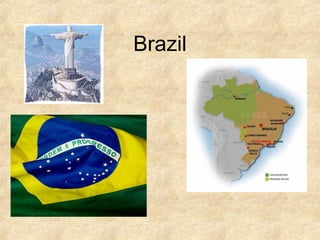
Brazil
Appearance
• Brazilians pride themselves on their attire
• 3-piece suits means “executive” whereas 2piece suits are associated with office workers
• Women are to dress conservative
– Elegant and feminine suits and dresses
• ALWAYS have a manicured nails
• Avoid wearing the combination of green and
yellow in any fashion (colors of the Brazilian flag)
Behavior
• Greeting
– Men shake hands and
keep eye contact
• Friends will give hugs or
slap each others backs

– Women kiss each other on
the cheeks, starting from
left and alternate
– If a woman wishes to
shake hands with a man,
she must extend her hand
first

– The “OK” symbol is a
RUDE gesture and should
never be used
– To express appreciation,
one may pinch their
earlobe with thumb and
forefinger
– To say good luck, one uses
the gesture “The Fig”
Behavior (cont.)
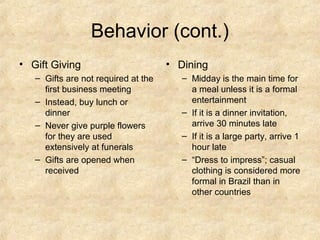
• Gift Giving
– Gifts are not required at the
first business meeting
– Instead, buy lunch or
dinner
– Never give purple flowers
for they are used
extensively at funerals
– Gifts are opened when
received

• Dining
– Midday is the main time for
a meal unless it is a formal
entertainment
– If it is a dinner invitation,
arrive 30 minutes late
– If it is a large party, arrive 1
hour late
– “Dress to impress”; casual
clothing is considered more
formal in Brazil than in
other countries
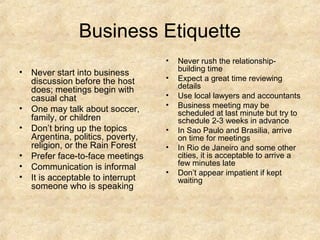
Business Etiquette
•

•

•
•
•
•
•

Never start into business
discussion before the host
does; meetings begin with
casual chat
One may talk about soccer,
family, or children
Don’t bring up the topics
Argentina, politics, poverty,
religion, or the Rain Forest
Prefer face-to-face meetings
Communication is informal
It is acceptable to interrupt
someone who is speaking

•
•
•
•
•
•

Never rush the relationshipbuilding time
Expect a great time reviewing
details
Use local lawyers and accountants
Business meeting may be
scheduled at last minute but try to
schedule 2-3 weeks in advance
In Sao Paulo and Brasilia, arrive
on time for meetings
In Rio de Janeiro and some other
cities, it is acceptable to arrive a
few minutes late
Don’t appear impatient if kept
waiting
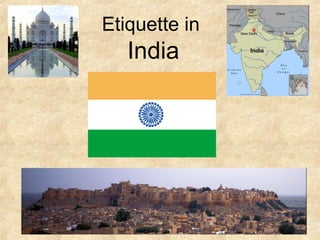
Etiquette in

India
Appearance
• Formal Business
– Men – suit and tie (jacket can be removed in the
summer)
– Women – conservative dresses or pantsuits

• Casual Business
– Men – short-sleeved shirts and long pants (shorts
only when exercising)
– Women – must keep upper arms, chest, back, and
legs covered at all times

• Use of leather products may be offensive
Behavior
• Never touch someone else’s head. The head is
considered the seat of the soul.
• Be careful with your feet. Feet are considered
unclean. Never point your feet at a person. If
your shoes or feet touch another person,
apologize.
• If you receive a wrapped gift, set it aside until the
giver leaves. Gifts are not opened in the
presence of the giver.
• Business lunches are more popular than
dinners. Keep in mind, Hindus do not eat beef
and Muslims do not eat pork.
Communications
• The official languages are English and Hindi.
English is widely used in business, politics and
education.
• Do not thank your hosts at the end of a meal.
"Thank you" is considered a form of payment
and insults your hosts.
• The word "no" is considered particulary harsh in
India. Refusing a request in a more evasive
manner is both common and polite. Never
directly refuse an invitation. Instead, use nonverbal cues and indirect communication to voice
your disagreement.
Indian Working Practices
• Indians appreciate punctuality but may not
reciprocate it. Try to be flexible.
• Make business appointments in the late morning
or early afternoon, ideally between the hours of
11am and 4pm.
• Deadlines should not be rushed! Making
decisions is often a slow and thoughtful process
in Indian culture. Showing impatience is seen as
rude and disrespectful.
Do’s and Don’ts
• Do wait for a female business colleague to
initiate the greeting. Indian men do not generally
shake hands with women out of respect.
• Do use titles whenever possible, such as
“Professor” or “Doctor”. If the person doesn’t
have an official title, use “Mr.”, “Mrs.”, or “Miss”
and their last name.
• Don’t refuse any food or drink offered to you
during business meetings.
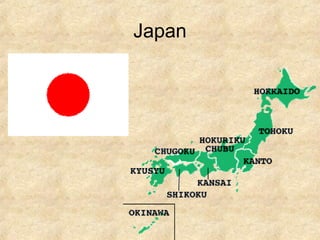
Japan
Appearance
• It is important to “Dress to Impress”
• Men should wear dark conservative
attire/business suits
• Women should dress conservatively,
minimal accessories and low heels
• No pants, Japanese men find it offensive
Behavior Do’s and Don’ts
•
•
•
•
•
•

Do Avoid the “OK” sign
Don’t point
Don’t blow your nose in public
Don’t pour your own drink
YouTube - Japanese Etiquette 2
Do come to an event fashionably late when
invited
• Don’t touch someone of the opposite sex in
public
Communication
• Customary meeting is a bow
• May receive handshake
• Must complete meishi exchange process
before business meeting can start
• Smiles can express either joy or pleasure, be
careful!
• Allow host to sit in silence if need be
• The Japanese prefer not to use the word
“no”
We hoped you learned a little about
global etiquette!
Arigato!

Merci!
THANK YOU!

¡Gracias!

Dhanyavaad!

Etoquette ba 381_presentation_use_this_one

  • 1.
  • 2.
    You May ThinkYou’re Polite, But How Much Do You Really Know About Global Etiquette?
  • 3.
    What is “etiquette”? OfficeEtiquette Reebok Commercial
  • 4.
    Etiquette is… ethical andsocially acceptable behavior regarding professional practice or action among the members of a profession in their dealings with each other.
  • 5.
    But etiquette isn’trecognized as one uniform set of standards around the globe… For example, a hand gesture in one country may have the exact opposite meaning in another culture!
  • 6.
    Why are globaletiquette and cultural differences important to us?
  • 7.
    As global businesscontinues to expand, the critical element of a successful business outcome may be the appreciation and respect for cultural differences. You will need to utilize your knowledge of cultural diversity and intercultural communication during your international travels and overseas assignments.
  • 8.
    Let’s see howmuch you know…… QUIZ TIME!
  • 9.
    1. In allbut one of the following countries it is expected that you bring a gift to a business meeting. In which country is it NOT expected? • • • • • China Japan Czech Republic Denmark Bolivia
  • 10.
    1. In allbut one of the following countries it is expected that you bring a gift to a business meeting. In which country is it NOT expected? • • • • • China Japan Czech Republic Denmark Bolivia
  • 11.
    2. In SaudiArabia, which is considered a popular gesture of friendship between men? • • • • • a high-five holding hands while walking a handshake winking a hug or kiss on the cheek
  • 12.
    2. In SaudiArabia, which is considered a popular gesture of friendship between men? • • • • • a high-five holding hands while walking a handshake winking a hug or kiss on the cheek
  • 13.
    3. In GreatBritain, tapping your nose indicates that something is: • • • • • confidential smelly inappropriate very important incredibly boring
  • 14.
    3. In GreatBritain, tapping your nose indicates that something is: • • • • • confidential smelly inappropriate very important incredibly boring
  • 15.
    4. Which ofthe following is/are associated with death and should not be given as gifts in the Chinese culture? • • • • • clocks straw sandals a handkerchief a stork or a crane all of the above
  • 16.
    4. Which ofthe following is/are associated with death and should not be given as gifts in the Chinese culture? • • • • • clocks straw sandals a handkerchief a stork or a crane all of the above
  • 17.
    5. When treatinga client to a business meal in China, the most appropriate tipping strategy would be: • • • • • 15% tip the more the better 20% tip no tip at all 50% tip
  • 18.
    5. When treatinga client to a business meal in China, the most appropriate tipping strategy would be: • • • • • 15% tip the more the better 20% tip no tip at all 50% tip
  • 19.
    6. When doingbusiness in Iran, a woman should cover their: • • • • • Mouth Feet Eyes Arms and Legs Arms, Legs and Hair
  • 20.
    6. When doingbusiness in Iran, a woman should cover their: • • • • • Mouth Feet Eyes Arms and Legs Arms, Legs and Hair
  • 21.
  • 22.
  • 23.
    Why Talk AboutFrance? • The English word “etiquette” comes from the French word “étiquette” meaning social etiquette or professional protocol… • France is the largest Western European country, thus Americans partake in many business deals with the French.
  • 24.
    French Heritage andCulture • France is known as a world center for culture. • The French are very proud of their long history and of their roles in world affairs. • The French go to great lengths to protect and maintain their culture. • For example, the Académie Française was established in the 1600’s to be the official authority of the French language.
  • 25.
    French Language • Frenchis the official language • If you don’t speak French, it is very important that you apologize for your lack of knowledge. • However, most individuals in business do speak English.
  • 26.
    Communication • The Frenchappreciate conversation as an art form. • They frequently interrupt each other, not to be rude, but because argument is considered entertaining. • They complain that Americans often “lecture” rather than “converse”. • As an American, you should be sensitive of the volume of your voice (don’t be too loud!) • French eye contact is frequent and intense, don’t be intimidated!
  • 27.
    Appearance • The Frenchare very conscientious of their appearance. • One should dress in well-tailored conservative attire • Dark colors or patterned fabrics are preferred. Bright colors and glitzy jewelry should be avoided. • French men do not loosen their ties or take off their jackets. Such behavior is considered unprofessional.
  • 28.
    Other Important French CulturalTrends • Punctuality is treated casually • French meals are to be enjoyed, not rushed through. Expect for a lunch or dinner to last anywhere from two to three hours! • Handshakes are brief and are accompanied by distinct eye contact, yet they aren’t as firm as we’re used to. Always shake upon meeting and leaving.
  • 29.
    Other Important French CulturalTrends • Education is very highly valued in France • Gift giving as a business meeting is up to the foreigner’s discretion, however suggested gifts are books and music, as they demonstrate interest in intellectual pursuits.
  • 30.
  • 31.
    Appearance • Brazilians pridethemselves on their attire • 3-piece suits means “executive” whereas 2piece suits are associated with office workers • Women are to dress conservative – Elegant and feminine suits and dresses • ALWAYS have a manicured nails • Avoid wearing the combination of green and yellow in any fashion (colors of the Brazilian flag)
  • 32.
    Behavior • Greeting – Menshake hands and keep eye contact • Friends will give hugs or slap each others backs – Women kiss each other on the cheeks, starting from left and alternate – If a woman wishes to shake hands with a man, she must extend her hand first – The “OK” symbol is a RUDE gesture and should never be used – To express appreciation, one may pinch their earlobe with thumb and forefinger – To say good luck, one uses the gesture “The Fig”
  • 33.
    Behavior (cont.) • GiftGiving – Gifts are not required at the first business meeting – Instead, buy lunch or dinner – Never give purple flowers for they are used extensively at funerals – Gifts are opened when received • Dining – Midday is the main time for a meal unless it is a formal entertainment – If it is a dinner invitation, arrive 30 minutes late – If it is a large party, arrive 1 hour late – “Dress to impress”; casual clothing is considered more formal in Brazil than in other countries
  • 34.
    Business Etiquette • • • • • • • Never startinto business discussion before the host does; meetings begin with casual chat One may talk about soccer, family, or children Don’t bring up the topics Argentina, politics, poverty, religion, or the Rain Forest Prefer face-to-face meetings Communication is informal It is acceptable to interrupt someone who is speaking • • • • • • Never rush the relationshipbuilding time Expect a great time reviewing details Use local lawyers and accountants Business meeting may be scheduled at last minute but try to schedule 2-3 weeks in advance In Sao Paulo and Brasilia, arrive on time for meetings In Rio de Janeiro and some other cities, it is acceptable to arrive a few minutes late Don’t appear impatient if kept waiting
  • 35.
  • 36.
    Appearance • Formal Business –Men – suit and tie (jacket can be removed in the summer) – Women – conservative dresses or pantsuits • Casual Business – Men – short-sleeved shirts and long pants (shorts only when exercising) – Women – must keep upper arms, chest, back, and legs covered at all times • Use of leather products may be offensive
  • 37.
    Behavior • Never touchsomeone else’s head. The head is considered the seat of the soul. • Be careful with your feet. Feet are considered unclean. Never point your feet at a person. If your shoes or feet touch another person, apologize. • If you receive a wrapped gift, set it aside until the giver leaves. Gifts are not opened in the presence of the giver. • Business lunches are more popular than dinners. Keep in mind, Hindus do not eat beef and Muslims do not eat pork.
  • 38.
    Communications • The officiallanguages are English and Hindi. English is widely used in business, politics and education. • Do not thank your hosts at the end of a meal. "Thank you" is considered a form of payment and insults your hosts. • The word "no" is considered particulary harsh in India. Refusing a request in a more evasive manner is both common and polite. Never directly refuse an invitation. Instead, use nonverbal cues and indirect communication to voice your disagreement.
  • 39.
    Indian Working Practices •Indians appreciate punctuality but may not reciprocate it. Try to be flexible. • Make business appointments in the late morning or early afternoon, ideally between the hours of 11am and 4pm. • Deadlines should not be rushed! Making decisions is often a slow and thoughtful process in Indian culture. Showing impatience is seen as rude and disrespectful.
  • 40.
    Do’s and Don’ts •Do wait for a female business colleague to initiate the greeting. Indian men do not generally shake hands with women out of respect. • Do use titles whenever possible, such as “Professor” or “Doctor”. If the person doesn’t have an official title, use “Mr.”, “Mrs.”, or “Miss” and their last name. • Don’t refuse any food or drink offered to you during business meetings.
  • 41.
  • 42.
    Appearance • It isimportant to “Dress to Impress” • Men should wear dark conservative attire/business suits • Women should dress conservatively, minimal accessories and low heels • No pants, Japanese men find it offensive
  • 43.
    Behavior Do’s andDon’ts • • • • • • Do Avoid the “OK” sign Don’t point Don’t blow your nose in public Don’t pour your own drink YouTube - Japanese Etiquette 2 Do come to an event fashionably late when invited • Don’t touch someone of the opposite sex in public
  • 44.
    Communication • Customary meetingis a bow • May receive handshake • Must complete meishi exchange process before business meeting can start • Smiles can express either joy or pleasure, be careful! • Allow host to sit in silence if need be • The Japanese prefer not to use the word “no”
  • 45.
    We hoped youlearned a little about global etiquette! Arigato! Merci! THANK YOU! ¡Gracias! Dhanyavaad!