Nursing Ethics
introduction to Nursing Ethics unit 01
1
“It is always
the right time
to do the right
thing.
Martin Luther King
2
Outcome:
Define the terms: ethics, nursing ethics and
bio-ethics, value, belief, moral, attitude,
conflict, dilemma, ethical dilemma.
Discuss the importance of ethic in nursing
Review criteria of a profession.
Develop characteristics of a professional
Nurse.
3
Ethics:
Derived from the Greek word “ethos”, which
means “custom or character”, ethics is a
branch of philosophy that is concerned with
human conduct, more specifically the
behavior of individuals in society. Ethics
examines the rational justification for our
moral judgments; it studies what is morally
right or wrong, just or unjust.
www.tbs-sct.gc.ca
4
Ethics:
The basic concepts and fundamental principles
of decent human conduct. It includes study of
universal values such as the essential equality
of all men and women, human or natural
rights, obedience to the law of land, concern
for health and safety and also for the natural
environment.
http://www.businessdictionary.com/definition/ethics.html#ixzz33AjgYYTp
5
Nursing Ethics:
Nursing ethics is a branch of applied ethics
that concerns with activities in the field of
nursing. Nursing ethics shares many
principles with medical ethics
http://en.wikipedia.org/wiki/Nursing_ethics
6
Nursing Ethics:
The values or moral principles governing
relationships between the nurse and patient,
the patient's family, other members of the
health professions, and the general public.
7
Bioethics:
Bioethics is multidisciplinary. It blends
philosophy, theology, history, and law with
medicine, nursing, health policy, and the
medical humanities. Insights from various
disciplines are brought to bear on the complex
interaction of human life, science, and
technology.
8
Values:
Something of worth; enduring beliefs or
attitudes about the worth of a person, object,
idea, or action. They are important because
they influence decisions, actions, even nurse’s
ethical decision making.
9
Belief:
Assumptions and convictions that are held to
be true, by an individual or a group, regarding
concepts, events, people, and things.
10
Moral:
Concerned with the principles of right and
wrong behavior.
OR
concerned with the judgment of the
goodness or badness of human action and
character
11
Attitude:
Psychologists define attitudes as a learned
tendency to evaluate things in a certain way.
This can include evaluations of people, issues,
objects or events. Such evaluations are often
positive or negative, but they can also be
uncertain at times.
For example, you might have mixed
feelings about a particular person or issue.
12
Conflict:
Conflict refers to some form of friction,
disagreement, or discord arising within a
group when the beliefs or actions of one or
more members of the group are either resisted
by or unacceptable to one or more members of
another group.
13
Dilemma:
 The definition of a dilemma is a situation
where there is no clear easy choice or answer.
OR
 is a problem offering two possibilities, neither
of which is practically acceptable.
14
Ethical dilemma:
An ethical dilemma is a complex situation that
often involves an apparent mental conflict
between moral imperatives, in which to obey one
would result in transgressing another.
15
Importance of Ethics in Nursing:
Ethics is important in nursing because it sets
forth a series of actions and decisions that are
in the best interests of a patient and dictate
what must be done
Ethics ensure that every person is given the
greatest level of attention and care possible.
It is a moral compass that pushes nurses to
administer services fairly and in a timely
fashion.
16
Importance of Ethics in Nursing:
Nursing ethics guide professionals toward the
right decision in difficult circumstances.
Ethics come into play by providing an answer
to any moral question such that it allows the
individual to proceed with other job tasks and
act in a way that communicates responsibility,
authority and trust.
A nursing ethic teaches practitioners to handle
all patients fairly and to provide them with
comfort.
17
Importance of Ethics in Nursing:
In nursing, ethics dictate that a provider
must go along with the wishes of a patient
and his family, even if the nurse does not
agree with these choices.
18
Criteria of a Profession:
"All professions seem to possess:
(1) Systematic theory.
(2) Authority.
(3) Community sanction.
(4) Ethical codes.
(5) Culture.
19
Systematic theory:
Professionals have a knowledge set that is
based on abstract principles, more than
operational procedures, and thus must pursue
an extensive formal education.
20
Authority:
Professionals have significant control over the
nature and extent of the services that they
render, because they serve clients who are
generally unable to judge the quality of those
services.
21
Community sanction:
Professionals are subject to licensure or
certification that delineates varying degrees of
occupational jurisdiction in accordance with
criteria over which they have considerable
influence.
22
Ethical codes:
Professionals adhere to standards of behavior
that are explicit, systematic, binding, and
public service oriented; prescribe colleague
relations that are cooperative, equalitarian,
and supportive; and are enforced by their
associations.
23
Culture:
Professionals have a career orientation that
leads them to high personal involvement in
their work and satisfaction with not only
monetary rewards, but also symbols such as
titles and awards.
24
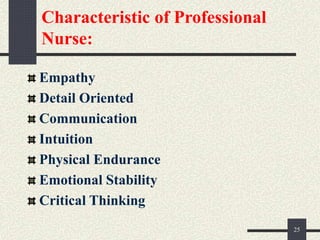
Characteristic of Professional
Nurse:
Empathy
Detail Oriented
Communication
Intuition
Physical Endurance
Emotional Stability
Critical Thinking
25
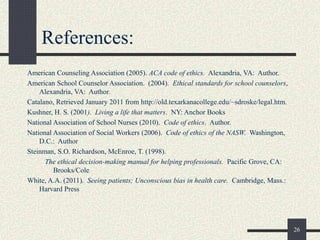
References:
American Counseling Association (2005). ACA code of ethics. Alexandria, VA: Author.
American School Counselor Association. (2004). Ethical standards for school counselors,
Alexandria, VA: Author.
Catalano, Retrieved January 2011 from http://old.texarkanacollege.edu/~sdroske/legal.htm.
Kushner, H. S. (2001). Living a life that matters. NY: Anchor Books
National Association of School Nurses (2010). Code of ethics. Author.
National Association of Social Workers (2006). Code of ethics of the NASW. Washington,
D.C.: Author
Steinman, S.O. Richardson, McEnroe, T. (1998).
The ethical decision-making manual for helping professionals. Pacific Grove, CA:
Brooks/Cole
White, A.A. (2011). Seeing patients; Unconscious bias in health care. Cambridge, Mass.:
Harvard Press
26
Any
27
28
29

Ethics Unit 1.pptx

  • 1.
    Nursing Ethics introduction toNursing Ethics unit 01 1
  • 2.
    “It is always theright time to do the right thing. Martin Luther King 2
  • 3.
    Outcome: Define the terms:ethics, nursing ethics and bio-ethics, value, belief, moral, attitude, conflict, dilemma, ethical dilemma. Discuss the importance of ethic in nursing Review criteria of a profession. Develop characteristics of a professional Nurse. 3
  • 4.
    Ethics: Derived from theGreek word “ethos”, which means “custom or character”, ethics is a branch of philosophy that is concerned with human conduct, more specifically the behavior of individuals in society. Ethics examines the rational justification for our moral judgments; it studies what is morally right or wrong, just or unjust. www.tbs-sct.gc.ca 4
  • 5.
    Ethics: The basic conceptsand fundamental principles of decent human conduct. It includes study of universal values such as the essential equality of all men and women, human or natural rights, obedience to the law of land, concern for health and safety and also for the natural environment. http://www.businessdictionary.com/definition/ethics.html#ixzz33AjgYYTp 5
  • 6.
    Nursing Ethics: Nursing ethicsis a branch of applied ethics that concerns with activities in the field of nursing. Nursing ethics shares many principles with medical ethics http://en.wikipedia.org/wiki/Nursing_ethics 6
  • 7.
    Nursing Ethics: The valuesor moral principles governing relationships between the nurse and patient, the patient's family, other members of the health professions, and the general public. 7
  • 8.
    Bioethics: Bioethics is multidisciplinary.It blends philosophy, theology, history, and law with medicine, nursing, health policy, and the medical humanities. Insights from various disciplines are brought to bear on the complex interaction of human life, science, and technology. 8
  • 9.
    Values: Something of worth;enduring beliefs or attitudes about the worth of a person, object, idea, or action. They are important because they influence decisions, actions, even nurse’s ethical decision making. 9
  • 10.
    Belief: Assumptions and convictionsthat are held to be true, by an individual or a group, regarding concepts, events, people, and things. 10
  • 11.
    Moral: Concerned with theprinciples of right and wrong behavior. OR concerned with the judgment of the goodness or badness of human action and character 11
  • 12.
    Attitude: Psychologists define attitudesas a learned tendency to evaluate things in a certain way. This can include evaluations of people, issues, objects or events. Such evaluations are often positive or negative, but they can also be uncertain at times. For example, you might have mixed feelings about a particular person or issue. 12
  • 13.
    Conflict: Conflict refers tosome form of friction, disagreement, or discord arising within a group when the beliefs or actions of one or more members of the group are either resisted by or unacceptable to one or more members of another group. 13
  • 14.
    Dilemma:  The definitionof a dilemma is a situation where there is no clear easy choice or answer. OR  is a problem offering two possibilities, neither of which is practically acceptable. 14
  • 15.
    Ethical dilemma: An ethicaldilemma is a complex situation that often involves an apparent mental conflict between moral imperatives, in which to obey one would result in transgressing another. 15
  • 16.
    Importance of Ethicsin Nursing: Ethics is important in nursing because it sets forth a series of actions and decisions that are in the best interests of a patient and dictate what must be done Ethics ensure that every person is given the greatest level of attention and care possible. It is a moral compass that pushes nurses to administer services fairly and in a timely fashion. 16
  • 17.
    Importance of Ethicsin Nursing: Nursing ethics guide professionals toward the right decision in difficult circumstances. Ethics come into play by providing an answer to any moral question such that it allows the individual to proceed with other job tasks and act in a way that communicates responsibility, authority and trust. A nursing ethic teaches practitioners to handle all patients fairly and to provide them with comfort. 17
  • 18.
    Importance of Ethicsin Nursing: In nursing, ethics dictate that a provider must go along with the wishes of a patient and his family, even if the nurse does not agree with these choices. 18
  • 19.
    Criteria of aProfession: "All professions seem to possess: (1) Systematic theory. (2) Authority. (3) Community sanction. (4) Ethical codes. (5) Culture. 19
  • 20.
    Systematic theory: Professionals havea knowledge set that is based on abstract principles, more than operational procedures, and thus must pursue an extensive formal education. 20
  • 21.
    Authority: Professionals have significantcontrol over the nature and extent of the services that they render, because they serve clients who are generally unable to judge the quality of those services. 21
  • 22.
    Community sanction: Professionals aresubject to licensure or certification that delineates varying degrees of occupational jurisdiction in accordance with criteria over which they have considerable influence. 22
  • 23.
    Ethical codes: Professionals adhereto standards of behavior that are explicit, systematic, binding, and public service oriented; prescribe colleague relations that are cooperative, equalitarian, and supportive; and are enforced by their associations. 23
  • 24.
    Culture: Professionals have acareer orientation that leads them to high personal involvement in their work and satisfaction with not only monetary rewards, but also symbols such as titles and awards. 24
  • 25.
    Characteristic of Professional Nurse: Empathy DetailOriented Communication Intuition Physical Endurance Emotional Stability Critical Thinking 25
  • 26.
    References: American Counseling Association(2005). ACA code of ethics. Alexandria, VA: Author. American School Counselor Association. (2004). Ethical standards for school counselors, Alexandria, VA: Author. Catalano, Retrieved January 2011 from http://old.texarkanacollege.edu/~sdroske/legal.htm. Kushner, H. S. (2001). Living a life that matters. NY: Anchor Books National Association of School Nurses (2010). Code of ethics. Author. National Association of Social Workers (2006). Code of ethics of the NASW. Washington, D.C.: Author Steinman, S.O. Richardson, McEnroe, T. (1998). The ethical decision-making manual for helping professionals. Pacific Grove, CA: Brooks/Cole White, A.A. (2011). Seeing patients; Unconscious bias in health care. Cambridge, Mass.: Harvard Press 26
  • 27.
  • 28.
  • 29.

Editor's Notes

  • #5 The study of the basic ideas about knowledge, right and wrong, reasoning, and the value of things (Philosophy) Rational Justification (aqli javaz)
  • #6 Conduct ( trz-e-amal)
  • #9 Multidisciplinary (something that combines several fields of study or academic interests) Theology (the study of religious faith, practice, and experience) Philosophy (the study of the basic ideas about knowledge, right and wrong, reasoning, and the value of things)
  • #13 Tendency (Rojhan )
  • #15 Dilemma (waswasa)
  • #16 Transgressing (had se tajawuz kr jana)
  • #17 Sets forth (age rkhna ,samne rkhna, bayan krna)