By Momal Ikram
Faryal Saleem
Sonia Naz
Qudsiha Erum
The vast majority of managers
mean to run ethical organizations,
yet corporate corruption is
widespread.
Part of the problem, of course, is
that some leaders are out-and-out
crooks, and they direct the
malfeasance from the top. But that
is rare.
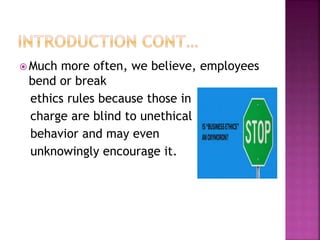
 Much more often, we believe, employees
bend or break
ethics rules because those in
charge are blind to unethical
behavior and may even
unknowingly encourage it.
 people most often see what they want to
see. But they suggest that this is
something further, the companies will
overlook unethical behavior when it is
their interest to do so.
 example baseball officially failed to
notice they had create conditions that
encouraged steroid used.
 Root out conflict of interest. Simply being
aware of them doesn't necessarily reduce
their negative effect on decision making.
 1. Ill Conceived Goals
 This barrier as a goal or incentive to promote change or a
behavior that encourages a negative one.
 example of the Ford Pinto where the Ford Motor Company
discovered in pre-production crash tests the “potential
danger of ruptured fuel tanks.” Ford then engaged in a
thorough and exhaustive cost-benefit analysis on the costs of
lawsuits from a defective product and “determined that it
would be cheaper to pay off lawsuits than to make repairs.”
The authors end by noting that “a host of psychological and
organizational factors diverted the Ford executives attention
from the ethical dimensions of the problem…”
 remedy business leaders must understand the incentive
systems which their company has in place and the effect that
it has on the workforce. They suggest “brainstorming
unintended consequences when devising goals and
incentives.” Management should also consider alternative
goals may be important to the reward.
 company will often overlook unethical
behavior in other companies
 the example of the drug company Mark which
sold two cancer drugs to the company
Ovation.
 Any company which has such a business
representative should understand whom it is
doing business with and that it cannot
outsource unethical behavior or assign a task
which might invite unethical behavior.
 companies often fail to “notice the gradual
erosion” of ethical standards
 of company auditors who find minor
violations by their client company over
several years and which by the final year the
has become a large violation or error.
 many companies will “reward results rather
than high-quality decisions.” This can lead to
companies rewarding unethical decisions,
 a recipe for disaster over the long term.
 barrier can be overcome by having the
possible outcomes of any decision or action
analyzed for both good and bad ethical
implications.
 Companies should examine behaviors which
“drive good outcomes, and reward quality
decisions, not just the results.”
 Create ethical standard of performance
 Publicize the firm’s commitment to ethical
values
 Encourage to do the right thing
 Mottos and mission statement
 Responsive in taking actions when ethics &
values are violated
 Ethical training & discussion
Companies can improve their
ethicality by installing codes of
ethics, ethics training and can
prevent ethical breakdowns by
following these steps

Ethics ppt p&o

  • 1.
    By Momal Ikram FaryalSaleem Sonia Naz Qudsiha Erum
  • 2.
    The vast majorityof managers mean to run ethical organizations, yet corporate corruption is widespread. Part of the problem, of course, is that some leaders are out-and-out crooks, and they direct the malfeasance from the top. But that is rare.
  • 3.
     Much moreoften, we believe, employees bend or break ethics rules because those in charge are blind to unethical behavior and may even unknowingly encourage it.
  • 4.
     people mostoften see what they want to see. But they suggest that this is something further, the companies will overlook unethical behavior when it is their interest to do so.  example baseball officially failed to notice they had create conditions that encouraged steroid used.  Root out conflict of interest. Simply being aware of them doesn't necessarily reduce their negative effect on decision making.
  • 5.
     1. IllConceived Goals  This barrier as a goal or incentive to promote change or a behavior that encourages a negative one.  example of the Ford Pinto where the Ford Motor Company discovered in pre-production crash tests the “potential danger of ruptured fuel tanks.” Ford then engaged in a thorough and exhaustive cost-benefit analysis on the costs of lawsuits from a defective product and “determined that it would be cheaper to pay off lawsuits than to make repairs.” The authors end by noting that “a host of psychological and organizational factors diverted the Ford executives attention from the ethical dimensions of the problem…”  remedy business leaders must understand the incentive systems which their company has in place and the effect that it has on the workforce. They suggest “brainstorming unintended consequences when devising goals and incentives.” Management should also consider alternative goals may be important to the reward.
  • 6.
     company willoften overlook unethical behavior in other companies  the example of the drug company Mark which sold two cancer drugs to the company Ovation.  Any company which has such a business representative should understand whom it is doing business with and that it cannot outsource unethical behavior or assign a task which might invite unethical behavior.
  • 7.
     companies oftenfail to “notice the gradual erosion” of ethical standards  of company auditors who find minor violations by their client company over several years and which by the final year the has become a large violation or error.
  • 8.
     many companieswill “reward results rather than high-quality decisions.” This can lead to companies rewarding unethical decisions,  a recipe for disaster over the long term.  barrier can be overcome by having the possible outcomes of any decision or action analyzed for both good and bad ethical implications.  Companies should examine behaviors which “drive good outcomes, and reward quality decisions, not just the results.”
  • 11.
     Create ethicalstandard of performance  Publicize the firm’s commitment to ethical values  Encourage to do the right thing  Mottos and mission statement
  • 12.
     Responsive intaking actions when ethics & values are violated  Ethical training & discussion
  • 13.
    Companies can improvetheir ethicality by installing codes of ethics, ethics training and can prevent ethical breakdowns by following these steps