Business Model
Jayesh Goswami – 242005
Karan Mathur – 242007
ABOUT
• Founded by Reed Hastings and Marc Randolph on August 29, 1997 in
California
• Launched on April 14, 1998 with only 30 employees and 925 DVDs
available through the pay-per-rent model
• Provides streaming media and video-on-demand online and DVD by
mail
TIMELINE
• 1997: NetFlix.com founded to offer online movie rentals
• 1998: Begins offering DVD rentals
• 1999: Group Arnault invests $30 million in the firm
• 2000: Launches personalized movie recommendation service CineMatch
• 2002: Raises $82 million in IPO
• 2007: Netflix introduces online streaming
• 2008: Partners with consumer electronic companies to incorporate Netflix
streaming on devices
• 2013: Original programming started with “House of Cards”
The idea of Netflix came to
Hastings when he was forced
to pay $40 in overdue fines
after returning Apollo 14 well
past its due date.
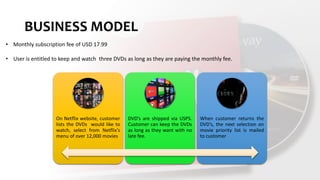
BUSINESS MODEL
• Monthly subscription fee of USD 17.99
• User is entitled to keep and watch three DVDs as long as they are paying the monthly fee.
On Netflix website, customer
lists the DVDs would like to
watch, select from Netflix’s
menu of over 12,000 movies
DVD’s are shipped via USPS.
Customer can keep the DVDs
as long as they want with no
late fee.
When customer returns the
DVD’s, the next selection on
movie priority list is mailed
to customer
BUSINESS MODEL CANVAS
Key Business
Partners
• USPS - Postal
• Cable
Operators
• Motion
Picture
Studios
Key Activities
• Mail Handling
• Video
Streaming
• IT
Infrastructure
Key Resources
• DVD
Inventory,
• Content
Value
Proposition
• Price
• Accessibility
• Convenience
• Original
Content
Customer
Relationship
• 24x7 Support
• Increased
Customer
Database
• Self-service
Model
Channels
• Netflix.xom
Cost Structure
• Fixed cost of
DVD’s
• Postal
Charges
• Maintenance
Revenue
Stream
• Monthly
Subscription
Rentals
Key Attributes
Customer interface
Financial Model
Key Competency
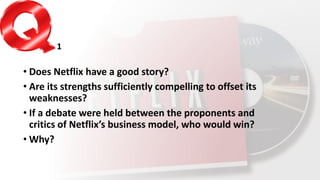
• Does Netflix have a good story?
• Are its strengths sufficiently compelling to offset its
weaknesses?
• If a debate were held between the proponents and
critics of Netflix’s business model, who would win?
• Why?
1
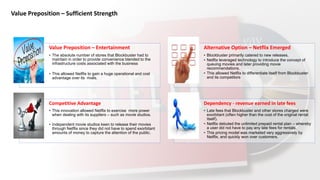
Value Preposition – Entertainment
• The absolute number of stores that Blockbuster had to
maintain in order to provide convenience blended to the
infrastructure costs associated with the business
• This allowed Netflix to gain a huge operational and cost
advantage over its rivals.
Alternative Option – Netflix Emerged
• Blockbuster primarily catered to new releases.
• Netflix leveraged technology to introduce the concept of
queuing movies and later providing movie
recommendations.
• This allowed Netflix to differentiate itself from Blockbuster
and its competitors
Competitive Advantage
• This innovation allowed Netflix to exercise more power
when dealing with its suppliers – such as movie studios.
• Independent movie studios keen to release their movies
through Netflix since they did not have to spend exorbitant
amounts of money to capture the attention of the public.
Dependency - revenue earned in late fees
• Late fees that Blockbuster and other stores charged were
exorbitant (often higher than the cost of the original rental
itself).
• Netflix debuted the unlimited prepaid rental plan – whereby
a user did not have to pay any late fees for rentals.
• This pricing model was marketed very aggressively by
Netflix, and quickly won over customers.
Value Preposition – Sufficient Strength
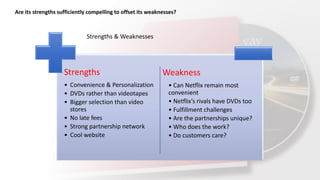
Strengths & Weaknesses
Strengths
• Convenience & Personalization
• DVDs rather than videotapes
• Bigger selection than video
stores
• No late fees
• Strong partnership network
• Cool website
Weakness
• Can Netflix remain most
convenient
• Netflix’s rivals have DVDs too
• Fulfillment challenges
• Are the partnerships unique?
• Who does the work?
• Do customers care?
Are its strengths sufficiently compelling to offset its weaknesses?
If a debate were held between the proponents and critics of Netflix’s business model, who would win?
Why?
In our opinion the proponents would win,
• As the value proposition of Netflix is unique in some aspects and if they adapt with new technologies to provide
movie on Demand like cable operators, they will be able to maintain their market share.
• Regarding the customer fatigue and subscription drop-outs after a couple of months, we think that the robust
personalized recommendation system, original-content and ever increasing new movies should keep the users
stick on to their subscriptions
• What is Netflix’s core competency?
• What are its strategic assets?
• Is there anything in Netflix’s business model that
makes what the company is doing hard to replicate?
Explain your answer.
2
What is Netflix’s core competency and Strategic Assets?
Netflix’s core
competency is
“Content delivery at
home in the most
convenient way”
Partnerships with the studios
Recommendation software
State-of-the-art distribution
network — shipping centers in the
U.S. that can reach most customers
with one-day delivery
Original programming content
Strategic Assets
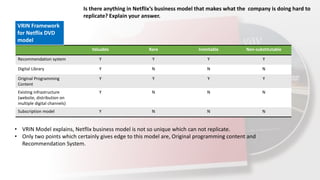
Is there anything in Netflix’s business model that makes what the company is doing hard to
replicate? Explain your answer.
Valuable Rare Inimitable Non-substitutable
Recommendation system Y Y Y Y
Digital Library Y N N N
Original Programming
Content
Y Y Y Y
Existing infrastructure
(website, distribution on
multiple digital channels)
Y N N N
Subscription model Y N N N
VRIN Framework
for Netflix DVD
model
• VRIN Model explains, Netflix business model is not so unique which can not replicate.
• Only two points which certainly gives edge to this model are, Original programming content and
Recommendation System.
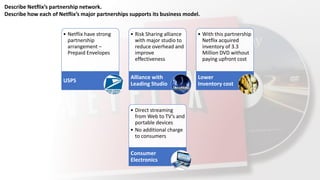
• Describe Netflix’s partnership network.
• Describe how each of Netflix’s major partnerships
supports its business model.
3
Describe Netflix’s partnership network.
Describe how each of Netflix’s major partnerships supports its business model.
• Netflix have strong
partnership
arrangement –
Prepaid Envelopes
USPS
• Risk Sharing alliance
with major studio to
reduce overhead and
improve
effectiveness
Alliance with
Leading Studio
• With this partnership
Netflix acquired
inventory of 3.3
Million DVD without
paying upfront cost
Lower
Inventory cost
• Direct streaming
from Web to TV’s and
portable devices
• No additional charge
to consumers
Consumer
Electronics
• If you were advising Netflix, what would you tell it to do to
make its business model more financially viable for the long
term?
4
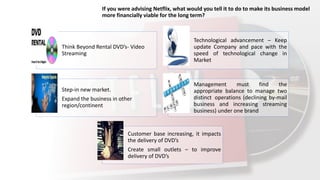
If you were advising Netflix, what would you tell it to do to make its business model
more financially viable for the long term?
Think Beyond Rental DVD’s- Video
Streaming
Technological advancement – Keep
update Company and pace with the
speed of technological change in
Market
Step-in new market.
Expand the business in other
region/continent
Management must find the
appropriate balance to manage two
distinct operations (declining by-mail
business and increasing streaming
business) under one brand
Customer base increasing, it impacts
the delivery of DVD’s
Create small outlets – to improve
delivery of DVD’s
• Describe how Netflix interfaces with its customers.
• To what extent do you believe that this component of
Netflix’s business model contributes to its sustainable
competitive advantage
5
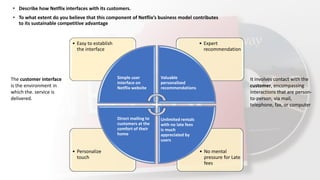
• Describe how Netflix interfaces with its customers.
• To what extent do you believe that this component of Netflix’s business model contributes
to its sustainable competitive advantage
• No mental
pressure for Late
fees
• Personalize
touch
• Expert
recommendation
• Easy to establish
the interface
Simple user
interface on
Netflix website
Valuable
personalized
recommendations
Unlimited rentals
with no late fees
is much
appreciated by
users
Direct mailing to
customers at the
comfort of their
home
The customer interface
is the environment in
which the. service is
delivered.
It involves contact with the
customer, encompassing
interactions that are person-
to-person, via mail,
telephone, fax, or computer
THANK
YOU
Just Chill-N-Enjoy…….

Netflix business model

  • 1.
    Business Model Jayesh Goswami– 242005 Karan Mathur – 242007
  • 2.
    ABOUT • Founded byReed Hastings and Marc Randolph on August 29, 1997 in California • Launched on April 14, 1998 with only 30 employees and 925 DVDs available through the pay-per-rent model • Provides streaming media and video-on-demand online and DVD by mail
  • 3.
    TIMELINE • 1997: NetFlix.comfounded to offer online movie rentals • 1998: Begins offering DVD rentals • 1999: Group Arnault invests $30 million in the firm • 2000: Launches personalized movie recommendation service CineMatch • 2002: Raises $82 million in IPO • 2007: Netflix introduces online streaming • 2008: Partners with consumer electronic companies to incorporate Netflix streaming on devices • 2013: Original programming started with “House of Cards” The idea of Netflix came to Hastings when he was forced to pay $40 in overdue fines after returning Apollo 14 well past its due date.
  • 4.
    BUSINESS MODEL • Monthlysubscription fee of USD 17.99 • User is entitled to keep and watch three DVDs as long as they are paying the monthly fee. On Netflix website, customer lists the DVDs would like to watch, select from Netflix’s menu of over 12,000 movies DVD’s are shipped via USPS. Customer can keep the DVDs as long as they want with no late fee. When customer returns the DVD’s, the next selection on movie priority list is mailed to customer
  • 5.
    BUSINESS MODEL CANVAS KeyBusiness Partners • USPS - Postal • Cable Operators • Motion Picture Studios Key Activities • Mail Handling • Video Streaming • IT Infrastructure Key Resources • DVD Inventory, • Content Value Proposition • Price • Accessibility • Convenience • Original Content Customer Relationship • 24x7 Support • Increased Customer Database • Self-service Model Channels • Netflix.xom Cost Structure • Fixed cost of DVD’s • Postal Charges • Maintenance Revenue Stream • Monthly Subscription Rentals Key Attributes Customer interface Financial Model Key Competency
  • 6.
    • Does Netflixhave a good story? • Are its strengths sufficiently compelling to offset its weaknesses? • If a debate were held between the proponents and critics of Netflix’s business model, who would win? • Why? 1
  • 7.
    Value Preposition –Entertainment • The absolute number of stores that Blockbuster had to maintain in order to provide convenience blended to the infrastructure costs associated with the business • This allowed Netflix to gain a huge operational and cost advantage over its rivals. Alternative Option – Netflix Emerged • Blockbuster primarily catered to new releases. • Netflix leveraged technology to introduce the concept of queuing movies and later providing movie recommendations. • This allowed Netflix to differentiate itself from Blockbuster and its competitors Competitive Advantage • This innovation allowed Netflix to exercise more power when dealing with its suppliers – such as movie studios. • Independent movie studios keen to release their movies through Netflix since they did not have to spend exorbitant amounts of money to capture the attention of the public. Dependency - revenue earned in late fees • Late fees that Blockbuster and other stores charged were exorbitant (often higher than the cost of the original rental itself). • Netflix debuted the unlimited prepaid rental plan – whereby a user did not have to pay any late fees for rentals. • This pricing model was marketed very aggressively by Netflix, and quickly won over customers. Value Preposition – Sufficient Strength
  • 8.
    Strengths & Weaknesses Strengths •Convenience & Personalization • DVDs rather than videotapes • Bigger selection than video stores • No late fees • Strong partnership network • Cool website Weakness • Can Netflix remain most convenient • Netflix’s rivals have DVDs too • Fulfillment challenges • Are the partnerships unique? • Who does the work? • Do customers care? Are its strengths sufficiently compelling to offset its weaknesses?
  • 9.
    If a debatewere held between the proponents and critics of Netflix’s business model, who would win? Why? In our opinion the proponents would win, • As the value proposition of Netflix is unique in some aspects and if they adapt with new technologies to provide movie on Demand like cable operators, they will be able to maintain their market share. • Regarding the customer fatigue and subscription drop-outs after a couple of months, we think that the robust personalized recommendation system, original-content and ever increasing new movies should keep the users stick on to their subscriptions
  • 10.
    • What isNetflix’s core competency? • What are its strategic assets? • Is there anything in Netflix’s business model that makes what the company is doing hard to replicate? Explain your answer. 2
  • 11.
    What is Netflix’score competency and Strategic Assets? Netflix’s core competency is “Content delivery at home in the most convenient way” Partnerships with the studios Recommendation software State-of-the-art distribution network — shipping centers in the U.S. that can reach most customers with one-day delivery Original programming content Strategic Assets
  • 12.
    Is there anythingin Netflix’s business model that makes what the company is doing hard to replicate? Explain your answer. Valuable Rare Inimitable Non-substitutable Recommendation system Y Y Y Y Digital Library Y N N N Original Programming Content Y Y Y Y Existing infrastructure (website, distribution on multiple digital channels) Y N N N Subscription model Y N N N VRIN Framework for Netflix DVD model • VRIN Model explains, Netflix business model is not so unique which can not replicate. • Only two points which certainly gives edge to this model are, Original programming content and Recommendation System.
  • 13.
    • Describe Netflix’spartnership network. • Describe how each of Netflix’s major partnerships supports its business model. 3
  • 14.
    Describe Netflix’s partnershipnetwork. Describe how each of Netflix’s major partnerships supports its business model. • Netflix have strong partnership arrangement – Prepaid Envelopes USPS • Risk Sharing alliance with major studio to reduce overhead and improve effectiveness Alliance with Leading Studio • With this partnership Netflix acquired inventory of 3.3 Million DVD without paying upfront cost Lower Inventory cost • Direct streaming from Web to TV’s and portable devices • No additional charge to consumers Consumer Electronics
  • 15.
    • If youwere advising Netflix, what would you tell it to do to make its business model more financially viable for the long term? 4
  • 16.
    If you wereadvising Netflix, what would you tell it to do to make its business model more financially viable for the long term? Think Beyond Rental DVD’s- Video Streaming Technological advancement – Keep update Company and pace with the speed of technological change in Market Step-in new market. Expand the business in other region/continent Management must find the appropriate balance to manage two distinct operations (declining by-mail business and increasing streaming business) under one brand Customer base increasing, it impacts the delivery of DVD’s Create small outlets – to improve delivery of DVD’s
  • 17.
    • Describe howNetflix interfaces with its customers. • To what extent do you believe that this component of Netflix’s business model contributes to its sustainable competitive advantage 5
  • 18.
    • Describe howNetflix interfaces with its customers. • To what extent do you believe that this component of Netflix’s business model contributes to its sustainable competitive advantage • No mental pressure for Late fees • Personalize touch • Expert recommendation • Easy to establish the interface Simple user interface on Netflix website Valuable personalized recommendations Unlimited rentals with no late fees is much appreciated by users Direct mailing to customers at the comfort of their home The customer interface is the environment in which the. service is delivered. It involves contact with the customer, encompassing interactions that are person- to-person, via mail, telephone, fax, or computer
  • 19.