1. Question on Case Study
· You’re a manager for ABC Company
· Your boss just told you a big secret he wants you to keep that
the company will have to lay off 200 workers. Luckily, your job
won’t be affected.
· But a rumor is circulating in the company, and one of the
workers who will be let go and is an old friend of yours asks the
question. “Am I going to lose my job? I’m about to finalize the
purchase of a new house. I need to know”.
· What would you say?
2. Business ethics importance –reasons with examples
Importance of Business Ethics:
Ethical behaviour and corporate social responsibility can bring
significant benefits to a business. For example, they may:
· attract customers to the firm's products, thereby boosting sales
and profits
· make employees want to stay with the business, reduce labour
turnover and therefore increase productivity
· attract more employees wanting to work for the business,
reduce recruitment costs and enable the company to get the most
talented employees
· attract investors and keep the company's share price high,
thereby protecting the business from takeover.
Ethical motivation:
· Employees working for an organization will feel better about
themselves and therefore more motivated to work hard.
· Ethical employee = happy employee = motivated employee =
productive employee
Balance the needs and wishes of stakeholders:
· Business are not just about money they are about giving back
to society, the community.
· Those companies that do so will also have an enhanced
reputation and be more profitable.
· There is pressure on business to recognize its responsibilities
to society. Business ethics requires businesses to think about
the impact of its decisions on people or stakeholders who are
directly or indirectly affected by those decisions.
Global challenges:
· Need to learn about the different values and cultures of the
regions it operates in.
· Don’t want to offend.
· Lose reputation, lose business.
Ethical pay-off:
· Organizations risk not only losing customers and employees,
but being exposed to civil and criminal liability.
· Sound ethical policy reduced risk exposure.
Employee Retention:
· Danger of losing employees who don’t want to work for an
unethical organization.
· Significant costs involved in replacing key people.
Prevention & Reduction of Criminal Penalties:
· In addition to the loss of reputation and business, nobody
really want to end up in court or even worse jail.
The US Sentencing Commission Guidelines state that to receive
a 40% reduction in federal penalties, a company must have “an
effective program to detect and prevent violations of the law”.
Preventing civil lawsuits:
· In additional to criminal offences, organizations need to be
vigilant to civil offences.
· Discrimination, sexual harassment, favoritism big concerns.
· Sound ethical policies can pre-empt unwanted behaviors.
Market leadership:
· Use ethical behavior as a unique selling feature to stand out in
the market place.
· Ethical organizations are considered more profitable
organizations.
Setting the Example:
· Don’t follow the crowd.
· Be the example that changes the way your industry operates.
3. Business ethics are unnecessary – Argue
The point of a business ethics course is to improve behavior in
business, and that an essential ingredient in that improved
behavior is knowing what's right or wrong.
· Business ethics deals with values, facts, and arguments.
· Well-reasoned arguments, by reason of their clarity, invite
counterarguments.
1. In perfectly competitive markets, the pursuit of profits will
ensure members of society are served in the most socially-
beneficial way. (the invisible hand of the market)
But:
· Hard to find an example of perfect competition.
· Not all steps to increase profit are socially-beneficial.
2. Business managers should do what is in the best interests of
the organization. (loyal agent argument).
· Usually a very short-term view of benefit.
· Usually only a financial view.
· Basically says ethics don’t matter at all.
3. To be ethical, it is enough for business people merely to obey
the law. Business ethics is to obey the law.
· Ethics is not limited to what is legal.
· Provides a useful excuse to act “unethically”.
4. Forms of discrimination-Intentional/Institutional aspects
with examples
4 Forms: Intention and Institutional Aspects
1. Isolated & Unintentional
2. Isolated & Intentional
3. Institutionalized & Unintentional
4. Institutionalized & Intentional
1. Isolated & Unintentional
· Individual person unknowingly discriminates
· A manager doesn’t bother to send the two employees in his
company from country X the information on the new job
opportunity because he doesn’t think people from country X
like this kind of job.
2. Isolated & Intentional
· Individual person unknowingly discriminates
· I don’t like Klingons work ethic & therefore will never hire
one to work in my department.
3. Institutionalized & Unintentional
· Discrimination happening on an organizational level, part of
procedures, practices
· Intention of policy not deliberate
· An organization only recruits from certain colleges. These
colleges happen to have a majority of white students, making
the likelihood of minorities getting employed with company less
likely.
4. Institutionalized & Intentional
· Organization knowingly and intentionally acts in a
discriminatory manner
· It is company policy not to promote anyone to a managerial
position under the age of 50
5. Affirmative action-Justify compensation purposes and
achieving social goals
Affirmative Action:
· An attempt to rectify past discrimination against women and
visual minorities
· Gives preferential treatment to groups that have experienced
discrimination, under-represented in education or employment
fields
· Recruit, hire, promote
· In America, some levels of government legally require
affirmative action plans
· Some claim this is in fact reverse discrimination against white
males.
The Case for Affirmative Action
· Compensation (Compensatory Justice)
· An obligation to compensate those who were wronged in the
past.
· Challenges with this?
· Who pays?
· Who receives the benefit?
· Achieving Social Goals
· Promote the public welfare
· Past discrimination has produced a high degree of correlation
between race and poverty
· Discrimination leads to inequality
· Inequality leads to poverty
· Poverty leads to discontent
· Discontent leads to social unrest, crime.
6. Duties of employer/obligations of employee
When an employee signs a contract of employment, this is an
agreement that the employee will perform various duties that
the employer has described. If these duties are not met, the
contract can be terminated by the employer.
Main Goal – Duties of an Employee
Work towards the goals of the firm and avoid activities that
might harm those goals
You should always read any contract carefully before signing it!
Firm’s Duties to the Employees:
· Fairness of Wages
· Working Conditions
· Job Satisfaction
Employee’s Obligation to the Firm
1. Conflicts of Interest
2. Bribes
3. Theft
4. Insider Trading
1. Conflicts of Interest
· Exists when an individual is carrying out a task on behalf of
the company and has a private interest in the outcome.
· To favor a particular supplier
· To favor a particular job candidate
· To choose to disclose confidential information for the benefit
of a friend
· Asked to do something you think is morally wrong
Conflicts of Interests? Black, white or grey?
· As dept. manager, you are hosting an informal celebration in
the office. The food budget is $200. Your next door neighbor
has just started her own catering business and asks to supply the
food. Since she is just starting out, she’ll do it at cost and
provide extra items at no charge.
· What might you want to consider?
2. Bribes
When something is offered to an employee from a person
outside the firm with the understanding that the employee will
do something favorable for that person as the employee
completes a job task.
· Money
· Favors
· Items
· Gifts?
Gifts or Bribe?
When is it okay to accept a gift without it being considered
bribery? Some considerations:
a. What is the value of the gift, and will it influence decision
making?
b. What is the purpose of the gift? Was it intended as a bribe?
c. What were the circumstances of the gift? Was it for a special
event celebration?
d. What is the position of the person receiving the gift? Are
they influential in decision making for the firm?
e. What is the accepted business practice in the area?
f. What is company policy?
g. What is the law?
A supplier sends a basket of expensive foodstuffs to your home
at Christmas with a card: "We hope you and your family enjoy
the 'goodies.‘".
What action(s) might you want to take?
3. Theft
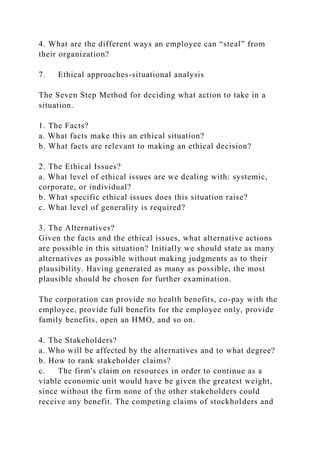
4. What are the different ways an employee can “steal” from
their organization?
7. Ethical approaches-situational analysis
The Seven Step Method for deciding what action to take in a
situation.
1. The Facts?
a. What facts make this an ethical situation?
b. What facts are relevant to making an ethical decision?
2. The Ethical Issues?
a. What level of ethical issues are we dealing with: systemic,
corporate, or individual?
b. What specific ethical issues does this situation raise?
c. What level of generality is required?
3. The Alternatives?
Given the facts and the ethical issues, what alternative actions
are possible in this situation? Initially we should state as many
alternatives as possible without making judgments as to their
plausibility. Having generated as many as possible, the most
plausible should be chosen for further examination.
The corporation can provide no health benefits, co-pay with the
employee, provide full benefits for the employee only, provide
family benefits, open an HMO, and so on.
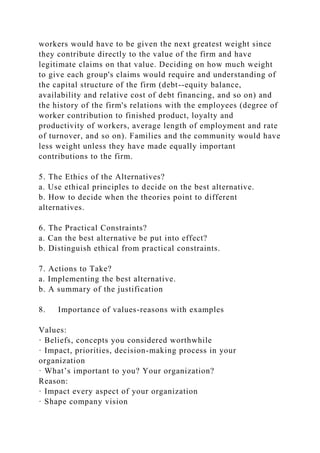
4. The Stakeholders?
a. Who will be affected by the alternatives and to what degree?
b. How to rank stakeholder claims?
c. The firm's claim on resources in order to continue as a
viable economic unit would have be given the greatest weight,
since without the firm none of the other stakeholders could
receive any benefit. The competing claims of stockholders and
workers would have to be given the next greatest weight since
they contribute directly to the value of the firm and have
legitimate claims on that value. Deciding on how much weight
to give each group's claims would require and understanding of
the capital structure of the firm (debt--equity balance,
availability and relative cost of debt financing, and so on) and
the history of the firm's relations with the employees (degree of
worker contribution to finished product, loyalty and
productivity of workers, average length of employment and rate
of turnover, and so on). Families and the community would have
less weight unless they have made equally important
contributions to the firm.
5. The Ethics of the Alternatives?
a. Use ethical principles to decide on the best alternative.
b. How to decide when the theories point to different
alternatives.
6. The Practical Constraints?
a. Can the best alternative be put into effect?
b. Distinguish ethical from practical constraints.
7. Actions to Take?
a. Implementing the best alternative.
b. A summary of the justification
8. Importance of values-reasons with examples
Values:
· Beliefs, concepts you considered worthwhile
· Impact, priorities, decision-making process in your
organization
· What’s important to you? Your organization?
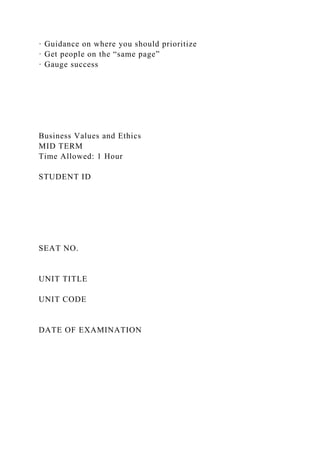
Reason:
· Impact every aspect of your organization
· Shape company vision
· Guidance on where you should prioritize
· Get people on the “same page”
· Gauge success
Business Values and Ethics
MID TERM
Time Allowed: 1 Hour
STUDENT ID
SEAT NO.
UNIT TITLE
UNIT CODE
DATE OF EXAMINATION
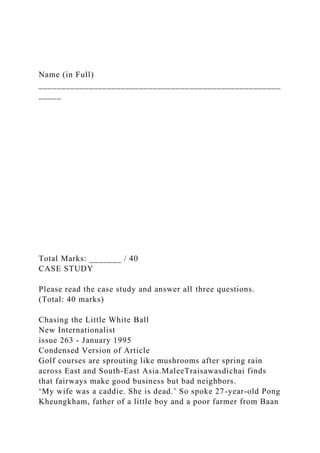
Name (in Full)
_____________________________________________________
_____
Total Marks: _______ / 40
CASE STUDY
Please read the case study and answer all three questions.
(Total: 40 marks)
Chasing the Little White Ball
New Internationalist
issue 263 - January 1995
Condensed Version of Article
Golf courses are sprouting like mushrooms after spring rain
across East and South-East Asia.MaleeTraisawasdichai finds
that fairways make good business but bad neighbors.
‘My wife was a caddie. She is dead.’ So spoke 27-year-old Pong
Kheungkham, father of a little boy and a poor farmer from Baan
Thung Yang – a small village in Chiang Rai Province, Thailand.
Janpeng, his wife, was two months pregnant when she
miscarried on the 17th hole at the Santiburi Private Community.
A month later she was dead.
Perhaps it was because she had carried the heavy bag over such
a long course or because of daily exposure to the chemical
pesticides used to keep the greens – but the cause of Janpeng’s
death was never clearly established. Her story shows how rich
golfers’ élitist passion is satisfied at the expense of the poor.
Golf constitutes an arrogant ‘power sport’ for the privileged
few.
Around Asia the advent of the golf course means disruption of
ecology and the human community. Japan, Asia’s most golf-
crazy country, has at least 2,016 golf courses covering 2,227.7
square kilometers of land. The area exceeds that of Tokyo.1
In Thailand – the centre of ‘golf mania’ in South-East Asia –
200 golf courses have depleted the country’s limited water
supply that is vital for rice farmers. In Malaysia over 160 golf
courses have swallowed up tracts of rainforest. In Indonesia 91
golf courses have bitten a big chunk out of traditional farming
wetlands and nature reserves, in one case expelling nearly 1,000
families.
China, Burma and Indochina are the new frontier of the
corporate golf industry. A ‘golf-resort-plus-casino’ package is
being introduced to Burma, Laos and Cambodia. In Laos, Thai
developer SompotPiyaoui’s plans for the KonPhapheng Resort
Development include two casinos and two courses, a 1,200-
room hotel, an international airport and a power station.
‘Setting up a resort complex in the middle of the KhonPhapheng
Fall, which is ecologically sensitive and the habitat of unique
fauna like the Irrawaddy dolphins, is in itself unacceptable. It is
a black and white issue. It’s like you were going to poison the
Mekong River right into Cambodia and Vietnam.’
Cheap land, weak regulations and feeble local opposition in
South-East Asia – particularly Indochina – are a strong draw for
Japanese developers. Back home in Japan strong local
opposition has managed to halt the construction of 720 golf
courses since 1988. For Asia’s poorest countries golf resorts
provide a lure to draw easy money from wealthy tourists,
expatriates and the local nouveaux riches.
How many ‘golf dollars’ stay in the host country is also a
matter of debate. ‘When a tourist starts his journey he buys a
Nikon camera and then flies with Japan Airlines,’ says Thai
anti-golf activist ChyantPholpoke. ‘Arriving in, say, the
Philippines for golfing, he takes a Toyota limousine and checks
in at a Japanese-owned hotel. He goes up to his room in a
Hitachi lift where he takes a drink from a Toshiba fridge, turns
on a Sharp air conditioner and a National TV.’
Golf is the sport of the powerful and influential. In Indonesia
half the existing golf courses are owned by President Suharto
and his family3. The US armed forces have 300 golf courses,
maintained at a cost of $60 million a year to the American
taxpayers.’ According to Thai Lieutenant General
SananKajornglam: ‘Most generals have to play golf because it’s
a high-society game. Golf is expensive. If you are known to be
good at golf and you play with the right clans, then let your
superiors win, you can curry favour and get promoted.’
Thai farmers are not so sure. In 1994 Thailand experienced its
worst-ever drought year. The Royal Irrigation Department (RID)
discovered 13 golf courses illegally diverting water from
irrigation canals. The Government, however, prohibited farmers
from growing a second rice crop while golf courses went on
pumping water from the reservoirs. An average course in
Thailand consumes 6,500 cubic meters of water per day –
enough to satisfy the domestic needs of 60,000 rural villagers.
SuradejVongsinlang – a water-resource engineer who quit his
golf-course job – is candid about water-theft tactics: ‘Some golf
courses near rivers dump rocks and sand into the river to make
the water level rise, so it will flow into their golf course.’
Caddies and course workers also fall victim to pesticide
poisoning. Caddies interviewed at Santiburi golf course in
Chiang Rai said they all suffered skin disease, dizziness and
kidney problems after just a year’s work. Dead birds are found
almost every morning after greenkeepers have sprayed pesticide
at night. In the US a Golf Course Superintendent Association’s
study confirmed that: ‘Among golf-course superintendents there
is more lung cancer, more brain cancer, more cancers of the
large intestine and prostate. Especially lung cancer.’
The image of Thai women is often used to sell the country to
tourists – golf tourism is no different. One promotion leaflet
entitled ‘Thailand Paradise Golf Plus’ pulls few punches: ‘The
splendour of the courses and club houses is unrivalled in
Europe. And the service offered by the caddies, who are young,
friendly, knowledgeable – and usually female – is unparalleled
in the world.’ A receptionist at the Santiburi golf course
revealed: ‘I have been approached by golfers many times to go
out. Once a Malaysian pro told me if I went with him he would
give me all the money he won from the game. But I managed to
refuse his offer gently.’
It remains to be seen whether the ‘nature-loving’ golfer can be
convinced.
MaleeTraisawasdichai is a journalist with the Nation in
Bangkok.
1GAG’M Newsletter, May 1994.
23Far Eastern Economic Review, 5 May 1994.
Questions
Answer all of the questions below. (Total: 40 marks)
Question 1
Assume the golf course is owned by the Thai government and
was created to promote economic success and improve the
standard of living in the country. Evaluate the success of this
golf course using the Triple Bottom Line. Be sure to use
specific examples from the case to support your evaluation.
Based upon your evaluation include a summarizing statement on
whether or not this golf-course has been successful.
(15marks)
Question 2
Imagine you are a local government official in neighboring
Cambodia and you have been asked to look at the golf course in
Thailand to decide if a similar development should happen in
your country. Using only a Utilitarian/Rule-Utilitarian
framework explain your decision. (10
marks)
Question 3
What are all of the factors that should be considered to decide if
the golf course manager (not owner) is Morally Responsible for
any damages that have occurred?
(15 marks)

1.Question on Case Study· You’re a manager for ABC Company·.docx

  • 1.
    1. Question onCase Study · You’re a manager for ABC Company · Your boss just told you a big secret he wants you to keep that the company will have to lay off 200 workers. Luckily, your job won’t be affected. · But a rumor is circulating in the company, and one of the workers who will be let go and is an old friend of yours asks the question. “Am I going to lose my job? I’m about to finalize the purchase of a new house. I need to know”. · What would you say? 2. Business ethics importance –reasons with examples Importance of Business Ethics: Ethical behaviour and corporate social responsibility can bring significant benefits to a business. For example, they may: · attract customers to the firm's products, thereby boosting sales and profits · make employees want to stay with the business, reduce labour turnover and therefore increase productivity · attract more employees wanting to work for the business, reduce recruitment costs and enable the company to get the most talented employees · attract investors and keep the company's share price high, thereby protecting the business from takeover.
  • 2.
    Ethical motivation: · Employeesworking for an organization will feel better about themselves and therefore more motivated to work hard. · Ethical employee = happy employee = motivated employee = productive employee Balance the needs and wishes of stakeholders: · Business are not just about money they are about giving back to society, the community. · Those companies that do so will also have an enhanced reputation and be more profitable. · There is pressure on business to recognize its responsibilities to society. Business ethics requires businesses to think about the impact of its decisions on people or stakeholders who are directly or indirectly affected by those decisions. Global challenges: · Need to learn about the different values and cultures of the regions it operates in. · Don’t want to offend. · Lose reputation, lose business. Ethical pay-off: · Organizations risk not only losing customers and employees, but being exposed to civil and criminal liability. · Sound ethical policy reduced risk exposure. Employee Retention: · Danger of losing employees who don’t want to work for an
  • 3.
    unethical organization. · Significantcosts involved in replacing key people. Prevention & Reduction of Criminal Penalties: · In addition to the loss of reputation and business, nobody really want to end up in court or even worse jail. The US Sentencing Commission Guidelines state that to receive a 40% reduction in federal penalties, a company must have “an effective program to detect and prevent violations of the law”. Preventing civil lawsuits: · In additional to criminal offences, organizations need to be vigilant to civil offences. · Discrimination, sexual harassment, favoritism big concerns. · Sound ethical policies can pre-empt unwanted behaviors. Market leadership: · Use ethical behavior as a unique selling feature to stand out in the market place. · Ethical organizations are considered more profitable organizations. Setting the Example: · Don’t follow the crowd. · Be the example that changes the way your industry operates.
  • 4.
    3. Business ethicsare unnecessary – Argue The point of a business ethics course is to improve behavior in business, and that an essential ingredient in that improved behavior is knowing what's right or wrong. · Business ethics deals with values, facts, and arguments. · Well-reasoned arguments, by reason of their clarity, invite counterarguments. 1. In perfectly competitive markets, the pursuit of profits will ensure members of society are served in the most socially- beneficial way. (the invisible hand of the market) But: · Hard to find an example of perfect competition. · Not all steps to increase profit are socially-beneficial. 2. Business managers should do what is in the best interests of the organization. (loyal agent argument). · Usually a very short-term view of benefit. · Usually only a financial view. · Basically says ethics don’t matter at all. 3. To be ethical, it is enough for business people merely to obey the law. Business ethics is to obey the law. · Ethics is not limited to what is legal. · Provides a useful excuse to act “unethically”. 4. Forms of discrimination-Intentional/Institutional aspects with examples 4 Forms: Intention and Institutional Aspects
  • 5.
    1. Isolated &Unintentional 2. Isolated & Intentional 3. Institutionalized & Unintentional 4. Institutionalized & Intentional 1. Isolated & Unintentional · Individual person unknowingly discriminates · A manager doesn’t bother to send the two employees in his company from country X the information on the new job opportunity because he doesn’t think people from country X like this kind of job. 2. Isolated & Intentional · Individual person unknowingly discriminates · I don’t like Klingons work ethic & therefore will never hire one to work in my department. 3. Institutionalized & Unintentional · Discrimination happening on an organizational level, part of procedures, practices · Intention of policy not deliberate · An organization only recruits from certain colleges. These colleges happen to have a majority of white students, making the likelihood of minorities getting employed with company less likely. 4. Institutionalized & Intentional · Organization knowingly and intentionally acts in a discriminatory manner · It is company policy not to promote anyone to a managerial position under the age of 50
  • 6.
    5. Affirmative action-Justifycompensation purposes and achieving social goals Affirmative Action: · An attempt to rectify past discrimination against women and visual minorities · Gives preferential treatment to groups that have experienced discrimination, under-represented in education or employment fields · Recruit, hire, promote · In America, some levels of government legally require affirmative action plans · Some claim this is in fact reverse discrimination against white males. The Case for Affirmative Action · Compensation (Compensatory Justice) · An obligation to compensate those who were wronged in the past. · Challenges with this? · Who pays? · Who receives the benefit? · Achieving Social Goals · Promote the public welfare · Past discrimination has produced a high degree of correlation between race and poverty · Discrimination leads to inequality · Inequality leads to poverty · Poverty leads to discontent · Discontent leads to social unrest, crime.
  • 7.
    6. Duties ofemployer/obligations of employee When an employee signs a contract of employment, this is an agreement that the employee will perform various duties that the employer has described. If these duties are not met, the contract can be terminated by the employer. Main Goal – Duties of an Employee Work towards the goals of the firm and avoid activities that might harm those goals You should always read any contract carefully before signing it! Firm’s Duties to the Employees: · Fairness of Wages · Working Conditions · Job Satisfaction Employee’s Obligation to the Firm 1. Conflicts of Interest 2. Bribes 3. Theft 4. Insider Trading 1. Conflicts of Interest · Exists when an individual is carrying out a task on behalf of the company and has a private interest in the outcome. · To favor a particular supplier · To favor a particular job candidate · To choose to disclose confidential information for the benefit of a friend · Asked to do something you think is morally wrong Conflicts of Interests? Black, white or grey? · As dept. manager, you are hosting an informal celebration in the office. The food budget is $200. Your next door neighbor has just started her own catering business and asks to supply the food. Since she is just starting out, she’ll do it at cost and
  • 8.
    provide extra itemsat no charge. · What might you want to consider? 2. Bribes When something is offered to an employee from a person outside the firm with the understanding that the employee will do something favorable for that person as the employee completes a job task. · Money · Favors · Items · Gifts? Gifts or Bribe? When is it okay to accept a gift without it being considered bribery? Some considerations: a. What is the value of the gift, and will it influence decision making? b. What is the purpose of the gift? Was it intended as a bribe? c. What were the circumstances of the gift? Was it for a special event celebration? d. What is the position of the person receiving the gift? Are they influential in decision making for the firm? e. What is the accepted business practice in the area? f. What is company policy? g. What is the law? A supplier sends a basket of expensive foodstuffs to your home at Christmas with a card: "We hope you and your family enjoy the 'goodies.‘". What action(s) might you want to take? 3. Theft
  • 9.
    4. What arethe different ways an employee can “steal” from their organization? 7. Ethical approaches-situational analysis The Seven Step Method for deciding what action to take in a situation. 1. The Facts? a. What facts make this an ethical situation? b. What facts are relevant to making an ethical decision? 2. The Ethical Issues? a. What level of ethical issues are we dealing with: systemic, corporate, or individual? b. What specific ethical issues does this situation raise? c. What level of generality is required? 3. The Alternatives? Given the facts and the ethical issues, what alternative actions are possible in this situation? Initially we should state as many alternatives as possible without making judgments as to their plausibility. Having generated as many as possible, the most plausible should be chosen for further examination. The corporation can provide no health benefits, co-pay with the employee, provide full benefits for the employee only, provide family benefits, open an HMO, and so on. 4. The Stakeholders? a. Who will be affected by the alternatives and to what degree? b. How to rank stakeholder claims? c. The firm's claim on resources in order to continue as a viable economic unit would have be given the greatest weight, since without the firm none of the other stakeholders could receive any benefit. The competing claims of stockholders and
  • 10.
    workers would haveto be given the next greatest weight since they contribute directly to the value of the firm and have legitimate claims on that value. Deciding on how much weight to give each group's claims would require and understanding of the capital structure of the firm (debt--equity balance, availability and relative cost of debt financing, and so on) and the history of the firm's relations with the employees (degree of worker contribution to finished product, loyalty and productivity of workers, average length of employment and rate of turnover, and so on). Families and the community would have less weight unless they have made equally important contributions to the firm. 5. The Ethics of the Alternatives? a. Use ethical principles to decide on the best alternative. b. How to decide when the theories point to different alternatives. 6. The Practical Constraints? a. Can the best alternative be put into effect? b. Distinguish ethical from practical constraints. 7. Actions to Take? a. Implementing the best alternative. b. A summary of the justification 8. Importance of values-reasons with examples Values: · Beliefs, concepts you considered worthwhile · Impact, priorities, decision-making process in your organization · What’s important to you? Your organization? Reason: · Impact every aspect of your organization · Shape company vision
  • 11.
    · Guidance onwhere you should prioritize · Get people on the “same page” · Gauge success Business Values and Ethics MID TERM Time Allowed: 1 Hour STUDENT ID SEAT NO. UNIT TITLE UNIT CODE DATE OF EXAMINATION
  • 12.
    Name (in Full) _____________________________________________________ _____ TotalMarks: _______ / 40 CASE STUDY Please read the case study and answer all three questions. (Total: 40 marks) Chasing the Little White Ball New Internationalist issue 263 - January 1995 Condensed Version of Article Golf courses are sprouting like mushrooms after spring rain across East and South-East Asia.MaleeTraisawasdichai finds that fairways make good business but bad neighbors. ‘My wife was a caddie. She is dead.’ So spoke 27-year-old Pong Kheungkham, father of a little boy and a poor farmer from Baan
  • 13.
    Thung Yang –a small village in Chiang Rai Province, Thailand. Janpeng, his wife, was two months pregnant when she miscarried on the 17th hole at the Santiburi Private Community. A month later she was dead. Perhaps it was because she had carried the heavy bag over such a long course or because of daily exposure to the chemical pesticides used to keep the greens – but the cause of Janpeng’s death was never clearly established. Her story shows how rich golfers’ élitist passion is satisfied at the expense of the poor. Golf constitutes an arrogant ‘power sport’ for the privileged few. Around Asia the advent of the golf course means disruption of ecology and the human community. Japan, Asia’s most golf- crazy country, has at least 2,016 golf courses covering 2,227.7 square kilometers of land. The area exceeds that of Tokyo.1 In Thailand – the centre of ‘golf mania’ in South-East Asia – 200 golf courses have depleted the country’s limited water supply that is vital for rice farmers. In Malaysia over 160 golf courses have swallowed up tracts of rainforest. In Indonesia 91 golf courses have bitten a big chunk out of traditional farming wetlands and nature reserves, in one case expelling nearly 1,000 families. China, Burma and Indochina are the new frontier of the corporate golf industry. A ‘golf-resort-plus-casino’ package is being introduced to Burma, Laos and Cambodia. In Laos, Thai developer SompotPiyaoui’s plans for the KonPhapheng Resort Development include two casinos and two courses, a 1,200- room hotel, an international airport and a power station. ‘Setting up a resort complex in the middle of the KhonPhapheng Fall, which is ecologically sensitive and the habitat of unique fauna like the Irrawaddy dolphins, is in itself unacceptable. It is a black and white issue. It’s like you were going to poison the Mekong River right into Cambodia and Vietnam.’ Cheap land, weak regulations and feeble local opposition in South-East Asia – particularly Indochina – are a strong draw for Japanese developers. Back home in Japan strong local
  • 14.
    opposition has managedto halt the construction of 720 golf courses since 1988. For Asia’s poorest countries golf resorts provide a lure to draw easy money from wealthy tourists, expatriates and the local nouveaux riches. How many ‘golf dollars’ stay in the host country is also a matter of debate. ‘When a tourist starts his journey he buys a Nikon camera and then flies with Japan Airlines,’ says Thai anti-golf activist ChyantPholpoke. ‘Arriving in, say, the Philippines for golfing, he takes a Toyota limousine and checks in at a Japanese-owned hotel. He goes up to his room in a Hitachi lift where he takes a drink from a Toshiba fridge, turns on a Sharp air conditioner and a National TV.’ Golf is the sport of the powerful and influential. In Indonesia half the existing golf courses are owned by President Suharto and his family3. The US armed forces have 300 golf courses, maintained at a cost of $60 million a year to the American taxpayers.’ According to Thai Lieutenant General SananKajornglam: ‘Most generals have to play golf because it’s a high-society game. Golf is expensive. If you are known to be good at golf and you play with the right clans, then let your superiors win, you can curry favour and get promoted.’ Thai farmers are not so sure. In 1994 Thailand experienced its worst-ever drought year. The Royal Irrigation Department (RID) discovered 13 golf courses illegally diverting water from irrigation canals. The Government, however, prohibited farmers from growing a second rice crop while golf courses went on pumping water from the reservoirs. An average course in Thailand consumes 6,500 cubic meters of water per day – enough to satisfy the domestic needs of 60,000 rural villagers. SuradejVongsinlang – a water-resource engineer who quit his golf-course job – is candid about water-theft tactics: ‘Some golf courses near rivers dump rocks and sand into the river to make the water level rise, so it will flow into their golf course.’ Caddies and course workers also fall victim to pesticide poisoning. Caddies interviewed at Santiburi golf course in Chiang Rai said they all suffered skin disease, dizziness and
  • 15.
    kidney problems afterjust a year’s work. Dead birds are found almost every morning after greenkeepers have sprayed pesticide at night. In the US a Golf Course Superintendent Association’s study confirmed that: ‘Among golf-course superintendents there is more lung cancer, more brain cancer, more cancers of the large intestine and prostate. Especially lung cancer.’ The image of Thai women is often used to sell the country to tourists – golf tourism is no different. One promotion leaflet entitled ‘Thailand Paradise Golf Plus’ pulls few punches: ‘The splendour of the courses and club houses is unrivalled in Europe. And the service offered by the caddies, who are young, friendly, knowledgeable – and usually female – is unparalleled in the world.’ A receptionist at the Santiburi golf course revealed: ‘I have been approached by golfers many times to go out. Once a Malaysian pro told me if I went with him he would give me all the money he won from the game. But I managed to refuse his offer gently.’ It remains to be seen whether the ‘nature-loving’ golfer can be convinced. MaleeTraisawasdichai is a journalist with the Nation in Bangkok. 1GAG’M Newsletter, May 1994. 23Far Eastern Economic Review, 5 May 1994. Questions Answer all of the questions below. (Total: 40 marks) Question 1 Assume the golf course is owned by the Thai government and was created to promote economic success and improve the standard of living in the country. Evaluate the success of this golf course using the Triple Bottom Line. Be sure to use specific examples from the case to support your evaluation.
  • 16.
    Based upon yourevaluation include a summarizing statement on whether or not this golf-course has been successful. (15marks) Question 2 Imagine you are a local government official in neighboring Cambodia and you have been asked to look at the golf course in Thailand to decide if a similar development should happen in your country. Using only a Utilitarian/Rule-Utilitarian framework explain your decision. (10 marks) Question 3 What are all of the factors that should be considered to decide if the golf course manager (not owner) is Morally Responsible for any damages that have occurred? (15 marks)