Code of
Conduct
Created by
Pooja Tiwari
Pooja Tiwari
Importance of Code of Conduct
Organizations communicate their ethical expectations to all the employees via Code of Conduct. HR department is custodian of
communicationandimplementation,sothatemployeeareawareandfullyunderstanditsrequirement.
Awrittencodeofconductdefiningbehaviouralexpectationsfromalltheemployeesandprovidingdirections/guidancetothemwhen
theyfacedadifficultsituationandallowingthemtotakewithethicaldecisions.
CodeofConductshouldreflecttheneeds,concernsandvalueoftheorganizationthatcreates,Adoptanduseit.Thereisnodefineset
ofelementsororderofcomponents.Organizationscreate thisbecauseoftheir meaningfulnessandusefulness.VisionandMission
statementoftheorganizationreflectincodeofconduct.
Code of Conduct also called code of ethics. When employee fails to comply with work rules, policies and procedure considered as
violationofthecode.
Pooja Tiwari
There are various ways of conducting code, but few of the steps help to create a better understanding. This start with leadership
commitmenttotheendresults.
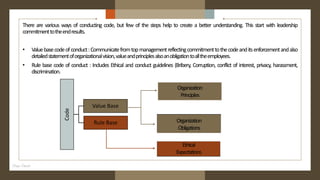
• Valuebasecodeofconduct:Communicatefromtopmanagementreflectingcommitmenttothecodeanditsenforcementandalso
detailedstatementoforganizationalvision,valueandprinciplesalsoanobligationtoalltheemployees.
• Rule base code of conduct : Includes Ethical and conduct guidelines (Bribery, Corruption, conflict of interest, privacy, harassment,
discrimination.
Code
Value Base
Rule Base
Organization
Principles
Organization
Obligations
Ethical
Expectations
Pooja Tiwari
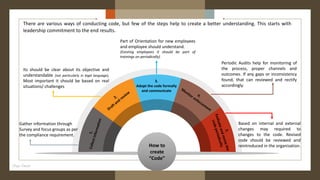
How to
create
“Code”
3.
Adopt the code formally
and communicate
Gather information through
Survey and focus groups as per
the compliance requirement.
Its should be clear about its objective and
understandable (not particularly in legal language),
Most important it should be based on real
situations/ challenges
Part of Orientation for new employees
and employee should understand.
(Existing employees it should be part of
trainings on periodically)
Periodic Audits help for monitoring of
the process, proper channels and
outcomes. If any gaps or inconsistency
found, that can reviewed and rectify
accordingly.
Based on internal and external
changes may required to
changes to the code. Revised
code should be reviewed and
reintroduced in the organization.
There are various ways of conducting code, but few of the steps help to create a better understanding. This starts with
leadership commitment to the end results.
Pooja Tiwari
1.
Focus on company vision/Mission and
Principles
2.
Purpose and Scope
3.
RACI Matrix
4.
Implementation and Communication
5.
Disciplinary actions, Penalties
and TAT
6.
Periodic Audits, Review and
update revise code versions (after amendments)
There are various sections to focus on while creating code of conduct, below are the few points
Sections
Pooja Tiwari
ThankYou!!
Organizations has to think carefully while drafting code of conduct weather to standardize the code or
localized the code (based on the what is acceptable behaviour in your organization), it should have clear and
non-judgemental guidelines for all the employees.
Pooja Tiwari

Code of conduct

  • 1.
  • 2.
    Importance of Codeof Conduct Organizations communicate their ethical expectations to all the employees via Code of Conduct. HR department is custodian of communicationandimplementation,sothatemployeeareawareandfullyunderstanditsrequirement. Awrittencodeofconductdefiningbehaviouralexpectationsfromalltheemployeesandprovidingdirections/guidancetothemwhen theyfacedadifficultsituationandallowingthemtotakewithethicaldecisions. CodeofConductshouldreflecttheneeds,concernsandvalueoftheorganizationthatcreates,Adoptanduseit.Thereisnodefineset ofelementsororderofcomponents.Organizationscreate thisbecauseoftheir meaningfulnessandusefulness.VisionandMission statementoftheorganizationreflectincodeofconduct. Code of Conduct also called code of ethics. When employee fails to comply with work rules, policies and procedure considered as violationofthecode. Pooja Tiwari
  • 3.
    There are variousways of conducting code, but few of the steps help to create a better understanding. This start with leadership commitmenttotheendresults. • Valuebasecodeofconduct:Communicatefromtopmanagementreflectingcommitmenttothecodeanditsenforcementandalso detailedstatementoforganizationalvision,valueandprinciplesalsoanobligationtoalltheemployees. • Rule base code of conduct : Includes Ethical and conduct guidelines (Bribery, Corruption, conflict of interest, privacy, harassment, discrimination. Code Value Base Rule Base Organization Principles Organization Obligations Ethical Expectations Pooja Tiwari
  • 4.
    How to create “Code” 3. Adopt thecode formally and communicate Gather information through Survey and focus groups as per the compliance requirement. Its should be clear about its objective and understandable (not particularly in legal language), Most important it should be based on real situations/ challenges Part of Orientation for new employees and employee should understand. (Existing employees it should be part of trainings on periodically) Periodic Audits help for monitoring of the process, proper channels and outcomes. If any gaps or inconsistency found, that can reviewed and rectify accordingly. Based on internal and external changes may required to changes to the code. Revised code should be reviewed and reintroduced in the organization. There are various ways of conducting code, but few of the steps help to create a better understanding. This starts with leadership commitment to the end results. Pooja Tiwari
  • 5.
    1. Focus on companyvision/Mission and Principles 2. Purpose and Scope 3. RACI Matrix 4. Implementation and Communication 5. Disciplinary actions, Penalties and TAT 6. Periodic Audits, Review and update revise code versions (after amendments) There are various sections to focus on while creating code of conduct, below are the few points Sections Pooja Tiwari
  • 6.
    ThankYou!! Organizations has tothink carefully while drafting code of conduct weather to standardize the code or localized the code (based on the what is acceptable behaviour in your organization), it should have clear and non-judgemental guidelines for all the employees. Pooja Tiwari