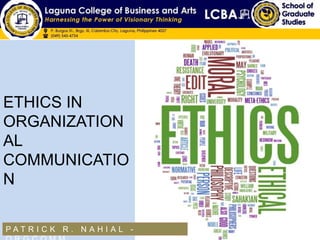
ETHICS IN
ORGANIZATION
AL
COMMUNICATIO
N
P A T R I C K R . N A H I A L -
• What is organizational ethics?
• Why is it important?
• Strong organizational ethics
• What are the Key Areas for Ethical
Communication
• Samples of unethical communication
practices
• Ethical Communication Guidelines
ETHICS IN ORGANIZATIONAL
COMMUNICATION
Main Ideas
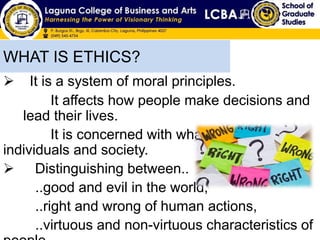
 It is a system of moral principles.
It affects how people make decisions and
lead their lives.
It is concerned with what is good for
individuals and society.
 Distinguishing between..
..good and evil in the world,
..right and wrong of human actions,
..virtuous and non-virtuous characteristics of
WHAT IS ETHICS?
WHAT IS COMMUNICATION
ETHICS?
 deals with the moral good present in any form
of human communication. This includes
interpersonal communication, mass
mediated communication, and digital
communication.
 Communication ethics concerns not only the
individual, but is of great concern to
businesses, corporations, and professional
entities.
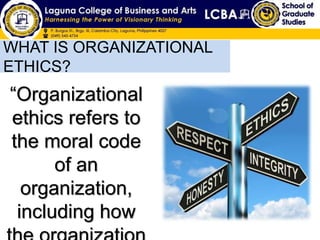
WHAT IS ORGANIZATIONAL
ETHICS?
“Organizational
ethics refers to
the moral code
of an
organization,
including how
IMPORTANCE OF ETHICAL
COMMUNICATION
• Public Image can affect organization’s ability to
accomplish
mission/ make a profit.
 A business must practice ethics in
organizational
communication to establish and
maintain a positive
image.
Why does it matter?
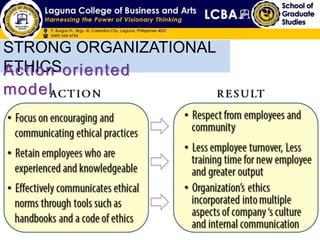
STRONG ORGANIZATIONAL
ETHICSAction-oriented
model
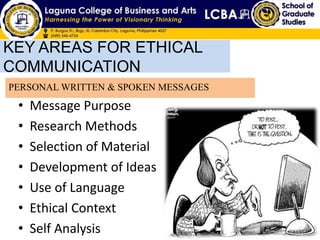
• Message Purpose
• Research Methods
• Selection of Material
• Development of Ideas
• Use of Language
• Ethical Context
• Self Analysis
KEY AREAS FOR ETHICAL
COMMUNICATION
PERSONAL WRITTEN & SPOKEN MESSAGES
• Cultural Context
• Misunderstanding
• Language
• Accountability
KEY AREAS FOR ETHICAL
COMMUNICATION
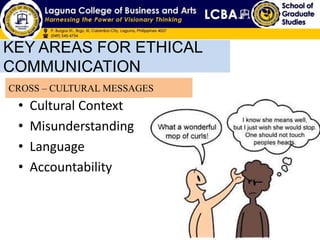
CROSS – CULTURAL MESSAGES
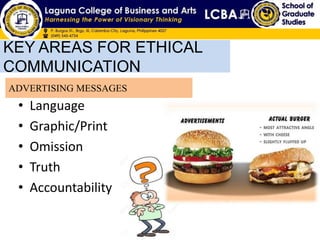
• Language
• Graphic/Print
• Omission
• Truth
• Accountability
KEY AREAS FOR ETHICAL
COMMUNICATION
ADVERTISING MESSAGES
SOME EXAMPLES OF UNETHICAL
COMMUNICATION
Plagiarism Stealing someone else’s work and
claiming it as your own.
Selective misquoting Deliberately omitting damaging or
unflattering comments to paint a better
(but untruthful picture ) of you or your
company
Misrepresenting numbers Increasing or decreasing numbers ,
altering statistics or omitting numerical
data.
Distorting visuals Making a product look bigger or
changing the scale of graphs and charts
to exaggerate or conceal the differences.
WHAT IS ETHICAL DILEMMA?
It is also known as moral dilemmas.
These are situations in which there is a
choice to be made between two options,
neither of which resolves the situation in
an ethically acceptable fashion.
ETHICAL COMMUNICATION
GUIDELINESWays to approach ethical communication and
decision-making Utilitarian Approach (Bentham/Mill)
o Doesthisactionprovidethegreatestgoodforgreatestnumber?
Rights Approach (Kant)
o Doesthisactionrespectthemoralrightsofeveryone?
Fairness or Justice Approach (Aristotle, John
Rawls)
o Isthisactionfairandfree ofdiscriminationoffavouritism?
Common Good Approach
o Doesthisactionsustainwelfareofthecommunity?
Virtue Approach
ETHICAL DILEMMA IN
ORGANIZATIONAL COMMUNICATION
Employees often work in teams to create marketing
campaigns, develop new products or fine-tune
services, yet rarely does everyone in a group contribute
equally to the final product.
If three members of a five-person team did all the
work, do those three members demand to receive
proper credit while pointing out that two members of
the team did not pull their weight?
ETHICAL DILEMMA IN
ORGANIZATIONAL COMMUNICATION
Tony, a data analyst for a major casino, is working after normal
business hours to finish an important project. He realizes that he is
missing data that had been sent to his co-worker Robert. Tony had
unintentionally observed Robert typing his password several days ago
and decides to log into Robert’s computer and resend the data to
himself. Upon doing so, Tony sees an open email regarding gambling
bets Robert placed over the last several days with a local sports book.
All employees of the casino are forbidden to engage in gambling
activities to avoid any hint of conflict of interest. Tony knows he should
report this but would have to admit to violating the company’s
information technology regulations by logging into Robert’s computer. If
he warns Robert to stop his betting, he would also have to reveal the
source of his information. What does Tony do in this situation?

ETHICS IN ORGANIZATIONAL COMMUNICATION

  • 1.
  • 2.
    • What isorganizational ethics? • Why is it important? • Strong organizational ethics • What are the Key Areas for Ethical Communication • Samples of unethical communication practices • Ethical Communication Guidelines ETHICS IN ORGANIZATIONAL COMMUNICATION Main Ideas
  • 3.
     It isa system of moral principles. It affects how people make decisions and lead their lives. It is concerned with what is good for individuals and society.  Distinguishing between.. ..good and evil in the world, ..right and wrong of human actions, ..virtuous and non-virtuous characteristics of WHAT IS ETHICS?
  • 4.
    WHAT IS COMMUNICATION ETHICS? deals with the moral good present in any form of human communication. This includes interpersonal communication, mass mediated communication, and digital communication.  Communication ethics concerns not only the individual, but is of great concern to businesses, corporations, and professional entities.
  • 5.
    WHAT IS ORGANIZATIONAL ETHICS? “Organizational ethicsrefers to the moral code of an organization, including how
  • 6.
    IMPORTANCE OF ETHICAL COMMUNICATION •Public Image can affect organization’s ability to accomplish mission/ make a profit.  A business must practice ethics in organizational communication to establish and maintain a positive image. Why does it matter?
  • 7.
  • 8.
    • Message Purpose •Research Methods • Selection of Material • Development of Ideas • Use of Language • Ethical Context • Self Analysis KEY AREAS FOR ETHICAL COMMUNICATION PERSONAL WRITTEN & SPOKEN MESSAGES
  • 9.
    • Cultural Context •Misunderstanding • Language • Accountability KEY AREAS FOR ETHICAL COMMUNICATION CROSS – CULTURAL MESSAGES
  • 10.
    • Language • Graphic/Print •Omission • Truth • Accountability KEY AREAS FOR ETHICAL COMMUNICATION ADVERTISING MESSAGES
  • 11.
    SOME EXAMPLES OFUNETHICAL COMMUNICATION Plagiarism Stealing someone else’s work and claiming it as your own. Selective misquoting Deliberately omitting damaging or unflattering comments to paint a better (but untruthful picture ) of you or your company Misrepresenting numbers Increasing or decreasing numbers , altering statistics or omitting numerical data. Distorting visuals Making a product look bigger or changing the scale of graphs and charts to exaggerate or conceal the differences.
  • 12.
    WHAT IS ETHICALDILEMMA? It is also known as moral dilemmas. These are situations in which there is a choice to be made between two options, neither of which resolves the situation in an ethically acceptable fashion.
  • 13.
    ETHICAL COMMUNICATION GUIDELINESWays toapproach ethical communication and decision-making Utilitarian Approach (Bentham/Mill) o Doesthisactionprovidethegreatestgoodforgreatestnumber? Rights Approach (Kant) o Doesthisactionrespectthemoralrightsofeveryone? Fairness or Justice Approach (Aristotle, John Rawls) o Isthisactionfairandfree ofdiscriminationoffavouritism? Common Good Approach o Doesthisactionsustainwelfareofthecommunity? Virtue Approach
  • 14.
    ETHICAL DILEMMA IN ORGANIZATIONALCOMMUNICATION Employees often work in teams to create marketing campaigns, develop new products or fine-tune services, yet rarely does everyone in a group contribute equally to the final product. If three members of a five-person team did all the work, do those three members demand to receive proper credit while pointing out that two members of the team did not pull their weight?
  • 15.
    ETHICAL DILEMMA IN ORGANIZATIONALCOMMUNICATION Tony, a data analyst for a major casino, is working after normal business hours to finish an important project. He realizes that he is missing data that had been sent to his co-worker Robert. Tony had unintentionally observed Robert typing his password several days ago and decides to log into Robert’s computer and resend the data to himself. Upon doing so, Tony sees an open email regarding gambling bets Robert placed over the last several days with a local sports book. All employees of the casino are forbidden to engage in gambling activities to avoid any hint of conflict of interest. Tony knows he should report this but would have to admit to violating the company’s information technology regulations by logging into Robert’s computer. If he warns Robert to stop his betting, he would also have to reveal the source of his information. What does Tony do in this situation?