ETHICS AND
CRISIS
COMMUNICATIONS
#Manship4002
Lecture 14
WHAT IS A CRISIS?
• Crisis = significant, disruptive event that
often features a rapid onset, and can
produce negative consequences for an
organization‘s financial health and
reputation.
EXAMPLES OF CRISES
 Natural disasters (public sector
organizations should demonstrate
responsibility for safety of citizens)
 workplace accidents, violence
 technical errors
 rumors
SOCIAL MEDIA FOR
CRISIS MANAGEMENT
• Organizations use social media to proactively
monitor and prepare for potential crisis
• Requires active listening, social media monitoring
• Organizations can use social media to provide up-
to-date information during a crisis event
•24 hour updates
• Social media messages enable reputation
managers to reach key demographics quickly and
efficiently during a crisis event
• Social media, used correctly, can establish positive
credibility and reputation for a brand
REPUTATION
―the collective representation of multiple
constituencies‘ images of a company, built up
over time and based on a company‘s identity
programs, its performance, and how
constituencies have perceived its behavior‖
 consumer sales (private sector)
 perceived product quality
 credibility (public sector)
 Companies that have an established and
positive reputation are more likely to recover
quickly after a major crisis (Ulmer, 2001).
REPUTATION
A corporate reputation is based on four
foundations
1. Reliability
2. Responsibility
3. Credibility
4. Trustworthiness
(Fombrun, 1996).
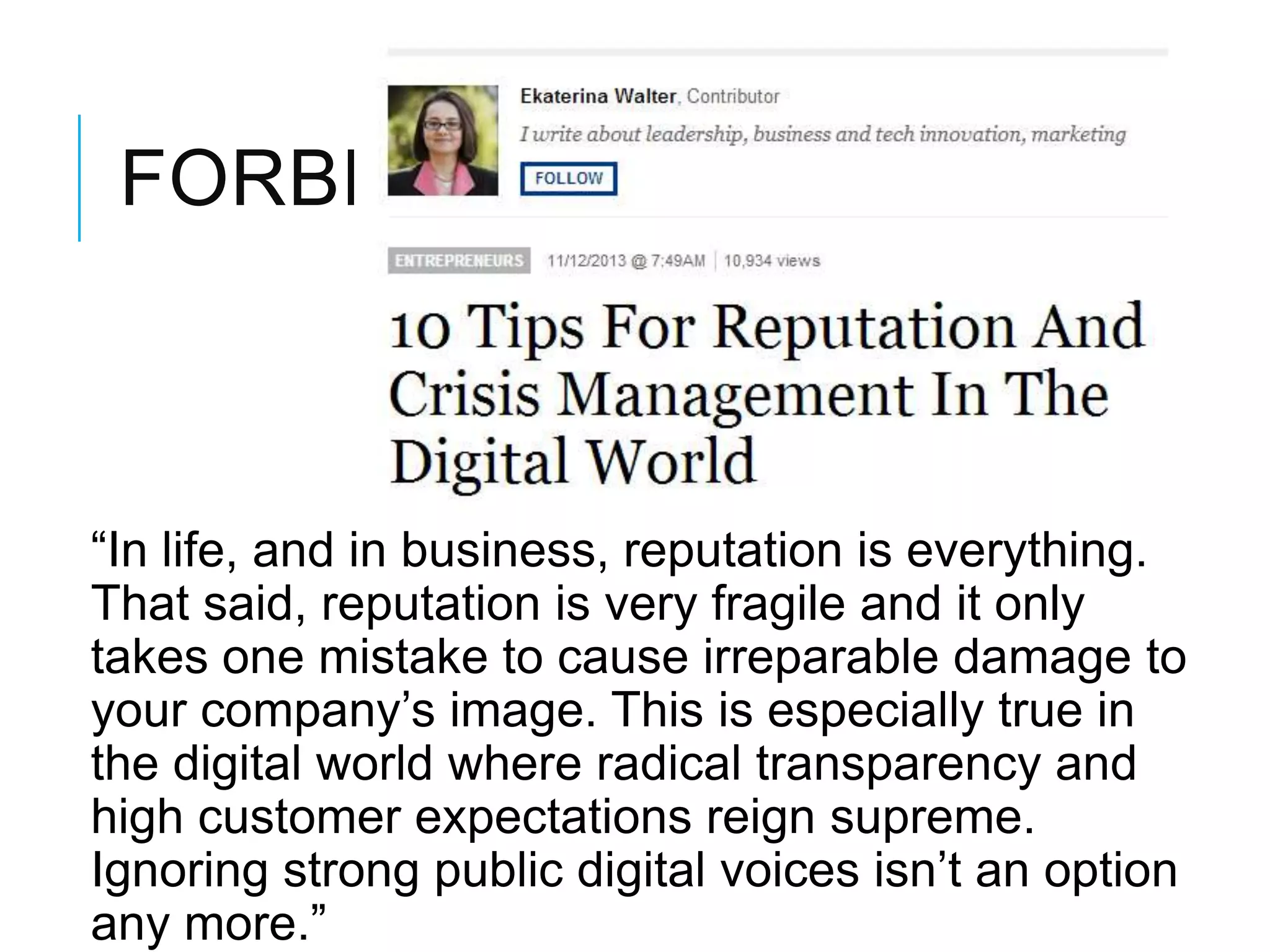
FORBES:
―In life, and in business, reputation is everything.
That said, reputation is very fragile and it only
takes one mistake to cause irreparable damage to
your company‘s image. This is especially true in
the digital world where radical transparency and
high customer expectations reign supreme.
Ignoring strong public digital voices isn‘t an option
any more.‖
1. Listen and Be Present: Not having a presence
on social communities can reflect badly on your
brand. Listen and respond – even if just with a
link to a website or form for customer feedback.
2. Set The Right Expectations: Make a plan for
how quickly people should expect your response
– 5 hrs? 24hrs? 48hrs?
3. Be Transparent: DON‘T erase negative posts,
ever. DON‘T try to cover up social media
mistakes. Customers don‘t expect you and your
teams to be perfect, just transparent and honest.
They expect you treat them like family…
4. Respond Thoughtfully: show you care; ―of
those customers who received a reply in
response to their negative review 33% turned
around and posted a positive review, and 34%
deleted their original negative review.‖
5. Never Lose your Cool: never be rude or attack
customers in social forms – unacceptable, and will
come back to bite your A*$!
6. Have a crisis management team (from PR,
HR, legal, marketing…)
7. Manage access to your social media
accounts carefully
8. Post moderation guidelines: “you can also
post your own moderation guidelines on your
social media pages to make it obvious what
behavior will or will not be tolerated within your
social communities. Being up-front about your
―house rules‖ makes it simpler to take down
offensive posts by referring to your rules and
pointing out how they were violated.‖
9. Hire experienced community managers
WHAT IS A BRAND‘S
RESPONSIBILITY ON
TWITTER?
“To respond.” - Conversocial
CEO Joshua March [a platform that enables
brands to manage interactions and increase
engagement with customers in social media]
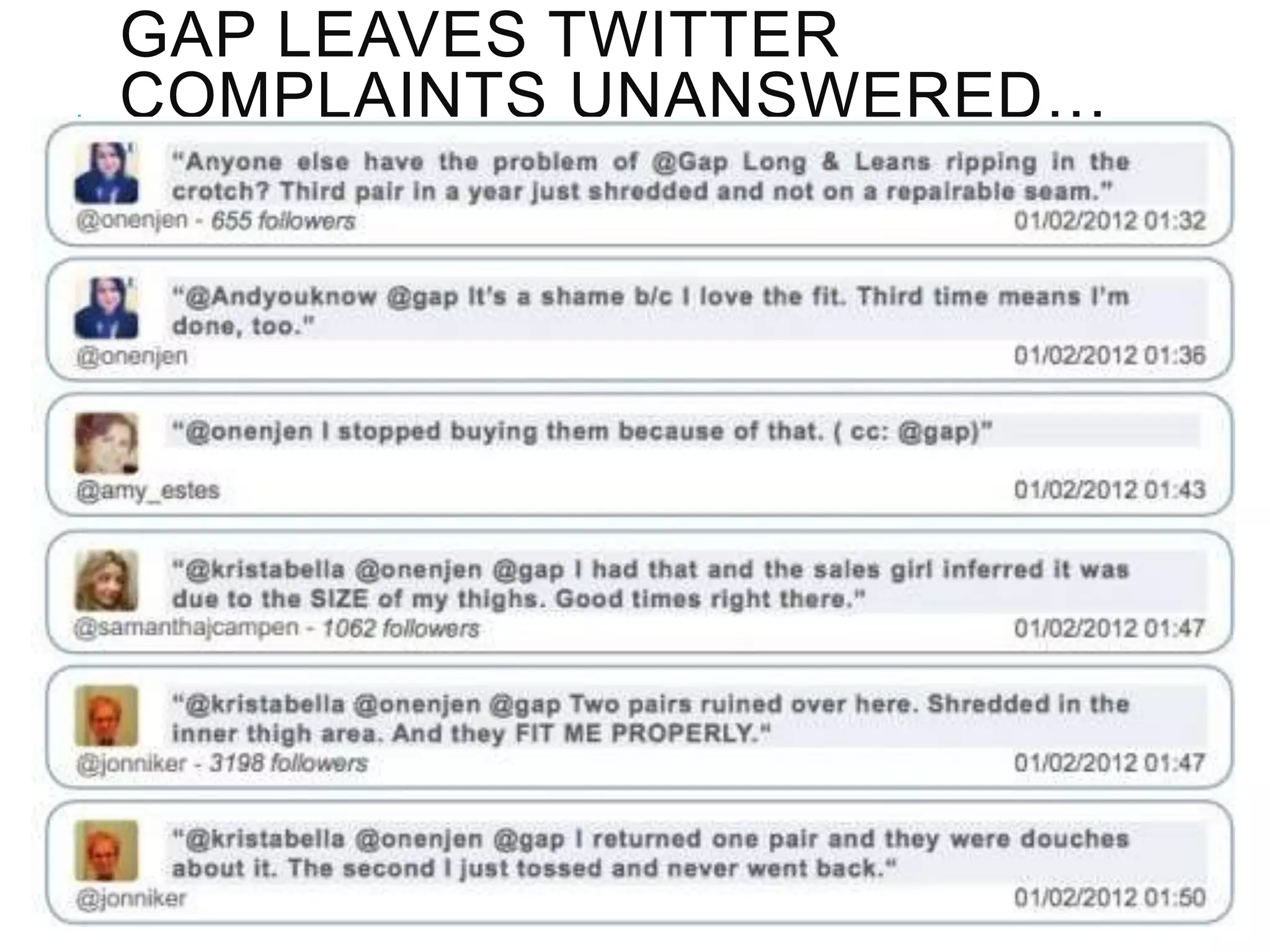
Many brands, however, don‘t respond to
customer service complaints on Twitter. Many
of these customer complains are direct queries
(48%), not simply negative comments (9%), so
they deserve responses.
GAP LEAVES TWITTER
COMPLAINTS UNANSWERED…
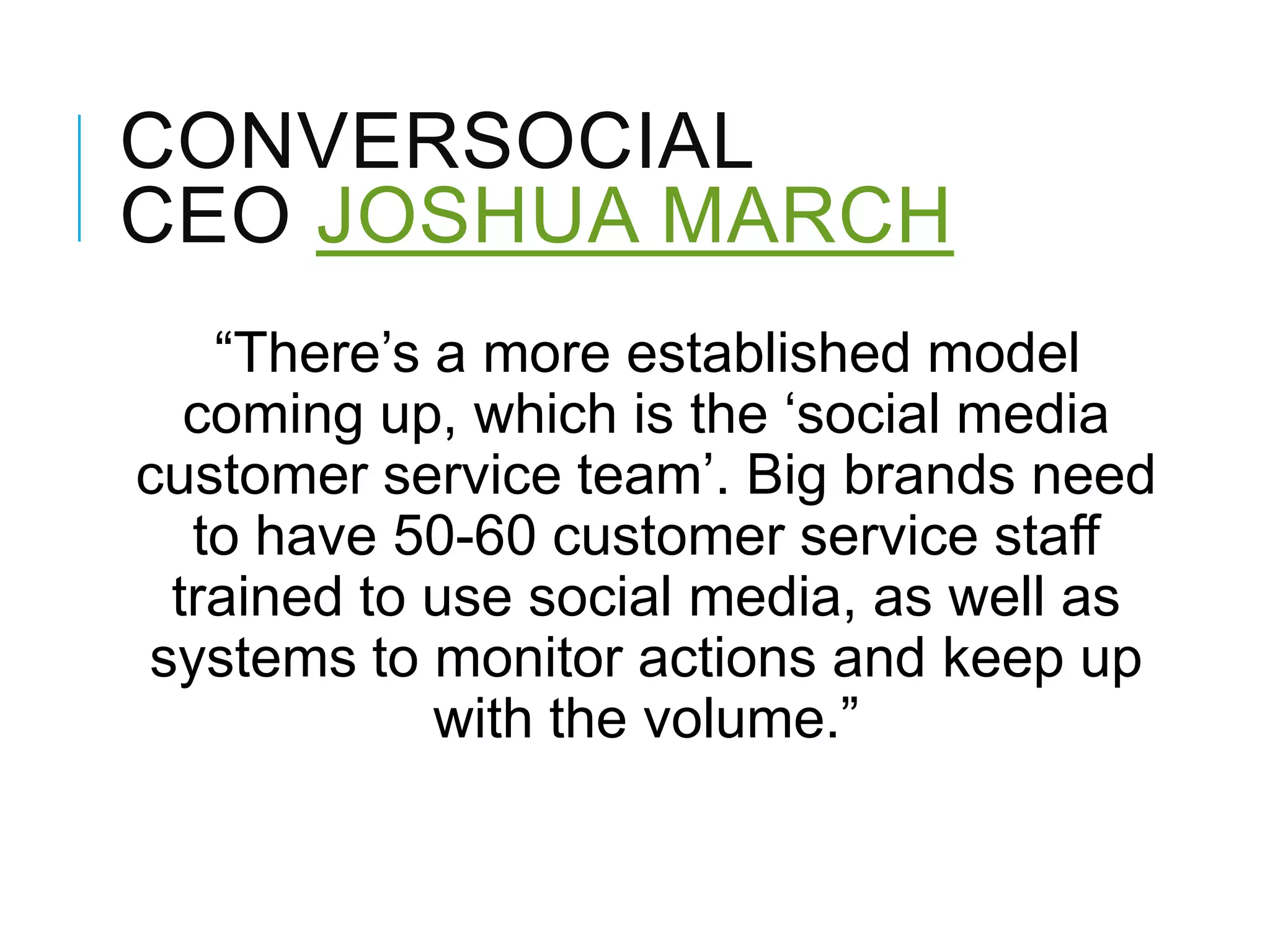
CONVERSOCIAL
CEO JOSHUA MARCH
―There‘s a more established model
coming up, which is the ‗social media
customer service team‘. Big brands need
to have 50-60 customer service staff
trained to use social media, as well as
systems to monitor actions and keep up
with the volume.‖
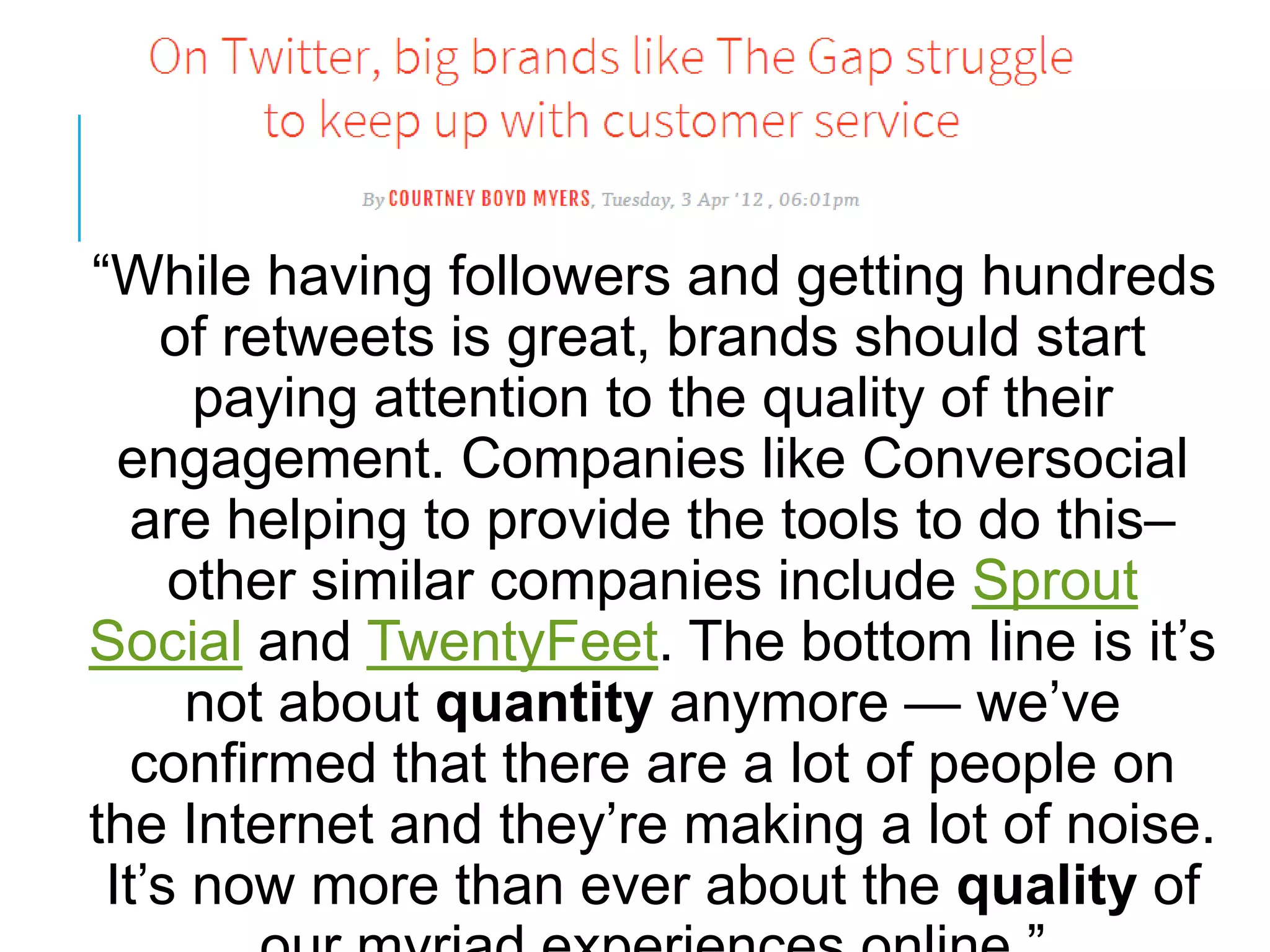
―While having followers and getting hundreds
of retweets is great, brands should start
paying attention to the quality of their
engagement. Companies like Conversocial
are helping to provide the tools to do this–
other similar companies include Sprout
Social and TwentyFeet. The bottom line is it‘s
not about quantity anymore — we‘ve
confirmed that there are a lot of people on
the Internet and they‘re making a lot of noise.
It‘s now more than ever about the quality of
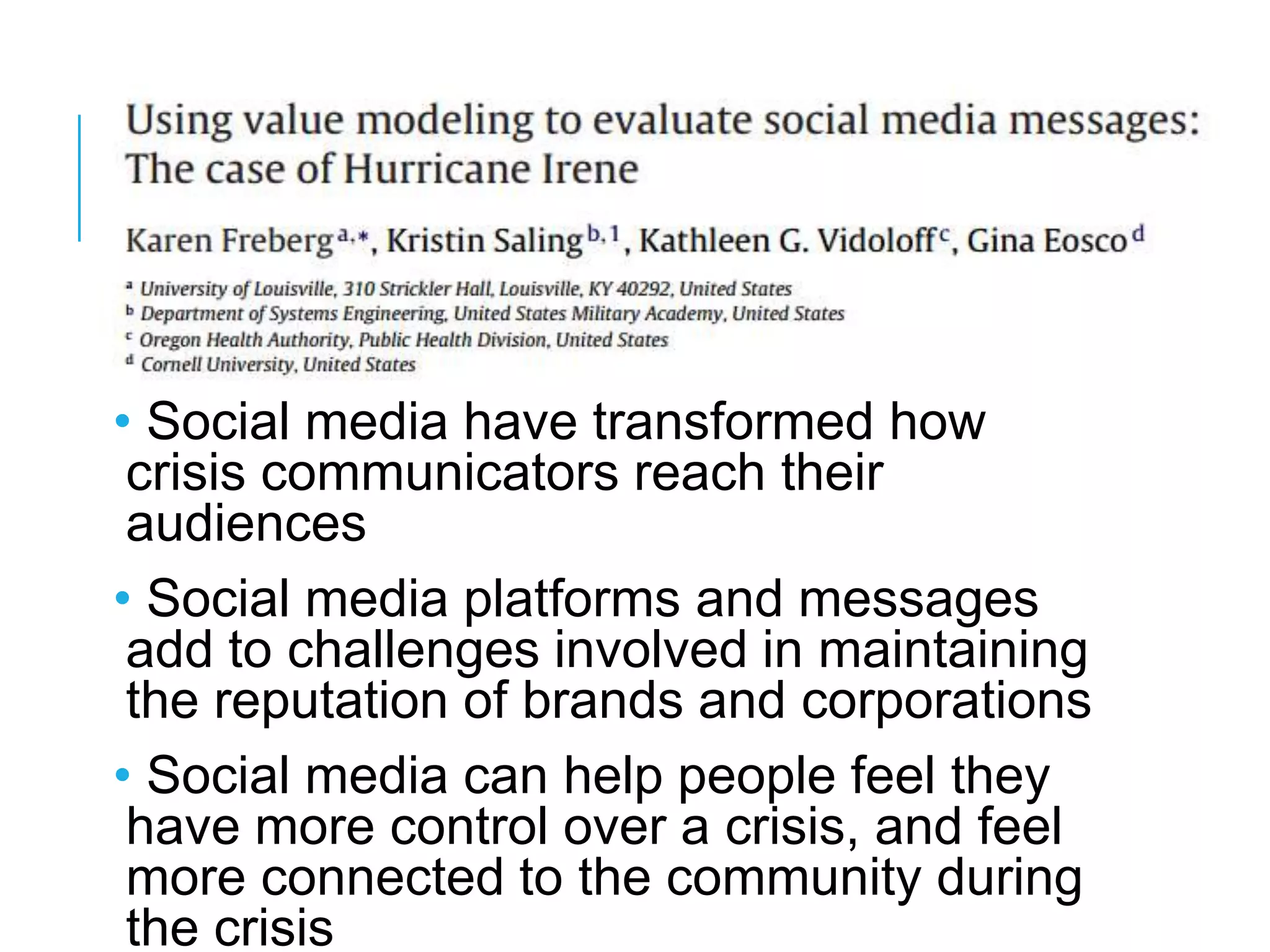
• Social media have transformed how
crisis communicators reach their
audiences
• Social media platforms and messages
add to challenges involved in maintaining
the reputation of brands and corporations
• Social media can help people feel they
have more control over a crisis, and feel
more connected to the community during
the crisis
INDIVIDUAL
EMPOWERMENT
DURING CRISIS
Using social media, individuals can contribute
directly to media by providing eyewitness
perspectives through video, photos, or texted
accounts of an event, often bypassing the
professional reporters on the scene, and
providing unfiltered views of what is
happening in the world.
9/11
Hurricane Katrina
2007 Virginia Tech shootings
PEOPLE USE SOCIAL
MEDIA DURING CRISES
 Community members who experienced
the 2007 southern California wildfires
sought information and used social media
to contact friends and family.
 Many people saw Tweets about TVA ash
spill crisis before they received traditional
media updates.
 Risks for organizations that provide
inaccurate information to stakeholders in a
time of crisis
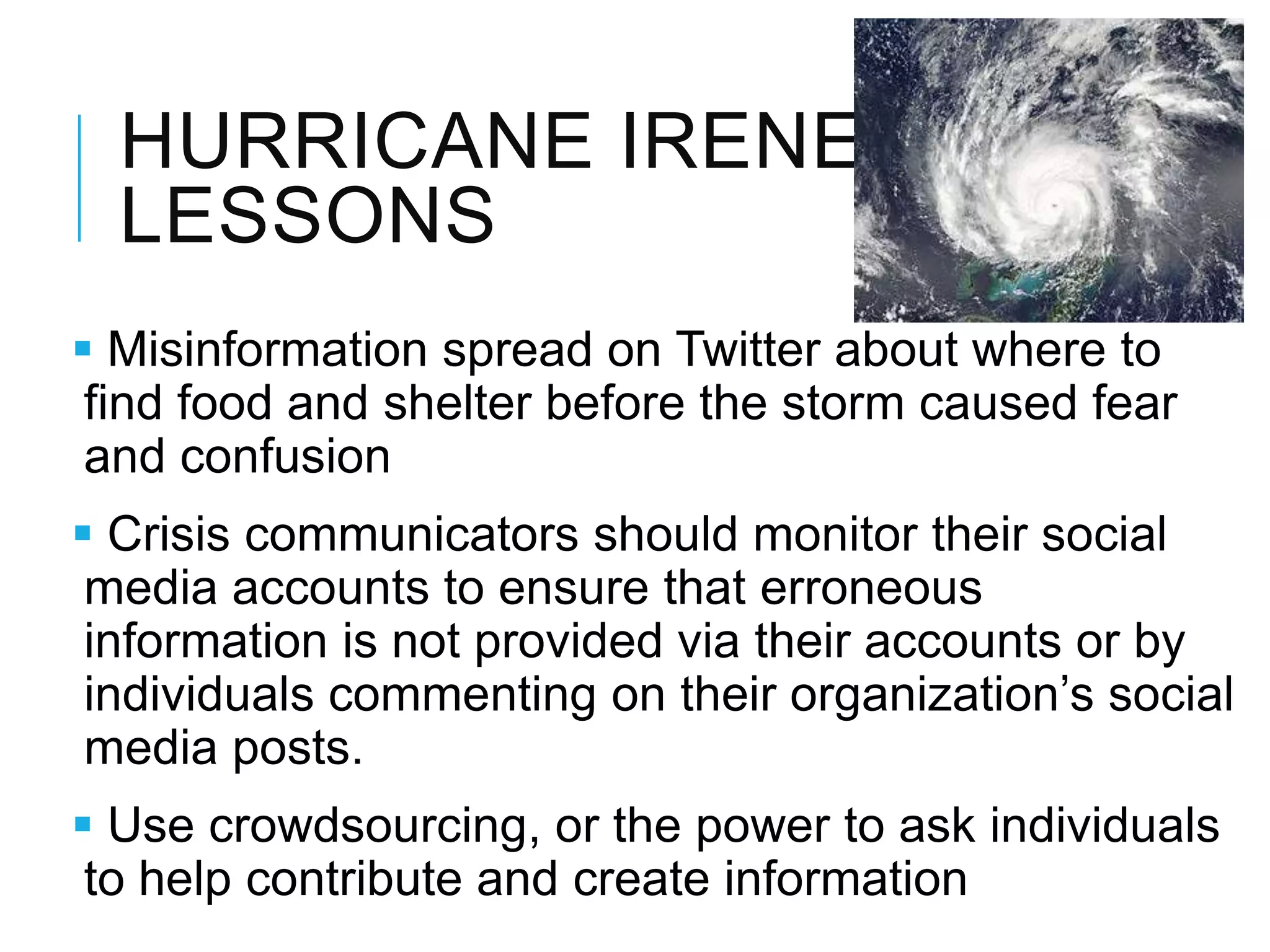
HURRICANE IRENE
LESSONS
 Misinformation spread on Twitter about where to
find food and shelter before the storm caused fear
and confusion
 Crisis communicators should monitor their social
media accounts to ensure that erroneous
information is not provided via their accounts or by
individuals commenting on their organization‘s social
media posts.
 Use crowdsourcing, or the power to ask individuals
to help contribute and create information
RESEARCH:
Social mention (www.socialmention.com) was used to
collect updates appearing on social media platforms
from August 22, 2011 to September 1, 2011 using the
search terms ―hurricane irene,‖ ―hurricane irene
safety,‖ ―hurricane irene mold,‖ and ―hurricane irene
food safety.‖
The social media updates collected about Hurricane
Irene came from multiple sources such as Twitter,
Facebook, Digg, YouTube, Yahoo! News, Google
News, Reddit, and Flickr.
The most frequently used social media platform was
Digg (N = 295) followed by Twitter (N = 231) and then
FINDINGS
―Hashtags are useful to incorporate
strategically into a crisis communications
plan‖
 To monitor what others are saying
 To ensure those impacted in the crisis are able to
follow what others are reporting
The improper use or improper dissemination of
hashtags may have impacted the wider
dissemination of what could have been very high
scoring messages.
Top social media updates on Social
Mention had links to more information
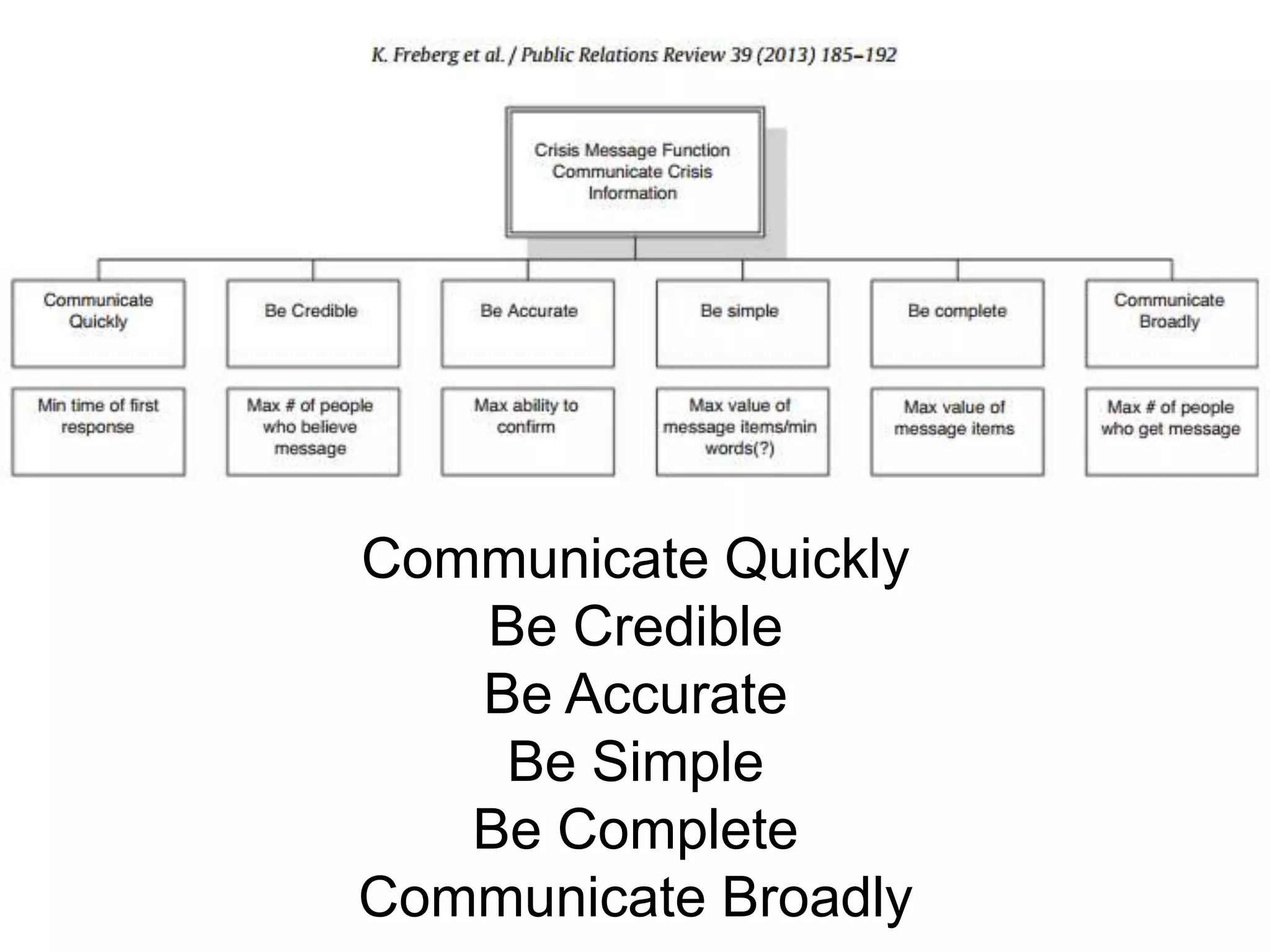
Communicate Quickly
Be Credible
Be Accurate
Be Simple
Be Complete
Communicate Broadly
WHAT CONSTITUTES A
―GOOD‖ CRISIS
MESSAGE?
Previous research has shown that crisis and
emergency messages are most effective when they
 feature a personal touch (i.e., personalized
messages)
 feature efficacy (i.e., providing individuals with
action steps to take).
Emergency messages ought to
1. Explain the event
2. Identify likely consequences and outcomes
3. Explain who is in charge and what they are doing
to mitigate harm
4. Explain what people can do to protect themselves
BEST PRACTICES FOR
CRISIS
COMMUNICATORS
 Integrate multimedia and links into
updates: Individuals want not only textual
information appearing in social media
updates related to a crisis, but also a visual
context of the information or a reference to
another credible source.
 Proper use of hashtags and tagged
keywords: Organizations and agencies
need to be strategic in monitoring and
assigning hashtags for specific events so
that others may monitor, follow, and respond.
BEST PRACTICES FOR
CRISIS
COMMUNICATORS
 Balance between official and
conversational updates: Most of the
updates collected from Social Mention
focused on addressing breaking news about
Hurricane Irene, but were framed to be more
conversational than official in tone
compared to traditional media. The more
conversational updates were more
successful than those in an official tone of
voice.
MORE RESOURCES ON
SOCIAL MEDIA AND CRISIS
COMMUNICATIONS
Idisaster 2.0: http://idisaster.wordpress.com/
Hootsuite: Social Media and Crisis Communications, FDR
Style: http://blog.hootsuite.com/lessons-crisis-
communications-fdr/
Sparkcentral Guest Blog: Crisis Management with Social
Media: http://usefulsocialmedia.com/reputation/sparkcentral-
guest-blog-crisis-management-social-media
4 Golden Rules for Tweeting During a Crisis:
http://socialmediatoday.com/howveryheather/1412701/4-
golden-rules-tweeting-during-crisis
Managing A Brand‘s Social Presence During Crisis:
http://www.linkedin.com/today/post/article/20130418211506-
8628736-managing-a-brand-s-social-presence-during-crisis

#Manship4002 Ethics and Crisis Communications via Social Media - Lecture 14

  • 1.
  • 2.
    WHAT IS ACRISIS? • Crisis = significant, disruptive event that often features a rapid onset, and can produce negative consequences for an organization‘s financial health and reputation.
  • 3.
    EXAMPLES OF CRISES Natural disasters (public sector organizations should demonstrate responsibility for safety of citizens)  workplace accidents, violence  technical errors  rumors
  • 4.
    SOCIAL MEDIA FOR CRISISMANAGEMENT • Organizations use social media to proactively monitor and prepare for potential crisis • Requires active listening, social media monitoring • Organizations can use social media to provide up- to-date information during a crisis event •24 hour updates • Social media messages enable reputation managers to reach key demographics quickly and efficiently during a crisis event • Social media, used correctly, can establish positive credibility and reputation for a brand
  • 5.
    REPUTATION ―the collective representationof multiple constituencies‘ images of a company, built up over time and based on a company‘s identity programs, its performance, and how constituencies have perceived its behavior‖  consumer sales (private sector)  perceived product quality  credibility (public sector)  Companies that have an established and positive reputation are more likely to recover quickly after a major crisis (Ulmer, 2001).
  • 6.
    REPUTATION A corporate reputationis based on four foundations 1. Reliability 2. Responsibility 3. Credibility 4. Trustworthiness (Fombrun, 1996).
  • 7.
    FORBES: ―In life, andin business, reputation is everything. That said, reputation is very fragile and it only takes one mistake to cause irreparable damage to your company‘s image. This is especially true in the digital world where radical transparency and high customer expectations reign supreme. Ignoring strong public digital voices isn‘t an option any more.‖
  • 8.
    1. Listen andBe Present: Not having a presence on social communities can reflect badly on your brand. Listen and respond – even if just with a link to a website or form for customer feedback. 2. Set The Right Expectations: Make a plan for how quickly people should expect your response – 5 hrs? 24hrs? 48hrs? 3. Be Transparent: DON‘T erase negative posts, ever. DON‘T try to cover up social media mistakes. Customers don‘t expect you and your teams to be perfect, just transparent and honest. They expect you treat them like family… 4. Respond Thoughtfully: show you care; ―of those customers who received a reply in response to their negative review 33% turned around and posted a positive review, and 34% deleted their original negative review.‖
  • 9.
    5. Never Loseyour Cool: never be rude or attack customers in social forms – unacceptable, and will come back to bite your A*$! 6. Have a crisis management team (from PR, HR, legal, marketing…) 7. Manage access to your social media accounts carefully 8. Post moderation guidelines: “you can also post your own moderation guidelines on your social media pages to make it obvious what behavior will or will not be tolerated within your social communities. Being up-front about your ―house rules‖ makes it simpler to take down offensive posts by referring to your rules and pointing out how they were violated.‖ 9. Hire experienced community managers
  • 11.
    WHAT IS ABRAND‘S RESPONSIBILITY ON TWITTER? “To respond.” - Conversocial CEO Joshua March [a platform that enables brands to manage interactions and increase engagement with customers in social media] Many brands, however, don‘t respond to customer service complaints on Twitter. Many of these customer complains are direct queries (48%), not simply negative comments (9%), so they deserve responses.
  • 12.
  • 13.
    CONVERSOCIAL CEO JOSHUA MARCH ―There‘sa more established model coming up, which is the ‗social media customer service team‘. Big brands need to have 50-60 customer service staff trained to use social media, as well as systems to monitor actions and keep up with the volume.‖
  • 14.
    ―While having followersand getting hundreds of retweets is great, brands should start paying attention to the quality of their engagement. Companies like Conversocial are helping to provide the tools to do this– other similar companies include Sprout Social and TwentyFeet. The bottom line is it‘s not about quantity anymore — we‘ve confirmed that there are a lot of people on the Internet and they‘re making a lot of noise. It‘s now more than ever about the quality of
  • 15.
    • Social mediahave transformed how crisis communicators reach their audiences • Social media platforms and messages add to challenges involved in maintaining the reputation of brands and corporations • Social media can help people feel they have more control over a crisis, and feel more connected to the community during the crisis
  • 16.
    INDIVIDUAL EMPOWERMENT DURING CRISIS Using socialmedia, individuals can contribute directly to media by providing eyewitness perspectives through video, photos, or texted accounts of an event, often bypassing the professional reporters on the scene, and providing unfiltered views of what is happening in the world. 9/11 Hurricane Katrina 2007 Virginia Tech shootings
  • 17.
    PEOPLE USE SOCIAL MEDIADURING CRISES  Community members who experienced the 2007 southern California wildfires sought information and used social media to contact friends and family.  Many people saw Tweets about TVA ash spill crisis before they received traditional media updates.  Risks for organizations that provide inaccurate information to stakeholders in a time of crisis
  • 18.
    HURRICANE IRENE LESSONS  Misinformationspread on Twitter about where to find food and shelter before the storm caused fear and confusion  Crisis communicators should monitor their social media accounts to ensure that erroneous information is not provided via their accounts or by individuals commenting on their organization‘s social media posts.  Use crowdsourcing, or the power to ask individuals to help contribute and create information
  • 19.
    RESEARCH: Social mention (www.socialmention.com)was used to collect updates appearing on social media platforms from August 22, 2011 to September 1, 2011 using the search terms ―hurricane irene,‖ ―hurricane irene safety,‖ ―hurricane irene mold,‖ and ―hurricane irene food safety.‖ The social media updates collected about Hurricane Irene came from multiple sources such as Twitter, Facebook, Digg, YouTube, Yahoo! News, Google News, Reddit, and Flickr. The most frequently used social media platform was Digg (N = 295) followed by Twitter (N = 231) and then
  • 20.
    FINDINGS ―Hashtags are usefulto incorporate strategically into a crisis communications plan‖  To monitor what others are saying  To ensure those impacted in the crisis are able to follow what others are reporting The improper use or improper dissemination of hashtags may have impacted the wider dissemination of what could have been very high scoring messages. Top social media updates on Social Mention had links to more information
  • 21.
    Communicate Quickly Be Credible BeAccurate Be Simple Be Complete Communicate Broadly
  • 22.
    WHAT CONSTITUTES A ―GOOD‖CRISIS MESSAGE? Previous research has shown that crisis and emergency messages are most effective when they  feature a personal touch (i.e., personalized messages)  feature efficacy (i.e., providing individuals with action steps to take). Emergency messages ought to 1. Explain the event 2. Identify likely consequences and outcomes 3. Explain who is in charge and what they are doing to mitigate harm 4. Explain what people can do to protect themselves
  • 23.
    BEST PRACTICES FOR CRISIS COMMUNICATORS Integrate multimedia and links into updates: Individuals want not only textual information appearing in social media updates related to a crisis, but also a visual context of the information or a reference to another credible source.  Proper use of hashtags and tagged keywords: Organizations and agencies need to be strategic in monitoring and assigning hashtags for specific events so that others may monitor, follow, and respond.
  • 24.
    BEST PRACTICES FOR CRISIS COMMUNICATORS Balance between official and conversational updates: Most of the updates collected from Social Mention focused on addressing breaking news about Hurricane Irene, but were framed to be more conversational than official in tone compared to traditional media. The more conversational updates were more successful than those in an official tone of voice.
  • 25.
    MORE RESOURCES ON SOCIALMEDIA AND CRISIS COMMUNICATIONS Idisaster 2.0: http://idisaster.wordpress.com/ Hootsuite: Social Media and Crisis Communications, FDR Style: http://blog.hootsuite.com/lessons-crisis- communications-fdr/ Sparkcentral Guest Blog: Crisis Management with Social Media: http://usefulsocialmedia.com/reputation/sparkcentral- guest-blog-crisis-management-social-media 4 Golden Rules for Tweeting During a Crisis: http://socialmediatoday.com/howveryheather/1412701/4- golden-rules-tweeting-during-crisis Managing A Brand‘s Social Presence During Crisis: http://www.linkedin.com/today/post/article/20130418211506- 8628736-managing-a-brand-s-social-presence-during-crisis

Editor's Notes

  • #9 - Most of the brand disasters could have been prevented just by picking up the early chatter and being prepared to address it before it escalates.