A D e c a d e o f L e s s o n s
GUIDE
DISASTER RESOURCE15TH EDITION
75
Q: Mr. Schmidt, how do you define social
media and is social media going to have
a lasting impact on crisis management
and related fields?
A. The term social media stands for
online social networking services such
as Facebook, Twitter, and YouTube, to
name a few well known ones. Social
media offers new ways to communi-
cate with others and build relationships
without ever having to physically meet.
That applies to personal as well as busi-
ness relationships, including those that
are forged in preparation for or as a
result of a natural disaster, an epidemic
outbreak, or an industrial accident.
No doubt about it, social media is here
to stay. This year smart phones will likely
take over as tech device number one for
social sharing, which means more and
more people will use social media on the
go. Professionals in business continuity
planning, crisis communication, emer-
gency management, and related fields will
ultimately follow the users and embrace
social media’s capabilities including open
communication and crowdsourcing in
order to engage stakeholders.
Q: For years, you have spoken about
the need to systematically monitor
the Internet due to the risks posed by
instant, global and uncensored online
communication. How has the rise of
social media affected this need to
monitor online content?
A. The need to monitor online and
especially social media content has dra-
matically risen over the past ten years
and will continue to increase. My con-
cerns in regard to the risks posed by
social media are closely related to two
challenges. First, we must always be
aware of the potentially damaging char-
acteristics of social media. And second,
in order to employ social media effec-
tively, crisis managers must develop and
implement social media strategies that
are tailored to the specific organization.
Q: What aspects of social media are you
particularly concerned about?
A. You mentioned it in your previous
question. Social media is instant, global
and uncensored. Each of these charac-
teristics has tremendous benefits when
it comes to crisis management, but
there are drawbacks, too. For example,
a large and steadily growing num-
ber of stakeholders not only consume
crisis related information online, but
they also engage in citizen journalism.
That means they generate their own
subjective and sometimes deliberately
inaccurate or misleading online content
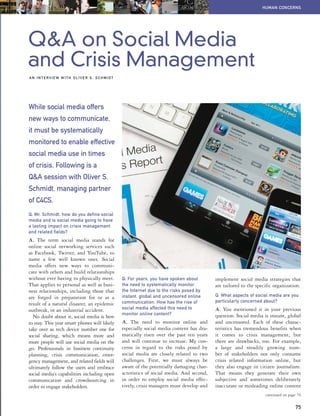
Q&A on Social Media
and Crisis Management
While social media offers
new ways to communicate,
it must be systematically
monitored to enable effective
social media use in times
of crisis. Following is a
Q&A session with Oliver S.
Schmidt, managing partner
of C4CS.
A n in terv iew with oliver s. schmidt
continued on page 76
Human Concerns
76 DISASTER RESOURCE GUIDe
continued from page 75
which may be distributed globally in a
matter of seconds. Unfortunately, tradi-
tional mass media are compounding the
problem because reporters are scanning
social media for story ideas as well as
crisis related information and may end
up publishing false information that can
trigger or exacerbate crises.
Another social media trait that can
hinder an effective crisis response and
create long term reputational issues is
the fact that while social media content
can easily be created and syndicated,
it does not automatically vanish after
a certain period of time. Once it has
been published, inaccurate information,
including rumors and false accusations,
can spread rapidly, for instance via RSS
and “retweeting”. And once mass infor-
mation sharing via social media has
begun, it cannot be stopped or undone
unless the negative content is removed
by each individual user or, as almost
never happens, by the particular social
networking service. Incorrect and dam-
aging social media content will hence
continue to spread and is unfortunately
going to be available and searchable
online indefinitely.
Q: What goes into the development of a
social media strategy so it fits the needs
of the organization?
A. Those involved in crisis manage-
ment and related fields must first
identify which social media tools the
organization’s stakeholders, includ-
ing its employees, are using. Knowing
what is happening online, establish-
ing a Social Media Policy, identifying
and engaging relevant influencers who
double as information hubs, and creat-
ing a strong social media following
across various stakeholder groups are
essential steps on the way to effective
social media use.
Furthermore, realistic goal setting,
senior management support, qualified
internal and external project manage-
ment, and a holistic approach to crisis
management that incorporates functional
areas such as operations, business continu-
ity planning, corporate communication,
IT, etc. are required. Depending on the
needs and priorities of these functional
areas, technical aspects, questions regard-
ing stakeholder management, legal
issues, etc. must be discussed and flow
into a social media strategy that serves as
an integral part of the crisis management
strategy and is linked to the organiza-
tion’s strategic goals.
Q: And finally, what must an organization
do in order to use social media effectively
once a crisis occurs?
A. While the specifics always depend on
the particular organization and a thor-
ough situational assessment, an effective
crisis response will ideally come down to
executing a crisis management strategy
that includes a comprehensive social
media component.
It is important to remember that
stakeholder engagement via social
media must be geared toward build-
ing social capital and stakeholder trust
well before a crisis occurs. This should
be done through continuously reaching
out to and fostering strong relationships
across various stakeholder groups so
that in the event of a crisis the affected
company, government agency or non-
profit organization is viewed not as an
adversary, but as a trusted partner its
stakeholders turn to in order to receive
crisis related information and support.
About the expert
Oliver S. Schmidt is the Managing Partner
of C4CS® (www.c4cs.com), a consulting firm
headquartered in Pittsburgh, Pennsylvania,
which has worked with client partners in the
Americas, Asia and Europe. For more informa-
tion contact him via email: schmidt@c4cs.com.
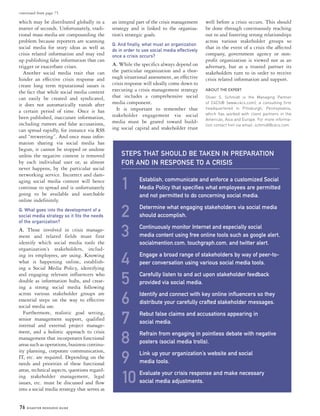
1	Establish, communicate and enforce a customized Social
Media Policy that specifies what employees are permitted
and not permitted to do concerning social media.
2	Determine what engaging stakeholders via social media
should accomplish.
3	Continuously monitor Internet and especially social
media content using free online tools such as google alert,
socialmention.com, touchgraph.com, and twitter alert.
4	Engage a broad range of stakeholders by way of peer-to-
peer conversation using various social media tools.
5	Carefully listen to and act upon stakeholder feedback
provided via social media.
6	Identify and connect with key online influencers so they
distribute your carefully crafted stakeholder messages.
7	Rebut false claims and accusations appearing in
social media.
8	Refrain from engaging in pointless debate with negative
posters (social media trolls).
9	Link up your organization’s website and social
media tools.
10	Evaluate your crisis response and make necessary
social media adjustments.
STEPS THAT SHOULD BE TAKEN IN PREPARATION
FOR AND IN RESPONSE TO A CRISIS

Social Media & Crisis Management--C4CS--Schmidt--DRG Interview

  • 1.
    A D ec a d e o f L e s s o n s GUIDE DISASTER RESOURCE15TH EDITION
  • 2.
    75 Q: Mr. Schmidt,how do you define social media and is social media going to have a lasting impact on crisis management and related fields? A. The term social media stands for online social networking services such as Facebook, Twitter, and YouTube, to name a few well known ones. Social media offers new ways to communi- cate with others and build relationships without ever having to physically meet. That applies to personal as well as busi- ness relationships, including those that are forged in preparation for or as a result of a natural disaster, an epidemic outbreak, or an industrial accident. No doubt about it, social media is here to stay. This year smart phones will likely take over as tech device number one for social sharing, which means more and more people will use social media on the go. Professionals in business continuity planning, crisis communication, emer- gency management, and related fields will ultimately follow the users and embrace social media’s capabilities including open communication and crowdsourcing in order to engage stakeholders. Q: For years, you have spoken about the need to systematically monitor the Internet due to the risks posed by instant, global and uncensored online communication. How has the rise of social media affected this need to monitor online content? A. The need to monitor online and especially social media content has dra- matically risen over the past ten years and will continue to increase. My con- cerns in regard to the risks posed by social media are closely related to two challenges. First, we must always be aware of the potentially damaging char- acteristics of social media. And second, in order to employ social media effec- tively, crisis managers must develop and implement social media strategies that are tailored to the specific organization. Q: What aspects of social media are you particularly concerned about? A. You mentioned it in your previous question. Social media is instant, global and uncensored. Each of these charac- teristics has tremendous benefits when it comes to crisis management, but there are drawbacks, too. For example, a large and steadily growing num- ber of stakeholders not only consume crisis related information online, but they also engage in citizen journalism. That means they generate their own subjective and sometimes deliberately inaccurate or misleading online content Q&A on Social Media and Crisis Management While social media offers new ways to communicate, it must be systematically monitored to enable effective social media use in times of crisis. Following is a Q&A session with Oliver S. Schmidt, managing partner of C4CS. A n in terv iew with oliver s. schmidt continued on page 76 Human Concerns
  • 3.
    76 DISASTER RESOURCEGUIDe continued from page 75 which may be distributed globally in a matter of seconds. Unfortunately, tradi- tional mass media are compounding the problem because reporters are scanning social media for story ideas as well as crisis related information and may end up publishing false information that can trigger or exacerbate crises. Another social media trait that can hinder an effective crisis response and create long term reputational issues is the fact that while social media content can easily be created and syndicated, it does not automatically vanish after a certain period of time. Once it has been published, inaccurate information, including rumors and false accusations, can spread rapidly, for instance via RSS and “retweeting”. And once mass infor- mation sharing via social media has begun, it cannot be stopped or undone unless the negative content is removed by each individual user or, as almost never happens, by the particular social networking service. Incorrect and dam- aging social media content will hence continue to spread and is unfortunately going to be available and searchable online indefinitely. Q: What goes into the development of a social media strategy so it fits the needs of the organization? A. Those involved in crisis manage- ment and related fields must first identify which social media tools the organization’s stakeholders, includ- ing its employees, are using. Knowing what is happening online, establish- ing a Social Media Policy, identifying and engaging relevant influencers who double as information hubs, and creat- ing a strong social media following across various stakeholder groups are essential steps on the way to effective social media use. Furthermore, realistic goal setting, senior management support, qualified internal and external project manage- ment, and a holistic approach to crisis management that incorporates functional areas such as operations, business continu- ity planning, corporate communication, IT, etc. are required. Depending on the needs and priorities of these functional areas, technical aspects, questions regard- ing stakeholder management, legal issues, etc. must be discussed and flow into a social media strategy that serves as an integral part of the crisis management strategy and is linked to the organiza- tion’s strategic goals. Q: And finally, what must an organization do in order to use social media effectively once a crisis occurs? A. While the specifics always depend on the particular organization and a thor- ough situational assessment, an effective crisis response will ideally come down to executing a crisis management strategy that includes a comprehensive social media component. It is important to remember that stakeholder engagement via social media must be geared toward build- ing social capital and stakeholder trust well before a crisis occurs. This should be done through continuously reaching out to and fostering strong relationships across various stakeholder groups so that in the event of a crisis the affected company, government agency or non- profit organization is viewed not as an adversary, but as a trusted partner its stakeholders turn to in order to receive crisis related information and support. About the expert Oliver S. Schmidt is the Managing Partner of C4CS® (www.c4cs.com), a consulting firm headquartered in Pittsburgh, Pennsylvania, which has worked with client partners in the Americas, Asia and Europe. For more informa- tion contact him via email: schmidt@c4cs.com. 1 Establish, communicate and enforce a customized Social Media Policy that specifies what employees are permitted and not permitted to do concerning social media. 2 Determine what engaging stakeholders via social media should accomplish. 3 Continuously monitor Internet and especially social media content using free online tools such as google alert, socialmention.com, touchgraph.com, and twitter alert. 4 Engage a broad range of stakeholders by way of peer-to- peer conversation using various social media tools. 5 Carefully listen to and act upon stakeholder feedback provided via social media. 6 Identify and connect with key online influencers so they distribute your carefully crafted stakeholder messages. 7 Rebut false claims and accusations appearing in social media. 8 Refrain from engaging in pointless debate with negative posters (social media trolls). 9 Link up your organization’s website and social media tools. 10 Evaluate your crisis response and make necessary social media adjustments. STEPS THAT SHOULD BE TAKEN IN PREPARATION FOR AND IN RESPONSE TO A CRISIS