Theories of Ethics: Consequentialism,
Utilitarianism, Teleological, Deontological;
Kohlberg Six Stage Moral Development
UNIT 4 MODULE 1 (PART II)
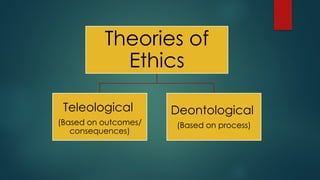
Theories of
Ethics
Teleological
(Based on outcomes/
consequences)
Deontological
(Based on process)
Teleological Theory of Ethics
 The Greek word "telos," which signifies an end, is where the word "teleological"
originates.
 Teleological theories state that an action's is entirely dependent on its outcomes, not on any
aspect of the action itself.
 Teleological ethics, also referred to as consequentialism, assesses the morality of a deed by
considering its results or ramifications.
 There are few types of this theory:
 Eudaimonism- This theory holds that a behaviour is morally right if it makes people
happy.
 Ethical Egoism- A decision that, from an individual's perspective, maximises self-
interest—sometimes even at the expense of others—is referred to as ethical egoism.
 Utilitarianism-According to this concept, a course of action is morally right if it
maximises satisfaction for all parties involved.
Key Points of Teleological Ethics
1. Focus on Outcomes: Actions are deemed right or wrong based on their results. Good
consequences make actions morally right, while bad consequences make them morally wrong.
2. Utilitarianism: The most prominent teleological theory, founded by Jeremy Bentham and John
Stuart Mill, which holds that the best action is the one that maximizes overall happiness or
utility.
3. Evaluation of Consequences: Decision-makers must consider the potential outcomes of their
actions and choose the one that produces the greatest net benefit or the least harm.
4. Cost-Benefit Analysis: Often involves weighing the positive and negative consequences to
determine the most ethical course of action.
Deontological Theory of Ethics
 The Greek word "deon," which meaning duty, is the source of the word "deontological."
 The core idea in deontological theories is duty or obligation.
 Deontological views hold that some behaviours are morally correct because they follow the
norms that govern them, not because they benefit oneself or others.
 Social Contract Theories-This idea states that a behaviour is morally right if it
complies with established standards, agreements, or laws that protect the general
welfare of the contractual parties.
 Social Justice Theories- This idea holds that if a behaviour reflects distributive,
retributive, and compensatory aspects of social justice, it is ethical.
 Positive And Negative Rights Theories- Positive rights theories hold that an action is
morally justified if it grants a person the necessities of life, such as the right to superior
healthcare, education, and other necessities.
Key Points of Deontological Ethics:
1. Rule-Based Morality: Actions are judged based on their adherence to rules, principles, or
duties. It emphasizes following ethical principles regardless of the outcomes.
2. Duty and Obligation: Moral duties and obligations are central to deontological ethics.
Individuals must act according to their moral duties.
3. Intrinsic Rightness: Certain actions are inherently right or wrong, independent of their
consequences. Lying, for instance, is considered wrong even if it produces good outcomes.
4. Universalizability: A key concept in Kantian ethics is that actions should be
universalizable, meaning one should act only according to maxims that can be consistently
applied as universal laws.
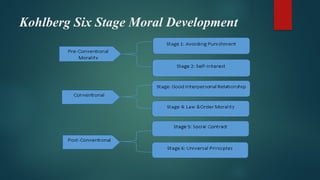
Kohlberg Six Stage Moral Development
Significance of Kohlberg Six Stage
Moral Development
 Understanding Moral Development
 Educational Applications
 Parental Guidance
 Counseling and Psychotherapy
 Corporate Ethics
 Criminal Justice
 Policy Making
 Cultural Sensitivity and Diversity
 Personal Growth
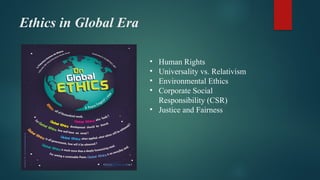
Ethics in Global Era
• Human Rights
• Universality vs. Relativism
• Environmental Ethics
• Corporate Social
Responsibility (CSR)
• Justice and Fairness
Ethics in Global Era
• Global Health Ethics
• Peace and Conflict
Resolution
• Technological Ethics
• Migration and Refugee
Ethics
• Intercultural Dialogue and
Respect
Significance of Global Ethics
Ensures Fair Treatment
Promotes Global Cooperation
Guides Global Policy
Encourages Sustainable Development
Key Points of Global Ethics:
1. Universal Values:
2. Interconnectedness
3. Global Justice
4. Environmental Ethics
5. Human Rights
6. Global Governance

Business ethics mba management course lu

  • 1.
    Theories of Ethics:Consequentialism, Utilitarianism, Teleological, Deontological; Kohlberg Six Stage Moral Development UNIT 4 MODULE 1 (PART II)
  • 2.
    Theories of Ethics Teleological (Based onoutcomes/ consequences) Deontological (Based on process)
  • 3.
    Teleological Theory ofEthics  The Greek word "telos," which signifies an end, is where the word "teleological" originates.  Teleological theories state that an action's is entirely dependent on its outcomes, not on any aspect of the action itself.  Teleological ethics, also referred to as consequentialism, assesses the morality of a deed by considering its results or ramifications.  There are few types of this theory:  Eudaimonism- This theory holds that a behaviour is morally right if it makes people happy.  Ethical Egoism- A decision that, from an individual's perspective, maximises self- interest—sometimes even at the expense of others—is referred to as ethical egoism.  Utilitarianism-According to this concept, a course of action is morally right if it maximises satisfaction for all parties involved.
  • 4.
    Key Points ofTeleological Ethics 1. Focus on Outcomes: Actions are deemed right or wrong based on their results. Good consequences make actions morally right, while bad consequences make them morally wrong. 2. Utilitarianism: The most prominent teleological theory, founded by Jeremy Bentham and John Stuart Mill, which holds that the best action is the one that maximizes overall happiness or utility. 3. Evaluation of Consequences: Decision-makers must consider the potential outcomes of their actions and choose the one that produces the greatest net benefit or the least harm. 4. Cost-Benefit Analysis: Often involves weighing the positive and negative consequences to determine the most ethical course of action.
  • 5.
    Deontological Theory ofEthics  The Greek word "deon," which meaning duty, is the source of the word "deontological."  The core idea in deontological theories is duty or obligation.  Deontological views hold that some behaviours are morally correct because they follow the norms that govern them, not because they benefit oneself or others.  Social Contract Theories-This idea states that a behaviour is morally right if it complies with established standards, agreements, or laws that protect the general welfare of the contractual parties.  Social Justice Theories- This idea holds that if a behaviour reflects distributive, retributive, and compensatory aspects of social justice, it is ethical.  Positive And Negative Rights Theories- Positive rights theories hold that an action is morally justified if it grants a person the necessities of life, such as the right to superior healthcare, education, and other necessities.
  • 6.
    Key Points ofDeontological Ethics: 1. Rule-Based Morality: Actions are judged based on their adherence to rules, principles, or duties. It emphasizes following ethical principles regardless of the outcomes. 2. Duty and Obligation: Moral duties and obligations are central to deontological ethics. Individuals must act according to their moral duties. 3. Intrinsic Rightness: Certain actions are inherently right or wrong, independent of their consequences. Lying, for instance, is considered wrong even if it produces good outcomes. 4. Universalizability: A key concept in Kantian ethics is that actions should be universalizable, meaning one should act only according to maxims that can be consistently applied as universal laws.
  • 7.
    Kohlberg Six StageMoral Development
  • 8.
    Significance of KohlbergSix Stage Moral Development  Understanding Moral Development  Educational Applications  Parental Guidance  Counseling and Psychotherapy  Corporate Ethics  Criminal Justice  Policy Making  Cultural Sensitivity and Diversity  Personal Growth
  • 9.
  • 10.
    Ethics in GlobalEra • Human Rights • Universality vs. Relativism • Environmental Ethics • Corporate Social Responsibility (CSR) • Justice and Fairness
  • 11.
    Ethics in GlobalEra • Global Health Ethics • Peace and Conflict Resolution • Technological Ethics • Migration and Refugee Ethics • Intercultural Dialogue and Respect
  • 12.
    Significance of GlobalEthics Ensures Fair Treatment Promotes Global Cooperation Guides Global Policy Encourages Sustainable Development
  • 13.
    Key Points ofGlobal Ethics: 1. Universal Values: 2. Interconnectedness 3. Global Justice 4. Environmental Ethics 5. Human Rights 6. Global Governance