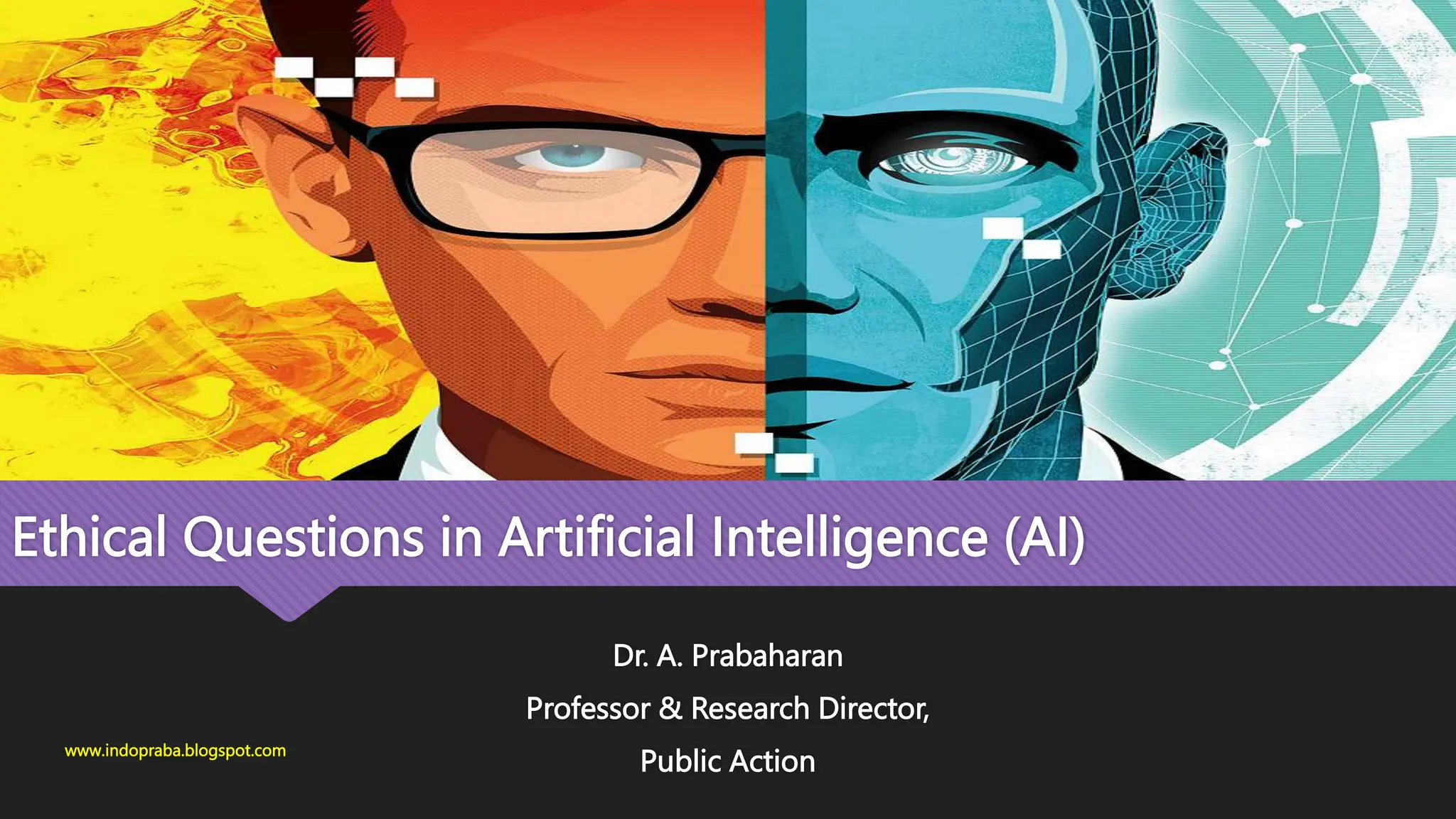
Ethical Questions in Artificial Intelligence (AI)
Dr. A. Prabaharan
Professor & Research Director,
Public Action
www.indopraba.blogspot.com
AI & Ethical Questions
Ethical questions in AI
encompass a wide range
of complex issues that
arise from the
development, deployment,
and impact of AI
technologies.
Here are some key ethical
questions in AI
www.indopraba.blogspot.com
Bias and Fairness
How can we ensure that AI systems are
free from biases and make fair and
equitable decisions, particularly in
sensitive domains such as hiring,
lending, and criminal justice?
www.indopraba.blogspot.com
Transparency and Accountability
 How can we ensure transparency and
accountability in AI decision-making
processes, especially in cases where AI
systems operate as black boxes, making it
difficult to understand their reasoning?
www.indopraba.blogspot.com
Privacy and Data Protection
 How can we protect individuals' privacy
rights and personal data in the context of
AI applications that rely on vast amounts
of data, such as surveillance systems,
recommendation algorithms, and
personalized services?
www.indopraba.blogspot.com
Autonomy and Human Agency
How can we preserve individuals'
autonomy and decision-making
authority in AI-driven
environments, ensuring that AI
technologies empower rather than
diminish human agency?
www.indopraba.blogspot.com
Safety and Risk Management
How can we manage the safety and
security risks associated with AI
technologies, including the potential for
accidents, errors, and unintended
consequences, while promoting innovation
and progress?
www.indopraba.blogspot.com
Accountability and Legal Liability
 How can we determine accountability and
legal liability for AI-related harms,
particularly in cases where responsibility is
diffused across multiple stakeholders,
including AI developers, providers, and
users?
www.indopraba.blogspot.com
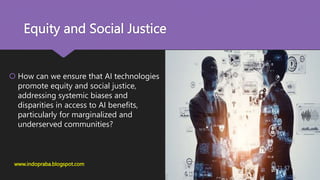
Equity and Social Justice
 How can we ensure that AI technologies
promote equity and social justice,
addressing systemic biases and
disparities in access to AI benefits,
particularly for marginalized and
underserved communities?
www.indopraba.blogspot.com
Human-Centric Design and Value Alignment
How can we ensure that AI
technologies align with human
values and preferences,
incorporating ethical considerations,
stakeholder input, and societal
goals into AI design and
deployment processes?
www.indopraba.blogspot.com
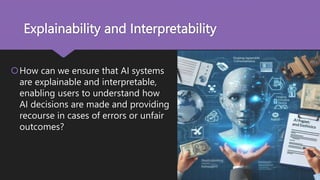
Explainability and Interpretability
How can we ensure that AI systems
are explainable and interpretable,
enabling users to understand how
AI decisions are made and providing
recourse in cases of errors or unfair
outcomes?
Global Governance and International Cooperation
 How can we develop global
governance mechanisms and promote
international cooperation to address
ethical challenges in AI, ensuring that
AI technologies are developed and
deployed in a manner that respects
human rights, promotes global peace,
and fosters sustainable development?
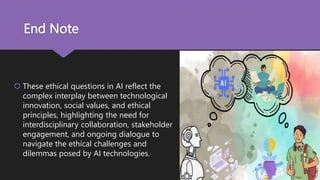
End Note
 These ethical questions in AI reflect the
complex interplay between technological
innovation, social values, and ethical
principles, highlighting the need for
interdisciplinary collaboration, stakeholder
engagement, and ongoing dialogue to
navigate the ethical challenges and
dilemmas posed by AI technologies.
www.indopraba.blogspot.com

Ethical Questions in Artificial Intelligence (AI).pptx

  • 1.
    Ethical Questions inArtificial Intelligence (AI) Dr. A. Prabaharan Professor & Research Director, Public Action www.indopraba.blogspot.com
  • 2.
    AI & EthicalQuestions Ethical questions in AI encompass a wide range of complex issues that arise from the development, deployment, and impact of AI technologies. Here are some key ethical questions in AI www.indopraba.blogspot.com
  • 3.
    Bias and Fairness Howcan we ensure that AI systems are free from biases and make fair and equitable decisions, particularly in sensitive domains such as hiring, lending, and criminal justice? www.indopraba.blogspot.com
  • 4.
    Transparency and Accountability How can we ensure transparency and accountability in AI decision-making processes, especially in cases where AI systems operate as black boxes, making it difficult to understand their reasoning? www.indopraba.blogspot.com
  • 5.
    Privacy and DataProtection  How can we protect individuals' privacy rights and personal data in the context of AI applications that rely on vast amounts of data, such as surveillance systems, recommendation algorithms, and personalized services? www.indopraba.blogspot.com
  • 6.
    Autonomy and HumanAgency How can we preserve individuals' autonomy and decision-making authority in AI-driven environments, ensuring that AI technologies empower rather than diminish human agency? www.indopraba.blogspot.com
  • 7.
    Safety and RiskManagement How can we manage the safety and security risks associated with AI technologies, including the potential for accidents, errors, and unintended consequences, while promoting innovation and progress? www.indopraba.blogspot.com
  • 8.
    Accountability and LegalLiability  How can we determine accountability and legal liability for AI-related harms, particularly in cases where responsibility is diffused across multiple stakeholders, including AI developers, providers, and users? www.indopraba.blogspot.com
  • 9.
    Equity and SocialJustice  How can we ensure that AI technologies promote equity and social justice, addressing systemic biases and disparities in access to AI benefits, particularly for marginalized and underserved communities? www.indopraba.blogspot.com
  • 10.
    Human-Centric Design andValue Alignment How can we ensure that AI technologies align with human values and preferences, incorporating ethical considerations, stakeholder input, and societal goals into AI design and deployment processes? www.indopraba.blogspot.com
  • 11.
    Explainability and Interpretability Howcan we ensure that AI systems are explainable and interpretable, enabling users to understand how AI decisions are made and providing recourse in cases of errors or unfair outcomes?
  • 12.
    Global Governance andInternational Cooperation  How can we develop global governance mechanisms and promote international cooperation to address ethical challenges in AI, ensuring that AI technologies are developed and deployed in a manner that respects human rights, promotes global peace, and fosters sustainable development?
  • 13.
    End Note  Theseethical questions in AI reflect the complex interplay between technological innovation, social values, and ethical principles, highlighting the need for interdisciplinary collaboration, stakeholder engagement, and ongoing dialogue to navigate the ethical challenges and dilemmas posed by AI technologies.
  • 14.