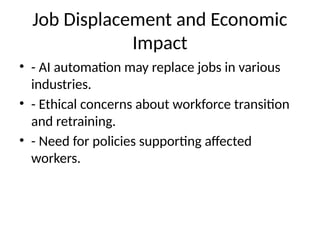
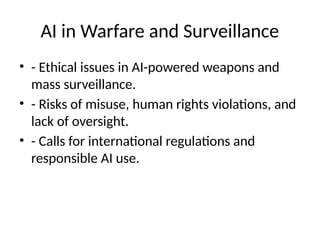
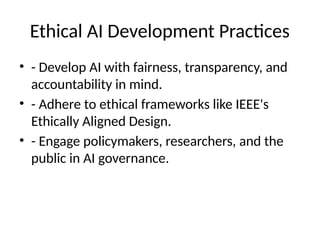
Ethical challenges in the development of artificial intelligence arise from the increasing influence AI systems have on individuals, societies, and global decision-making processes. As AI technologies are designed to learn from vast datasets and make autonomous or semi-autonomous decisions, concerns about bias and fairness become critical, since biased training data or flawed algorithms can reinforce existing social inequalities related to race, gender, economic status, or geography. Transparency and explainability also pose major ethical issues, as many advanced AI models operate as “black boxes,” making it difficult for users and stakeholders to understand how decisions are made, which in turn affects trust, accountability, and the ability to challenge or correct harmful outcomes. Privacy and data protection are equally significant challenges, as AI systems often rely on large amounts of personal and sensitive data, raising risks of surveillance, data misuse, and unauthorized access if strong safeguards are not in place. Additionally, the rapid automation enabled by AI introduces ethical concerns related to job displacement, workforce inequality, and the responsibility of organizations to reskill employees and ensure inclusive economic growth. The potential misuse of AI for malicious purposes, such as deepfakes, autonomous weapons, cyberattacks, and large-scale misinformation, further highlights the need for responsible development and strict regulatory oversight. Moreover, questions of accountability and liability arise when AI systems cause harm, as it is often unclear whether responsibility lies with developers, data providers, users, or the AI system itself. Addressing these ethical challenges requires interdisciplinary collaboration, robust ethical frameworks, transparent governance, and human-centered design principles to ensure that AI development aligns with societal values, protects fundamental rights, and contributes positively to long-term human well-being.
![Ethical Challenges in AI
Development
Jeevaprasath C.
[Date]](https://image.slidesharecdn.com/ethicalchallengesinaidevelopment-260102170757-a10b4001/85/Ethical_Challenges_in_AI_Development-pptx-1-320.jpg)