GOODTOGREATGOODTOGREAT
Chapters 4-6Chapters 4-6
By Jim CollinsBy Jim Collins
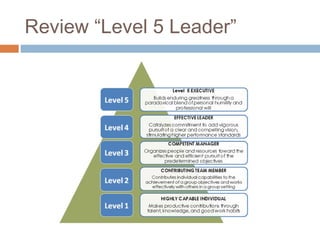
Review “Level 5 Leader”
Interview with Jim Collins:
YouTube Clip
Level 5
Leadership
First Who…
Then What
Confront the
Brutal Facts
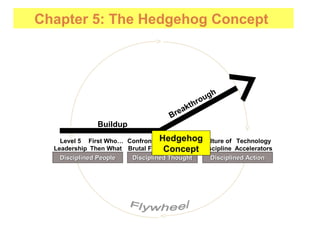
Hedgehog
Concept
Culture of
Discipline
Technology
Accelerators
Disciplined PeopleDisciplined People Disciplined ThoughtDisciplined Thought Disciplined ActionDisciplined Action
Buildup
Breakthrough
Confront the
Brutal Facts
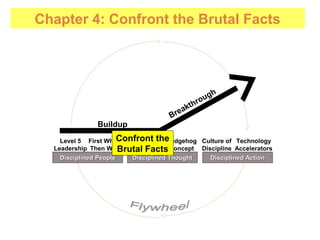
Chapter 4: Confront the Brutal Facts
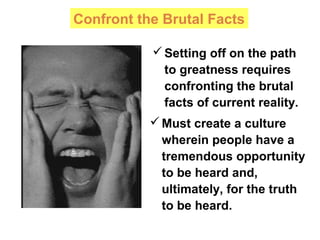
Confront the Brutal Facts
Must create a culture
wherein people have a
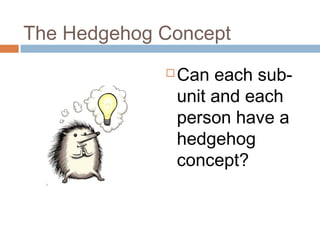
tremendous opportunity
to be heard and,
ultimately, for the truth
to be heard.
Setting off on the path
to greatness requires
confronting the brutal
facts of current reality.
Chap.4: Confront the Brutal FactsChap.4: Confront the Brutal Facts
(Yet never lose faith)
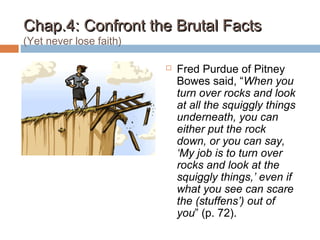
 Fred Purdue of Pitney
Bowes said, “When you
turn over rocks and look
at all the squiggly things
underneath, you can
either put the rock
down, or you can say,
‘My job is to turn over
rocks and look at the
squiggly things,’ even if
what you see can scare
the (stuffens’) out of
you” (p. 72).
Confront the Brutal FactsConfront the Brutal Facts
(Yet never lose faith)(Yet never lose faith)
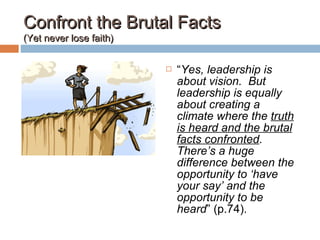
 “Yes, leadership is
about vision. But
leadership is equally
about creating a
climate where the truth
is heard and the brutal
facts confronted.
There’s a huge
difference between the
opportunity to ‘have
your say’ and the
opportunity to be
heard” (p.74).
Confront the Brutal FactsConfront the Brutal Facts
(Yet never lose faith)(Yet never lose faith)
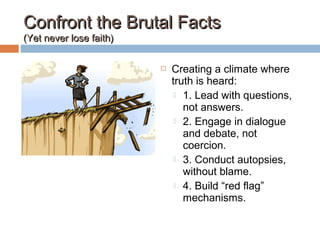
 Creating a climate where
truth is heard:
 1. Lead with questions,
not answers.
 2. Engage in dialogue
and debate, not
coercion.
 3. Conduct autopsies,
without blame.
 4. Build “red flag”
mechanisms.
The Stockdale Paradox
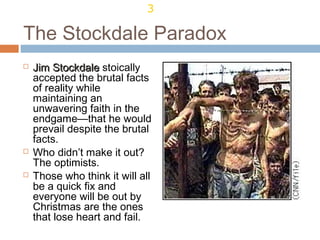
 Jim StockdaleJim Stockdale stoically
accepted the brutal facts
of reality while
maintaining an
unwavering faith in the
endgame—that he would
prevail despite the brutal
facts.
 Who didn’t make it out?
The optimists.
 Those who think it will all
be a quick fix and
everyone will be out by
Christmas are the ones
that lose heart and fail.
3
Remember The StockdaleRemember The Stockdale
ParadoxParadox
 Retain faith that
you will prevail
in the end,
regardless of
the difficulties.
 AND at the
same time
confront the
most brutal facts
of your current
reality, whatever
they might be.
Martin Luther King, Jr.Martin Luther King, Jr.
 Discuss
Do you believe King displayed the
Stockdale paradox mentality
during the Civil Rights
Movement?
Why or why not?
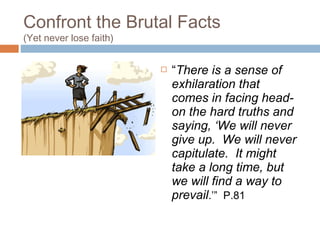
Confront the Brutal Facts
(Yet never lose faith)
 “There is a sense of
exhilaration that
comes in facing head-
on the hard truths and
saying, ‘We will never
give up. We will never
capitulate. It might
take a long time, but
we will find a way to
prevail.’” P.81
Confront the Brutal FactsConfront the Brutal Facts
(Yet never lose faith)(Yet never lose faith)
 What are some of the brutal facts that we must
face?
 Using The Stockdale Paradox phrase a
statement about one of these brutal facts?
 What mills might we need to sell?
 What restaurants might we need to close?
 What “corporate raiders” need to be fought off?
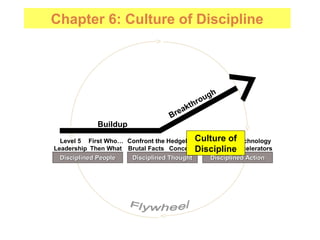
Level 5
Leadership
First Who…
Then What
Confront the
Brutal Facts
Hedgehog
Concept
Culture of
Discipline
Technology
Accelerators
Disciplined PeopleDisciplined People Disciplined ThoughtDisciplined Thought Disciplined ActionDisciplined Action
Buildup
Breakthrough
Hedgehog
Concept
Chapter 5: The Hedgehog Concept
Chap. 5: The Hedgehog ConceptChap. 5: The Hedgehog Concept
 “The fox knows many things,
but the hedgehog knows one
big thing.”
 Foxes pursue many ends at the
same time and see the world in
all its complexity. They are
scattered or diffused, moving
on many levels.
 Hedgehogs simplify a complex
world into a single organizing
idea, a basic principle or
concept that unifies and guides
everything.
 For a hedgehog, anything that
does not somehow relate to the
hedgehog idea holds no
relevance.
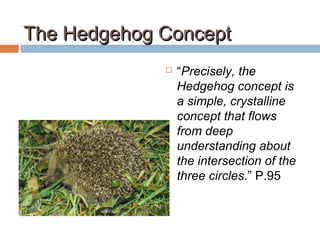
The Hedgehog ConceptThe Hedgehog Concept
 “Precisely, the
Hedgehog concept is
a simple, crystalline
concept that flows
from deep
understanding about
the intersection of the
three circles.” P.95
The Hedgehog ConceptThe Hedgehog Concept
 You can be passionate about all you want, but if
you can’t be the best at it or if it doesn’t make
economic sense, then you might have a lot of fun,
but you won’t get great results.
 If we can’t be the best at it, then why are we
doing it at all?
 A Hedgehog Concept is not a goal to be the best,
a strategy to be the best, an intention to be the
best, a plan to be the best. It is an understanding
of what you can be the best at.
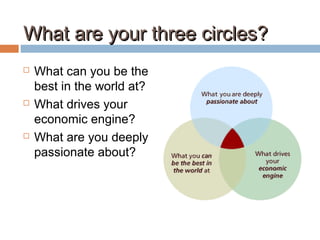
What are your three circles?What are your three circles?
 What can you be the
best in the world at?
 What drives your
economic engine?
 What are you deeply
passionate about?
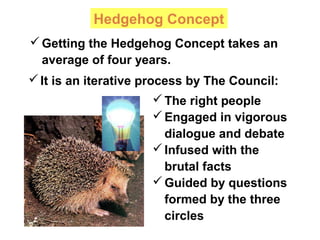
Hedgehog Concept
Getting the Hedgehog Concept takes an
average of four years.
The right people
Engaged in vigorous
dialogue and debate
Infused with the
brutal facts
Guided by questions
formed by the three
circles
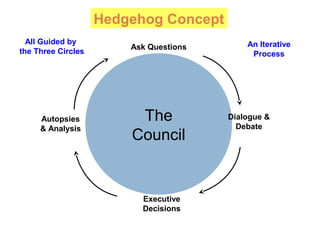
It is an iterative process by The Council:
Hedgehog Concept
The
Council
All Guided by
the Three Circles
Ask Questions
Dialogue &
Debate
Autopsies
& Analysis
Executive
Decisions
An Iterative
Process
The Hedgehog ConceptThe Hedgehog Concept
 At what you can be best in the world. This
standard goes far beyond core competence — just
because you possess a core competence doesn’t
necessarily mean you are the best in the world at
that competence. Conversely, what you can be
best in the world at might not even be something
in which you are currently engaged. The
Hedgehog Concept is not a goal or strategy to be
the best at something; it is an understanding of
what you can be the best at and, almost equally
important, what you cannot be the best at.
The Hedgehog ConceptThe Hedgehog Concept
 What drives your economic engine? To get
insight into the drivers of your economic engine,
search for the one denominator (profit per x, for
example, or cash flow per x) that has the single
greatest impact. If you could pick one and only one
ratio to systematically increase over time to make a
greater impact, what would that ratio be? This
denominator can be subtle, sometimes even
unobvious. The key is to use the denominator to
gain understanding and insight into your economic
model.
The Hedgehog ConceptThe Hedgehog Concept
 What you are deeply passionate about. Good-to-
great companies did not pick a course of action,
then encourage their people to become passionate
about their direction. Rather, those companies
decided to do only those things that they could get
passionate about. They recognized that passion
cannot be manufactured, nor can it be the end
result of a motivation effort. You can only discover
what ignites your passion and the passions of
those around you.
The Hedgehog ConceptThe Hedgehog Concept
 The essence of the process is to
get the right people engaged in
vigorous dialogue and debate, in
fused with the brutal facts and
guided by questions formed by the
three circles. P.114
The Hedgehog ConceptThe Hedgehog Concept
 “Kno w ‘o ne big thing ’ and stick to
it.” P. 119
The Hedgehog Concept
 Which is more important: the
goal to be the best at something,
or realistic understanding of what
you can (and cannot) be the best
at?
The Hedgehog Concept
 Can each sub-
unit and each
person have a
hedgehog
concept?
The Hedgehog Concept
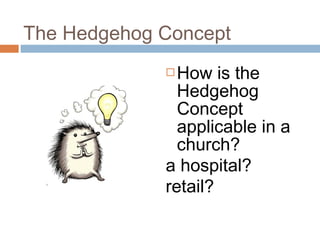
 How is the
Hedgehog
Concept
applicable in a
church?
a hospital?
retail?
Level 5
Leadership
First Who…
Then What
Confront the
Brutal Facts
Hedgehog
Concept
Culture of
Discipline
Technology
Accelerators
Disciplined PeopleDisciplined People Disciplined ThoughtDisciplined Thought Disciplined ActionDisciplined Action
Buildup
Breakthrough
Culture of
Discipline
Chapter 6: Culture of Discipline
Culture of Discipline
People who “rinse their
cottage cheese”
Not about a tyrant who
disciplines
Getting disciplined people
who engage in disciplined
thought and who then take
disciplined action,
fanatically consistent with
three circles
Culture of Discipline
Requires people who
adhere to a consistent
system.
Gives people freedom
and responsibility
within framework of
that system.
Involves a duality.
FREEDOM (AND RESPONSIBILITY)FREEDOM (AND RESPONSIBILITY)
WITHIN A FRAMEWORKWITHIN A FRAMEWORK
 Disciplined People:
 Not trying to discipline the wrong people into
the right behaviors, but getting self-
disciplined people on the bus in the first place
 Disciplined Thought:
 You need to confront the brutal facts of
reality, while retaining resolute faith that you
can and will create a path to greatness
 Disciplined Action:
 Primary subject of this chapter
 The comparison companies often tried to skip
this jump right to disciplined plan
Culture of Discipline
Budgeting is to decide which arenas fit
Hedgehog Concept and should be fully funded
and which should not be funded at all.
“Stop doing” lists are
more important than “to
do” lists.
“Anything that does not
fit with our Hedgehog
Concept, we will not do.”
Includes willingness to shun opportunities
that fall outside the three circles.
A Culture of DisciplineA Culture of Discipline
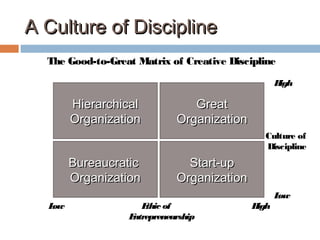
“Avoid bureaucracy and hierarchy and
instead create a culture of discipline. When
you put these two complementary forces
together—a culture of discipline with an
ethic of entrepreneurship—you get a
magical alchemy of superior performance
and sustained results” (p.121-122).
A Culture of DisciplineA Culture of Discipline
The Good-to-Great Matrix of Creative Discipline
High
Culture of
Discipline
Low
Low Ethic of High
Entrepreneurship
HierarchicalHierarchical
OrganizationOrganization
GreatGreat
OrganizationOrganization
BureaucraticBureaucratic
OrganizationOrganization
Start-upStart-up
OrganizationOrganization
A Culture of DisciplineA Culture of Discipline
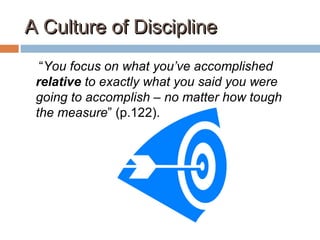
“You focus on what you’ve accomplished
relative to exactly what you said you were
going to accomplish – no matter how tough
the measure” (p.122).
A Culture of DisciplineA Culture of Discipline
“The point is to first get self-disciplined
people who engage in very rigorous
thinking, who then take disciplined
action within the framework of a
consistent system designed around
the Hedgehog Concept” (p. 126).
A Culture of DisciplineA Culture of Discipline
“They displayed a remarkable
discipline to unplug all sorts of
extraneous junk” (p.139).
A Culture of DisciplineA Culture of Discipline
Do you have a “stop” doing list?
What should be on the list?

Good to great 4 6 (revised)

  • 1.
  • 2.
  • 3.
    Review “Level 5Leader” Interview with Jim Collins: YouTube Clip
  • 4.
    Level 5 Leadership First Who… ThenWhat Confront the Brutal Facts Hedgehog Concept Culture of Discipline Technology Accelerators Disciplined PeopleDisciplined People Disciplined ThoughtDisciplined Thought Disciplined ActionDisciplined Action Buildup Breakthrough Confront the Brutal Facts Chapter 4: Confront the Brutal Facts
  • 5.
    Confront the BrutalFacts Must create a culture wherein people have a tremendous opportunity to be heard and, ultimately, for the truth to be heard. Setting off on the path to greatness requires confronting the brutal facts of current reality.
  • 6.
    Chap.4: Confront theBrutal FactsChap.4: Confront the Brutal Facts (Yet never lose faith)  Fred Purdue of Pitney Bowes said, “When you turn over rocks and look at all the squiggly things underneath, you can either put the rock down, or you can say, ‘My job is to turn over rocks and look at the squiggly things,’ even if what you see can scare the (stuffens’) out of you” (p. 72).
  • 7.
    Confront the BrutalFactsConfront the Brutal Facts (Yet never lose faith)(Yet never lose faith)  “Yes, leadership is about vision. But leadership is equally about creating a climate where the truth is heard and the brutal facts confronted. There’s a huge difference between the opportunity to ‘have your say’ and the opportunity to be heard” (p.74).
  • 8.
    Confront the BrutalFactsConfront the Brutal Facts (Yet never lose faith)(Yet never lose faith)  Creating a climate where truth is heard:  1. Lead with questions, not answers.  2. Engage in dialogue and debate, not coercion.  3. Conduct autopsies, without blame.  4. Build “red flag” mechanisms.
  • 9.
    The Stockdale Paradox Jim StockdaleJim Stockdale stoically accepted the brutal facts of reality while maintaining an unwavering faith in the endgame—that he would prevail despite the brutal facts.  Who didn’t make it out? The optimists.  Those who think it will all be a quick fix and everyone will be out by Christmas are the ones that lose heart and fail. 3
  • 10.
    Remember The StockdaleRememberThe Stockdale ParadoxParadox  Retain faith that you will prevail in the end, regardless of the difficulties.  AND at the same time confront the most brutal facts of your current reality, whatever they might be.
  • 11.
    Martin Luther King,Jr.Martin Luther King, Jr.  Discuss Do you believe King displayed the Stockdale paradox mentality during the Civil Rights Movement? Why or why not?
  • 12.
    Confront the BrutalFacts (Yet never lose faith)  “There is a sense of exhilaration that comes in facing head- on the hard truths and saying, ‘We will never give up. We will never capitulate. It might take a long time, but we will find a way to prevail.’” P.81
  • 13.
    Confront the BrutalFactsConfront the Brutal Facts (Yet never lose faith)(Yet never lose faith)  What are some of the brutal facts that we must face?  Using The Stockdale Paradox phrase a statement about one of these brutal facts?  What mills might we need to sell?  What restaurants might we need to close?  What “corporate raiders” need to be fought off?
  • 14.
    Level 5 Leadership First Who… ThenWhat Confront the Brutal Facts Hedgehog Concept Culture of Discipline Technology Accelerators Disciplined PeopleDisciplined People Disciplined ThoughtDisciplined Thought Disciplined ActionDisciplined Action Buildup Breakthrough Hedgehog Concept Chapter 5: The Hedgehog Concept
  • 15.
    Chap. 5: TheHedgehog ConceptChap. 5: The Hedgehog Concept  “The fox knows many things, but the hedgehog knows one big thing.”  Foxes pursue many ends at the same time and see the world in all its complexity. They are scattered or diffused, moving on many levels.  Hedgehogs simplify a complex world into a single organizing idea, a basic principle or concept that unifies and guides everything.  For a hedgehog, anything that does not somehow relate to the hedgehog idea holds no relevance.
  • 16.
    The Hedgehog ConceptTheHedgehog Concept  “Precisely, the Hedgehog concept is a simple, crystalline concept that flows from deep understanding about the intersection of the three circles.” P.95
  • 17.
    The Hedgehog ConceptTheHedgehog Concept  You can be passionate about all you want, but if you can’t be the best at it or if it doesn’t make economic sense, then you might have a lot of fun, but you won’t get great results.  If we can’t be the best at it, then why are we doing it at all?  A Hedgehog Concept is not a goal to be the best, a strategy to be the best, an intention to be the best, a plan to be the best. It is an understanding of what you can be the best at.
  • 18.
    What are yourthree circles?What are your three circles?  What can you be the best in the world at?  What drives your economic engine?  What are you deeply passionate about?
  • 19.
    Hedgehog Concept Getting theHedgehog Concept takes an average of four years. The right people Engaged in vigorous dialogue and debate Infused with the brutal facts Guided by questions formed by the three circles It is an iterative process by The Council:
  • 20.
    Hedgehog Concept The Council All Guidedby the Three Circles Ask Questions Dialogue & Debate Autopsies & Analysis Executive Decisions An Iterative Process
  • 21.
    The Hedgehog ConceptTheHedgehog Concept  At what you can be best in the world. This standard goes far beyond core competence — just because you possess a core competence doesn’t necessarily mean you are the best in the world at that competence. Conversely, what you can be best in the world at might not even be something in which you are currently engaged. The Hedgehog Concept is not a goal or strategy to be the best at something; it is an understanding of what you can be the best at and, almost equally important, what you cannot be the best at.
  • 22.
    The Hedgehog ConceptTheHedgehog Concept  What drives your economic engine? To get insight into the drivers of your economic engine, search for the one denominator (profit per x, for example, or cash flow per x) that has the single greatest impact. If you could pick one and only one ratio to systematically increase over time to make a greater impact, what would that ratio be? This denominator can be subtle, sometimes even unobvious. The key is to use the denominator to gain understanding and insight into your economic model.
  • 23.
    The Hedgehog ConceptTheHedgehog Concept  What you are deeply passionate about. Good-to- great companies did not pick a course of action, then encourage their people to become passionate about their direction. Rather, those companies decided to do only those things that they could get passionate about. They recognized that passion cannot be manufactured, nor can it be the end result of a motivation effort. You can only discover what ignites your passion and the passions of those around you.
  • 24.
    The Hedgehog ConceptTheHedgehog Concept  The essence of the process is to get the right people engaged in vigorous dialogue and debate, in fused with the brutal facts and guided by questions formed by the three circles. P.114
  • 25.
    The Hedgehog ConceptTheHedgehog Concept  “Kno w ‘o ne big thing ’ and stick to it.” P. 119
  • 26.
    The Hedgehog Concept Which is more important: the goal to be the best at something, or realistic understanding of what you can (and cannot) be the best at?
  • 27.
    The Hedgehog Concept Can each sub- unit and each person have a hedgehog concept?
  • 28.
    The Hedgehog Concept How is the Hedgehog Concept applicable in a church? a hospital? retail?
  • 29.
    Level 5 Leadership First Who… ThenWhat Confront the Brutal Facts Hedgehog Concept Culture of Discipline Technology Accelerators Disciplined PeopleDisciplined People Disciplined ThoughtDisciplined Thought Disciplined ActionDisciplined Action Buildup Breakthrough Culture of Discipline Chapter 6: Culture of Discipline
  • 30.
    Culture of Discipline Peoplewho “rinse their cottage cheese” Not about a tyrant who disciplines Getting disciplined people who engage in disciplined thought and who then take disciplined action, fanatically consistent with three circles
  • 31.
    Culture of Discipline Requirespeople who adhere to a consistent system. Gives people freedom and responsibility within framework of that system. Involves a duality.
  • 32.
    FREEDOM (AND RESPONSIBILITY)FREEDOM(AND RESPONSIBILITY) WITHIN A FRAMEWORKWITHIN A FRAMEWORK  Disciplined People:  Not trying to discipline the wrong people into the right behaviors, but getting self- disciplined people on the bus in the first place  Disciplined Thought:  You need to confront the brutal facts of reality, while retaining resolute faith that you can and will create a path to greatness  Disciplined Action:  Primary subject of this chapter  The comparison companies often tried to skip this jump right to disciplined plan
  • 33.
    Culture of Discipline Budgetingis to decide which arenas fit Hedgehog Concept and should be fully funded and which should not be funded at all. “Stop doing” lists are more important than “to do” lists. “Anything that does not fit with our Hedgehog Concept, we will not do.” Includes willingness to shun opportunities that fall outside the three circles.
  • 34.
    A Culture ofDisciplineA Culture of Discipline “Avoid bureaucracy and hierarchy and instead create a culture of discipline. When you put these two complementary forces together—a culture of discipline with an ethic of entrepreneurship—you get a magical alchemy of superior performance and sustained results” (p.121-122).
  • 35.
    A Culture ofDisciplineA Culture of Discipline The Good-to-Great Matrix of Creative Discipline High Culture of Discipline Low Low Ethic of High Entrepreneurship HierarchicalHierarchical OrganizationOrganization GreatGreat OrganizationOrganization BureaucraticBureaucratic OrganizationOrganization Start-upStart-up OrganizationOrganization
  • 36.
    A Culture ofDisciplineA Culture of Discipline “You focus on what you’ve accomplished relative to exactly what you said you were going to accomplish – no matter how tough the measure” (p.122).
  • 37.
    A Culture ofDisciplineA Culture of Discipline “The point is to first get self-disciplined people who engage in very rigorous thinking, who then take disciplined action within the framework of a consistent system designed around the Hedgehog Concept” (p. 126).
  • 38.
    A Culture ofDisciplineA Culture of Discipline “They displayed a remarkable discipline to unplug all sorts of extraneous junk” (p.139).
  • 39.
    A Culture ofDisciplineA Culture of Discipline Do you have a “stop” doing list? What should be on the list?