ESTIMATION OF PRIMARY
PRODUCTIVITY OF
FRESHWATER BODIES
usalmashaik@gmail.com
Material required
• BOD bottle (2 light / transparent and 1 dark)
• Nylon or Jute ropes
• Burettes
Reagents:
• Manganous sulphate solution,
• Alkaline iodide azide solution,
• Sodium thiosulphate, Concentrated Sulphuric acid,
• Starch indicator solution etc.
Procedure
Fill three BOD bottles with water sample in round stoppered bottles (1 Light bottle, 1 dark
bottle and 1 control light bottle) avoiding air bubbles
Water sample in the control bottle is immediately fixed by using Winker’s fixatives
The dark bottle is wrapped with aluminum foil and kept in a black bag to protect from light
Use one of the light bottles for estimating the initial dissolved oxygen As control
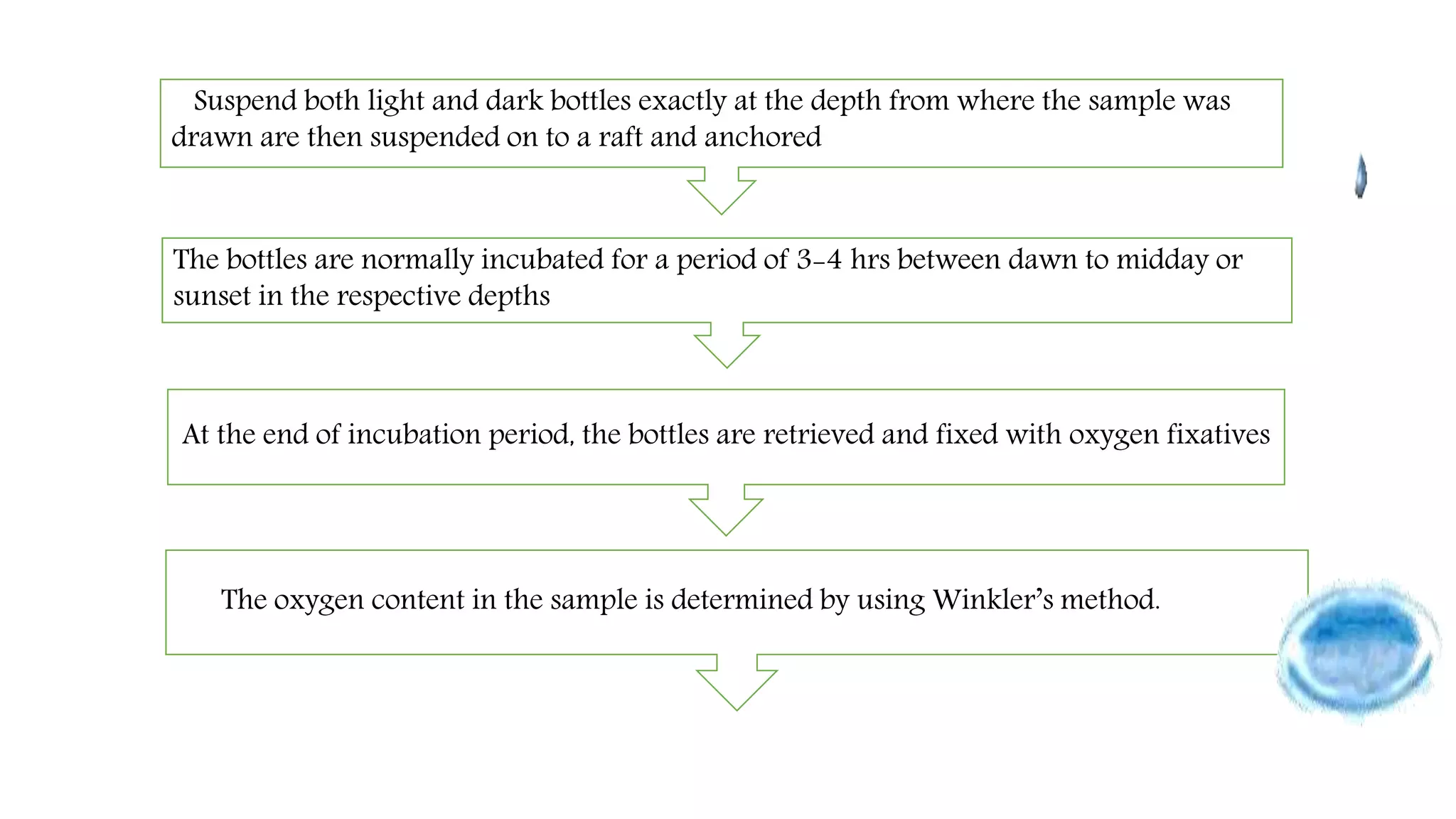
Suspend both light and dark bottles exactly at the depth from where the sample was
drawn are then suspended on to a raft and anchored
The bottles are normally incubated for a period of 3-4 hrs between dawn to midday or
sunset in the respective depths
At the end of incubation period, the bottles are retrieved and fixed with oxygen fixatives
The oxygen content in the sample is determined by using Winkler’s method.
CALCULATION
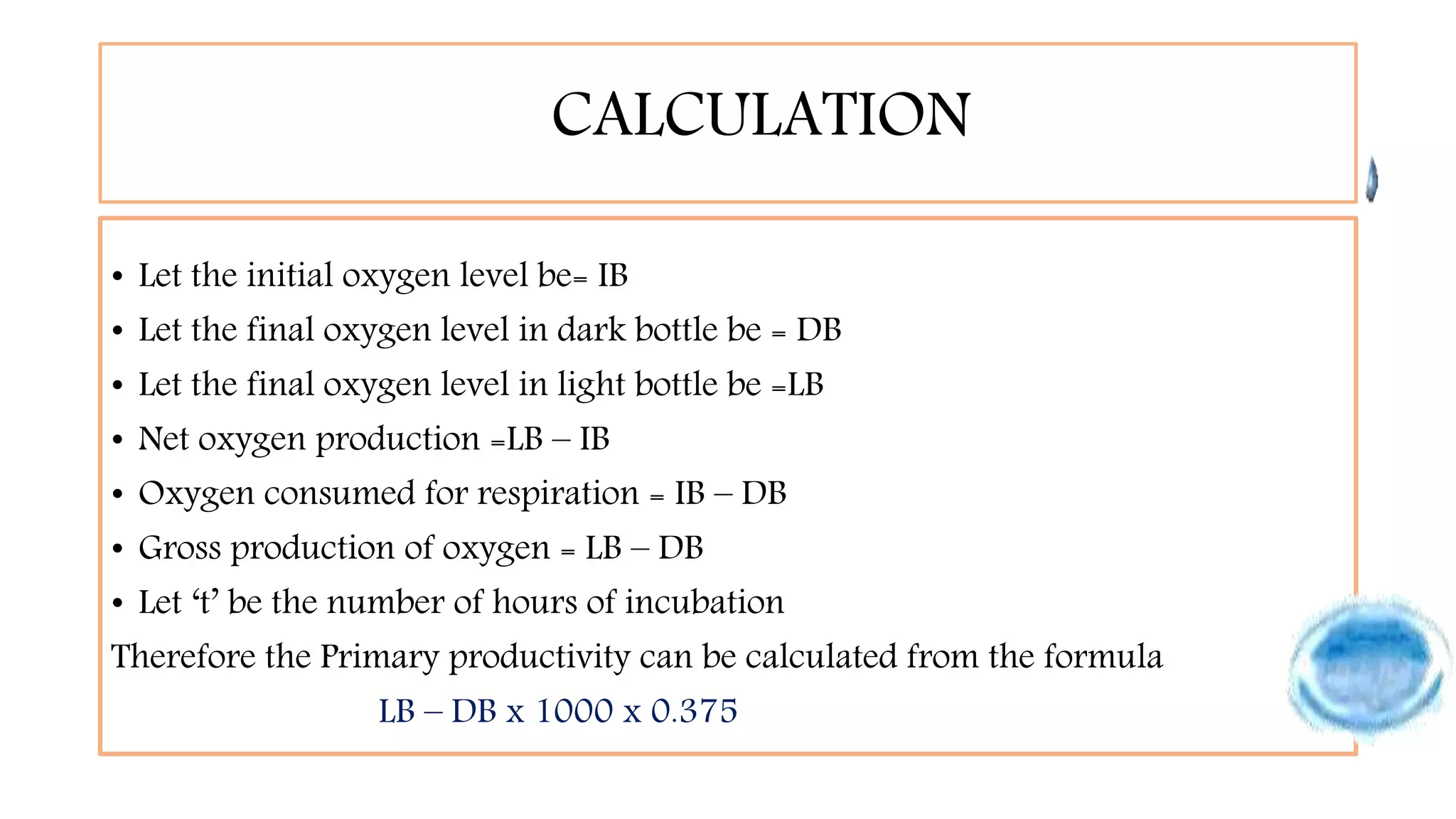
• Let the initial oxygen level be= IB
• Let the final oxygen level in dark bottle be = DB
• Let the final oxygen level in light bottle be =LB
• Net oxygen production =LB – IB
• Oxygen consumed for respiration = IB – DB
• Gross production of oxygen = LB – DB
• Let ‘t’ be the number of hours of incubation
Therefore the Primary productivity can be calculated from the formula
LB – DB x 1000 x 0.375
Gross primary productivity = LB – DB x 1000 x 0.375 mg C/m3/hour
1.25 x t
LB - IB x 1000 x 0.375
Net primary productivity = mg C/m3/hour
1.25×t
IB – DB x 1000 x 1 x 0.375
Community respiration rate = t mg C/m3/hour
Estimation of primary productivity of freshwater bodies

Estimation of primary productivity of freshwater bodies

  • 1.
    ESTIMATION OF PRIMARY PRODUCTIVITYOF FRESHWATER BODIES usalmashaik@gmail.com
  • 2.
    Material required • BODbottle (2 light / transparent and 1 dark) • Nylon or Jute ropes • Burettes Reagents: • Manganous sulphate solution, • Alkaline iodide azide solution, • Sodium thiosulphate, Concentrated Sulphuric acid, • Starch indicator solution etc.
  • 3.
    Procedure Fill three BODbottles with water sample in round stoppered bottles (1 Light bottle, 1 dark bottle and 1 control light bottle) avoiding air bubbles Water sample in the control bottle is immediately fixed by using Winker’s fixatives The dark bottle is wrapped with aluminum foil and kept in a black bag to protect from light Use one of the light bottles for estimating the initial dissolved oxygen As control
  • 4.
    Suspend both lightand dark bottles exactly at the depth from where the sample was drawn are then suspended on to a raft and anchored The bottles are normally incubated for a period of 3-4 hrs between dawn to midday or sunset in the respective depths At the end of incubation period, the bottles are retrieved and fixed with oxygen fixatives The oxygen content in the sample is determined by using Winkler’s method.
  • 5.
    CALCULATION • Let theinitial oxygen level be= IB • Let the final oxygen level in dark bottle be = DB • Let the final oxygen level in light bottle be =LB • Net oxygen production =LB – IB • Oxygen consumed for respiration = IB – DB • Gross production of oxygen = LB – DB • Let ‘t’ be the number of hours of incubation Therefore the Primary productivity can be calculated from the formula LB – DB x 1000 x 0.375
  • 6.
    Gross primary productivity= LB – DB x 1000 x 0.375 mg C/m3/hour 1.25 x t LB - IB x 1000 x 0.375 Net primary productivity = mg C/m3/hour 1.25×t IB – DB x 1000 x 1 x 0.375 Community respiration rate = t mg C/m3/hour