Course Title: Chemistry Lab
Course Code: CHEM 102
Green University of Bangladesh
Dept. Of EEE
Presented by :
Mr. Asif kabir
ID: 232001014
Mr. Maruf Ahmed Joy
ID: 232001013
Presented To :
Jagannath Biswas
Associate Professor,
Dept of Textile
Green University Of Bangladesh
Exp name: Estimation of Copper Contained in a
Supplied Solution by Iodometric Method
2
Contents
01 Objectives
02 Theory
03 Apparatus
04 Procedure
05 Table with Calculation
05 Result
Objectives
3
• To study the amount of copper present in copper salt solution.
• To study oxidation reduction titration.
• To study the percentage of copper present.
Theory
4
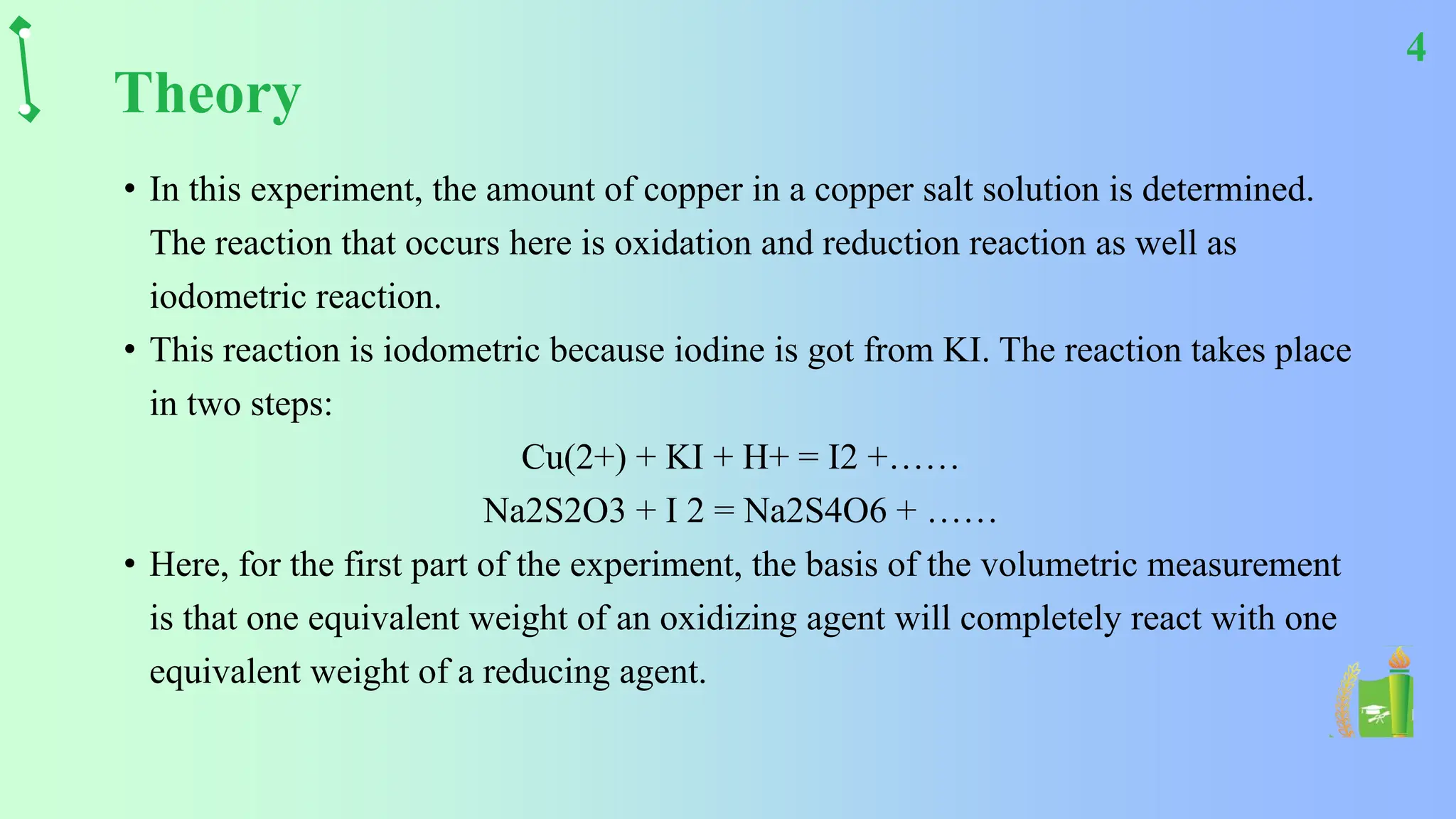
• In this experiment, the amount of copper in a copper salt solution is determined.
The reaction that occurs here is oxidation and reduction reaction as well as
iodometric reaction.
• This reaction is iodometric because iodine is got from KI. The reaction takes place
in two steps:
Cu(2+) + KI + H+ = I2 +……
Na2S2O3 + I 2 = Na2S4O6 + ……
• Here, for the first part of the experiment, the basis of the volumetric measurement
is that one equivalent weight of an oxidizing agent will completely react with one
equivalent weight of a reducing agent.
Theory
5
• 1000 ML 1M Na2S2O3 react with 63.54g Cu2+
(Average volume) (Exp -3)m react with [(63.54* average * Ex4) / 1000] Cu2+
• 10mL Cu solution contain = x g cu2+
1000mL Cu solution contain = x * 100 g/L
= y g/L
• So, the weight of copper in the supplied solution may then be easily calculated
using the above relation.
Apparatus
6
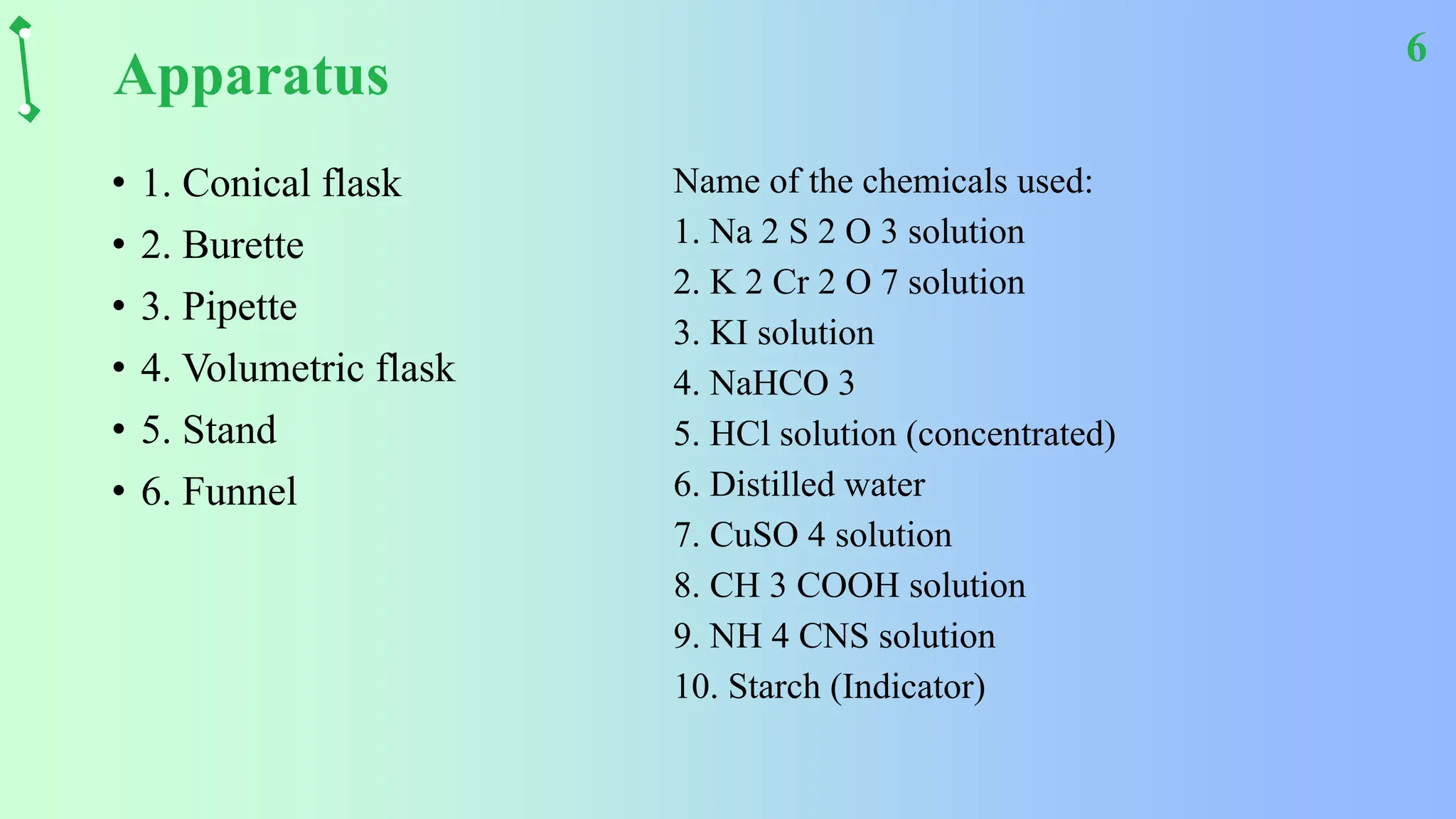
• 1. Conical flask
• 2. Burette
• 3. Pipette
• 4. Volumetric flask
• 5. Stand
• 6. Funnel
Name of the chemicals used:
1. Na 2 S 2 O 3 solution
2. K 2 Cr 2 O 7 solution
3. KI solution
4. NaHCO 3
5. HCl solution (concentrated)
6. Distilled water
7. CuSO 4 solution
8. CH 3 COOH solution
9. NH 4 CNS solution
10. Starch (Indicator)
Procedure 7
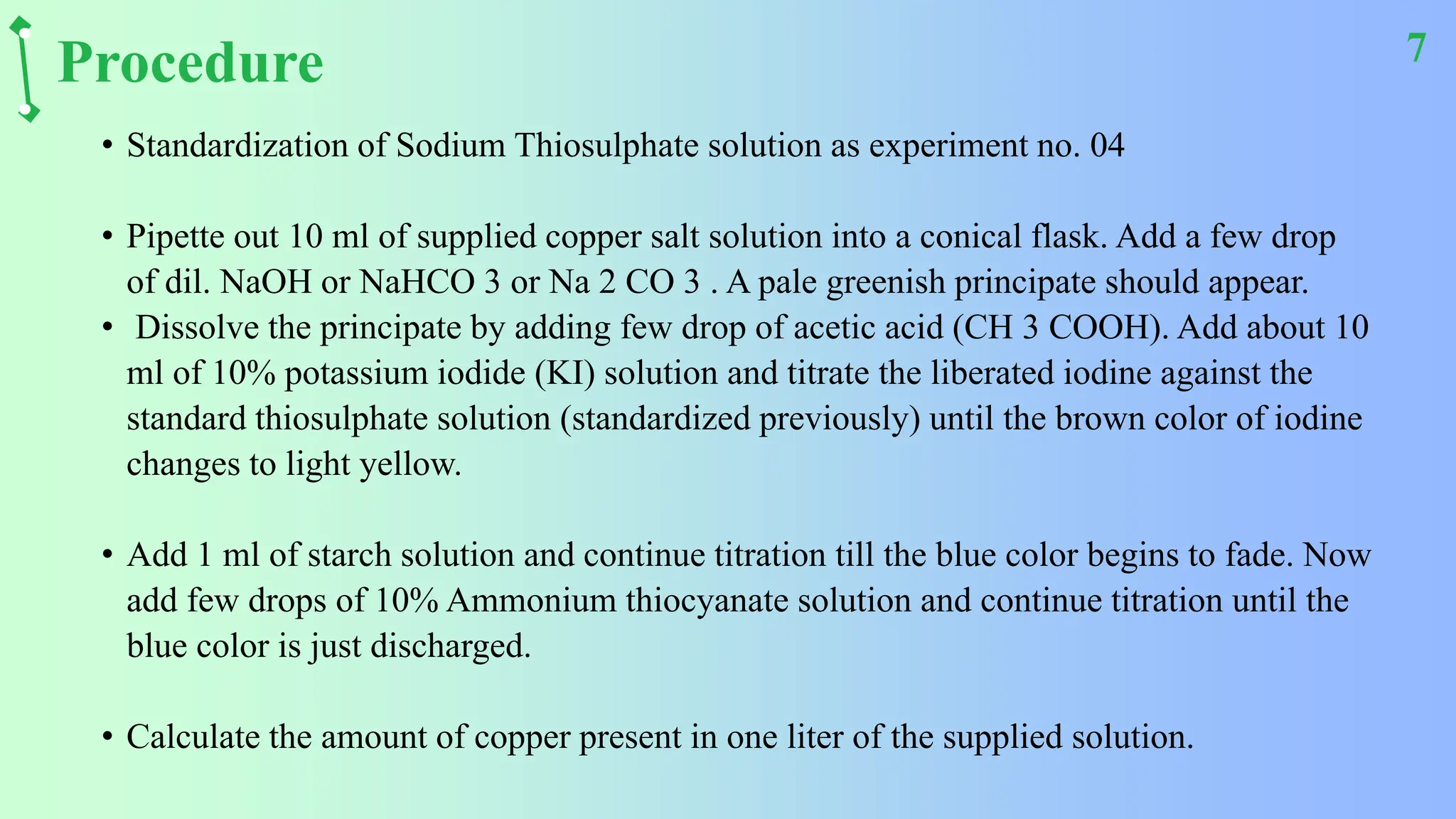
• Standardization of Sodium Thiosulphate solution as experiment no. 04
• Pipette out 10 ml of supplied copper salt solution into a conical flask. Add a few drop
of dil. NaOH or NaHCO 3 or Na 2 CO 3 . A pale greenish principate should appear.
• Dissolve the principate by adding few drop of acetic acid (CH 3 COOH). Add about 10
ml of 10% potassium iodide (KI) solution and titrate the liberated iodine against the
standard thiosulphate solution (standardized previously) until the brown color of iodine
changes to light yellow.
• Add 1 ml of starch solution and continue titration till the blue color begins to fade. Now
add few drops of 10% Ammonium thiocyanate solution and continue titration until the
blue color is just discharged.
• Calculate the amount of copper present in one liter of the supplied solution.
Table with Calculation 8
• Table 1: Data for standardization of Sodium Thiosulphate solution with standard 0.02 M potassium
Dichromate Solution =
NO. of
obs
Volume of
k2Cr2O7
(ml)
Initial
(ml)
Final
(ml)
Volume of
Na2S2O3
ml
Average
Volume
Of
Na2S2O3
(ml)
Strength of
Na2S2O3
(M)
1 10 0 12.4 12.4
2 10 12.4 25.2 12.8 12.8667 0.01554
3 10 25.2 38.6 13.4
Table with Calculation 9
• Table 2: Determination of Cu 2+ content in supplied solution by standard ……M potassium Dichromate
Solution:
NO. of
obs
Volume of
Cu2+
Solution
(ml)
Initial
(ml)
Final
(ml)
Volume of
Na2S2O3
ml
Average
Volume
Of
Na2S2O3
(ml)
Strength of
Cu2+
Solution
(M)
1 10 0 10.8 10.8
2 10 10.8 20.9 10.1 10 0.978
3 10 20.9 31 9.1
Result 10
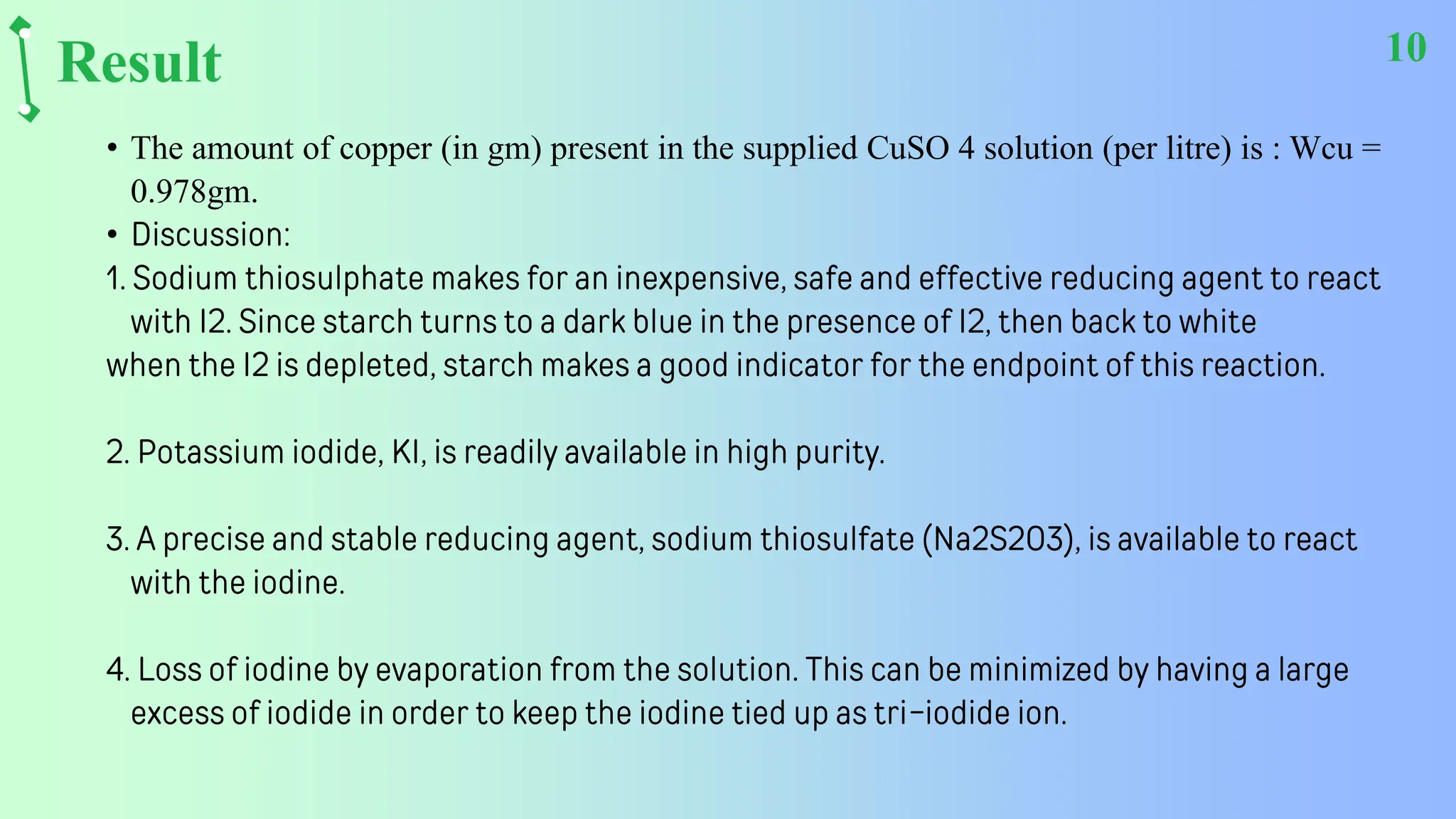
• The amount of copper (in gm) present in the supplied CuSO 4 solution (per litre) is : Wcu =
0.978gm.
• Discussion:
1. Sodium thiosulphate makes for an inexpensive, safe and effective reducing agent to react
with I2. Since starch turns to a dark blue in the presence of I2, then back to white
when the I2 is depleted, starch makes a good indicator for the endpoint of this reaction.
2. Potassium iodide, KI, is readily available in high purity.
3. A precise and stable reducing agent, sodium thiosulfate (Na2S2O3), is available to react
with the iodine.
4. Loss of iodine by evaporation from the solution. This can be minimized by having a large
excess of iodide in order to keep the iodine tied up as tri-iodide ion.
Thank You

Estimation of Copper contained in a supplied solution by iodometric method.pptx

  • 1.
    Course Title: ChemistryLab Course Code: CHEM 102 Green University of Bangladesh Dept. Of EEE Presented by : Mr. Asif kabir ID: 232001014 Mr. Maruf Ahmed Joy ID: 232001013 Presented To : Jagannath Biswas Associate Professor, Dept of Textile Green University Of Bangladesh Exp name: Estimation of Copper Contained in a Supplied Solution by Iodometric Method
  • 2.
    2 Contents 01 Objectives 02 Theory 03Apparatus 04 Procedure 05 Table with Calculation 05 Result
  • 3.
    Objectives 3 • To studythe amount of copper present in copper salt solution. • To study oxidation reduction titration. • To study the percentage of copper present.
  • 4.
    Theory 4 • In thisexperiment, the amount of copper in a copper salt solution is determined. The reaction that occurs here is oxidation and reduction reaction as well as iodometric reaction. • This reaction is iodometric because iodine is got from KI. The reaction takes place in two steps: Cu(2+) + KI + H+ = I2 +…… Na2S2O3 + I 2 = Na2S4O6 + …… • Here, for the first part of the experiment, the basis of the volumetric measurement is that one equivalent weight of an oxidizing agent will completely react with one equivalent weight of a reducing agent.
  • 5.
    Theory 5 • 1000 ML1M Na2S2O3 react with 63.54g Cu2+ (Average volume) (Exp -3)m react with [(63.54* average * Ex4) / 1000] Cu2+ • 10mL Cu solution contain = x g cu2+ 1000mL Cu solution contain = x * 100 g/L = y g/L • So, the weight of copper in the supplied solution may then be easily calculated using the above relation.
  • 6.
    Apparatus 6 • 1. Conicalflask • 2. Burette • 3. Pipette • 4. Volumetric flask • 5. Stand • 6. Funnel Name of the chemicals used: 1. Na 2 S 2 O 3 solution 2. K 2 Cr 2 O 7 solution 3. KI solution 4. NaHCO 3 5. HCl solution (concentrated) 6. Distilled water 7. CuSO 4 solution 8. CH 3 COOH solution 9. NH 4 CNS solution 10. Starch (Indicator)
  • 7.
    Procedure 7 • Standardizationof Sodium Thiosulphate solution as experiment no. 04 • Pipette out 10 ml of supplied copper salt solution into a conical flask. Add a few drop of dil. NaOH or NaHCO 3 or Na 2 CO 3 . A pale greenish principate should appear. • Dissolve the principate by adding few drop of acetic acid (CH 3 COOH). Add about 10 ml of 10% potassium iodide (KI) solution and titrate the liberated iodine against the standard thiosulphate solution (standardized previously) until the brown color of iodine changes to light yellow. • Add 1 ml of starch solution and continue titration till the blue color begins to fade. Now add few drops of 10% Ammonium thiocyanate solution and continue titration until the blue color is just discharged. • Calculate the amount of copper present in one liter of the supplied solution.
  • 8.
    Table with Calculation8 • Table 1: Data for standardization of Sodium Thiosulphate solution with standard 0.02 M potassium Dichromate Solution = NO. of obs Volume of k2Cr2O7 (ml) Initial (ml) Final (ml) Volume of Na2S2O3 ml Average Volume Of Na2S2O3 (ml) Strength of Na2S2O3 (M) 1 10 0 12.4 12.4 2 10 12.4 25.2 12.8 12.8667 0.01554 3 10 25.2 38.6 13.4
  • 9.
    Table with Calculation9 • Table 2: Determination of Cu 2+ content in supplied solution by standard ……M potassium Dichromate Solution: NO. of obs Volume of Cu2+ Solution (ml) Initial (ml) Final (ml) Volume of Na2S2O3 ml Average Volume Of Na2S2O3 (ml) Strength of Cu2+ Solution (M) 1 10 0 10.8 10.8 2 10 10.8 20.9 10.1 10 0.978 3 10 20.9 31 9.1
  • 10.
    Result 10 • Theamount of copper (in gm) present in the supplied CuSO 4 solution (per litre) is : Wcu = 0.978gm. • Discussion: 1. Sodium thiosulphate makes for an inexpensive, safe and effective reducing agent to react with I2. Since starch turns to a dark blue in the presence of I2, then back to white when the I2 is depleted, starch makes a good indicator for the endpoint of this reaction. 2. Potassium iodide, KI, is readily available in high purity. 3. A precise and stable reducing agent, sodium thiosulfate (Na2S2O3), is available to react with the iodine. 4. Loss of iodine by evaporation from the solution. This can be minimized by having a large excess of iodide in order to keep the iodine tied up as tri-iodide ion.
  • 11.

Editor's Notes