Essentials of Contemporary Management 5th Edition Jones Solutions Manual
Essentials of Contemporary Management 5th Edition Jones Solutions Manual
Essentials of Contemporary Management 5th Edition Jones Solutions Manual
Essentials of Contemporary Management 5th Edition Jones Solutions Manual
Essentials of Contemporary Management 5th Edition Jones Solutions Manual
1.
Essentials of ContemporaryManagement 5th
Edition Jones Solutions Manual download
https://testbankdeal.com/product/essentials-of-contemporary-
management-5th-edition-jones-solutions-manual/
Explore and download more test bank or solution manual
at testbankdeal.com
2.
We believe theseproducts will be a great fit for you. Click
the link to download now, or visit testbankdeal.com
to discover even more!
Essentials of Contemporary Management Canadian 5th Edition
Jones Solutions Manual
https://testbankdeal.com/product/essentials-of-contemporary-
management-canadian-5th-edition-jones-solutions-manual/
Essentials of Contemporary Management 5th Edition Jones
Test Bank
https://testbankdeal.com/product/essentials-of-contemporary-
management-5th-edition-jones-test-bank/
Essentials of Contemporary Management 7th Edition Jones
Solutions Manual
https://testbankdeal.com/product/essentials-of-contemporary-
management-7th-edition-jones-solutions-manual/
ICD 10 CM PCS Coding Theory and Practice 2016 Edition 1st
Edition Lovaasen Test Bank
https://testbankdeal.com/product/icd-10-cm-pcs-coding-theory-and-
practice-2016-edition-1st-edition-lovaasen-test-bank/
3.
Fundamentals of CorporateFinance Canadian 3rd Edition
Berk Test Bank
https://testbankdeal.com/product/fundamentals-of-corporate-finance-
canadian-3rd-edition-berk-test-bank/
Action Research Using Strategic Inquiry to Improve
Teaching and Learning 1st Edition Rock Test Bank
https://testbankdeal.com/product/action-research-using-strategic-
inquiry-to-improve-teaching-and-learning-1st-edition-rock-test-bank/
Contemporary Advertising and Integrated Marketing
Communications 14th Edition Arens Test Bank
https://testbankdeal.com/product/contemporary-advertising-and-
integrated-marketing-communications-14th-edition-arens-test-bank/
Industrial Organization Markets and Strategies 2nd Edition
Belleflamme Solutions Manual
https://testbankdeal.com/product/industrial-organization-markets-and-
strategies-2nd-edition-belleflamme-solutions-manual/
Medical Surgical Nursing Critical Thinking for Person
Centred Care 3rd Edition Lemone Test Bank
https://testbankdeal.com/product/medical-surgical-nursing-critical-
thinking-for-person-centred-care-3rd-edition-lemone-test-bank/
4.
Analog Integrated CircuitDesign 2nd Edition Carusone
Solutions Manual
https://testbankdeal.com/product/analog-integrated-circuit-design-2nd-
edition-carusone-solutions-manual/
5.
Chapter 10 -Leaders and Leadership
10-1
Chapter 10
Leaders and Leadership
Learning Objectives 291
Key Definitions/Terms 291
Chapter Overview 293
Lecture Outline 293
Lecture Enhancers 305
Management in Action 307
Building Management Skills 310
Managing Ethically 311
Small Group Breakout Exercise 312
Be the Manager 313
Case in the News 314
Supplemental Features 316
Video Case 316
Manager’s Hot Seat 318
Self-Assessment(s) 318
Test Your Knowledge 318
Instructor’s Powerpoint Slides 319
CHAPTER CONTENTS
6.
Chapter 10 -Leaders and Leadership
10-2
LO 10-1.Explain what leadership is, when leaders are effective and
ineffective, and the sources of power that enable managers to be
effective leaders.
LO 10-2. Identify the traits that show the strongest relationship to
leadership, the behaviors leaders engage in, and the limitations of
the trait and behavior models of leadership.
LO 10-3. Explain how contingency models of leadership enhance our
understanding of effective leadership and management in
organizations.
LO 10-4. Describe what transformational leadership is, and explain how
managers can engage in it.
LO 10-5. Characterize the relationship between gender and leadership and
explain how emotional intelligence may contribute to leadership
effectiveness.
charismatic leader An enthusiastic, self-confident
leader who is able to clearly communicate his or
her vision of how good things could be.
coercive power The ability of a manager to punish
others.
consideration Behavior indicating that a manager
trusts, respects, and cares about subordinates.
developmental consideration Behavior a leader
engages in to support and encourage followers and
help them develop and grow on the job.
empowerment The expansion of employees’
knowledge, tasks, and decision-making
responsibilities.
expert power Power that is based on the special
knowledge, skills, and expertise that a leader
possesses.
initiating structure Behavior that managers
engage in to ensure that work gets done,
subordinates perform their jobs acceptably, and the
organization is efficient and effective.
intellectual stimulation Behavior a leader engages
in to make followers be aware of problems and
view these problems in new ways, consistent with
the leader’s vision.
leader An individual who is able to exert influence
over other people to help achieve group or
organizational goals.
LEARNING OBJECTIVES
KEY DEFINITIONS/TERMS
7.
Chapter 10 -Leaders and Leadership
10-3
leader–member relations The extent to which
followers like, trust, and are loyal to their leader; a
determinant of how favorable a situation is for
leading.
leadership The process by which an individual
exerts influence over other people and inspires,
motivates, and directs their activities to help
achieve group or organizational goals.
leadership substitute A characteristic of a
subordinate or of a situation or context that acts in
place of the influence of a leader and makes
leadership unnecessary.
legitimate power The authority that a manager has
by virtue of his or her position in an organization’s
hierarchy.
path-goal theory A contingency model of
leadership proposing that leaders can motivate
subordinates by identifying their desired outcomes,
rewarding them for high performance and the
attainment of work goals with these desired
outcomes, and clarifying for them the paths leading
to the attainment of work goals.
position power The amount of legitimate, reward,
and coercive power that a leader has by virtue of
his or her position in an organization; a determinant
of how favorable a situation is for leading.
referent power Power that comes from
subordinates’ and coworkers’ respect, admiration,
and loyalty.
relationship-oriented leaders Leaders whose
primary concern is to develop good relationships
with their subordinates and to be liked by them.
reward power The ability of a manager to give or
withhold tangible and intangible rewards.
servant leader A leader who has a strong desire to
serve and work for the benefit of others.
task-oriented leaders Leaders whose primary
concern is to ensure that subordinates perform at a
high level.
task structure The extent to which the work to be
performed is clear-cut so that a leader’s
subordinates know what needs to be accomplished
and how to go about doing it; a determinant of how
favorable a situation is for leading.
transactional leadership Leadership that
motivates subordinates by rewarding them for high
performance and reprimanding them for low
performance.
transformational leadership Leadership that
makes subordinates aware of the importance of
their jobs and performance to the organization and
aware of their own needs for personal growth and
that motivates subordinates to work for the good of
the organization.
8.
Chapter 10 -Leaders and Leadership
10-4
In this chapter we describe what leadership is and examine the major leadership models that shed light
on the factors that contribute to a manager’s being an effective leader. We look at trait and behavior
models, which focus on what leaders are like and what they do, and contingency models—Fiedler’s
contingency model, path-goal theory, and the leader substitutes model—each of which takes into
account the complexity surrounding leadership and the role of the situation in leader effectiveness. We
also describe how managers can use transformational leadership to dramatically affect their
organizations. By the end of this chapter, you will have a good appreciation of the many factors and
issues that managers face in their quest to be effective leaders.
NOTE ABOUT INSTRUCTOR’S
POWERPOINT SLIDES
The Instructor PowerPoint Slides include most
Student PowerPoint slides, along with additional
material that can be used to expand the lecture.
Images of the Instructor PowerPoint slides can be
found at the end of this chapter on page 319.
BASIC POWERPOINT SLIDE 1
(INSTRUCTOR’S POWERPOINT SLIDE 1)
Chapter Title
Management Snapshot (pp. 315-316 of text)
McGrath Effectively Leads MTV Networks
How Can A Manager Continuously Transform A Hip Company In A Rapidly Changing Environment?
As chairperson and CEO of MTV Networks, Judy McGrath holds an extremely challenging leadership position.
MTV is a unit of Viacom and is the home of more than ten channels. She has received the Vanguard Award for
Distinguished Leadership and was ranked 10th in Fortune Magazine’s list of the most powerful women in
business in 2007. Her career at MTV began as a writer of promotional pieces. Her personal leadership style
emphasizes empowering all members of the MTV organization, as well as its viewers. She is visionary and can
see possibilities and opportunities where others might see just risks. She works hard, perseveres, and believes
that anything is possible. Under her leadership, MTV has launched scores of successful new programs, all of
which were risky and could have failed. Currently, McGrath is pushing her company to deliver services from
multiple digital platforms, such as cell phones, new broadband channels, and video games. Clearly, challenging
times lie ahead for her. Her vision and decisiveness, combined with her style of empowering employees,
encouraging risk taking and creativity, and making sure that all enjoy the ride suggest that MTV is in good
hands.
CHAPTER OVERVIEW
LECTURE OUTLINE
9.
Chapter 10 -Leaders and Leadership
10-5
I. The Nature Of Leadership
A. Leadership is the process by which a person exerts
influence over other people and inspires, motivates, and
directs their activities to help achieve group or organizational
goals.
1. When leaders are effective, the influence they exert
helps a group achieve its performance goals.
2. When leaders are ineffective, their influence does not
contribute to, and often detracts from, goal attainment.
2. Effective leadership increases an organization’s ability
to meet all challenges, including the need to obtain a
competitive advantage, the need to foster ethical
behavior, and the need to manage a diverse workforce
fairly and equitably.
B. Personal Leadership Style and Managerial Tasks: A
manager’s personal leadership style is the specific way in
which he or she chooses to influence other people.
1. Managers at all levels and in all kinds of organizations
have their own personal leadership styles that determine
how they lead employees and how they perform other
management tasks.
a. Although leading is one of the four principal tasks
of managing, a distinction is often made between
managers and leaders.
b. When this distinction is made, managers are
thought of as those organizational members who
establish and implement procedures and processes to
ensure smooth functioning and who are accountable
for goal accomplishment.
c. Leaders, on the other hand, look to the future, chart
the course for the organization, and attract, retain,
motivate, and inspire, and develop relationships with
employees based on trust and mutual respect.
2. Servant Leaders: Leaders who have a strong desire to
work for and serve others. Servant leaders share power
with followers and pay attention to those who are least
well off in society.
C. Leadership Styles across Cultures: Some evidence
LO 10-1: Explain what leadership is,
when leaders are effective
and ineffective, and the
sources of power that enable
managers to be effective
leaders.
STUDENT POWERPOINT SLIDE 2
(INSTRUCTOR’S POWERPOINT
SLIDE 4)
Leadership and Leader
STUDENT POWERPOINT SLIDE 3
(INSTRUCTOR’S POWERPOINT SLIDE 5)
Personal Leadership Style
TEXT REFERENCE
Ethics in Action:
Servant Leadership at Zingerman’s
Zingerman’s Delicatessen sells both
traditional and exotic foods from around the
world, but has also expanded from the
original deli into a community of related
businesses called Zingerman’s Community
of Businesses, which includes a mail order
business, a bakery, a catering business, a
creamery, a restaurant, a wholesale coffee
business, and a training business and has
combined annual revenues of about $30
million. From the start, Zingerman’s has
10.
Chapter 10 -Leaders and Leadership
10-6
suggests that leadership styles vary not only among
individuals, but also among countries and cultures.
1. Some research suggests that European managers tend
to be more humanistic than both Japanese and American
managers.
2. Japan’s collectivistic culture places its primary
emphasis on the group rather than the individual, so the
importance of the individual’s needs, desires, and
personality is minimized.
3. In the United States, organizations tend to be very
profit oriented and thus downplay the needs and desires
of individual employees.
4. Another noted cross-cultural difference is in time
horizons.
a. U.S. managers tend to have a personal style that
reflects the short-run profit orientation of their
companies, while Japanese managers tend to have
personal styles that reflect a long-run growth
orientation.
b. Managers in Europe’s large international firms
have a philosophy that lies in between the long term
approach of the Japanese and the short term approach
of the Americans.
5. Research on the global aspects of leadership is in its
infancy. As it continues, more cultural differences in
managers’ leadership styles may be discovered.
D. Power: The Key to Leadership: A key component of
effective leadership is found in the power the leader has to
affect other people’s behavior and get them to act in certain
ways. There are several types of power. Effective leaders take
steps to ensure that they have sufficient levels of each type
and that they use their power in beneficial ways.
1. Legitimate power is the authority a manager has by
virtue of his or her position in an organization’s
hierarchy.
2. Reward power is the ability of a manager to give or
withhold tangible rewards such as pay raises, bonuses,
and choice job assignments, as well as intangible rewards
such as verbal praise, a pat on back, or respect.
a. Effective managers use their reward power so that
been committed to excellent customer
service, great food, and a commitment to
people and community. As part of their
commitment to people and community,
founders Weinzweig and Saginaw have
incorporated servant leadership into their
personal leadership styles. They realize that
increasing success means increasing
responsibility to serve others, and doing
what’s best for the company. Weinzweig
and Saginaw also have a strong sense of
commitment to serving the local
community; Zingerman’s founded the
nonprofit organization Food Gatherers to
eliminate hunger and distribute food to the
needy, and Food Gatherers is now an
independent nonprofit responsible for the
Washtenaw County Food Bank with over
5,000 volunteers and a 19-member staff.On
Zingerman’s 20th anniversary, 13 nonprofit
community organizations in Ann Arbor
erected a plaque next to Zingerman’s
Delicatessen with a dedication that read,
“Thank you for feeding, sheltering,
educating, uplifting, and inspiring an entire
community.” Clearly, for Weinzweig and
Saginaw, leadership does entail being of
service to others
(Box in text on pp. 318-319).
STUDENT POWERPOINT SLIDE 4
(INSTRUCTOR’S POWERPOINT SLIDE 9)
Figure 10.1 – Sources of Managerial
Power
11.
Chapter 10 -Leaders and Leadership
10-7
subordinates understand that their receipt is sign that
they are doing a good job.
b. Ineffective managers use rewards in a more
controlling manner that signals to subordinates that
the manager has the upper hand.
3. Coercive power is the ability of a manager to punish
others.
a. Punishment may include verbal reprimands,
reductions in pay, or actual dismissal.
b. Managers who rely heavily on coercive power tend
to be ineffective as leaders sometimes even get
themselves fired.
4. Expert power is based on the special knowledge,
skills, and expertise that a leader possesses.
a. The nature of expert power varies, depending on
the leader’s level in the hierarchy.
b. Effective leaders take steps to ensure that they
have an adequate amount of expert power to perform
their leadership roles.
c. Expert power tends to be best used in a guiding or
coaching manner rather than in an arrogant, high-
handed manner.
5. Referent power stems from subordinates’ and
coworkers’ respect, admiration, and loyalty to and for
their leader.
a Leaders who are likable and whom subordinates
admire are likely to possess referent power.
b. Because referent power is a function of the
personal characteristics of a leader, managers can
increase their referent power by taking time to get to
know their subordinates and showing interest in
them.
E. Empowerment: An Ingredient in Modern
Management: Empowerment is the process of giving
employees at all levels in the organization the authority to
make decisions, be responsible for their outcomes, improve
quality, and cut costs.
1. It is becoming increasingly popular in organizations
STUDENT POWERPOINT SLIDE 5
(INSTRUCTOR’S POWERPOINT SLIDE
11)
Legitimate and Reward Power
STUDENT POWERPOINT SLIDE 6
(INSTRUCTOR’S POWERPOINT SLIDE
12)
Coercive and Expert Power
STUDENT POWERPOINT SLIDE 7
(INSTRUCTOR’S POWERPOINT
SLIDE 13)
Referent Power
12.
Chapter 10 -Leaders and Leadership
10-8
and can contribute to effective leadership for several
reasons:
a. It increases a manager’s ability to get things done.
b. It often increases workers’ involvement,
motivation, and commitment.
c. It gives managers more time to concentrate on their
pressing concerns because they less time on day-to-
day supervisory responsibilities.
2. The personal leadership style of managers who
empower subordinates often entails developing
subordinates’ ability to make good decisions as well as
being their guide, coach, and source of inspiration.
II. Trait and Behavior Models of Leadership
Early approaches to leadership, called the trait model and the
behavior model, sought to determine what effective leaders
are like as people and what they do that makes them so
effective.
A. The Trait Model: The trait model of leadership focused
on identifying the personal characteristics that are responsible
for effective leadership.
1. Decades of research indicate that certain personal
characteristics do appear to be associated with effective
leadership.
2. However, traits alone are not the key to understanding
leader effectiveness.
3. Some effective leaders do not possess all of the traits
identified in this model, and some leaders who do possess
them are not effective in their leadership roles.
4. This lack of a consistent relationship between leader
traits and leader effectiveness led researchers to shift their
attention away from what leaders are like (their traits) to
what effective managers actually do, i.e., their behaviors.
C. The Behavior Model: Researchers at Ohio State
University in the 1940s and 1950s identified two basic kinds
of leader behaviors that many managers engaged in to
influence their subordinates: consideration and initiating
structure.
1. Consideration: Leaders engage in consideration when
STUDENT POWERPOINT SLIDE 8
(INSTRUCTOR’S POWERPOINT SLIDE
14)
Empowerment
LO 10-2: Identify the traits that
show the strongest
relationship to leadership,
the behaviors leaders
engage in, and the
limitations of the trait and
behavior models of
leadership.
STUDENT POWERPOINT SLIDE 9
(INSTRUCTOR’S POWERPOINT SLIDE
15)
Leadership Models
13.
Chapter 10 -Leaders and Leadership
10-9
they show their subordinates that they trust, respect, and
care about them.
a. Managers who truly look out for the well-being of
their subordinates, and do what they can to help
subordinates feel good and enjoy their work, perform
consideration behaviors.
2. Initiating Structure: Leaders engage in initiating
structure when they make sure that work gets done, and
the organization is effective and efficient.
a. Assigning tasks to individuals or work groups,
making schedules, encouraging adherence to rules are
examples of initiating structure.
3. Initiating structure and consideration are independent
leader behaviors. Leaders can be high on both, low on
both, or high on one and low on the other.
III. Contingency Models of Leadership
A. Contingency models of leadership take into account the
situation or context within which leadership occurs. They
propose that whether or not a manager is an effective leader is
the result of the interplay between what the manager is like,
what he or she does, and the situation in which leadership
takes place.
B. Fiedler’s Contingency Model: Fiedler’s contingency
model helps explain why a manager may be an effective
leader in one situation and ineffective in another. It also
suggests which kinds of managers are likely to be most
effective in which situations.
1.Leader Style: Fiedler hypothesized that personal
characteristics can influence leader effectiveness. He uses
the term leader style to refer to a manager’s characteristic
approach to leadership and identified two basic leader
styles: relationship-oriented and task-oriented. All
managers can be described as having one style or the
other.
a. Relationship-oriented leaders are primarily
concerned with developing good relationships with
their subordinates and being liked by them. They get
the job done while focusing on maintaining high-
quality interpersonal relationships with subordinates.
b. Task-oriented leaders are primarily concerned
STUDENT POWERPOINT SLIDE 10
(INSTRUCTOR’S POWERPOINT SLIDE
17)
The Behavior Model
LO 10- 3: Explain how
contingency models of
leadership enhance our
understanding of effective
leadership and
management in
organizations.
STUDENT POWERPOINT SLIDE 11
(INSTRUCTOR’S POWERPOINT SLIDE
18)
Contingency Models of Leadership
14.
Chapter 10 -Leaders and Leadership
10-10
with ensuring that subordinates perform at a high
level. Task-oriented managers focus on task
accomplishment and making sure the job gets done.
c. According Fielder, leadership style is an enduring
characteristic. Managers cannot change their style,
nor can they adopt different styles in different kinds
of situations.
2 Situational Characteristics: Fielder identified three
situational characteristics that are important determinants
of how favorable a situation is for leading. According to
Fielder, if a situation is favorable for leading, it is
relatively easy for a manager to influence subordinates so
that they perform at a high level. In a situation that is
unfavorable for leading, it is much more difficult for a
manager to exert influence.
a. Leader-member relations describes the extent to
which followers like, trust, and are loyal to their
leader. Situations are more favorable for leading
when leader-member relationships are good.
b. Task structure is the extent to which the work to
be performed is clear-cut so that the leader’s
subordinates know what needs to be accomplished
and how to go about doing it. When task structure is
high, situations are favorable for leading. When task
structure is low, the situation is unfavorable for
leading.
c Position power is the amount of legitimate, reward,
and coercive power a leader has by virtue of his or
her position in an organization. Leadership situations
are more favorable for leading when position power
is strong.
3. Combining Leader Style and the Situation: By
taking all possible combinations of these factors, Fiedler
identified eight leadership situations which vary in their
favorability for leading. Based on extensive research,
Fielder determined that:
a. relationship-oriented leaders are most effective in
moderately favorable situations, and,
b. task-oriented leaders are most effective in very
favorable or very unfavorable situations.
4. Putting the Contingency Model into Practice
STUDENT POWERPOINT SLIDE 12
(INSTRUCTOR’S POWERPOINT
SLIDE 19)
Fiedler’s Model
STUDENT POWERPOINT SLIDE 13
(INSTRUCTOR’S POWERPOINT SLIDE
20)
Relationship-oriented and Task-oriented
Style
STUDENT POWERPOINT SLIDE 14
(INSTRUCTOR’S POWERPOINT
SLIDE 22)
Fiedler’s Model: Leader-member
Relations…
Chapter 10 -Leaders and Leadership
10-11
a. According to Fiedler, managers must be placed in
leadership situations that fit their style or the situation
must need to be changed to suit the manager’s style,
if he or she is to be effective.
b. Research studies support some aspects of Fiedler’s
model but also suggest that it needs some
modifications.
C House’s Path-Goal Theory: In his path-goal theory,
researcher Robert House focused on what leaders can do to
motivate their subordinates to achieve group or organizational
goals.
1. The premise is that effective leaders motivate
subordinates to achieve goals by:
a. Clearly identifying the outcomes that subordinates
are trying to obtain in the workplace,
b. Rewarding subordinates with these outcomes for
high performance and the attainment of work goals,
and
c. Clarifying for subordinates the paths leading to the
attainment of work goals.
d. Based on the expectancy theory of motivation,
path-goal theory provides managers with three
guidelines to follow to be effective leaders:
i. Find out what outcomes your subordinates are
trying to obtain from their jobs and the
organization.
ii. Reward subordinates for high performance and
goal attainment with the outcomes they desire.
iii. Clarify the paths to goal attainment for
subordinates, remove any obstacles to high
performance, and express confidence in
subordinates’ capabilities.
2. Path-goal theory identifies four kinds of behaviors that
leaders can engage in to motivate subordinates. Which
behaviors managers should use to lead effectively
depends upon the nature of the subordinates and the kind
of work they do. The behaviors are:
a. Directive behaviors, which are similar to initiating
STUDENT POWERPOINT SLIDE 15
(INSTRUCTOR’S POWERPOINT SLIDE
23)
Figure 10.2 - Fiedler’s Contingency
Theory of Leadership
STUDENT POWERPOINT SLIDE 16
(INSTRUCTOR’S POWERPOINT SLIDE
24)
House’s Path-Goal Theory
STUDENT POWERPOINT SLIDE 17
(INSTRUCTOR’S POWERPOINT
SLIDE 25)
House’s Path-Goal Theory: Kinds of
Leadership Behaviors
17.
Chapter 10 -Leaders and Leadership
10-12
structure and include showing subordinates how to
complete tasks, and taking concrete steps to improve
performance.
b. Supportive behaviors, which are similar to
consideration and include looking out for
subordinates' best interest,
c. Participative behaviors, which give subordinates a
say in matters and decisions that affect them, and
d. Achievement-oriented behaviors, which motivate
subordinates to perform at the highest level possible
by setting very challenging goals and believing in
subordinates’ capabilities.
D. The Leader Substitutes Model: This model suggests that
leadership is sometimes unnecessary because substitutes for
leadership are present.
1. A leadership substitute is something that acts in place
of the influence of a leader and makes leadership
unnecessary.
2. Characteristics of subordinates, such as their skills,
abilities, experience, knowledge, and motivation, can be
substitutes for leadership.
3. Characteristics of the situation or context, such as the
extent to which the work is interesting, can also be
substitutes.
4. When managers empower their subordinates or use
self-managed teams, the need for leadership influence is
decreased because team members manage themselves.
5. Substitutes for leadership can increase organizational
efficiency and effectiveness because they free up some of
the leader’s valuable time.
E. Bringing It All Together: The three contingency models
help managers hone in on the necessary ingredients for
effective leadership. They are complementary, since each one
looks at the leadership question from a different angle.
IV. Transformational Leadership
A. Transformational leadership occurs when managers
change their subordinates in three important ways.
1. Transformational managers make subordinates
STUDENT POWERPOINT SLIDE 18
(INSTRUCTOR’S POWERPOINT SLIDE
26)
The Leader Substitutes Model
LO 10-4: Describe what
18.
Chapter 10 -Leaders and Leadership
10-13
aware of how important their jobs are to the
organization and how important it is that they
perform those jobs as best they can, so that the
organization can attain its goals.
2. Transformational managers make their
subordinates aware of their own needs for
personal growth, development, and
accomplishment.
3. Transformational managers motivate their
subordinates to work for the good of the
organization as a whole, not just for their own
personal gain.
Managers and other transformational leaders can influence
their followers in three ways: by being a charismatic leader,
by intellectually stimulating subordinates, and by engaging in
developmental consideration.
B. Being a Charismatic Leader: Transformational managers
are charismatic leaders. They have a vision of how good
things could be in their groups and organizations that is in
contrast with the status quo.
1.Their vision usually includes dramatic improvements in
both group and organizational performance.
2. Charismatic leaders are excited and enthusiastic about
their vision and clearly communicate it to their
subordinates.
3. The essence of charisma is having a vision and
enthusiastically communicating it to others.
C. Stimulating Subordinates Intellectually:
Transformational managers openly share information so that
subordinates are aware of problems and the need for change.
1. They help subordinates to view problems from a
different perspective that is consistent with the manager’s
vision.
2. They engage and empower subordinates to take
personal responsibility for helping to solve problems.
D. Engaging in Developmental Consideration When
managers engage in developmental consideration, they go out
of their way to support and encourage subordinates, giving
them opportunities to enhance their skills and excel on the
job.
transformational
leadership is, and explain
how managers can
engage in it.
STUDENT POWERPOINT SLIDE 19
(INSTRUCTOR’S POWERPOINT SLIDE
27)
Transformational Leadership
STUDENT POWERPOINT SLIDE 20
(INSTRUCTOR’S POWERPOINT
SLIDE 28)
Charismatic Leader
STUDENT POWERPOINT SLIDE 21
(INSTRUCTOR’S POWERPOINT SLIDE
29)
Intellectual Stimulation
19.
Chapter 10 -Leaders and Leadership
10-14
E. The Distinction Between Transformational and
Transactional Leadership
1. Transformational leadership is often contrasted with
transactional leadership.
2. Transactional leadership involves managers using
their reward and coercive power to encourage high
performance.
a. When managers reward high performers,
reprimand low performers, and motivate by
reinforcing desired behaviors, they are engaging in
transactional leadership.
b. Many transformational leaders engage in
transactional leadership, but at the same time have
their eyes on the bigger picture of how much better
things could be in their organizations.
3. Research has found that when leaders engage in
transformational leadership, subordinates tend to have
higher levels of job satisfaction and performance. Also,
they are more likely to trust their leaders, trust their
organizations, and feel that they are being treated fairly.
This, in turn, may positively influence their motivation
level.
V. Gender and Leadership
A. Although there are relatively more women in management
positions today than ten years ago, there are relatively few
women in top management, and in some organizations, even
in middle management. When women do advance to top
management positions, special attention is often focused on
the fact that they are women.
B. A widespread stereotype of women in management is that
they are nurturing, supportive, and concerned with
interpersonal relations.
1. Such stereotypes suggest that women tend to be more
relationship oriented as managers and engage in more
consideration behaviors, whereas men are more task
oriented and engage in more initiating structure
behaviors.
2. However, research suggests that that male and female
managers in leadership positions behave in similar ways.
Women do not engage in more consideration than men,
STUDENT POWERPOINT SLIDE 22
(INSTRUCTOR’S POWERPOINT SLIDE
30)
Developmental Consideration
STUDENT POWERPOINT SLIDE 23
(INSTRUCTOR’S POWERPOINT
SLIDE 31)
Transactional Leadership
TEXT REFERENCE
Focus on Diversity:
Admitting a Mistake Helps Small Business
Leader
Things seemed to be going well for
Maureen Borzacchiello, CEO of Creative
Display Solutions, a small business which
provides displays, graphics, and exhibits for
use in trade shows and at events for
companies ranging from American Express,
FedEx, and General Electric to Comedy
Central, Linens & Things, and The Weather
Channel
However, in 2006 she realized that she had
overextended her business financially.
Still confident that if she could get through
this tough period, she would be able to get
her business back on track, Borzacchiello
decided to be honest with her employees
about the company’s current financial
problems, why they occurred, and how she
would strive to prevent such problems in the
20.
Chapter 10 -Leaders and Leadership
10-15
and men do not engage in more initiating structure than
women.
C. However, research does suggest that men and women may
differ in leadership style.
1. Women tend to be more participative than men,
involving subordinates in decision making and seeking
input.
2. Also, research suggests that men tend to be harsher
when they punish their subordinates than women.
D. There are at least two reasons why women leaders are
more participative than male leaders.
1. First, women must sometimes work harder to
overcome resistance to their leadership and engender
subordinate trust and respect.
2. Second, they sometimes possess stronger interpersonal
skills.
E. The key finding from research is that male and female
managers do not differ significantly in their propensities to
perform different leader behaviors, and that across different
kinds of organizational settings, male and female managers
tend to be equally effective as leaders.
VI. Emotional Intelligence And Leadership
A. Preliminary research suggests that emotions and moods of
leaders at work influence their behavior and effectiveness as
leaders. A leader’s level of emotional intelligence may play a
strong role in leadership effectiveness. Also, emotional
intelligence plays a crucial role in how leaders relate to and
deal with their followers, particularly when it comes to
encouraging followers to be creative.
future. By being honest and open with
employees, Borzacchiello gained their
commitment and support. True to her
promise, within 2 months, all employees
were able to return to their regular work
hours and by the beginning of 2007,
Creative Display Solutions had over $1
million in revenues (which was more than
double its revenues at the time of the
financial problems). To this day, Creative
Display Solutions remains a profitable
business and by 2008, its list of clients
included more than 500 companies.
(Box in text on pp. 335-336)
LO 5: Characterize the relationship
between gender and
leadership and explain how
emotional intelligence may
contribute to leadership
effectiveness
STUDENT POWERPOINT SLIDE 24
(INSTRUCTOR’S POWERPOINT SLIDE
32)
Gender and Leadership
STUDENT POWERPOINT SLIDE 25
(INSTRUCTOR’S POWERPOINT SLIDE
33)
Emotional Intelligence and Leadership
prophesied. As anexception to the general rule, our prophecy was
fulfilled; for, just as we reached the soft snow on Looking Stead, the
huge banks of mist rolled up from both valleys, and far away in the
north we saw ‘hoary-headed old Skiddaw’ bathed in sunshine, while
a keen dry wind blew up out of Ennerdale. We trudged along
through the snow on the High Level, and about mid-day were facing
the ice-covered slabs and snow-wreathed ledges on the north-east
side of the Pillar Rock. Little was said as we scrambled to the foot of
Walker’s Gully; for each of us fully recognised what was ahead, and
it was better to be silent, than to utter discouraging remarks.
The rope was put on at the foot of the crags, Field being the ‘anchor’
of the party, whilst I, as usual, was placed next to Jones, to serve as
a special buttress when hand and foot holds should become scarce.
A strong jet of ice-cold water came rushing down over the first pitch,
so that, not wishing to have our enthusiasm cooled so early in the
day, we climbed up the wet, slippery slabs on our left. About fifty
feet higher we had some difficulty in a shallow sloping chimney,
down which a mud avalanche seemed to have fallen quite recently,
and here our leader remarked ‘we ought to have been equipped with
mud-guards.’ We were soon facing the main gully, with its
tremendous chock-stones rising one above the other, over which
streamed large quantities of water, suggesting a somewhat too rapid
cleansing of our mud-stained garments. We entered the chimney
and found it just wide enough to back up, with both feet on the
right-hand wall; the falling ice-chips apprising us of the fact that
hard work was in progress higher up.
We climbed very rapidly for about fifty feet, close together, until
almost within touch of the uninviting stream of water falling over the
first jammed boulder, which was now just above our heads. Knowing
this to be one of the most difficult pitches in the lower part of the
climb, a short ‘council of war’ was held, for all seemed desirous of
avoiding a cold bath as long as possible. Then, screwing up his
courage, Jones made a bold dash through the waterfall to the back
of the cave. Knowing his objection to monopolising pleasures of this
23.
kind, we followedhim, and were soon all gasping and shivering
below the jammed boulder. After further consideration and
experiment, the only safe course, apparently, was for me to stand
under the waterfall and give the leader a shoulder over the mauvais
pas. As our ablutions seemed likely now to be very thorough, we ate
our lunch and watched, for a time, the falling water, which, in my
opinion, to some extent spoilt the view. The discomfort of our
position, however, soon impressed upon us the necessity of moving.
Field therefore held me firmly from the back of the cave, whilst I
stood under the shower-bath; and Jones mounted on my shoulders,
from whence he reached a hold on the top of the boulder, over
which he pulled himself with an exclamation of delight. I then retired
to the cave with considerable alacrity. Sounds from above warned us
that the leader was scarcely yet secure, so we steadily paid out
about forty feet of his rope, until he reached safe anchorage at the
top of the three boulders forming the pitch. In following we wasted
very little time under the waterfall, and soon joined Jones on a little
snow-patch, from which we could study the situation. A hundred
feet or so higher, and apparently overhanging our present position,
was the top jammed boulder. Evidence was not wanting, however, to
show us that we were not safe from falling objects; for, stuck in a
curiously upright position in the snow in front of us, were three
walking-sticks, with two pairs of torn gloves and some much-worn
socks lying by their side. We thought at first a party of tourists had
somehow reached here and forgotten their ‘impedimenta;’ but our
leader remembered that some friends, having climbed the Pillar Rock
at Christmas, had thrown their sticks and luggage down into Jordan
Gap before descending themselves. The snow proved harder than
they thought, their property making an unexpected descent into
Walker’s Gully, and here were we confronted with the opportunity of
acting as a rescue party; but, not thirsting for fame, we decided to
leave the relics undisturbed.
Jones now led us up several small, wet pitches, until we came to a
sudden stop in a great cave, where there was no apparent way out,
except through a very small hole high up in its roof; an outside route
24.
being practically impossibleon account of the accumulation of ice on
both walls. Jones remarked that he was not going ‘to emulate the
camel that failed to go through the eye of a needle;’ so, to reduce
his bulk as far as possible, he emptied his pockets and left his wet
jacket for Field to sit upon. No holds on the side of the cave were
available, so the leader climbed upon my shoulders, but he could
barely reach his arms through the hole. Field, meanwhile, was
smoking and making the most of his comfortable position. With
somewhat insincere apologies, we called on him to form an
additional buttress, and, from his shoulders, I was able to force the
leader through the hole, amidst the sound of tearing clothes and
muffled remonstrances from their owner.
I shall not readily forget my own sufferings in that hole. The first
attempt, from Field’s shoulders, was a complete failure, because the
upper part of my body absolutely refused to fit the shape of the
hole. After several fruitless efforts and much wasted energy, I
happened to look up and saw Jones smiling down at me. “That is
not right. Go down and have another try,” said he. He then loosed
the rope rather suddenly, whereupon I made an unexpected descent
upon Field, who was standing below enjoying my troubles; and there
was much confusion in the cave. After extricating ourselves, Field
again kindly placed his shoulders at my service, but from a
somewhat higher level than before, and this, with the aid of his ice-
axe applied from below, ultimately landed me at the top of the hole
feeling very roughly handled. Field then sent up our jackets, and,
after the hole had been slightly enlarged by removing some loose
rocks, he came up himself in good style.
We were now at the foot of the formidable top-pitch, which had
never been climbed. A sudden seriousness settled on us all as we
looked up at it, and remembered that this pitch had defied some of
the finest cragsmen of our time. The walls on both sides were
perpendicular, and the rounded appearance of the rocks suggested
an unusual absence of hand and foot holds, whilst the presence of
ice in several places caused us much uneasiness. There were three
25.
large flat chock-stonespiled irregularly right across the chasm.
Towards the upper one, which overhung considerably, the two walls
converged so much that it seemed possible to ‘back up’ the last part
of the climb, if the leader could only reach it safely. The only other
alternative would be to climb up on the right wall, close under the
lower chock-stone, and traverse outwards and upwards until suitable
holds could be found. A troublesome sleet was beginning to fall; so
that we were glad to climb into the cave directly beneath the chock-
stones. A firm ‘hitch’ was discovered in the back of the cave, by
which Field could anchor us; and he settled himself in a wet corner
where his attention was occupied in dodging the drops of falling
water and directing our movements.
Our first efforts were on the left wall; and by means of an ice-axe
fixed in a narrow corner, Jones skilfully and safely wedged himself in
a crack which led almost to the top of the first boulder. However, for
the next half-hour his attempts to make further progress were in
vain, for a hand could not be spared to chip the ice off the rocks;
and it was found necessary to abandon this left wall and to try the
opposite one, which now occupied our attention for some time.
Jones made several attempts from a shoulder to effect a lodgment
below the chock-stone. Then, whilst enjoying a well-earned rest, we
espied a small rock, wedged high up in the crack between the main
wall and the roof of the cave. That small rock proved to be the key
of the situation, for, after probably the finest piece of climbing I have
ever witnessed, a rope was passed through the hole behind it, and
we were in a position to attempt the climb safely. We were all
suffering acutely from cold, especially Field, on account of his
inaction, though he declared that the excitement of our movements
kept him warm. Notwithstanding this, our leader, taking off his boots
and jacket, prepared for a long struggle on that icy wall, whilst I
padded my head to gain an inch or two in height. Jones now swung
up as high as possible on the hitched rope; then, while standing on
my head, he found a very small hold for one of his toes, and after
ascending a few feet was hidden from our sight by the intervening
chock-stone. The next few minutes were anxious ones; we shivered
26.
with cold, andheld the rope firmly in case there should be a mishap
higher up. Almost immediately there was a rush of falling snow far
out over the pitch, and it scarcely needed our leader’s jödel of
success to assure us that at last Walker’s Gully had yielded to the
onslaught of the climber.
We pushed the leader’s boots into his jacket pockets and sent up all
our ‘luggage.’ Owing to the half-frozen condition of our fingers, tying
the various things on the rope took so long a time, that we called
forth an impatient exclamation from above. Eventually we, in turn,
landed safely at the top, after swinging ignominiously on the rope, in
much the same way as our ‘luggage’ had done. However, the great
hitherto unclimbed pitch of Walker’s Gully was below us, and there
followed the usual congratulations. Our progress up from the screes
had been slow, something like three hours, but much time had been
spent in reconnoitring under extremely bad conditions.
The situation was still rather serious, for we were perched on a
narrow snow-ledge on the very brink of the upper chock-stone; and
the three of us were almost in a state of collapse from cold and the
saturated state of our clothes. The forced inaction of the leader,
whilst we were finishing the climb, had made him so benumbed as
to be almost helpless, and he was sitting with his feet in the wet
snow, ineffectually trying to put on his boots. We had carefully kept
some stockings and gloves dry in the rücksack; but the opening of
the sack with half-frozen fingers proved unfortunate, for its contents
escaped, and, with the other relics which had come down through
Jordan Gap, now adorned the snow-patch far below. It was then
agreed that this narrow, exposed ledge was, under the
circumstances, not a suitable dressing room; so we gathered up our
belongings, including our leader’s boots, and carefully ascended the
snow until we came to a safe resting place. Here we resorted to the
usual means of thawing ourselves, and our leader’s boots were
restored to their appointed places.
27.
The race upthe steep snow seemed to revive our spirits, and, by the
time the dry rocks below Great Doup were reached, our sufferings
gave way to the glow of success. One little excitement was still in
store for us, for Jones told us that he was threatened with frost-bite
in both feet. On removing his boots we found that his statement was
true, so we rubbed his feet with soft snow, and, before putting on
his boots, the troublesome feet were placed as far as possible in the
pockets of the warmest member of the party, until circulation was
thoroughly restored.
Night was drawing on apace; so we bade farewell to our ‘vanquished
foe,’ and were soon scampering along the High Level, bound for the
well-earned comforts of Wastdale.
Iron Crag Chimney.—Towards the head of the Shoulthwaite
Valley, which is 3½ miles from Keswick, near the road to Ambleside,
may be seen high up on the right-hand side, a magnificent couloir. It
runs up the south side of one of the steepest faces of rock in the
district, and is called, after the rock, Iron Crag Chimney. We had
passed in sight of the Crag scores of times, but the chimney is so
cunningly hidden away on the far side from the road, that it was not
until Mr. J. W. Robinson told us of it, that we dreamt of there being
anything worth climbing there. He and my brother went to prospect
it in March, 1896, but found it in such a very bad condition, that
after climbing the comparatively easy first pitch, they were forced to
beat a retreat. They came back, however, with a glowing account of
the second pitch, and spoke very excitedly about ‘“a thing” at least
100 feet high, wet, mossy, and with an overhanging stone half-way
up, from which the water dropped out four yards into the bed of the
gully, 40 feet below.’ They thought, however, that a small ledge, up
to which they had climbed, would continue far enough along the left
wall of the gully to enable them to traverse well out from under the
stone, and so reach the top of it. Of the nature of the climbing
above that they knew nothing, but were both anxious to try it and
confident of success.
28.
Continued bad weatherhindered another attempt until June of the
same year, when Mr. F. W. Jackson and I joined the other two and
we set out to attack this formidable ‘hundred-footer.’ The day was
fine and the rocks in perfect condition, and we succeeded in
climbing the chimney throughout. I intend to give more detail of the
second ascent; but it may be as well to mention here that the
second pitch only yielded after several attempts, by more than one
member of the party, and only with the aid of a shoulder, given from
the little ledge, was the leader able to climb to the top of the ‘chock-
stone.’ After this another thirty feet of chimney brought us to the top
of the pitch, and great were the rejoicings that we had, after a very
severe struggle, mastered it. I shall never forget how white the face
of one member of the party was when it appeared over the top of
the pitch, how he yelled to us to ‘haul in the taut,’ how he ‘quoth
“nevermore,”’ and how impolitely he spoke to the leader for having
climbed it at all. Altogether this second pitch gave us a good deal of
trouble, but the top part of the chimney, though very rotten and
steep, and liable to come away in small quantities, was climbed with
comparative ease.
After this, except some exploration of the Crags by Mr. H. W. Blunt, it
was not visited again by climbers until the New Year of 1899, when
Mr. O. G. Jones, with my father, my brother, and myself, found
ourselves standing at the bottom of the first pitch. We had
expatiated on the difficulty of the second pitch, and Jones was very
keen on trying it, having, in fact, come over from Wastdale with us
for that purpose. En route to Iron Crag we had climbed a gully on
the west side of the massif, which consisted of a series of very
interesting chimneys, the pleasures of which were greatly enhanced
by magnificent views of Derwentwater. This had made us somewhat
later than we anticipated, and an animated discussion was held at
the bottom as to whether, considering the lateness of the hour and
the bad condition of the gully, which was streaming with water, it
would not be advisable for two of the party to stay below or go
round and join the others at the top. This was decided against; ‘all
or none,’ said Jones, so we roped up with him leading. He soon
29.
reached the smallledge under the stone, and then stopped to take
breath and prospect. ‘Shall I come up to you?’ shouted my brother.
‘No thanks! I’ll have a try from here alone, and you would get wet
through in no time up here,’ returned he. This consideration for my
brother was utterly unlike him, for, amongst other similar occasions,
I well remember one on which, in a gully—or rather waterfall—in
Wales, he got wet through on the first pitch, and insisted on our
finishing with him all the eight pitches. His look of glee when we
emerged from the top of each pitch with the water running down us
was a thing to be remembered. However, to return, he jammed his
left foot against the left wall of the gully and pressed his back
against the other, and almost before we had time to see what had
happened, was smiling down on us from the top of the pitch. It was
very disgusting to see him just ‘romp’ up the place we had found so
difficult the year before, and when I had climbed up to him he
smiled sardonically and said, ‘Is that your pitch? Well, really——!’ A
small handhold had weathered away since the time of the first
ascent, which somewhat simplified the passing over the ‘chock-
stone,’ but even now I think most people would find it difficult. We
could only apologise and feel small, but, had we known it, there was
a surfeit of excitement and difficulty in store for us higher up.
The pitch we had just climbed was composed of most excellent rock,
but up above, where we now were, everything was changed, and
the upper rocks, which had been rotten enough before, were now,
as a result of the heavy rain, of the worst description imaginable.
Great pieces as large as one’s head came away at once, and every
step had to be most carefully tested before we could proceed. Now
was the time for us to appreciate our leader, for a less careful man
would have ‘pounded’ us severely before we had made any progress
worth mentioning. As it was, several big pieces had to be removed,
and some came whizzing past in much too close proximity to be
pleasant.
After the second pitch the chimney continues straight up and is fairly
wide for two hundred feet or so; but there is no good anchorage
30.
until the levelskyline is reached. Towards the top it narrows down to
a thin, rotten and very steep crack. By slow and very careful
progress we reached this crack, which had been climbed straight up
on the first ascent; but after Jones had tried it a few times he
evidently thought it hopeless, for he shouted down to us, ‘It won’t
go to-day. The rain has made everything too rotten. We shall have to
go back.’ It was four o’clock, raining heavily and nearly dark, and to
go back meant in all probability sleeping on the top of the second
pitch, an idea which none of us relished. So my brother climbed up
to Jones and, after consulting for a while, they decided to climb out
of the crack on the right-hand side. To do this a shoulder would have
to be given, from a small shelving ledge, to enable the leader to
reach the firmer and less steep rock up above. This was the most
obvious route of ascent, but the ledge looked very unstable and
rotten, and vibrated a little on being tested. However, Jones thought
it might hold if stepped on in the right way; so my brother climbed
up on to it and Jones followed. By utilising the side of the crack,
they were able to put very little pressure on the ledge; Jones
climbed on to his companion’s shoulders, and, when he had cleared
away a few of the loose rocks, was, after an anxious moment or
two, able to draw himself up on to the skyline and disappear from
our sight. After a few seconds he gave a cheer and called to my
brother to follow him. This he had just begun to do and had left the
ledge about five feet, when I heard a dull ominous crack, and, on
looking up, saw the whole thing coming down. There was no time to
do anything but squeeze into the chimney and warn my father. I
succeeded in getting far enough inside to escape serious damage,
but the heel of my left boot, which projected a little, was torn
entirely away. My father’s escape was more marvellous, for it
seemed that nothing could save him; but on looking down I saw the
great rock strike a projecting piece of the chimney only a few inches
above his head, and spread out like a fan into a thousand splinters
which shot far out into the air, falling again near the foot of the
chimney; and thus we escaped with only a few slight bruises. One
shudders to think what would have happened if the ledge had fallen
when Jones and my brother were on it. It may be of interest to say
31.
here that duringthe whole of our climbs with Jones, this was the
only approach to an accident we had, and under his leadership the
possibility of anything going wrong seemed, and always was, very
remote indeed.
After this we were not long in joining the other two at the top. By
this time it was nearly dark and still raining heavily, and on the crest
of the chimney we were faced by a bitterly cold wind. Jones, who
had been exposed to this during the time we were ascending, was
shaking with cold, and he shouted through the storm—‘Hurry up!
Coil the rope and then we’ll do a sprint.’ On looking round we found
that he had gone. We finished coiling the rope and hurried up to
where he had been, but could not see him anywhere. We shouted
again and again, but got no answer. After peering about and
shouting several times we came to a standstill. ‘Is he subject to fits?’
inquired my father in a most doleful tone of voice. We had never
heard of anything of the sort, so set off down the side of the crags
in the hope of finding him awaiting us below. A miserable hour was
spent in walking about the bottom of the crags calling his name; but
the whistling of the wind in the rocks above, and the swishing of the
rain were the only answers we got; so we set off down the fell-side,
and, after floundering about in the dark, over the stone-walls and
through the river, we found ourselves at last on the main road to
Keswick. We were very anxious to know what had become of Jones,
so hastened home, where we found him, ‘dressed up in all his best,’
toasting his feet in front of a comfortable fire. ‘Where have you
been?’ ‘Dinner has been waiting an hour,’ and so on, were the thanks
we got for our weary hunt among the crags for him, and the query
of my father’s about his taking ‘fits’ became one of his favourite
jokes. After proposing the ‘sprint’ to us he had run round a
projecting shoulder of rock to leeward, and started off to Keswick
over the moor, by the route we had taken earlier in the day. We had
expected him to go down to the Shoulthwaite Valley, and in this way
had missed him.
32.
So finished oneof the most exciting days we ever spent with Owen
Glynne Jones; and its events are indelibly stamped on my memory.
But, full of incident as the day had been, my pleasantest recollection
is of the evening that followed; when, by the fire and over our pipes,
we fought old battles over again, recalling to life happy days and
exciting moments on the fells, ending with the songs and glees
Jones loved so well to sing, and across the space of years, taking us
back into the ‘dear, dead days,’ will come into our ‘mind’s eye’ the
picture of him kneeling by the piano, singing with the keen
enthusiasm which characterized everything he did, his favourite
hymn—
Lead, kindly Light, amid the encircling gloom,
...
O’er moor and fen, o’er crag and torrent,
Till the night is gone.
Engineers’ Chimney, Gable Crag.—This new and interesting
climb is situated about midway between the Oblique Chimney and
the Central Gully. The beginning of it lies at nearly the same level as
that of the Oblique Chimney, and can be reached by traversing some
easy ledges from the ‘Sheep Walk,’ or by ascending directly from the
foot of the Crags. Although the chimney was well known to many
climbers, its ascent had, curiously enough, not been seriously
attempted until July 30th, 1899, when Messrs. G. T. Glover and W.
N. Ling made the first ascent. Since then it has been ascended on
two other occasions, and it seems likely to become as popular as
any of the Gable Crag climbs. The scenery is magnificent and the
climbing throughout of a most interesting character, and in the
centre of the lower part of the chimney a loosely wedged stone adds
an element of risk and difficulty, which is absent from the other
chimneys on this face. About eight feet from its commencement the
chimney divides into two branches, but the route lies up the left-
hand one. A good resting place for the second man is to be obtained
33.
in the right-handbranch, and he ought to stay here while the leader
is negotiating the very difficult passage over the chock-stone. In all
the ascents so far it has been found advisable to pass a rope behind
and over this stone, to improvise a handhold, and even then this ten
feet or so will be found quite difficult enough for most people. After
this, another twenty-five feet of careful climbing brings one to a
broad, sloping ledge where a rest can be taken. From here two
routes are available. One is to keep to the chimney, which continues
straight upward for about forty feet, and the other is to traverse out
round the left-hand buttress for a few feet and then bear upwards,
joining the ‘Sheep Walk’ near the top of the Crags. The former of
these involves about twenty feet of fairly easy climbing, until the
small cave, roofed over with the stone which dominates the chimney,
is reached. From this cave the easiest method of ascent is to utilise a
thin crack in the left wall into which some small stones are firmly
jammed and which may be reached by wedging across the chimney
and traversing outwards, a slight projecting ledge affording some
help in the process. The ‘take-off’ into the crack is somewhat
delicate and decidedly sensational on account of the scanty foothold,
but once gained ten to twelve feet of further climbing practically
finishes the chimney. The traverse route round the buttress is much
easier, but it entirely evades the most sensational part of the climb.
West Wall Climb, Deep Ghyll.—For climbers of Deep Ghyll
who ascend the second pitch by the right-hand exit, this new route
is probably the best way out of the Ghyll. After thus passing the
second pitch, the West Wall Climb starts from a point about twenty-
six yards below the entrance to the Great Chimney. By climbing over
two small ledges and up a conspicuous thirty-feet chimney, a broad
ledge is reached, where further direct progress is not advisable.
The best way lies around a corner to the right and up a series of
easy ledges, working gradually back again to above the
commencement of the climb. About half-way up ‘The Wall’ an
undercut pinnacle is reached and ascended on the left before a
lodgment can be effected on its outside edge, and some enjoyable
34.
work follows untila spacious ledge on the right can be utilised.
When Messrs. J. W. Robinson, J. H. Doncaster, and H. W. Blunt first
made the ascent, in the September of 1898, this portion of the climb
was considered difficult, and it is probably the only part where
special care is necessary. Above this the climbing can be varied
considerably, but the direct ascent of a rock ridge, straight ahead, is
to be recommended. The course throughout is well within the
powers of most climbing parties, and the magnificent views of
Scawfell Pinnacle and Deep Ghyll add additional interest to the
ascent.
We are indebted to two friends for the notes on the following climbs:
—To Mr. G. T. Glover for those on the Ling Chimney, and to Mr. W. R.
Reade for those on the West Jordan Gully.
The Ling Chimney, Eagle’s Nest Arête.—In the first edition
of his book Mr. O. G. Jones mentions that there are two chimneys on
the left-hand side of the Eagle’s Nest Arête, ‘the right of these is
shallow and open ... whether it can be climbed or not I have never
ascertained.’ On October 15th, 1899, Messrs. W. N. Ling, C. E.
Martineau and G. T. Glover made the first recorded ascent of it, after
a preliminary exploration from above. From the top of the small
grass gully which commences the arête climb, one traverses about
ten feet across some rock to the left, being then in a direct line
below the final chimney. Going straight upwards, by steep rock
steps, an upright slab is swarmed up with the hands and feet on
each side, until a platform is reached, on which the second man can
join the leader. About fifteen feet above this is another platform at
the foot of a narrow chimney which needs careful climbing for about
ten feet, until a foothold can be utilised on the sharp edge of the left
wall.
From here some stiff pulls on the arms land one out either on a
broad ledge above the easy gully route, or up a continuation of the
chimney to the right-hand side of the narrow pinnacle at the finish of
35.
the true arêteclimb. The ascent, as a whole, requires more care
than the gully route.
The West Jordan Gully, Pillar Rock.—This deeply cut gully,
or, more correctly speaking, chimney, is a striking feature of the
Western face of the Pillar Rock, and, together with the East Jordan
Gully, the head of which it meets at Jordan Gap, cuts off the actual
Pillar Rock from Pisgah. Probably many climbers have examined the
West Jordan Gully, but it does not appear to have been seriously
attacked before July, 1898, when Mr. W. P. McCulloch and the writer
climbed it. Walking up the bed of the gully we passed a tempting
looking crack on the North wall which ends in a small cave; above
this cave the gully is ‘chocked’ by several overhanging stones which
from below seem very formidable obstacles. We, however, avoided
the crack and, mounting a series of jammed stones, reached the
innermost recesses of the chimney. We were now almost on a level
with the top of the crack, and, the gully being here narrow enough
to brace firmly across, we backed upwards and outwards for about
fifteen feet, reaching the cave without great exertion. So far we had
done well, but still the great jammed stones, round which we had to
pass, loomed black overhead. Holds for the traverse outward looked
anything but satisfactory, so Mr. McCulloch, after passing the rope
round a conveniently placed jammed stone, climbed on to my
shoulders and, with considerable difficulty, dragged himself into a
small cave about fifteen feet above. As this cave would only
accommodate one man, I climbed to Mr. McCulloch’s level, with a
little assistance from the rope, and took the lead. Traversing
outwards for about fifteen feet, I climbed a sensational forty-feet
chimney, which we had surveyed from above several days previously,
and landed safely in the bed of the gully past all difficulties. The
height of the whole pitch is slightly under 100 feet, and, from
beginning to end, the climbing is of a most interesting character. The
second ascent was made by the brothers Broadrick, in August of the
same year, but there is no record of it having been climbed since.
CHAPTER I
THE PILLARROCK AND ITS PURLIEUS UP TO
DATE
In conformity with its deserts as the grandest mass of crags in
Lakeland, the Pillar Rock has, of recent years, received most
attention from those in search of new routes and variations. So
numerous and intertwined are some of the latter that it would be
difficult to say by how many different ways the top of the famous
rock can now be attained. There are certainly a score that possess
the merit of individuality. However, though there is one important
exception, that of the New West Climb, the old routes still
monopolise the bulk of the traffic. With the development of the craft
of rock-climbing the once popular, easy routes, such as the Old West
Climb or the Pendlebury Traverse, have become less used than
formerly. For a moderate party with an expert leader the North Climb
is now the favourite course, though the ‘New West’ has become
recognised as the finer climb. This recognition will, probably, in due
course make the latter outrival in popularity its older compeer. But
the ‘Slab and Notch,’ with the finish up the left wall of the Great
Chimney, still takes most Pillarites to the goal of their ambition. In
the other extreme stands the New North West Climb, and fortunately
so. It is too difficult and dangerous to attract those climbers who
truly realise that they have a life to lose. Famous experts—one of
whom made the descent alone—declare the New North West Climb
to be unjustifiable. For the descent of the Rock, especially after
reaching the top by one of the longer climbs, the Central Jordan
Crack is most generally used. Even under the worst conditions of
storm, ice, or snow a rope looped around the top retaining wall of
38.
the crack allowsdownward escape to be made with comparative
ease and safety.
39.
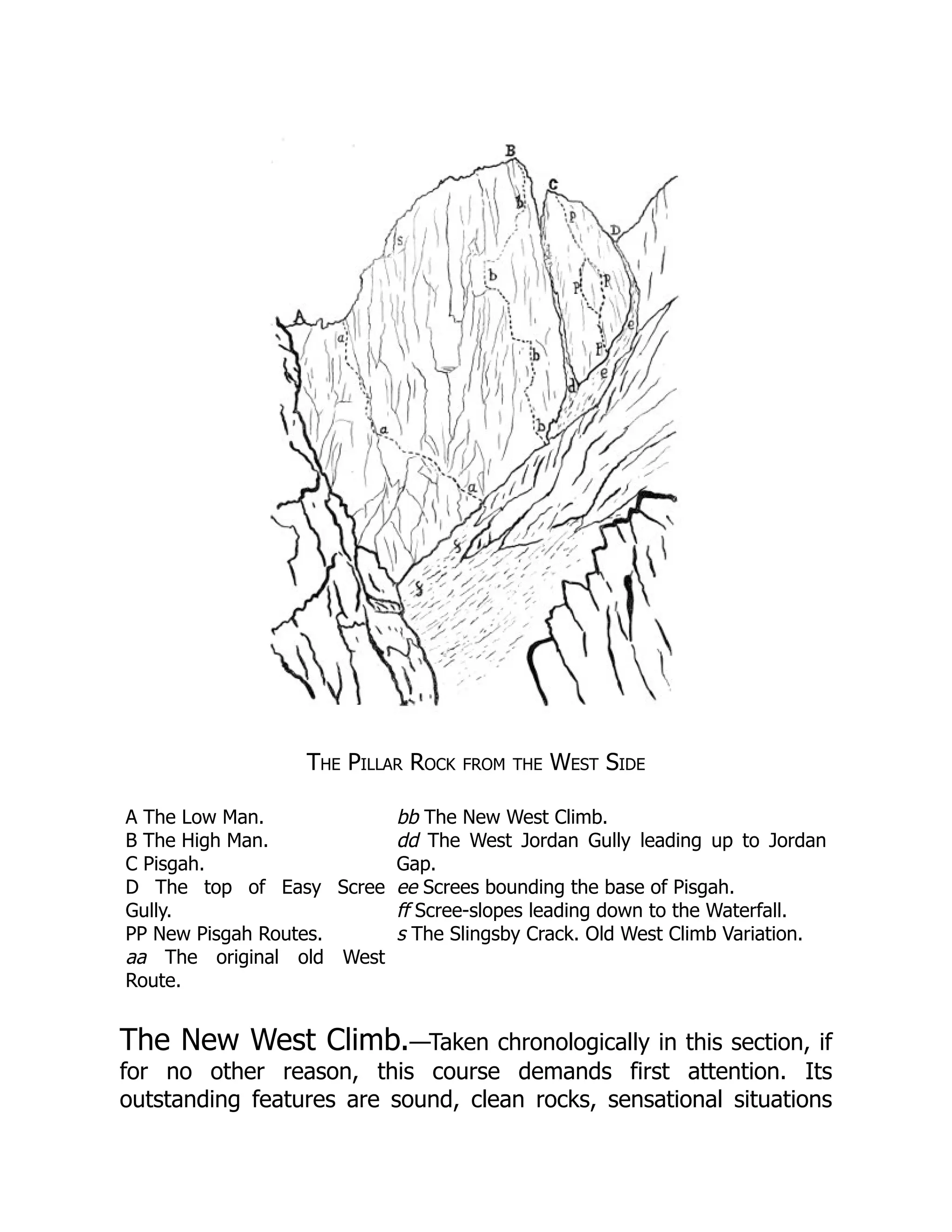
The Pillar Rockfrom the West Side
A The Low Man.
B The High Man.
C Pisgah.
D The top of Easy Scree
Gully.
PP New Pisgah Routes.
aa The original old West
Route.
bb The New West Climb.
dd The West Jordan Gully leading up to Jordan
Gap.
ee Screes bounding the base of Pisgah.
ff Scree-slopes leading down to the Waterfall.
s The Slingsby Crack. Old West Climb Variation.
The New West Climb.—Taken chronologically in this section, if
for no other reason, this course demands first attention. Its
outstanding features are sound, clean rocks, sensational situations
40.
with magnificent views,and secure belays at each section where
they are really required. The climbing begins about 20 yards down
the screes from the foot of the West Jordan Gully; the exact point is
just below some large boulders which abut against the base of the
main rock. Large hand- and footholds enable the steep lower rocks
to be easily climbed, though at one point, about 60 feet above the
start, there is a smooth place that gives trouble when ice is present.
About 20 feet higher, a well-marked ledge leads to the right and out
of the groove up which the climb has thus far run. Some turfy ledges
then soon conduct the climber up to an impending nose of rock.
After struggling up a short, steep pitch in the base of this, it
becomes obvious that a traverse to the left is advisable. The place is
vertical, but bulky and numerous holds enable the passage to be
made in comfort. The traverse finishes abruptly on a steep buttress,
with turf ledges at its foot. On the right a convenient crack provides
means of upward progress for about 30 feet; then an all too short
scramble up a steep arête gives access to two small ledges with
accommodation for one climber only on each. The rocks directly
ahead overhang threateningly, and a traverse to the left into the
base of a steep chimney—the key to the climb—becomes advisable.
This movement is sensational, but the handholds nowadays are
ample for the swing across. Yet it is advisable to take the precaution
to hitch the rope over the splendid belay at the beginning of the
traverse, especially if the conditions are adverse. Once across this
section, a large chock-stone in the foot of the chimney can be
utilised as anchorage whilst the leader moves upwards. The upper
part of this 30 foot chimney is probably the most awkward part of
the whole climb. If the back be kept on the left wall throughout,
numerous small, but sufficient, excrescences can be found on the
confronting side of the chimney. It would seem advisable to keep as
much as possible in the narrow cleft.
A secure resting-place, with room for three or more climbers, is
shortly gained, and the chimney, which becomes loose and
repulsive-looking higher up, should now be deserted in favour of an
interesting traverse to the right. The passage around the vertical
41.
corner is impressive,but careful use of the feet prevents the
awkward attitudes so often seen here. The movement across the
face to the right is still continued over capacious ledges in a slightly
upward direction to some prominent shattered rocks. Good
anchorage is available here. The final section begins above the
shattered rocks, and lies up a small, shallow crack which closes in
about 15 feet higher and necessitates a delicate step across a
smooth slab on the right. A well-marked, grassy recess is thus
eventually gained. The ascent finishes up this, and emerges within a
few feet of the summit of the Pillar Rock.
Savage Gully.—The direct ascent of this great rift, the aspect of
which is familiar to all who visit the Rock by way of the North Climb,
is too risky and dangerous to deserve serious attention from rock-
climbers. Yet from a historical and topographical point of view the
description of the first ascent by Mr. P. A. Thompson may prove of
interest. Though this indefatigable pioneer was finally safeguarded
by tying on a rope lowered from near the ‘Nose,’ the party who
made the second ascent—Messrs. Barton—conceded the honour of
precedence to Mr. Thompson, saying that the rope thus held could
not be considered any aid. On the lower 110 feet, resting-places
have since been found, and at no point is it necessary for the leader
to take out more than 60 feet of rope. Under the date June 3, 1909,
Mr. Thompson wrote:—
‘Savage Gully was climbed right through by me to-day after I had
examined the route, held from the top of the Nose by Mr. L. J.
Oppenheimer. The almost vertical portion immediately beyond the
point where the ordinary North Climb diverges is by far the hardest
part of the climb. The leader must run out 110 feet of rope, and
there are no hitches or convenient resting-places on the way. The
gully is divided by a narrow rib of rock, between which and the right-
hand wall the climb starts. The first 25 feet present no great
difficulty, but beyond this point the climbing becomes severe.
Backing up does not appear to be possible, and the holds lie
sometimes on the right and sometimes on the left of the rib, which
42.
was crossed inall five times. These crossings were always
sensational, and, one from right to left, about half-way up, was
greasy. At the top of the pitch a platform was reached, and an
excellent holding ground found in a small cave between the
continuation of the rib and the left-hand wall of the gully. Here I sent
my boots down, and unroping, waited while Mr. Oppenheimer
climbed by the ordinary route to the top of the crack leading down
into Savage Gully, from which point he threw down a rope. With a
second man in the cave to give a shoulder the best route would
probably lie directly up the crack on the left of the rib, but this was
too difficult to try alone. On the right the gully was comparatively
easy for some distance, and climbing up for 30 feet I reached the
rope and tied on. This branch of the gully then became too steep
and narrow to follow, and another traverse had to be made across
the rib, here expanded to a considerable buttress, on a shelving
ledge, wide enough to kneel on, and with small handholds. This
traverse is the only serious difficulty in the upper part of the climb.
The moral support of the rope was inconsiderable, as 10 feet of
slack had to be taken in before the traverse could be made. On
reaching the left-hand branch of the gully 30 feet more of climbing
up slabs which, in stockinged feet, proved easy led to the foot of the
crack. The final steep little chimney was wet, but otherwise not very
difficult. Mr. Oppenheimer came up over the Nose, rejoining me in
two hours after the start from the foot of the gully.’
The New North West Climb.—This exceptionally severe
course was first climbed on the 8th of June 1906 by Messrs. F. W.
Botterill, L. J. Oppenheimer, A. Botterill, and Dr. J. H. Taylor. It is only
suitable for experts, who, moreover, would be well advised to come
to it in perfect form after a lengthy climbing holiday. Success
depends on the skill of the leader. He can receive scanty support
from his companions at the places where such aid is really required.
Absence of a dependable belay for the long lead up the difficult
upper section of the face militates against any claim for safety the
expedition may be said to possess.
43.
The course startsfrom the westerly end of the Green Ledge. This is
marked g on Mr. Jones’ line drawing facing p. 254. By a curious error
he named it the Nose. The rocks are comparatively easy at the
outset; some short chimneys lead up to a sloping slab, where a
traverse to the left is made into a more obvious chimney. This gives
about 45 feet of interesting back and knee work until it is possible to
work out to the right, and then up easy rocks to the crest of the
buttress, where stands a prominent cairn. Broad, grass-covered
slabs lead to the base of the nose of the Low Man, where the real
difficulties begin.
The route at first bears away to the west up some slabs, and then
returns around a corner to a good ledge several yards long, whereon
stands a prominent cairn. Anchorage is available at this point. The
ledge is traversed to its extreme easterly end, and, after rounding a
projecting rock, an ascent of about 10 feet allows a V shaped recess
to be gained. This has been called ‘Le Coin.’ Above this important
stance there are three distinct ledges to be gained. The first of these
entails about 15 feet of difficult ascent from ‘Le Coin’; probably the
best way lies up the right wall. The first ledge possesses a sound
belay, and the second is recognizable by a larger belay, which is
cracked, but safe at present. A party of three might foregather here.
An ascent of quite 35 feet then leads to a ‘triangular’ ledge,
possessing practically no dependable belay. The key to further
progress here is the negotiation of a sensational stride around a
corner to the left and thus into an open, exposed chimney nearly 50
feet high. Above this there is a difficult and risky traverse back to the
right, mostly on a small, grassy ledge. A broad recess slightly higher
soon gives ample resting space. From the second ledge above ‘Le
Coin,’ whereon stands the ‘cracked belay,’ to this point entails a lead
out for the first man of about 90 feet. The difficulty and danger of
this section will undoubtedly militate against the North-West Climb
ever becoming ‘an easy day for a lady.’ The ascent to the crest of the
Low Man is made up a conspicuous cleft, Oppenheimer’s chimney,
44.
which is reachedafter crossing some broken rocks to the right. Two
projecting chock-stones facilitate the ascent.
G. P. Abraham & Sons, Photos Keswick
“OVER THE NOSE”—THE PILLAR ROCK
The High Man from above the Nose on the North
Climb.—This ascent can be made in several different ways, some
of which were made in the earlier days, but, like many variations on
the Pillar Rock, never recorded by the pioneers. Yet Stony Gully,
which gives the usual route from the Nose up to the Low Man, is
best avoided should the climbers find themselves ‘under fire’ from
45.
another party whohave thoughtlessly gone on in advance. There
have been several narrow escapes from falling stones hereabouts. At
such times knowledge of the alternative ways up the High Man may
be useful. After surmounting the Nose, Stony Gully should be
crossed and left immediately. Easy grass and rock ledges then afford
rapid upward progress to be made to the base of the steep rocks of
the High Man. All the way up the sharp, rocky, north-east arête of
the peak is conspicuous overhead, and the point to aim for is a
deeply cut chimney somewhat to the left of a line directly below the
summit of the arête. This chimney was climbed some years ago; its
recesses are narrow and steep below, but higher up there is a broad
ledge on the right, whence the pull over the dominating chock-stone
can be taken. The climber emerges on the great, sloping slabs which
slant down the upper right-hand wall of the Great Chimney. They are
an unmistakable feature in the view of the east side of the rock from
the Shamrock. The slabs may be crossed more easily than their
appearance would indicate, and thus the usual upper section of the
Great Chimney entered on a level with the ledge leading around and
below the Notch.
On the other hand, these slabs can be avoided by climbing upwards
to the right to a broad ledge and then around the prominent
perpendicular nose of the High Man to join the easy, ordinary route
from the Low Man. There is yet another way to the top of the Rock,
which was used by Mr. Botterill’s party in 1909. This runs almost
directly up the nose of the High Man from the broad ledge previously
mentioned. The place is steep and sensational enough to warn off
novices, but the rock is firm and yields sufficient hand and footholds,
though these are awkwardly spaced. The same party reached this
nose from below by climbing up the outer right-hand wall of the
chimney first mentioned. This is probably the easier of the two
routes, for the rock is deeply split into convenient clefts for hands
and feet. Incidentally it might be mentioned that those ascending
the Rock by the Old Wall Route, from near the top of Walker’s Gully,
pass below these more difficult climbs and take a slanting course up
to a small square-looking chimney, above which the usual way from
46.
the Low Manis gained. This was one of the earliest ways up the
Pillar Rock, and the ascent involves less real hand and footwork than
any other route.
The Curtain and Arête.—This forms the left-hand wall of the
Great Chimney, and may be climbed from bottom to top. At the
beginning there is a variation which slants up to the crest of the
Curtain from a point a few feet below the beginning of the fine pitch
in the Great Chimney. A still more interesting method of attack lies
up an unmistakable cleft behind a huge detached obelisk on the
south or left-hand side of the Curtain. Above the cleft a narrow crack
affords a very pleasing exit. Once on the crest of the Curtain the
work is straightforward, the ordinary tracks from the east side being
crossed en route. The final stretch of the arête, which lands the
climber on the top of the rock, involves some exhilarating arm-
swings on capacious holds.
The West Jordan Crack and the Far West Jordan Climb
were discovered in 1909 by Messrs. H. B. Gibson and W. B. Brunskill.
A poised block, which stands a few feet west of the foot of the old
West Jordan Climb, marks the base of operations. From this the
‘Crack’ route slants upwards to the left over the top of a steep slab
to a diminutive ledge at the foot of a vertical corner, up which rises a
narrow crack. The ascent of this 20 foot corner is the crux of the
climb; above it the summit cairn is only a few feet away. The Far
West Jordan Climb is somewhat the easier of the two problems.
From above the poised block previously mentioned, the route
diverges at once to the left, and, after crossing a grass-floored
depression, it makes for a detached spike, about 5 feet high, close
to the left sky-line. This affords good anchorage for the second
climber whilst the leader tackles the ensuing somewhat exposed
section from the top of the detached spike. This consists of a
passage up a crack to the right of an overhanging block. Above this
a fine arête is gained which leads to the summit.
47.
Welcome to ourwebsite – the perfect destination for book lovers and
knowledge seekers. We believe that every book holds a new world,
offering opportunities for learning, discovery, and personal growth.
That’s why we are dedicated to bringing you a diverse collection of
books, ranging from classic literature and specialized publications to
self-development guides and children's books.
More than just a book-buying platform, we strive to be a bridge
connecting you with timeless cultural and intellectual values. With an
elegant, user-friendly interface and a smart search system, you can
quickly find the books that best suit your interests. Additionally,
our special promotions and home delivery services help you save time
and fully enjoy the joy of reading.
Join us on a journey of knowledge exploration, passion nurturing, and
personal growth every day!
testbankdeal.com