Essentials of Contemporary Management 5th Edition Jones Solutions Manual
Essentials of Contemporary Management 5th Edition Jones Solutions Manual
Essentials of Contemporary Management 5th Edition Jones Solutions Manual
Essentials of Contemporary Management 5th Edition Jones Solutions Manual
Essentials of Contemporary Management 5th Edition Jones Solutions Manual
1.
Essentials of ContemporaryManagement 5th
Edition Jones Solutions Manual download pdf
https://testbankdeal.com/product/essentials-of-contemporary-
management-5th-edition-jones-solutions-manual/
Visit testbankdeal.com to explore and download the complete
collection of test banks or solution manuals!
2.
We believe theseproducts will be a great fit for you. Click
the link to download now, or visit testbankdeal.com
to discover even more!
Essentials of Contemporary Management Canadian 5th Edition
Jones Solutions Manual
https://testbankdeal.com/product/essentials-of-contemporary-
management-canadian-5th-edition-jones-solutions-manual/
Essentials of Contemporary Management 5th Edition Jones
Test Bank
https://testbankdeal.com/product/essentials-of-contemporary-
management-5th-edition-jones-test-bank/
Essentials of Contemporary Management 7th Edition Jones
Solutions Manual
https://testbankdeal.com/product/essentials-of-contemporary-
management-7th-edition-jones-solutions-manual/
ICD 10 CM PCS Coding Theory and Practice 2016 Edition 1st
Edition Lovaasen Test Bank
https://testbankdeal.com/product/icd-10-cm-pcs-coding-theory-and-
practice-2016-edition-1st-edition-lovaasen-test-bank/
3.
Fundamentals of CorporateFinance Canadian 3rd Edition
Berk Test Bank
https://testbankdeal.com/product/fundamentals-of-corporate-finance-
canadian-3rd-edition-berk-test-bank/
Action Research Using Strategic Inquiry to Improve
Teaching and Learning 1st Edition Rock Test Bank
https://testbankdeal.com/product/action-research-using-strategic-
inquiry-to-improve-teaching-and-learning-1st-edition-rock-test-bank/
Contemporary Advertising and Integrated Marketing
Communications 14th Edition Arens Test Bank
https://testbankdeal.com/product/contemporary-advertising-and-
integrated-marketing-communications-14th-edition-arens-test-bank/
Industrial Organization Markets and Strategies 2nd Edition
Belleflamme Solutions Manual
https://testbankdeal.com/product/industrial-organization-markets-and-
strategies-2nd-edition-belleflamme-solutions-manual/
Medical Surgical Nursing Critical Thinking for Person
Centred Care 3rd Edition Lemone Test Bank
https://testbankdeal.com/product/medical-surgical-nursing-critical-
thinking-for-person-centred-care-3rd-edition-lemone-test-bank/
4.
Analog Integrated CircuitDesign 2nd Edition Carusone
Solutions Manual
https://testbankdeal.com/product/analog-integrated-circuit-design-2nd-
edition-carusone-solutions-manual/
5.
Chapter 10 -Leaders and Leadership
10-1
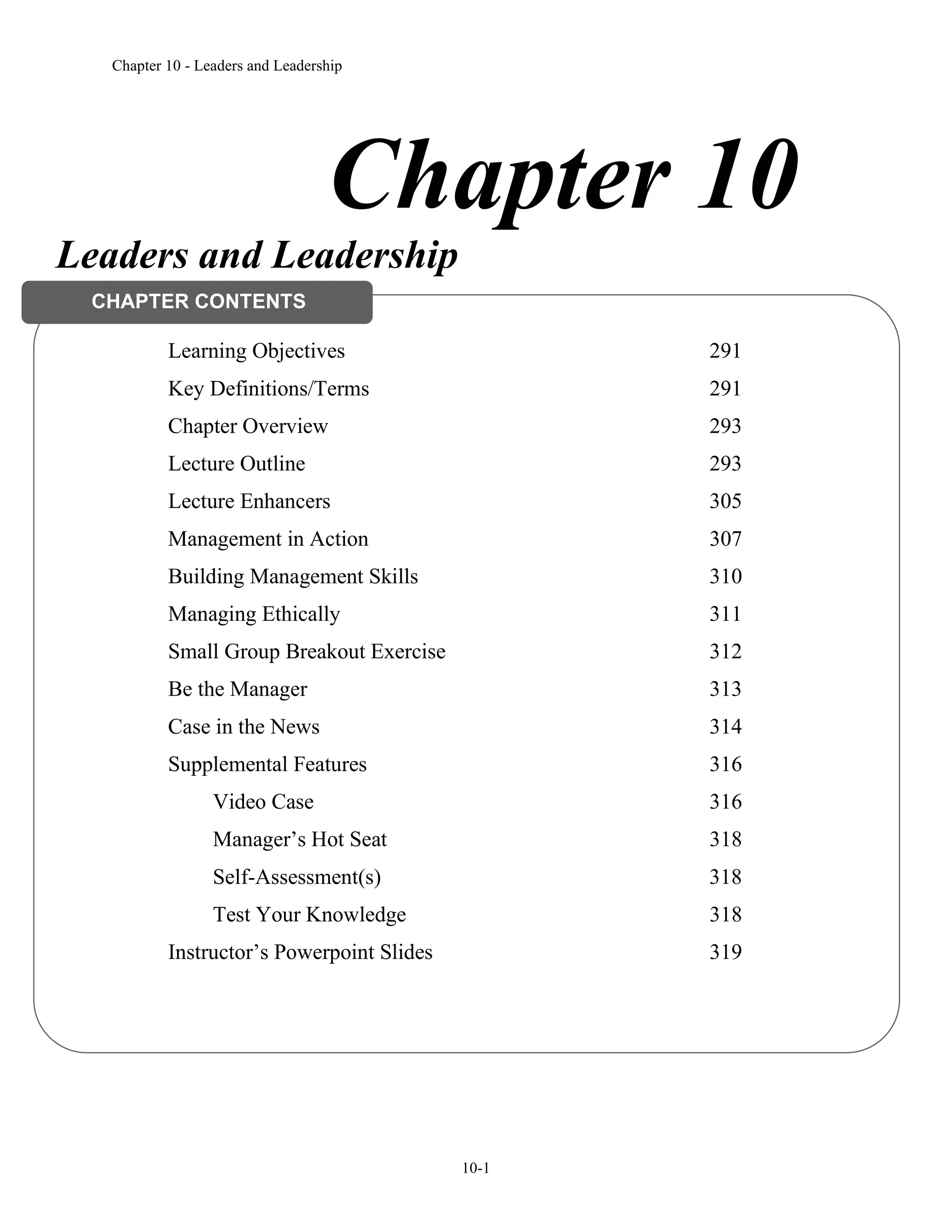
Chapter 10
Leaders and Leadership
Learning Objectives 291
Key Definitions/Terms 291
Chapter Overview 293
Lecture Outline 293
Lecture Enhancers 305
Management in Action 307
Building Management Skills 310
Managing Ethically 311
Small Group Breakout Exercise 312
Be the Manager 313
Case in the News 314
Supplemental Features 316
Video Case 316
Manager’s Hot Seat 318
Self-Assessment(s) 318
Test Your Knowledge 318
Instructor’s Powerpoint Slides 319
CHAPTER CONTENTS
6.
Chapter 10 -Leaders and Leadership
10-2
LO 10-1.Explain what leadership is, when leaders are effective and
ineffective, and the sources of power that enable managers to be
effective leaders.
LO 10-2. Identify the traits that show the strongest relationship to
leadership, the behaviors leaders engage in, and the limitations of
the trait and behavior models of leadership.
LO 10-3. Explain how contingency models of leadership enhance our
understanding of effective leadership and management in
organizations.
LO 10-4. Describe what transformational leadership is, and explain how
managers can engage in it.
LO 10-5. Characterize the relationship between gender and leadership and
explain how emotional intelligence may contribute to leadership
effectiveness.
charismatic leader An enthusiastic, self-confident
leader who is able to clearly communicate his or
her vision of how good things could be.
coercive power The ability of a manager to punish
others.
consideration Behavior indicating that a manager
trusts, respects, and cares about subordinates.
developmental consideration Behavior a leader
engages in to support and encourage followers and
help them develop and grow on the job.
empowerment The expansion of employees’
knowledge, tasks, and decision-making
responsibilities.
expert power Power that is based on the special
knowledge, skills, and expertise that a leader
possesses.
initiating structure Behavior that managers
engage in to ensure that work gets done,
subordinates perform their jobs acceptably, and the
organization is efficient and effective.
intellectual stimulation Behavior a leader engages
in to make followers be aware of problems and
view these problems in new ways, consistent with
the leader’s vision.
leader An individual who is able to exert influence
over other people to help achieve group or
organizational goals.
LEARNING OBJECTIVES
KEY DEFINITIONS/TERMS
7.
Chapter 10 -Leaders and Leadership
10-3
leader–member relations The extent to which
followers like, trust, and are loyal to their leader; a
determinant of how favorable a situation is for
leading.
leadership The process by which an individual
exerts influence over other people and inspires,
motivates, and directs their activities to help
achieve group or organizational goals.
leadership substitute A characteristic of a
subordinate or of a situation or context that acts in
place of the influence of a leader and makes
leadership unnecessary.
legitimate power The authority that a manager has
by virtue of his or her position in an organization’s
hierarchy.
path-goal theory A contingency model of
leadership proposing that leaders can motivate
subordinates by identifying their desired outcomes,
rewarding them for high performance and the
attainment of work goals with these desired
outcomes, and clarifying for them the paths leading
to the attainment of work goals.
position power The amount of legitimate, reward,
and coercive power that a leader has by virtue of
his or her position in an organization; a determinant
of how favorable a situation is for leading.
referent power Power that comes from
subordinates’ and coworkers’ respect, admiration,
and loyalty.
relationship-oriented leaders Leaders whose
primary concern is to develop good relationships
with their subordinates and to be liked by them.
reward power The ability of a manager to give or
withhold tangible and intangible rewards.
servant leader A leader who has a strong desire to
serve and work for the benefit of others.
task-oriented leaders Leaders whose primary
concern is to ensure that subordinates perform at a
high level.
task structure The extent to which the work to be
performed is clear-cut so that a leader’s
subordinates know what needs to be accomplished
and how to go about doing it; a determinant of how
favorable a situation is for leading.
transactional leadership Leadership that
motivates subordinates by rewarding them for high
performance and reprimanding them for low
performance.
transformational leadership Leadership that
makes subordinates aware of the importance of
their jobs and performance to the organization and
aware of their own needs for personal growth and
that motivates subordinates to work for the good of
the organization.
8.
Chapter 10 -Leaders and Leadership
10-4
In this chapter we describe what leadership is and examine the major leadership models that shed light
on the factors that contribute to a manager’s being an effective leader. We look at trait and behavior
models, which focus on what leaders are like and what they do, and contingency models—Fiedler’s
contingency model, path-goal theory, and the leader substitutes model—each of which takes into
account the complexity surrounding leadership and the role of the situation in leader effectiveness. We
also describe how managers can use transformational leadership to dramatically affect their
organizations. By the end of this chapter, you will have a good appreciation of the many factors and
issues that managers face in their quest to be effective leaders.
NOTE ABOUT INSTRUCTOR’S
POWERPOINT SLIDES
The Instructor PowerPoint Slides include most
Student PowerPoint slides, along with additional
material that can be used to expand the lecture.
Images of the Instructor PowerPoint slides can be
found at the end of this chapter on page 319.
BASIC POWERPOINT SLIDE 1
(INSTRUCTOR’S POWERPOINT SLIDE 1)
Chapter Title
Management Snapshot (pp. 315-316 of text)
McGrath Effectively Leads MTV Networks
How Can A Manager Continuously Transform A Hip Company In A Rapidly Changing Environment?
As chairperson and CEO of MTV Networks, Judy McGrath holds an extremely challenging leadership position.
MTV is a unit of Viacom and is the home of more than ten channels. She has received the Vanguard Award for
Distinguished Leadership and was ranked 10th in Fortune Magazine’s list of the most powerful women in
business in 2007. Her career at MTV began as a writer of promotional pieces. Her personal leadership style
emphasizes empowering all members of the MTV organization, as well as its viewers. She is visionary and can
see possibilities and opportunities where others might see just risks. She works hard, perseveres, and believes
that anything is possible. Under her leadership, MTV has launched scores of successful new programs, all of
which were risky and could have failed. Currently, McGrath is pushing her company to deliver services from
multiple digital platforms, such as cell phones, new broadband channels, and video games. Clearly, challenging
times lie ahead for her. Her vision and decisiveness, combined with her style of empowering employees,
encouraging risk taking and creativity, and making sure that all enjoy the ride suggest that MTV is in good
hands.
CHAPTER OVERVIEW
LECTURE OUTLINE
9.
Chapter 10 -Leaders and Leadership
10-5
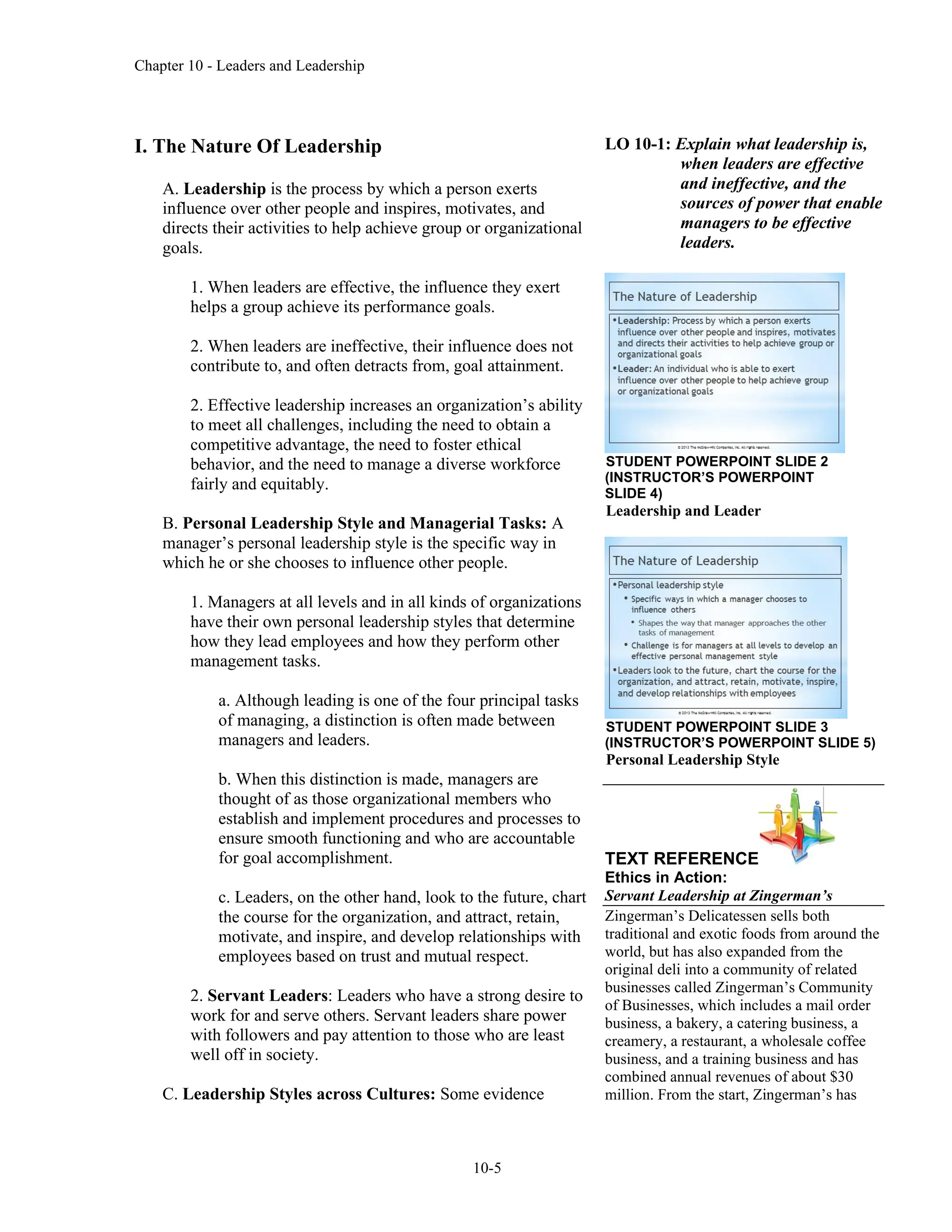
I. The Nature Of Leadership
A. Leadership is the process by which a person exerts
influence over other people and inspires, motivates, and
directs their activities to help achieve group or organizational
goals.
1. When leaders are effective, the influence they exert
helps a group achieve its performance goals.
2. When leaders are ineffective, their influence does not
contribute to, and often detracts from, goal attainment.
2. Effective leadership increases an organization’s ability
to meet all challenges, including the need to obtain a
competitive advantage, the need to foster ethical
behavior, and the need to manage a diverse workforce
fairly and equitably.
B. Personal Leadership Style and Managerial Tasks: A
manager’s personal leadership style is the specific way in
which he or she chooses to influence other people.
1. Managers at all levels and in all kinds of organizations
have their own personal leadership styles that determine
how they lead employees and how they perform other
management tasks.
a. Although leading is one of the four principal tasks
of managing, a distinction is often made between
managers and leaders.
b. When this distinction is made, managers are
thought of as those organizational members who
establish and implement procedures and processes to
ensure smooth functioning and who are accountable
for goal accomplishment.
c. Leaders, on the other hand, look to the future, chart
the course for the organization, and attract, retain,
motivate, and inspire, and develop relationships with
employees based on trust and mutual respect.
2. Servant Leaders: Leaders who have a strong desire to
work for and serve others. Servant leaders share power
with followers and pay attention to those who are least
well off in society.
C. Leadership Styles across Cultures: Some evidence
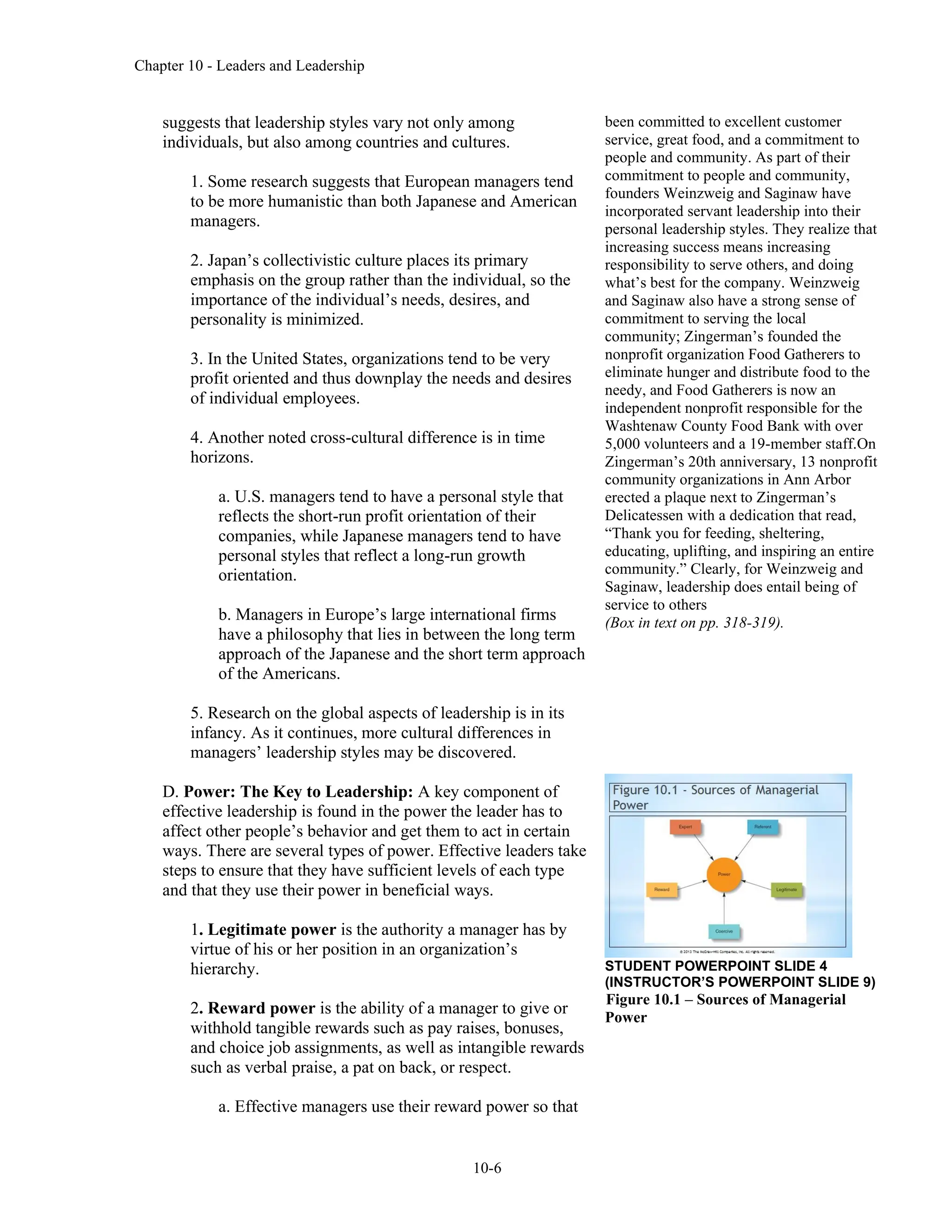
LO 10-1: Explain what leadership is,
when leaders are effective
and ineffective, and the
sources of power that enable
managers to be effective
leaders.
STUDENT POWERPOINT SLIDE 2
(INSTRUCTOR’S POWERPOINT
SLIDE 4)
Leadership and Leader
STUDENT POWERPOINT SLIDE 3
(INSTRUCTOR’S POWERPOINT SLIDE 5)
Personal Leadership Style
TEXT REFERENCE
Ethics in Action:
Servant Leadership at Zingerman’s
Zingerman’s Delicatessen sells both
traditional and exotic foods from around the
world, but has also expanded from the
original deli into a community of related
businesses called Zingerman’s Community
of Businesses, which includes a mail order
business, a bakery, a catering business, a
creamery, a restaurant, a wholesale coffee
business, and a training business and has
combined annual revenues of about $30
million. From the start, Zingerman’s has
10.
Chapter 10 -Leaders and Leadership
10-6
suggests that leadership styles vary not only among
individuals, but also among countries and cultures.
1. Some research suggests that European managers tend
to be more humanistic than both Japanese and American
managers.
2. Japan’s collectivistic culture places its primary
emphasis on the group rather than the individual, so the
importance of the individual’s needs, desires, and
personality is minimized.
3. In the United States, organizations tend to be very
profit oriented and thus downplay the needs and desires
of individual employees.
4. Another noted cross-cultural difference is in time
horizons.
a. U.S. managers tend to have a personal style that
reflects the short-run profit orientation of their
companies, while Japanese managers tend to have
personal styles that reflect a long-run growth
orientation.
b. Managers in Europe’s large international firms
have a philosophy that lies in between the long term
approach of the Japanese and the short term approach
of the Americans.
5. Research on the global aspects of leadership is in its
infancy. As it continues, more cultural differences in
managers’ leadership styles may be discovered.
D. Power: The Key to Leadership: A key component of
effective leadership is found in the power the leader has to
affect other people’s behavior and get them to act in certain
ways. There are several types of power. Effective leaders take
steps to ensure that they have sufficient levels of each type
and that they use their power in beneficial ways.
1. Legitimate power is the authority a manager has by
virtue of his or her position in an organization’s
hierarchy.
2. Reward power is the ability of a manager to give or
withhold tangible rewards such as pay raises, bonuses,
and choice job assignments, as well as intangible rewards
such as verbal praise, a pat on back, or respect.
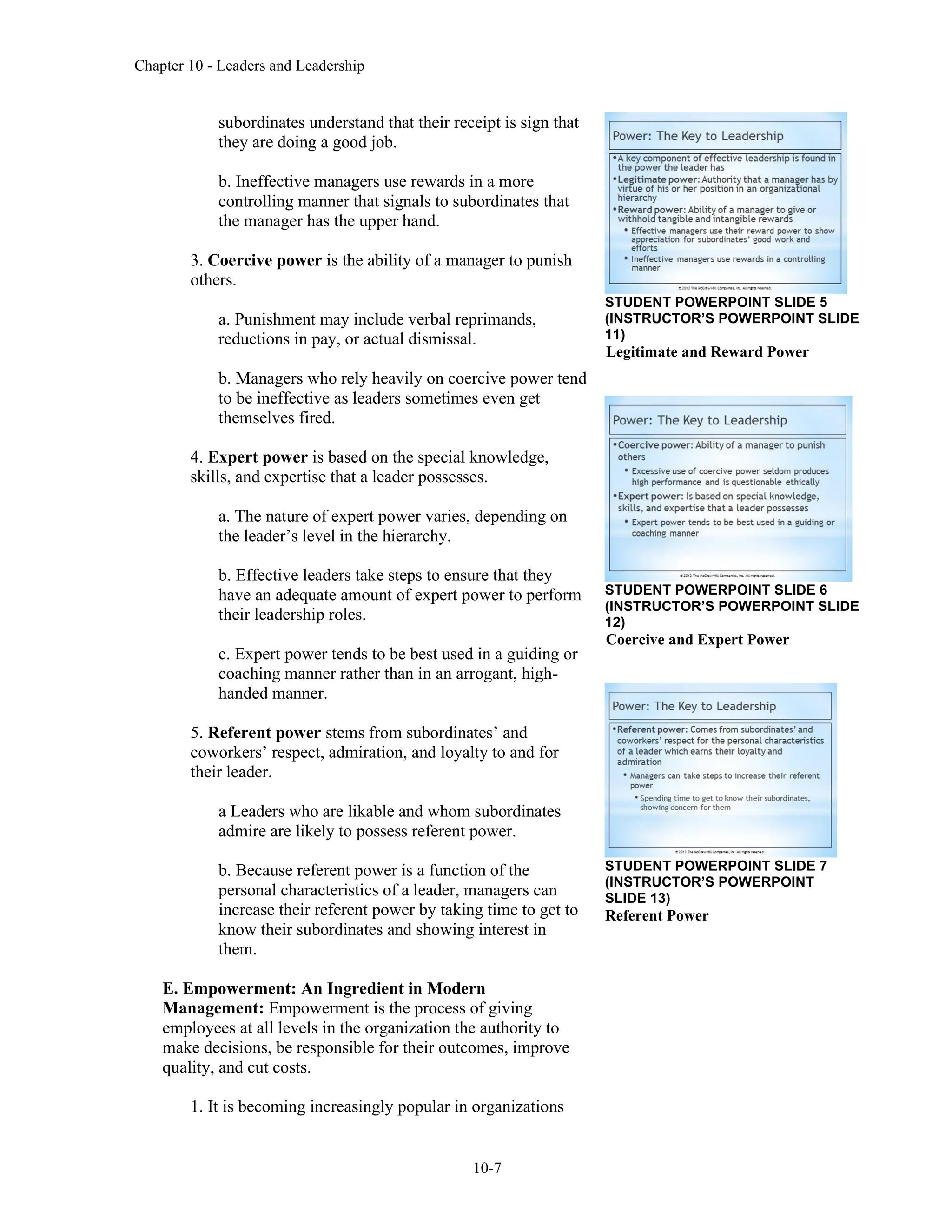
a. Effective managers use their reward power so that
been committed to excellent customer
service, great food, and a commitment to
people and community. As part of their
commitment to people and community,
founders Weinzweig and Saginaw have
incorporated servant leadership into their
personal leadership styles. They realize that
increasing success means increasing
responsibility to serve others, and doing
what’s best for the company. Weinzweig
and Saginaw also have a strong sense of
commitment to serving the local
community; Zingerman’s founded the
nonprofit organization Food Gatherers to
eliminate hunger and distribute food to the
needy, and Food Gatherers is now an
independent nonprofit responsible for the
Washtenaw County Food Bank with over
5,000 volunteers and a 19-member staff.On
Zingerman’s 20th anniversary, 13 nonprofit
community organizations in Ann Arbor
erected a plaque next to Zingerman’s
Delicatessen with a dedication that read,
“Thank you for feeding, sheltering,
educating, uplifting, and inspiring an entire
community.” Clearly, for Weinzweig and
Saginaw, leadership does entail being of
service to others
(Box in text on pp. 318-319).
STUDENT POWERPOINT SLIDE 4
(INSTRUCTOR’S POWERPOINT SLIDE 9)
Figure 10.1 – Sources of Managerial
Power
11.
Chapter 10 -Leaders and Leadership
10-7
subordinates understand that their receipt is sign that
they are doing a good job.
b. Ineffective managers use rewards in a more
controlling manner that signals to subordinates that
the manager has the upper hand.
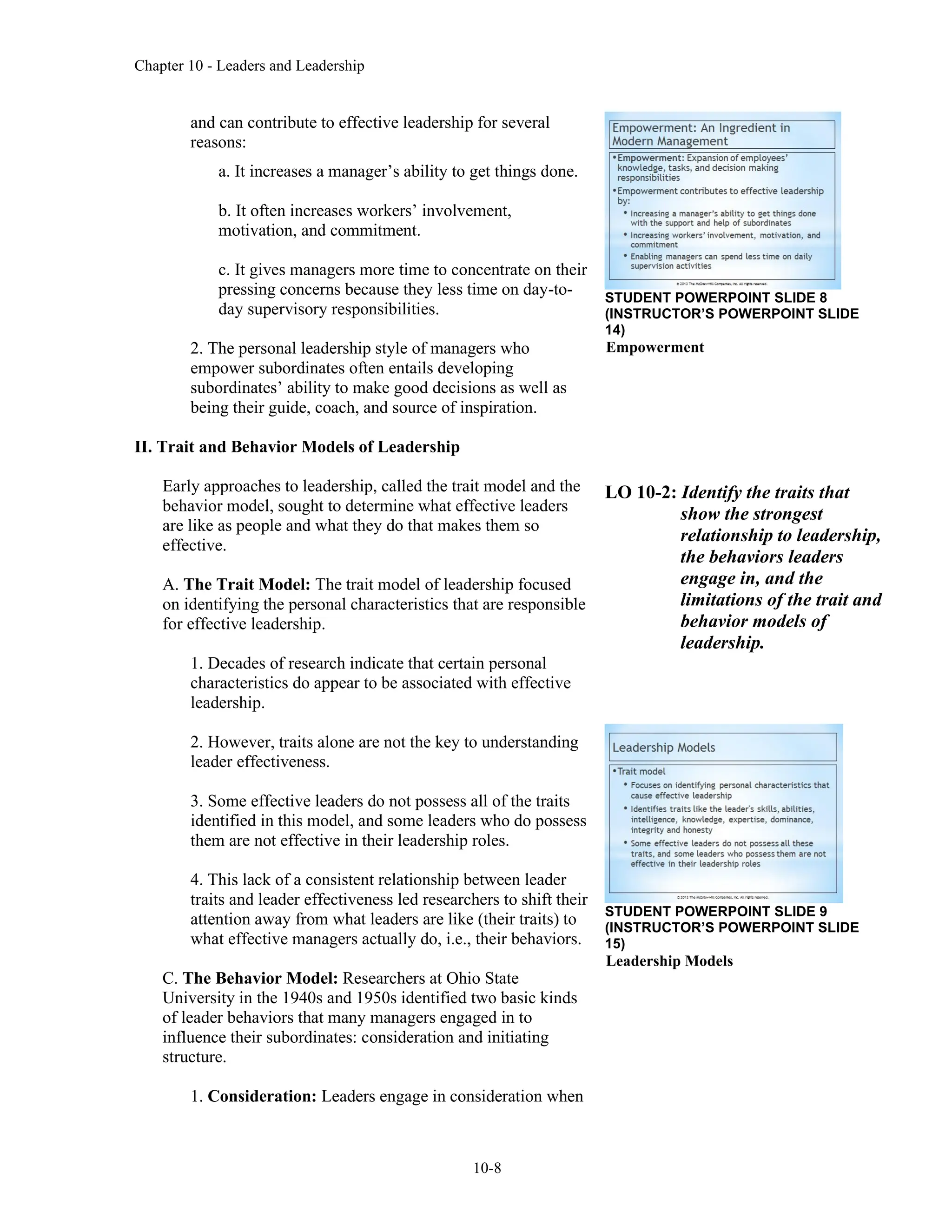
3. Coercive power is the ability of a manager to punish
others.
a. Punishment may include verbal reprimands,
reductions in pay, or actual dismissal.
b. Managers who rely heavily on coercive power tend
to be ineffective as leaders sometimes even get
themselves fired.
4. Expert power is based on the special knowledge,
skills, and expertise that a leader possesses.
a. The nature of expert power varies, depending on
the leader’s level in the hierarchy.
b. Effective leaders take steps to ensure that they
have an adequate amount of expert power to perform
their leadership roles.
c. Expert power tends to be best used in a guiding or
coaching manner rather than in an arrogant, high-
handed manner.
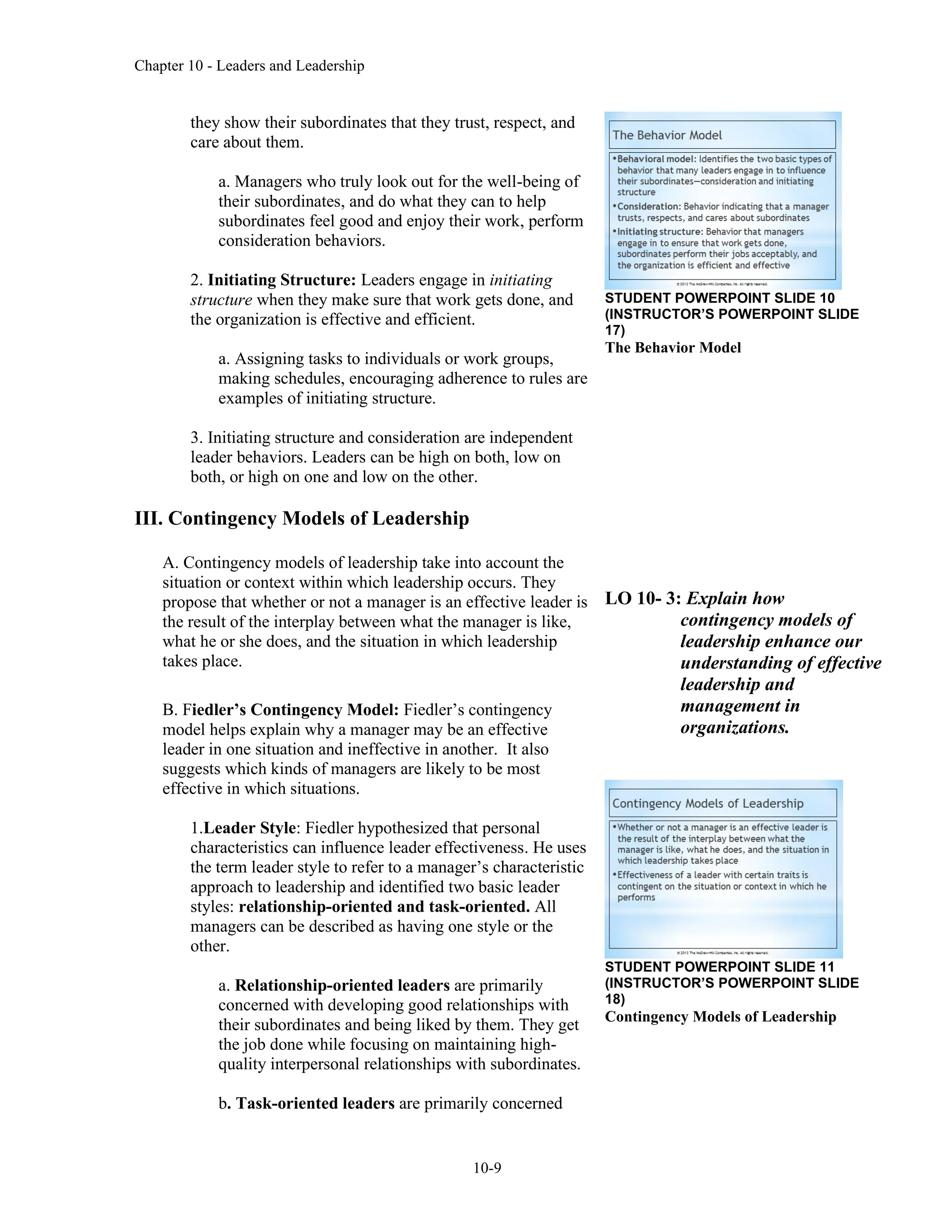
5. Referent power stems from subordinates’ and
coworkers’ respect, admiration, and loyalty to and for
their leader.
a Leaders who are likable and whom subordinates
admire are likely to possess referent power.
b. Because referent power is a function of the
personal characteristics of a leader, managers can
increase their referent power by taking time to get to
know their subordinates and showing interest in
them.
E. Empowerment: An Ingredient in Modern
Management: Empowerment is the process of giving
employees at all levels in the organization the authority to
make decisions, be responsible for their outcomes, improve
quality, and cut costs.
1. It is becoming increasingly popular in organizations
STUDENT POWERPOINT SLIDE 5
(INSTRUCTOR’S POWERPOINT SLIDE
11)
Legitimate and Reward Power
STUDENT POWERPOINT SLIDE 6
(INSTRUCTOR’S POWERPOINT SLIDE
12)
Coercive and Expert Power
STUDENT POWERPOINT SLIDE 7
(INSTRUCTOR’S POWERPOINT
SLIDE 13)
Referent Power
12.
Chapter 10 -Leaders and Leadership
10-8
and can contribute to effective leadership for several
reasons:
a. It increases a manager’s ability to get things done.
b. It often increases workers’ involvement,
motivation, and commitment.
c. It gives managers more time to concentrate on their
pressing concerns because they less time on day-to-
day supervisory responsibilities.
2. The personal leadership style of managers who
empower subordinates often entails developing
subordinates’ ability to make good decisions as well as
being their guide, coach, and source of inspiration.
II. Trait and Behavior Models of Leadership
Early approaches to leadership, called the trait model and the
behavior model, sought to determine what effective leaders
are like as people and what they do that makes them so
effective.
A. The Trait Model: The trait model of leadership focused
on identifying the personal characteristics that are responsible
for effective leadership.
1. Decades of research indicate that certain personal
characteristics do appear to be associated with effective
leadership.
2. However, traits alone are not the key to understanding
leader effectiveness.
3. Some effective leaders do not possess all of the traits
identified in this model, and some leaders who do possess
them are not effective in their leadership roles.
4. This lack of a consistent relationship between leader
traits and leader effectiveness led researchers to shift their
attention away from what leaders are like (their traits) to
what effective managers actually do, i.e., their behaviors.
C. The Behavior Model: Researchers at Ohio State
University in the 1940s and 1950s identified two basic kinds
of leader behaviors that many managers engaged in to
influence their subordinates: consideration and initiating
structure.
1. Consideration: Leaders engage in consideration when
STUDENT POWERPOINT SLIDE 8
(INSTRUCTOR’S POWERPOINT SLIDE
14)
Empowerment
LO 10-2: Identify the traits that
show the strongest
relationship to leadership,
the behaviors leaders
engage in, and the
limitations of the trait and
behavior models of
leadership.
STUDENT POWERPOINT SLIDE 9
(INSTRUCTOR’S POWERPOINT SLIDE
15)
Leadership Models
13.
Chapter 10 -Leaders and Leadership
10-9
they show their subordinates that they trust, respect, and
care about them.
a. Managers who truly look out for the well-being of
their subordinates, and do what they can to help
subordinates feel good and enjoy their work, perform
consideration behaviors.
2. Initiating Structure: Leaders engage in initiating
structure when they make sure that work gets done, and
the organization is effective and efficient.
a. Assigning tasks to individuals or work groups,
making schedules, encouraging adherence to rules are
examples of initiating structure.
3. Initiating structure and consideration are independent
leader behaviors. Leaders can be high on both, low on
both, or high on one and low on the other.
III. Contingency Models of Leadership
A. Contingency models of leadership take into account the
situation or context within which leadership occurs. They
propose that whether or not a manager is an effective leader is
the result of the interplay between what the manager is like,
what he or she does, and the situation in which leadership
takes place.
B. Fiedler’s Contingency Model: Fiedler’s contingency
model helps explain why a manager may be an effective
leader in one situation and ineffective in another. It also
suggests which kinds of managers are likely to be most
effective in which situations.
1.Leader Style: Fiedler hypothesized that personal
characteristics can influence leader effectiveness. He uses
the term leader style to refer to a manager’s characteristic
approach to leadership and identified two basic leader
styles: relationship-oriented and task-oriented. All
managers can be described as having one style or the
other.
a. Relationship-oriented leaders are primarily
concerned with developing good relationships with
their subordinates and being liked by them. They get
the job done while focusing on maintaining high-
quality interpersonal relationships with subordinates.
b. Task-oriented leaders are primarily concerned
STUDENT POWERPOINT SLIDE 10
(INSTRUCTOR’S POWERPOINT SLIDE
17)
The Behavior Model
LO 10- 3: Explain how
contingency models of
leadership enhance our
understanding of effective
leadership and
management in
organizations.
STUDENT POWERPOINT SLIDE 11
(INSTRUCTOR’S POWERPOINT SLIDE
18)
Contingency Models of Leadership
14.
Chapter 10 -Leaders and Leadership
10-10
with ensuring that subordinates perform at a high
level. Task-oriented managers focus on task
accomplishment and making sure the job gets done.
c. According Fielder, leadership style is an enduring
characteristic. Managers cannot change their style,
nor can they adopt different styles in different kinds
of situations.
2 Situational Characteristics: Fielder identified three
situational characteristics that are important determinants
of how favorable a situation is for leading. According to
Fielder, if a situation is favorable for leading, it is
relatively easy for a manager to influence subordinates so
that they perform at a high level. In a situation that is
unfavorable for leading, it is much more difficult for a
manager to exert influence.
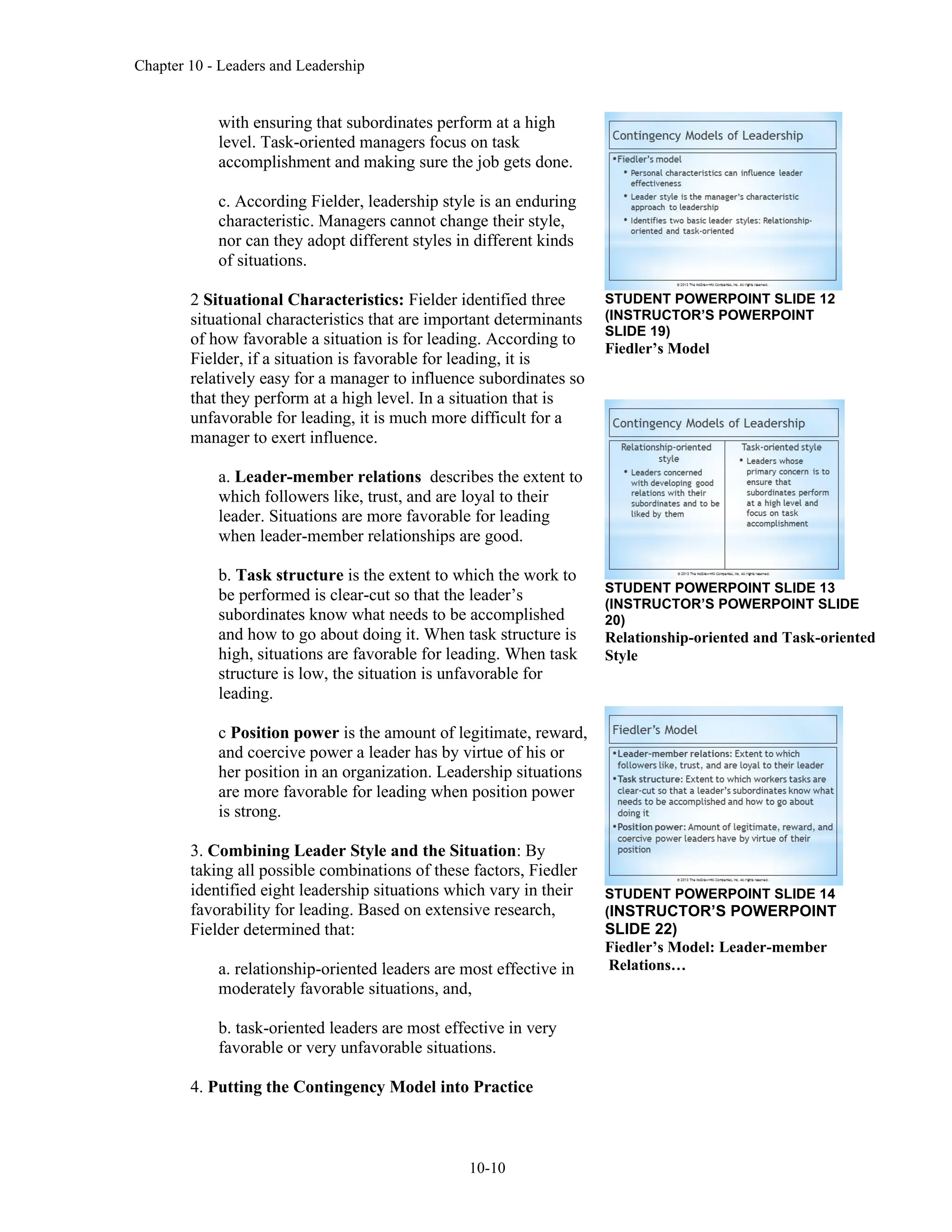
a. Leader-member relations describes the extent to
which followers like, trust, and are loyal to their
leader. Situations are more favorable for leading
when leader-member relationships are good.
b. Task structure is the extent to which the work to
be performed is clear-cut so that the leader’s
subordinates know what needs to be accomplished
and how to go about doing it. When task structure is
high, situations are favorable for leading. When task
structure is low, the situation is unfavorable for
leading.
c Position power is the amount of legitimate, reward,
and coercive power a leader has by virtue of his or
her position in an organization. Leadership situations
are more favorable for leading when position power
is strong.
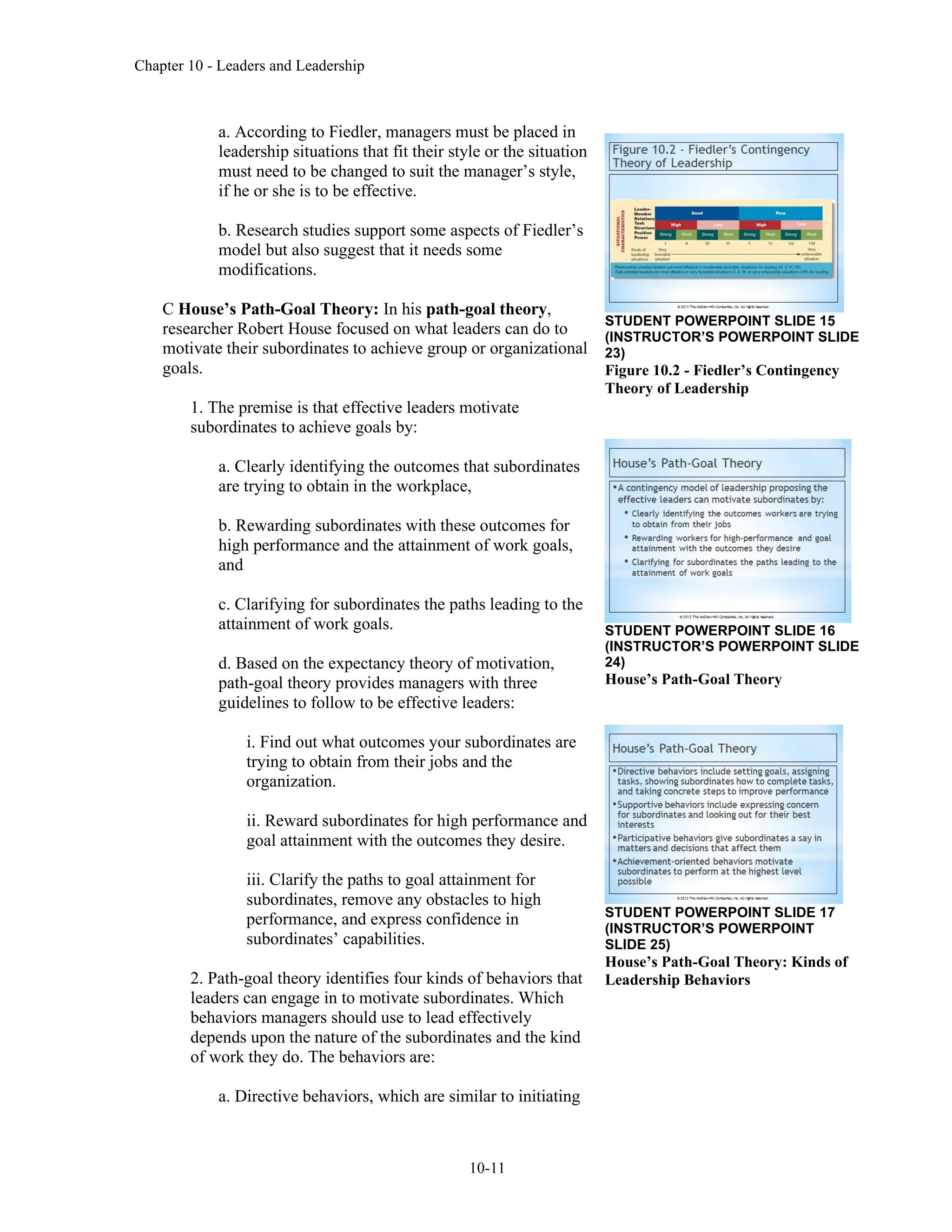
3. Combining Leader Style and the Situation: By
taking all possible combinations of these factors, Fiedler
identified eight leadership situations which vary in their
favorability for leading. Based on extensive research,
Fielder determined that:
a. relationship-oriented leaders are most effective in
moderately favorable situations, and,
b. task-oriented leaders are most effective in very
favorable or very unfavorable situations.
4. Putting the Contingency Model into Practice
STUDENT POWERPOINT SLIDE 12
(INSTRUCTOR’S POWERPOINT
SLIDE 19)
Fiedler’s Model
STUDENT POWERPOINT SLIDE 13
(INSTRUCTOR’S POWERPOINT SLIDE
20)
Relationship-oriented and Task-oriented
Style
STUDENT POWERPOINT SLIDE 14
(INSTRUCTOR’S POWERPOINT
SLIDE 22)
Fiedler’s Model: Leader-member
Relations…
15.
Chapter 10 -Leaders and Leadership
10-11
a. According to Fiedler, managers must be placed in
leadership situations that fit their style or the situation
must need to be changed to suit the manager’s style,
if he or she is to be effective.
b. Research studies support some aspects of Fiedler’s
model but also suggest that it needs some
modifications.
C House’s Path-Goal Theory: In his path-goal theory,
researcher Robert House focused on what leaders can do to
motivate their subordinates to achieve group or organizational
goals.
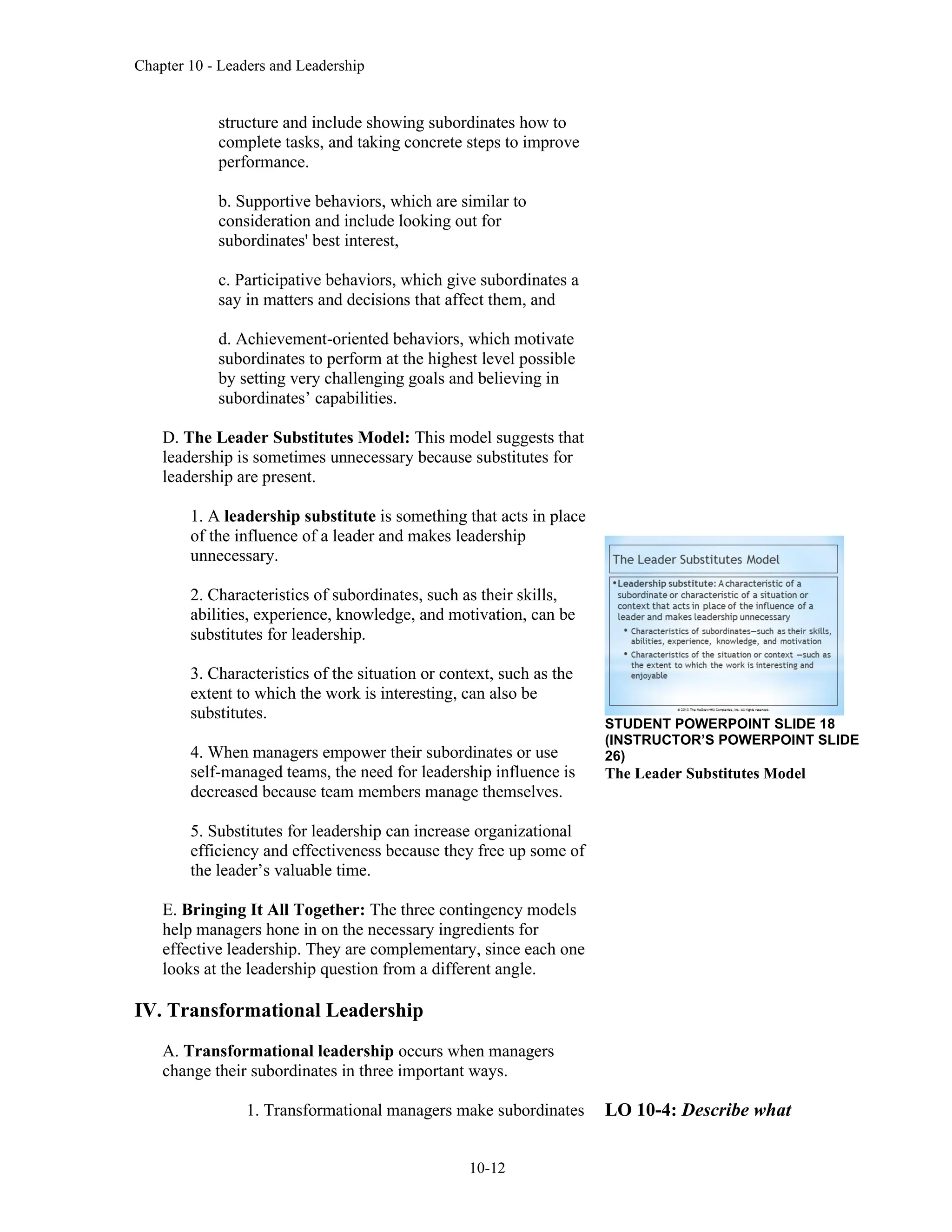
1. The premise is that effective leaders motivate
subordinates to achieve goals by:
a. Clearly identifying the outcomes that subordinates
are trying to obtain in the workplace,
b. Rewarding subordinates with these outcomes for
high performance and the attainment of work goals,
and
c. Clarifying for subordinates the paths leading to the
attainment of work goals.
d. Based on the expectancy theory of motivation,
path-goal theory provides managers with three
guidelines to follow to be effective leaders:
i. Find out what outcomes your subordinates are
trying to obtain from their jobs and the
organization.
ii. Reward subordinates for high performance and
goal attainment with the outcomes they desire.
iii. Clarify the paths to goal attainment for
subordinates, remove any obstacles to high
performance, and express confidence in
subordinates’ capabilities.
2. Path-goal theory identifies four kinds of behaviors that
leaders can engage in to motivate subordinates. Which
behaviors managers should use to lead effectively
depends upon the nature of the subordinates and the kind
of work they do. The behaviors are:
a. Directive behaviors, which are similar to initiating
STUDENT POWERPOINT SLIDE 15
(INSTRUCTOR’S POWERPOINT SLIDE
23)
Figure 10.2 - Fiedler’s Contingency
Theory of Leadership
STUDENT POWERPOINT SLIDE 16
(INSTRUCTOR’S POWERPOINT SLIDE
24)
House’s Path-Goal Theory
STUDENT POWERPOINT SLIDE 17
(INSTRUCTOR’S POWERPOINT
SLIDE 25)
House’s Path-Goal Theory: Kinds of
Leadership Behaviors
16.
Chapter 10 -Leaders and Leadership
10-12
structure and include showing subordinates how to
complete tasks, and taking concrete steps to improve
performance.
b. Supportive behaviors, which are similar to
consideration and include looking out for
subordinates' best interest,
c. Participative behaviors, which give subordinates a
say in matters and decisions that affect them, and
d. Achievement-oriented behaviors, which motivate
subordinates to perform at the highest level possible
by setting very challenging goals and believing in
subordinates’ capabilities.
D. The Leader Substitutes Model: This model suggests that
leadership is sometimes unnecessary because substitutes for
leadership are present.
1. A leadership substitute is something that acts in place
of the influence of a leader and makes leadership
unnecessary.
2. Characteristics of subordinates, such as their skills,
abilities, experience, knowledge, and motivation, can be
substitutes for leadership.
3. Characteristics of the situation or context, such as the
extent to which the work is interesting, can also be
substitutes.
4. When managers empower their subordinates or use
self-managed teams, the need for leadership influence is
decreased because team members manage themselves.
5. Substitutes for leadership can increase organizational
efficiency and effectiveness because they free up some of
the leader’s valuable time.
E. Bringing It All Together: The three contingency models
help managers hone in on the necessary ingredients for
effective leadership. They are complementary, since each one
looks at the leadership question from a different angle.
IV. Transformational Leadership
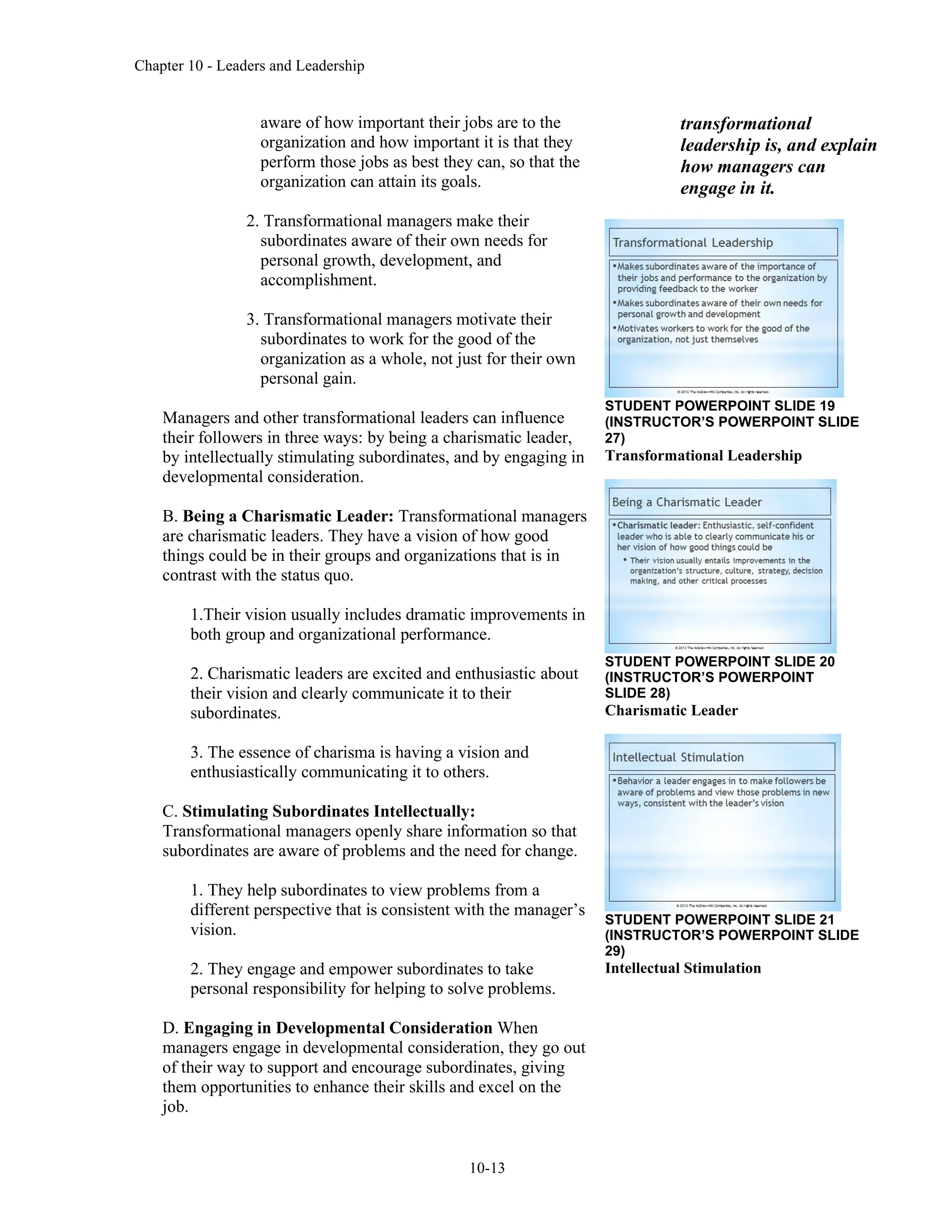
A. Transformational leadership occurs when managers
change their subordinates in three important ways.
1. Transformational managers make subordinates
STUDENT POWERPOINT SLIDE 18
(INSTRUCTOR’S POWERPOINT SLIDE
26)
The Leader Substitutes Model
LO 10-4: Describe what
17.
Chapter 10 -Leaders and Leadership
10-13
aware of how important their jobs are to the
organization and how important it is that they
perform those jobs as best they can, so that the
organization can attain its goals.
2. Transformational managers make their
subordinates aware of their own needs for
personal growth, development, and
accomplishment.
3. Transformational managers motivate their
subordinates to work for the good of the
organization as a whole, not just for their own
personal gain.
Managers and other transformational leaders can influence
their followers in three ways: by being a charismatic leader,
by intellectually stimulating subordinates, and by engaging in
developmental consideration.
B. Being a Charismatic Leader: Transformational managers
are charismatic leaders. They have a vision of how good
things could be in their groups and organizations that is in
contrast with the status quo.
1.Their vision usually includes dramatic improvements in
both group and organizational performance.
2. Charismatic leaders are excited and enthusiastic about
their vision and clearly communicate it to their
subordinates.
3. The essence of charisma is having a vision and
enthusiastically communicating it to others.
C. Stimulating Subordinates Intellectually:
Transformational managers openly share information so that
subordinates are aware of problems and the need for change.
1. They help subordinates to view problems from a
different perspective that is consistent with the manager’s
vision.
2. They engage and empower subordinates to take
personal responsibility for helping to solve problems.
D. Engaging in Developmental Consideration When
managers engage in developmental consideration, they go out
of their way to support and encourage subordinates, giving
them opportunities to enhance their skills and excel on the
job.
transformational
leadership is, and explain
how managers can
engage in it.
STUDENT POWERPOINT SLIDE 19
(INSTRUCTOR’S POWERPOINT SLIDE
27)
Transformational Leadership
STUDENT POWERPOINT SLIDE 20
(INSTRUCTOR’S POWERPOINT
SLIDE 28)
Charismatic Leader
STUDENT POWERPOINT SLIDE 21
(INSTRUCTOR’S POWERPOINT SLIDE
29)
Intellectual Stimulation
18.
Chapter 10 -Leaders and Leadership
10-14
E. The Distinction Between Transformational and
Transactional Leadership
1. Transformational leadership is often contrasted with
transactional leadership.
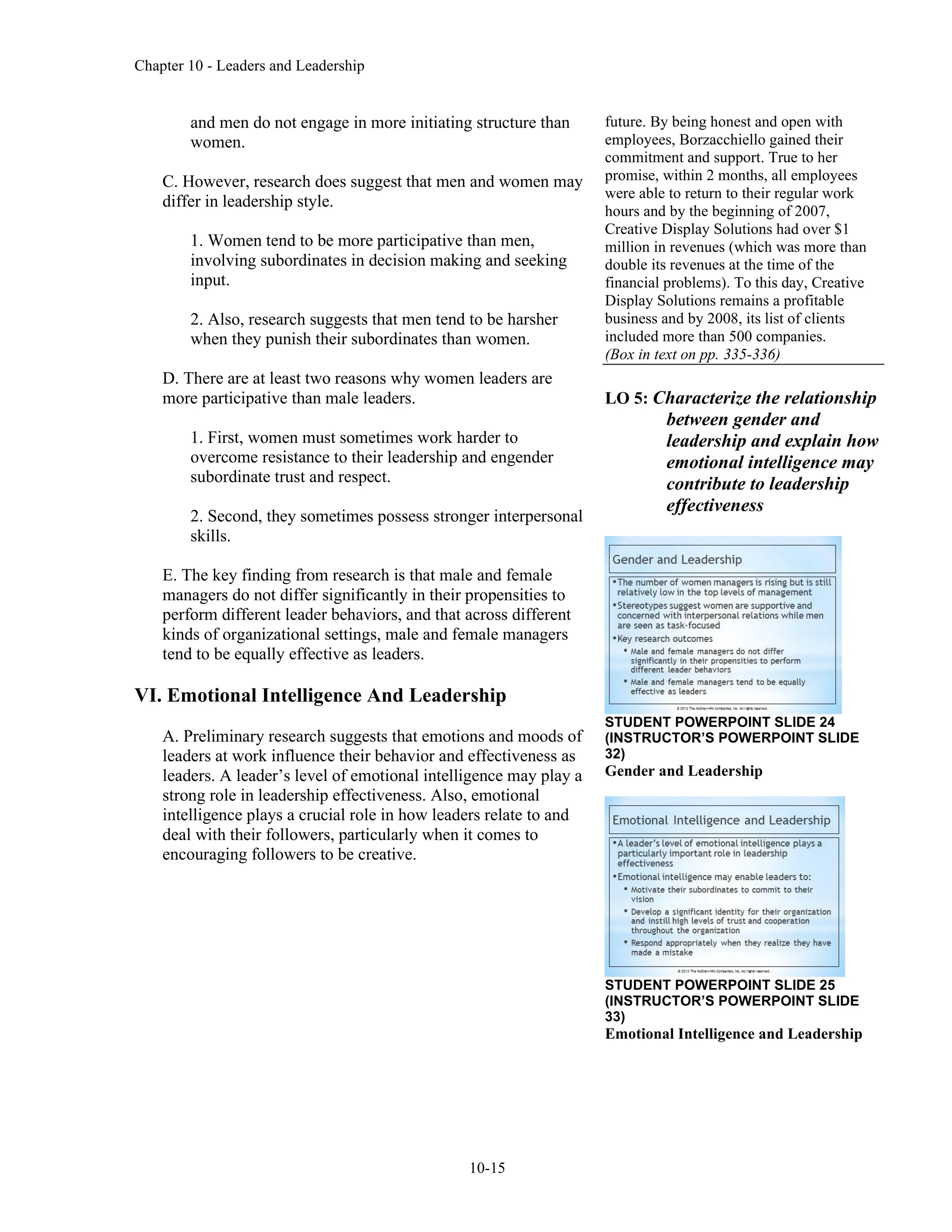
2. Transactional leadership involves managers using
their reward and coercive power to encourage high
performance.
a. When managers reward high performers,
reprimand low performers, and motivate by
reinforcing desired behaviors, they are engaging in
transactional leadership.
b. Many transformational leaders engage in
transactional leadership, but at the same time have
their eyes on the bigger picture of how much better
things could be in their organizations.
3. Research has found that when leaders engage in
transformational leadership, subordinates tend to have
higher levels of job satisfaction and performance. Also,
they are more likely to trust their leaders, trust their
organizations, and feel that they are being treated fairly.
This, in turn, may positively influence their motivation
level.
V. Gender and Leadership
A. Although there are relatively more women in management
positions today than ten years ago, there are relatively few
women in top management, and in some organizations, even
in middle management. When women do advance to top
management positions, special attention is often focused on
the fact that they are women.
B. A widespread stereotype of women in management is that
they are nurturing, supportive, and concerned with
interpersonal relations.
1. Such stereotypes suggest that women tend to be more
relationship oriented as managers and engage in more
consideration behaviors, whereas men are more task
oriented and engage in more initiating structure
behaviors.
2. However, research suggests that that male and female
managers in leadership positions behave in similar ways.
Women do not engage in more consideration than men,
STUDENT POWERPOINT SLIDE 22
(INSTRUCTOR’S POWERPOINT SLIDE
30)
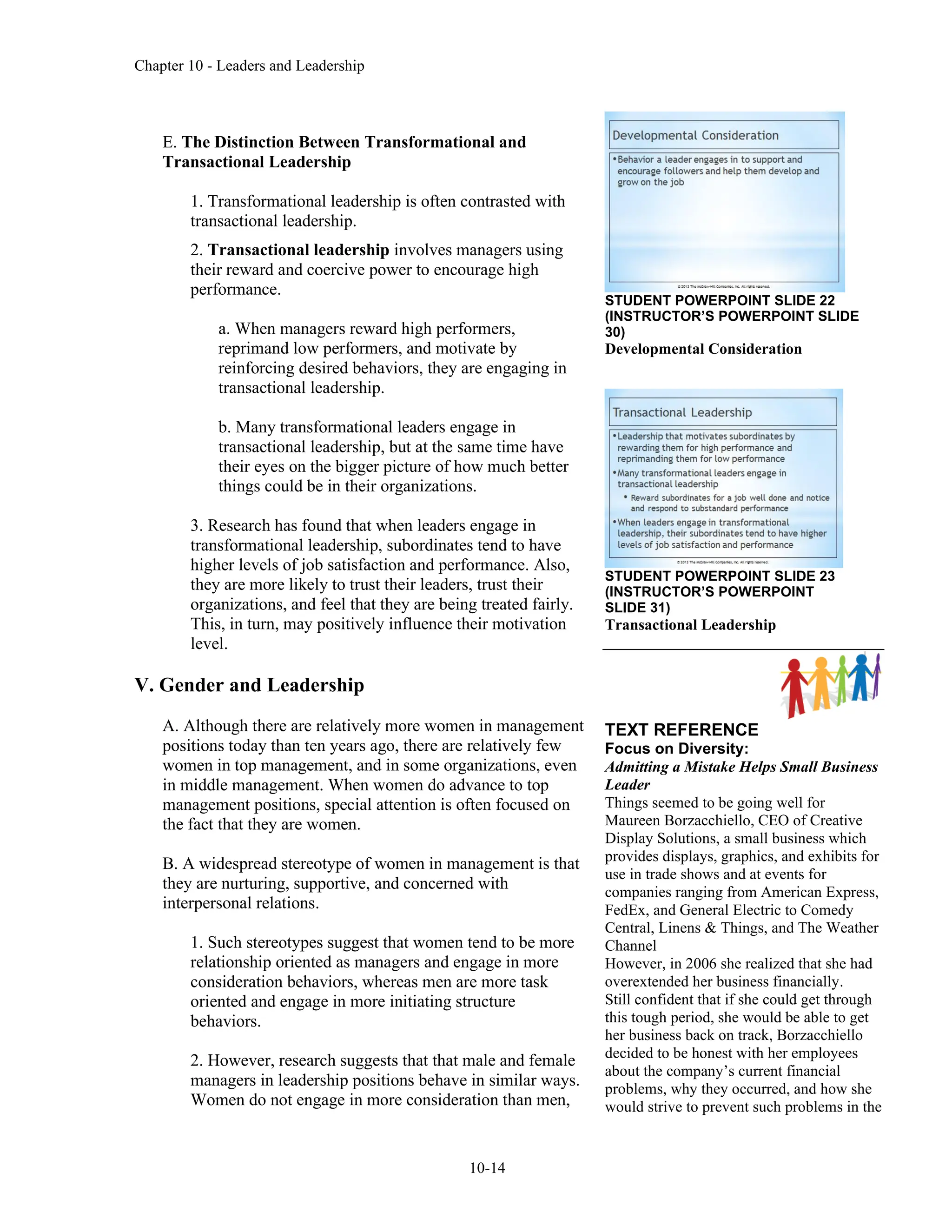
Developmental Consideration
STUDENT POWERPOINT SLIDE 23
(INSTRUCTOR’S POWERPOINT
SLIDE 31)
Transactional Leadership
TEXT REFERENCE
Focus on Diversity:
Admitting a Mistake Helps Small Business
Leader
Things seemed to be going well for
Maureen Borzacchiello, CEO of Creative
Display Solutions, a small business which
provides displays, graphics, and exhibits for
use in trade shows and at events for
companies ranging from American Express,
FedEx, and General Electric to Comedy
Central, Linens & Things, and The Weather
Channel
However, in 2006 she realized that she had
overextended her business financially.
Still confident that if she could get through
this tough period, she would be able to get
her business back on track, Borzacchiello
decided to be honest with her employees
about the company’s current financial
problems, why they occurred, and how she
would strive to prevent such problems in the
19.
Chapter 10 -Leaders and Leadership
10-15
and men do not engage in more initiating structure than
women.
C. However, research does suggest that men and women may
differ in leadership style.
1. Women tend to be more participative than men,
involving subordinates in decision making and seeking
input.
2. Also, research suggests that men tend to be harsher
when they punish their subordinates than women.
D. There are at least two reasons why women leaders are
more participative than male leaders.
1. First, women must sometimes work harder to
overcome resistance to their leadership and engender
subordinate trust and respect.
2. Second, they sometimes possess stronger interpersonal
skills.
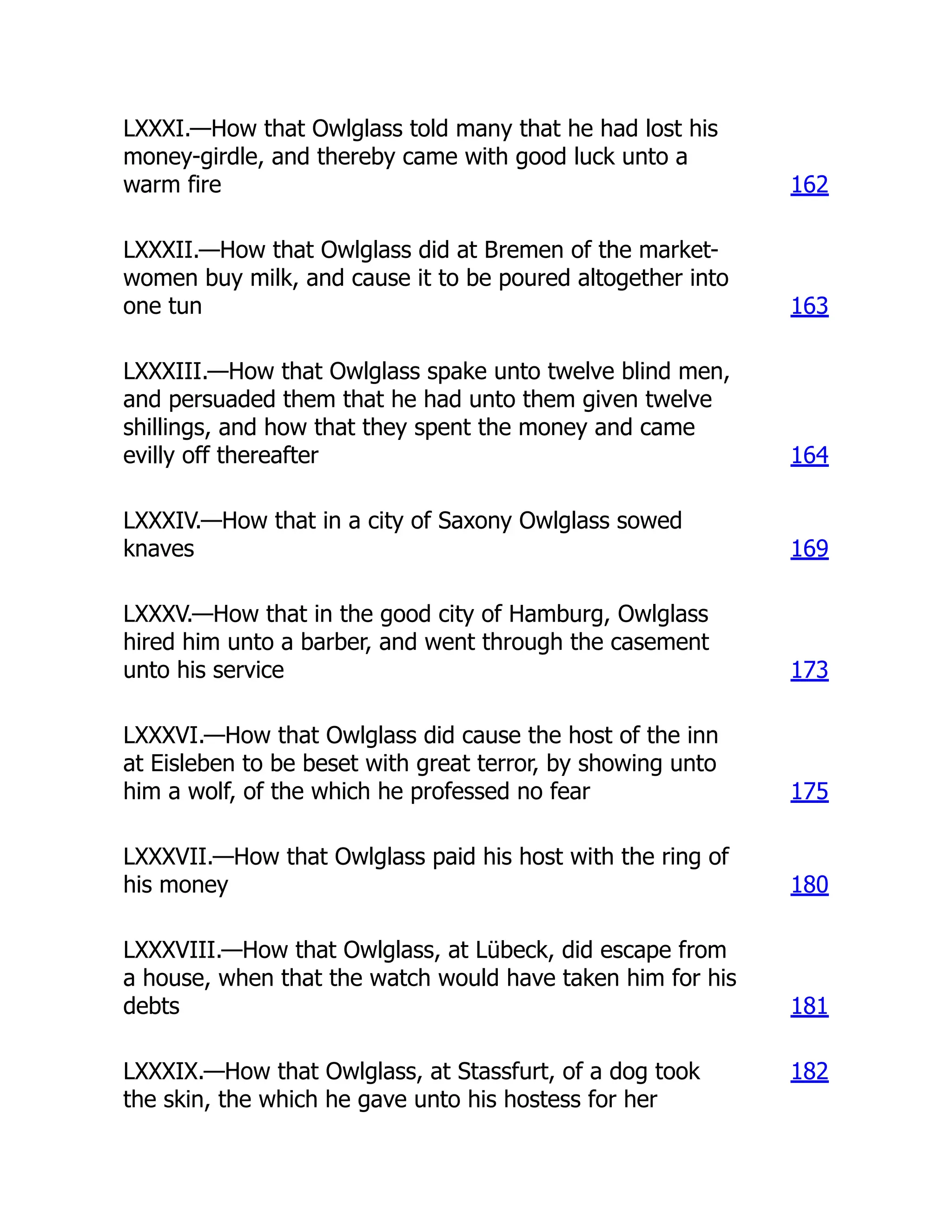
E. The key finding from research is that male and female
managers do not differ significantly in their propensities to
perform different leader behaviors, and that across different
kinds of organizational settings, male and female managers
tend to be equally effective as leaders.
VI. Emotional Intelligence And Leadership
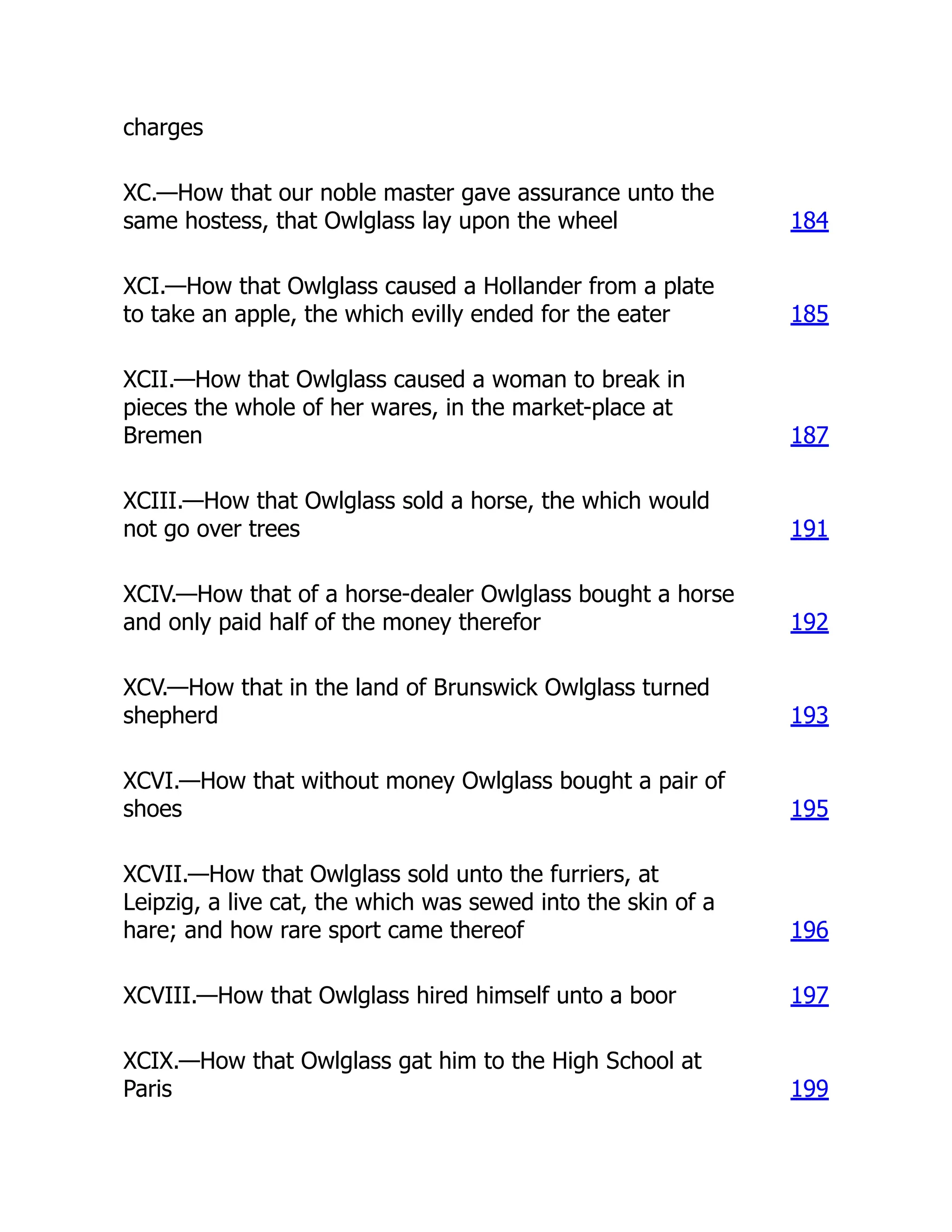
A. Preliminary research suggests that emotions and moods of
leaders at work influence their behavior and effectiveness as
leaders. A leader’s level of emotional intelligence may play a
strong role in leadership effectiveness. Also, emotional
intelligence plays a crucial role in how leaders relate to and
deal with their followers, particularly when it comes to
encouraging followers to be creative.
future. By being honest and open with
employees, Borzacchiello gained their
commitment and support. True to her
promise, within 2 months, all employees
were able to return to their regular work
hours and by the beginning of 2007,
Creative Display Solutions had over $1
million in revenues (which was more than
double its revenues at the time of the
financial problems). To this day, Creative
Display Solutions remains a profitable
business and by 2008, its list of clients
included more than 500 companies.
(Box in text on pp. 335-336)
LO 5: Characterize the relationship
between gender and
leadership and explain how
emotional intelligence may
contribute to leadership
effectiveness
STUDENT POWERPOINT SLIDE 24
(INSTRUCTOR’S POWERPOINT SLIDE
32)
Gender and Leadership
STUDENT POWERPOINT SLIDE 25
(INSTRUCTOR’S POWERPOINT SLIDE
33)
Emotional Intelligence and Leadership
LXXXI.—How that Owlglasstold many that he had lost his
money-girdle, and thereby came with good luck unto a
warm fire 162
LXXXII.—How that Owlglass did at Bremen of the market-
women buy milk, and cause it to be poured altogether into
one tun 163
LXXXIII.—How that Owlglass spake unto twelve blind men,
and persuaded them that he had unto them given twelve
shillings, and how that they spent the money and came
evilly off thereafter 164
LXXXIV.—How that in a city of Saxony Owlglass sowed
knaves 169
LXXXV.—How that in the good city of Hamburg, Owlglass
hired him unto a barber, and went through the casement
unto his service 173
LXXXVI.—How that Owlglass did cause the host of the inn
at Eisleben to be beset with great terror, by showing unto
him a wolf, of the which he professed no fear 175
LXXXVII.—How that Owlglass paid his host with the ring of
his money 180
LXXXVIII.—How that Owlglass, at Lübeck, did escape from
a house, when that the watch would have taken him for his
debts 181
LXXXIX.—How that Owlglass, at Stassfurt, of a dog took
the skin, the which he gave unto his hostess for her
182
22.
charges
XC.—How that ournoble master gave assurance unto the
same hostess, that Owlglass lay upon the wheel 184
XCI.—How that Owlglass caused a Hollander from a plate
to take an apple, the which evilly ended for the eater 185
XCII.—How that Owlglass caused a woman to break in
pieces the whole of her wares, in the market-place at
Bremen 187
XCIII.—How that Owlglass sold a horse, the which would
not go over trees 191
XCIV.—How that of a horse-dealer Owlglass bought a horse
and only paid half of the money therefor 192
XCV.—How that in the land of Brunswick Owlglass turned
shepherd 193
XCVI.—How that without money Owlglass bought a pair of
shoes 195
XCVII.—How that Owlglass sold unto the furriers, at
Leipzig, a live cat, the which was sewed into the skin of a
hare; and how rare sport came thereof 196
XCVIII.—How that Owlglass hired himself unto a boor 197
XCIX.—How that Owlglass gat him to the High School at
Paris 199
23.
C.—How Owlglass wouldfain have been an innkeeper at
Rouen, but was beguiled by a one-eyed man, and again, in
turn, cozened him 199
CI.—How, in Berlin, Owlglass was an officer, and collected
taxes of the boors 201
CII.—How that in his latter days Owlglass became a pious
monk, and what came thereof 203
CIII.—How that when at Möllen Owlglass lay sick, his
mother came unto him 206
CIV.—How that when Owlglass was sick unto death, he
made confession of three things, the which it sorely
troubled him he had not done 207
CV.—Saith, how that to a greedy priest Owlglass confessed
his sins, and paid him handsomely for his pains 209
CVI.—How that Owlglass in three parts did divide all that
belonged unto him; and the one part gave he freely unto
his friends, and another thereof humbly to the town council
of Möllen, and the third part unto the priest there 211
CVII.—How that at Möllen Owlglass died, and the swine did
cast down the coffin when that the good priests sang the
vigil 212
CVIII.—How that our for ever prized Master Owlglass was
buried 213
24.
CIX.—Telleth what stoodupon his gravestone 214
CX.—How in after time our most excellent Owlglass was
esteemed so worthy that he was made a holy Saint; and on
the day of All Fools in April do the folk alway keep his
memory, as also when they do a foolish thing, the which
maketh him continually esteemed of great and small 215
CXI.—Reciteth a few grave reflections of this present
chronicler 216
APPENDICES.
Appendix A.
Bibliographical Notes for the Literary History of
Eulenspiegel 219
Appendix B.
The Historical Eulenspiegel and his Gravestone 240
Appendix C.
Of Dr. Thomas Murner, the Author of Eulenspiegel 244
25.
Appendix D.
The Versesinserted by William Copland in the English
black-letter Howleglas of 1528 247
Appendix E.
The Bakâla Legend of the Valacqs analogous to Owlglass 249
Appendix F.
Works akin to the Eulenspiegel Literature 252
26.
ILLUSTRATIONS.
Cup and Ball(Frontispiece)
Vignette Owlglass (Title)
PAGE
Tyll Owlglass 1
Child Owlglass 4
Beehive borne, coloured 15
Doctor Owlglass, coloured 23
Hot Water Cure 24
Wisdom and Impudence 27
Watchman Owlglass 34
Painter Owlglass 46
Respected Reader 56
27.
Furrier Owlglass 61
PoultererOwlglass, coloured 75
Blacksmith Owlglass 81
Brewer Owlglass, coloured 96
Ware Wolf! 107
Nimble Owlglass 116
Provident Owlglass 121
Sawyer Owlglass 127
Optical Owlglass 129
Nothing like Leather! 132
A Pleasant Sight 137
Horse-dealer Owlglass 144
A Young Bride 151
A Genial Fellow 175
A Fat Friend 186
28.
Unhorsed 191
Shepherd Owlglass194
Owlglass selleth Puss, coloured 196
Monk Owlglass 203
Dip not too deep! coloured 208
The Device of the Owl and Glass 214
Put out the Light! 217
The Gravestone 240
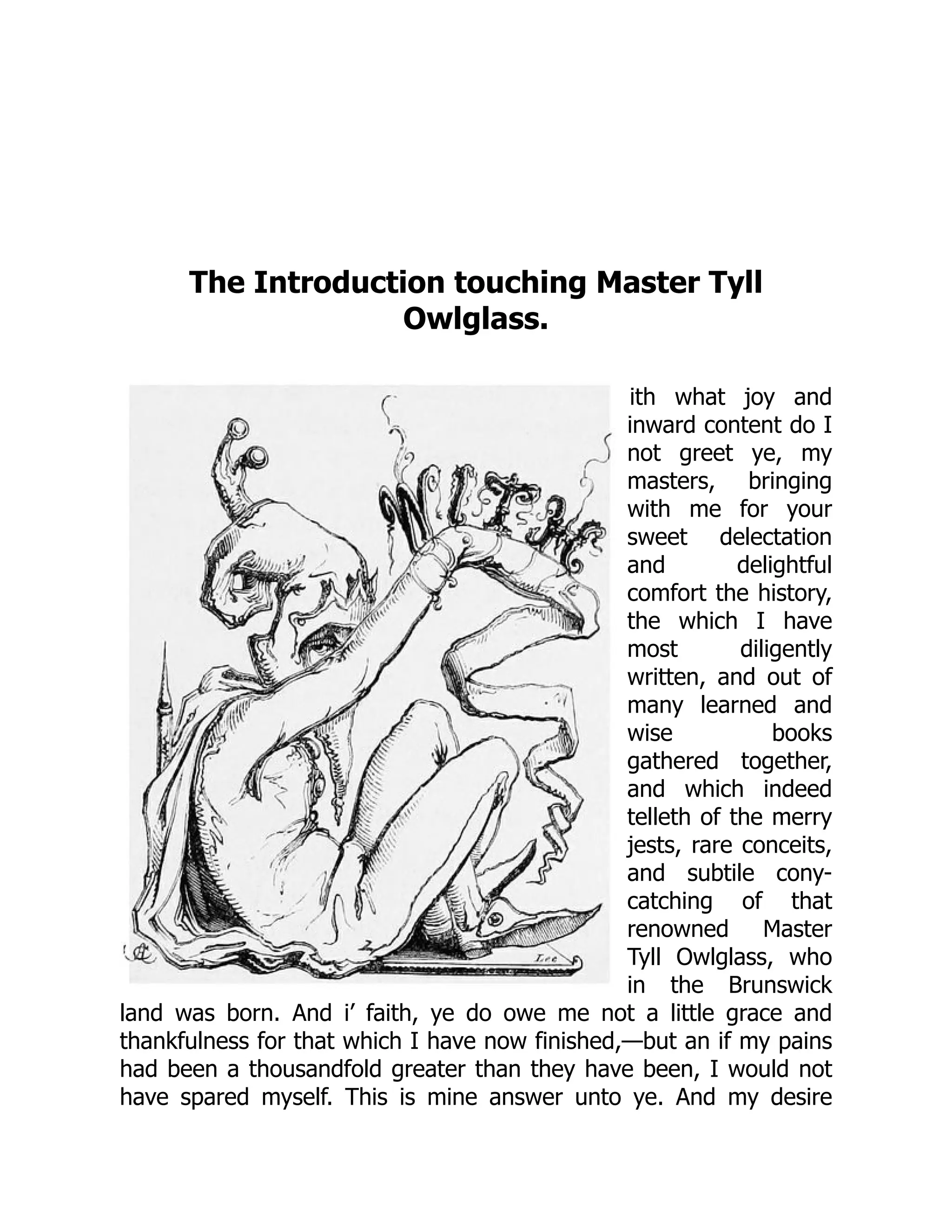
The Introduction touchingMaster Tyll
Owlglass.
ith what joy and
inward content do I
not greet ye, my
masters, bringing
with me for your
sweet delectation
and delightful
comfort the history,
the which I have
most diligently
written, and out of
many learned and
wise books
gathered together,
and which indeed
telleth of the merry
jests, rare conceits,
and subtile cony-
catching of that
renowned Master
Tyll Owlglass, who
in the Brunswick
land was born. And i’ faith, ye do owe me not a little grace and
thankfulness for that which I have now finished,—but an if my pains
had been a thousandfold greater than they have been, I would not
have spared myself. This is mine answer unto ye. And my desire
31.
hath been, thatye shall most merrily sit ye round the fire and laugh
until that your sides shall ache, and your inner man be shaken with
the continual reverberation of your delighted spirit. For an ill heart is
such an one that doth never rejoice, but trembleth ever and anon at
the wonders with the which we be encompassed, so do ye now,
without any other speech from me, accept this little book, and
therein read, and ponder well the deeds of this noble master, who
from low estate and boorish condition rose to be the companion of
princes and dukes, and, by his infinitude of rare parts, remaineth
well known and beloved of all men in divers countries and lands all
over the fair domain of Christendom. And now do I bid ye farewell,
and leave ye with a companion less tedious than am I, and in the
reading of his life will ye not lose your labour, that know I well.
32.
A
The First Adventure.
HowTyll Owlglass was born and was in one
day three times christened.
s verily all creatures must have a beginning of their lives, so that
they may come into this world to abide therein, so also must it
be with the famous Master Owlglass, who lived in Germany many
years, and of whom many notable adventures are told and noised
about all over that country. In the land of Brunswick, in the deep
wood named Melme, lieth a village named Kneitlingen, and there
was born the pious child Owlglass. And the name of his father was
Nicolaus, commonly said Claus, Owlglass, and his mother’s name
was Anna Wertbeck. It fortuned, that when the child was born that
they made a great feast, and sent the child to be christened in the
village of Amptlen; hard by the castle of Amptlen, which was after
destroyed by the people of Magdeburg. And when the child was
baptised, he was called Tyll Owlglass. Truly, however, after that the
feast had come to an end, the godfathers and godmothers of the
child having eaten and drunken right lustily (for it was the custom of
that place most heartily to do these things), set forth on their way
homeward, and the sun being hot, they were tired and they minded
not their steps to be careful of them, and so it came to pass, that
one of them carrying the child caught her foot upon a stone and fell
into a ditch, so child and all were quickly covered with mud. But as
weeds cannot so easily come to harm, the child was not hurt, but
only thus christened in the mire.
33.
When they gothome, the child was washed clean in hot water. Thus
was Owlglass in one day three times christened, first in the church,
then in the mud of the ditch, and at last in warm water. So is it
always shown with great and famous persons, that, in their infancy,
strange and most wonderful things do foreshow their future
greatness.
34.
U
The Second Adventure.
Howthat Owlglass when that he was a child
did give a marvellous answer to a man that
asked the way.
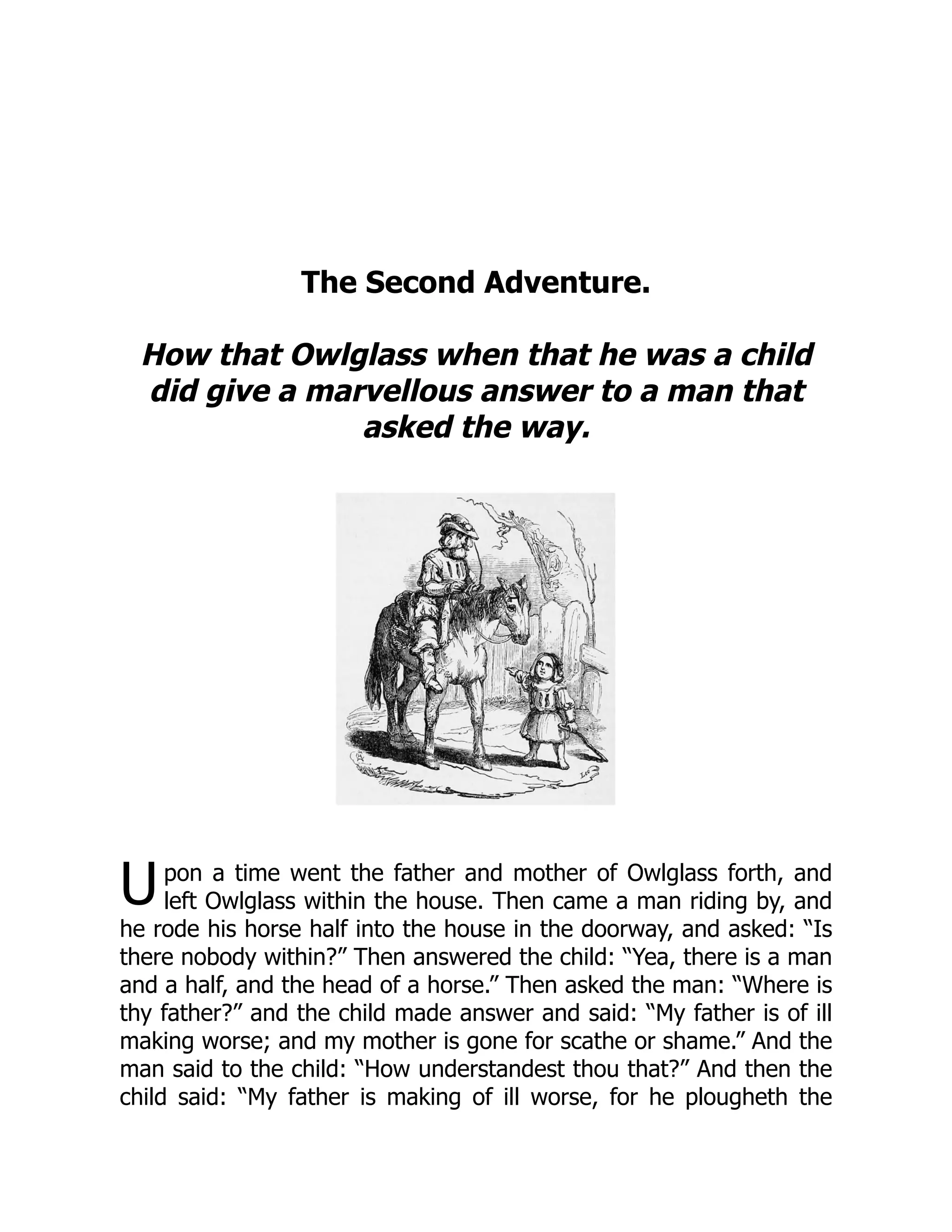
pon a time went the father and mother of Owlglass forth, and
left Owlglass within the house. Then came a man riding by, and
he rode his horse half into the house in the doorway, and asked: “Is
there nobody within?” Then answered the child: “Yea, there is a man
and a half, and the head of a horse.” Then asked the man: “Where is
thy father?” and the child made answer and said: “My father is of ill
making worse; and my mother is gone for scathe or shame.” And the
man said to the child: “How understandest thou that?” And then the
child said: “My father is making of ill worse, for he plougheth the
35.
field and makethgreat holes, that men should fall therein when they
ride. And my mother is gone to borrow bread, and when she giveth
it again and giveth less it is a shame, and when she giveth it and
giveth more it is scathe.” Then said the man: “Which is the way to
ride?” And the child answered and said: “There where the geese go.”
And then rode the man his way to the geese, and when he came to
the geese they flew into the water; then wist he not whither to ride,
but turned again to the child and said: “The geese be flown into the
water, and thus wot I not what to do nor whither to ride.” Then
answered the child: “Ye must ride where the geese go and not
where they swim.” Then departed the man and rode his way, and
marvelled of the answer of the child. Thus from the mouths of babes
cometh forth wisdom and ready conceit.
36.
N
The Third Adventure.
Howall the boors did cry out shame upon
Owlglass for his knavery; and how he rode
upon a horse behind his father.
ow when Owlglass had come to an age to run about, he began
playing divers tricks and knavish actions among the boys of his
village; and he fought and tumbled about upon the grass, that he
looked more like a monkey than a boy. But when it came to pass
that he was four years old, his malice waxed greater and greater, so
that his father was ever being disputed with by the neighbours, who
cried out shame upon Owlglass, as being so great a knave; and
though it happened that his father did scold him with many words,
Owlglass did always excuse himself by knavish answers. Thereat the
father thought he would quickly learn the verity of these sayings of
the neighbours, and at a time when the boors were all walking in the
streets, he did set his son Owlglass behind him on his horse. Then,
also, he commanded Owlglass that he should be most quiet and
silent. What, then, did the pious and good child? He did silently play
tricks and mocked the people, whereon they did most loudly cry out
upon Owlglass: “Fie upon the little malicious knave!”
Now as Owlglass spake never a word in all this time, his father did
not know how it came to pass that the people did cry out so loudly;
and Owlglass complained to him, and said: “Hearest thou, father!
Here sit I silently behind thee upon thy horse and say no word, and
yet the people cry out against me for my knavery.” Then the father
sayeth but little, and taketh Owlglass and setteth him upon the
37.
horse in frontof him. Then did Owlglass open his mouth wide, and
did stretch forth his tongue, in mockery of the people. And the
people did run forth, crying: “Out upon the little knave!” Yet did not
the father see the knavery, but said: “Alas for thee, that thou
shouldst have been born in an unhappy hour!” So much did he love
Owlglass, that he then departed out of the land of Brunswick, and
he did abide in the land of Magdeburg, hard by the river Saale.
In a little time thereafter, so sorrowful was he, that he gave up the
ghost, and left his wife and child in great poverty. Thus it is that
great men are often persecuted and smitten with many blows in
their own land, nor do they find good comfort therein! Owlglass,
although he knew not any handicraft, did grow up and wax older in
knavery; and when that he was sixteen years old, did excel in tricks,
quips, and quiddities.
38.
I
The Fourth Adventure.
HowOwlglass did learn to dance upon a rope,
and did fall therefrom into the river Saale.
t hath been said of old time, by the wise and cunning: “When that
the cat is out of the house, then play the mice.” Thus fared it with
Owlglass after that his father was dead. His mother had become old
and full of years, and she could no longer have the mastery over
Owlglass, and he did learn many greatly knavish conceits. And his
mother was sorely troubled of Owlglass, and bore not with his
knavery.
Now it fortuned, that the house where Owlglass and his mother did
live, lay hard by the river Saale, and Owlglass did go up into the
garret of the house, and there did learn to dance upon a rope, until
that his mother did find him going to and fro upon the rope, and did
so belabour him with a cudgel, that he fled through the window of
the garret on to the roof, where she could not follow him. And this
often came to pass, until he grew older, and she became weak and
of no strength to have power over him. Then thought he, it was time
that he should in open day render it manifest unto all, how great
was his perfection in the art of dancing upon the rope, and he did
stretch the rope across the river Saale, from one house even unto a
house which lay over against them on the other side. And when that
the people beheld such unwonted sport, they did run together, old
and young, in a great crowd, and did marvel much that Owlglass
should go hither and thither in so sure a manner upon the rope.
39.
Happiness is, however,but for the few, and seldom doth evil fortune
fail to sow sorrowful seeds in the midst of joyous doings; and thus
fortuned it, that the mother of Owlglass did hear the shouting of the
people at the feats of Owlglass, and that she might reprove with
heavy punishment the knavery of her son, she hastened to the place
where the rope was tied, and cut it through with a knife secretly.
Then did good Master Owlglass plump into the water with much
mockery and despite; and all the people did laugh greatly thereat,
and Owlglass was vexed, so that he could speak no word; nor did he
fear the bath and the peril of drowning as much as the jests of the
people, who ran after him, blessing the bath with much outcry. Thus
did Master Owlglass come evilly off in his first undertaking.
40.
I
The Fifth Adventure.
HowOwlglass did move two hundred young
people, that they did give unto him their
shoes, with the which he made rare sport upon
his rope.
n no long space of time thereafter, Owlglass did desire to avenge
him, concerning the mockery which befel him after the bath,
therefore did he tie the rope across unto another house, and once
again told the people that he would dance to and fro upon the rope.
Soon did the people come together in great multitude, and there
were in that place both old and young; then Owlglass spake unto
the young people, and said that he would show unto them a most
rare device upon the rope with their shoes. Then did they believe
him, and with that put their shoes off their feet and gave them unto
Owlglass, and he did put them all together upon a string and went
up on to the rope; and all the people thought that he was going to
make some wonderful stroke therewith. But the boys were sad, and
would fain have received their shoes again.
When, therefore, Owlglass was sitting upon the rope and had ended
his trickery, he cried out with a loud voice and spake these words:
“Be ye now every one in readiness, and let him seek his shoes
again;” and he cut the string and threw all the shoes upon the
ground, in such wise that one shoe fell upon another into a great
heap, and none could be distinguished. Then did the people, old and
young, come in great crowds, and caught a shoe here and another
41.
there; and onespake and said this was his shoe, whereat another
did make answer that it was his; and then fell they to fisticuffs, and
with great blows they pulled out the hairs from their heads: one lay
on the ground, and the other belaboured him with sturdy strokes;
and one wept with a loud voice while another did laugh, and a third
screamed like a peacock. Thus went things forward, until the old
men began also to give many stripes to the crowd.
But Owlglass, sitting upon his rope, laughed until his stomach shook
again, and cried out: “Right merry may ye be! Seek ye your shoes
again in that wise in which I sought my way forth from the bath.”
Then did he come down from his rope, and left them in contention;
nor did he again come forth, for fear of the people, but abode at
home with his mother. Thereover did his mother greatly rejoice, and
thought that now he was a wise and gentle person, and soon,
therefore, would things go better with them all. Yet knew she not of
his knavery, and wherefore he dared not go out. But the wisdom of
Owlglass was great; for it is better to abide in darkness with a whole
skin, than live in a palace of light and be beaten with many stripes.
Thus did, therefore, our great example of wit and judgment.
42.
T
The Sixth Adventure.
Howthat Owlglass his mother did move him
that he should learn a handicraft.
he mother of Owlglass was right glad that her son was so still,
and chid him only for that he would learn no handicraft. Yet
answered he never a word unto all her reproofs, the which she was
never tired of bestowing upon him. At last he opened his mouth and
spake unto her, saying: “Dear mother, as it happeneth that one
beginneth action, so also is the ending thereof.” For he knew in his
wisdom, that if he had begun with knavish doings, and should turn
therefrom and live honestly, yet in the world would no one give heed
unto him, but the rather regard him as a greater knave than before,
esteeming him to be a hypocrite as well as a knave. “That believe I
right truly,” answered his mother; “and thus have I seen no bread in
my house these four weeks gone by, nor have I had thereof any.”
“That toucheth not my speech,” said Owlglass. “But with Saint
Nicolaus must the poor man fast upon his even; and if perchance he
should have bread, he may feast right merrily with Saint Martin on
his day. Therefore will we also eat.”
43.
T
The Seventh Adventure.
HowOwlglass did deceive a baker at Strasfurt,
and gat bread for his mother.
hen thought Owlglass: “God help us, how shall I compass it that
my mother may be rendered quiet? Where shall I get me bread
for her needs?” Thus went he forth from the village where they
abode, and departed on the way towards the town of Strasfurt, and
there beheld he a baker’s shop. Then went he in unto the baker, and
asked him, saying: “Would he for a crown send bread unto his lord?”
Then named he the name of a lord who abode in that town, and
also the place where he lay, that the baker might send with Owlglass
a boy to carry the bread and receive the money therefor.
Thereat answered the baker, that he would do everything that he
commanded, and Owlglass gave him a sack wherein to count the
loaves; but this sack had a secret hole, not to be seen. The baker
sent with him a lad to receive the money.
Now when Owlglass had gat him a bow-shot from the house of the
baker, he privily let a wheaten loaf fall down into the mire, and
thereat set he the bag down and said unto the baker’s lad: “Alas! the
bread which is thus made dirty I can never bring in unto my lord.
Run quickly home and get for it another loaf, and I will wait here till
that thou dost come again.” Then hasted the good lad to his
master’s house, and did get another loaf for him; but Owlglass
secretly hid himself in a house outside the town until that a cart
44.
came by, whichdid receive him and his bag; and he returned unto
the house of his mother.
When that the lad came back unto the place where Owlglass had let
the loaf fall, he found that he was beguiled; and he went back and
told his master, who speedily ran unto the inn where lay the
worshipful lord of whom Owlglass spake, and he asked the serving-
men of that lord for Owlglass; but they knew him not. Then the
baker perceived that he was cheated of his bread, and so returned
home. But Owlglass gave the bread to his mother, and bade her to
feast with Saint Martin. Thus can a great man ever overcome the
besetting evils of life.
45.
T
The Eighth Adventure.
HowOwlglass with other children, was forced
to eat fat soup, and gat blows likewise.
here was in the village where Owlglass lived with his mother, a
custom that when anyone killed a pig, the neighbour’s children
came to him in his house to eat a soup or broth, which was called
the butcher-broth. Now there lived in this village a farmer who was
avaricious, and yet he dared not to refuse the children the soup;
then thought he of a cunning way by which he might make them
sick of the soup-eating; and he cut into it the sour crumb of the
bread.
When the boys and girls came, Owlglass also was among them, and
he let them come in, and closed the doors and poured out the soup,
and the broth was more than the children could eat; when one of
them was full and was going away, the farmer had a rod with the
which he struck him, so that each child was forced to eat more than
it wished. The host knew well of the knavery of Owlglass, and
therefore when that he was beating another child he always
bestowed some hearty strokes upon him. And this did he for so long,
as that they had ended all the eating, and that they felt like the dogs
after grass-grazing. Thereafter would no one go unto the stingy
farmer’s house to eat the butcher-broth.
46.
T
The Ninth Adventure.
HowOwlglass brought it about that the stingy
farmer’s poultry drew for baits.
he next day, when he that had beaten the children went forth,
Owlglass met him, and he said unto Owlglass: “Dear Owlglass,
when wilt thou come again to eat the butcher-soup at my house?”
“Yea, that will I,” answered Owlglass, “when thy poultry draw for
baits, and four and four together fight for a little bread.” Then said
the other: “Wilt thou be so long?” But Owlglass said: “An if I came
ere the time of the fat soup hath come?” Then he went on his way
and thought over it until the time that the man’s poultry ran about
the streets; then had Owlglass some twenty strings tied together at
the midst, and at either end of the string was a morsel of bread
hanging. These took he and threw to the poultry. When then the
fowls here and there picked up and swallowed the bread, they could
not keep hold, for at the other end another fowl was pulling, so that
they were contending, and thus from the size of the bread they
could not get rid of it, and so stood more than thirty fowls one over
against the other and in throttling ran a wager.
47.
A
The Tenth Adventure.
HowOwlglass was again moved of his mother
to depart to a foreign land, that he might learn
a handicraft.
fter that Owlglass had played a bitter knavery somewhere, so
that he might not dare show himself, he sat at home with his
mother; and she, with many words, continually chid him, in that he
would learn no craft to get money thereby. And she spake unto him
saying, that he should depart into a foreign land, that he might there
profit somewhat. But his mother had just killed a pig and so long as
our good master Owlglass knew that any of it remained he would
not quit. The mother of Owlglass thereat scolded him, until that he
agreed to set forth, and made a small bundle of clothes and food,
and, at length, went his way. Soon our wise master felt hungry, and
thereat took forth from his wallet the provision he had, and did eat
until there was none left. Thereafter did he not tarry long on
thought, but when that it was dark, came again to the house of his
mother. Then went he up to the garret and lay among the straw,
where he slept lustily until the day had broken, then wake he up by
reason of a noise he did hear in the neighbour’s court. And Owlglass
did look forth, and beheld a fox stealing the poultry from the
roosting place. Then could Owlglass no longer keep silent, but cried
with a loud voice: “Alas! thou cunning thief, an if I were not in a far
country from this, it would go hard with thee but I would kill thee.”
Then heard the mother of Owlglass what he said, and came and
marvelled not a little at beholding him.
48.
Welcome to ourwebsite – the perfect destination for book lovers and
knowledge seekers. We believe that every book holds a new world,
offering opportunities for learning, discovery, and personal growth.
That’s why we are dedicated to bringing you a diverse collection of
books, ranging from classic literature and specialized publications to
self-development guides and children's books.
More than just a book-buying platform, we strive to be a bridge
connecting you with timeless cultural and intellectual values. With an
elegant, user-friendly interface and a smart search system, you can
quickly find the books that best suit your interests. Additionally,
our special promotions and home delivery services help you save time
and fully enjoy the joy of reading.
Join us on a journey of knowledge exploration, passion nurturing, and
personal growth every day!
testbankdeal.com