Essentials of Contemporary Management 5th Edition Jones Solutions Manual
Essentials of Contemporary Management 5th Edition Jones Solutions Manual
Essentials of Contemporary Management 5th Edition Jones Solutions Manual
Essentials of Contemporary Management 5th Edition Jones Solutions Manual
Essentials of Contemporary Management 5th Edition Jones Solutions Manual
1.
Essentials of ContemporaryManagement 5th
Edition Jones Solutions Manual pdf download
https://testbankfan.com/product/essentials-of-contemporary-
management-5th-edition-jones-solutions-manual/
2.
Chapter 10 -Leaders and Leadership
10-1
Chapter 10
Leaders and Leadership
Learning Objectives 291
Key Definitions/Terms 291
Chapter Overview 293
Lecture Outline 293
Lecture Enhancers 305
Management in Action 307
Building Management Skills 310
Managing Ethically 311
Small Group Breakout Exercise 312
Be the Manager 313
Case in the News 314
Supplemental Features 316
Video Case 316
Manager’s Hot Seat 318
Self-Assessment(s) 318
Test Your Knowledge 318
Instructor’s Powerpoint Slides 319
CHAPTER CONTENTS
3.
Chapter 10 -Leaders and Leadership
10-2
LO 10-1.Explain what leadership is, when leaders are effective and
ineffective, and the sources of power that enable managers to be
effective leaders.
LO 10-2. Identify the traits that show the strongest relationship to
leadership, the behaviors leaders engage in, and the limitations of
the trait and behavior models of leadership.
LO 10-3. Explain how contingency models of leadership enhance our
understanding of effective leadership and management in
organizations.
LO 10-4. Describe what transformational leadership is, and explain how
managers can engage in it.
LO 10-5. Characterize the relationship between gender and leadership and
explain how emotional intelligence may contribute to leadership
effectiveness.
charismatic leader An enthusiastic, self-confident
leader who is able to clearly communicate his or
her vision of how good things could be.
coercive power The ability of a manager to punish
others.
consideration Behavior indicating that a manager
trusts, respects, and cares about subordinates.
developmental consideration Behavior a leader
engages in to support and encourage followers and
help them develop and grow on the job.
empowerment The expansion of employees’
knowledge, tasks, and decision-making
responsibilities.
expert power Power that is based on the special
knowledge, skills, and expertise that a leader
possesses.
initiating structure Behavior that managers
engage in to ensure that work gets done,
subordinates perform their jobs acceptably, and the
organization is efficient and effective.
intellectual stimulation Behavior a leader engages
in to make followers be aware of problems and
view these problems in new ways, consistent with
the leader’s vision.
leader An individual who is able to exert influence
over other people to help achieve group or
organizational goals.
LEARNING OBJECTIVES
KEY DEFINITIONS/TERMS
4.
Chapter 10 -Leaders and Leadership
10-3
leader–member relations The extent to which
followers like, trust, and are loyal to their leader; a
determinant of how favorable a situation is for
leading.
leadership The process by which an individual
exerts influence over other people and inspires,
motivates, and directs their activities to help
achieve group or organizational goals.
leadership substitute A characteristic of a
subordinate or of a situation or context that acts in
place of the influence of a leader and makes
leadership unnecessary.
legitimate power The authority that a manager has
by virtue of his or her position in an organization’s
hierarchy.
path-goal theory A contingency model of
leadership proposing that leaders can motivate
subordinates by identifying their desired outcomes,
rewarding them for high performance and the
attainment of work goals with these desired
outcomes, and clarifying for them the paths leading
to the attainment of work goals.
position power The amount of legitimate, reward,
and coercive power that a leader has by virtue of
his or her position in an organization; a determinant
of how favorable a situation is for leading.
referent power Power that comes from
subordinates’ and coworkers’ respect, admiration,
and loyalty.
relationship-oriented leaders Leaders whose
primary concern is to develop good relationships
with their subordinates and to be liked by them.
reward power The ability of a manager to give or
withhold tangible and intangible rewards.
servant leader A leader who has a strong desire to
serve and work for the benefit of others.
task-oriented leaders Leaders whose primary
concern is to ensure that subordinates perform at a
high level.
task structure The extent to which the work to be
performed is clear-cut so that a leader’s
subordinates know what needs to be accomplished
and how to go about doing it; a determinant of how
favorable a situation is for leading.
transactional leadership Leadership that
motivates subordinates by rewarding them for high
performance and reprimanding them for low
performance.
transformational leadership Leadership that
makes subordinates aware of the importance of
their jobs and performance to the organization and
aware of their own needs for personal growth and
that motivates subordinates to work for the good of
the organization.
5.
Chapter 10 -Leaders and Leadership
10-4
In this chapter we describe what leadership is and examine the major leadership models that shed light
on the factors that contribute to a manager’s being an effective leader. We look at trait and behavior
models, which focus on what leaders are like and what they do, and contingency models—Fiedler’s
contingency model, path-goal theory, and the leader substitutes model—each of which takes into
account the complexity surrounding leadership and the role of the situation in leader effectiveness. We
also describe how managers can use transformational leadership to dramatically affect their
organizations. By the end of this chapter, you will have a good appreciation of the many factors and
issues that managers face in their quest to be effective leaders.
NOTE ABOUT INSTRUCTOR’S
POWERPOINT SLIDES
The Instructor PowerPoint Slides include most
Student PowerPoint slides, along with additional
material that can be used to expand the lecture.
Images of the Instructor PowerPoint slides can be
found at the end of this chapter on page 319.
BASIC POWERPOINT SLIDE 1
(INSTRUCTOR’S POWERPOINT SLIDE 1)
Chapter Title
Management Snapshot (pp. 315-316 of text)
McGrath Effectively Leads MTV Networks
How Can A Manager Continuously Transform A Hip Company In A Rapidly Changing Environment?
As chairperson and CEO of MTV Networks, Judy McGrath holds an extremely challenging leadership position.
MTV is a unit of Viacom and is the home of more than ten channels. She has received the Vanguard Award for
Distinguished Leadership and was ranked 10th in Fortune Magazine’s list of the most powerful women in
business in 2007. Her career at MTV began as a writer of promotional pieces. Her personal leadership style
emphasizes empowering all members of the MTV organization, as well as its viewers. She is visionary and can
see possibilities and opportunities where others might see just risks. She works hard, perseveres, and believes
that anything is possible. Under her leadership, MTV has launched scores of successful new programs, all of
which were risky and could have failed. Currently, McGrath is pushing her company to deliver services from
multiple digital platforms, such as cell phones, new broadband channels, and video games. Clearly, challenging
times lie ahead for her. Her vision and decisiveness, combined with her style of empowering employees,
encouraging risk taking and creativity, and making sure that all enjoy the ride suggest that MTV is in good
hands.
CHAPTER OVERVIEW
LECTURE OUTLINE
6.
Chapter 10 -Leaders and Leadership
10-5
I. The Nature Of Leadership
A. Leadership is the process by which a person exerts
influence over other people and inspires, motivates, and
directs their activities to help achieve group or organizational
goals.
1. When leaders are effective, the influence they exert
helps a group achieve its performance goals.
2. When leaders are ineffective, their influence does not
contribute to, and often detracts from, goal attainment.
2. Effective leadership increases an organization’s ability
to meet all challenges, including the need to obtain a
competitive advantage, the need to foster ethical
behavior, and the need to manage a diverse workforce
fairly and equitably.
B. Personal Leadership Style and Managerial Tasks: A
manager’s personal leadership style is the specific way in
which he or she chooses to influence other people.
1. Managers at all levels and in all kinds of organizations
have their own personal leadership styles that determine
how they lead employees and how they perform other
management tasks.
a. Although leading is one of the four principal tasks
of managing, a distinction is often made between
managers and leaders.
b. When this distinction is made, managers are
thought of as those organizational members who
establish and implement procedures and processes to
ensure smooth functioning and who are accountable
for goal accomplishment.
c. Leaders, on the other hand, look to the future, chart
the course for the organization, and attract, retain,
motivate, and inspire, and develop relationships with
employees based on trust and mutual respect.
2. Servant Leaders: Leaders who have a strong desire to
work for and serve others. Servant leaders share power
with followers and pay attention to those who are least
well off in society.
C. Leadership Styles across Cultures: Some evidence
LO 10-1: Explain what leadership is,
when leaders are effective
and ineffective, and the
sources of power that enable
managers to be effective
leaders.
STUDENT POWERPOINT SLIDE 2
(INSTRUCTOR’S POWERPOINT
SLIDE 4)
Leadership and Leader
STUDENT POWERPOINT SLIDE 3
(INSTRUCTOR’S POWERPOINT SLIDE 5)
Personal Leadership Style
TEXT REFERENCE
Ethics in Action:
Servant Leadership at Zingerman’s
Zingerman’s Delicatessen sells both
traditional and exotic foods from around the
world, but has also expanded from the
original deli into a community of related
businesses called Zingerman’s Community
of Businesses, which includes a mail order
business, a bakery, a catering business, a
creamery, a restaurant, a wholesale coffee
business, and a training business and has
combined annual revenues of about $30
million. From the start, Zingerman’s has
7.
Chapter 10 -Leaders and Leadership
10-6
suggests that leadership styles vary not only among
individuals, but also among countries and cultures.
1. Some research suggests that European managers tend
to be more humanistic than both Japanese and American
managers.
2. Japan’s collectivistic culture places its primary
emphasis on the group rather than the individual, so the
importance of the individual’s needs, desires, and
personality is minimized.
3. In the United States, organizations tend to be very
profit oriented and thus downplay the needs and desires
of individual employees.
4. Another noted cross-cultural difference is in time
horizons.
a. U.S. managers tend to have a personal style that
reflects the short-run profit orientation of their
companies, while Japanese managers tend to have
personal styles that reflect a long-run growth
orientation.
b. Managers in Europe’s large international firms
have a philosophy that lies in between the long term
approach of the Japanese and the short term approach
of the Americans.
5. Research on the global aspects of leadership is in its
infancy. As it continues, more cultural differences in
managers’ leadership styles may be discovered.
D. Power: The Key to Leadership: A key component of
effective leadership is found in the power the leader has to
affect other people’s behavior and get them to act in certain
ways. There are several types of power. Effective leaders take
steps to ensure that they have sufficient levels of each type
and that they use their power in beneficial ways.
1. Legitimate power is the authority a manager has by
virtue of his or her position in an organization’s
hierarchy.
2. Reward power is the ability of a manager to give or
withhold tangible rewards such as pay raises, bonuses,
and choice job assignments, as well as intangible rewards
such as verbal praise, a pat on back, or respect.
a. Effective managers use their reward power so that
been committed to excellent customer
service, great food, and a commitment to
people and community. As part of their
commitment to people and community,
founders Weinzweig and Saginaw have
incorporated servant leadership into their
personal leadership styles. They realize that
increasing success means increasing
responsibility to serve others, and doing
what’s best for the company. Weinzweig
and Saginaw also have a strong sense of
commitment to serving the local
community; Zingerman’s founded the
nonprofit organization Food Gatherers to
eliminate hunger and distribute food to the
needy, and Food Gatherers is now an
independent nonprofit responsible for the
Washtenaw County Food Bank with over
5,000 volunteers and a 19-member staff.On
Zingerman’s 20th anniversary, 13 nonprofit
community organizations in Ann Arbor
erected a plaque next to Zingerman’s
Delicatessen with a dedication that read,
“Thank you for feeding, sheltering,
educating, uplifting, and inspiring an entire
community.” Clearly, for Weinzweig and
Saginaw, leadership does entail being of
service to others
(Box in text on pp. 318-319).
STUDENT POWERPOINT SLIDE 4
(INSTRUCTOR’S POWERPOINT SLIDE 9)
Figure 10.1 – Sources of Managerial
Power
8.
Chapter 10 -Leaders and Leadership
10-7
subordinates understand that their receipt is sign that
they are doing a good job.
b. Ineffective managers use rewards in a more
controlling manner that signals to subordinates that
the manager has the upper hand.
3. Coercive power is the ability of a manager to punish
others.
a. Punishment may include verbal reprimands,
reductions in pay, or actual dismissal.
b. Managers who rely heavily on coercive power tend
to be ineffective as leaders sometimes even get
themselves fired.
4. Expert power is based on the special knowledge,
skills, and expertise that a leader possesses.
a. The nature of expert power varies, depending on
the leader’s level in the hierarchy.
b. Effective leaders take steps to ensure that they
have an adequate amount of expert power to perform
their leadership roles.
c. Expert power tends to be best used in a guiding or
coaching manner rather than in an arrogant, high-
handed manner.
5. Referent power stems from subordinates’ and
coworkers’ respect, admiration, and loyalty to and for
their leader.
a Leaders who are likable and whom subordinates
admire are likely to possess referent power.
b. Because referent power is a function of the
personal characteristics of a leader, managers can
increase their referent power by taking time to get to
know their subordinates and showing interest in
them.
E. Empowerment: An Ingredient in Modern
Management: Empowerment is the process of giving
employees at all levels in the organization the authority to
make decisions, be responsible for their outcomes, improve
quality, and cut costs.
1. It is becoming increasingly popular in organizations
STUDENT POWERPOINT SLIDE 5
(INSTRUCTOR’S POWERPOINT SLIDE
11)
Legitimate and Reward Power
STUDENT POWERPOINT SLIDE 6
(INSTRUCTOR’S POWERPOINT SLIDE
12)
Coercive and Expert Power
STUDENT POWERPOINT SLIDE 7
(INSTRUCTOR’S POWERPOINT
SLIDE 13)
Referent Power
9.
Chapter 10 -Leaders and Leadership
10-8
and can contribute to effective leadership for several
reasons:
a. It increases a manager’s ability to get things done.
b. It often increases workers’ involvement,
motivation, and commitment.
c. It gives managers more time to concentrate on their
pressing concerns because they less time on day-to-
day supervisory responsibilities.
2. The personal leadership style of managers who
empower subordinates often entails developing
subordinates’ ability to make good decisions as well as
being their guide, coach, and source of inspiration.
II. Trait and Behavior Models of Leadership
Early approaches to leadership, called the trait model and the
behavior model, sought to determine what effective leaders
are like as people and what they do that makes them so
effective.
A. The Trait Model: The trait model of leadership focused
on identifying the personal characteristics that are responsible
for effective leadership.
1. Decades of research indicate that certain personal
characteristics do appear to be associated with effective
leadership.
2. However, traits alone are not the key to understanding
leader effectiveness.
3. Some effective leaders do not possess all of the traits
identified in this model, and some leaders who do possess
them are not effective in their leadership roles.
4. This lack of a consistent relationship between leader
traits and leader effectiveness led researchers to shift their
attention away from what leaders are like (their traits) to
what effective managers actually do, i.e., their behaviors.
C. The Behavior Model: Researchers at Ohio State
University in the 1940s and 1950s identified two basic kinds
of leader behaviors that many managers engaged in to
influence their subordinates: consideration and initiating
structure.
1. Consideration: Leaders engage in consideration when
STUDENT POWERPOINT SLIDE 8
(INSTRUCTOR’S POWERPOINT SLIDE
14)
Empowerment
LO 10-2: Identify the traits that
show the strongest
relationship to leadership,
the behaviors leaders
engage in, and the
limitations of the trait and
behavior models of
leadership.
STUDENT POWERPOINT SLIDE 9
(INSTRUCTOR’S POWERPOINT SLIDE
15)
Leadership Models
10.
Chapter 10 -Leaders and Leadership
10-9
they show their subordinates that they trust, respect, and
care about them.
a. Managers who truly look out for the well-being of
their subordinates, and do what they can to help
subordinates feel good and enjoy their work, perform
consideration behaviors.
2. Initiating Structure: Leaders engage in initiating
structure when they make sure that work gets done, and
the organization is effective and efficient.
a. Assigning tasks to individuals or work groups,
making schedules, encouraging adherence to rules are
examples of initiating structure.
3. Initiating structure and consideration are independent
leader behaviors. Leaders can be high on both, low on
both, or high on one and low on the other.
III. Contingency Models of Leadership
A. Contingency models of leadership take into account the
situation or context within which leadership occurs. They
propose that whether or not a manager is an effective leader is
the result of the interplay between what the manager is like,
what he or she does, and the situation in which leadership
takes place.
B. Fiedler’s Contingency Model: Fiedler’s contingency
model helps explain why a manager may be an effective
leader in one situation and ineffective in another. It also
suggests which kinds of managers are likely to be most
effective in which situations.
1.Leader Style: Fiedler hypothesized that personal
characteristics can influence leader effectiveness. He uses
the term leader style to refer to a manager’s characteristic
approach to leadership and identified two basic leader
styles: relationship-oriented and task-oriented. All
managers can be described as having one style or the
other.
a. Relationship-oriented leaders are primarily
concerned with developing good relationships with
their subordinates and being liked by them. They get
the job done while focusing on maintaining high-
quality interpersonal relationships with subordinates.
b. Task-oriented leaders are primarily concerned
STUDENT POWERPOINT SLIDE 10
(INSTRUCTOR’S POWERPOINT SLIDE
17)
The Behavior Model
LO 10- 3: Explain how
contingency models of
leadership enhance our
understanding of effective
leadership and
management in
organizations.
STUDENT POWERPOINT SLIDE 11
(INSTRUCTOR’S POWERPOINT SLIDE
18)
Contingency Models of Leadership
11.
Chapter 10 -Leaders and Leadership
10-10
with ensuring that subordinates perform at a high
level. Task-oriented managers focus on task
accomplishment and making sure the job gets done.
c. According Fielder, leadership style is an enduring
characteristic. Managers cannot change their style,
nor can they adopt different styles in different kinds
of situations.
2 Situational Characteristics: Fielder identified three
situational characteristics that are important determinants
of how favorable a situation is for leading. According to
Fielder, if a situation is favorable for leading, it is
relatively easy for a manager to influence subordinates so
that they perform at a high level. In a situation that is
unfavorable for leading, it is much more difficult for a
manager to exert influence.
a. Leader-member relations describes the extent to
which followers like, trust, and are loyal to their
leader. Situations are more favorable for leading
when leader-member relationships are good.
b. Task structure is the extent to which the work to
be performed is clear-cut so that the leader’s
subordinates know what needs to be accomplished
and how to go about doing it. When task structure is
high, situations are favorable for leading. When task
structure is low, the situation is unfavorable for
leading.
c Position power is the amount of legitimate, reward,
and coercive power a leader has by virtue of his or
her position in an organization. Leadership situations
are more favorable for leading when position power
is strong.
3. Combining Leader Style and the Situation: By
taking all possible combinations of these factors, Fiedler
identified eight leadership situations which vary in their
favorability for leading. Based on extensive research,
Fielder determined that:
a. relationship-oriented leaders are most effective in
moderately favorable situations, and,
b. task-oriented leaders are most effective in very
favorable or very unfavorable situations.
4. Putting the Contingency Model into Practice
STUDENT POWERPOINT SLIDE 12
(INSTRUCTOR’S POWERPOINT
SLIDE 19)
Fiedler’s Model
STUDENT POWERPOINT SLIDE 13
(INSTRUCTOR’S POWERPOINT SLIDE
20)
Relationship-oriented and Task-oriented
Style
STUDENT POWERPOINT SLIDE 14
(INSTRUCTOR’S POWERPOINT
SLIDE 22)
Fiedler’s Model: Leader-member
Relations…
12.
Chapter 10 -Leaders and Leadership
10-11
a. According to Fiedler, managers must be placed in
leadership situations that fit their style or the situation
must need to be changed to suit the manager’s style,
if he or she is to be effective.
b. Research studies support some aspects of Fiedler’s
model but also suggest that it needs some
modifications.
C House’s Path-Goal Theory: In his path-goal theory,
researcher Robert House focused on what leaders can do to
motivate their subordinates to achieve group or organizational
goals.
1. The premise is that effective leaders motivate
subordinates to achieve goals by:
a. Clearly identifying the outcomes that subordinates
are trying to obtain in the workplace,
b. Rewarding subordinates with these outcomes for
high performance and the attainment of work goals,
and
c. Clarifying for subordinates the paths leading to the
attainment of work goals.
d. Based on the expectancy theory of motivation,
path-goal theory provides managers with three
guidelines to follow to be effective leaders:
i. Find out what outcomes your subordinates are
trying to obtain from their jobs and the
organization.
ii. Reward subordinates for high performance and
goal attainment with the outcomes they desire.
iii. Clarify the paths to goal attainment for
subordinates, remove any obstacles to high
performance, and express confidence in
subordinates’ capabilities.
2. Path-goal theory identifies four kinds of behaviors that
leaders can engage in to motivate subordinates. Which
behaviors managers should use to lead effectively
depends upon the nature of the subordinates and the kind
of work they do. The behaviors are:
a. Directive behaviors, which are similar to initiating
STUDENT POWERPOINT SLIDE 15
(INSTRUCTOR’S POWERPOINT SLIDE
23)
Figure 10.2 - Fiedler’s Contingency
Theory of Leadership
STUDENT POWERPOINT SLIDE 16
(INSTRUCTOR’S POWERPOINT SLIDE
24)
House’s Path-Goal Theory
STUDENT POWERPOINT SLIDE 17
(INSTRUCTOR’S POWERPOINT
SLIDE 25)
House’s Path-Goal Theory: Kinds of
Leadership Behaviors
13.
Chapter 10 -Leaders and Leadership
10-12
structure and include showing subordinates how to
complete tasks, and taking concrete steps to improve
performance.
b. Supportive behaviors, which are similar to
consideration and include looking out for
subordinates' best interest,
c. Participative behaviors, which give subordinates a
say in matters and decisions that affect them, and
d. Achievement-oriented behaviors, which motivate
subordinates to perform at the highest level possible
by setting very challenging goals and believing in
subordinates’ capabilities.
D. The Leader Substitutes Model: This model suggests that
leadership is sometimes unnecessary because substitutes for
leadership are present.
1. A leadership substitute is something that acts in place
of the influence of a leader and makes leadership
unnecessary.
2. Characteristics of subordinates, such as their skills,
abilities, experience, knowledge, and motivation, can be
substitutes for leadership.
3. Characteristics of the situation or context, such as the
extent to which the work is interesting, can also be
substitutes.
4. When managers empower their subordinates or use
self-managed teams, the need for leadership influence is
decreased because team members manage themselves.
5. Substitutes for leadership can increase organizational
efficiency and effectiveness because they free up some of
the leader’s valuable time.
E. Bringing It All Together: The three contingency models
help managers hone in on the necessary ingredients for
effective leadership. They are complementary, since each one
looks at the leadership question from a different angle.
IV. Transformational Leadership
A. Transformational leadership occurs when managers
change their subordinates in three important ways.
1. Transformational managers make subordinates
STUDENT POWERPOINT SLIDE 18
(INSTRUCTOR’S POWERPOINT SLIDE
26)
The Leader Substitutes Model
LO 10-4: Describe what
14.
Chapter 10 -Leaders and Leadership
10-13
aware of how important their jobs are to the
organization and how important it is that they
perform those jobs as best they can, so that the
organization can attain its goals.
2. Transformational managers make their
subordinates aware of their own needs for
personal growth, development, and
accomplishment.
3. Transformational managers motivate their
subordinates to work for the good of the
organization as a whole, not just for their own
personal gain.
Managers and other transformational leaders can influence
their followers in three ways: by being a charismatic leader,
by intellectually stimulating subordinates, and by engaging in
developmental consideration.
B. Being a Charismatic Leader: Transformational managers
are charismatic leaders. They have a vision of how good
things could be in their groups and organizations that is in
contrast with the status quo.
1.Their vision usually includes dramatic improvements in
both group and organizational performance.
2. Charismatic leaders are excited and enthusiastic about
their vision and clearly communicate it to their
subordinates.
3. The essence of charisma is having a vision and
enthusiastically communicating it to others.
C. Stimulating Subordinates Intellectually:
Transformational managers openly share information so that
subordinates are aware of problems and the need for change.
1. They help subordinates to view problems from a
different perspective that is consistent with the manager’s
vision.
2. They engage and empower subordinates to take
personal responsibility for helping to solve problems.
D. Engaging in Developmental Consideration When
managers engage in developmental consideration, they go out
of their way to support and encourage subordinates, giving
them opportunities to enhance their skills and excel on the
job.
transformational
leadership is, and explain
how managers can
engage in it.
STUDENT POWERPOINT SLIDE 19
(INSTRUCTOR’S POWERPOINT SLIDE
27)
Transformational Leadership
STUDENT POWERPOINT SLIDE 20
(INSTRUCTOR’S POWERPOINT
SLIDE 28)
Charismatic Leader
STUDENT POWERPOINT SLIDE 21
(INSTRUCTOR’S POWERPOINT SLIDE
29)
Intellectual Stimulation
15.
Chapter 10 -Leaders and Leadership
10-14
E. The Distinction Between Transformational and
Transactional Leadership
1. Transformational leadership is often contrasted with
transactional leadership.
2. Transactional leadership involves managers using
their reward and coercive power to encourage high
performance.
a. When managers reward high performers,
reprimand low performers, and motivate by
reinforcing desired behaviors, they are engaging in
transactional leadership.
b. Many transformational leaders engage in
transactional leadership, but at the same time have
their eyes on the bigger picture of how much better
things could be in their organizations.
3. Research has found that when leaders engage in
transformational leadership, subordinates tend to have
higher levels of job satisfaction and performance. Also,
they are more likely to trust their leaders, trust their
organizations, and feel that they are being treated fairly.
This, in turn, may positively influence their motivation
level.
V. Gender and Leadership
A. Although there are relatively more women in management
positions today than ten years ago, there are relatively few
women in top management, and in some organizations, even
in middle management. When women do advance to top
management positions, special attention is often focused on
the fact that they are women.
B. A widespread stereotype of women in management is that
they are nurturing, supportive, and concerned with
interpersonal relations.
1. Such stereotypes suggest that women tend to be more
relationship oriented as managers and engage in more
consideration behaviors, whereas men are more task
oriented and engage in more initiating structure
behaviors.
2. However, research suggests that that male and female
managers in leadership positions behave in similar ways.
Women do not engage in more consideration than men,
STUDENT POWERPOINT SLIDE 22
(INSTRUCTOR’S POWERPOINT SLIDE
30)
Developmental Consideration
STUDENT POWERPOINT SLIDE 23
(INSTRUCTOR’S POWERPOINT
SLIDE 31)
Transactional Leadership
TEXT REFERENCE
Focus on Diversity:
Admitting a Mistake Helps Small Business
Leader
Things seemed to be going well for
Maureen Borzacchiello, CEO of Creative
Display Solutions, a small business which
provides displays, graphics, and exhibits for
use in trade shows and at events for
companies ranging from American Express,
FedEx, and General Electric to Comedy
Central, Linens & Things, and The Weather
Channel
However, in 2006 she realized that she had
overextended her business financially.
Still confident that if she could get through
this tough period, she would be able to get
her business back on track, Borzacchiello
decided to be honest with her employees
about the company’s current financial
problems, why they occurred, and how she
would strive to prevent such problems in the
16.
Chapter 10 -Leaders and Leadership
10-15
and men do not engage in more initiating structure than
women.
C. However, research does suggest that men and women may
differ in leadership style.
1. Women tend to be more participative than men,
involving subordinates in decision making and seeking
input.
2. Also, research suggests that men tend to be harsher
when they punish their subordinates than women.
D. There are at least two reasons why women leaders are
more participative than male leaders.
1. First, women must sometimes work harder to
overcome resistance to their leadership and engender
subordinate trust and respect.
2. Second, they sometimes possess stronger interpersonal
skills.
E. The key finding from research is that male and female
managers do not differ significantly in their propensities to
perform different leader behaviors, and that across different
kinds of organizational settings, male and female managers
tend to be equally effective as leaders.
VI. Emotional Intelligence And Leadership
A. Preliminary research suggests that emotions and moods of
leaders at work influence their behavior and effectiveness as
leaders. A leader’s level of emotional intelligence may play a
strong role in leadership effectiveness. Also, emotional
intelligence plays a crucial role in how leaders relate to and
deal with their followers, particularly when it comes to
encouraging followers to be creative.
future. By being honest and open with
employees, Borzacchiello gained their
commitment and support. True to her
promise, within 2 months, all employees
were able to return to their regular work
hours and by the beginning of 2007,
Creative Display Solutions had over $1
million in revenues (which was more than
double its revenues at the time of the
financial problems). To this day, Creative
Display Solutions remains a profitable
business and by 2008, its list of clients
included more than 500 companies.
(Box in text on pp. 335-336)
LO 5: Characterize the relationship
between gender and
leadership and explain how
emotional intelligence may
contribute to leadership
effectiveness
STUDENT POWERPOINT SLIDE 24
(INSTRUCTOR’S POWERPOINT SLIDE
32)
Gender and Leadership
STUDENT POWERPOINT SLIDE 25
(INSTRUCTOR’S POWERPOINT SLIDE
33)
Emotional Intelligence and Leadership
17.
Chapter 10 -Leaders and Leadership
10-16
Lecturer Enhancer 10.1
WANTED: A GLOBAL BOSS
Any time there’s a big international merger, there are inevitable worries about “culture clash.”
When Marjorie Scardino, a tall, wisecracking Texan, was named to head Britain’s blue-blooded
Pearson Publishing Company in November 1996, the company’s stock plunged for a day in
London. In 1997 Ford Motor named Henry Wallace, a Scottish executive, to take over its Mazda
unit. As the first Scot in memory to head a major Japanese company, he faces a nation of
skeptics. “Ford sends people who don’t speak Japanese at all,” grumbles one business leader in
Hiroshima, Mazda’s hometown.
But Wallace’s bad Japanese—he gets tutoring once per week, hardly matters these days. Nor
does Scardino’s Texarkana drawl grate much on British ears. With surprising speed, the big
multinationals, and many small ones, have come to speak the same language and inhabit a
common culture. The global environment has bred a new kind of executive, the global boss, who
is breaking down cultural barriers.
How does one qualify as a topnotch global boss? First, learn their language. Global managers
speak a combination of straight-shooting American pragmatism, Japanese-inspired management
ideas (like kaizen, or continuous improvement), and M.B.A. jargon such as “strategic resource
allocation.” They’re tough, smart, and flexible enough to survive in the global economy.
Another must is “benchmarking.” This buzzword means measuring your company against the
best practices of other companies worldwide. Smart global bosses personally benchmark
themselves against the world’s most successful multinational managers.
Big companies must go global to be near the billions of new consumers and to find the best deal
worldwide on wages, taxes, and local talent. That takes a savvy global boss. A New York
headhunter once described a search he did for a semiconductor company. “They were looking for
someone [who understands why] the chips were designed in India, water-etched in Japan, diced
and mounted in Korea, assembled in Thailand, encapsulated in Singapore, and distributed
everywhere,” he said. “About one in a million fits that description.”
Indeed, there aren’t enough global bosses to go around, even if many companies haven’t yet
figured out that they need them. Few large U.S. companies, for instance, have foreigners on their
boards. The coming of the global boss is less of a revolution than culture creep. For example,
don’t we hear much about the Japanese way of doing business, as we did in the ‘80s? Because
everyone has adopted it. Today American executives chant “corporate benchmarking” in their
sleep and the Japanese idolize Bill Gates.
LECTURE ENHANCERS
18.
Chapter 10 -Leaders and Leadership
10-17
For global bosses, even time zones are a competitive edge. An American president of Fujitsu PC
in Milpitas, California once told how his team worked nonstop for months to develop software
for Fujitsu’s brand new Lifebook notebook computers, the kind of cutting-edge product that just
has to beat the competition to market. “When the work had been done in Japan, they would ship
it here in the morning, our time. We did validation testing, wrote it up, and shipped the results
back to them in the evening.”
“That sense of cross-border trust was a big step for a Japanese firm,” said the U.S. president of
Fujitsu. So was Fujitsu’s decision to put him, a former Apple exec, in charge. He says that his
Tokyo bosses “stopped thinking in terms of local control of worldwide enterprise.” Like global
bosses everywhere, they can’t afford to.
Lecture Enhancer 10.2
TYPE A MANAGERS
Up to 80 percent of corporate executives exhibit varying degrees of hostile behavior that, at the
extreme, are working against the best interests of their own companies, according to David
Glass, a social psychologist. The behavior being exhibited by these managers is called Type A.
Type A personalities are compulsive work-oriented overachievers; Type B personalities are more
laid-back. Type A behavior is characterized by impatience, irritation, anger, and aggression. In
contrast to the 80 percent among managerial ranks, only 40 to 50 percent of the general
population exhibits this type of behavior. Extreme Type A corporate executives are hostile to the
employee involvement being used by firms as a means to improve worker morale and to increase
productivity. Type A behavior is the reason why more companies have not made a successful
transition to effective employee involvement despite widespread attention that has been devoted
to work teams, quality circles, and other cooperative work place measures.
Type A managers are involved in a constant struggle to achieve more and more in less and less
time. They see their enemies as the clock and other people, and typically try to measure their
accomplishments in terms of numbers and speed.
In its extreme, Type A behavior is addictive in the same manner of other addictions, such as
gambling and excessive use of alcohol. Managers who exhibit this behavior are at increased risk
of heart disease and other stress-related illnesses and so are the people who work for them. The
fuel for the addiction, in this case, is the body’s own adrenaline. The individual gets a bio-
chemical “high” by creating crisis or stress situations and then putting out the fires. And just as
alcohol often affects others in addition to the alcoholic, extreme Type A behavior often has
negative effects upon others.
19.
Chapter 10 -Leaders and Leadership
10-18
With their aggressive, action-oriented, impatient behavior, Type A’s are often viewed as the
ideal management types. However, they do not always possess the edge in management success.
When the job involves complex judgment, accuracy rather than speed, and working as part of a
team, the more relaxed Type B’s tend to outperform them. This may be one reason why more
Type B’s surface at the top levels of management, while the Type A’s dominate the ranks of
middle management. Other reasons have also been advanced. First, it is likely that Type A’s,
because of increased risk of heart attacks and other disabilities, just do not last long enough to
rise to the highest levels. Another possibility is that the impatience and irritation that accompany
extreme Type A behavior are often incompatible with the long-term decision-making strategies
of top management. A third factor is that the hostile behavior of Type A’s may make them
enemies along the way which can count against the managers when promotion time comes.
Another alternative is that Type A’s are more likely to quit organizational life and become
entrepreneurs.
Type A personalities are two and one-half times more likely to die of heart disease than Type B.
Research has found that the poison ingredient is hostility. Chronic anger and hostility are
harmful because they cause physical stress, which can lead to illness. Hostile men get angry
more often and with greater intensity than others. Every time anger occurs it hits the heart. While
specialists in personality believe hostility is a difficult trait to change, it is not impossible.
Notes for Topics for Discussion and Action
DISCUSSION
1. Describe the steps managers can take to increase their power and ability to be effective
leaders.
A manager should ensure that he or she has sufficient levels of power. For example, in order to
use their legitimate power they must be given the authority or necessary responsibilities within
the organization. The other sources of power that help a manager be an effective leader include
reward power, coercive power, expert power, and referent power. A manager needs to use the
power that he or she has in beneficial ways and not abuse it. For example, when using reward
power, managers need to give or withhold tangible and intangible rewards to their subordinates.
When using coercive power, they need to punish employees when necessary. This would include
verbal reprimands, reductions in pay or working hours, or actual dismissal. When using their
expert power, managers must show that they have gained significant knowledge from their
experience. And to maintain or increase referent power, a manager should behave in ways that
encourage respect, admiration and loyalty from subordinates and coworkers.
MANAGEMENT IN ACTION
20.
Chapter 10 -Leaders and Leadership
10-19
2. Think of specific situations in which it might be especially important for a manager to engage
in consideration and initiating structure.
Leaders engage in consideration when they show their subordinates that they trust, respect, and
care about them. A manager is performing consideration behaviors when he/she takes steps that
will benefit the well being of his/her subordinates. It is always important for managers to show
their subordinates respect, an example of consideration behavior. Due to the increasing
importance of customer service, organizations are beginning to realize that if they are considerate
and respectful to their employees, their employees in turn will be considerate and respectful to
their customers.
Leaders engage in initiating structure when they take steps to make sure that the work gets done,
subordinates perform their jobs acceptably, and the organization is efficient and effective.
Delegating responsibilities is an example of initiating structure. When a manager assigns projects
to subordinates or schedules their working hours and break times, he or she is initiating structure
in the organization.
3. Discuss why managers might want to change the behaviors they engage in, given their
situation, their subordinates, and the nature of the work being done. Do you think managers are
able to readily change their leadership behaviors? Why or why not?
Because different types of leading behaviors work best in different situations, the manager must
understand of the nature of the situation. Subordinates are people with varied personalities, and
people respond differently to different leadership behaviors and styles. A manager must also be
cognizant of the different types of tasks performed by his or her subordinates. Some leadership
behaviors are more appropriate certain tasks more so than for others. It is very important for
managers to develop a way for determining what kinds of leader behaviors are likely to work in
different situations in order to be effective and efficient managers.
4. Discuss why substitutes for leadership can contribute to organizational effectiveness.
A leadership substitute is something that acts in place of the influence of a leader and makes
leadership unnecessary. An organization may be fortunate to have extremely motivated
employees who are able to perform the majority of their responsibilities without guidance from
their managers. If employees are not in need of constant leadership than those who usually
perform these functions are then able to spend their time doing other things required to increase
the effectiveness of the organization.
21.
Chapter 10 -Leaders and Leadership
10-20
5. Describe what transformational leadership is and explain how managers can engage in it.
Transformational leadership occurs when a manager has an extremely dramatic effect on his or
her subordinates and/or organizations. Transformational leadership occurs when managers
change, or transform, their subordinates in three important ways:
(a) The manager makes subordinates aware of how important their jobs are for the organization
and how important it is that they perform them as best as they can, so that the organization can
obtain its goals.
(b) The manager makes their subordinates aware of the subordinates’ own needs for personal
growth, development, and accomplishment.
(c) The manager motivates their subordinates to work for the good of the organization, not just
for their own personal gain or benefit.
6. Imagine that you are working in an organization in an entry level position upon graduation
and have come up with what you think is a great idea for improving a critical process in the
organization that relates to your job. In what ways might your supervisor encourage you to
implement your idea? How might your supervisor discourage you from even sharing your idea
with others?
Effectively managing workers with creative ideas is quite challenging for some leaders. A
supportive, uncritical leadership style that offers positive feedback will encourage a creative
worker to implement his or her idea. Too much initiating structure often inhibits creativity and
has the opposite effect.
ACTION
7. Interview a manager to find out how the three situational characteristics that Fiedler
identified affect his or her ability to provide leadership.
When a situation is favorable for leading, it is relatively easy for a manager to influence
subordinates so they perform at a high level and contribute to organizational efficiency and
effectiveness.
Fiedler identified three situational characteristics that are important in determining how
favorable a situation is for leading. They include leader-member relations, task structure and
position power.
Leader-member relations describes the extent to which followers like, trust, and are loyal to their
leader. When a manager has good leader-member relations, the situation is more favorable for
leading.
22.
Chapter 10 -Leaders and Leadership
10-21
Task structure describes the extent to which the work to be performed by a leader’s subordinates
is clear-cut, so that they know what needs to be accomplished and how to go about doing it. If an
organization possesses high task structure, the situation is more favorable for leading.
Position power describes the amount of legitimate, reward, and coercive power a leader has by
virtue of his or her position in an organization. If a manager has strong position power, the
situation is more favorable for leading.
8. Find a company that has dramatically turned around its fortunes and improved its
performance. Determine whether a transformational manager was behind the turnaround and, if
one was, what this manager did.
(Note to the instructor: Students’ answers may vary. The answer given below is merely
indicative.)
The revolution at Xerox under the leadership of Anne Mulcahy is a fine example of turnaround
management. With falling revenues in 1999 and 2000, Xerox trusted its new CEO, Anne
Mulcahy, to turn it around. Mulcahy realized that Xerox did not manage its cash well, and did
not put it too best use. She encouraged managers to constantly assess their own performance and
to receive feedback from associates, both above them and below. Xerox managers now undergo
360 degree assessments from employees at all levels of the company. The company has become
selective about the employees who undergo management training.
The answers of students could vary. Other companies like HP, Nissan, IBM, Polaroid,
McDonalds are some of the other examples that students can cite.
AACSB: Reflective Thinking
Analyzing Failures of Leadership
Think about a situation you are familiar with in which a leader was very ineffective. Then,
answer the following questions:
BUILDING MANAGEMENT SKILLS
23.
Chapter 10 -Leaders and Leadership
10-22
1. What sources of power did this leader have? Did the leader have enough power to influence
his or her followers?
(Note to Instructor: Student answers will vary based on their personal experiences. Information
is provided to define the terms used in the questions.)
The sources of power are legitimate power, reward power, coercive power, expert power, and
referent power. Legitimate power is the authority a manager has by virtue of his or her position
in an organization’s hierarchy. Reward power is based on the ability of a manager to fire or
withhold tangible rewards such as pay raise, bonuses or choice job assignments and intangible
rewards such as verbal praise, a pat on the back or respect. Coercive power comes from the
ability of a manager to punish subordinates by means ranging from verbal reprimands to actual
dismissal. Expert power is based in the special knowledge, skills, and expertise that a leader
possesses. Referent power is a function of the personal characteristics of leader that result in
subordinates’ and coworkers’ respect, admiration, and loyalty of and to the leader.
2. What kinds of behaviors did this leader engage in? Were they appropriate for the situation?
Why or why not?
Leaders who show their subordinates that they trust, respect, and care about them are engaged in
consideration behavior. Leaders who are mostly concerned about making sure that the work gets
done are engaged in initiating structure behavior. These are independent behaviors. Leaders can
be high on both, low on both, or high on one and low on the other.
According to Fiedler, it is important that a leader’s style be correctly matched with the situation
in order for the leader to be effective. Task oriented leaders are most effective in situations in
which leader-member relations are good. Task structure can be either high or low and position
power can be either weak or strong. In all other situations, a relationship-oriented leader will be
more effective.
3. From what you know, do you think this leader was a task-oriented leader or a relationship-
oriented leader? How favorable was this leader’s situation for leading?
Relationship-oriented leaders are primarily concerned with developing good relationships with
their subordinates and being liked by them, focusing on having high quality interpersonal
relationships Task-oriented leaders are primarily concerned with ensuring that subordinates
perform at a high level, focusing on making sure that the job gets done.
Fiedler identified three situational characteristics that determine whether the situation is
favorable for leading. They include: leader-member relations, task structure, and position power.
24.
Chapter 10 -Leaders and Leadership
10-23
4. What steps did this leader take to motivate his or her followers? Were these steps appropriate
or inappropriate? Why?
Steps the leader could have taken to motivate his or her followers include the following:
• Practice open communication.
• Be clear of your expectations of followers.
• Guide followers in setting reasonable goals and challenging goals.
• Reward followers for high performance and goal attainment.
• Express confidence in followers’ abilities.
• Provide the support that followers need to obtain goals or fulfill responsibilities.
• Look out for best interests of followers.
• Allow followers a say in decisions that affect them.
The appropriateness of specific motivational techniques will depend on many factors, including
the follower’s needs, expectancies, and possible concerns about overpayment or underpayment
inequity.
5. What signs, if any, did this leader show of being a transformational leader?
A transformational leader has an extremely dramatic effect on his/her subordinates and/or
organization. They are charismatic, intellectually stimulating to subordinates, and engage in
developmental consideration. Transformational leadership occurs when managers change (or
transform) their subordinates in three important ways:
(a) The manager makes subordinates aware of how important their jobs are for the organization
and how necessary it is that they perform them as best as they can, so that the organization can
obtain its goals.
(b) The manager makes their subordinates aware of the subordinates’ own needs for personal
growth, development, and accomplishment.
(c) The manager motivates their subordinates to work for the good of the organization, not just
for their own personal gain or benefit.
AACSB: Reflective Thinking
(Note to Instructor: Student answers will vary.)
1. Either alone or in a group, think about the ethical implications of the use of coercive power.
A manager that relies heavily upon coercive power to manage his employees must be careful to
never ‘cross the line’ by engaging in behaviors that can be seen by subordinates as unfair,
offensive, demeaning, or abusive.
MANAGING ETHICALLY
25.
Chapter 10 -Leaders and Leadership
10-24
2. To what extent do managers and organizations have an ethical obligation to put limits on the
extent to which coercive power is exercised?
Organizations must ensure that all managers, including those that rely upon coercive power,
always remain within the boundaries of professional and ethical conduct. This is especially
important since as leaders, managers are expected to set an example for subordinates. Behaviors
sometimes associated with coercive power that should never be tolerated include yelling, use of
profane language, or abrupt, unjustified demotion or dismissals.
AACSB: Ethics
Improving Leadership Effectiveness
1. Analyze the sources of power that Caruso has available to her to influence the decorators.
What advice can you give her to either increase her power base or use her existing power more
effectively?
Caruso has available to her at least four sources of power, including legitimate, reward, coercive,
and expert power. By nature of her hands-off approach she is not using her legitimate power. She
is the owner of the company and has the right to define the acceptable practices to be performed
by her employees, such as respect to customers. Her expert power can also help here. Since she
has been very successful in the past and has experienced an increase in business, she must
convey to her decorators that she knows how to satisfy customers and that they do not. If her
employees choose not to respond to her legitimate and expert power, she must use her coercive
power by reprimanding them or withholding top assignments from them until their customers are
more satisfied. If employees respond to her legitimate power and when customers are pleased
with the decorator’s work and attitude, then she should exercise her reward power by praising
them and considering a bonus system.
2. Given what you have learned in this chapter (for example, from the behavior model and path-
goal theory), does Caruso seem to be performing appropriate leader behaviors in this situation?
What advice can you give her about the kinds of behaviors she should perform?
Caruso does not seem to be performing appropriate behaviors. She is nowhere close to
performing the steps that are suggested in path-goal theory to motivate subordinates. She should
clearly identify the outcomes that her decorators are trying to achieve from the situation. Do they
actually want to make customers unhappy or are they unaware that is what they are doing? She
needs to clarify to the decorators the paths that they need to take to ensure customer satisfaction.
They might need to be shown what appropriate and inappropriate ways of dealing with
customers are. When they follow this path she should reward the decorators for high
performance, especially when they behave in ways that makes the customer happy.
SMALL GROUP BREAKOUT EXERCISE
26.
Chapter 10 -Leaders and Leadership
10-25
The behavior model of leadership includes the behavior of consideration and initiating structure.
Caruso is showing consideration when she practices her hands on approach, giving her designers
creative control over their products. However, she is not initiating structure, which is detrimental
to the organization. She needs to more effectively manage her decorators by letting them know
what behaviors are expected of them, which could include rules such being on time, keeping all
appointments, and being courteous to customers.
3. What steps would you advise Caruso to take to increase the decorator’s motivation to deliver
high quality customer service?
In order to increase the decorator’s motivation, Caruso should initiate structure and set goals for
them to accomplish. She should also motivate workers to perform at the highest level possible by
setting challenging goals, expecting them to be met, and showing that she is confident that the
decorators will be able to meet those goals.
4. Would you advise Caruso to try to engage in transformational leadership in this situation? If
not, why? If so, what steps would you advise her to take.
Caruso should engage in transformational leadership. This would include making the decorators
aware of how important their jobs and behaviors are for the success of the organization. If they
service customers who wind up unhappy, these customers will not request their services again,
not recommend their services to friends and neighbors, and perhaps speak negatively about the
organization. All of this would be very detrimental to the business. She should also make them
aware that in order to foster their personal growth and success they must create satisfied
customers that will speak very highly of their abilities. She should also motivate her decorators
to work for the good of the organization and behave in ways that will help, not hinder, the
success of it.
AACSB: Analytic
Questions
The manager could adapt the transformational leadership approach. Where the managers should
make the subordinates aware of how important their jobs are for the organization and how
necessary it is for them to perform those jobs as best they can so the organization can attain its
goals. Transformational managers make their subordinates aware of the subordinates’ own needs
for personal growth, development, and accomplishment. Transformational managers motivate
their subordinates to work for the good of the organization as a whole, not just for their own
personal gain or benefit.
BE THE MANAGER
have known theMarkenmore family ever since I knew anything. Guy
Markenmore and I were close friends as boys and young men, until
the estrangement happened, of which you heard the other day. Now,
do you think it would be proper if I attended the funeral—having
regard to present circumstances?”
Mr. Fransemmery fell into a naturally judicial attitude. His face
became thoughtful, and, at first, a little doubtful. But suddenly it
cleared.
“My dear sir!” he said. “It is, I believe, within my recollection that,
when you were giving evidence before myself and my fellow-
jurymen the other morning, you said, clearly, plainly distinctly,
without any apparent mental reserve that your one-time feeling of
anger and resentment against the late Guy Markenmore had
completely died out years ago, and that, had you met him again,
you would have offered him your hand. Am I right?”
“Quite!” replied Harborough. “On all points.”
“Then I see no reason why you should not attend the funeral
ceremonies,” said Mr. Fransemmery. “None!”
“Well—one’s got to remember that there are people—close at hand—
who believe I killed Guy Markenmore,” said Harborough.
“Um!” remarked Mr. Fransemmery dryly. “But—are there? I mean—
seriously?”
“Mrs. Tretheroe—and her following,” suggested Harborough.
“Has she any following?” asked Mr. Fransemmery, more dryly. “And
as for herself—temper, my dear sir, temper! I don’t believe the
woman thinks anything of the sort, if you could really get at her
mind—if she has one.”
“I think she did—at first,” said Harborough, after a moment’s
reflection. “Natural, perhaps.”
“Natural, perhaps, if one is foolish enough to believe that people
cherish resentment indefinitely,” said Mr. Fransemmery. “She must
29.
know that heraccusation was ridiculous! I do not think I should
attach the slightest importance to Mrs. Tretheroe’s opinion. But,” he
added, as if struck by a sudden happy thought, “I know what I
should do!—I should just ask the two young people at Markenmore
Court what their wishes are. My opinion is that they would be glad of
your presence.”
“Hadn’t thought of that,” said Harborough. “Bit slow, I think. I’m
sorry enough for them, God knows! And I think they know that
whatever I once felt about their brother I—well, I got over it long
since.”
Mr. Fransemmery gave his visitor a keen, sidelong glance. “I suppose
Guy Markenmore really did treat you badly?” he suggested.
“Yes!” answered Harborough, with simple directness. “But—I’ve
forgotten it. And—not all his fault, either. As I say—I’ve forgotten it.”
“Queer business, this murder!” remarked Mr. Fransemmery. “And
now here’s a second mystery. You’ve heard, of course, about this
Baron von Eckhardstein?”
“No,” replied Harborough. “I’ve heard nothing. I’ve been away from
Greycloister since very early this morning until just now—came
straight to see you as soon as I got back. What about von
Eckhardstein?”
“Disappeared!” exclaimed Mr. Fransemmery. “Last night. Clean gone!
—no one knows where.” He proceeded to give his guest a
circumstantial account of the day’s doings, and of his own share in
them. “What do you think of that?” he asked in conclusion. “Odd,
isn’t it?”
“The whole affair’s odd,” asserted Harborough. “It looks to me as if—
but, really, I think that’s impossible!”
“What’s impossible?” demanded Mr. Fransemmery.
“Well, I was thinking—I was going to say—it almost looks as though
this might be a second murder!” answered Harborough diffidently.
“I’ve been wondering—but, as I said, I’m a bit slow at the thinking
30.
game, sometimes—if vonEckhardstein wasn’t the man who turned
up at the Sceptre at two o’clock in the morning? In that case——”
Mr. Fransemmery started.
“Ah!” he said. “When you came in, I was just getting to some such
conclusion myself! If he was that man, then that accounts for
something else. But—supposing he was—you were going to say.”
“I was going to say that in that case, it looks as if he and Guy
Markenmore had been mixed up in business matters,” replied
Harborough. “And if so, business matters—some big money deal—
may be at the bottom of this. For instance, somebody may have
wanted to get rid of both of ’em? Heard of cases of that sort myself
—not in this country, though.”
“It may be, it may be!” assented Mr. Fransemmery. “The whole thing
is a mystery which seems difficult of solution, and——”
What more Mr. Fransemmery was going to say was never said. At
that moment the door opened, the trim parlour-maid murmured
something indistinctly, stepped aside, vanished, and gave place to
Valencia Markenmore, who came into the room so rapidly that she
failed to see Harborough, whose tall figure was hidden from her by a
screen.
“Oh, Mr. Fransemmery!” she exclaimed, as she entered. “Do forgive
me for rushing in on you so unceremoniously, but I’m in an awful lot
of trouble, and I want your help, and—oh!”
She had rounded the screen by that time, and had caught sight of
Harborough. Harborough got to his feet, looking uncertain and
awkward.
“I’ll go!” he said.
“No, indeed!” protested Valencia. “Not a bit of it—I’d—I’d just as
soon tell you as Mr. Fransemmery—I’ll tell you both. You’re men—
you’ll know what to do.”
31.
Mr. Fransemmery signedto Harborough to stay where he was and
drew a chair forward to the hearth.
“What is it, my dear?” he enquired, as Valencia seated herself.
“Anything that we can do, I am quite sure will be done—if it’s within
our power.”
“I don’t know that it’s in anybody’s power to do,” answered Valencia.
“Nothing, I should think! The thing’s done, and can’t be undone!”
“And what is done?” asked Mr. Fransemmery softly.
Valencia looked from one man to the other. Each was watching her
attentively; each saw that she was somewhat excited and vexed,
and probably angry.
“I may as well blurt it straight out!” she said suddenly. “My brother
Harry is married to Poppy Wrenne!”
Again she glanced at the two men—this time enquiringly.
Harborough became Sphinx-like in expression; Mr. Fransemmery
took off his spectacles and began to polish them.
“Um!” he said, in still softer accents. “A secret marriage?”
“Of course!” exclaimed Valencia. “Three months ago—in London.”
“And known, until now, to nobody?” enquired Mr. Fransemmery.
“Yes, it was known!” said Valencia. “It was known to Mrs. Braxfield!”
“The bride’s mother!” remarked Mr. Fransemmery slowly. “Dear me!
Really! And so—Poppy Wrenne is really Lady Markenmore?”
“Of course!” snapped Valencia.
“There’s no doubt about the marriage?—its legality, I mean?” asked
Mr. Fransemmery.
“None!” declared Valencia, as curtly as before, “whatever!”
Mr. Fransemmery remained silent a moment. Then he looked past
Valencia, towards Harborough. Harborough, rubbing his chin, stared
at the fire. Mr. Fransemmery turned to Valencia.
32.
“And what isthe trouble?” he enquired. “As you say, my dear, since
the thing is done—why, it is done!”
“The trouble’s this, Mr. Fransemmery,” replied Valencia. “Harry came
and told me this an hour ago. He said that he and Poppy Wrenne
had been in love with each other ever since she left that boarding-
school that her mother sent her to, and lately Mrs. Braxfield had
been in the secret, and she had consented, not only to their
engagement, but to their marriage in London, when Poppy was
staying there three months since. It was when Harry went up to
town for a holiday—he was away quite a month. Well, now—now
that things are as they are—you both know what I mean—Mrs.
Braxfield insists that the time has come for this to be made public;
she insists that her daughter shall take her rightful place at—at the
funeral tomorrow, as Lady Markenmore, and she has threatened
Harry that unless this is done, she will—well, I suppose she’ll make a
scene!”
“And—your brother?” asked Mr. Fransemmery. “What does he say?”
“He would rather have postponed it until the funeral is over,” replied
Valencia. “Then he was going to announce it, in due form. But Mrs.
Braxfield is adamant—he’s seen her twice today, and she won’t
budge an inch! She insists that Lady Markenmore should be in her
rightful place tomorrow—to be seen and known as Lady Markenmore
by everybody.”
Mr. Fransemmery caught his other guest’s eye.
“What do you say, Harborough?” he asked.
Harborough, conscious of Valencia’s sudden gaze in his direction,
flushed under his brown skin.
“I—er—oh, well, I—don’t think I’m much of a hand at advising in
these matters,” he said shyly. “I—er—don’t know much about ’em,
don’t you know. But—er—it seems to me that it might be—I might
ask, eh?—What does the young lady—Lady Markenmore—say about
it?”
33.
“Good!” muttered Mr.Fransemmery. “Excellent! Now, my dear, what
does Lady Markenmore say about it?”
“Lady Markenmore, who isn’t at home, but who’s arriving there late
tonight, writes that she would infinitely prefer to do precisely what
her husband prefers and proposes to do,” replied Valencia. “She
agrees entirely with Harry—but as far as I can gather, Mrs. Braxfield
is the sort of person who will either have her own way or make
things very disagreeable if she doesn’t get it! That’s the situation—
and don’t you think, Mr. Fransemmery, that as you know all of us,
you might see Mrs. Braxfield, tonight, and persuade her to listen to
reason? I don’t want any scenes tomorrow.”
“I will go!” said Mr. Fransemmery. “I will talk to Mrs. Braxfield. But—
do I understand that your brother’s intention——”
“Harry’s intention is to announce his marriage as soon as the funeral
is over,” said Valencia. “I am not going to the church—there will only
be men there. When they come back to the house, there will be
some legal formalities—my father’s will, and so on. Mr. Chilford will
be there, and others, kinsfolk, you know. He will make the
announcement then.”
“I will go and see Mrs. Braxfield at once,” said Mr. Fransemmery.
“Whether I have sufficient influence with the good lady to move her
to accede to your proposition, my dear, I do not know, but I will do
my utmost. But you,” he continued, as all three went out into the
hall, where he took down his overcoat and cap, “you, my dear,
cannot go back across the park alone! Harborough?”
“All right, sir,” said Harborough quietly. “I’m going with her.”
“Thank you—both,” murmured Valencia. “Not that I’m afraid of
crossing the park by myself, though.”
Mr. Fransemmery opened his front door, went along a path in his
garden, and whistled.
The two people behind him heard a rustle; then the rattling of a
chain.
34.
“My dog!” saidMr. Fransemmery. “I never go out at night without
him. Down, Tinker!—I call him Tinker,” he continued, “because I
bought him, as a pup, from a disreputable fellow who came round
here mending pots and pans.”
“What is he?” asked Valencia. “A mongrel? of sorts?”
“No,” replied Mr. Fransemmery. “He’s a pure-bred Airedale—the
finest breed in the world for—shall we say?—police purposes. That’s
what I bought him for. This is a lonely situation—and we have queer
folk round here sometimes.”
At the gate of Mr. Fransemmery’s garden the three separated; the
two younger people went away across the hill-side and the park in
the direction of Markenmore Court; Mr. Fransemmery took the
nearest route to Woodland Cottage, his dog running a little in front
of him. The dusk had come long since; the skies were dark; Mr.
Fransemmery, who had gained much knowledge of weather since
taking up his residence in the country, fancied that there would be
rain before morning. And it was dark on the surface of the land, and
in Deep Lane, into which he presently descended, it was black as a
winter midnight. Down there, in the few yards which he had to
traverse before climbing the opposite bank, Mr. Fransemmery’s
Airedale terrier left him; presently he heard him whimper amongst
the thick bushes.
“Rabbits!” said Mr. Fransemmery. “Come away for this time, Tinker!”
The terrier came back, still whining, and obviously restless and
unwilling. He behaved as if he wished to return to the spot he had
just left, but his master called him to heel, and went forward. Just
then Mr. Fransemmery’s thoughts were not of rabbit-warrens and
eager dogs—they were of the unexpected revelation which Valencia
Markenmore had made to him, and of his coming interview with that
capable and masterful woman, Mrs. Braxfield.
TOO LATE
Mrs. Braxfieldherself opened the door of Woodland Cottage to Mr.
Fransemmery, and making out his identity by the light of the lamp in
her hall, bade him enter in tones of warm welcome.
“Never rains but it pours!” she exclaimed, as she ushered the visitor
towards her parlour. “I’ve got one caller already, and now here’s
another; glad to see you, Mr. Fransemmery!”
Mr. Fransemmery stepped into a well-lighted, cosy sitting-room, and
found himself staring at Blick. Blick smiled and nodded; he
recognized the newcomer as the bland and spectacled gentleman
who had acted as foreman of the jury at the recent inquest. Mr.
Fransemmery, of course, knew who Blick was. He hesitated on the
threshold.
“If you’re talking business matters—” he suggested.
“Not at all!” exclaimed Mrs. Braxfield. “This young gentleman—too
young, I tell him, to have such a job as he has!—simply came to ask
me what he calls a pertinent question about my evidence the other
morning. I’m a very good-tempered woman, as you well know, Mr.
Fransemmery, or I might have given his question another name, and
called it impertinent! What do you think he wanted to know, Mr.
Fransemmery? If I was certain that the man I saw on the hill-side
the morning of the murder was Mr. John Harborough? The idea!”
Blick, who looked very much at home in an easy chair, gave Mrs.
Braxfield a whimsical glance.
“Well, you haven’t told me yet if you were certain!” he said.
Mrs. Braxfield bridled.
“I’m not so old that I’ve lost the use of my eyes, my lad!” she
exclaimed. “I can see as well as you can!—better, for anything I
know.”
37.
“It was veryearly in the morning,” remarked Blick. “The light was
uncertain—I’ve learned that there was a good deal of mist about on
the hill-sides—Hobbs, the man who found Guy Markenmore’s body,
says that about here it was very misty indeed that Tuesday morning
——”
“How does he know?” demanded Mrs. Braxfield sharply. “Was he
about here at that time—four o’clock?”
“He was about here an hour and a half later, and if it was misty at
five-thirty it would be still more so at four-fifteen,” retorted Blick.
“Now, if it was—as it was!—misty you might easily mistake one
person for another, Mrs. Braxfield. And, at that time you referred to
in your evidence, there was a man, closely resembling Mr.
Harborough in height, build, and general appearance—I don’t refer
to facial resemblance—who was somewhere in this immediate
neighbourhood.”
“What man?” asked Mrs. Braxfield suspiciously.
“Baron von Eckhardstein,” said Blick. “That’s a fact!”
Mrs. Braxfield turned to Mr. Fransemmery, who had been standing
during the exchange of words, and pointed him to an easy chair,
opposite that in which Blick sat. She took another, between the two
men.
“Oh!” she said. “So he was up here, was he? That foreign man,
staying at Mrs. Tretheroe’s? Oh! Indeed! Well, I never saw him!—the
man I saw was Mr. Harborough. To be sure, now to think of it, that
foreigner is about Mr. Harborough’s height and figure.”
“Now that you think of it again, don’t you think that you may have
been mistaken?” suggested Blick. “Don’t you think that the man you
saw may have been von Eckhardstein, and not Harborough? Come,
now!”
“No!” said Mrs. Braxfield. “You won’t come it over me, young man!
I’ve been in a law-court before today, and you’re suggesting answers
to your witness. The man I saw, and that I spoke about in that
38.
witness-box was JohnHarborough! Do you think that I shouldn’t
know a man who’s been well known to me ever since he was that
high? Ridiculous!”
“You hadn’t seen Harborough for seven years,” said Blick.
“What’s seven years out of thirty-five?” retorted Mrs. Braxfield, with
scorn. “I remember John Harborough being born, there at
Greycloister. I tell you it was him that I saw on Tuesday morning—of
course it was! It is ridiculous, isn’t it, Mr. Fransemmery?”
Mr. Fransemmery, utterly puzzled to know what all this was about,
glanced at the detective.
“I—er—thought that Mr. Harborough fully admitted that he was up
this way on Tuesday morning about four o’clock?” he observed.
“Mr. Harborough did; Mr. Harborough was up here,” agreed Blick.
“There’s no question of that. But, so was another man—von
Eckhardstein. It’s all—for me—a question of exact times and places.
I thought that Mrs. Braxfield might have been mistaken, but as she
was not, I can only congratulate her on her excellent eyesight! Oh,
by the way, Mrs. Braxfield,” he added, with a smile. “There’s another
matter—a pleasanter one—-on which I must congratulate you! I
heard in the village, just before I came up, of the event which you
had announced. I wish your daughter every happiness in her new
station; from what I’m told she’ll fill it admirably.”
“Why, thank you, I think she will, and I’m much obliged to you,”
responded Mrs. Braxfield. “But that’ll be so much Greek to Mr.
Fransemmery—you don’t know what he’s talking about, Mr.
Fransemmery, do you?
“I—I think I do, Mrs. Braxfield,” replied Mr. Fransemmery. “I—the
fact is, just before coming out, I had a visit from Miss Markenmore.
She told me that her brother, now Sir Henry Markenmore, was
married to your daughter, and that he intends to make public
announcement of the fact to his kinsfolk and his solicitor tomorrow,
after the sad ceremony of which we are all aware is over. But—er—I
understood that no other announcement had yet been made?”
39.
“Did you?” exclaimedMrs. Braxfield, a little contemptuously. “No
doubt you would—from Valencia Markenmore! But they have me to
reckon with, Mr. Fransemmery, and I intend that my daughter, Lady
Markenmore, shall occupy her rightful position tomorrow! She’ll get
home here tonight from London, where she’s been staying with
friends—I expect her from Selcaster station about eleven o’clock.
She’s coming by the last train, and tomorrow morning she’ll assume
her proper place at Markenmore Court. As to whether she attends
the funeral ceremonies of Sir Anthony and Mr. Guy she and her
husband, Sir Harry, can decide; I’m nothing to do with that, Mr.
Fransemmery. What I have to do with is making sure that my
daughter, now that she is Lady Markenmore, is in her proper position
as mistress of Markenmore Court when its late master is carried out
for burial!”
Mr. Fransemmery made no immediate reply. He was conscious now
that the ground had been cut from under his feet; there was no
chance of fulfilling his promise to Valencia. Evidently, the new Lady
Markenmore’s mother had assumed responsibility, mounted her high
horse, and had her own way.
“I sincerely hope the young people will be happy,” he said lamely. “I
—er—trust so!”
“Be their own fault if they aren’t!” declared Mrs. Braxfield sharply.
“What’s to prevent it? I shan’t! I’ve been uncommonly good to them
—especially to him; far more so than most mothers would have been
in similar circumstances, I assure you, Mr. Fransemmery. You don’t
know everything!”
“I know next to nothing, ma’am,” protested Mr. Fransemmery. “I am
just acquainted with the bare fact of the marriage.”
“Well, I’ll tell you,” said Mrs. Braxfield. “I don’t mind your knowing,
and I don’t mind this young man knowing, stranger though he is
——”
“I’ve been trying to say good-bye for the last ten minutes,” said Blick
good-humouredly. “But you were so engrossed with your family
40.
affairs that youdidn’t notice I’d risen, Mrs. Braxfield. I wasn’t
lingering to listen—out of curiosity.”
“Never said you were!” retorted Mrs. Braxfield. “Sit down again—as
you’re concerned in Guy Markenmore’s affairs, you’re concerned in
his brother’s, my son-in-law. I said I didn’t mind your knowing the
facts of this marriage—I don’t mind anybody knowing; it’s not my
fault that it hasn’t been open. It was like this, Mr. Fransemmery. You
know that my daughter is a very pretty, very graceful, highly
accomplished girl. She gets her good looks from my family—all our
women have been distinguished for their good looks, though I say it
myself.”
“You may safely and justly say it for yourself, ma’am!” murmured Mr.
Fransemmery. “As I have frequently observed.”
“I join in Mr. Fransemmery’s sentiments, Mrs. Braxfield,” added Blick
with a bow. “Precisely what I was thinking!”
“Well, I’ve worn very well,” said Mrs. Braxfield complacently. “We all
do—and as I say, my daughter has inherited the family good looks.
And as for her accomplishments—well, if she isn’t a well-educated
young woman, it’s her own fault. She went to the Girl’s High School
at Selcaster from being ten until she was fifteen; then she’d two
years at the very best boarding-school I could hear of in London,
and she finished off with twelve months in Paris. Cost me no end of
money, I can tell you, her education did! And having brought her up
like that, well, I sold my business at the Sceptre and retired here, so
that the girl would have proper surroundings. And it was not so long
after coming here, Mr. Fransemmery, that I found out that she and
young Harry Markenmore were sweet on each other, and meeting in
these woods and so on. I wasn’t going to have that going on unless
I knew what it all meant, and what it was going to lead to, so I had
it out with him. Then he got me to consent to an engagement,
though he persuaded me to let him keep that secret from his father
and sister for a while. And in the end he got round me about this
marriage—he promised that if I’d only consent to that, he’d tell Sir
Anthony of it very soon afterwards. So I gave way, and I saw them
41.
married, in aLondon church, and just afterwards Sir Anthony fell ill,
and Harry made that an excuse for putting things off, and though
there were times—plenty of them, Mr. Fransemmery!—when he
could have told his father—and of course, he could have told his
sister at any time—he was always making excuses. So when Sir
Anthony died the other day, and this affair of Guy’s happened, and
Harry came into the title and estates, I made up my mind that I’d
have the thing seen to and put right at once, and I told him so. I’ve
seen him twice today, and he’s just like every Markenmore that ever
I knew—obstinate and self-willed! He wanted to put it off again—
until his father and brother were buried. I said No!—my daughter
was going to take her proper position as mistress of Markenmore
Court tomorrow morning. And so she will!”
“I think, ma’am,” observed Mr. Fransemmery quietly, “you said just
now that you had announced this marriage?”
“I have!” answered Mrs. Braxfield.
“To whom, may I ask?” enquired the elder visitor. “Mr. Blick, I think,
has heard it from somebody in the village?”
“I announced it to the proper people,” replied Mrs. Braxfield with
spirit. “I’m not the sort of person to do otherwise. I announced it to
the Vicar; to Mr. Chilford, the Markenmore’s family solicitor; and to
Mrs. Perrin, the wife of the principal tenant-farmer.”
“With leave, I suppose, to tell the news to any one?” suggested Mr.
Fransemmery.
“Of course! Why not, Mr. Fransemmery?” exclaimed Mrs. Braxfield.
“My daughter is Lady Markenmore!”
Mr. Fransemmery coughed—a short, dry, embarrassed cough—and
Mrs. Braxfield looked at him, suddenly and sharply. She had
detected, or fancied she had detected, some meaning in that cough.
“What now?” she asked, a note of impatience in her voice. “What’s
that mean, Mr. Fransemmery? I know you’re a lawyer, though you
42.
don’t practise it—areyou implying that my daughter isn’t Lady
Markenmore?”
“If her husband is Sir Harry Markenmore, ma’am, your daughter is
certainly Lady Markenmore,” replied Mr. Fransemmery calmly. “But—
is he?”
Mrs. Braxfield’s rosy cheeks turned pale. Blick, who was watching
her closely, saw a sudden compression of her lips; he saw, too, an
involuntary, mechanical lifting of her hand, upward. But the colour
came back as she turned on Mr. Fransemmery.
“Whatever do you mean?” she demanded with an awkward attempt
at an incredulous laugh. “Sir Harry! Of course, he’s Sir Harry! His
father’s dead—his brother’s dead——”
“Supposing his brother left a son?” said Mr. Fransemmery, in quiet,
level tones. “What then?”
Mrs. Braxfield turned paler than before. And now Blick, keenly alive
to the new situation and possibilities, saw that she was really
alarmed. She stared silently at Mr. Fransemmery—stared and stared,
and still remained silent. And Blick spoke, looking at the elder man.
“You wouldn’t say that unless you’d some grounds for saying it,” he
observed. “Have you? Because, if so, I’d like to know. It’s my duty to
get all the information I can about Guy Markenmore.”
“Mr. Blick,” answered Mr. Fransemmery in his gravest accents, “your
profession being what it is, I can speak freely to you. And I will
speak freely to Mrs. Braxfield, things having developed as they have.
What I am going to say has only been known to me for a few hours;
I think it may be known to the Markenmores’ solicitor by now—it
may be—and possibly to Harry Markenmore. But I’ll tell you and Mrs.
Braxfield what it is, now—it may save some trouble. Mind, this is
nothing that I can personally vouch for!—it is only something that I
have heard. And it is this—I may tell you that I have spent the whole
day searching for Baron von Eckhardstein; I have been all up and
down in the lonelier parts of the woods and in some of the Down
valleys. About noon I was in that very out-of-the-way valley on the
43.
other side ofone hill, called Grayling Bottom—a wild, solitary place,
Mr. Blick. There is just one human habitation in it, tenanted by a
woman whom Mrs. Braxfield no doubt knows—Margaret Hilson. It
was very chilly in that valley—a sunless, cold place always—and I
asked Margaret Hilson to let me sit by her cottage fire while I ate my
lunch, which I had carried out with me. This woman is a close,
reserved person—the sort, I should say, who could keep secrets for
ever if she chose—but she talked to me with some freedom about
the present events and situation. And finding that I was a lawyer,
she talked still more freely, and in the end—knowing, as she said,
that things would have to come out—she said she would tell me
something that she had kept entirely to herself for four years.
Briefly, it was this: Margaret Hilson says that at just about the time
of Guy Markenmore’s disappearance from these parts, there also
disappeared a girl named Myra Halliwell, a very pretty girl, one of
two daughters of a small farmer in this neighbourhood, whose sister,
Daphne Halliwell, she said, went out to India as lady’s-maid to Mrs.
Tretheroe, came back with her, and is now in her service at the
Dower House. This Myra, says Margaret Hilson, was considered to be
engaged to be married to a man named Roper—James Roper—a
woodman, still, I believe, employed on the Markenmore estate. But,
as I have said, she, according to Margaret Hilson, completely
disappeared at the same time that Guy Markenmore left the Court.
That,” observed Mr. Fransemmery, pausing in his narration and
glancing significantly at the detective, “is an important matter to
keep in mind—in view of what follows.”
Blick nodded. But he was not watching Mr. Fransemmery so much as
he was watching Mrs. Braxfield. Obviously she was more than deeply
interested in the story which was being so unexpectedly revealed to
her, and since the introduction of Myra Halliwell’s name her interest
had deepened almost to the point of agitation. Her colour came and
went; her lips were alternately compressed and relaxed; clearly,
thought Blick, this woman was distinctly anxious, not to say alarmed.
And when Mr. Fransemmery paused, she kept her eyes on him with
44.
an expression whichshowed that she was waiting, with almost
frightened eagerness, to know what was coming next.
“Well,” continued Mr. Fransemmery, “what follows is this: Margaret
Hilson, some four years after the disappearance of Myra Halliwell
from these parts, went to London to visit a sister of hers who lived
near Wandsworth Common. Margaret usually went out on the
Common of a morning, to take the air, while her sister, a working-
man’s wife, was engaged on her household tasks. One morning, as
she was strolling about, she saw a young, smartly dressed woman
whose appearance seemed familiar to her, and who had with her a
nursemaid in charge of a perambulator in which was a child. They
came near, and in the smart young woman Margaret Hilson
recognized Myra Halliwell. The recognition was mutual; they stopped
and spoke to each other. And the result was that Myra Halliwell,
pledging Margaret to secrecy, confided to her that she was married
to Mr. Guy Markenmore, and that the child in the perambulator, now
three years old, was their son——”
Mrs. Braxfield suddenly smote the table with her clenched fist.
“A lie!” she exclaimed hoarsely. “A lie—all through! Why!—he asked
Mrs. Tretheroe to marry him, the night he was here! You both heard
her swear it—in the witness-box; you know you did!”
Blick said nothing. He was watching Mr. Fransemmery now—
convinced that there was more in and behind this story than he had
at first imagined. Its various phases were opening up new ideas,
new visions to him; he was becoming professionally excited over it.
“I have not yet finished, Mrs. Braxfield,” said Mr. Fransemmery
quietly. “Allow me—now, Margaret Hilson, who, in my opinion, is just
the woman to keep close thoughts—promised young Mrs. Guy that
she would keep the secret, and she did. But, a year ago, Margaret
Hilson went to visit her sister again—at the same place. Again, she
took her walks on Wandsworth Common. And, one morning, she
met, not Mrs. Guy Markenmore, but the same nurse, with the same
child, then grown into a sturdy boy of five. She spoke to the nurse,
45.
who told herthat the mother was dead—had died a year previously,
of pneumonia; the child, she said, was being brought up by a lady to
whose care he had been entrusted on his mother’s death, and she,
the nurse, remained with him. The nurse, who probably saw no
reason why she should not talk freely to a woman with whom she
had seen her late mistress in close and intimate conversation, added
some details. She said that the child’s father came to see him twice
a week, and always spent Sunday afternoon with him; she, the
nurse, spoke of him as a handsome and well-to-do man. She further
said that the child was called after him—Guy. Finally, she told
Margaret Hilson where her late mistress was buried, and Margaret
Hilson went to see the grave. She found it easily enough from the
particulars given her, and she saw the inscription on the tombstone
—Myra, wife of Guy Markenmore. That, too, Margaret Hilson has
kept to herself—but, Mrs. Braxfield, she was not going to keep it to
herself longer than tonight! Her intention, when I called at her
cottage, was to tell Mr. Chilford all that she knew, this evening; as I
did call, she told me. I advised her to tell Chilford at once—by now,
she may have done so—I suppose she has. I don’t think there’s the
slightest ground for doubting the truth of her story—why should
there be? And it is, of course, absolutely certain that if the late Guy
Markenmore’s little boy is alive—why, he’s the heir to the title and
the estates!”
DEEP LANE
Mr. Fransemmerybrought his story to an end with a force and
emphasis worthy of a judicial utterance, and Blick, who was now
busily occupied with suggestions of a surprising sort, nodded assent
to his concluding remarks. But Mrs. Braxfield, in spite of her obvious
agitation, showed a dogged disinclination to accept Mr.
Fransemmery’s premise.
“That’s all very well, Mr. Fransemmery,” she said after a pause.
“You’re a lawyer, and ought to know! But it’s all ifs and buts! If, as
you say, Guy Markenmore married Myra Halliwell, and if they had a
child, a son, and if that son’s alive—well, then, of course, he
succeeds his father—or his grandfather, for as far as I’m aware,
there’s nobody knows which died first, Sir Anthony or his elder son—
in the title and estates. But—it’s all if!—if—if—if! I don’t believe Guy
Markenmore ever married that girl—not I! He may have taken her
away with him, and they may have lived together in London, and
there may be a child—but all that doesn’t prove any marriage, Mr.
Fransemmery!”
“What about the inscription on the tombstone, Mrs. Braxfield?”
suggested Mr. Fransemmery. “My informant saw it!—and I take
Margaret Hilson to be a truthful woman.”
“I’m not saying anything against Margaret Hilson,” retorted Mrs.
Braxfield. “A decent enough woman! And I don’t deny that she may
have seen such an inscription. But that proves nothing. Anybody
could so describe anybody else—especially in a London cemetery,
and who’d be the wiser! There’ll have to be more evidence than that
forthcoming, Mr. Fransemmery, before it’s proved that all you’ve told
is true—marriage lines, and birth certificate, and so on.”
“All that will doubtless be brought forward, ma’am,” replied Mr.
Fransemmery. “We shall hear more, I’m convinced—much more!
Somebody must know.”
48.
“And you sayyou advised Margaret Hilson to go and tell this tale to
Lawyer Chilford?” asked Mrs. Braxfield. “At once?”
“At once!” answered Mr. Fransemmery. “Matters of that sort can’t be
allowed to wait. I think Margaret Hilson will already have seen Mr.
Chilford—she spoke of going down to his house early this evening.”
“Then they’ll know at the Court,” observed Mrs. Braxfield with a
frown. “Chilford would be sure to go there and tell them as soon as
he got to know.”
“They may know—by now,” asserted Mr. Fransemmery. “But whether
they know tonight or tomorrow, Mrs. Braxfield, what is certain is that
this matter will have to be fully investigated. And if I may give you a
little advice, ma’am, in the capacity of a neighbour who wishes you
well, I should counsel you to wait a little before you send your
daughter to Markenmore Court as Lady Markenmore. She may, you
know, be only Mrs. Harry Markenmore. Count twenty, ma’am!”
With this Mr. Fransemmery, nodding at Mrs. Braxfield with the
warning expression of a sage counsellor, rose to take his leave; his
Airedale terrier, hitherto sleeping with one eye open under the table,
rose too; accompanied by Blick they sallied out into the night; dark,
save for the light of stars, for the moon had not yet risen. In silence
they threaded the garden paths of Woodland Cottage and emerged
upon the open hill-side.
“Queer revelations!” muttered Blick at last as they paced slowly
across the close-cropped turf. “I gather that you believe this story
about Guy Markenmore’s marriage?”
“I do!” replied Mr. Fransemmery firmly. “Putting everything together
—I do! The woman from whom I got my information today, Margaret
Hilson, is the sort of person that makes an ideal witness—you know
what I mean. The sort that tells just what she knows, doesn’t want
to add or subtract, embellish or disfigure, gives a plain affirmation or
an equally plain negative; the sort, in fact, that hasn’t the
imagination necessary to a deviation from truth. I have no doubt
whatever that she gave me a plain, unvarnished account of what
49.
happened during hertwo visits to London, nor any that she saw the
grave and the inscription she describes. And as to the probabilities of
the marriage—well, Mr. Blick, I am, perhaps, a bit of an old gossip!—
anyway, I like to talk to the country people about their affairs,
though I hope I am not a Paul Pry. I like to hear of their little
comedies and tragedies—I take a sympathetic interest in them. Now,
long before I heard this story from Mrs. Hilson, I had heard of Myra
Halliwell and her disappearance, and I had had a hint from one or
two old people in the village that it might not be unconnected with
Guy Markenmore. So—I was not unduly surprised at what Mrs.
Hilson told me.”
“I wonder if Myra’s sister—the woman at the Dower House—knows
anything about it?” said Blick.
“Daffy, as they call her—I wonder, too,” answered Mr. Fransemmery.
“I think not, though. Daffy—whose correct name is Daphne—has
been away in India for three years with Mrs. Tretheroe, and has only
recently returned. Of course she may. But if she does, you may be
certain she’ll soon let it be known!”
“She looks,” remarked Blick thoughtfully, “like a woman who’s got a
good many secrets. Secretive!—very much so. Well, it’s an odd
business, sir! And as you unfolded your story to Mrs. Braxfield I
began to speculate on its possible relation to my particular business
—naturally!”
“In what way, now?” asked Mr. Fransemmery.
“Well, first of all,” replied Blick. “An obvious question: Has this
anything to do with Guy Markenmore’s murder?”
“Ah!” exclaimed Mr. Fransemmery. “Has it, indeed. A very big
question, my good sir, and a remarkably difficult one to answer.”
“Another,” continued Blick. “Mrs. Tretheroe told us at the inquest that
she and Guy Markenmore had renewed their old love-affairs when
they met last Monday night, and had agreed to get married at once.
Now, I’d like to know this: Did Guy Markenmore tell her that he’d
been married before, lost his wife, and had a son living?”
50.
“Did he, indeed?”said Mr. Fransemmery. “I wonder? But—who
knows?”
“If he did,” Blick went on, “why didn’t she divulge that fact at the
inquest? If she knew it, why did she conceal it?”
“Aye—why?” muttered Mr. Fransemmery. “Why?”
“And if Guy Markenmore didn’t tell her—the woman he was going to
marry!—why didn’t he?” said Blick. “Did he or didn’t he? It strikes
me, sir, that there’s a good deal that’s of high importance in that!”
“I shouldn’t wonder,” agreed Mr. Fransemmery. “But then, between
you and me, there’s a good deal else that I’ve wondered about ever
since I heard Mrs. Tretheroe’s evidence!”
“What, for instance?” asked Blick.
“Nothing, in any particular instance,” replied Mr. Fransemmery. “I
have wondered, generally, if Mrs. Tretheroe told all she might have
told; if she was candid, open, ingenuous, truthful. Between
ourselves, I think she’s a vain, selfish, silly woman—and as stupid as
such a woman always is!”
“Stupidity of that sort is very often allied with a good deal of
cunning, isn’t it, though?” suggested Blick. “She’s struck me—what
bit I’ve seen of her—as the sort of woman who could play a game.”
“I shouldn’t wonder!” agreed Mr. Fransemmery.
“Then, the question for me is—is she playing any game now, and if
so, what is it?” said Blick. “And has von Eckhardstein anything to do
with it?”
“Ah!” exclaimed Mr. Fransemmery. “That’s still another question!”
“Nice mystery altogether!” muttered Blick.
“Black as this lane, my friend,” said Mr. Fransemmery, as they
descended into the deep and narrow cutting which, high-banked and
tortuous, wound its way upward to the summit of the downs
between The Warren and Woodland Cottage. “And you’ll want
51.
something more thanstarlight by which to find your way in it! Up to
now, I believe, you’ve scarcely got hold of the ghost of a clue?”
“Got no more than a very slender thread, which mayn’t be a thread
at all,” answered Blick, thinking of the information that Lansbury had
given him. “No!—so far, Mr. Fransemmery, I’ve very little, indeed, to
work on. I—what’s your dog up to?”
The Airedale terrier, who had preceded the two men into the
darkness of the lane, had run on before them to the spot whereat he
had shown inordinate signs of restlessness and curiosity when Mr.
Fransemmery was on his way to Mrs. Braxfield. He was now
whimpering again, and as they came near the bushes, they heard
him tearing and scratching at the soil; the whimpering presently
changed to growling.
“Now I shouldn’t wonder if that is a badger!” remarked Mr.
Fransemmery. “I have had an idea that there were badgers, or a
badger, in this lane, and hereabouts, for some time; I fancied that I
detected footprints in the loose, sandy soil. If only I had a lantern, I
could soon tell, for a badger’s burrow is easily distinguishable from a
fox’s hole.”
Blick put a hand in his coat pocket and produced something which,
under pressure of his fingers, gave a sharp metallic click, followed by
a steady glare of light.
“There you are!” he said. “Electric torches are better than lanterns.
Where is he?”
Mr. Fransemmery forced aside the bushes behind which the Airedale
was busy, and revealed him at work, digging furiously at a cavity in
the bank. The terrier turned his head, blinked at the light, and went
on with his task more eagerly. Mr. Fransemmery sniffed.
“Pho!” he exclaimed. “A badger, certainly! No mistaking the rank
odour—quite different to that of a fox. But he won’t be there now,
my boy! Badgers go abroad soon after it’s dark, on the search for
roots, and insects, and frogs, and the larvae of wasps and bees.
Come away, Tinker!”
52.
But the Airedalewent on digging, and Blick watched him with
interest, keeping the glare of his electric torch on the mouth of the
burrow.
“Good hand at excavation!” he said. “He’s thrown some stuff out
already. He’d soon be deep into the bank at that rate if—hello!”
He suddenly stooped forward, pushed the dog aside and from the
gravelly soil and loose sand that he had thrown up dragged forth an
object which shone bright in the glare of the torch. With a sharp
exclamation he held it up to Mr. Fransemmery.
“Look at that!” said Blick.
Mr. Fransemmery looked—and recoiled.
“Good Heavens!” he exclaimed. “A revolver!”
Blick straightened himself, and holding his find in his left hand,
turned the full light of the electric torch on it.
“A Webley-Fosbery automatic pistol,” he said. “And—new! And
thrown in there not so long ago! Mr. Fransemmery!—what if we’ve
found the thing that caused Guy Markenmore’s death? I shouldn’t
wonder!”
Mr. Fransemmery backed away into the lane.
“Is—is that loaded?” he asked nervously. “I beg you to be careful,
my dear sir! I have the greatest horror——”
“You hold the torch,” interrupted Blick. “I’ll be careful: I know all
about firearms.” He handed the electric torch to his companion, and
with both hands free began to examine the mechanism of the
automatic pistol. “Nothing in it,” he announced presently. “Not a
single cartridge! But look you here, sir—this has not been in there
long! Not a speck of rust—all bright, clean, fresh——”
“The sand is very dry,” said Mr. Fransemmery, glancing at the mouth
of the burrow. “And the gravel, too. Perhaps——”
“No!” said Blick. “If that had been there long, there’d have been at
any rate some show of rust, at least a speck or two on the metal.
53.
Talk about luck!I feel inclined to give your dog a silver collar!”
“You attach great importance to this?” suggested Mr. Fransemmery.
“The greatest!” exclaimed Blick. “I should just think so! Why!—we’re
within half a mile of the place where Guy Markenmore was shot
dead with a pistol of some sort, and here is a pistol, an automatic
pistol, which has obviously been thrown—quite recently—into a hole
in the bank, behind bushes, in a lonely lane! Important? My dear sir!
—it’s a clue!”
“We are close to my house,” observed Mr. Fransemmery. “Let us go
there and consider the matter more fully. Bless me!—what a very
remarkable discovery! It does, indeed, need deep and precise
attention.”
“It’ll get it!” said Blick grimly. “First material clue I’ve struck.”
Mr. Fransemmery led the way to his house. At his door they were
met by the trim parlourmaid.
“Mr. Chilford is waiting for you in the library, sir,” she said. “I told him
I didn’t know how long you’d be out, but he said he must wait.”
Blick pulled Mr. Fransemmery’s sleeve as they entered the hall.
“Not a word about the automatic pistol!” he whispered. “Don’t want
that to get out at all, yet. Look here—Chilford mightn’t want my
presence; shall I go?”
“No; come in,” said Mr. Fransemmery. “I want you to come in. I’ll tell
him that you know all about this Hilson business. Ah, Chilford!” he
went on, as they entered the library, where the solicitor, evidently
full of thought, sat staring at the fire. “I know what’s brought you
here—I expected it! You’ve had Margaret Hilson to see you—she’d
tell you she’d seen me already. Well, Mr. Blick is fully conversant with
her story, so——”
Chilford looked from one to the other.
“Something more than Margaret Hilson’s story brought me here,
Fransemmery,” he answered. “I’ve seen her, of course—she called on
54.
me late thisafternoon. I didn’t know what to think of her story,
exactly, as long as it was just hers, unsupported. But since seven
o’clock, this evening, I’ve known it to be true—in every detail!”
“You have?” exclaimed Mr. Fransemmery. “How now?”
Chilford waved a hand towards the window from which, had it not
been night and the blinds drawn, they would have looked across the
park to Markenmore Court.
“The successor to the title and estates is down there!” he said. “A
boy of six!—quite unaware of what he’s come into!”
Mr. Fransemmery glanced at Blick, and saw that what he himself was
thinking about was also in the detective’s thoughts—the question
raised by Mrs. Braxfield as to marriage or no marriage.
“You’re sure, then, of his right?” he said, turning to Chilford. “But—
how has he turned up? This is something unexpected, isn’t it?”
“Hadn’t the ghost of a notion that any such development would
occur,” answered Chilford. “Nobody ever suggested to me that Guy
Markenmore had been married—I always understood that he never
had! And when that woman, Margaret Hilson, came to me this
evening, just after I’d returned from my office, with the story she’d
already told you, I was more than a little amazed. But I know her for
a decent, respectable woman, not at all likely to invent fairy-tales,
nor, for that matter, to tell what she didn’t believe to be true, and
when I’d heard her, I began to think there might be, well, something
in it. And do you know, Fransemmery, she hadn’t left my house half
an hour when there drove up from Selcaster railway station a well-
known London solicitor, Quillamane, of Bedford Row, who brought
with him a lady and a small boy, and a story agreeing entirely with
that which I’d just listened to. What’s more,” concluded Chilford,
with a dry laugh and a wink at Mr. Fransemmery, “he brought full
documentary proofs of all that he had to tell. Pooh!—the thing’s
quite clear. There’s a Sir Guy Markenmore in Markenmore Court
tonight!—and he’s six years old!”
55.
“Then Guy Markenmoredid marry Myra Halliwell?” said Mr.
Fransemmery.
“He did!—when they both left here,” answered Chilford. “And they
lived very quietly, Clapham or Tooting or Wandsworth way, at first.
Later, she lived there alone—he was a good deal away from her, and
had a West End flat. She died—but there’s the boy. Quillamane
knows the whole thing—has all the papers, marriage certificates,
birth certificates, everything: he has been in Guy’s confidence all
along. When the child’s mother died, the child was placed in the
hands of Quillamane’s sister, who’s now with him at the Court—
they’re all there: I took them up, myself.”
“And Harry Markenmore and his sister—how did they take it?” asked
Mr. Fransemmery.
“To tell you the truth, they took it like bricks!” replied Chilford. “They
didn’t turn a hair, either of ’em, and to do them justice, they
immediately began to make much of the youngster. But I say!—I
reckon I know who’ll be furious about it! Why, I heard that Harry
Markenmore has secretly married Poppy Wrenne, with her mother’s
knowledge!”
“That’s so!” said Mr. Fransemmery. “The marriage took place in
London, three months ago, in the mother’s presence.”
“Then Madam Braxfield will be the angriest woman in Christendom
when she hears of this!” exclaimed Chilford. “Of course, she was
hoping that Guy was dead long since, and nobody’d ever heard of
him for seven years, and that Harry would get the title, and Poppy
be my Lady Markenmore! Well—that’s knocked on the head! Queer
business! and Quillamane tells me there may be more. It turns out
that Guy, who’d made a regular pot of money in his business doings,
all left, of course, to the youngster by a recent will, wanted to give
Markenmore Court absolutely to his brother and sister, and was
going to take steps to hand it over as soon as he succeeded. But the
estates are entailed! This child gets everything! Interesting, isn’t it,
Fransemmery, from a lawyer’s point of view?”
56.
“From that point—very,”agreed Mr. Fransemmery. “Complicated,
too.”
He was wondering if Chilford wanted to expatiate on the intricacies
of the situation, and hoping he didn’t, for he himself felt in no
humour for discussing legal questions. But Chilford presently went
away and Blick, after a whispered word with Mr. Fransemmery, went
with him. Together, they walked towards the village, on the outskirts
of which Chilford lived.
“Any luck in your line yet, young man?” asked Chilford, before they
parted.
“Precious little!” replied Blick.
“As mysterious a case as ever I heard of!” exclaimed Chilford. “Not a
ray of light on it!”
Blick left him at the cross-roads and turned into the Sceptre.
Remembering Crawley, and not averse to a friendly chat before
retiring, he looked into the bar-parlour and asked for him. Grimsdale,
reading a paper behind his bar, shook his head.
“Never been back, Mr. Blick,” he answered. “He ordered his dinner
for seven o’clock, but he didn’t come in for it. Ain’t set eyes on him
since he went out just after breakfast; I suppose he’s altered his
mind and gone elsewhere. Don’t signify, neither—he paid his bill!”
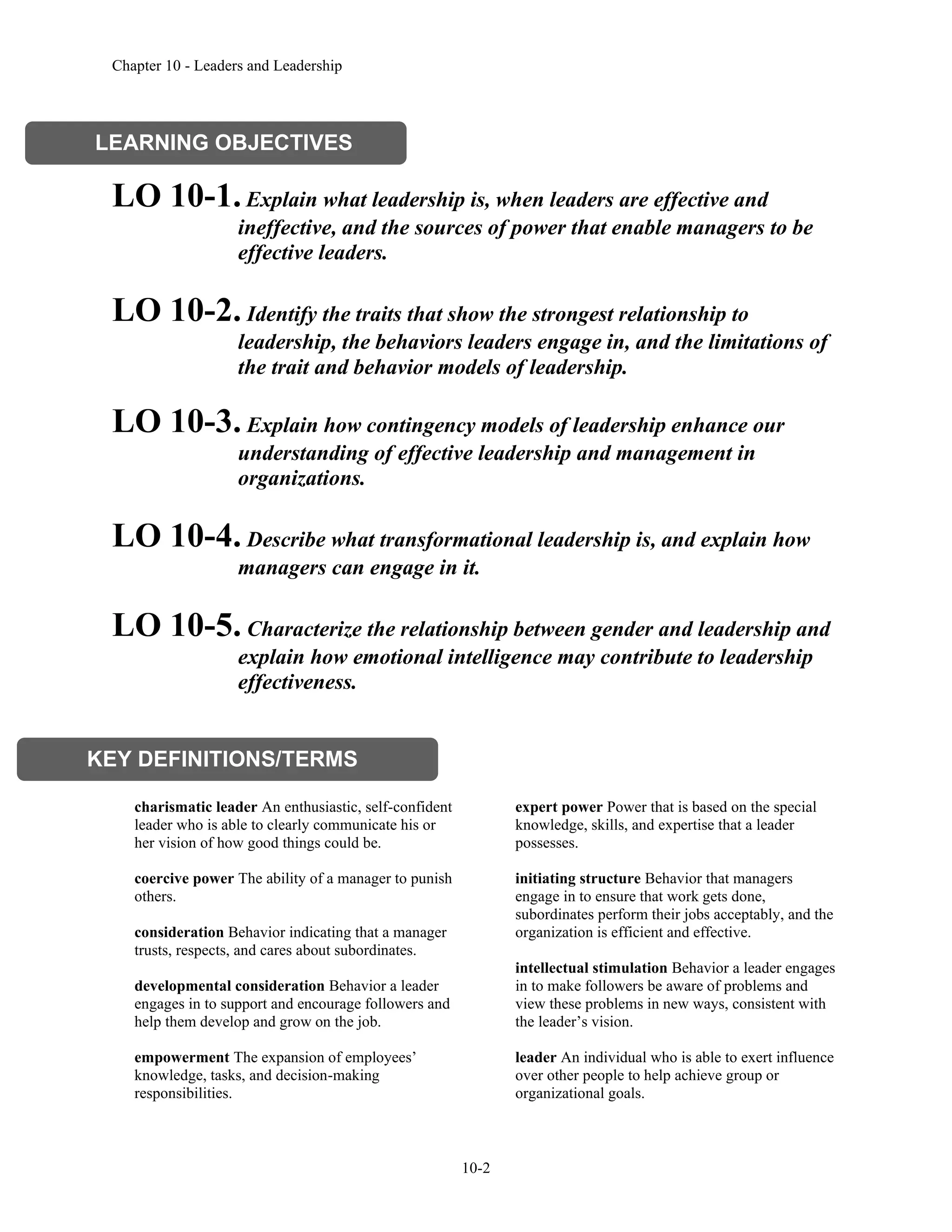
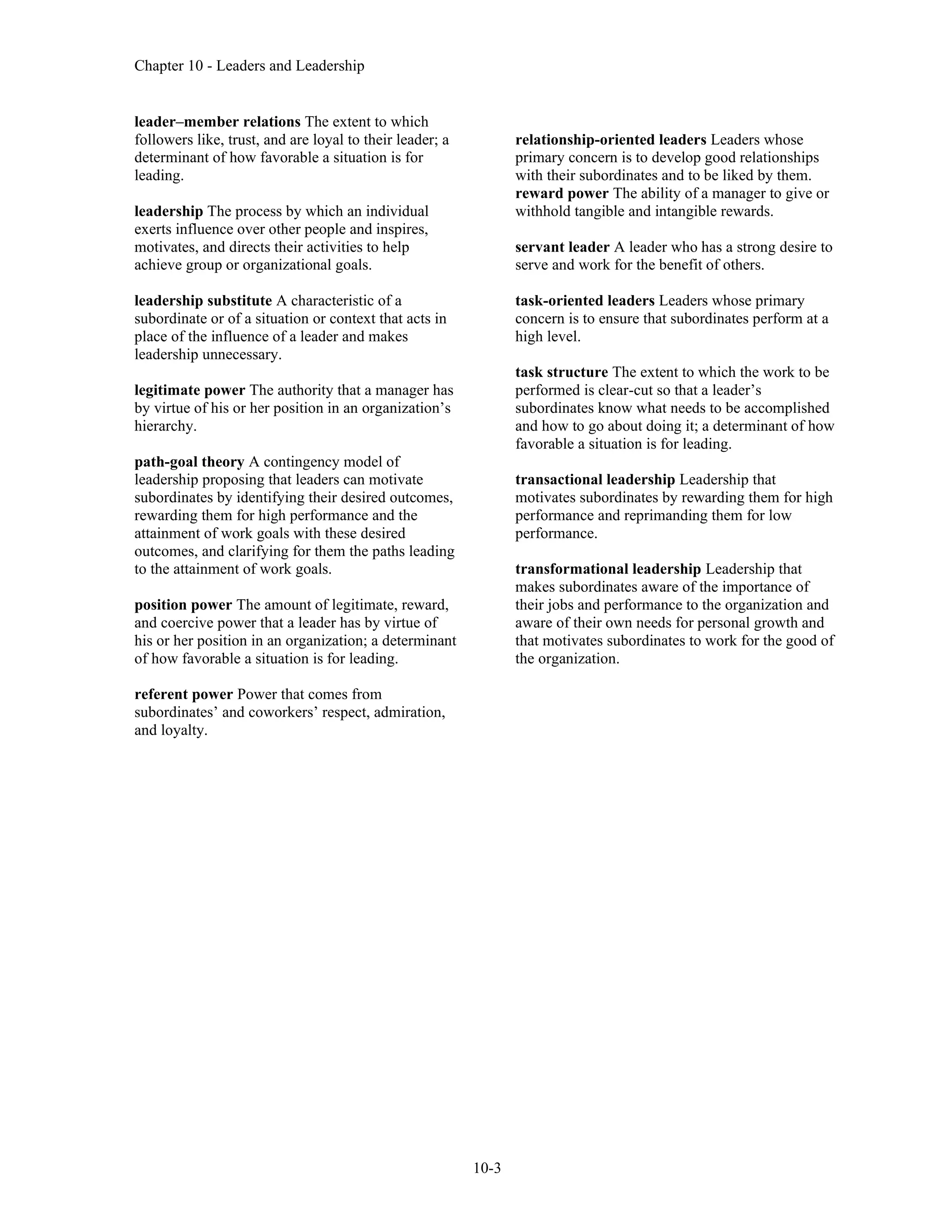
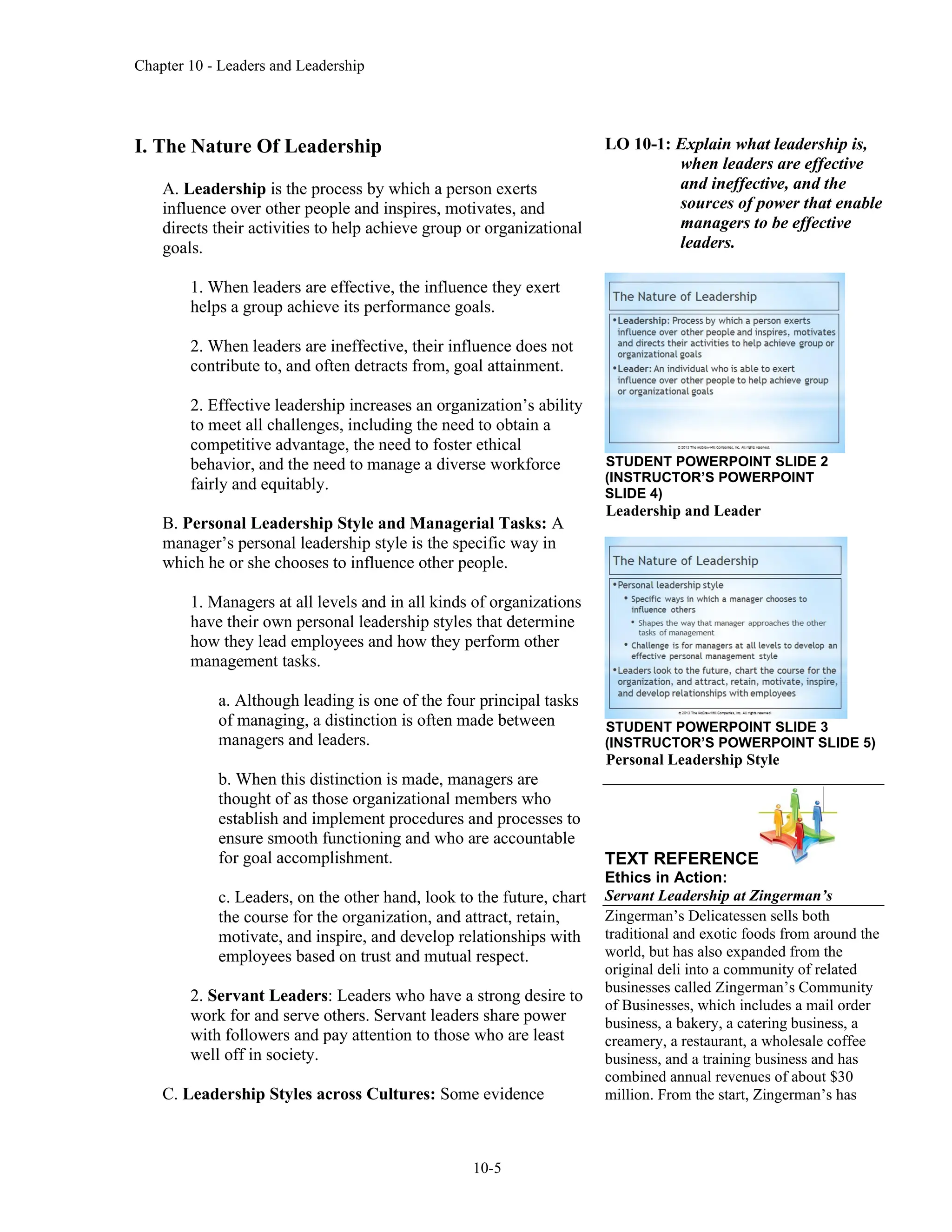
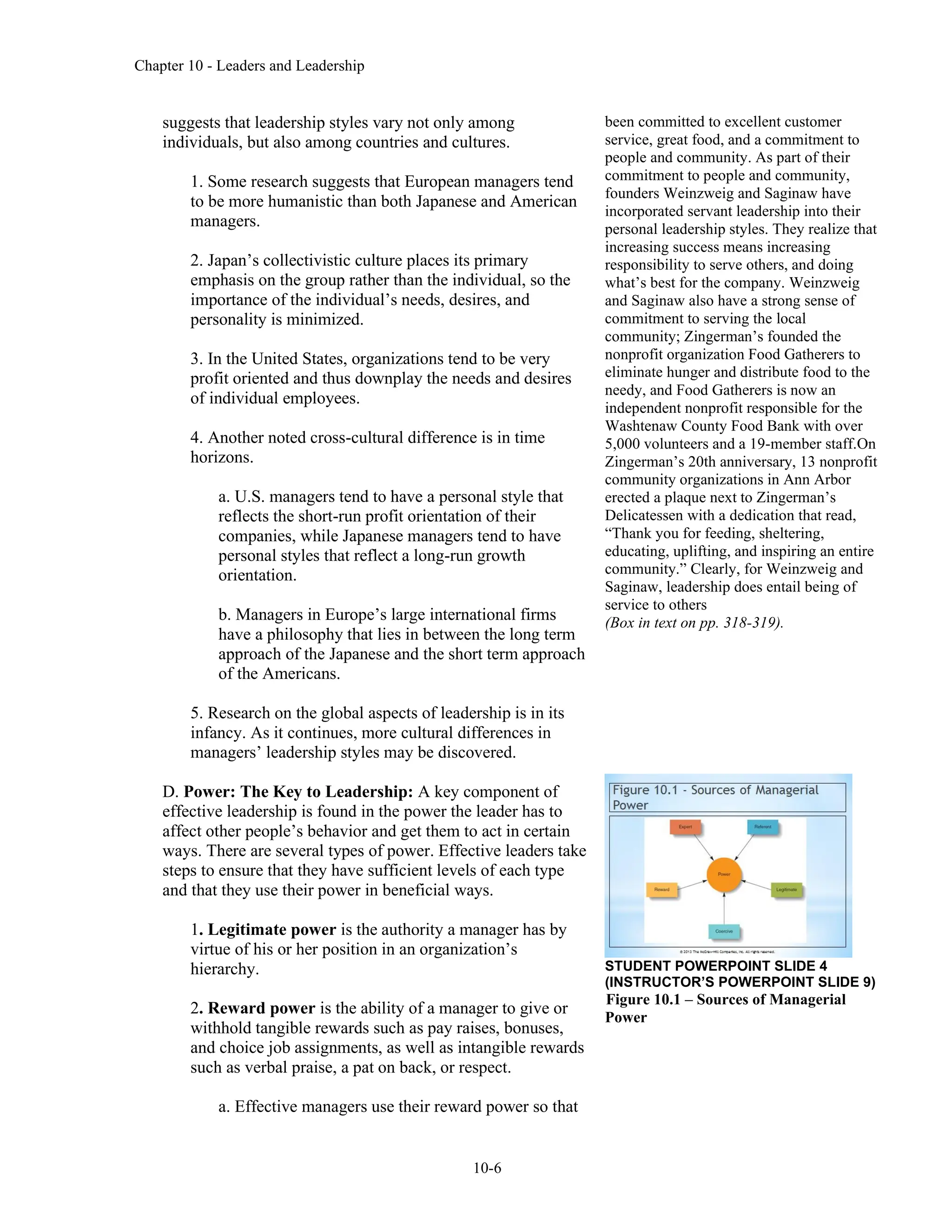
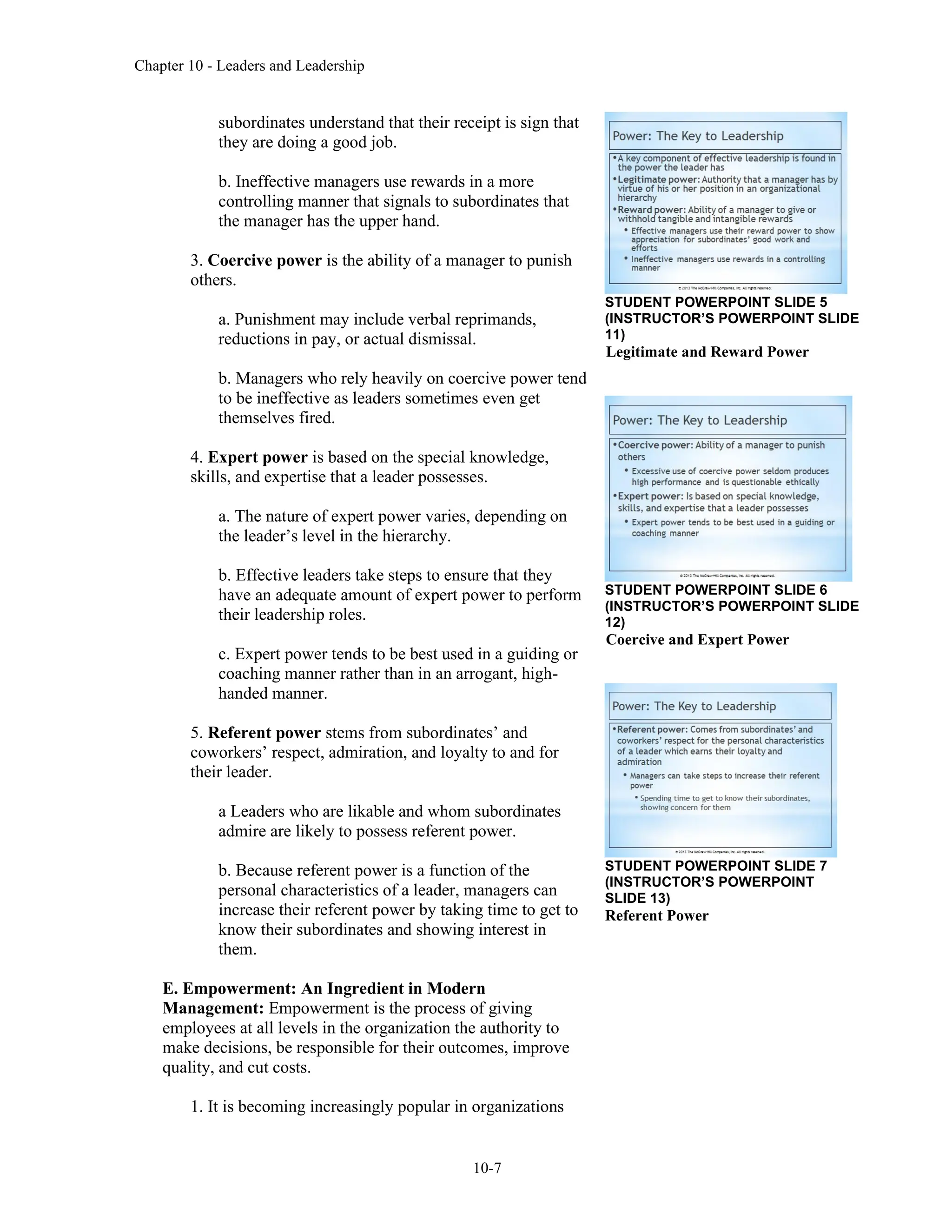
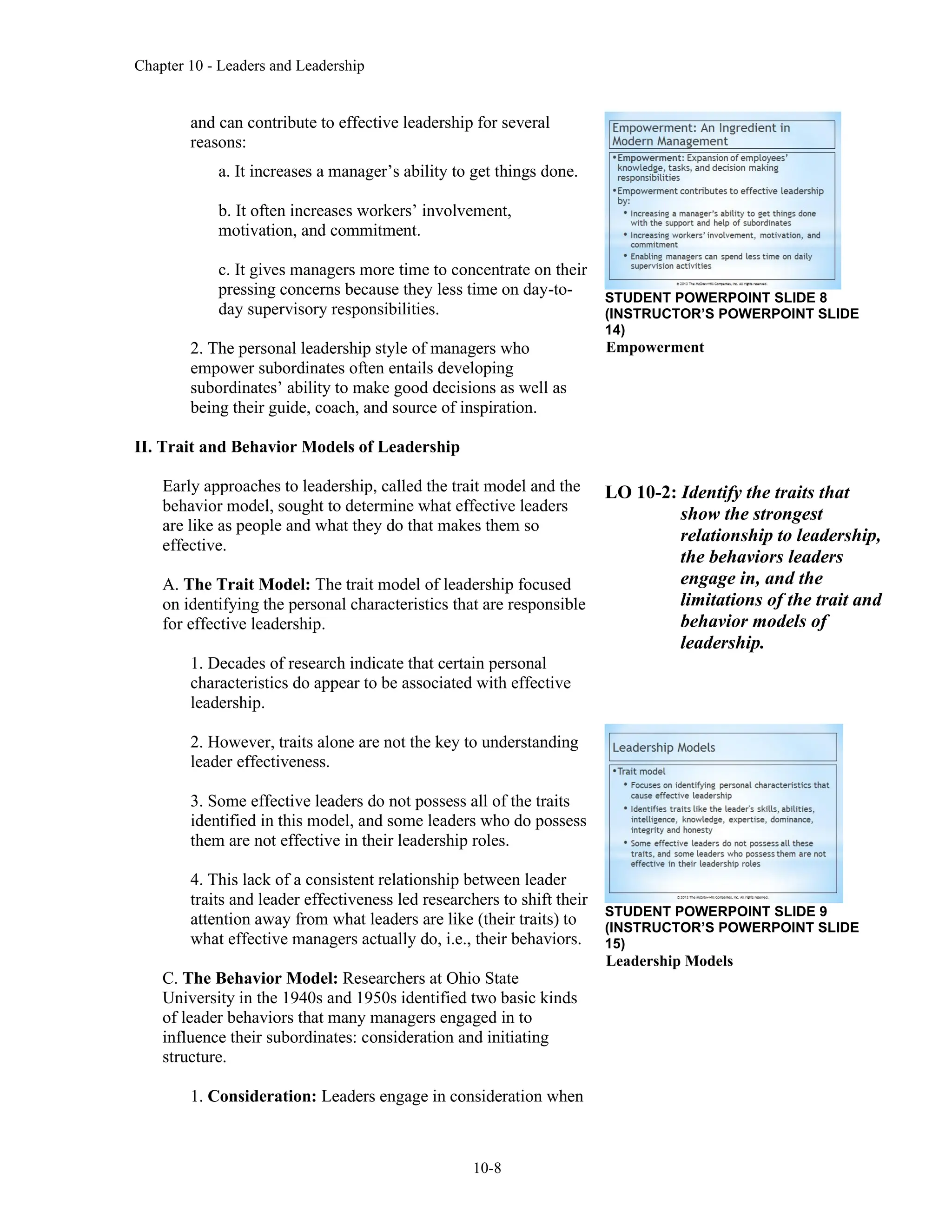
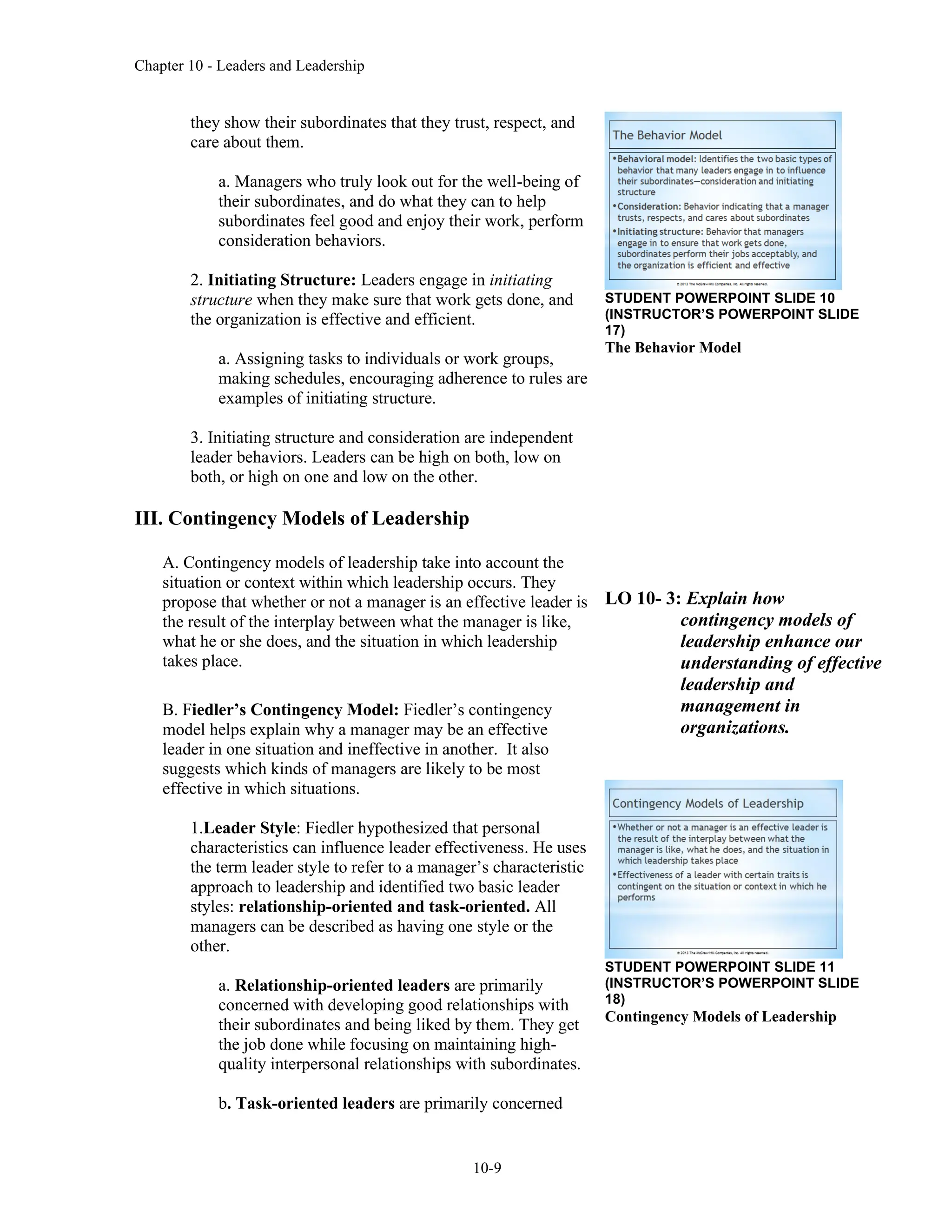
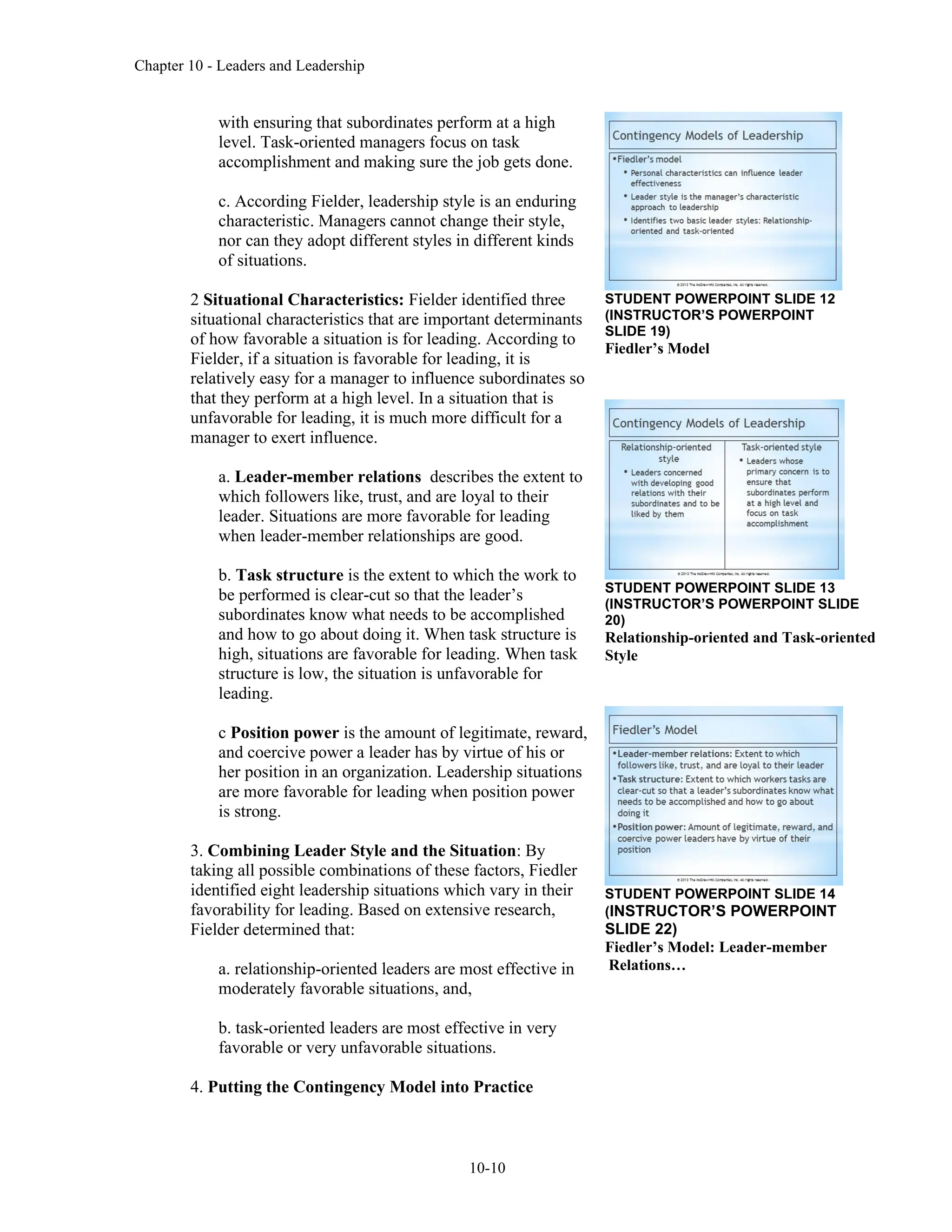
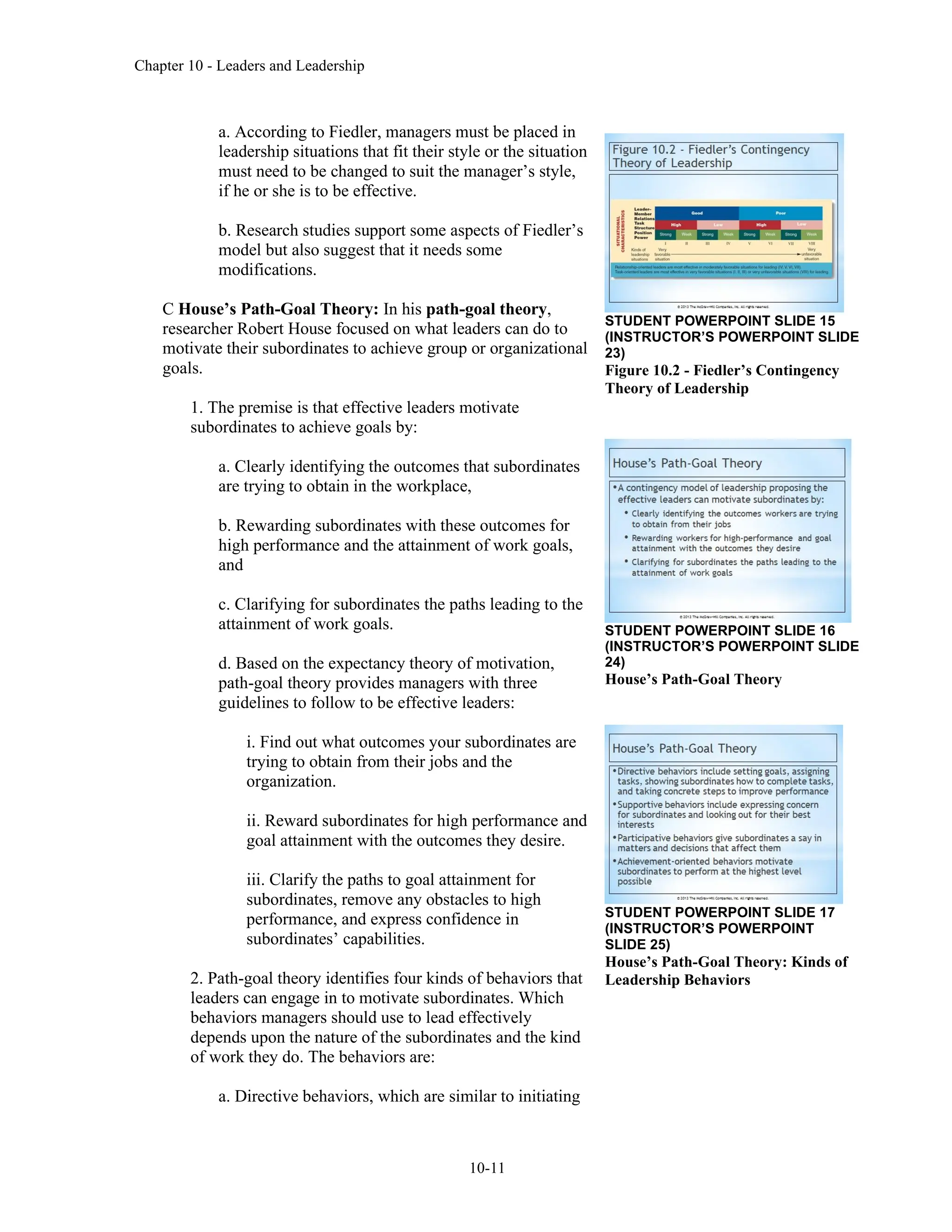
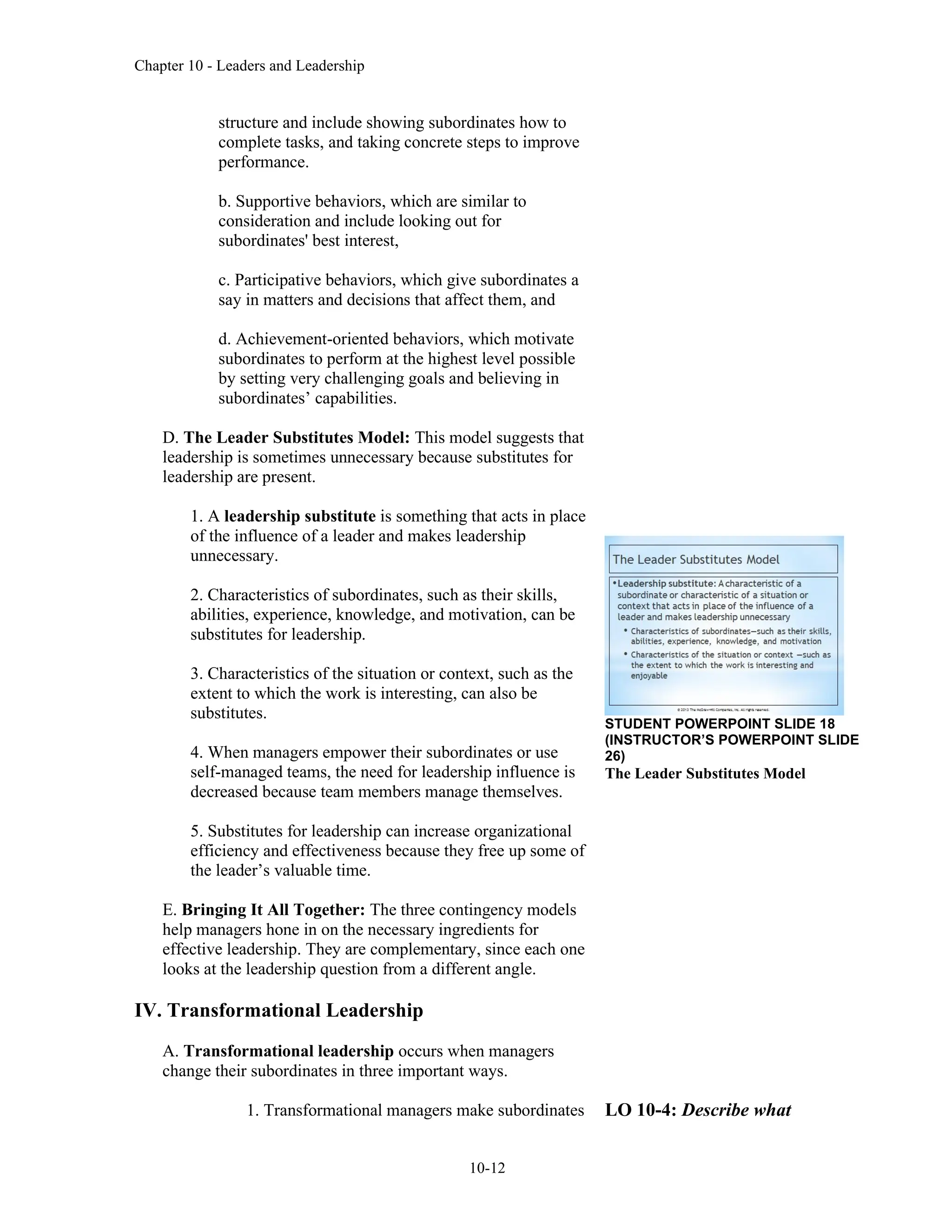
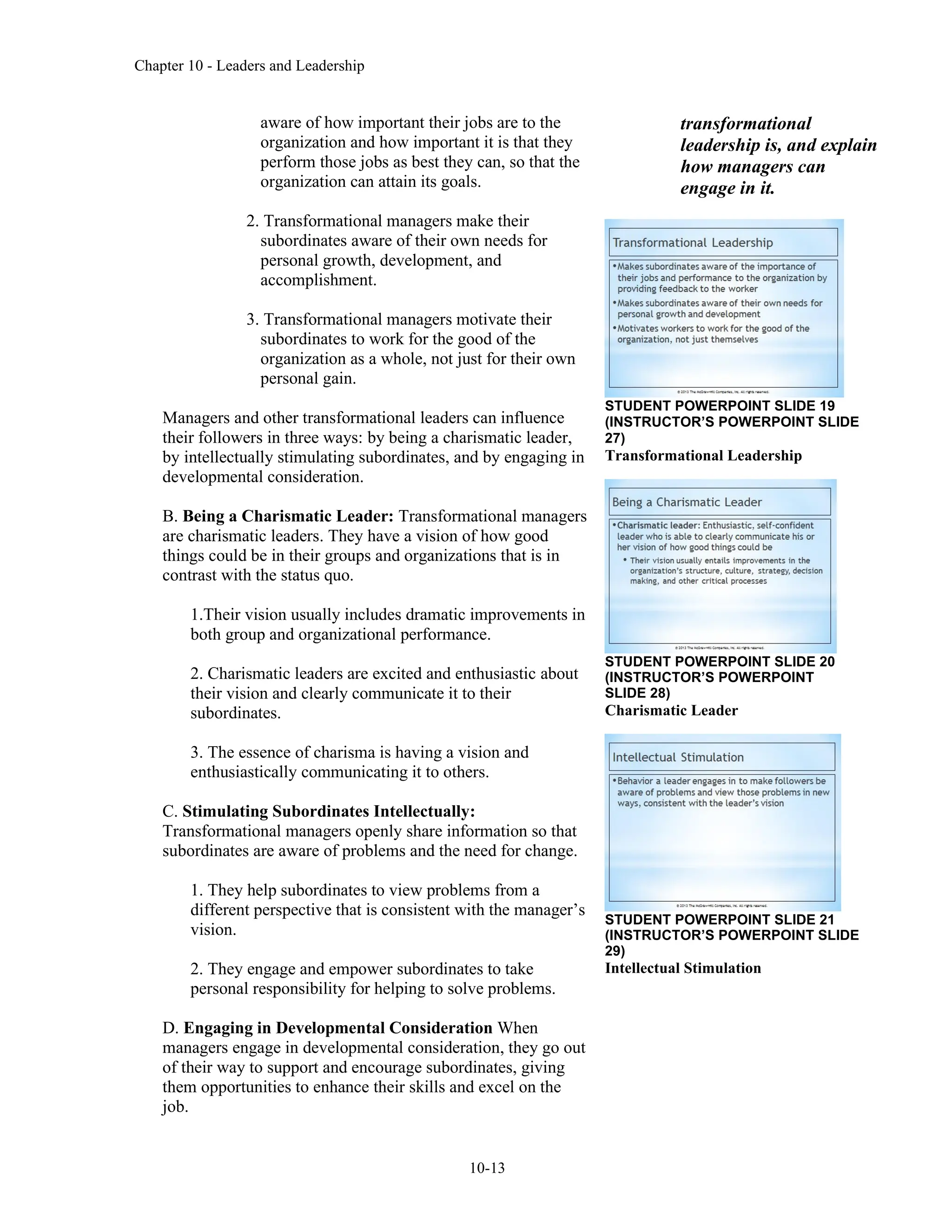
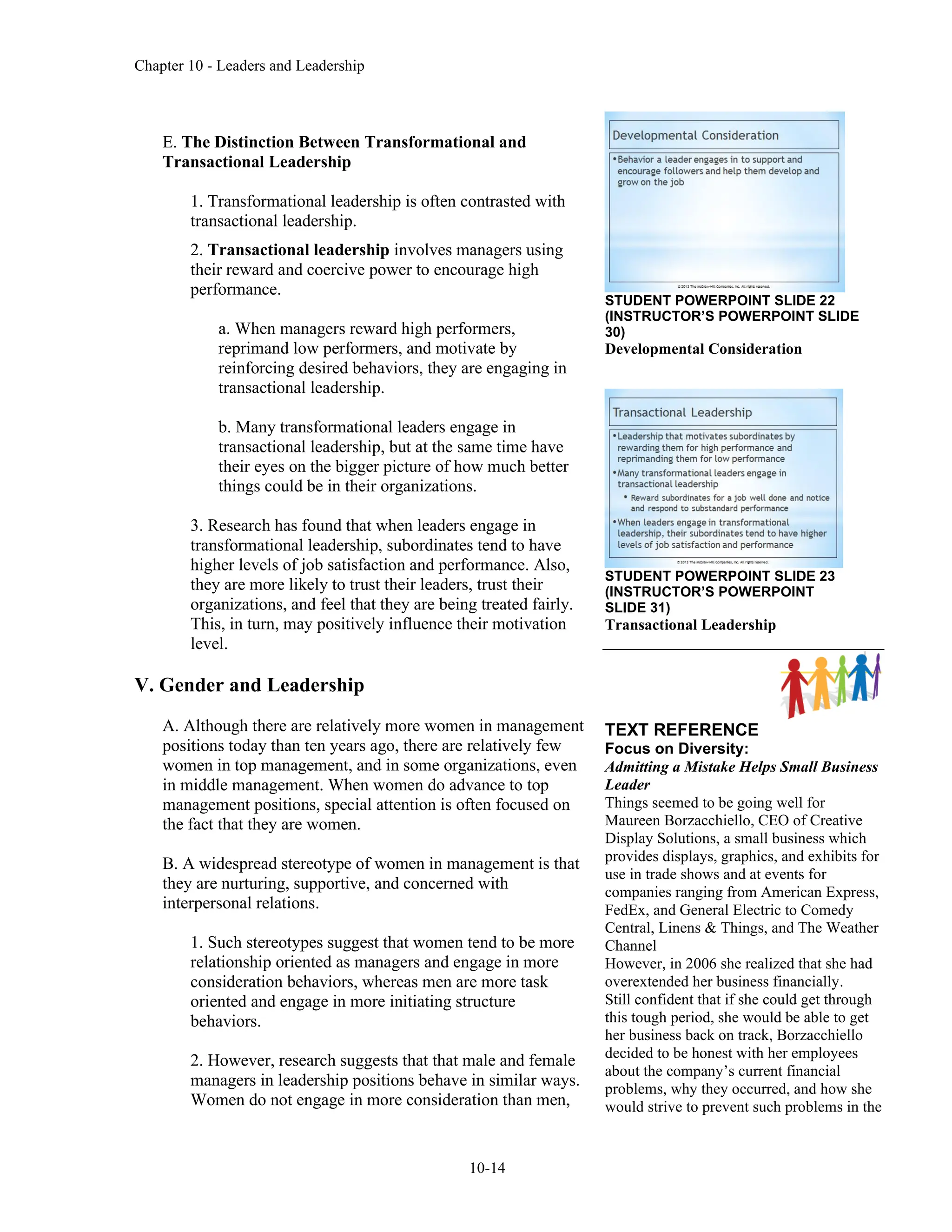
![Chapter 10 - Leaders and Leadership
10-16
Lecturer Enhancer 10.1
WANTED: A GLOBAL BOSS
Any time there’s a big international merger, there are inevitable worries about “culture clash.”
When Marjorie Scardino, a tall, wisecracking Texan, was named to head Britain’s blue-blooded
Pearson Publishing Company in November 1996, the company’s stock plunged for a day in
London. In 1997 Ford Motor named Henry Wallace, a Scottish executive, to take over its Mazda
unit. As the first Scot in memory to head a major Japanese company, he faces a nation of
skeptics. “Ford sends people who don’t speak Japanese at all,” grumbles one business leader in
Hiroshima, Mazda’s hometown.
But Wallace’s bad Japanese—he gets tutoring once per week, hardly matters these days. Nor
does Scardino’s Texarkana drawl grate much on British ears. With surprising speed, the big
multinationals, and many small ones, have come to speak the same language and inhabit a
common culture. The global environment has bred a new kind of executive, the global boss, who
is breaking down cultural barriers.
How does one qualify as a topnotch global boss? First, learn their language. Global managers
speak a combination of straight-shooting American pragmatism, Japanese-inspired management
ideas (like kaizen, or continuous improvement), and M.B.A. jargon such as “strategic resource
allocation.” They’re tough, smart, and flexible enough to survive in the global economy.
Another must is “benchmarking.” This buzzword means measuring your company against the
best practices of other companies worldwide. Smart global bosses personally benchmark
themselves against the world’s most successful multinational managers.
Big companies must go global to be near the billions of new consumers and to find the best deal
worldwide on wages, taxes, and local talent. That takes a savvy global boss. A New York
headhunter once described a search he did for a semiconductor company. “They were looking for
someone [who understands why] the chips were designed in India, water-etched in Japan, diced
and mounted in Korea, assembled in Thailand, encapsulated in Singapore, and distributed
everywhere,” he said. “About one in a million fits that description.”
Indeed, there aren’t enough global bosses to go around, even if many companies haven’t yet
figured out that they need them. Few large U.S. companies, for instance, have foreigners on their
boards. The coming of the global boss is less of a revolution than culture creep. For example,
don’t we hear much about the Japanese way of doing business, as we did in the ‘80s? Because
everyone has adopted it. Today American executives chant “corporate benchmarking” in their
sleep and the Japanese idolize Bill Gates.
LECTURE ENHANCERS](https://image.slidesharecdn.com/13903-250330114027-fb4963f3/75/Essentials-of-Contemporary-Management-5th-Edition-Jones-Solutions-Manual-17-2048.jpg)