LEADING
CHAPTER 8
topics
1. what is leading?
2. How leaders
influence others?
3. The nature of
leadership
4. Behavioral
approaches to
leadership skills
5. contingency
approaches to
leadership style
What is
leading?
Leading is that management function which “involves
influencing others to engage in the work behaviors
necessary to reach organizational goals.” the definition
indicates that a person or group of persons tasked
with managing a group must assume the role
performed by leaders. While leading refers to the
function, leadership refers to the process.
how leaders
influence
others
Engineer managers are expected to maintain effective
work forces. To be able to do so, they are required to
perform leadership roles. Leaders are said to be able to
influence others because of the power they possess.
Power refers to ability of a leader to exert force on
another.
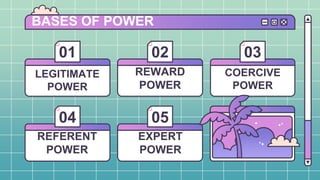
LEGITIMATE
POWER
REWARD
POWER
02
COERCIVE
POWER
03
REFERENT
POWER
04
EXPERT
POWER
05
BASES OF POWER
01
LEGITIMATE
POWER
01
A person who occupies a higher position has
legitimate power over persons in lower
positions within the organization. A supervisor,
for instance, can issue orders to the workers in
his unit. Compliance can be expected.
REWARD
POWER
02
When a person can give rewards to anybody
who follows order or request, he is said to have
a reward power. Rewards may be classified into
two forms: material and psychic.
Material rewards refer to money or other
tangible benefit like cars, house and lot etc.
psychic rewards consist of recognition, praises,
etc.
COERCIVE
POWER
03
When a person compels another to comply with
others through threats or punishment, he is said
to possess coercive power. Punishment may
take the form of demotion, dismissal,
withholding of promotion, etc.
REFERENT
POWER
04
When a person can get compliance from
another because the latter would want to be
identified with the former, that person is said to
have referent power.
EXPERT
POWER
05
Experts provide specialized information
regarding their specific lines of expertise. Thus
influence, called expert power, is possessed by
people with great skills in technology.
The nature
of
leadership
Leadership may be referred to as “the process of
influencing and supporting others to work enthusiastically
toward achieving objectives.” Leadership is expected of
any manager in charge of any unit or division.
Willing to accept
responsibility, possess
vigor, initiative,
persistence, and health
Traits of effecitve leaders
Personal
drive
Desired to
lead
Person who gave all the
qualifications for
leadership.
Personal
integrity
Person who is well-
regarded by others as
one who has integrity
possesses one trait of a
leader.
The activities of leaders
require moves that will
produced the needed
outputs. For the moves to be
continuous and precise, self-
confidence is a must.
Traits of effecitve leaders
self-
confidence
analytical
ability
The ability to analyze is
one desirable trait that
leader can use to tide
him over many
challenging aspects of
leadership.
knowledge of the
company and
industry
A leader who is well-
informed about his
company, the industry
where the company
belongs, and the
technology utilized by the
industry.
When a person has
sufficient personal
magnetism that leads
people to follow his
directives
Traits of effecitve leaders
Charisma creativity
The ability to combined existing
data, experience, and
preconditions from various
sources in such a way that the
results will be subjectively
regarded as new, valuable,
innovative and direct solution to an
identified problem situation.
flexibility
A leader who allows this
situation as long as the
required oututs are
produced.
—V.K SARAF
“Integrity means and includes
honesty, honour, incorruptibility,
rectitude, righteousness,
uprightness, and similar virtues”
Technical
skills
These are skills a leader must
possess to enable him to
understand and make decisions
about work processes, activities
and technology.
Human
skills
Refers to the ability of a
leader to deal with
people, both inside and
outside the organization.
Conceptual
skills
The ability to think in
abstract terms, to see
how parts fit together to
form the whole.
Leadership skills
Behavioral
approaches to
leadership styles
Those in position of leadership exhibit a pattern of
behavior that is unique and different from other patterns.
ways leaders approach people
positive
leadership
negative
leadership
When the leader’s approach
emphasizes rewards, the style
used is positive leadership.
When punishment is emphasized
by the leader, the style is said to
be negative leadership.
Leaders who make
decision themselves,
without consulting
subordinates.
ways leaders uses power
autocratic participative
When a leader openly
invites his subordinates
to participate or share in
decisions, policy-making
and operation methods.
free-rein
Leaders who set
objectives and allow
employees or
subordinates relative
freedom to do whatever
it takes to accomplish
this objectives.
Employee
orientation
Task orientation
A leader is said to be employee oriented
when he considers employees as human
being of “intrinsic importance and with
individual and personal need” to satisfy.
A leader is said to be task-oriented if he
places stress on production and the
technical aspectsof the job and
employees are viewed as the means of
gettimg the work done.
Leaders orientation towards task
and people
CONTINGENC
Y
APPROACHE
S TO
LEADERSHIP
STYLE
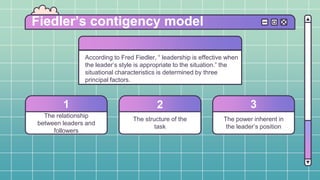
Fiedler’s contigency model
1
The relationship
between leaders and
followers
2
The structure of the
task
3
The power inherent in
the leader’s position
The structure of the
task
According to Fred Fiedler, “ leadership is effective when
the leader’s style is appropriate to the situation.” the
situational characteristics is determined by three
principal factors.
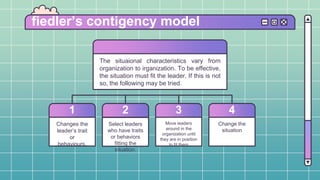
fiedler’s contigency model
Changes the
leader’s trait
or
behaviours.
Select leaders
who have traits
or behaviors
fitting the
situation.
Change the
situation
Move leaders
around in the
organization until
they are in position
to fit them
1 2 3 4
The situaional characteristics vary from
organization to irganization. To be effective,
the situation must fit the leader. If this is not
so, the following may be tried.
directin
g
For people who
lack
competence but
are enthusiastic
and committed.
supporti
ng
For people who
have competence
but lack of
confidence or
motivation.
hersey and blanchard situational
leadership model
coachin
g
For people who
have some
competence but
lack of
commitment.
delegati
ng
For people who
have both
competence
and
commitment.
hersey and blanchard situational
leadership model
Development Stage of Subordinates and Recommend
Leadership Style
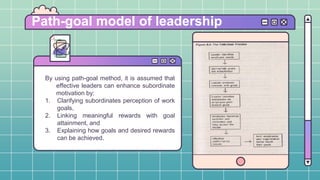
Path-goal model of leadership
By using path-goal method, it is assumed that
effective leaders can enhance subordinate
motivation by:
1. Clarifying subordinates perception of work
goals,
2. Linking meaningful rewards with goal
attainment, and
3. Explaining how goals and desired rewards
can be achieved.
vroom’s decision making
model
Vroom’s model of leadership is one of that
prescribes the proper leadership style for
various situations, focusing on the
appropriate degress of delegation of decision
making authority.
Five distinct decision-making styles are
identified under the Vroom model. Two of
them are autocratic, two others are
consultative, and one group is directed.
THANK YOU FOR
LISTENING!
END!

Chapter 8 - Leading.pptx

  • 1.
  • 2.
    topics 1. what isleading? 2. How leaders influence others? 3. The nature of leadership 4. Behavioral approaches to leadership skills 5. contingency approaches to leadership style
  • 3.
    What is leading? Leading isthat management function which “involves influencing others to engage in the work behaviors necessary to reach organizational goals.” the definition indicates that a person or group of persons tasked with managing a group must assume the role performed by leaders. While leading refers to the function, leadership refers to the process.
  • 4.
    how leaders influence others Engineer managersare expected to maintain effective work forces. To be able to do so, they are required to perform leadership roles. Leaders are said to be able to influence others because of the power they possess. Power refers to ability of a leader to exert force on another.
  • 5.
  • 6.
    LEGITIMATE POWER 01 A person whooccupies a higher position has legitimate power over persons in lower positions within the organization. A supervisor, for instance, can issue orders to the workers in his unit. Compliance can be expected.
  • 7.
    REWARD POWER 02 When a personcan give rewards to anybody who follows order or request, he is said to have a reward power. Rewards may be classified into two forms: material and psychic. Material rewards refer to money or other tangible benefit like cars, house and lot etc. psychic rewards consist of recognition, praises, etc.
  • 8.
    COERCIVE POWER 03 When a personcompels another to comply with others through threats or punishment, he is said to possess coercive power. Punishment may take the form of demotion, dismissal, withholding of promotion, etc.
  • 9.
    REFERENT POWER 04 When a personcan get compliance from another because the latter would want to be identified with the former, that person is said to have referent power.
  • 10.
    EXPERT POWER 05 Experts provide specializedinformation regarding their specific lines of expertise. Thus influence, called expert power, is possessed by people with great skills in technology.
  • 11.
    The nature of leadership Leadership maybe referred to as “the process of influencing and supporting others to work enthusiastically toward achieving objectives.” Leadership is expected of any manager in charge of any unit or division.
  • 12.
    Willing to accept responsibility,possess vigor, initiative, persistence, and health Traits of effecitve leaders Personal drive Desired to lead Person who gave all the qualifications for leadership. Personal integrity Person who is well- regarded by others as one who has integrity possesses one trait of a leader.
  • 13.
    The activities ofleaders require moves that will produced the needed outputs. For the moves to be continuous and precise, self- confidence is a must. Traits of effecitve leaders self- confidence analytical ability The ability to analyze is one desirable trait that leader can use to tide him over many challenging aspects of leadership. knowledge of the company and industry A leader who is well- informed about his company, the industry where the company belongs, and the technology utilized by the industry.
  • 14.
    When a personhas sufficient personal magnetism that leads people to follow his directives Traits of effecitve leaders Charisma creativity The ability to combined existing data, experience, and preconditions from various sources in such a way that the results will be subjectively regarded as new, valuable, innovative and direct solution to an identified problem situation. flexibility A leader who allows this situation as long as the required oututs are produced.
  • 15.
    —V.K SARAF “Integrity meansand includes honesty, honour, incorruptibility, rectitude, righteousness, uprightness, and similar virtues”
  • 16.
    Technical skills These are skillsa leader must possess to enable him to understand and make decisions about work processes, activities and technology. Human skills Refers to the ability of a leader to deal with people, both inside and outside the organization. Conceptual skills The ability to think in abstract terms, to see how parts fit together to form the whole. Leadership skills
  • 17.
    Behavioral approaches to leadership styles Thosein position of leadership exhibit a pattern of behavior that is unique and different from other patterns.
  • 18.
    ways leaders approachpeople positive leadership negative leadership When the leader’s approach emphasizes rewards, the style used is positive leadership. When punishment is emphasized by the leader, the style is said to be negative leadership.
  • 19.
    Leaders who make decisionthemselves, without consulting subordinates. ways leaders uses power autocratic participative When a leader openly invites his subordinates to participate or share in decisions, policy-making and operation methods. free-rein Leaders who set objectives and allow employees or subordinates relative freedom to do whatever it takes to accomplish this objectives.
  • 20.
    Employee orientation Task orientation A leaderis said to be employee oriented when he considers employees as human being of “intrinsic importance and with individual and personal need” to satisfy. A leader is said to be task-oriented if he places stress on production and the technical aspectsof the job and employees are viewed as the means of gettimg the work done. Leaders orientation towards task and people
  • 21.
  • 22.
    Fiedler’s contigency model 1 Therelationship between leaders and followers 2 The structure of the task 3 The power inherent in the leader’s position The structure of the task According to Fred Fiedler, “ leadership is effective when the leader’s style is appropriate to the situation.” the situational characteristics is determined by three principal factors.
  • 23.
    fiedler’s contigency model Changesthe leader’s trait or behaviours. Select leaders who have traits or behaviors fitting the situation. Change the situation Move leaders around in the organization until they are in position to fit them 1 2 3 4 The situaional characteristics vary from organization to irganization. To be effective, the situation must fit the leader. If this is not so, the following may be tried.
  • 24.
    directin g For people who lack competencebut are enthusiastic and committed. supporti ng For people who have competence but lack of confidence or motivation. hersey and blanchard situational leadership model coachin g For people who have some competence but lack of commitment. delegati ng For people who have both competence and commitment.
  • 25.
    hersey and blanchardsituational leadership model Development Stage of Subordinates and Recommend Leadership Style
  • 26.
    Path-goal model ofleadership By using path-goal method, it is assumed that effective leaders can enhance subordinate motivation by: 1. Clarifying subordinates perception of work goals, 2. Linking meaningful rewards with goal attainment, and 3. Explaining how goals and desired rewards can be achieved.
  • 27.
    vroom’s decision making model Vroom’smodel of leadership is one of that prescribes the proper leadership style for various situations, focusing on the appropriate degress of delegation of decision making authority. Five distinct decision-making styles are identified under the Vroom model. Two of them are autocratic, two others are consultative, and one group is directed.
  • 28.