Essentials of Contemporary Management 5th Edition Jones Solutions Manual
Essentials of Contemporary Management 5th Edition Jones Solutions Manual
Essentials of Contemporary Management 5th Edition Jones Solutions Manual
Essentials of Contemporary Management 5th Edition Jones Solutions Manual
Essentials of Contemporary Management 5th Edition Jones Solutions Manual
1.
Visit https://testbankfan.com todownload the full version and
browse more test banks or solution manuals
Essentials of Contemporary Management 5th Edition
Jones Solutions Manual
_____ Press the link below to begin your download _____
https://testbankfan.com/product/essentials-of-contemporary-
management-5th-edition-jones-solutions-manual/
Access testbankfan.com now to download high-quality
test banks or solution manuals
2.
Here are somerecommended products for you. Click the link to
download, or explore more at testbankfan.com
Essentials of Contemporary Management Canadian 5th Edition
Jones Solutions Manual
https://testbankfan.com/product/essentials-of-contemporary-management-
canadian-5th-edition-jones-solutions-manual/
Essentials of Contemporary Management 5th Edition Jones
Test Bank
https://testbankfan.com/product/essentials-of-contemporary-
management-5th-edition-jones-test-bank/
Essentials of Contemporary Management 7th Edition Jones
Solutions Manual
https://testbankfan.com/product/essentials-of-contemporary-
management-7th-edition-jones-solutions-manual/
MATLAB for Engineers 5th Edition Moore Solutions Manual
https://testbankfan.com/product/matlab-for-engineers-5th-edition-
moore-solutions-manual/
3.
Ethical Obligations andDecision Making in Accounting Text
and Cases 4th Edition Mintz Test Bank
https://testbankfan.com/product/ethical-obligations-and-decision-
making-in-accounting-text-and-cases-4th-edition-mintz-test-bank/
Business Ethics Ethical Decision Making and Cases 9th
Edition Ferrell Solutions Manual
https://testbankfan.com/product/business-ethics-ethical-decision-
making-and-cases-9th-edition-ferrell-solutions-manual/
Statistics 13th Edition McClave Test Bank
https://testbankfan.com/product/statistics-13th-edition-mcclave-test-
bank/
Living in the Environment 18th Edition Miller Solutions
Manual
https://testbankfan.com/product/living-in-the-environment-18th-
edition-miller-solutions-manual/
Essentials of MIS 13th Edition laudon Solutions Manual
https://testbankfan.com/product/essentials-of-mis-13th-edition-laudon-
solutions-manual/
4.
Art History Volume2 5th Edition Stokstad Test Bank
https://testbankfan.com/product/art-history-volume-2-5th-edition-
stokstad-test-bank/
5.
Chapter 10 -Leaders and Leadership
10-1
Chapter 10
Leaders and Leadership
Learning Objectives 291
Key Definitions/Terms 291
Chapter Overview 293
Lecture Outline 293
Lecture Enhancers 305
Management in Action 307
Building Management Skills 310
Managing Ethically 311
Small Group Breakout Exercise 312
Be the Manager 313
Case in the News 314
Supplemental Features 316
Video Case 316
Manager’s Hot Seat 318
Self-Assessment(s) 318
Test Your Knowledge 318
Instructor’s Powerpoint Slides 319
CHAPTER CONTENTS
6.
Chapter 10 -Leaders and Leadership
10-2
LO 10-1.Explain what leadership is, when leaders are effective and
ineffective, and the sources of power that enable managers to be
effective leaders.
LO 10-2. Identify the traits that show the strongest relationship to
leadership, the behaviors leaders engage in, and the limitations of
the trait and behavior models of leadership.
LO 10-3. Explain how contingency models of leadership enhance our
understanding of effective leadership and management in
organizations.
LO 10-4. Describe what transformational leadership is, and explain how
managers can engage in it.
LO 10-5. Characterize the relationship between gender and leadership and
explain how emotional intelligence may contribute to leadership
effectiveness.
charismatic leader An enthusiastic, self-confident
leader who is able to clearly communicate his or
her vision of how good things could be.
coercive power The ability of a manager to punish
others.
consideration Behavior indicating that a manager
trusts, respects, and cares about subordinates.
developmental consideration Behavior a leader
engages in to support and encourage followers and
help them develop and grow on the job.
empowerment The expansion of employees’
knowledge, tasks, and decision-making
responsibilities.
expert power Power that is based on the special
knowledge, skills, and expertise that a leader
possesses.
initiating structure Behavior that managers
engage in to ensure that work gets done,
subordinates perform their jobs acceptably, and the
organization is efficient and effective.
intellectual stimulation Behavior a leader engages
in to make followers be aware of problems and
view these problems in new ways, consistent with
the leader’s vision.
leader An individual who is able to exert influence
over other people to help achieve group or
organizational goals.
LEARNING OBJECTIVES
KEY DEFINITIONS/TERMS
7.
Chapter 10 -Leaders and Leadership
10-3
leader–member relations The extent to which
followers like, trust, and are loyal to their leader; a
determinant of how favorable a situation is for
leading.
leadership The process by which an individual
exerts influence over other people and inspires,
motivates, and directs their activities to help
achieve group or organizational goals.
leadership substitute A characteristic of a
subordinate or of a situation or context that acts in
place of the influence of a leader and makes
leadership unnecessary.
legitimate power The authority that a manager has
by virtue of his or her position in an organization’s
hierarchy.
path-goal theory A contingency model of
leadership proposing that leaders can motivate
subordinates by identifying their desired outcomes,
rewarding them for high performance and the
attainment of work goals with these desired
outcomes, and clarifying for them the paths leading
to the attainment of work goals.
position power The amount of legitimate, reward,
and coercive power that a leader has by virtue of
his or her position in an organization; a determinant
of how favorable a situation is for leading.
referent power Power that comes from
subordinates’ and coworkers’ respect, admiration,
and loyalty.
relationship-oriented leaders Leaders whose
primary concern is to develop good relationships
with their subordinates and to be liked by them.
reward power The ability of a manager to give or
withhold tangible and intangible rewards.
servant leader A leader who has a strong desire to
serve and work for the benefit of others.
task-oriented leaders Leaders whose primary
concern is to ensure that subordinates perform at a
high level.
task structure The extent to which the work to be
performed is clear-cut so that a leader’s
subordinates know what needs to be accomplished
and how to go about doing it; a determinant of how
favorable a situation is for leading.
transactional leadership Leadership that
motivates subordinates by rewarding them for high
performance and reprimanding them for low
performance.
transformational leadership Leadership that
makes subordinates aware of the importance of
their jobs and performance to the organization and
aware of their own needs for personal growth and
that motivates subordinates to work for the good of
the organization.
8.
Chapter 10 -Leaders and Leadership
10-4
In this chapter we describe what leadership is and examine the major leadership models that shed light
on the factors that contribute to a manager’s being an effective leader. We look at trait and behavior
models, which focus on what leaders are like and what they do, and contingency models—Fiedler’s
contingency model, path-goal theory, and the leader substitutes model—each of which takes into
account the complexity surrounding leadership and the role of the situation in leader effectiveness. We
also describe how managers can use transformational leadership to dramatically affect their
organizations. By the end of this chapter, you will have a good appreciation of the many factors and
issues that managers face in their quest to be effective leaders.
NOTE ABOUT INSTRUCTOR’S
POWERPOINT SLIDES
The Instructor PowerPoint Slides include most
Student PowerPoint slides, along with additional
material that can be used to expand the lecture.
Images of the Instructor PowerPoint slides can be
found at the end of this chapter on page 319.
BASIC POWERPOINT SLIDE 1
(INSTRUCTOR’S POWERPOINT SLIDE 1)
Chapter Title
Management Snapshot (pp. 315-316 of text)
McGrath Effectively Leads MTV Networks
How Can A Manager Continuously Transform A Hip Company In A Rapidly Changing Environment?
As chairperson and CEO of MTV Networks, Judy McGrath holds an extremely challenging leadership position.
MTV is a unit of Viacom and is the home of more than ten channels. She has received the Vanguard Award for
Distinguished Leadership and was ranked 10th in Fortune Magazine’s list of the most powerful women in
business in 2007. Her career at MTV began as a writer of promotional pieces. Her personal leadership style
emphasizes empowering all members of the MTV organization, as well as its viewers. She is visionary and can
see possibilities and opportunities where others might see just risks. She works hard, perseveres, and believes
that anything is possible. Under her leadership, MTV has launched scores of successful new programs, all of
which were risky and could have failed. Currently, McGrath is pushing her company to deliver services from
multiple digital platforms, such as cell phones, new broadband channels, and video games. Clearly, challenging
times lie ahead for her. Her vision and decisiveness, combined with her style of empowering employees,
encouraging risk taking and creativity, and making sure that all enjoy the ride suggest that MTV is in good
hands.
CHAPTER OVERVIEW
LECTURE OUTLINE
9.
Chapter 10 -Leaders and Leadership
10-5
I. The Nature Of Leadership
A. Leadership is the process by which a person exerts
influence over other people and inspires, motivates, and
directs their activities to help achieve group or organizational
goals.
1. When leaders are effective, the influence they exert
helps a group achieve its performance goals.
2. When leaders are ineffective, their influence does not
contribute to, and often detracts from, goal attainment.
2. Effective leadership increases an organization’s ability
to meet all challenges, including the need to obtain a
competitive advantage, the need to foster ethical
behavior, and the need to manage a diverse workforce
fairly and equitably.
B. Personal Leadership Style and Managerial Tasks: A
manager’s personal leadership style is the specific way in
which he or she chooses to influence other people.
1. Managers at all levels and in all kinds of organizations
have their own personal leadership styles that determine
how they lead employees and how they perform other
management tasks.
a. Although leading is one of the four principal tasks
of managing, a distinction is often made between
managers and leaders.
b. When this distinction is made, managers are
thought of as those organizational members who
establish and implement procedures and processes to
ensure smooth functioning and who are accountable
for goal accomplishment.
c. Leaders, on the other hand, look to the future, chart
the course for the organization, and attract, retain,
motivate, and inspire, and develop relationships with
employees based on trust and mutual respect.
2. Servant Leaders: Leaders who have a strong desire to
work for and serve others. Servant leaders share power
with followers and pay attention to those who are least
well off in society.
C. Leadership Styles across Cultures: Some evidence
LO 10-1: Explain what leadership is,
when leaders are effective
and ineffective, and the
sources of power that enable
managers to be effective
leaders.
STUDENT POWERPOINT SLIDE 2
(INSTRUCTOR’S POWERPOINT
SLIDE 4)
Leadership and Leader
STUDENT POWERPOINT SLIDE 3
(INSTRUCTOR’S POWERPOINT SLIDE 5)
Personal Leadership Style
TEXT REFERENCE
Ethics in Action:
Servant Leadership at Zingerman’s
Zingerman’s Delicatessen sells both
traditional and exotic foods from around the
world, but has also expanded from the
original deli into a community of related
businesses called Zingerman’s Community
of Businesses, which includes a mail order
business, a bakery, a catering business, a
creamery, a restaurant, a wholesale coffee
business, and a training business and has
combined annual revenues of about $30
million. From the start, Zingerman’s has
10.
Chapter 10 -Leaders and Leadership
10-6
suggests that leadership styles vary not only among
individuals, but also among countries and cultures.
1. Some research suggests that European managers tend
to be more humanistic than both Japanese and American
managers.
2. Japan’s collectivistic culture places its primary
emphasis on the group rather than the individual, so the
importance of the individual’s needs, desires, and
personality is minimized.
3. In the United States, organizations tend to be very
profit oriented and thus downplay the needs and desires
of individual employees.
4. Another noted cross-cultural difference is in time
horizons.
a. U.S. managers tend to have a personal style that
reflects the short-run profit orientation of their
companies, while Japanese managers tend to have
personal styles that reflect a long-run growth
orientation.
b. Managers in Europe’s large international firms
have a philosophy that lies in between the long term
approach of the Japanese and the short term approach
of the Americans.
5. Research on the global aspects of leadership is in its
infancy. As it continues, more cultural differences in
managers’ leadership styles may be discovered.
D. Power: The Key to Leadership: A key component of
effective leadership is found in the power the leader has to
affect other people’s behavior and get them to act in certain
ways. There are several types of power. Effective leaders take
steps to ensure that they have sufficient levels of each type
and that they use their power in beneficial ways.
1. Legitimate power is the authority a manager has by
virtue of his or her position in an organization’s
hierarchy.
2. Reward power is the ability of a manager to give or
withhold tangible rewards such as pay raises, bonuses,
and choice job assignments, as well as intangible rewards
such as verbal praise, a pat on back, or respect.
a. Effective managers use their reward power so that
been committed to excellent customer
service, great food, and a commitment to
people and community. As part of their
commitment to people and community,
founders Weinzweig and Saginaw have
incorporated servant leadership into their
personal leadership styles. They realize that
increasing success means increasing
responsibility to serve others, and doing
what’s best for the company. Weinzweig
and Saginaw also have a strong sense of
commitment to serving the local
community; Zingerman’s founded the
nonprofit organization Food Gatherers to
eliminate hunger and distribute food to the
needy, and Food Gatherers is now an
independent nonprofit responsible for the
Washtenaw County Food Bank with over
5,000 volunteers and a 19-member staff.On
Zingerman’s 20th anniversary, 13 nonprofit
community organizations in Ann Arbor
erected a plaque next to Zingerman’s
Delicatessen with a dedication that read,
“Thank you for feeding, sheltering,
educating, uplifting, and inspiring an entire
community.” Clearly, for Weinzweig and
Saginaw, leadership does entail being of
service to others
(Box in text on pp. 318-319).
STUDENT POWERPOINT SLIDE 4
(INSTRUCTOR’S POWERPOINT SLIDE 9)
Figure 10.1 – Sources of Managerial
Power
11.
Chapter 10 -Leaders and Leadership
10-7
subordinates understand that their receipt is sign that
they are doing a good job.
b. Ineffective managers use rewards in a more
controlling manner that signals to subordinates that
the manager has the upper hand.
3. Coercive power is the ability of a manager to punish
others.
a. Punishment may include verbal reprimands,
reductions in pay, or actual dismissal.
b. Managers who rely heavily on coercive power tend
to be ineffective as leaders sometimes even get
themselves fired.
4. Expert power is based on the special knowledge,
skills, and expertise that a leader possesses.
a. The nature of expert power varies, depending on
the leader’s level in the hierarchy.
b. Effective leaders take steps to ensure that they
have an adequate amount of expert power to perform
their leadership roles.
c. Expert power tends to be best used in a guiding or
coaching manner rather than in an arrogant, high-
handed manner.
5. Referent power stems from subordinates’ and
coworkers’ respect, admiration, and loyalty to and for
their leader.
a Leaders who are likable and whom subordinates
admire are likely to possess referent power.
b. Because referent power is a function of the
personal characteristics of a leader, managers can
increase their referent power by taking time to get to
know their subordinates and showing interest in
them.
E. Empowerment: An Ingredient in Modern
Management: Empowerment is the process of giving
employees at all levels in the organization the authority to
make decisions, be responsible for their outcomes, improve
quality, and cut costs.
1. It is becoming increasingly popular in organizations
STUDENT POWERPOINT SLIDE 5
(INSTRUCTOR’S POWERPOINT SLIDE
11)
Legitimate and Reward Power
STUDENT POWERPOINT SLIDE 6
(INSTRUCTOR’S POWERPOINT SLIDE
12)
Coercive and Expert Power
STUDENT POWERPOINT SLIDE 7
(INSTRUCTOR’S POWERPOINT
SLIDE 13)
Referent Power
12.
Chapter 10 -Leaders and Leadership
10-8
and can contribute to effective leadership for several
reasons:
a. It increases a manager’s ability to get things done.
b. It often increases workers’ involvement,
motivation, and commitment.
c. It gives managers more time to concentrate on their
pressing concerns because they less time on day-to-
day supervisory responsibilities.
2. The personal leadership style of managers who
empower subordinates often entails developing
subordinates’ ability to make good decisions as well as
being their guide, coach, and source of inspiration.
II. Trait and Behavior Models of Leadership
Early approaches to leadership, called the trait model and the
behavior model, sought to determine what effective leaders
are like as people and what they do that makes them so
effective.
A. The Trait Model: The trait model of leadership focused
on identifying the personal characteristics that are responsible
for effective leadership.
1. Decades of research indicate that certain personal
characteristics do appear to be associated with effective
leadership.
2. However, traits alone are not the key to understanding
leader effectiveness.
3. Some effective leaders do not possess all of the traits
identified in this model, and some leaders who do possess
them are not effective in their leadership roles.
4. This lack of a consistent relationship between leader
traits and leader effectiveness led researchers to shift their
attention away from what leaders are like (their traits) to
what effective managers actually do, i.e., their behaviors.
C. The Behavior Model: Researchers at Ohio State
University in the 1940s and 1950s identified two basic kinds
of leader behaviors that many managers engaged in to
influence their subordinates: consideration and initiating
structure.
1. Consideration: Leaders engage in consideration when
STUDENT POWERPOINT SLIDE 8
(INSTRUCTOR’S POWERPOINT SLIDE
14)
Empowerment
LO 10-2: Identify the traits that
show the strongest
relationship to leadership,
the behaviors leaders
engage in, and the
limitations of the trait and
behavior models of
leadership.
STUDENT POWERPOINT SLIDE 9
(INSTRUCTOR’S POWERPOINT SLIDE
15)
Leadership Models
13.
Chapter 10 -Leaders and Leadership
10-9
they show their subordinates that they trust, respect, and
care about them.
a. Managers who truly look out for the well-being of
their subordinates, and do what they can to help
subordinates feel good and enjoy their work, perform
consideration behaviors.
2. Initiating Structure: Leaders engage in initiating
structure when they make sure that work gets done, and
the organization is effective and efficient.
a. Assigning tasks to individuals or work groups,
making schedules, encouraging adherence to rules are
examples of initiating structure.
3. Initiating structure and consideration are independent
leader behaviors. Leaders can be high on both, low on
both, or high on one and low on the other.
III. Contingency Models of Leadership
A. Contingency models of leadership take into account the
situation or context within which leadership occurs. They
propose that whether or not a manager is an effective leader is
the result of the interplay between what the manager is like,
what he or she does, and the situation in which leadership
takes place.
B. Fiedler’s Contingency Model: Fiedler’s contingency
model helps explain why a manager may be an effective
leader in one situation and ineffective in another. It also
suggests which kinds of managers are likely to be most
effective in which situations.
1.Leader Style: Fiedler hypothesized that personal
characteristics can influence leader effectiveness. He uses
the term leader style to refer to a manager’s characteristic
approach to leadership and identified two basic leader
styles: relationship-oriented and task-oriented. All
managers can be described as having one style or the
other.
a. Relationship-oriented leaders are primarily
concerned with developing good relationships with
their subordinates and being liked by them. They get
the job done while focusing on maintaining high-
quality interpersonal relationships with subordinates.
b. Task-oriented leaders are primarily concerned
STUDENT POWERPOINT SLIDE 10
(INSTRUCTOR’S POWERPOINT SLIDE
17)
The Behavior Model
LO 10- 3: Explain how
contingency models of
leadership enhance our
understanding of effective
leadership and
management in
organizations.
STUDENT POWERPOINT SLIDE 11
(INSTRUCTOR’S POWERPOINT SLIDE
18)
Contingency Models of Leadership
14.
Chapter 10 -Leaders and Leadership
10-10
with ensuring that subordinates perform at a high
level. Task-oriented managers focus on task
accomplishment and making sure the job gets done.
c. According Fielder, leadership style is an enduring
characteristic. Managers cannot change their style,
nor can they adopt different styles in different kinds
of situations.
2 Situational Characteristics: Fielder identified three
situational characteristics that are important determinants
of how favorable a situation is for leading. According to
Fielder, if a situation is favorable for leading, it is
relatively easy for a manager to influence subordinates so
that they perform at a high level. In a situation that is
unfavorable for leading, it is much more difficult for a
manager to exert influence.
a. Leader-member relations describes the extent to
which followers like, trust, and are loyal to their
leader. Situations are more favorable for leading
when leader-member relationships are good.
b. Task structure is the extent to which the work to
be performed is clear-cut so that the leader’s
subordinates know what needs to be accomplished
and how to go about doing it. When task structure is
high, situations are favorable for leading. When task
structure is low, the situation is unfavorable for
leading.
c Position power is the amount of legitimate, reward,
and coercive power a leader has by virtue of his or
her position in an organization. Leadership situations
are more favorable for leading when position power
is strong.
3. Combining Leader Style and the Situation: By
taking all possible combinations of these factors, Fiedler
identified eight leadership situations which vary in their
favorability for leading. Based on extensive research,
Fielder determined that:
a. relationship-oriented leaders are most effective in
moderately favorable situations, and,
b. task-oriented leaders are most effective in very
favorable or very unfavorable situations.
4. Putting the Contingency Model into Practice
STUDENT POWERPOINT SLIDE 12
(INSTRUCTOR’S POWERPOINT
SLIDE 19)
Fiedler’s Model
STUDENT POWERPOINT SLIDE 13
(INSTRUCTOR’S POWERPOINT SLIDE
20)
Relationship-oriented and Task-oriented
Style
STUDENT POWERPOINT SLIDE 14
(INSTRUCTOR’S POWERPOINT
SLIDE 22)
Fiedler’s Model: Leader-member
Relations…
15.
Chapter 10 -Leaders and Leadership
10-11
a. According to Fiedler, managers must be placed in
leadership situations that fit their style or the situation
must need to be changed to suit the manager’s style,
if he or she is to be effective.
b. Research studies support some aspects of Fiedler’s
model but also suggest that it needs some
modifications.
C House’s Path-Goal Theory: In his path-goal theory,
researcher Robert House focused on what leaders can do to
motivate their subordinates to achieve group or organizational
goals.
1. The premise is that effective leaders motivate
subordinates to achieve goals by:
a. Clearly identifying the outcomes that subordinates
are trying to obtain in the workplace,
b. Rewarding subordinates with these outcomes for
high performance and the attainment of work goals,
and
c. Clarifying for subordinates the paths leading to the
attainment of work goals.
d. Based on the expectancy theory of motivation,
path-goal theory provides managers with three
guidelines to follow to be effective leaders:
i. Find out what outcomes your subordinates are
trying to obtain from their jobs and the
organization.
ii. Reward subordinates for high performance and
goal attainment with the outcomes they desire.
iii. Clarify the paths to goal attainment for
subordinates, remove any obstacles to high
performance, and express confidence in
subordinates’ capabilities.
2. Path-goal theory identifies four kinds of behaviors that
leaders can engage in to motivate subordinates. Which
behaviors managers should use to lead effectively
depends upon the nature of the subordinates and the kind
of work they do. The behaviors are:
a. Directive behaviors, which are similar to initiating
STUDENT POWERPOINT SLIDE 15
(INSTRUCTOR’S POWERPOINT SLIDE
23)
Figure 10.2 - Fiedler’s Contingency
Theory of Leadership
STUDENT POWERPOINT SLIDE 16
(INSTRUCTOR’S POWERPOINT SLIDE
24)
House’s Path-Goal Theory
STUDENT POWERPOINT SLIDE 17
(INSTRUCTOR’S POWERPOINT
SLIDE 25)
House’s Path-Goal Theory: Kinds of
Leadership Behaviors
16.
Chapter 10 -Leaders and Leadership
10-12
structure and include showing subordinates how to
complete tasks, and taking concrete steps to improve
performance.
b. Supportive behaviors, which are similar to
consideration and include looking out for
subordinates' best interest,
c. Participative behaviors, which give subordinates a
say in matters and decisions that affect them, and
d. Achievement-oriented behaviors, which motivate
subordinates to perform at the highest level possible
by setting very challenging goals and believing in
subordinates’ capabilities.
D. The Leader Substitutes Model: This model suggests that
leadership is sometimes unnecessary because substitutes for
leadership are present.
1. A leadership substitute is something that acts in place
of the influence of a leader and makes leadership
unnecessary.
2. Characteristics of subordinates, such as their skills,
abilities, experience, knowledge, and motivation, can be
substitutes for leadership.
3. Characteristics of the situation or context, such as the
extent to which the work is interesting, can also be
substitutes.
4. When managers empower their subordinates or use
self-managed teams, the need for leadership influence is
decreased because team members manage themselves.
5. Substitutes for leadership can increase organizational
efficiency and effectiveness because they free up some of
the leader’s valuable time.
E. Bringing It All Together: The three contingency models
help managers hone in on the necessary ingredients for
effective leadership. They are complementary, since each one
looks at the leadership question from a different angle.
IV. Transformational Leadership
A. Transformational leadership occurs when managers
change their subordinates in three important ways.
1. Transformational managers make subordinates
STUDENT POWERPOINT SLIDE 18
(INSTRUCTOR’S POWERPOINT SLIDE
26)
The Leader Substitutes Model
LO 10-4: Describe what
17.
Chapter 10 -Leaders and Leadership
10-13
aware of how important their jobs are to the
organization and how important it is that they
perform those jobs as best they can, so that the
organization can attain its goals.
2. Transformational managers make their
subordinates aware of their own needs for
personal growth, development, and
accomplishment.
3. Transformational managers motivate their
subordinates to work for the good of the
organization as a whole, not just for their own
personal gain.
Managers and other transformational leaders can influence
their followers in three ways: by being a charismatic leader,
by intellectually stimulating subordinates, and by engaging in
developmental consideration.
B. Being a Charismatic Leader: Transformational managers
are charismatic leaders. They have a vision of how good
things could be in their groups and organizations that is in
contrast with the status quo.
1.Their vision usually includes dramatic improvements in
both group and organizational performance.
2. Charismatic leaders are excited and enthusiastic about
their vision and clearly communicate it to their
subordinates.
3. The essence of charisma is having a vision and
enthusiastically communicating it to others.
C. Stimulating Subordinates Intellectually:
Transformational managers openly share information so that
subordinates are aware of problems and the need for change.
1. They help subordinates to view problems from a
different perspective that is consistent with the manager’s
vision.
2. They engage and empower subordinates to take
personal responsibility for helping to solve problems.
D. Engaging in Developmental Consideration When
managers engage in developmental consideration, they go out
of their way to support and encourage subordinates, giving
them opportunities to enhance their skills and excel on the
job.
transformational
leadership is, and explain
how managers can
engage in it.
STUDENT POWERPOINT SLIDE 19
(INSTRUCTOR’S POWERPOINT SLIDE
27)
Transformational Leadership
STUDENT POWERPOINT SLIDE 20
(INSTRUCTOR’S POWERPOINT
SLIDE 28)
Charismatic Leader
STUDENT POWERPOINT SLIDE 21
(INSTRUCTOR’S POWERPOINT SLIDE
29)
Intellectual Stimulation
18.
Chapter 10 -Leaders and Leadership
10-14
E. The Distinction Between Transformational and
Transactional Leadership
1. Transformational leadership is often contrasted with
transactional leadership.
2. Transactional leadership involves managers using
their reward and coercive power to encourage high
performance.
a. When managers reward high performers,
reprimand low performers, and motivate by
reinforcing desired behaviors, they are engaging in
transactional leadership.
b. Many transformational leaders engage in
transactional leadership, but at the same time have
their eyes on the bigger picture of how much better
things could be in their organizations.
3. Research has found that when leaders engage in
transformational leadership, subordinates tend to have
higher levels of job satisfaction and performance. Also,
they are more likely to trust their leaders, trust their
organizations, and feel that they are being treated fairly.
This, in turn, may positively influence their motivation
level.
V. Gender and Leadership
A. Although there are relatively more women in management
positions today than ten years ago, there are relatively few
women in top management, and in some organizations, even
in middle management. When women do advance to top
management positions, special attention is often focused on
the fact that they are women.
B. A widespread stereotype of women in management is that
they are nurturing, supportive, and concerned with
interpersonal relations.
1. Such stereotypes suggest that women tend to be more
relationship oriented as managers and engage in more
consideration behaviors, whereas men are more task
oriented and engage in more initiating structure
behaviors.
2. However, research suggests that that male and female
managers in leadership positions behave in similar ways.
Women do not engage in more consideration than men,
STUDENT POWERPOINT SLIDE 22
(INSTRUCTOR’S POWERPOINT SLIDE
30)
Developmental Consideration
STUDENT POWERPOINT SLIDE 23
(INSTRUCTOR’S POWERPOINT
SLIDE 31)
Transactional Leadership
TEXT REFERENCE
Focus on Diversity:
Admitting a Mistake Helps Small Business
Leader
Things seemed to be going well for
Maureen Borzacchiello, CEO of Creative
Display Solutions, a small business which
provides displays, graphics, and exhibits for
use in trade shows and at events for
companies ranging from American Express,
FedEx, and General Electric to Comedy
Central, Linens & Things, and The Weather
Channel
However, in 2006 she realized that she had
overextended her business financially.
Still confident that if she could get through
this tough period, she would be able to get
her business back on track, Borzacchiello
decided to be honest with her employees
about the company’s current financial
problems, why they occurred, and how she
would strive to prevent such problems in the
19.
Chapter 10 -Leaders and Leadership
10-15
and men do not engage in more initiating structure than
women.
C. However, research does suggest that men and women may
differ in leadership style.
1. Women tend to be more participative than men,
involving subordinates in decision making and seeking
input.
2. Also, research suggests that men tend to be harsher
when they punish their subordinates than women.
D. There are at least two reasons why women leaders are
more participative than male leaders.
1. First, women must sometimes work harder to
overcome resistance to their leadership and engender
subordinate trust and respect.
2. Second, they sometimes possess stronger interpersonal
skills.
E. The key finding from research is that male and female
managers do not differ significantly in their propensities to
perform different leader behaviors, and that across different
kinds of organizational settings, male and female managers
tend to be equally effective as leaders.
VI. Emotional Intelligence And Leadership
A. Preliminary research suggests that emotions and moods of
leaders at work influence their behavior and effectiveness as
leaders. A leader’s level of emotional intelligence may play a
strong role in leadership effectiveness. Also, emotional
intelligence plays a crucial role in how leaders relate to and
deal with their followers, particularly when it comes to
encouraging followers to be creative.
future. By being honest and open with
employees, Borzacchiello gained their
commitment and support. True to her
promise, within 2 months, all employees
were able to return to their regular work
hours and by the beginning of 2007,
Creative Display Solutions had over $1
million in revenues (which was more than
double its revenues at the time of the
financial problems). To this day, Creative
Display Solutions remains a profitable
business and by 2008, its list of clients
included more than 500 companies.
(Box in text on pp. 335-336)
LO 5: Characterize the relationship
between gender and
leadership and explain how
emotional intelligence may
contribute to leadership
effectiveness
STUDENT POWERPOINT SLIDE 24
(INSTRUCTOR’S POWERPOINT SLIDE
32)
Gender and Leadership
STUDENT POWERPOINT SLIDE 25
(INSTRUCTOR’S POWERPOINT SLIDE
33)
Emotional Intelligence and Leadership
20.
Chapter 10 -Leaders and Leadership
10-16
Lecturer Enhancer 10.1
WANTED: A GLOBAL BOSS
Any time there’s a big international merger, there are inevitable worries about “culture clash.”
When Marjorie Scardino, a tall, wisecracking Texan, was named to head Britain’s blue-blooded
Pearson Publishing Company in November 1996, the company’s stock plunged for a day in
London. In 1997 Ford Motor named Henry Wallace, a Scottish executive, to take over its Mazda
unit. As the first Scot in memory to head a major Japanese company, he faces a nation of
skeptics. “Ford sends people who don’t speak Japanese at all,” grumbles one business leader in
Hiroshima, Mazda’s hometown.
But Wallace’s bad Japanese—he gets tutoring once per week, hardly matters these days. Nor
does Scardino’s Texarkana drawl grate much on British ears. With surprising speed, the big
multinationals, and many small ones, have come to speak the same language and inhabit a
common culture. The global environment has bred a new kind of executive, the global boss, who
is breaking down cultural barriers.
How does one qualify as a topnotch global boss? First, learn their language. Global managers
speak a combination of straight-shooting American pragmatism, Japanese-inspired management
ideas (like kaizen, or continuous improvement), and M.B.A. jargon such as “strategic resource
allocation.” They’re tough, smart, and flexible enough to survive in the global economy.
Another must is “benchmarking.” This buzzword means measuring your company against the
best practices of other companies worldwide. Smart global bosses personally benchmark
themselves against the world’s most successful multinational managers.
Big companies must go global to be near the billions of new consumers and to find the best deal
worldwide on wages, taxes, and local talent. That takes a savvy global boss. A New York
headhunter once described a search he did for a semiconductor company. “They were looking for
someone [who understands why] the chips were designed in India, water-etched in Japan, diced
and mounted in Korea, assembled in Thailand, encapsulated in Singapore, and distributed
everywhere,” he said. “About one in a million fits that description.”
Indeed, there aren’t enough global bosses to go around, even if many companies haven’t yet
figured out that they need them. Few large U.S. companies, for instance, have foreigners on their
boards. The coming of the global boss is less of a revolution than culture creep. For example,
don’t we hear much about the Japanese way of doing business, as we did in the ‘80s? Because
everyone has adopted it. Today American executives chant “corporate benchmarking” in their
sleep and the Japanese idolize Bill Gates.
LECTURE ENHANCERS
21.
Chapter 10 -Leaders and Leadership
10-17
For global bosses, even time zones are a competitive edge. An American president of Fujitsu PC
in Milpitas, California once told how his team worked nonstop for months to develop software
for Fujitsu’s brand new Lifebook notebook computers, the kind of cutting-edge product that just
has to beat the competition to market. “When the work had been done in Japan, they would ship
it here in the morning, our time. We did validation testing, wrote it up, and shipped the results
back to them in the evening.”
“That sense of cross-border trust was a big step for a Japanese firm,” said the U.S. president of
Fujitsu. So was Fujitsu’s decision to put him, a former Apple exec, in charge. He says that his
Tokyo bosses “stopped thinking in terms of local control of worldwide enterprise.” Like global
bosses everywhere, they can’t afford to.
Lecture Enhancer 10.2
TYPE A MANAGERS
Up to 80 percent of corporate executives exhibit varying degrees of hostile behavior that, at the
extreme, are working against the best interests of their own companies, according to David
Glass, a social psychologist. The behavior being exhibited by these managers is called Type A.
Type A personalities are compulsive work-oriented overachievers; Type B personalities are more
laid-back. Type A behavior is characterized by impatience, irritation, anger, and aggression. In
contrast to the 80 percent among managerial ranks, only 40 to 50 percent of the general
population exhibits this type of behavior. Extreme Type A corporate executives are hostile to the
employee involvement being used by firms as a means to improve worker morale and to increase
productivity. Type A behavior is the reason why more companies have not made a successful
transition to effective employee involvement despite widespread attention that has been devoted
to work teams, quality circles, and other cooperative work place measures.
Type A managers are involved in a constant struggle to achieve more and more in less and less
time. They see their enemies as the clock and other people, and typically try to measure their
accomplishments in terms of numbers and speed.
In its extreme, Type A behavior is addictive in the same manner of other addictions, such as
gambling and excessive use of alcohol. Managers who exhibit this behavior are at increased risk
of heart disease and other stress-related illnesses and so are the people who work for them. The
fuel for the addiction, in this case, is the body’s own adrenaline. The individual gets a bio-
chemical “high” by creating crisis or stress situations and then putting out the fires. And just as
alcohol often affects others in addition to the alcoholic, extreme Type A behavior often has
negative effects upon others.
22.
Chapter 10 -Leaders and Leadership
10-18
With their aggressive, action-oriented, impatient behavior, Type A’s are often viewed as the
ideal management types. However, they do not always possess the edge in management success.
When the job involves complex judgment, accuracy rather than speed, and working as part of a
team, the more relaxed Type B’s tend to outperform them. This may be one reason why more
Type B’s surface at the top levels of management, while the Type A’s dominate the ranks of
middle management. Other reasons have also been advanced. First, it is likely that Type A’s,
because of increased risk of heart attacks and other disabilities, just do not last long enough to
rise to the highest levels. Another possibility is that the impatience and irritation that accompany
extreme Type A behavior are often incompatible with the long-term decision-making strategies
of top management. A third factor is that the hostile behavior of Type A’s may make them
enemies along the way which can count against the managers when promotion time comes.
Another alternative is that Type A’s are more likely to quit organizational life and become
entrepreneurs.
Type A personalities are two and one-half times more likely to die of heart disease than Type B.
Research has found that the poison ingredient is hostility. Chronic anger and hostility are
harmful because they cause physical stress, which can lead to illness. Hostile men get angry
more often and with greater intensity than others. Every time anger occurs it hits the heart. While
specialists in personality believe hostility is a difficult trait to change, it is not impossible.
Notes for Topics for Discussion and Action
DISCUSSION
1. Describe the steps managers can take to increase their power and ability to be effective
leaders.
A manager should ensure that he or she has sufficient levels of power. For example, in order to
use their legitimate power they must be given the authority or necessary responsibilities within
the organization. The other sources of power that help a manager be an effective leader include
reward power, coercive power, expert power, and referent power. A manager needs to use the
power that he or she has in beneficial ways and not abuse it. For example, when using reward
power, managers need to give or withhold tangible and intangible rewards to their subordinates.
When using coercive power, they need to punish employees when necessary. This would include
verbal reprimands, reductions in pay or working hours, or actual dismissal. When using their
expert power, managers must show that they have gained significant knowledge from their
experience. And to maintain or increase referent power, a manager should behave in ways that
encourage respect, admiration and loyalty from subordinates and coworkers.
MANAGEMENT IN ACTION
23.
Chapter 10 -Leaders and Leadership
10-19
2. Think of specific situations in which it might be especially important for a manager to engage
in consideration and initiating structure.
Leaders engage in consideration when they show their subordinates that they trust, respect, and
care about them. A manager is performing consideration behaviors when he/she takes steps that
will benefit the well being of his/her subordinates. It is always important for managers to show
their subordinates respect, an example of consideration behavior. Due to the increasing
importance of customer service, organizations are beginning to realize that if they are considerate
and respectful to their employees, their employees in turn will be considerate and respectful to
their customers.
Leaders engage in initiating structure when they take steps to make sure that the work gets done,
subordinates perform their jobs acceptably, and the organization is efficient and effective.
Delegating responsibilities is an example of initiating structure. When a manager assigns projects
to subordinates or schedules their working hours and break times, he or she is initiating structure
in the organization.
3. Discuss why managers might want to change the behaviors they engage in, given their
situation, their subordinates, and the nature of the work being done. Do you think managers are
able to readily change their leadership behaviors? Why or why not?
Because different types of leading behaviors work best in different situations, the manager must
understand of the nature of the situation. Subordinates are people with varied personalities, and
people respond differently to different leadership behaviors and styles. A manager must also be
cognizant of the different types of tasks performed by his or her subordinates. Some leadership
behaviors are more appropriate certain tasks more so than for others. It is very important for
managers to develop a way for determining what kinds of leader behaviors are likely to work in
different situations in order to be effective and efficient managers.
4. Discuss why substitutes for leadership can contribute to organizational effectiveness.
A leadership substitute is something that acts in place of the influence of a leader and makes
leadership unnecessary. An organization may be fortunate to have extremely motivated
employees who are able to perform the majority of their responsibilities without guidance from
their managers. If employees are not in need of constant leadership than those who usually
perform these functions are then able to spend their time doing other things required to increase
the effectiveness of the organization.
24.
Chapter 10 -Leaders and Leadership
10-20
5. Describe what transformational leadership is and explain how managers can engage in it.
Transformational leadership occurs when a manager has an extremely dramatic effect on his or
her subordinates and/or organizations. Transformational leadership occurs when managers
change, or transform, their subordinates in three important ways:
(a) The manager makes subordinates aware of how important their jobs are for the organization
and how important it is that they perform them as best as they can, so that the organization can
obtain its goals.
(b) The manager makes their subordinates aware of the subordinates’ own needs for personal
growth, development, and accomplishment.
(c) The manager motivates their subordinates to work for the good of the organization, not just
for their own personal gain or benefit.
6. Imagine that you are working in an organization in an entry level position upon graduation
and have come up with what you think is a great idea for improving a critical process in the
organization that relates to your job. In what ways might your supervisor encourage you to
implement your idea? How might your supervisor discourage you from even sharing your idea
with others?
Effectively managing workers with creative ideas is quite challenging for some leaders. A
supportive, uncritical leadership style that offers positive feedback will encourage a creative
worker to implement his or her idea. Too much initiating structure often inhibits creativity and
has the opposite effect.
ACTION
7. Interview a manager to find out how the three situational characteristics that Fiedler
identified affect his or her ability to provide leadership.
When a situation is favorable for leading, it is relatively easy for a manager to influence
subordinates so they perform at a high level and contribute to organizational efficiency and
effectiveness.
Fiedler identified three situational characteristics that are important in determining how
favorable a situation is for leading. They include leader-member relations, task structure and
position power.
Leader-member relations describes the extent to which followers like, trust, and are loyal to their
leader. When a manager has good leader-member relations, the situation is more favorable for
leading.
COLUMBUS RETURNS TOSPAIN
January obliged several court
Isabella decided fifteenth delay
Ferdinand wrecked discovered search
Santa
Maria
farewell seaport voyage
At last Columbus gave up the search for gold, and decided to return
to Spain. He wished to tell King Ferdinand and Queen Isabella of the
islands he had visited.
He was sure that he had discovered a new way to India, and he
wished to ask the king for more ships and more men. He believed
that great riches could be found on these islands which he had
visited.
Early in January he gave a farewell feast to the natives. Then he
sailed for Spain, taking with him six Indians.
His flagship, the Santa Maria, had been wrecked. One of his captains
had sailed away in the Pinta and had not returned. And so Columbus
was obliged to cross the ocean in the Nina, which was the smallest
of his three ships.
The voyage was long and the storms were many. The little ship was
tossed about by the waves and was often in great danger. But at last
the shores of Spain were seen by the sailors, and great was their
joy.
At noon, on the fifteenth of March, 1493, they sailed into the harbor
which they had left more than seven months before. All the people
in the town crowded to the shore. For a long time they had thought
28.
that Columbus waslost at sea, and that they would never see him
and his sailors again.
The first act of Columbus was to lead his men to the church, where
they gave thanks to God for their safe return.
Very soon the good news spread over all Spain. Bells were rung, and
great fires were lighted on the hilltops.
King Ferdinand and Queen Isabella were several hundred miles from
the seaport town where Columbus landed with his sailors. As soon
as the king and queen heard of his safe return, they sent Columbus
a letter asking him to come without delay to their court.
29.
COLUMBUS AT THECOURT OF
SPAIN
third thronged bearing honor
knelt banners received turtle
praise kingdom officers parrots
joined listened awaiting account
The time of year was delightful for the long journey through Spain.
Every mile of the way Columbus and his men received a welcome.
As they passed along the plains and over the mountains, men,
women, and children came to see the brave sailors who had dared
to cross the ocean.
When they reached the end of their journey, they were met by
officers of the king. Then all marched into the city through crowded
streets where banners were flying.
First came Columbus riding a fine horse. Next walked six Indians,
painted and wearing feathers in their hair.
The sailors followed, carrying strange birds and animals from across
the sea. Some had live parrots which they had caught and tamed.
One man carried a turtle shell almost as large as himself. Others
showed with great pride the curious rings and crowns of gold which
they had brought from the islands.
The king and queen sat on their throne awaiting Columbus. When he
came near, they rose to greet him, and they asked him to take a
seat by their side.
In the great room were the lords and ladies of the court and the
chief men of the kingdom. Every one looked with wonder at the
30.
painted Indians andat the strange gifts which were carried by the
sailors.
Columbus then gave an account of his wonderful voyage. When his
story was done, the king and queen knelt in thanks to God. Then the
great crowd of people joined them in thanksgiving and in a grand
song of praise.
So great was the honor paid to Columbus that he rode with the king
and his son through the streets of the city. The people thronged to
see him, and they called him the third king.
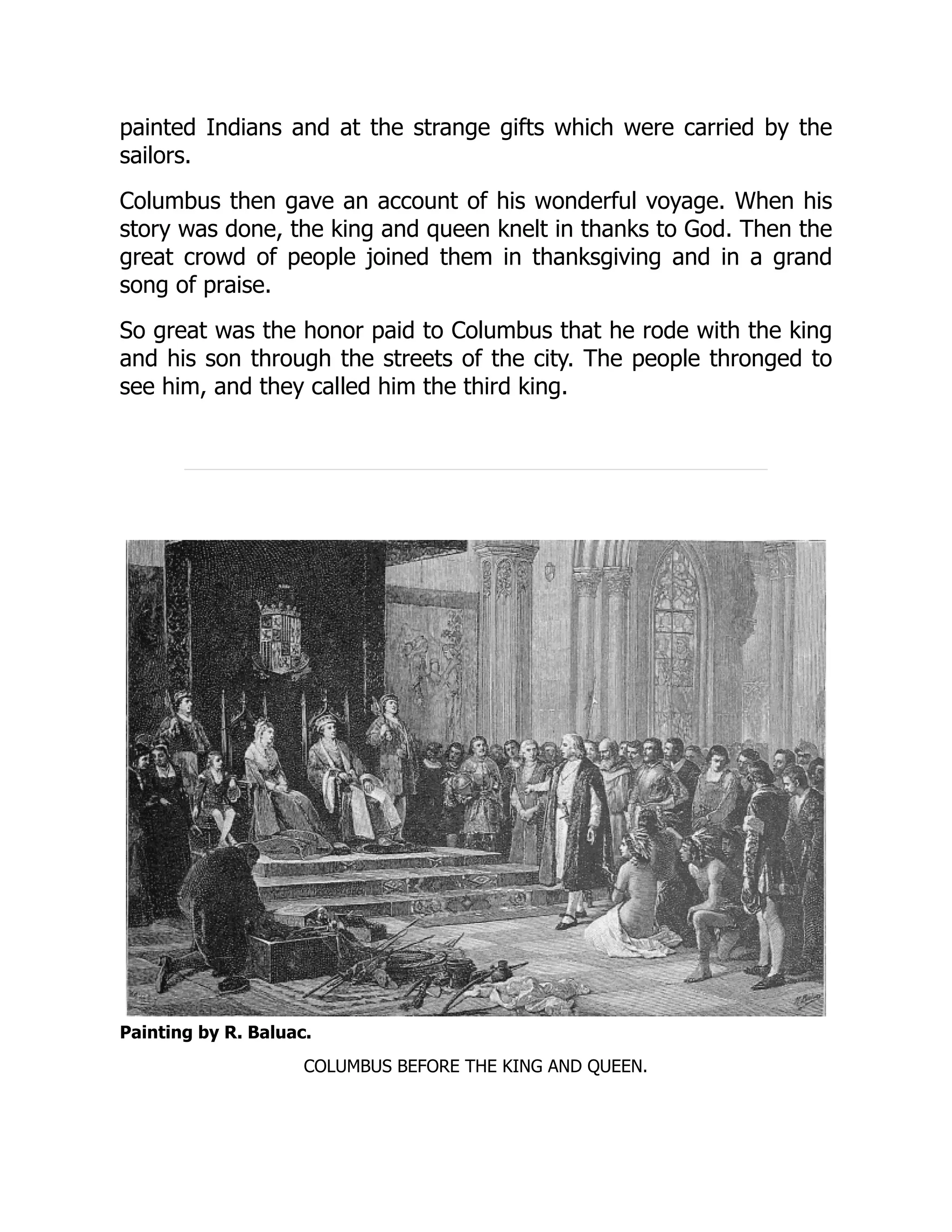
Painting by R. Baluac.
COLUMBUS BEFORE THE KING AND QUEEN.
32.
THE FIRST THANKSGIVING
I.
rejoiceThursday invited quail
rushes lowlands dainties guests
arrived cranberries already whoops
Almost a year had passed since the first company of Pilgrims had
come to America. About fifty of those who had crossed the ocean in
the Mayflower were now living in their new home.
They had laid out a village street and had built a few houses in the
place which they called Plymouth. Their houses were made of logs.
The roofs were very steep and were covered with grass and rushes.
It had been a busy summer for the Pilgrims. They had worked hard
in the gardens and the fields. But the harvests were good and there
would be food enough for the coming winter. How thankful they
were!
"Let us set aside a day in which to give thanks for this great
harvest," they said. "It is God who has sent the sunshine and the
rain to make the seeds grow. We will have a day of thanksgiving,
and ask the friendly Indians to come and rejoice with us."
So the Indian chief and his band were invited to the feast. Such a
busy time as that was for the Pilgrims! The men went to the forest
to hunt deer, wild turkeys, and other game. All the women were at
work, and the smoke of the ovens rose from the chimneys.
Even the children helped. Some of them gathered the cranberries
that were turning red in the lowlands. Some picked the wild grapes
that were growing purple on the vines. Others brought home the
33.
nuts which werefalling from the trees. The older boys were sent to
the beach for clams.
The Indians were invited to come on Thursday. At sunrise on that
day the Pilgrims were awakened by whoops and yells which told
them that their guests had already arrived.
II.
game feast November stew
roasts poured turkeys veil
stuffed sermon popcorn haze
It was in the month of November, but the weather was mild and
lovely, and a soft blue haze seemed to veil the woods.
Late wild flowers were blooming. Bright leaves were falling from the
trees. It was the time of year that we call Indian summer.
A great fire was built out of doors for the cooking, and long tables
were spread in the open air. When the loud roll of the drum was
heard, all the people went to the log fort on the hill which was used
as a meeting house. There they gave thanks to God for the rich
harvest of the year.
Everybody, young and old, was there. The little children must have
grown very tired of the long sermon. They must have wanted to go
home to the good dinner which they knew was waiting for them.
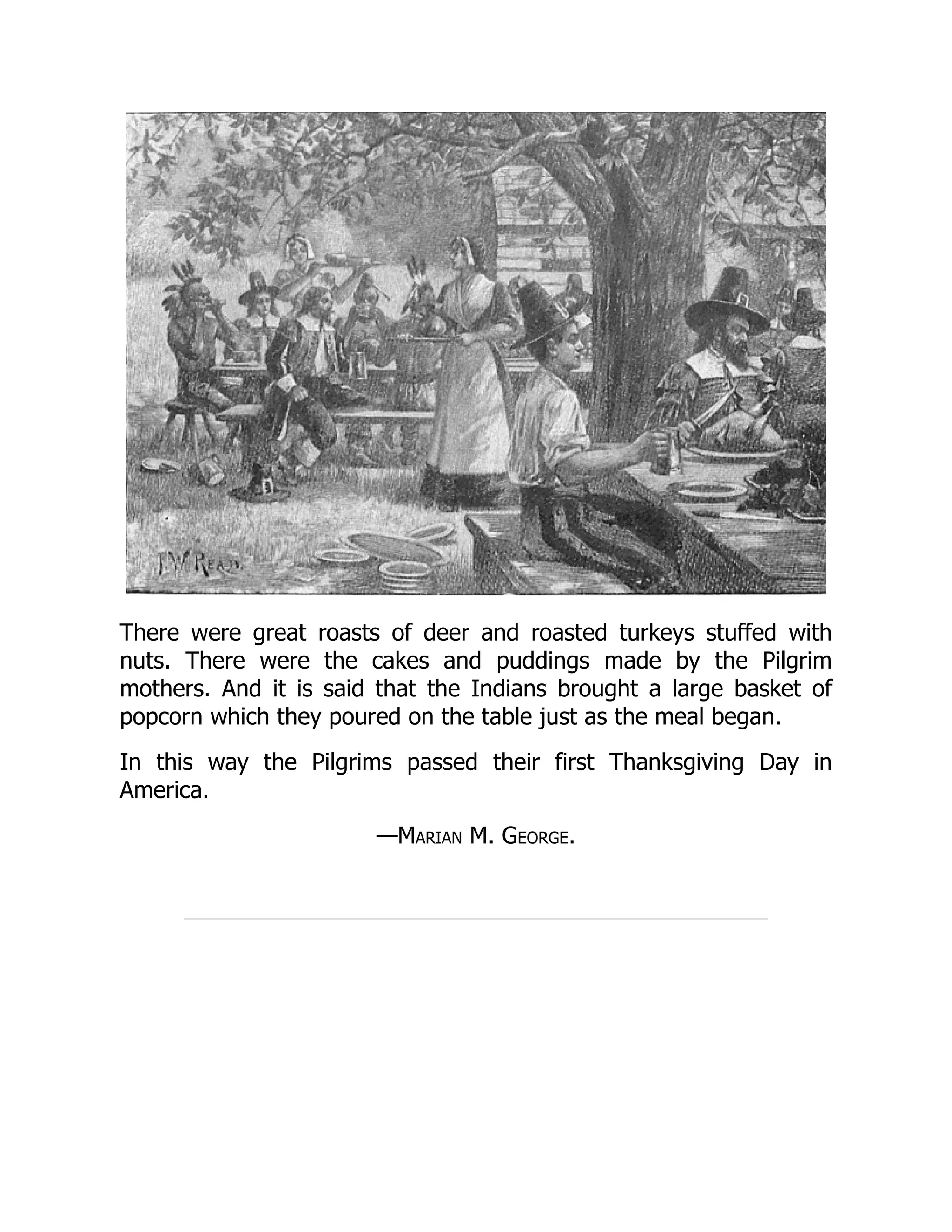
At last the Thanksgiving feast was ready. In the middle of the long
table stood a huge bowl of stew made of different kinds of game.
34.
There were greatroasts of deer and roasted turkeys stuffed with
nuts. There were the cakes and puddings made by the Pilgrim
mothers. And it is said that the Indians brought a large basket of
popcorn which they poured on the table just as the meal began.
In this way the Pilgrims passed their first Thanksgiving Day in
America.
—Marian M. George.
35.
THANKSGIVING DAY
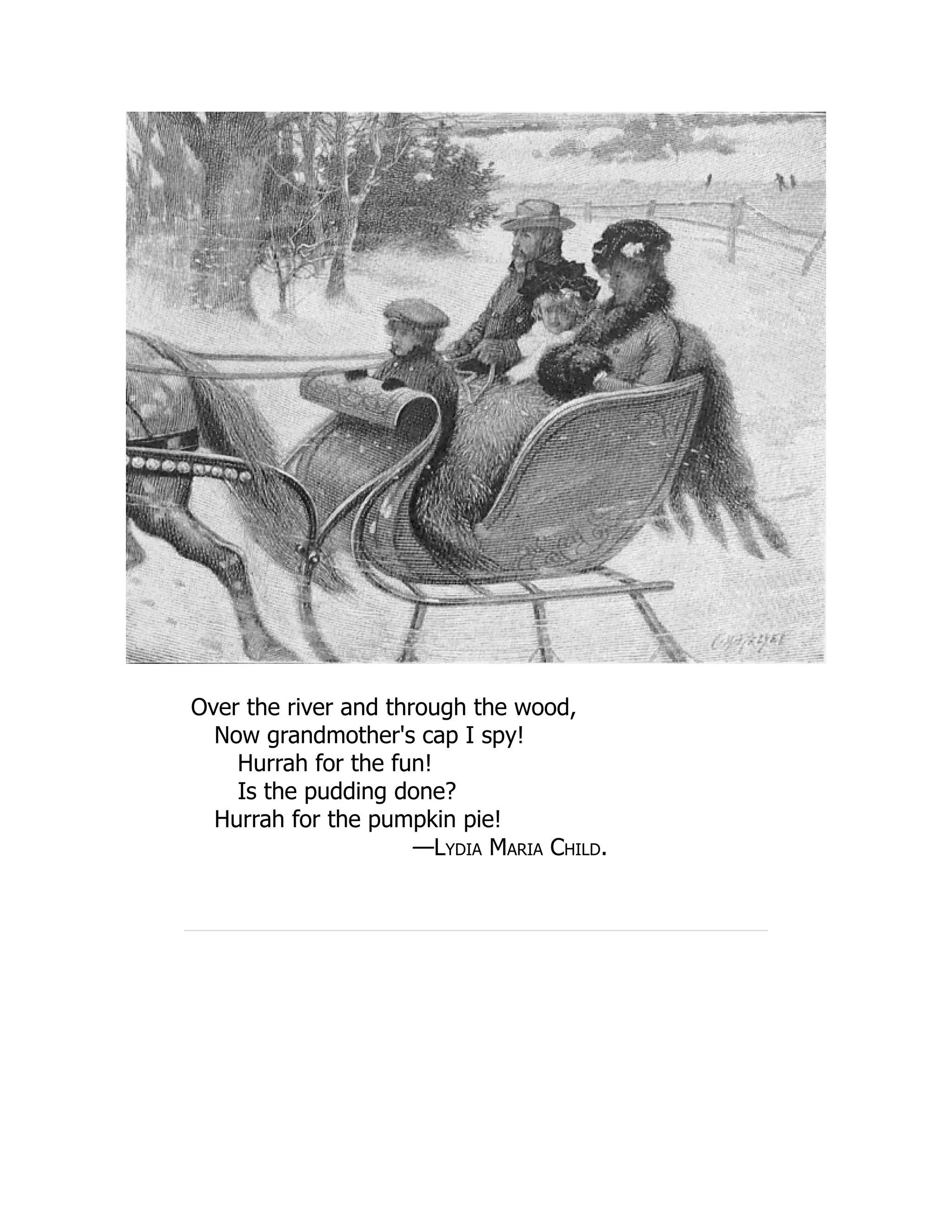
Over theriver and through the wood,
To grandfather's house we go;
The horse knows the way
To carry the sleigh
Through the white and drifted snow.
Over the river and through the wood,
Oh, how the wind does blow!
It stings the toes
And bites the nose,
As over the ground we go.
Over the river and through the wood,
To have a first-rate play;
Here the bells ring,
"Ting-a-ling-ding!"
Hurrah for Thanksgiving Day!
Over the river and through the wood,
Trot fast, my dapple-gray!
Spring over the ground,
Like a hunting hound!
For this is Thanksgiving Day.
Over the river and through the wood,
And straight through the barnyard gate.
We seem to go
Extremely slow,
It is so hard to wait!
36.
Over the riverand through the wood,
Now grandmother's cap I spy!
Hurrah for the fun!
Is the pudding done?
Hurrah for the pumpkin pie!
—Lydia Maria Child.
37.
THE SNOW BABY
I.
freezeshaggy Eskimos cliffs
noisy icebergs enormous hoofs
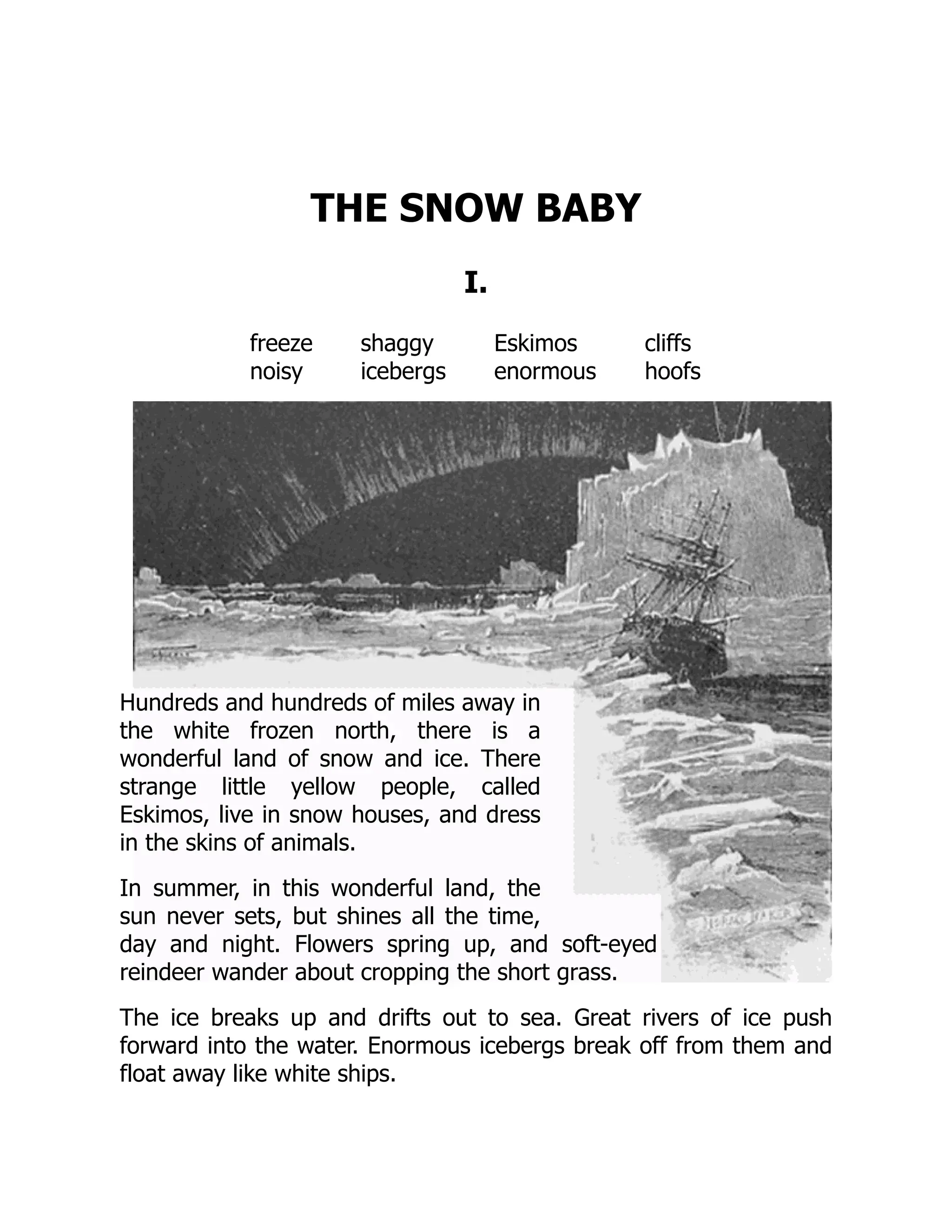
Hundreds and hundreds of miles away in
the white frozen north, there is a
wonderful land of snow and ice. There
strange little yellow people, called
Eskimos, live in snow houses, and dress
in the skins of animals.
In summer, in this wonderful land, the
sun never sets, but shines all the time,
day and night. Flowers spring up, and soft-eyed
reindeer wander about cropping the short grass.
The ice breaks up and drifts out to sea. Great rivers of ice push
forward into the water. Enormous icebergs break off from them and
float away like white ships.
38.
The blue wavesdance and sparkle in the sun. Singing brooks rush
down the mountains. Thousands of noisy sea birds come to the
rocky cliffs to lay their eggs.
Glossy seals swim in the water, and once in a while a shaggy white
bear goes running over the floating ice in search of seals.
The Eskimos, paddling swiftly through the water in their strange skin
boats, hunt these animals for food and clothing.
In winter there is no sunshine at all in Eskimo land. For four long,
long months it is dark all the time, just as it is here in the night. The
ground is covered deep with snow, and the poor deer must dig
through it with their hoofs for grass and moss.
The sea is covered thick with ice, and the birds fly away. The cold is
so terrible that the Eskimos would freeze to death were it not for
their thick, warm fur coats.
II.
hooded blankets veranda bushy
coffee sealskin September sugar
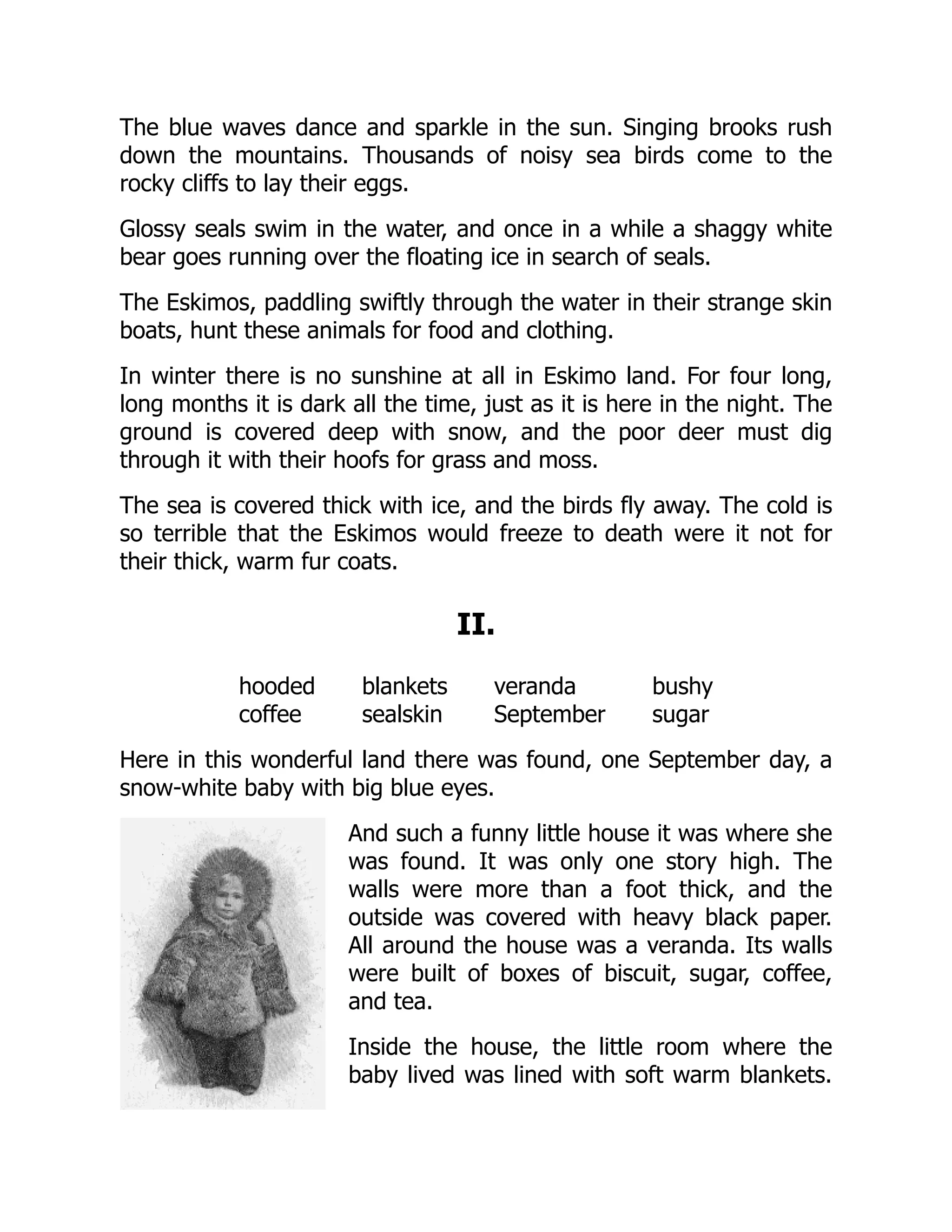
Here in this wonderful land there was found, one September day, a
snow-white baby with big blue eyes.
And such a funny little house it was where she
was found. It was only one story high. The
walls were more than a foot thick, and the
outside was covered with heavy black paper.
All around the house was a veranda. Its walls
were built of boxes of biscuit, sugar, coffee,
and tea.
Inside the house, the little room where the
baby lived was lined with soft warm blankets.
39.
There was abright carpet on the floor and pictures on the walls.
All these things, like the boxes of food outside, came in the ship
which brought the baby's father and mother to this strange country.
One window of the baby's room looked out upon a great river of ice.
From the other window you could see high red and brown
mountains. And here was the sea in which strange-looking icebergs
floated.
III.
August mittens trousers sleigh
steamed northern language sledge
When the people of that land heard that there was a white baby in
the small black house, they came hundreds of miles to see the little
stranger.
They talked to the baby in their own queer language. They called
her the Snow Baby, and they brought her presents of fur mittens
and little sealskin boots.
After the sun went away the baby lived for days and weeks in a little
room lined with blankets. A lamp was kept burning in the room all
the time, both day and night.
One of the Eskimo women made a little suit of clothes for the baby,
all out of furs. There were only two pieces in this suit. First there
was a pair of little trousers and boots made together. Over this a
hooded coat was worn.
When the sun returned, the Snow Baby was taken out of doors
every day. No matter how cold it was she had a sleigh ride on her
little Eskimo sledge. You should have seen her team of dogs with
their bright eyes, their sharp-pointed ears, and their big bushy tails.
40.
For nearly ayear the Snow Baby lived in this strange, northern
home. But one day in August a big black ship came up the bay. It
was the same ship that had brought the Snow Baby's father and
mother to the Snowland.
Then the baby and her mother went on board the ship and steamed
away south to their own American home.
From "The Snow Baby."
Copyright, 1901, by Frederick A. Stokes Company.
41.
A SNOW HOUSE
kneespuppy harness dries
force needle clothing twists
thaws dimly platform whales
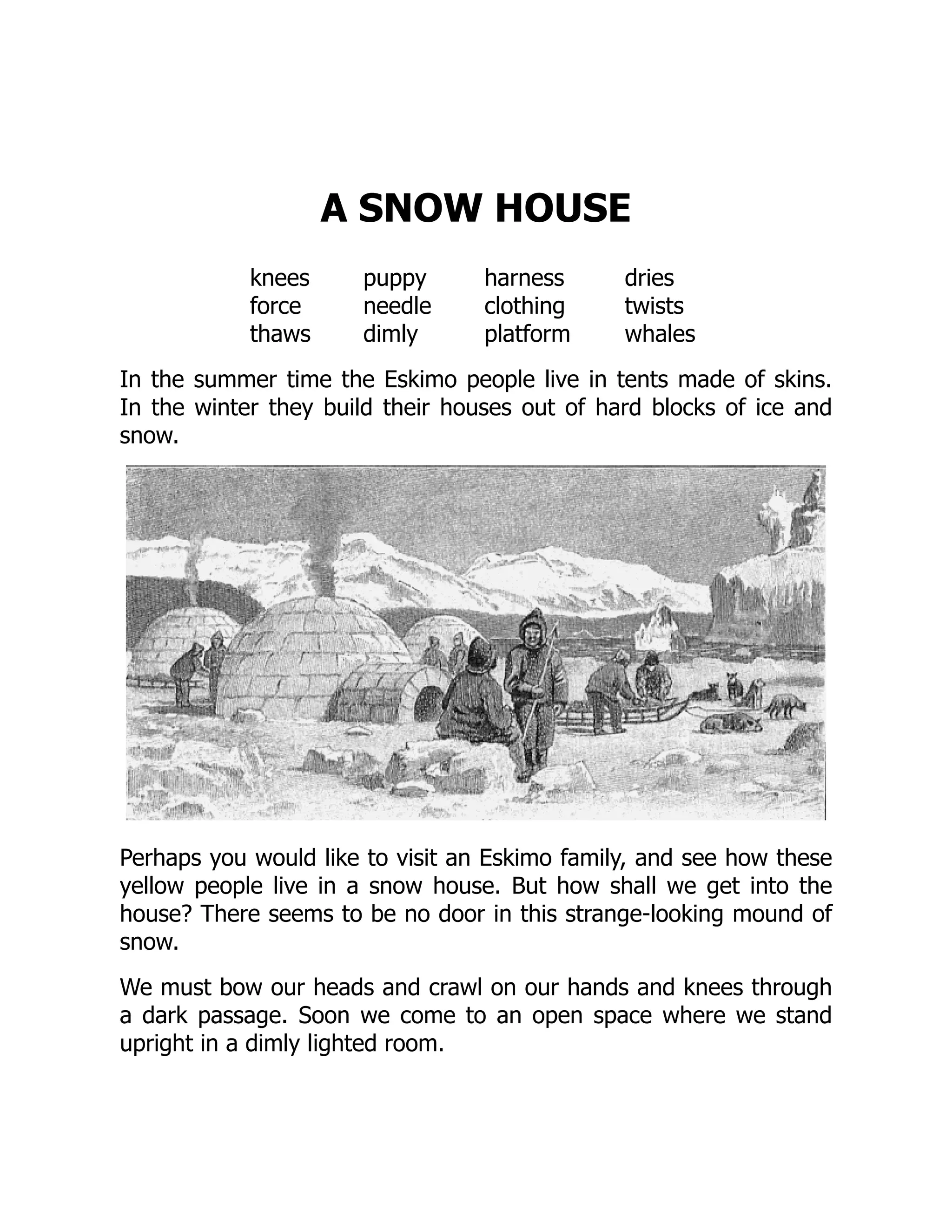
In the summer time the Eskimo people live in tents made of skins.
In the winter they build their houses out of hard blocks of ice and
snow.
Perhaps you would like to visit an Eskimo family, and see how these
yellow people live in a snow house. But how shall we get into the
house? There seems to be no door in this strange-looking mound of
snow.
We must bow our heads and crawl on our hands and knees through
a dark passage. Soon we come to an open space where we stand
upright in a dimly lighted room.
42.
All around theroom is a bank of snow next to the wall of the house.
The top of this bank is broad and level like a table. It is covered with
the thick skins of reindeer, bear, and foxes. Here the family eat and
sleep, and here the children play.
Near the doorway stands the stove, on a raised platform. You would
think it a very poor stove, for it is only a hollow stone filled with oil
and moss. When the moss is lighted, it burns like the wick of a lamp.
This stove warms the room, melts the water for drinking, dries wet
clothing, and thaws the frozen meat. It lights the room dimly and we
see the Eskimo father, mother, and children in their snow house.
A bag is lying on the thick furs. Now it moves and the mother takes
it in her arms. See, it is a baby boy in a bag of feathers.
When an Eskimo baby is in the house, he lies in his feather bag. And
when he is out of doors, he is always on his mother's back, inside of
her fur hood.
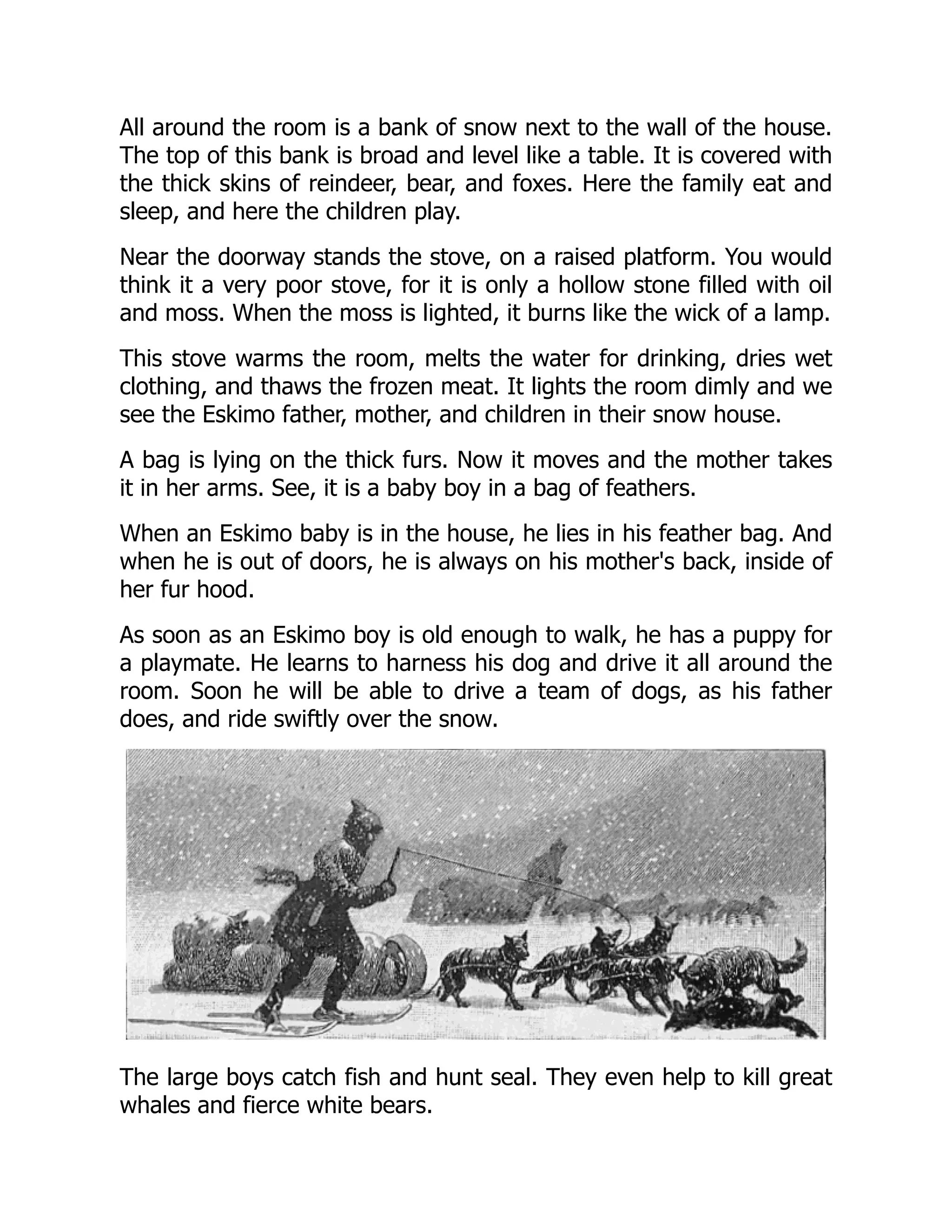
As soon as an Eskimo boy is old enough to walk, he has a puppy for
a playmate. He learns to harness his dog and drive it all around the
room. Soon he will be able to drive a team of dogs, as his father
does, and ride swiftly over the snow.
The large boys catch fish and hunt seal. They even help to kill great
whales and fierce white bears.
43.
But what doesthe little Eskimo girl do? The little sister learns to sew
and to make clothes out of skins. She makes her own needle from a
hard bone or a piece of iron, and she twists thread from strips of
deerskin. Everything the Eskimos use they make with their own
hands.
Sometimes our ships force their way through the frozen ocean to
their land of ice and snow. The Eskimo people think these great
ships the most wonderful things they have ever seen.
44.
THE NORTHERN SEAS
Up!up! let us a voyage take;
Why sit we here at ease?
Find us a vessel tight and snug,
Bound for the northern seas.
I long to see the Northern Lights,
With their rushing splendors, fly,
Like living things, with flaming wings,
Wide o'er the wondrous sky.
I long to see those icebergs vast,
With heads all crowned with snow,
Whose green roots sleep in the awful deep,
Two hundred fathoms low.
I long to hear the thundering crash
Of their terrific fall;
And the echoes from a thousand cliffs,
Like lonely voices call.
There we shall see the fierce white bear,
The sleepy seals aground,
And the spouting whales that to and fro
Sail with a dreary sound.
We'll pass the shores of solemn pine,
Where wolves and black bears prowl,
And away to the rocky isles of mist
To rouse the northern fowl.
And there, in the wastes of the silent sky,
45.
With the silentearth below,
We shall see far off to his lonely rock
The lonely eagle go.
Then softly, softly we will tread
By island streams, to see
Where the pelican of the silent North
Sits there all silently.
—William Howitt.
46.
DECEMBER
And now December'ssnows are here,
The light flakes flutter down,
And hoarfrost glitters, white and fair,
Upon the branches brown.
—Selected.
47.
JANUARY
Wintry day! frostyday!
God a cloak on all doth lay;
On the earth the snow he sheddeth,
O'er the lamb a fleece he spreadeth,
Gives the bird a coat of feather
To protect it from the weather.
—Selected.
48.
FEBRUARY
In the snowingand the blowing,
In the cold and cruel sleet,
Little flowers begin their growing,
Underneath your feet.
—Mary Mapes Dodge.
49.
CHRISTMAS EVERYWHERE
Everywhere, everywhere,Christmas to-night!
Christmas in lands of the fir-tree and pine.
Christmas in lands of the palm-tree and vine.
Christmas where snow peaks stand solemn and white.
Christmas where cornfields lie sunny and bright!
Christmas where children are hopeful and gay,
Christmas where old men are patient and gray,
Christmas where peace, like a dove in his flight,
Broods o'er brave men in the thick of the fight,
Everywhere, everywhere, Christmas to-night.
For the Christ-Child who comes is the Master of all;
No palace too great and no cottage too small.
—Phillips Brooks.
50.
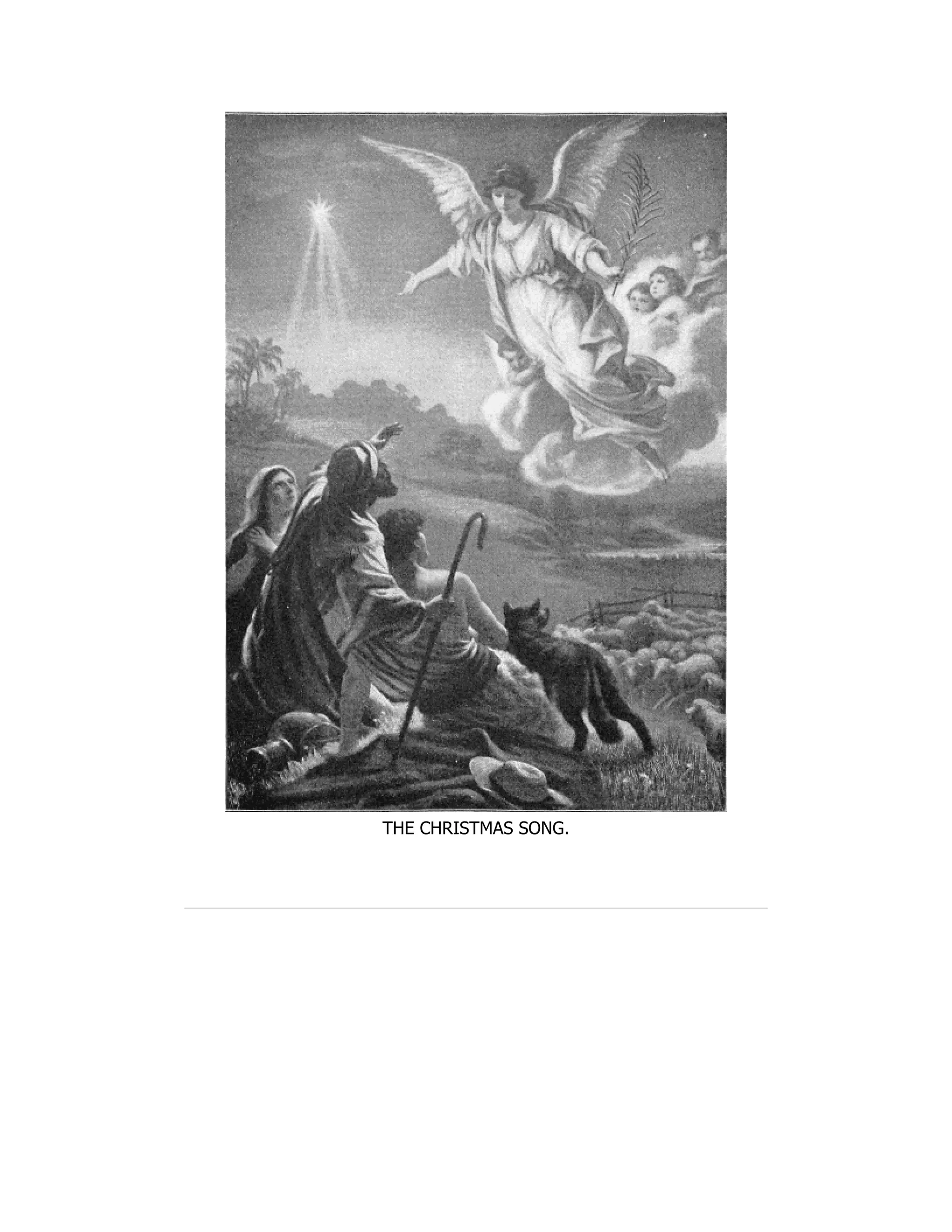
THE CHRISTMAS SONG
Andsuddenly there was with the angel a multitude of the heavenly
host praising God, and saying: "Glory to God in the highest, and on
earth peace, good will to man."
—St. Luke.
The shepherds were watching their flocks
On a beautiful starlit night,
When the sky was suddenly filled
With a band of angels bright.
Oh! shepherds fear not but rejoice,
For we bring good news, they sing;
In Bethlehem is born this day,
A saviour who is Christ your King!
A glad and wonderful song
Rang through the heavens then;
It was "Glory to God on high,
Peace on earth, good will toward men."
THE NEW YEAR
TheNew Year comes in the midnight hour
When the beautiful world is still,
And the moonlight falls in a silver stream
Over meadow and wood and hill.
We can not hear the tread of his feet,
For so silently comes he;
But the ringing bells the good news tell
As they sound over land and sea.
Where'er he steps new joys upspring,
And hopes, that were lost or dim,
Grow sweet and strong in the golden hours,
That he everywhere bears with him.
He brings us snow from the fleecy clouds;
He sends us the springtime showers;
He gladdens our world with the light of love
And fills its lap with flowers.
Some day, as softly as he came,
He will pass through the open door,
And we who sing at his coming now
Will never see him more.
—Marie Zetterberg.
53.
HOW PLANTS GROW
trunkhalves dissolves juice
swells course openings blood
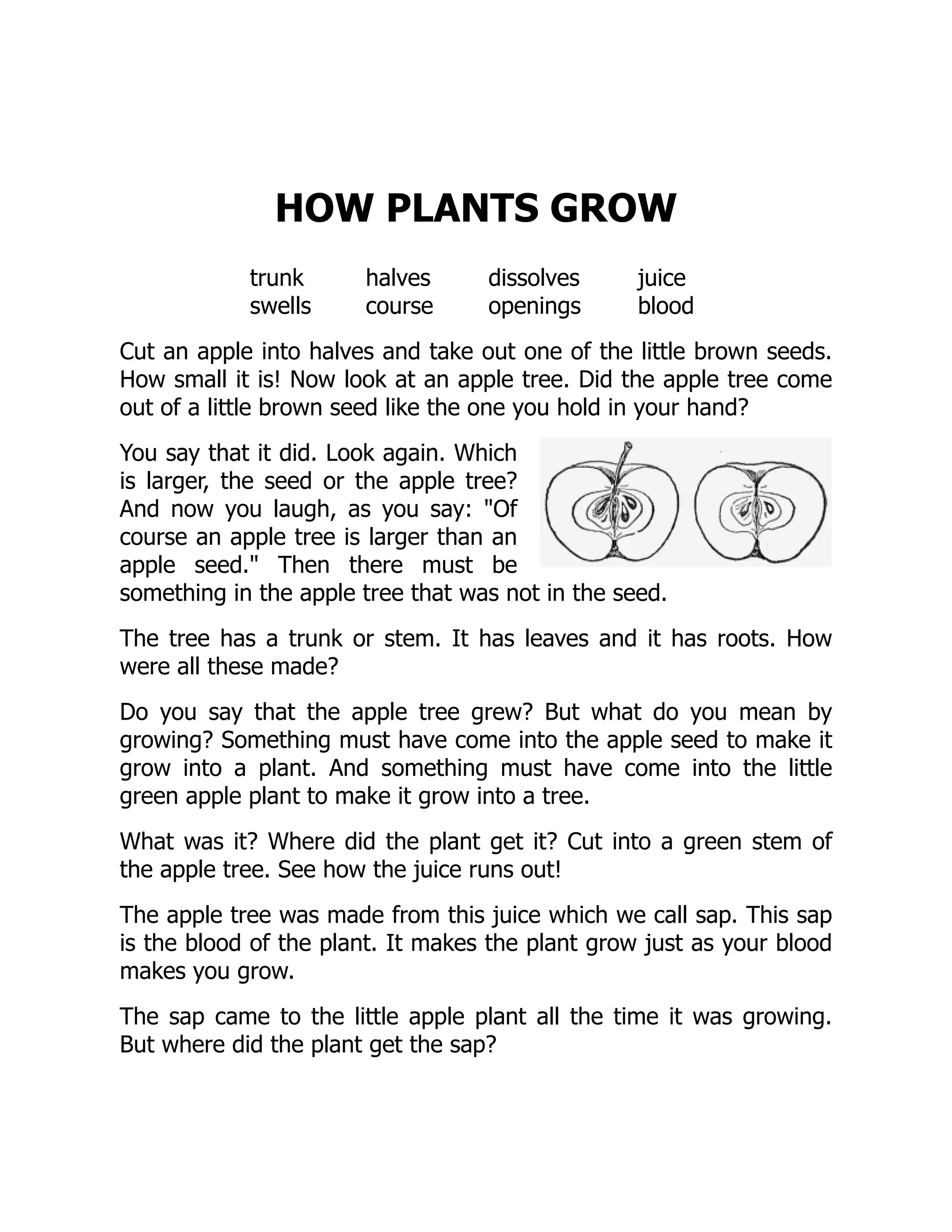
Cut an apple into halves and take out one of the little brown seeds.
How small it is! Now look at an apple tree. Did the apple tree come
out of a little brown seed like the one you hold in your hand?
You say that it did. Look again. Which
is larger, the seed or the apple tree?
And now you laugh, as you say: "Of
course an apple tree is larger than an
apple seed." Then there must be
something in the apple tree that was not in the seed.
The tree has a trunk or stem. It has leaves and it has roots. How
were all these made?
Do you say that the apple tree grew? But what do you mean by
growing? Something must have come into the apple seed to make it
grow into a plant. And something must have come into the little
green apple plant to make it grow into a tree.
What was it? Where did the plant get it? Cut into a green stem of
the apple tree. See how the juice runs out!
The apple tree was made from this juice which we call sap. This sap
is the blood of the plant. It makes the plant grow just as your blood
makes you grow.
The sap came to the little apple plant all the time it was growing.
But where did the plant get the sap?
54.
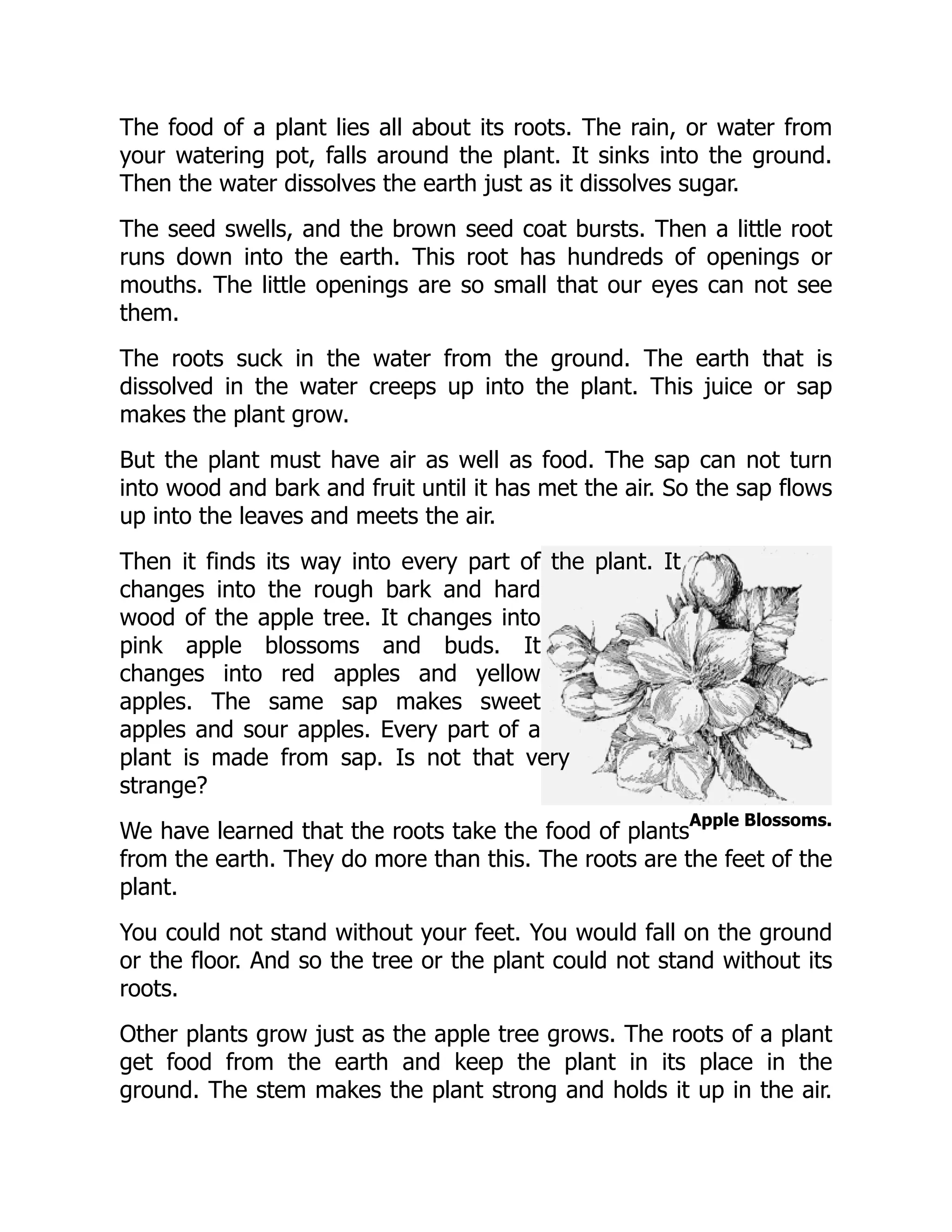
Apple Blossoms.
The foodof a plant lies all about its roots. The rain, or water from
your watering pot, falls around the plant. It sinks into the ground.
Then the water dissolves the earth just as it dissolves sugar.
The seed swells, and the brown seed coat bursts. Then a little root
runs down into the earth. This root has hundreds of openings or
mouths. The little openings are so small that our eyes can not see
them.
The roots suck in the water from the ground. The earth that is
dissolved in the water creeps up into the plant. This juice or sap
makes the plant grow.
But the plant must have air as well as food. The sap can not turn
into wood and bark and fruit until it has met the air. So the sap flows
up into the leaves and meets the air.
Then it finds its way into every part of the plant. It
changes into the rough bark and hard
wood of the apple tree. It changes into
pink apple blossoms and buds. It
changes into red apples and yellow
apples. The same sap makes sweet
apples and sour apples. Every part of a
plant is made from sap. Is not that very
strange?
We have learned that the roots take the food of plants
from the earth. They do more than this. The roots are the feet of the
plant.
You could not stand without your feet. You would fall on the ground
or the floor. And so the tree or the plant could not stand without its
roots.
Other plants grow just as the apple tree grows. The roots of a plant
get food from the earth and keep the plant in its place in the
ground. The stem makes the plant strong and holds it up in the air.
55.
And the leavesdraw in just what the plants need from the air
around them.
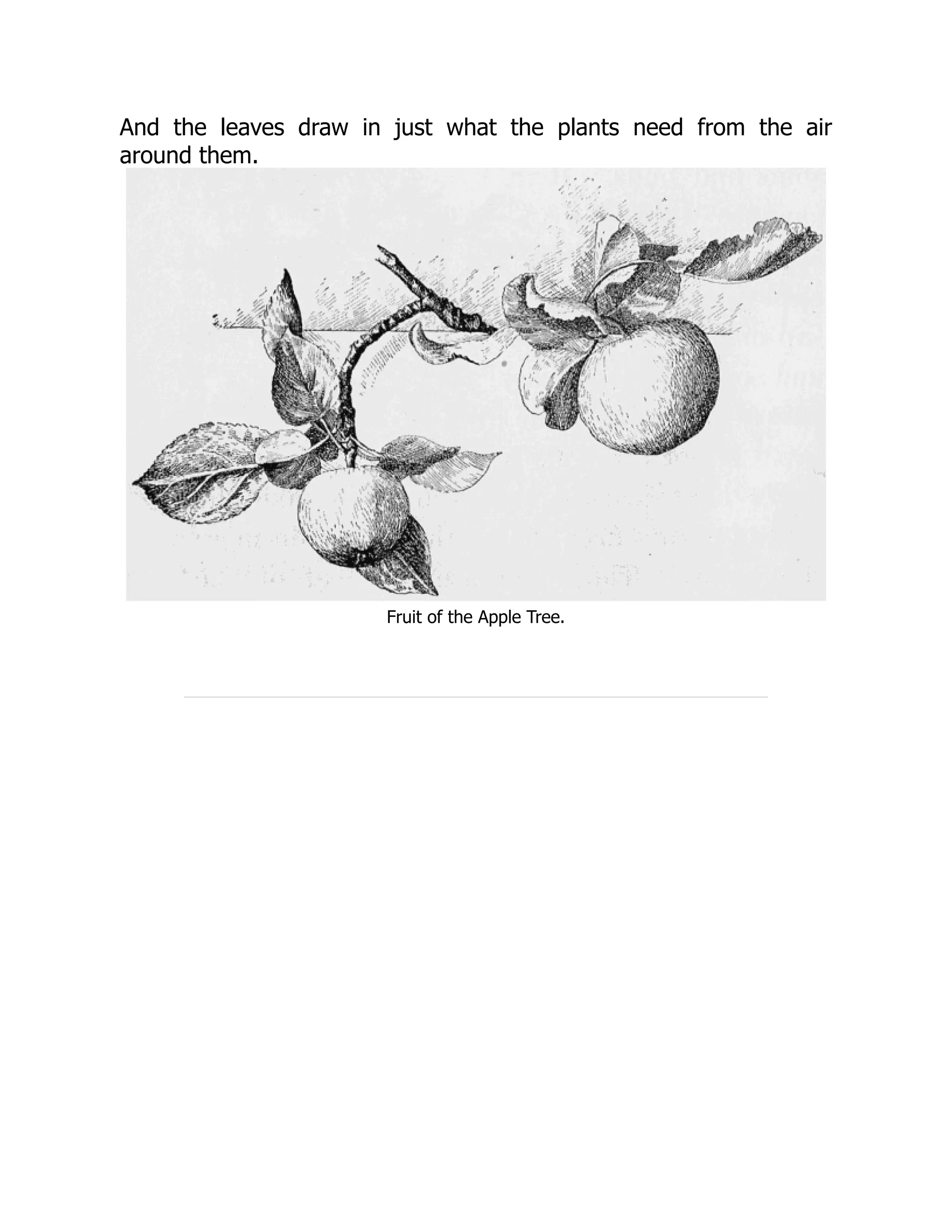
Fruit of the Apple Tree.
56.
TALKING IN THEIRSLEEP
"You think I am dead,"
The apple tree said,
"Because I have never a leaf to show—
Because I stoop
And my branches droop,
And the dull gray mosses over me grow.
But I'm still alive in trunk and shoot;
The buds of next May
I fold away—
But I pity the withered grass at my foot."
"You think I am dead,"
The quick grass said,
"Because I have parted with stem and blade.
But under the ground
I am safe and sound
With the snow's thick blanket over me laid.
I'm all alive and ready to shoot,
Should the spring of the year
Come dancing here—
But I pity the flowers without branch or root."
"You think I am dead,"
A soft voice said,
"Because not a branch or root I own!
I never have died
But close I hide,
In a plumy seed that the wind has sown.
Patient I wait through the long winter hours;
You will see me again—
57.
I shall laughat you then,
Out of the eyes of a hundred flowers."
—Edith M. Thomas.
58.
A RIDDLE
I haveonly one foot, but thousands of toes;
My one foot stands, but never goes;
I have many arms and they're mighty all;
And hundreds of fingers, large and small.
None e'er saw me eat—I've no mouth to bite;
Yet I feed all day in the full sunlight;
In the summer with song I shake and quiver,
But in winter I fast and groan and shiver.
—George Macdonald.
59.
SNOWFLAKES
ut of thesky they come,
Wandering down the air,
Some to the roofs, and some
Whiten the branches bare;
Some in the empty nest,
Some on the ground below,
Until the world is dressed
All in a gown of snow;
Dressed in a fleecy gown
Out of the snowflakes spun;
Wearing a golden crown,
Over her head the sun.
Out of the sky again
Ghosts of the flowers that died
Visit the earth, and then
Under the white drifts hide.
—Frank Dempster Sherman.
60.
Welcome to ourwebsite – the perfect destination for book lovers and
knowledge seekers. We believe that every book holds a new world,
offering opportunities for learning, discovery, and personal growth.
That’s why we are dedicated to bringing you a diverse collection of
books, ranging from classic literature and specialized publications to
self-development guides and children's books.
More than just a book-buying platform, we strive to be a bridge
connecting you with timeless cultural and intellectual values. With an
elegant, user-friendly interface and a smart search system, you can
quickly find the books that best suit your interests. Additionally,
our special promotions and home delivery services help you save time
and fully enjoy the joy of reading.
Join us on a journey of knowledge exploration, passion nurturing, and
personal growth every day!
testbankfan.com


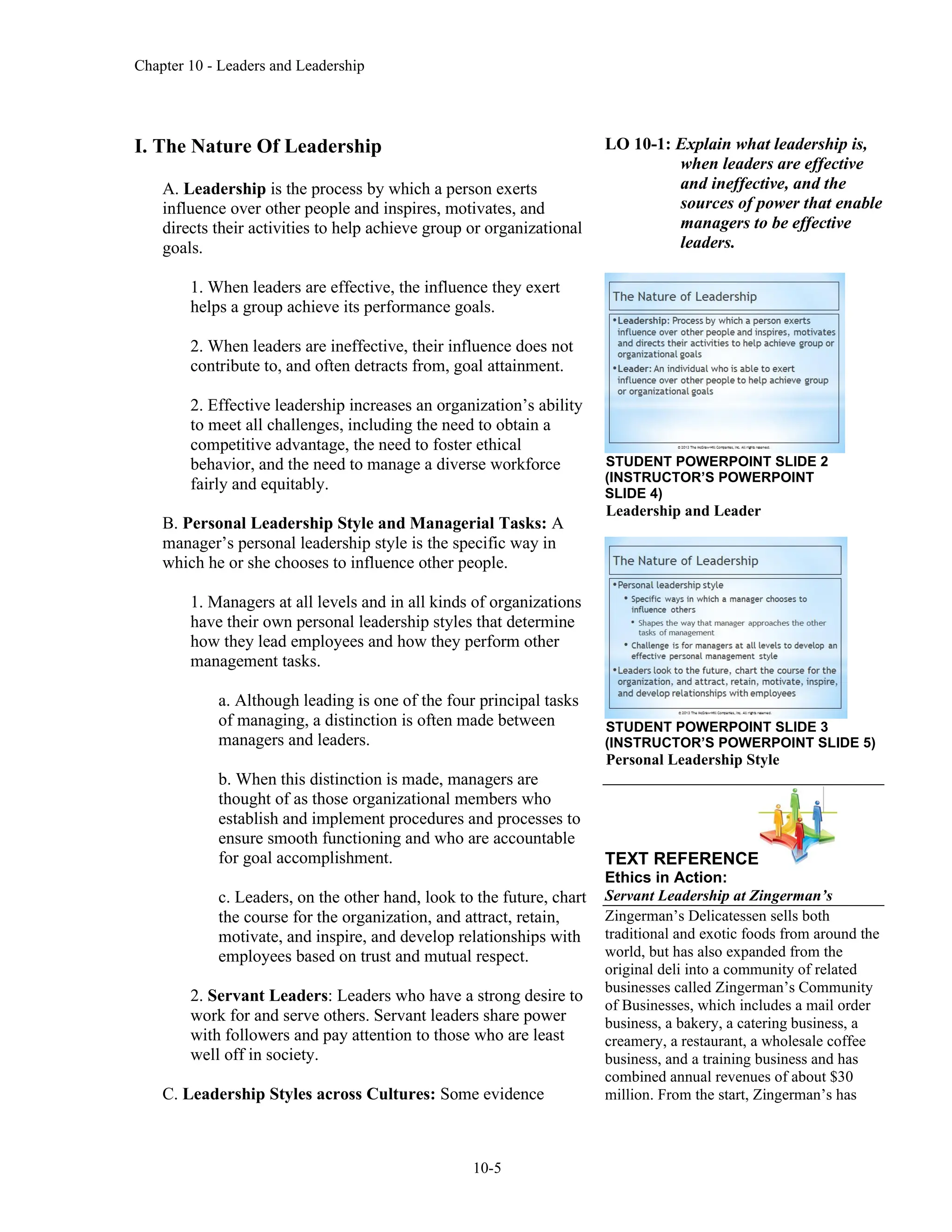
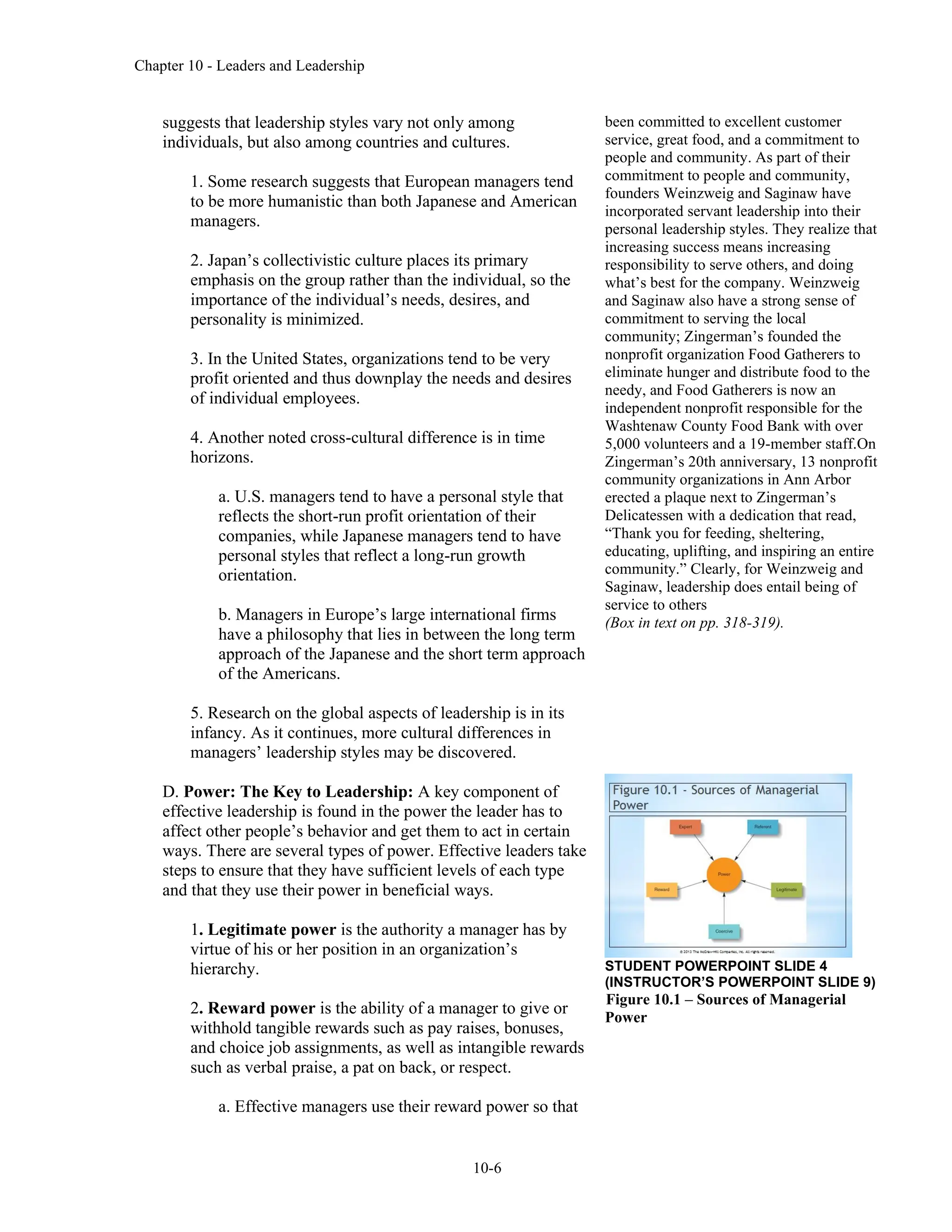
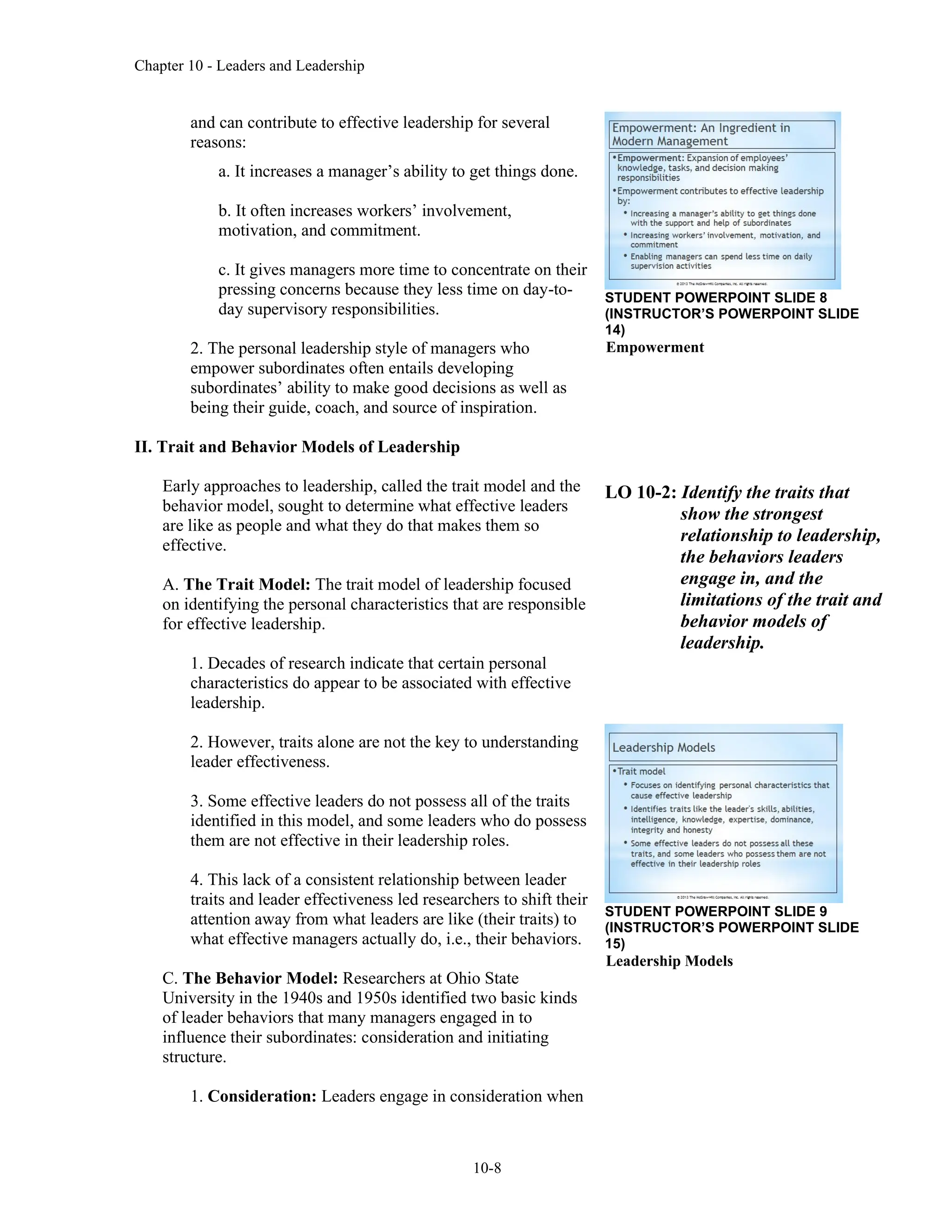
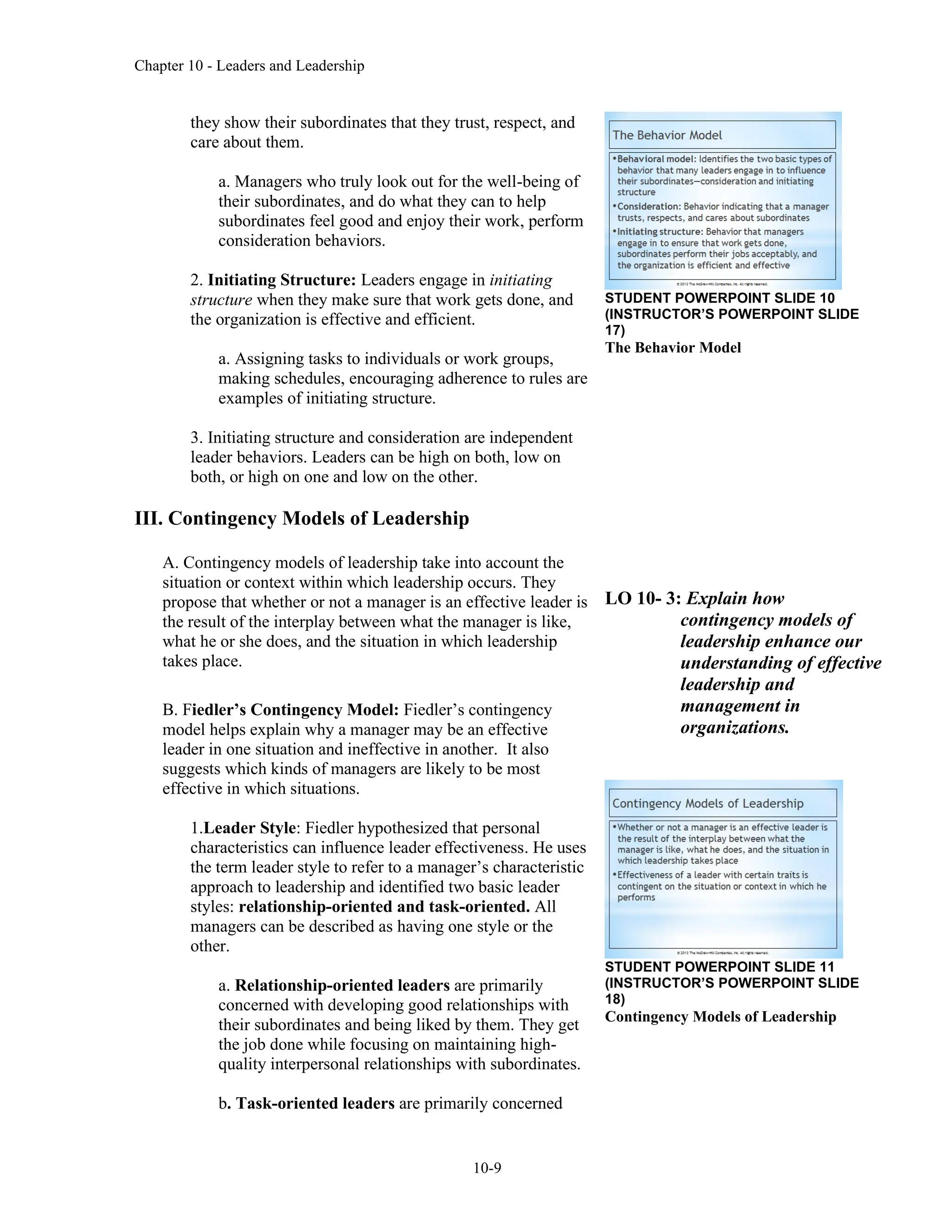
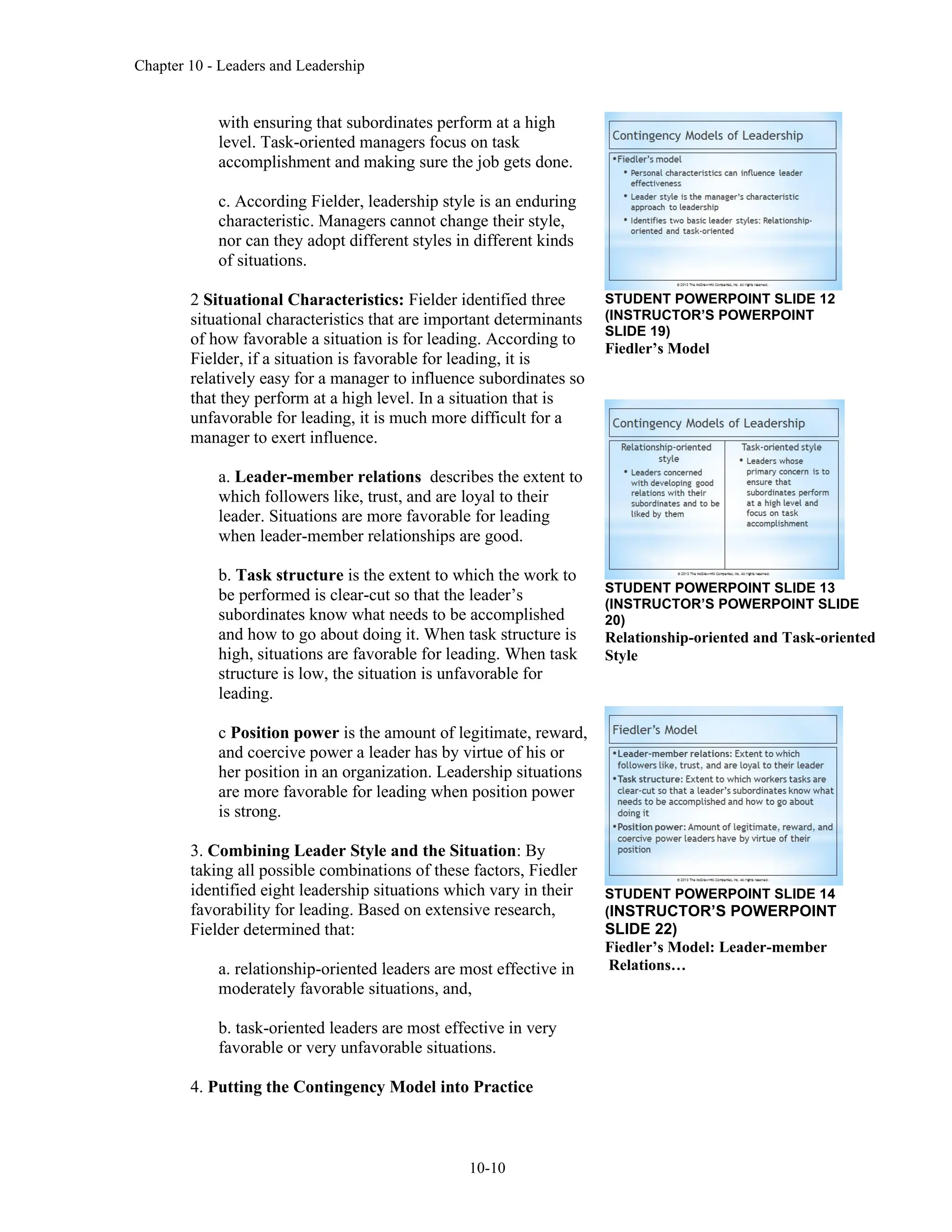
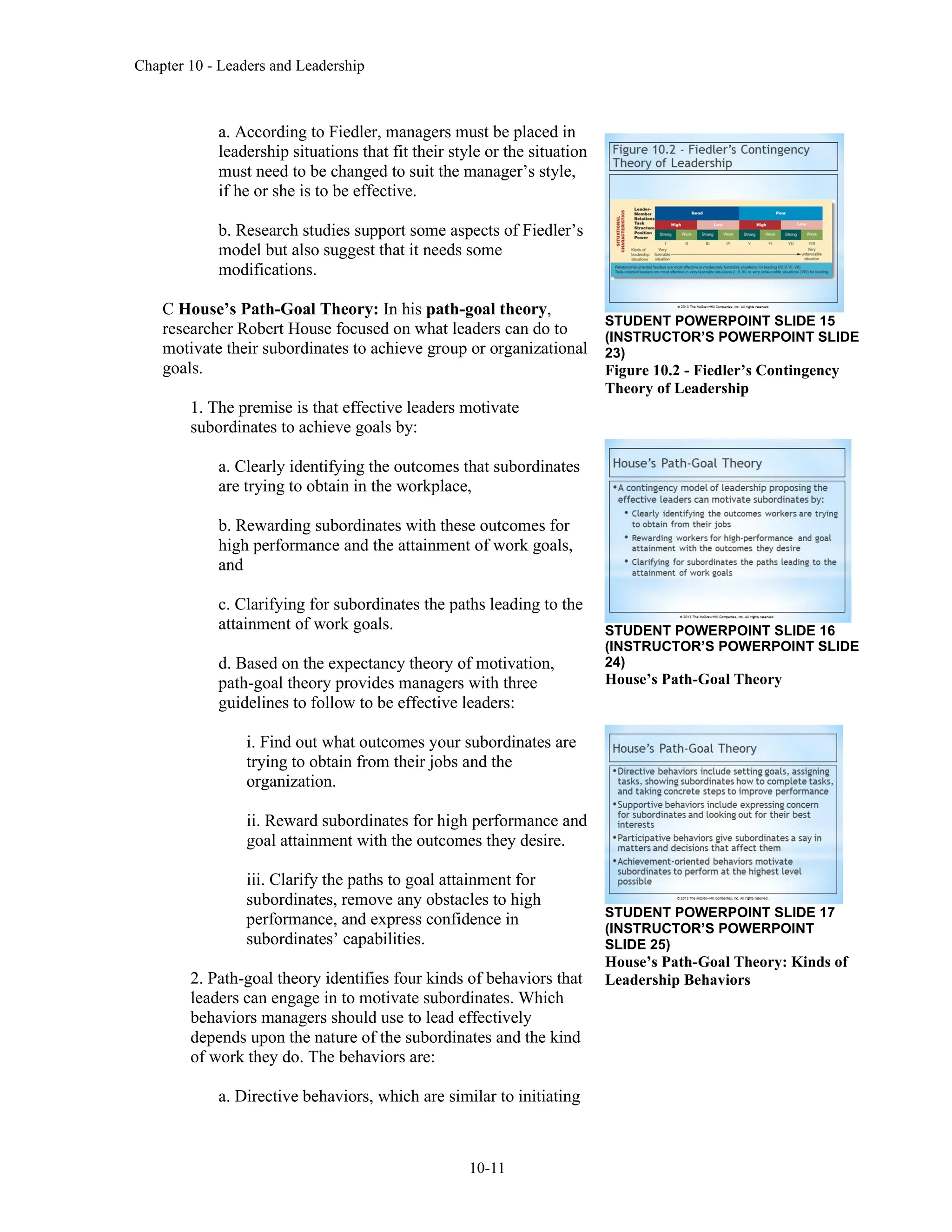
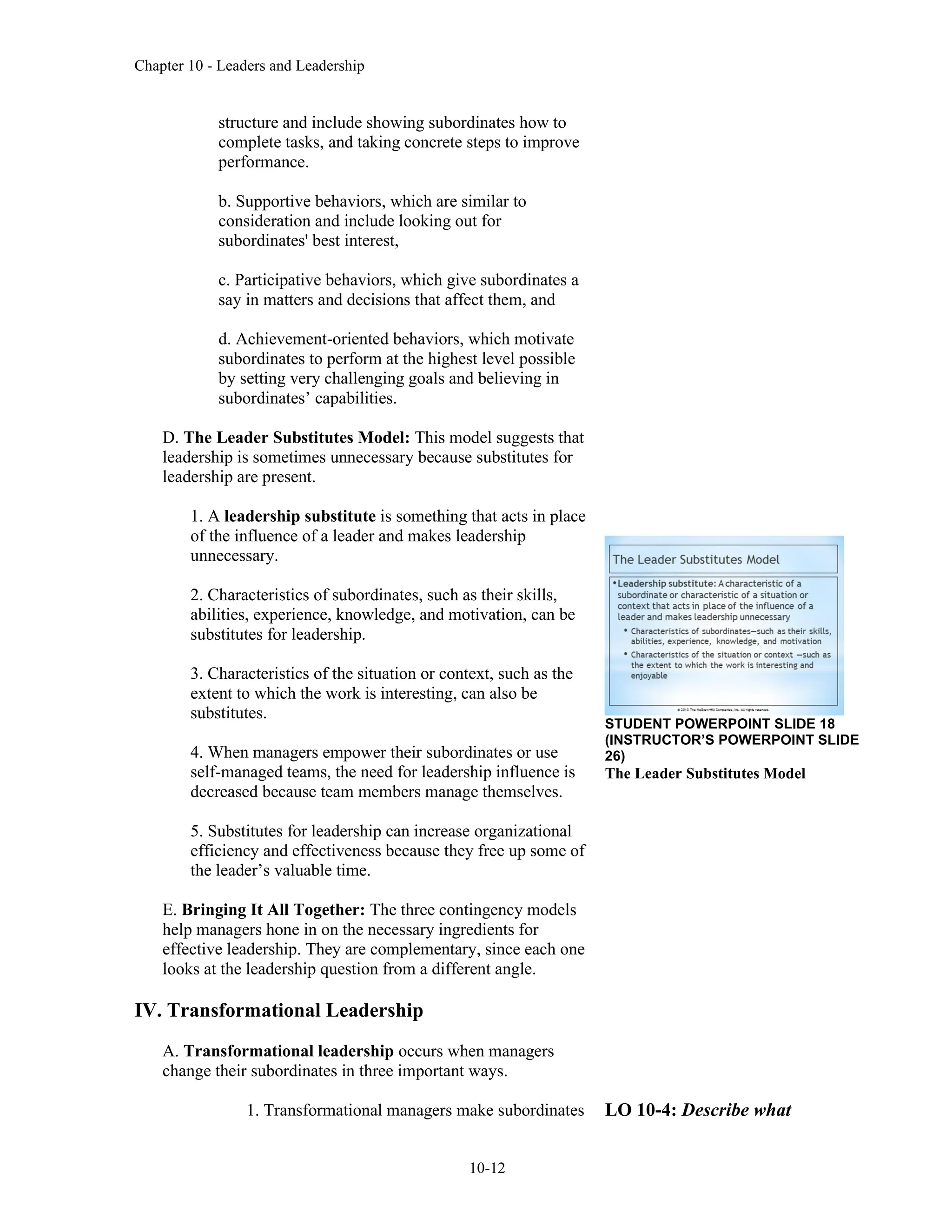
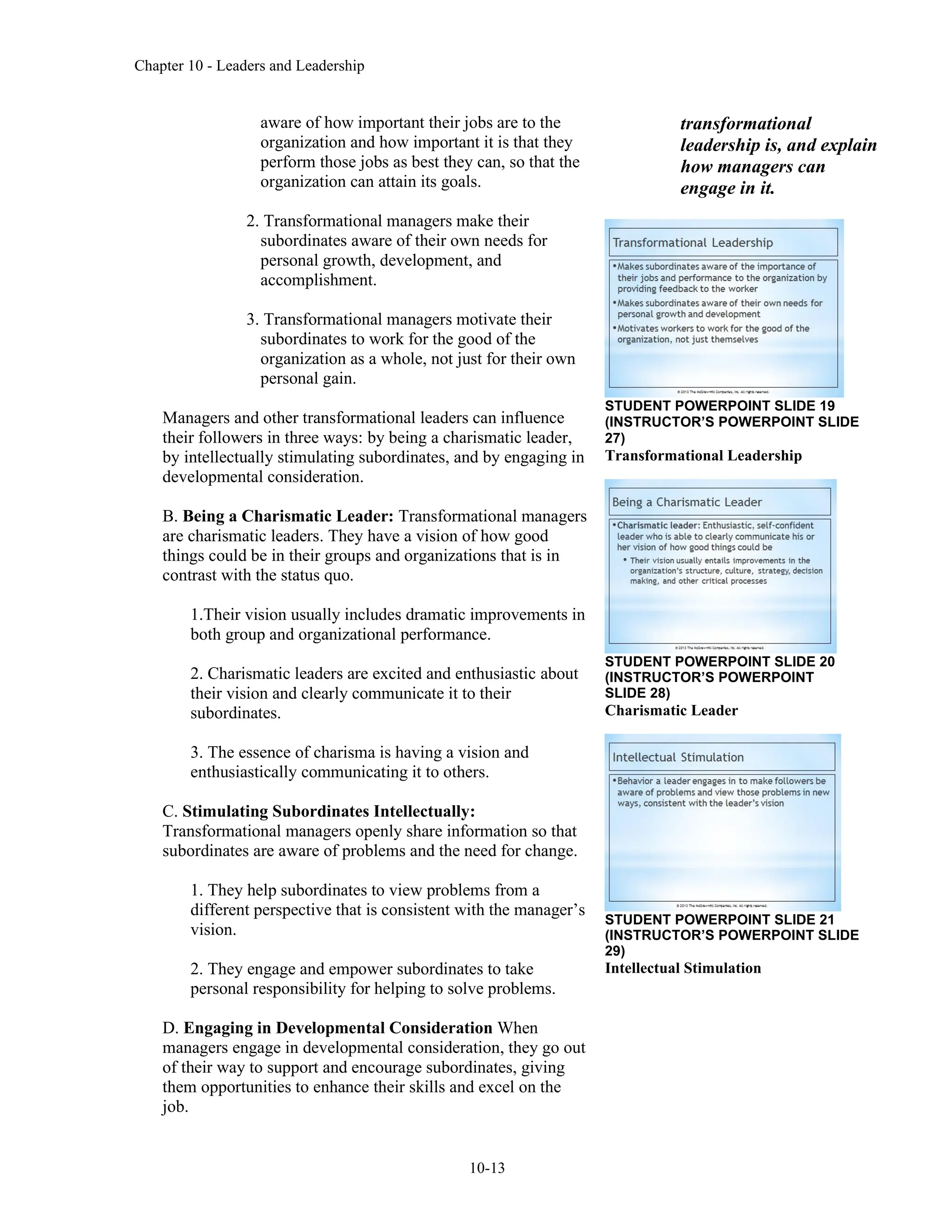
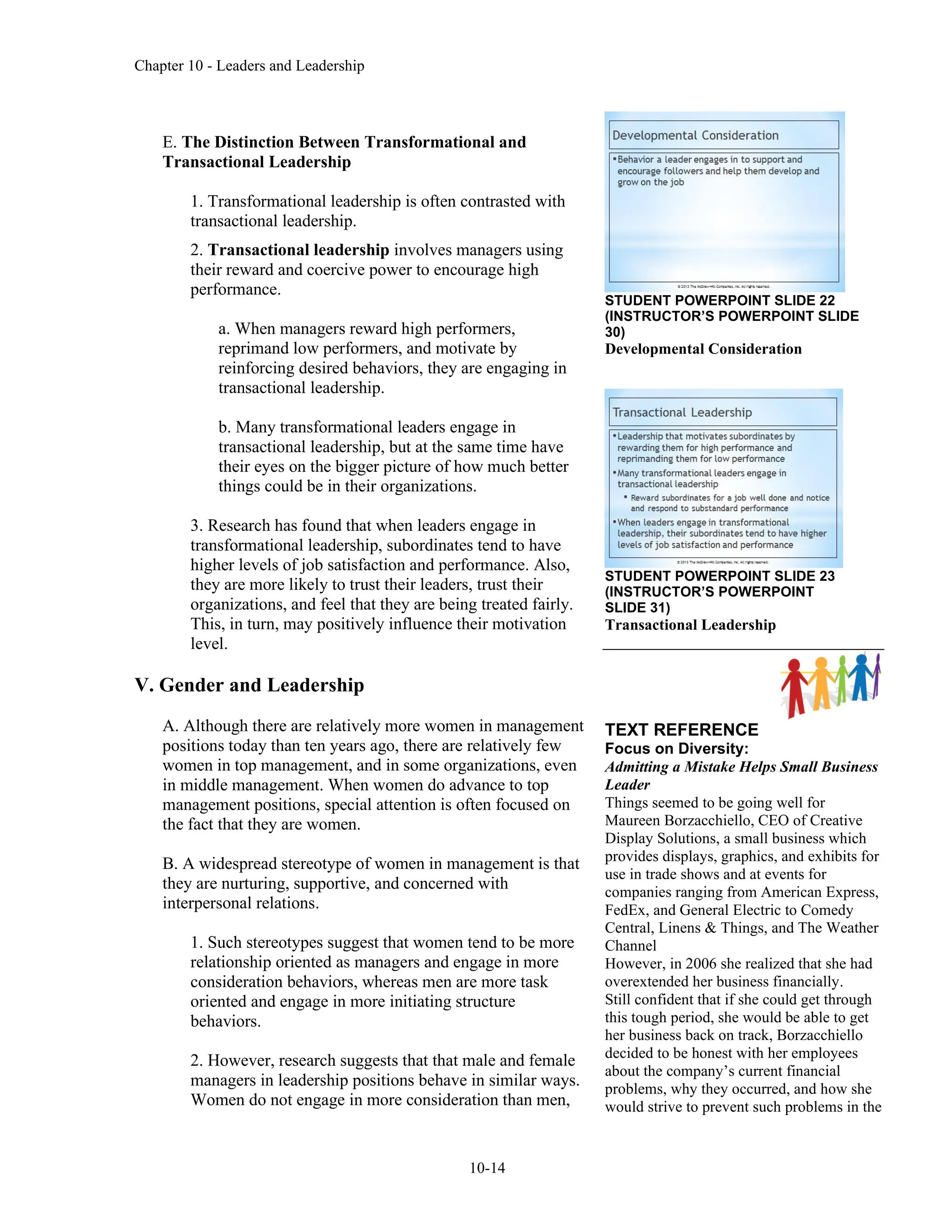
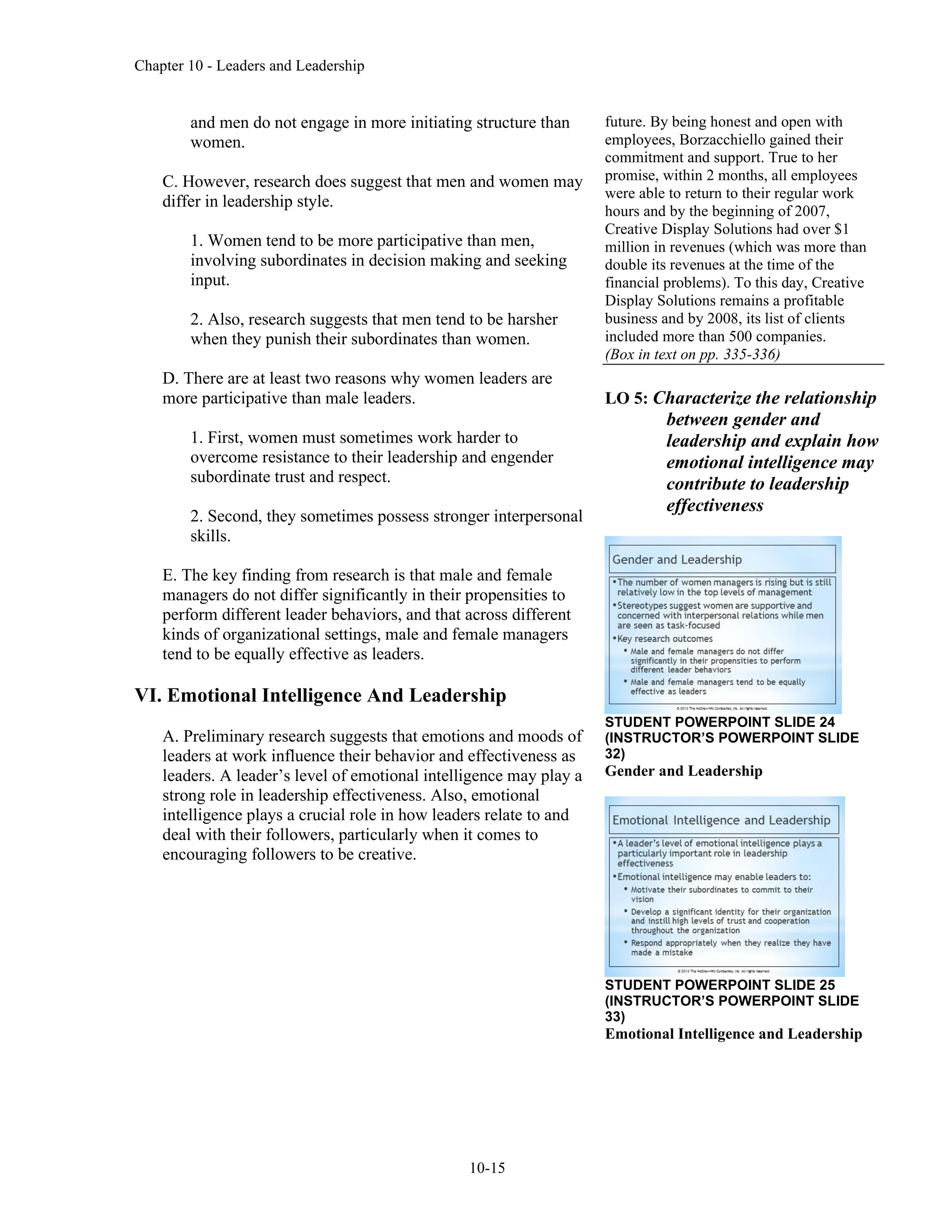
![Chapter 10 - Leaders and Leadership
10-16
Lecturer Enhancer 10.1
WANTED: A GLOBAL BOSS
Any time there’s a big international merger, there are inevitable worries about “culture clash.”
When Marjorie Scardino, a tall, wisecracking Texan, was named to head Britain’s blue-blooded
Pearson Publishing Company in November 1996, the company’s stock plunged for a day in
London. In 1997 Ford Motor named Henry Wallace, a Scottish executive, to take over its Mazda
unit. As the first Scot in memory to head a major Japanese company, he faces a nation of
skeptics. “Ford sends people who don’t speak Japanese at all,” grumbles one business leader in
Hiroshima, Mazda’s hometown.
But Wallace’s bad Japanese—he gets tutoring once per week, hardly matters these days. Nor
does Scardino’s Texarkana drawl grate much on British ears. With surprising speed, the big
multinationals, and many small ones, have come to speak the same language and inhabit a
common culture. The global environment has bred a new kind of executive, the global boss, who
is breaking down cultural barriers.
How does one qualify as a topnotch global boss? First, learn their language. Global managers
speak a combination of straight-shooting American pragmatism, Japanese-inspired management
ideas (like kaizen, or continuous improvement), and M.B.A. jargon such as “strategic resource
allocation.” They’re tough, smart, and flexible enough to survive in the global economy.
Another must is “benchmarking.” This buzzword means measuring your company against the
best practices of other companies worldwide. Smart global bosses personally benchmark
themselves against the world’s most successful multinational managers.
Big companies must go global to be near the billions of new consumers and to find the best deal
worldwide on wages, taxes, and local talent. That takes a savvy global boss. A New York
headhunter once described a search he did for a semiconductor company. “They were looking for
someone [who understands why] the chips were designed in India, water-etched in Japan, diced
and mounted in Korea, assembled in Thailand, encapsulated in Singapore, and distributed
everywhere,” he said. “About one in a million fits that description.”
Indeed, there aren’t enough global bosses to go around, even if many companies haven’t yet
figured out that they need them. Few large U.S. companies, for instance, have foreigners on their
boards. The coming of the global boss is less of a revolution than culture creep. For example,
don’t we hear much about the Japanese way of doing business, as we did in the ‘80s? Because
everyone has adopted it. Today American executives chant “corporate benchmarking” in their
sleep and the Japanese idolize Bill Gates.
LECTURE ENHANCERS](https://image.slidesharecdn.com/13903-250315102414-d7737a95/75/Essentials-of-Contemporary-Management-5th-Edition-Jones-Solutions-Manual-20-2048.jpg)