Unit 10: Activity & Exercise pattern
By
Muhammad Baqar
Clinical Instructor
An activity Exercise pattern:
• Refers to a patient's routine of exercise, activity,
leisure, and recreation, including activities of
daily living (ADLs) that require energy
expenditure.
• It involves the level of physical fitness, movement
capabilities, and any functional limitations.
• This pattern also considers factors that affect
mobility and exercise, such as pain, discomfort, or
any conditions that impact physical performance.
Activity:
• “Activity" is defined as any bodily movement
produced by the contraction of skeletal
muscles that increases energy expenditure.
• This includes both planned and routine
movements, such as exercise, activities of
daily living (ADLs), and mobility.
Exercise:
• Exercise is a planned, structured, and
repetitive bodily movement performed to
improve or maintain physical fitness.
• It is a subset of physical activity that is
deliberate and aimed at enhancing
cardiovascular endurance, muscle strength,
flexibility, and overall health.
Activity tolerance
• Activity tolerance refers to a person's capacity to
perform physical activities without experiencing
undue fatigue or adverse effects.
• It is an important aspect of patient assessment in
nursing, as it helps determine the level of physical
exertion a patient can safely undertake.
• Factors influencing activity tolerance include age,
physical condition, emotional status, and the
presence of any chronic illnesses.
Mobility and Immobility
• Mobility Refers to the ability to move freely, easily,
rhythmically, and purposefully in the environment.
• It involves the capacity of muscles and joints to
perform movements necessary for activities of daily
living and other functional activities
• Includes walking, running, sitting, standing, lifting,
pushing, pulling, and performing activities of daily
living (ADLs).
• Immobility: Refers to the inability to move about
freely.
Body Alignment
• Body alignment, also known as posture,
• Refers to the positioning of the joints, tendons,
ligaments, and muscles while sitting, standing, or
lying down.
• Proper body alignment means that the
individual's body is in a balanced state, which
minimizes strain on the musculoskeletal system.
BODY MECHANICS
• Body mechanics refers to the coordinated use
of the body parts to produce motion and
maintain balance during activity.
• It involves the application of physical
principles to the movements of the body in
daily activities, especially to avoid injury and
maintain posture.
BODY MECHANICS COMPONENTS
It includes four components:
• Body alignment (Posture)
• Balance (stability)
• Coordinated body movement and Joint
mobility
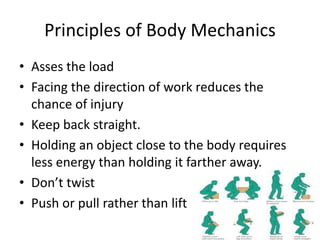
Principles of Body Mechanics
• Asses the load
• Facing the direction of work reduces the
chance of injury
• Keep back straight.
• Holding an object close to the body requires
less energy than holding it farther away.
• Don’t twist
• Push or pull rather than lift
FACTORS AFFECTING MOBILITY AND
ACTIVITY
• Developmental Stage
• Nutrition
• Lifestyle
• Health Status
• Environment
• Diseases and Abnormalities
Benefits of exercise:
• Normalizes glucose level
• Improves gait and balance
• Reduces feelings of
depression and anxiety
• Improves cardiovascular
function
• Increases energy
• Promotes bone density
• Improves mobility
• Promotes weight loss
• Reduces blood pressure
• Lowers cholesterol
• Promotes rest and
relaxation
• Improves sleep
• Increase flow and
oxygenation of all body
parts
• Increase depth of
respiration
• Increase respiratory rate
• Increase appetite
• Improved appearance
• Improved Self-concept
Effects of Immobility on body systems
• Increase cardiac workload
• Increase risk of venous thrombosis (blood clotting)
• Decrease depth of respiration
• Decrease respiratory rate
• Impaired gas exchange
• Disturbance in appetite
• Altered Protein metabolism
• Altered digestion and utilization of nutrients
• Increase risk of renal calculi
• Decrease bladder muscle tone
• Decrease muscle size, tone and strength
Effects of Immobility on body systems
• Decrease joint mobility, flexibility
• Decrease stability
• Increase risk of contractures formation
• Increase risk of electrolyte imbalance
• Altered exchange of nutrients and gases.
• Increase risk of skin breakdown and formation of decubitus ulcers.
• Increase sense of powerlessness
• Decrease self concept
• Decrease social interaction
• Decrease sensory stimulation
• Altered sleep-wake patterns
• Increase risk of depression
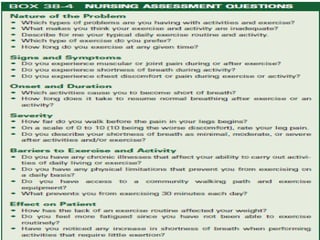
Focus Assessment Criteria
(Subjective data)
• Weakness
• Fatigue
• Dsypnea
• Lack of sleep or rest
• Asses for related factors
• Lack of incentive
• Unwillingness to participate in activates
• Lack of confidence in ability to perform activity
• Fear of injury or aggravating disease as a result of participating in
activity
• Difficulty performing activities of daily living because of decreased
energy or a lack of strength Pain that hinders with performance of
activates .
Objective Data
Asses for defining characteristics
Asses strength and balance; evaluate person’s ability to:
• Reposition self in a bed
• Assume and maintain sitting position
• Rise to standing
• Asses response of activity:
• Take vital signs
• Pulse ( rate, rhythm, quality) Respiration, ( rate, depth,
effort ) Blood Pressure
• Asses for the presence of :
• Cyanosis, confusion and vertigo
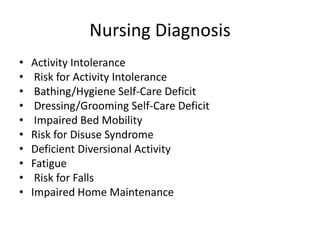
Nursing Diagnosis
• Activity Intolerance
• Risk for Activity Intolerance
• Bathing/Hygiene Self-Care Deficit
• Dressing/Grooming Self-Care Deficit
• Impaired Bed Mobility
• Risk for Disuse Syndrome
• Deficient Diversional Activity
• Fatigue
• Risk for Falls
• Impaired Home Maintenance
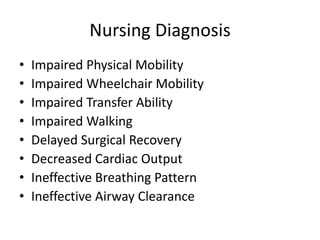
Nursing Diagnosis
• Impaired Physical Mobility
• Impaired Wheelchair Mobility
• Impaired Transfer Ability
• Impaired Walking
• Delayed Surgical Recovery
• Decreased Cardiac Output
• Ineffective Breathing Pattern
• Ineffective Airway Clearance
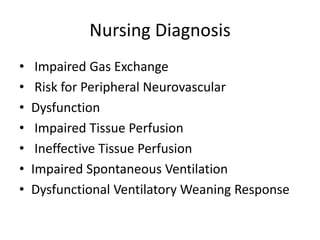
Nursing Diagnosis
• Impaired Gas Exchange
• Risk for Peripheral Neurovascular
• Dysfunction
• Impaired Tissue Perfusion
• Ineffective Tissue Perfusion
• Impaired Spontaneous Ventilation
• Dysfunctional Ventilatory Weaning Response
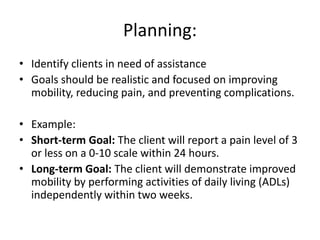
Planning:
• Identify clients in need of assistance
• Goals should be realistic and focused on improving
mobility, reducing pain, and preventing complications.
• Example:
• Short-term Goal: The client will report a pain level of 3
or less on a 0-10 scale within 24 hours.
• Long-term Goal: The client will demonstrate improved
mobility by performing activities of daily living (ADLs)
independently within two weeks.
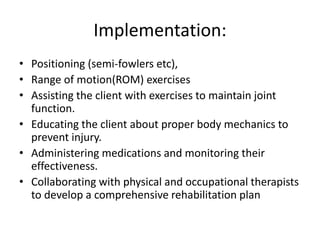
Implementation:
• Positioning (semi-fowlers etc),
• Range of motion(ROM) exercises
• Assisting the client with exercises to maintain joint
function.
• Educating the client about proper body mechanics to
prevent injury.
• Administering medications and monitoring their
effectiveness.
• Collaborating with physical and occupational therapists
to develop a comprehensive rehabilitation plan
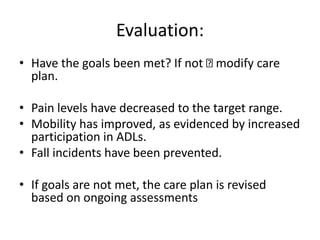
Evaluation:
• Have the goals been met? If not modify care
plan.
• Pain levels have decreased to the target range.
• Mobility has improved, as evidenced by increased
participation in ADLs.
• Fall incidents have been prevented.
• If goals are not met, the care plan is revised
based on ongoing assessments
Unit  10:  Activity & Exercise pattern..

Unit 10: Activity & Exercise pattern..

  • 2.
    Unit 10: Activity& Exercise pattern By Muhammad Baqar Clinical Instructor
  • 3.
    An activity Exercisepattern: • Refers to a patient's routine of exercise, activity, leisure, and recreation, including activities of daily living (ADLs) that require energy expenditure. • It involves the level of physical fitness, movement capabilities, and any functional limitations. • This pattern also considers factors that affect mobility and exercise, such as pain, discomfort, or any conditions that impact physical performance.
  • 4.
    Activity: • “Activity" isdefined as any bodily movement produced by the contraction of skeletal muscles that increases energy expenditure. • This includes both planned and routine movements, such as exercise, activities of daily living (ADLs), and mobility.
  • 5.
    Exercise: • Exercise isa planned, structured, and repetitive bodily movement performed to improve or maintain physical fitness. • It is a subset of physical activity that is deliberate and aimed at enhancing cardiovascular endurance, muscle strength, flexibility, and overall health.
  • 6.
    Activity tolerance • Activitytolerance refers to a person's capacity to perform physical activities without experiencing undue fatigue or adverse effects. • It is an important aspect of patient assessment in nursing, as it helps determine the level of physical exertion a patient can safely undertake. • Factors influencing activity tolerance include age, physical condition, emotional status, and the presence of any chronic illnesses.
  • 7.
    Mobility and Immobility •Mobility Refers to the ability to move freely, easily, rhythmically, and purposefully in the environment. • It involves the capacity of muscles and joints to perform movements necessary for activities of daily living and other functional activities • Includes walking, running, sitting, standing, lifting, pushing, pulling, and performing activities of daily living (ADLs). • Immobility: Refers to the inability to move about freely.
  • 8.
    Body Alignment • Bodyalignment, also known as posture, • Refers to the positioning of the joints, tendons, ligaments, and muscles while sitting, standing, or lying down. • Proper body alignment means that the individual's body is in a balanced state, which minimizes strain on the musculoskeletal system.
  • 9.
    BODY MECHANICS • Bodymechanics refers to the coordinated use of the body parts to produce motion and maintain balance during activity. • It involves the application of physical principles to the movements of the body in daily activities, especially to avoid injury and maintain posture.
  • 10.
    BODY MECHANICS COMPONENTS Itincludes four components: • Body alignment (Posture) • Balance (stability) • Coordinated body movement and Joint mobility
  • 11.
    Principles of BodyMechanics • Asses the load • Facing the direction of work reduces the chance of injury • Keep back straight. • Holding an object close to the body requires less energy than holding it farther away. • Don’t twist • Push or pull rather than lift
  • 12.
    FACTORS AFFECTING MOBILITYAND ACTIVITY • Developmental Stage • Nutrition • Lifestyle • Health Status • Environment • Diseases and Abnormalities
  • 13.
    Benefits of exercise: •Normalizes glucose level • Improves gait and balance • Reduces feelings of depression and anxiety • Improves cardiovascular function • Increases energy • Promotes bone density • Improves mobility • Promotes weight loss • Reduces blood pressure • Lowers cholesterol • Promotes rest and relaxation • Improves sleep • Increase flow and oxygenation of all body parts • Increase depth of respiration • Increase respiratory rate • Increase appetite • Improved appearance • Improved Self-concept
  • 14.
    Effects of Immobilityon body systems • Increase cardiac workload • Increase risk of venous thrombosis (blood clotting) • Decrease depth of respiration • Decrease respiratory rate • Impaired gas exchange • Disturbance in appetite • Altered Protein metabolism • Altered digestion and utilization of nutrients • Increase risk of renal calculi • Decrease bladder muscle tone • Decrease muscle size, tone and strength
  • 15.
    Effects of Immobilityon body systems • Decrease joint mobility, flexibility • Decrease stability • Increase risk of contractures formation • Increase risk of electrolyte imbalance • Altered exchange of nutrients and gases. • Increase risk of skin breakdown and formation of decubitus ulcers. • Increase sense of powerlessness • Decrease self concept • Decrease social interaction • Decrease sensory stimulation • Altered sleep-wake patterns • Increase risk of depression
  • 16.
    Focus Assessment Criteria (Subjectivedata) • Weakness • Fatigue • Dsypnea • Lack of sleep or rest • Asses for related factors • Lack of incentive • Unwillingness to participate in activates • Lack of confidence in ability to perform activity • Fear of injury or aggravating disease as a result of participating in activity • Difficulty performing activities of daily living because of decreased energy or a lack of strength Pain that hinders with performance of activates .
  • 17.
    Objective Data Asses fordefining characteristics Asses strength and balance; evaluate person’s ability to: • Reposition self in a bed • Assume and maintain sitting position • Rise to standing • Asses response of activity: • Take vital signs • Pulse ( rate, rhythm, quality) Respiration, ( rate, depth, effort ) Blood Pressure • Asses for the presence of : • Cyanosis, confusion and vertigo
  • 19.
    Nursing Diagnosis • ActivityIntolerance • Risk for Activity Intolerance • Bathing/Hygiene Self-Care Deficit • Dressing/Grooming Self-Care Deficit • Impaired Bed Mobility • Risk for Disuse Syndrome • Deficient Diversional Activity • Fatigue • Risk for Falls • Impaired Home Maintenance
  • 20.
    Nursing Diagnosis • ImpairedPhysical Mobility • Impaired Wheelchair Mobility • Impaired Transfer Ability • Impaired Walking • Delayed Surgical Recovery • Decreased Cardiac Output • Ineffective Breathing Pattern • Ineffective Airway Clearance
  • 21.
    Nursing Diagnosis • ImpairedGas Exchange • Risk for Peripheral Neurovascular • Dysfunction • Impaired Tissue Perfusion • Ineffective Tissue Perfusion • Impaired Spontaneous Ventilation • Dysfunctional Ventilatory Weaning Response
  • 22.
    Planning: • Identify clientsin need of assistance • Goals should be realistic and focused on improving mobility, reducing pain, and preventing complications. • Example: • Short-term Goal: The client will report a pain level of 3 or less on a 0-10 scale within 24 hours. • Long-term Goal: The client will demonstrate improved mobility by performing activities of daily living (ADLs) independently within two weeks.
  • 23.
    Implementation: • Positioning (semi-fowlersetc), • Range of motion(ROM) exercises • Assisting the client with exercises to maintain joint function. • Educating the client about proper body mechanics to prevent injury. • Administering medications and monitoring their effectiveness. • Collaborating with physical and occupational therapists to develop a comprehensive rehabilitation plan
  • 24.
    Evaluation: • Have thegoals been met? If not modify care plan. • Pain levels have decreased to the target range. • Mobility has improved, as evidenced by increased participation in ADLs. • Fall incidents have been prevented. • If goals are not met, the care plan is revised based on ongoing assessments