http://www.youtube.com/user/BritishHeartFound# p/u/0/djFb8PGS34g
Compare and contrast the Drosophila and Zebrafish as animal systems for the study of human disease. April, Laura, Alaa
What’s an Animal System? An  animal system  is a living, non-human animal used for the research and investigation of human disease
 
Drosophila Melangaster
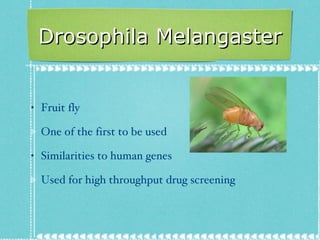
Drosophila Melangaster Fruit fly One of the first to be used  Similarities to human genes Used for high throughput drug screening
Advantages Fast development Carry out sophisticated loss-of-function and gain-of-function genetic analysis Easy and rapid genetic analysis  Short generation time High fecundity  Easy maintenance in large numbers Mutants are easier to obtain
Neurodegenerative Diseases Generation of transgenic Drosophila which over express mutated proteins causing them to develop degenerative diseases allowing us to use them as models for Alzeimers and Huntingtons disease. Animal models have helped us find possible cause of HD:    (1) Expansion of unstable CAG repeat    (2) Effect of Quasi-pure polyglutamine tracts   (3) Implications to Caspases 1 & 3
Parkinson’s disease Disease background: -Progressive degenerate disorder of the CNS -Idopathic disorder -Symptoms are movement related -Dominant cause = mutations of alpha synuclein Animal model: -Flies with mutant alpha synuclein have developed motor impairment -Research on Parkin specific mutations in  association with indirect fly muscles
Spinal Muscular Atrophy (SMA) Disease background: -Characterised by degeneration of motor neurons -Mutation of Survival Motor Neuron(SMN) gene in humans Model: -Model mimics phenotype of human disorder -The Fibroblast Growth Factor (FGF) signalling pathway in humans is the homolog to the drosophilas’ SMN  -SMN gene mutation results in: 1)Reduced viability  2)Decreased motility  3)Develops muscular atrophy in the adult thorax
Heart Disease Disease background  -Umbrella term for many heart related diseases -Leading Cause of death in the UK  -Examples: CHD, Cardiovascular disease and Heart failure.  Animal Model -New research field  -Less complicated circulatory system than in humans -From screening 7,061, 500 were found to be associated with cardiovascular disorders -Mutant flies have low levels of PE -Initiate a new mechanism for synthesising fats -This is the protein SREBP which activates enzymes that synthesise fats -High levels of this protein along with triglycerides and heart damaging fats. -Fat accumulation and distribution to the membrane leads to heart problems. -Inhibiting this protein allows restoration of fat balances and therefore reduced heart malfunctions.
Zebrafish
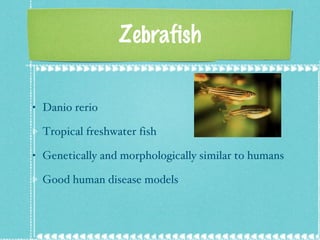
Zebrafish Danio rerio Tropical freshwater fish Genetically and morphologically similar to humans  Good human disease models
Advantages Short generation time (especially for a vertebrate)  Transparent embryo  Genetic tractability  Easy manipulation
Spinal Muscular Atrophy(SMA) The Morpholino Spinal Motor Neuron(SMN) protein gene is the faulty gene is some forms of SMA This has been researched using gene knockdowns of the SMN gene in Zebrafish embryos Morphant axons exhibit motor axon specific pathofinding defects with no increase in the rate of apoptosis in motor neurons. Concluding - SMN has an important function in motor axon development and maintenance
Heart Disease Special ability to regenerate damaged heart Our capability of developing our heart once should mean we can do it again? Fast heart development - 12 hours  Transparent embryo allows viewing of heart and blood vessel development Similarities in key genes and chemical messengers means we can try to replicate the process in humans
Drosophila  Vs. Zebrafish Zebrafish Zebrafish
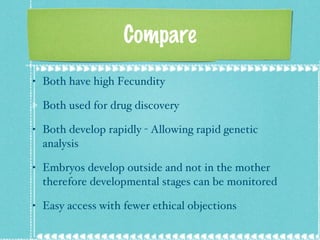
Compare Both have high Fecundity  Both used for drug discovery Both develop rapidly - Allowing rapid genetic analysis Embryos develop outside and not in the mother therefore developmental stages can be monitored Easy access with fewer ethical objections
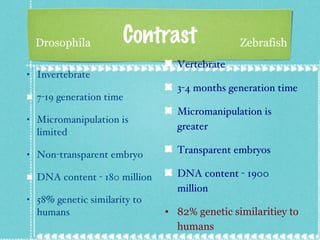
Contrast Invertebrate 7-19 generation time Micromanipulation is limited Non-transparent embryo DNA content - 180 million 58% genetic similarity to humans Vertebrate 3-4 months generation time Micromanipulation is greater Transparent embryos  DNA content - 1900 million 82% genetic similaritiey to humans  Drosophila Zebrafish
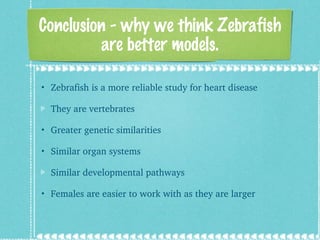
Conclusion - why we think Zebrafish are better models. Zebrafish is a more reliable study for heart disease  They are vertebrates Greater genetic similarities  Similar organ systems Similar developmental pathways Females are easier to work with as they are larger
References  Peter.J.Russel.  Essential I-Genetics (first edition) Pearson education Griffths, Miller, Suzuki, Lewontin & Gelbart An introduction to genetic analysis (7th edition) W.H.Freeman http://www.bhf.org.uk / British heart foundation Modeling spinal muscular atrophy in  Drosophila  links  Smn  to FGF signaling Anindya Sen 1 ,  Takakazu Yokokura 1 ,  Mark W. Kankel 1 ,  Douglas N. Dimlich 1 ,  Jan Manent 1 ,  Subhabrata Sanyal 2 , and  Spyros Artavanis-Tsakonas 1,3 Richard Butler  In vivo analysis of neurological disease mechanisms in zebrafish. Thesis 15014   http://www.nature.com/ng/journal/v39/n5/full/ng0507-589.html http://www.ncbi.nlm.nih.gov/pubmed/11206415 http://pubs.acs. org/subscribe/journals/mdd/v07/i06/html/604 feature_ma.html http://genome.cshlp.org/cont ent/9/2/99.long http://www.statistics.gov.uk/articles/hsq/hsq28_death.pdf http://www.shef.ac.uk/mediacentre/index.html
Q & A

Essay 1

  • 1.
  • 2.
    Compare and contrastthe Drosophila and Zebrafish as animal systems for the study of human disease. April, Laura, Alaa
  • 3.
    What’s an AnimalSystem? An animal system is a living, non-human animal used for the research and investigation of human disease
  • 4.
  • 5.
  • 6.
    Drosophila Melangaster Fruitfly One of the first to be used Similarities to human genes Used for high throughput drug screening
  • 7.
    Advantages Fast developmentCarry out sophisticated loss-of-function and gain-of-function genetic analysis Easy and rapid genetic analysis Short generation time High fecundity Easy maintenance in large numbers Mutants are easier to obtain
  • 8.
    Neurodegenerative Diseases Generationof transgenic Drosophila which over express mutated proteins causing them to develop degenerative diseases allowing us to use them as models for Alzeimers and Huntingtons disease. Animal models have helped us find possible cause of HD: (1) Expansion of unstable CAG repeat (2) Effect of Quasi-pure polyglutamine tracts (3) Implications to Caspases 1 & 3
  • 9.
    Parkinson’s disease Diseasebackground: -Progressive degenerate disorder of the CNS -Idopathic disorder -Symptoms are movement related -Dominant cause = mutations of alpha synuclein Animal model: -Flies with mutant alpha synuclein have developed motor impairment -Research on Parkin specific mutations in association with indirect fly muscles
  • 10.
    Spinal Muscular Atrophy(SMA) Disease background: -Characterised by degeneration of motor neurons -Mutation of Survival Motor Neuron(SMN) gene in humans Model: -Model mimics phenotype of human disorder -The Fibroblast Growth Factor (FGF) signalling pathway in humans is the homolog to the drosophilas’ SMN -SMN gene mutation results in: 1)Reduced viability 2)Decreased motility 3)Develops muscular atrophy in the adult thorax
  • 11.
    Heart Disease Diseasebackground -Umbrella term for many heart related diseases -Leading Cause of death in the UK -Examples: CHD, Cardiovascular disease and Heart failure. Animal Model -New research field -Less complicated circulatory system than in humans -From screening 7,061, 500 were found to be associated with cardiovascular disorders -Mutant flies have low levels of PE -Initiate a new mechanism for synthesising fats -This is the protein SREBP which activates enzymes that synthesise fats -High levels of this protein along with triglycerides and heart damaging fats. -Fat accumulation and distribution to the membrane leads to heart problems. -Inhibiting this protein allows restoration of fat balances and therefore reduced heart malfunctions.
  • 12.
  • 13.
    Zebrafish Danio rerioTropical freshwater fish Genetically and morphologically similar to humans Good human disease models
  • 14.
    Advantages Short generationtime (especially for a vertebrate) Transparent embryo Genetic tractability Easy manipulation
  • 15.
    Spinal Muscular Atrophy(SMA)The Morpholino Spinal Motor Neuron(SMN) protein gene is the faulty gene is some forms of SMA This has been researched using gene knockdowns of the SMN gene in Zebrafish embryos Morphant axons exhibit motor axon specific pathofinding defects with no increase in the rate of apoptosis in motor neurons. Concluding - SMN has an important function in motor axon development and maintenance
  • 16.
    Heart Disease Specialability to regenerate damaged heart Our capability of developing our heart once should mean we can do it again? Fast heart development - 12 hours Transparent embryo allows viewing of heart and blood vessel development Similarities in key genes and chemical messengers means we can try to replicate the process in humans
  • 17.
    Drosophila Vs.Zebrafish Zebrafish Zebrafish
  • 18.
    Compare Both havehigh Fecundity Both used for drug discovery Both develop rapidly - Allowing rapid genetic analysis Embryos develop outside and not in the mother therefore developmental stages can be monitored Easy access with fewer ethical objections
  • 19.
    Contrast Invertebrate 7-19generation time Micromanipulation is limited Non-transparent embryo DNA content - 180 million 58% genetic similarity to humans Vertebrate 3-4 months generation time Micromanipulation is greater Transparent embryos DNA content - 1900 million 82% genetic similaritiey to humans Drosophila Zebrafish
  • 20.
    Conclusion - whywe think Zebrafish are better models. Zebrafish is a more reliable study for heart disease They are vertebrates Greater genetic similarities Similar organ systems Similar developmental pathways Females are easier to work with as they are larger
  • 21.
    References Peter.J.Russel. Essential I-Genetics (first edition) Pearson education Griffths, Miller, Suzuki, Lewontin & Gelbart An introduction to genetic analysis (7th edition) W.H.Freeman http://www.bhf.org.uk / British heart foundation Modeling spinal muscular atrophy in Drosophila links Smn to FGF signaling Anindya Sen 1 , Takakazu Yokokura 1 , Mark W. Kankel 1 , Douglas N. Dimlich 1 , Jan Manent 1 , Subhabrata Sanyal 2 , and Spyros Artavanis-Tsakonas 1,3 Richard Butler In vivo analysis of neurological disease mechanisms in zebrafish. Thesis 15014 http://www.nature.com/ng/journal/v39/n5/full/ng0507-589.html http://www.ncbi.nlm.nih.gov/pubmed/11206415 http://pubs.acs. org/subscribe/journals/mdd/v07/i06/html/604 feature_ma.html http://genome.cshlp.org/cont ent/9/2/99.long http://www.statistics.gov.uk/articles/hsq/hsq28_death.pdf http://www.shef.ac.uk/mediacentre/index.html
  • 22.