





IBM Professional Marketplace: Optimizing a Global Workforce with Enterprise Search Global Business Services
Speakers Eric Andersen Senior I/T Architect, Emerging Technology & Architecture, IBM Global Business Services Lead Architect, IBM Professional Marketplace Email: eric.andersen@us.ibm.com Twitter: @eric_andersen Vladimir Zelevinsky Manager, Applied Research, Endeca Technologies Email: vzelevinsky@endeca.com Blog: http://facets.endeca.com
Agenda The Business Challenge: Globalization of both the Workforce and Customers The Solution: Enterprise Search for the Workforce – IBM Professional Marketplace Matching Workforce Supply and Demand Additional Information-matching Techniques and Applications
The Business Challenge Global Business Services Globalization of workforce and customers
Workforce Supply and Demand Globalization IBM has over 259,000 professionals from over 63 countries available to work with customers in various ways Includes not just Global Business Services but also Global Technology Services, IBM Research, Integrated Supply Chain, S&D, Software Group Global Delivery Centers in India, China, Brazil, Romania, Russia, Argentina, etc. 100% owned affiliates across the globe Even subcontractors A large percentage of IBM customer projects involve professionals from multiple countries Globalization of delivery and labor sources create complexity in finding, deploying and motivating talent Engagement profitability hinges on the ability to locate and deploy these resources optimally
The Solution Global Business Services Enterprise Search for the Workforce: IBM Professional Marketplace
What is IBM Professional Marketplace? The Marketplace is a dynamic new business model: It is designed to optimize the engagement and project staffing process. It is not an external job/career tool. The new business paradigm is ‘self-service’: Executives, Business Managers and Project Managers weigh trade-offs for project staffing based on client (or internal project owner) and financial commitments.  More efficient and strategic staffing decisions are made as a result. The Marketplace combines both workforce supply and demand: Most demand cannot be satisfied instantly – multiple candidates often desired, longer staffing cycles occur, various sourcing options considered and pursued. Thus demand is created in the form of an “Open Seat” (resource request)
What is IBM Professional Marketplace? Professionals gain insight, leverage in the new model: The professional profile communicates skills, experiences and preferences - all of which drive deployment decisions.  Professionals also have visibility to view and search all open seats. New “talent pools” are continually being added to the Marketplace: The intent is to drive all client facing and internal project staffing through the Marketplace – thus all types of resources from all sourcing models must be integrated in some way The Marketplace is global: Delivering on cross-business unit, global engagements requires consistent Marketplace design and pre-negotiated rules of engagement.
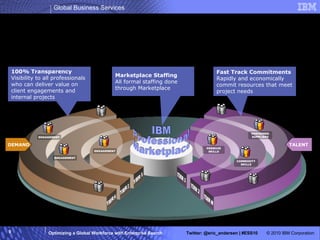
The IBM Professional Marketplace facilitates a global talent exchange DEMAND TALENT PREMIUM SKILLS COMMODITY SKILLS PREFERRED SUPPLIERS ENGAGEMENT ENGAGEMENT ENGAGEMENT Fast Track Commitments   Rapidly and economically commit resources that meet project needs 100% Transparency Visibility to all professionals who can deliver value on client engagements and internal projects Marketplace Staffing All formal staffing done through Marketplace IBM  Professional  Marketplace  IBM  Professional  Marketplace
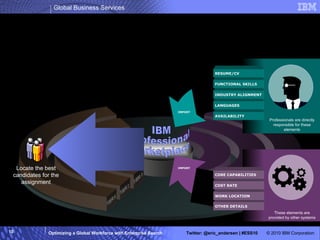
Marketplace uses comprehensive profiles for precise staffing Professionals are directly responsible for these elements AVAILABILITY LANGUAGES INDUSTRY ALIGNMENT FUNCTIONAL SKILLS RESUME/CV These elements are provided by other systems IMPORT IMPORT Locate the best candidates for the assignment OTHER DETAILS WORK LOCATION COST RATE CORE CAPABILITIES IBM  Professional  Marketplace  IBM  Professional  Marketplace
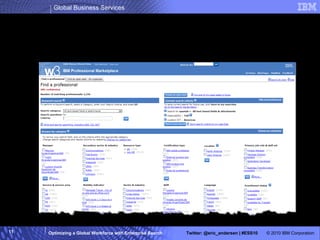
The main page of the Marketplace is “Find a Professional” – faceted search across many customizable parameters
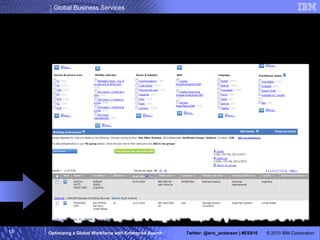
Significant benefits of faceted search for the enterprise Diverse types of data all incorporated into a single facet-based user experience – availability, location, job role, experience level, industry, cost, deployability – even specialty data such as certifications, visa, languages spoken One click selects and de-selects allow for “exploratory search” – when staffing, you don’t know who is available until you look Fast and easy “trade-off analysis” – more experienced resource might cost more, specific skills might only be available from across the country or the world, the perfect candidate might not be available for another month. Human decisions must be made. No “dead ends” – each click brings back a complete filtering of all other facets – so the user can always see what remaining options are left (and how many results they represent)
The results show individuals that meet criteria, with controls for further refinement <name masked> <name masked> <name masked> <name masked> <name masked>
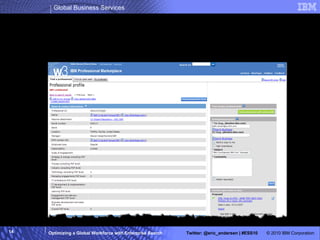
Drilling down reveals a person’s history and expertise, and enables locating others with similar traits <name masked> <name masked> <name masked>
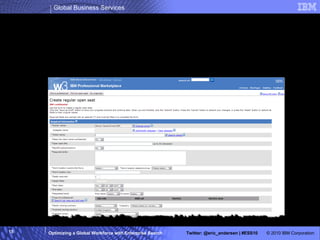
When no resources are found, the requestor can save the search as an “Open Seat” so others can respond
Marketplace drives real business results Faster fulfillment Reduction in open seat time-to-close Optimized bench Subcontractor and unnecessary hiring avoidance Increased agility Faster, more effective bid response Transparency Visibility into extended talent pools optimal skill selection Fewer opportunities abandoned due to skill issues “ Before Professional Marketplace, all these Resource Requests were managed by e-mails and stored in spreadsheets. Data was always incomplete, difficult to get, and communications was a nightmare. Professional Marketplace solved all these problems”   --  Belgian RDM
Matching Workforce Supply and Demand Global Business Services Approaches and Best Practices
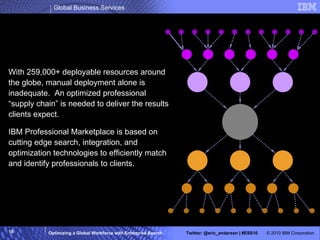
Matching professionals with clients With 259,000+ deployable resources around the globe, manual deployment alone is inadequate.  An optimized professional “supply chain” is needed to deliver the results clients expect.  IBM Professional Marketplace is based on cutting edge search, integration, and optimization technologies to efficiently match and identify professionals to clients.
Basic Matching: Create and Leverage Data Similarities Ensure Open Seats capture well-defined criteria that can identify professionals Use ranges to capture uncertainty/flexibility of customer need Reduce structured/unstructured mapping where possible Drive precision in data when needed, but with optional fields Some examples: Professional availability vs client start date: both may have flexibility Work location: Is country or city flexible or defined by cost, project mandates, or travel restrictions? Skills: Quantify Job Role/Skill Set needs – though skills need can often only be described using free-form text Specialized skills: Certifications, languages, experience levels, security clearance, industry specialization, etc.
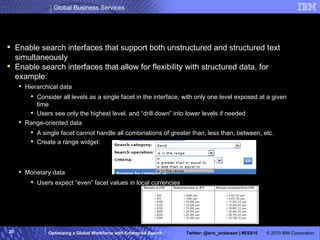
Basic Matching: Leverage Search Flexibility Enable search interfaces that support both unstructured and structured text simultaneously Enable search interfaces that allow for flexibility with structured data, for example: Hierarchical data Consider all levels as a single facet in the interface, with only one level exposed at a given time Users see only the highest level, and “drill down” into lower levels if needed Range-oriented data A single facet cannot handle all combinations of greater than, less than, between, etc. Create a range widget: Monetary data Users expect “even” facet values in local currencies
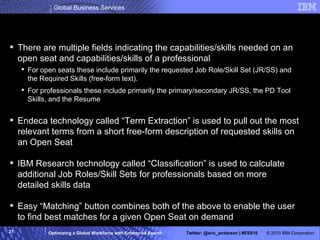
Advanced Matching 1: Capability-based Mapping There are multiple fields indicating the capabilities/skills needed on an open seat and capabilities/skills of a professional For open seats these include primarily the requested Job Role/Skill Set (JR/SS) and the Required Skills (free-form text). For professionals these include primarily the primary/secondary JR/SS, the PD Tool Skills, and the Resume Endeca technology called “Term Extraction” is used to pull out the most relevant terms from a short free-form description of requested skills on an Open Seat IBM Research technology called “Classification” is used to calculate additional Job Roles/Skill Sets for professionals based on more detailed skills data Easy “Matching” button combines both of the above to enable the user to find best matches for a given Open Seat on demand
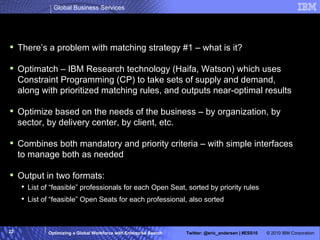
Advanced Matching 2: “Optimatch” There’s a problem with matching strategy #1 – what is it? Optimatch – IBM Research technology (Haifa, Watson) which uses Constraint Programming (CP) to take sets of supply and demand, along with prioritized matching rules, and outputs near-optimal results Optimize based on the needs of the business – by organization, by sector, by delivery center, by client, etc. Combines both mandatory and priority criteria – with simple interfaces to manage both as needed Output in two formats: List of “feasible” professionals for each Open Seat, sorted by priority rules List of “feasible” Open Seats for each professional, also sorted
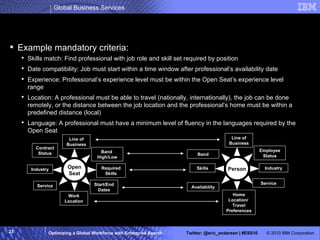
Advanced Matching 2: “Optimatch” Example mandatory criteria: Skills match: Find professional with job role and skill set required by position Date compatibility: Job must start within a time window after professional’s availability date Experience: Professional’s experience level must be within the Open Seat’s experience level range Location: A professional must be able to travel (nationally, internationally), the job can be done remotely, or the distance between the job location and the professional’s home must be within a predefined distance (local) Language: A professional must have a minimum level of fluency in the languages required by the Open Seat Open Seat Line of Business Band  High/Low Required Skills Work Location Start/End Dates Service Industry Contract Status Person Line of Business Employee Status Industry Home Location/  Travel Preferences Service Availability Skills Band
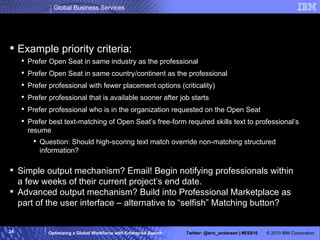
Advanced Matching 2: “Optimatch” Example priority criteria: Prefer Open Seat in same industry as the professional Prefer Open Seat in same country/continent as the professional Prefer professional with fewer placement options (criticality) Prefer professional that is available sooner after job starts Prefer professional who is in the organization requested on the Open Seat Prefer best text-matching of Open Seat’s free-form required skills text to professional’s resume Question: Should high-scoring text match override non-matching structured information? Simple output mechanism? Email! Begin notifying professionals within a few weeks of their current project’s end date. Advanced output mechanism? Build into Professional Marketplace as part of the user interface – alternative to “selfish” Matching button?
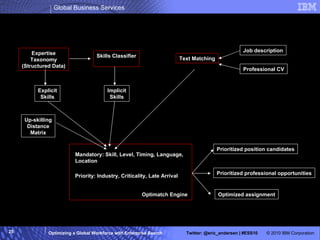
Advanced Matching 2: “Optimatch” Expertise Taxonomy (Structured Data) Skills Classifier Explicit Skills Implicit Skills Text Matching Job description Professional CV Up-skilling Distance Matrix Optimatch Engine Mandatory: Skill, Level, Timing, Language, Location Priority: Industry, Criticality, Late Arrival Prioritized position candidates Prioritized professional opportunities Optimized assignment
Outline 1.  Nitty-gritty details 2.  Epic generalizations
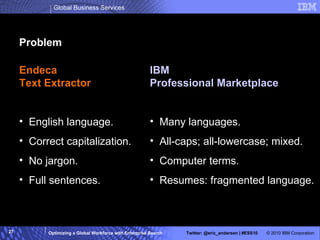
Problem Endeca Text Extractor English language. Correct capitalization. No jargon. Full sentences. IBM Professional Marketplace Many languages. All-caps; all-lowercase; mixed. Computer terms. Resumes: fragmented language.
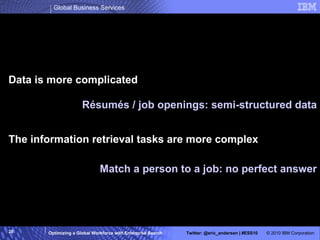
Data is more complicated The information retrieval tasks are more complex Résumés / job openings: semi-structured data Match a person to a job: no perfect answer
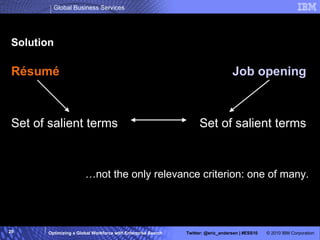
Solution … not the only relevance criterion: one of many. Résumé Set of salient terms Job opening Set of salient terms
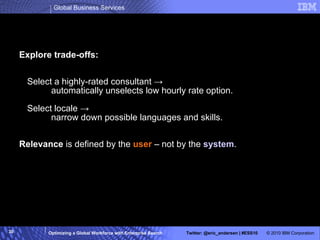
Explore trade-offs: Select a highly-rated consultant  -> automatically unselects low hourly rate option. Select locale  -> narrow down possible languages and skills. Relevance  is defined by the  user  – not by the  system .
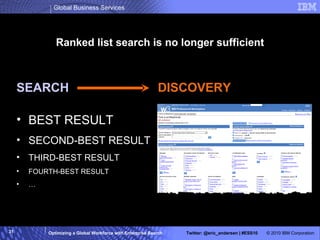
Ranked list search is no longer sufficient SEARCH BEST RESULT SECOND-BEST RESULT THIRD-BEST RESULT FOURTH-BEST RESULT … DISCOVERY
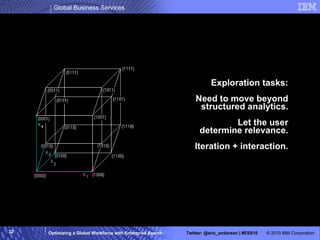
Exploration tasks: Need to move beyond structured analytics. Let the user determine relevance. Iteration + interaction.
The world is getting smaller Global economy Global workforce Instantaneous communications
The world is getting bigger Number of projects Scale of projects Size of workforce Communication issues Variety of technologies Complexity of operations
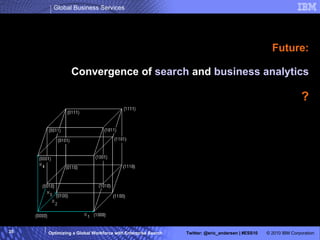
Future: Convergence of  search  and  business analytics ?

Optimizing a Global Workforce with Enterprise Search

  • 1.
    IBM Professional Marketplace:Optimizing a Global Workforce with Enterprise Search Global Business Services
  • 2.
    Speakers Eric AndersenSenior I/T Architect, Emerging Technology & Architecture, IBM Global Business Services Lead Architect, IBM Professional Marketplace Email: eric.andersen@us.ibm.com Twitter: @eric_andersen Vladimir Zelevinsky Manager, Applied Research, Endeca Technologies Email: vzelevinsky@endeca.com Blog: http://facets.endeca.com
  • 3.
    Agenda The BusinessChallenge: Globalization of both the Workforce and Customers The Solution: Enterprise Search for the Workforce – IBM Professional Marketplace Matching Workforce Supply and Demand Additional Information-matching Techniques and Applications
  • 4.
    The Business ChallengeGlobal Business Services Globalization of workforce and customers
  • 5.
    Workforce Supply andDemand Globalization IBM has over 259,000 professionals from over 63 countries available to work with customers in various ways Includes not just Global Business Services but also Global Technology Services, IBM Research, Integrated Supply Chain, S&D, Software Group Global Delivery Centers in India, China, Brazil, Romania, Russia, Argentina, etc. 100% owned affiliates across the globe Even subcontractors A large percentage of IBM customer projects involve professionals from multiple countries Globalization of delivery and labor sources create complexity in finding, deploying and motivating talent Engagement profitability hinges on the ability to locate and deploy these resources optimally
  • 6.
    The Solution GlobalBusiness Services Enterprise Search for the Workforce: IBM Professional Marketplace
  • 7.
    What is IBMProfessional Marketplace? The Marketplace is a dynamic new business model: It is designed to optimize the engagement and project staffing process. It is not an external job/career tool. The new business paradigm is ‘self-service’: Executives, Business Managers and Project Managers weigh trade-offs for project staffing based on client (or internal project owner) and financial commitments. More efficient and strategic staffing decisions are made as a result. The Marketplace combines both workforce supply and demand: Most demand cannot be satisfied instantly – multiple candidates often desired, longer staffing cycles occur, various sourcing options considered and pursued. Thus demand is created in the form of an “Open Seat” (resource request)
  • 8.
    What is IBMProfessional Marketplace? Professionals gain insight, leverage in the new model: The professional profile communicates skills, experiences and preferences - all of which drive deployment decisions. Professionals also have visibility to view and search all open seats. New “talent pools” are continually being added to the Marketplace: The intent is to drive all client facing and internal project staffing through the Marketplace – thus all types of resources from all sourcing models must be integrated in some way The Marketplace is global: Delivering on cross-business unit, global engagements requires consistent Marketplace design and pre-negotiated rules of engagement.
  • 9.
    The IBM ProfessionalMarketplace facilitates a global talent exchange DEMAND TALENT PREMIUM SKILLS COMMODITY SKILLS PREFERRED SUPPLIERS ENGAGEMENT ENGAGEMENT ENGAGEMENT Fast Track Commitments Rapidly and economically commit resources that meet project needs 100% Transparency Visibility to all professionals who can deliver value on client engagements and internal projects Marketplace Staffing All formal staffing done through Marketplace IBM Professional Marketplace IBM Professional Marketplace
  • 10.
    Marketplace uses comprehensiveprofiles for precise staffing Professionals are directly responsible for these elements AVAILABILITY LANGUAGES INDUSTRY ALIGNMENT FUNCTIONAL SKILLS RESUME/CV These elements are provided by other systems IMPORT IMPORT Locate the best candidates for the assignment OTHER DETAILS WORK LOCATION COST RATE CORE CAPABILITIES IBM Professional Marketplace IBM Professional Marketplace
  • 11.
    The main pageof the Marketplace is “Find a Professional” – faceted search across many customizable parameters
  • 12.
    Significant benefits offaceted search for the enterprise Diverse types of data all incorporated into a single facet-based user experience – availability, location, job role, experience level, industry, cost, deployability – even specialty data such as certifications, visa, languages spoken One click selects and de-selects allow for “exploratory search” – when staffing, you don’t know who is available until you look Fast and easy “trade-off analysis” – more experienced resource might cost more, specific skills might only be available from across the country or the world, the perfect candidate might not be available for another month. Human decisions must be made. No “dead ends” – each click brings back a complete filtering of all other facets – so the user can always see what remaining options are left (and how many results they represent)
  • 13.
    The results showindividuals that meet criteria, with controls for further refinement <name masked> <name masked> <name masked> <name masked> <name masked>
  • 14.
    Drilling down revealsa person’s history and expertise, and enables locating others with similar traits <name masked> <name masked> <name masked>
  • 15.
    When no resourcesare found, the requestor can save the search as an “Open Seat” so others can respond
  • 16.
    Marketplace drives realbusiness results Faster fulfillment Reduction in open seat time-to-close Optimized bench Subcontractor and unnecessary hiring avoidance Increased agility Faster, more effective bid response Transparency Visibility into extended talent pools optimal skill selection Fewer opportunities abandoned due to skill issues “ Before Professional Marketplace, all these Resource Requests were managed by e-mails and stored in spreadsheets. Data was always incomplete, difficult to get, and communications was a nightmare. Professional Marketplace solved all these problems” -- Belgian RDM
  • 17.
    Matching Workforce Supplyand Demand Global Business Services Approaches and Best Practices
  • 18.
    Matching professionals withclients With 259,000+ deployable resources around the globe, manual deployment alone is inadequate. An optimized professional “supply chain” is needed to deliver the results clients expect. IBM Professional Marketplace is based on cutting edge search, integration, and optimization technologies to efficiently match and identify professionals to clients.
  • 19.
    Basic Matching: Createand Leverage Data Similarities Ensure Open Seats capture well-defined criteria that can identify professionals Use ranges to capture uncertainty/flexibility of customer need Reduce structured/unstructured mapping where possible Drive precision in data when needed, but with optional fields Some examples: Professional availability vs client start date: both may have flexibility Work location: Is country or city flexible or defined by cost, project mandates, or travel restrictions? Skills: Quantify Job Role/Skill Set needs – though skills need can often only be described using free-form text Specialized skills: Certifications, languages, experience levels, security clearance, industry specialization, etc.
  • 20.
    Basic Matching: LeverageSearch Flexibility Enable search interfaces that support both unstructured and structured text simultaneously Enable search interfaces that allow for flexibility with structured data, for example: Hierarchical data Consider all levels as a single facet in the interface, with only one level exposed at a given time Users see only the highest level, and “drill down” into lower levels if needed Range-oriented data A single facet cannot handle all combinations of greater than, less than, between, etc. Create a range widget: Monetary data Users expect “even” facet values in local currencies
  • 21.
    Advanced Matching 1:Capability-based Mapping There are multiple fields indicating the capabilities/skills needed on an open seat and capabilities/skills of a professional For open seats these include primarily the requested Job Role/Skill Set (JR/SS) and the Required Skills (free-form text). For professionals these include primarily the primary/secondary JR/SS, the PD Tool Skills, and the Resume Endeca technology called “Term Extraction” is used to pull out the most relevant terms from a short free-form description of requested skills on an Open Seat IBM Research technology called “Classification” is used to calculate additional Job Roles/Skill Sets for professionals based on more detailed skills data Easy “Matching” button combines both of the above to enable the user to find best matches for a given Open Seat on demand
  • 22.
    Advanced Matching 2:“Optimatch” There’s a problem with matching strategy #1 – what is it? Optimatch – IBM Research technology (Haifa, Watson) which uses Constraint Programming (CP) to take sets of supply and demand, along with prioritized matching rules, and outputs near-optimal results Optimize based on the needs of the business – by organization, by sector, by delivery center, by client, etc. Combines both mandatory and priority criteria – with simple interfaces to manage both as needed Output in two formats: List of “feasible” professionals for each Open Seat, sorted by priority rules List of “feasible” Open Seats for each professional, also sorted
  • 23.
    Advanced Matching 2:“Optimatch” Example mandatory criteria: Skills match: Find professional with job role and skill set required by position Date compatibility: Job must start within a time window after professional’s availability date Experience: Professional’s experience level must be within the Open Seat’s experience level range Location: A professional must be able to travel (nationally, internationally), the job can be done remotely, or the distance between the job location and the professional’s home must be within a predefined distance (local) Language: A professional must have a minimum level of fluency in the languages required by the Open Seat Open Seat Line of Business Band High/Low Required Skills Work Location Start/End Dates Service Industry Contract Status Person Line of Business Employee Status Industry Home Location/ Travel Preferences Service Availability Skills Band
  • 24.
    Advanced Matching 2:“Optimatch” Example priority criteria: Prefer Open Seat in same industry as the professional Prefer Open Seat in same country/continent as the professional Prefer professional with fewer placement options (criticality) Prefer professional that is available sooner after job starts Prefer professional who is in the organization requested on the Open Seat Prefer best text-matching of Open Seat’s free-form required skills text to professional’s resume Question: Should high-scoring text match override non-matching structured information? Simple output mechanism? Email! Begin notifying professionals within a few weeks of their current project’s end date. Advanced output mechanism? Build into Professional Marketplace as part of the user interface – alternative to “selfish” Matching button?
  • 25.
    Advanced Matching 2:“Optimatch” Expertise Taxonomy (Structured Data) Skills Classifier Explicit Skills Implicit Skills Text Matching Job description Professional CV Up-skilling Distance Matrix Optimatch Engine Mandatory: Skill, Level, Timing, Language, Location Priority: Industry, Criticality, Late Arrival Prioritized position candidates Prioritized professional opportunities Optimized assignment
  • 26.
    Outline 1. Nitty-gritty details 2. Epic generalizations
  • 27.
    Problem Endeca TextExtractor English language. Correct capitalization. No jargon. Full sentences. IBM Professional Marketplace Many languages. All-caps; all-lowercase; mixed. Computer terms. Resumes: fragmented language.
  • 28.
    Data is morecomplicated The information retrieval tasks are more complex Résumés / job openings: semi-structured data Match a person to a job: no perfect answer
  • 29.
    Solution … notthe only relevance criterion: one of many. Résumé Set of salient terms Job opening Set of salient terms
  • 30.
    Explore trade-offs: Selecta highly-rated consultant -> automatically unselects low hourly rate option. Select locale -> narrow down possible languages and skills. Relevance is defined by the user – not by the system .
  • 31.
    Ranked list searchis no longer sufficient SEARCH BEST RESULT SECOND-BEST RESULT THIRD-BEST RESULT FOURTH-BEST RESULT … DISCOVERY
  • 32.
    Exploration tasks: Needto move beyond structured analytics. Let the user determine relevance. Iteration + interaction.
  • 33.
    The world isgetting smaller Global economy Global workforce Instantaneous communications
  • 34.
    The world isgetting bigger Number of projects Scale of projects Size of workforce Communication issues Variety of technologies Complexity of operations
  • 35.
    Future: Convergence of search and business analytics ?

Editor's Notes

  • #10 The IBM Professional Marketplace is a transformational business model that optimizes the assignment of professionals to deliver improved profitability and delivery excellence through increased visibility to all labor pools available to a project. Resource ‘buy’ requests are brought to a common marketplace where staffing alternatives can be evaluated and resources can be secured. Resource providers have visibility into staffing needs and are able to ‘sell’ available capacity at pre-determined or negotiated rates. Employee categorization includes JRSS, Resume, Skills, Location, Languages, Availability, PDF Level, Band Level, and Cost Rate. The objectives of marketplace are to: Make all viable staffing options visible to resource requestors. Provide relevant buying decision information to enable faster, more profitable staffing decisions. Deploy organizational, process and tooling changes to support the marketplace. Introduce rules of engagement that result in an efficient marketplace of buyers and sellers.