

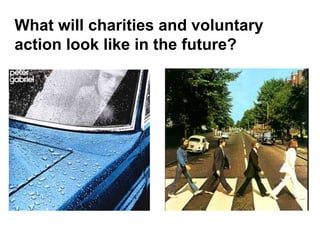
Here comes the flood?
The changing landscape for charities
and voluntary action
Karl Wilding
NCVO Public Policy
karl.wilding@ncvo.org.uk
Twitter: @karlwilding
Structure
• How did we get here?
• What is the „third sector‟ now?
• The changing landscape
• What will charities and voluntary action look like
in the future?
How did we get here? The Compact years
• The post-1996 agenda:
– Mainstreaming in public policy
– Shift in public service delivery role
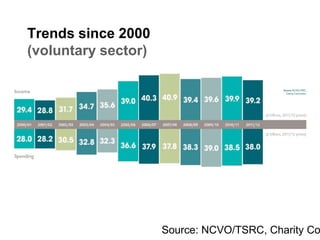
Trends since 2000
(voluntary sector)
Source: NCVO/TSRC, Charity Co
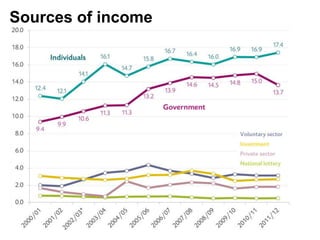
Sources of income
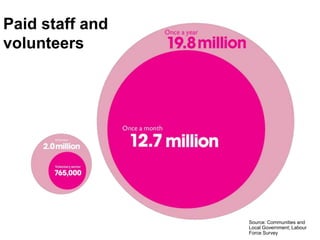
Paid staff and
volunteers
Source: Communities and
Local Government; Labour
Force Survey
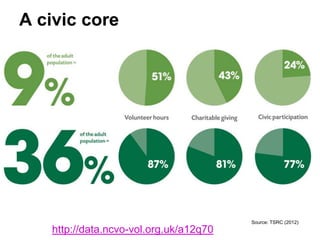
A civic core
http://data.ncvo-vol.org.uk/a12q70
Source: TSRC (2012)
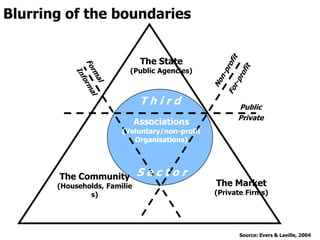
The State
(Public Agencies)
The Market
(Private Firms)
The Community
(Households,
Families)
Associations
(Voluntary/non-profit
Organisations)
Public
Private
T h i r d
S e c t o r
Source: Evers & Laville, 2004
Blurring of the boundaries
What’s driving the new landscape?
• Politics and policy
• Economic change
• Demographic change
• Social attitudes
• Technological advance
• de
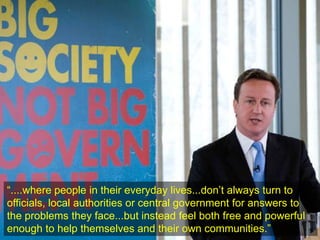
“....where people in their everyday lives...don‟t always turn to
officials, local authorities or central government for answers to
the problems they face...but instead feel both free and powerful
enough to help themselves and their own communities.”
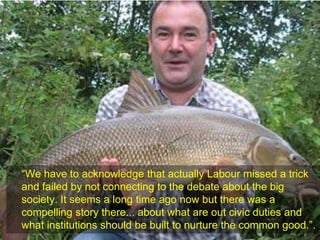
“We have to acknowledge that actually Labour missed a trick
and failed by not connecting to the debate about the big
society. It seems a long time ago now but there was a
compelling story there... about what are out civic duties and
what institutions should be built to nurture the common good.”.
Challenges and opportunities
• What‟s the voluntary sector for?
• What‟s volunteering „for‟?
• Why is it campaigning and lobbying?
• Is there an accountability and regulatory
deficit?
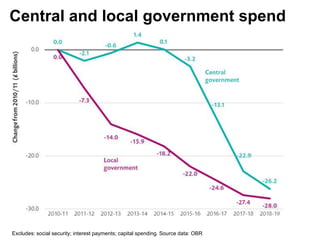
Central and local government spend
Excludes: social security; interest payments; capital spending. Source data: OBR
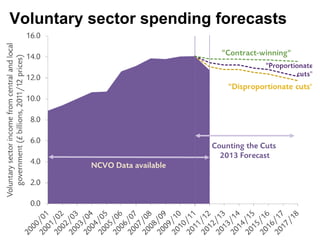
Voluntary sector spending forecasts
Challenges and opportunities
• Reductions in public funding
• Public services: mutualisation,
charitisation, social value
• New forms of funding and finance: social
enterprise and social investment
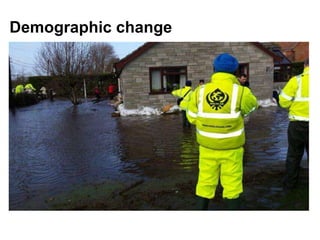
Demographic change
18
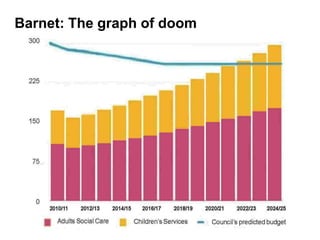
Barnet: The graph of doom
Challenges and opportunities
• Ageing: workforce, donors,
intergenerational conflict and inequality
• Super diversity
• Social cohesion and bridging social capital
Challenges and opportunities
• Data: not very big
• Digital natives
• The rise of the networked nonprofit
• Disintermediation & relevance
• Network effects and winner takes all
• Social entrepreneurs: sector agnostic?
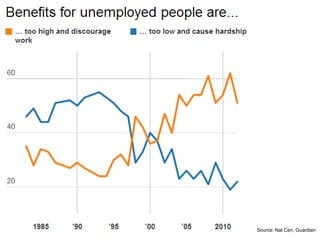
Source: Nat Cen, Guardian
24
25
Challenges and opportunities
• Trust/Values
• Charities as public bad
• From volunteering to participation
What will charities and voluntary
action look like in the future?
Provocations
• Voluntary „sector‟ growth
• Social action: wider, shallower
• Sector less relevant. Or more?
• Digital disruption
• Public trust and institutions
• Governance really is critical. More than
ever?
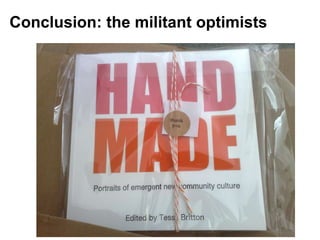
Conclusion: the militant optimists

Here comes the flood? The changing landscape for charities and voluntary action

  • 1.
    Here comes theflood? The changing landscape for charities and voluntary action Karl Wilding NCVO Public Policy karl.wilding@ncvo.org.uk Twitter: @karlwilding
  • 2.
    Structure • How didwe get here? • What is the „third sector‟ now? • The changing landscape • What will charities and voluntary action look like in the future?
  • 3.
    How did weget here? The Compact years • The post-1996 agenda: – Mainstreaming in public policy – Shift in public service delivery role
  • 4.
    Trends since 2000 (voluntarysector) Source: NCVO/TSRC, Charity Co
  • 5.
  • 6.
    Paid staff and volunteers Source:Communities and Local Government; Labour Force Survey
  • 7.
  • 8.
    The State (Public Agencies) TheMarket (Private Firms) The Community (Households, Families) Associations (Voluntary/non-profit Organisations) Public Private T h i r d S e c t o r Source: Evers & Laville, 2004 Blurring of the boundaries
  • 9.
    What’s driving thenew landscape? • Politics and policy • Economic change • Demographic change • Social attitudes • Technological advance
  • 10.
    • de “....where peoplein their everyday lives...don‟t always turn to officials, local authorities or central government for answers to the problems they face...but instead feel both free and powerful enough to help themselves and their own communities.”
  • 11.
    “We have toacknowledge that actually Labour missed a trick and failed by not connecting to the debate about the big society. It seems a long time ago now but there was a compelling story there... about what are out civic duties and what institutions should be built to nurture the common good.”.
  • 12.
    Challenges and opportunities •What‟s the voluntary sector for? • What‟s volunteering „for‟? • Why is it campaigning and lobbying? • Is there an accountability and regulatory deficit?
  • 13.
    Central and localgovernment spend Excludes: social security; interest payments; capital spending. Source data: OBR
  • 14.
  • 16.
    Challenges and opportunities •Reductions in public funding • Public services: mutualisation, charitisation, social value • New forms of funding and finance: social enterprise and social investment
  • 17.
  • 18.
  • 19.
    Challenges and opportunities •Ageing: workforce, donors, intergenerational conflict and inequality • Super diversity • Social cohesion and bridging social capital
  • 22.
    Challenges and opportunities •Data: not very big • Digital natives • The rise of the networked nonprofit • Disintermediation & relevance • Network effects and winner takes all • Social entrepreneurs: sector agnostic?
  • 23.
  • 24.
  • 25.
  • 26.
    Challenges and opportunities •Trust/Values • Charities as public bad • From volunteering to participation
  • 27.
    What will charitiesand voluntary action look like in the future?
  • 28.
    Provocations • Voluntary „sector‟growth • Social action: wider, shallower • Sector less relevant. Or more? • Digital disruption • Public trust and institutions • Governance really is critical. More than ever?
  • 29.

Editor's Notes

  • #5 Sector’s income steadilyincreased to £41 billion (in 2011/12 prices) by 2007/08.Recession hit the voluntary sector as well – large drop in income, followed by a slow recovery (mirrors the pattern of the whole economy?)Expenditure was kept up during the recession – dipping into reserves. But this couldn’t be maintained – spending seems to have lagged behind income.Now lets focus on 2011/12 – which saw income drop.
  • #6 This graph shows the relatives sizes of different income sources – the top line is income from individuals, which has consistently been the highest, and the next one down is income from government – which we’ll come onto in a bit.The important part is to recognise how big the contribution of these two sources is – 4 pounds out of every 5 the sector receives comes from individuals or government.
  • #11 Quote is very similar to the full quote by Thatcher on society
  • #12 Jon Cruddas, with a big fish. http://www.theguardian.com/politics/blog/2009/sep/09/jon-cruddas-fishingAll sides are thinking about the transfer of risk and responsibility to individuals and communities: in that sense, Big Society can trace lineage to the third way. Cant but help think all of them trace lineage to Samuel Smiles and working class responses in the late nineteenth century (the so called golden age of popular institutions)Quote: http://www.independent.co.uk/news/uk/politics/labour-to-embrace-david-camerons-big-society-8192956.html
  • #14 Overall govt spending pictire: fiscal mandate, AME rising, significant DEL cuts, local govt hit hardest and first. For the sector, long term trend of grants in decline, contracts growth….Rational (in the short term sense of the word) behaviours in response to reduced funding: insourcing, non-inflationary settlements, asking orgs to subsidise contracts with voluntary income, parcelling up work into fewer larger contracts, changing eligibility criteria.
  • #16 SIBs another example of the new world of finance, alongside PbRNeed to be careful about criticising these: like all tools, they have their place. Problem applies when they are applied in the wrong context (Maslow’s Hammer!) or when people assume they are a substitute for other tools such as grant funding
  • #18 http://www.sikh24.com/2014/02/khalsa-aid-causes-waves-in-british-floods-humanitarian-relief/#.U2IF_YFdWutI thought this was an interesting illustration of how society is changing, of super diversity, of bridging social capital – need to check, but I don’t think the Somerset levels are home to a large sikh community
  • #19 The important point about this in this context is that demographic change is driving expenditure in public services; and that this is arguably more important than current narratives about spending cuts
  • #21 Source: https://twitter.com/stevebridger/status/461029280630067201
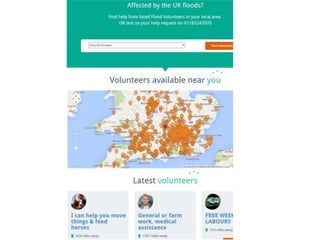
  • #22 Flood volunteers: interesting because a) its private sector, and b) it uses technology in a way that is useful at a local level, whilst disintermediating local infrastructure.I think that there’s an analogy here with record stores. Would be nice to work this one up – particularly as record stores, and the resurgence of vinyl, show that every big trend has a counter trend
  • #23 Data – a real difficult one for most organisations, but trying to make the argument for better use of data is important for me (and not assuming a £200k turnover org can develop the equiv of tescoclubcard)Network effects – see throwaway comment at end of John Naughton’s article on winner takes all. This is so important… http://www.theguardian.com/technology/2014/apr/27/no-joke-robots-taking-over-replace-middle-classes-automatons
  • #24 Hardening social attitudes – point is challenge of informing and changing attitudes and being on the wrong side of public opinion
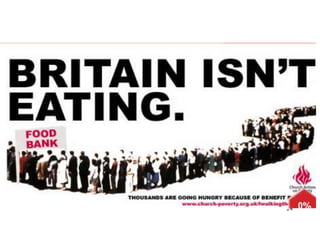
  • #25 But the idea that the sector doesn’t campaign and isnt independent of govt is a myth – seeing some really hard edged campaigns that defend the most marginalised.
  • #26 There’s probably a few things going on here, but the point worth making is that we have to accountable and transparent – the problem of trust in institutions more widely is not something charities are immune from.
  • #27 Senior salaries (Daily Telegraph, PASC enquiry)Interns: unethical practices/exploitationZero-hours contracts: unethical practices/exploitation
  • #28 Here comes the floodOrHere comes the sun
  • #29 Lawyer said to me the other day: Karl, there are only two reasons why things go wrong in voluntary organisations: fear and greed.So, governance is the critical issue.
  • #30 Rotterdam – alt library: http://www.shareable.net/blog/re-imagining-libraries-a-book-needs-your-helphttp://www.communityloversguide.org/http://www.civicsystemslab.org/http://davidbarrie.typepad.com/david_barrie/2010/09/militant-optimists-urban-development.html