PRACTICAL TRANSPARENCY:
NEXT STEPS FOR THE
VOLUNTARY SECTOR?
@KARLWILDING
NCVO PUBLIC POLICY
JUNE 2015
(SPEAKING NOTES ARE EMBEDDED IN THE
SLIDES!)
2
3
IMPACT
FUNDING
OPERATIONS
GOVERNANCE
SERVICES
RESEARCH
CAMPAIGNING
4
5
6
8
9
10
12
13
WHERE NEXT?
14
15
16
17

Gold standard transparency for charities

Editor's Notes

  • #3 The environment has changed: media and public demands re transparency have changed Some of this is a political agenda But some isn’t: for the millennial generation transparency is no longer a hygiene issue: it is now a values issue. In short, people think transparency is a good thing, it is the opposite of the closed institutions that we have too often learned are corrupt (think FIFA or Mid Staffs hospital). So, if we’re at all concerned about a gap emerging between our values and those of our supporters – which I think would undermine trust – then I think we have to think more about transparency.
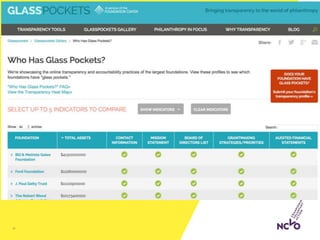
  • #4 We’ve said that charities should be the gold standard when it comes to transparency. We should be better than other sectors that can compel people to engage with them (the state) or are much more likely to be one of many organisations in a market (where consumers or users can choose, not always the case in areas of market failure occupied by charities) Some do not agree – and the strategy has been to focus the debate on financial reporting, to box in those who think transparency is a good thing. I don’t think we’ve don’t enough therefore to explain our thinking – that transparency is about more than the end of year report, than about the availability of financial data, or indeed any data. Its about a cultural change, an approach that would see us act much more like the open, networked organisationsthat I think are the future of our sector. In saying this, I am drawing upon Beth Kanter’s work, that we should be ‘networked nonprofits’, and that transparency means we should be more like glasshouses (or greenhouses, if you prefer, in the UK). As such, I would argue that Kanter is spot on by saying that transparency isnt just an inherent valuable; but that the values, culture and practices of transparency themselves generate value, over and above the costs incurred.
  • #5 So, if we’re going to move forward the debate on what ‘gold standard’ transparency’ looks like then I think that we need to move the debate beyond the narrow confines of money and instead think about the broader way that organisations might function or work and think about what being an open, networked nonprofit might mean for them. As a starter for 10, I think we need to debate what gold standard transparency might mean across these 7 domains. And for the avoidance of doubt, lets be clear: gold standard is not a euphemism for more. I cant agree with those who seek to give transparency a bad name by simply dumping data or producing 200 page annual reports and accounts: obfuscation via increased disclosure is a classic strategy that ultimately has the opposite effect to what is needed. Gold standard transparency is about better, not more; it is about data and narrative, about stories and explanations, so that data is not marooned and left to others to explain. Gold standard transparency is about process and how we work, not just counting outputs (or even outcomes), so that our stakeholders can ‘puncture the membrane’, so that they can see inside – a real opportunity given our challenge of public understanding
  • #6 Impact What difference do you make? How do you measure this? What can and can’t you measure? What you don’t measure and why? How effective are you compared to other interventions? Intended outcome: gold standard transparency creates an environment where it is safe to fail, or fail forward.
  • #7 Money Where does it come from and what do you spend it on? Sorry, I know this is dull, but people want to know. We’re behind government on this. And the likes of the NAO want to be able to ‘follow the money’. They’re firmly of the view that transparency reduces graft: sunlight is the best disinfectant Wake up call: xBRL is coming. Then our financial data will be machine readable. So if we don’t sort the narrative out, someone else will do it for us. I think that this is incredibly important.
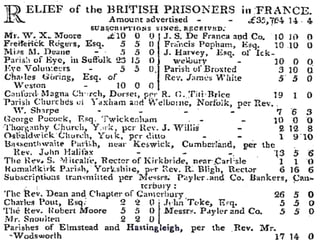
  • #8 Charities have always been transparent. This is a newspaper article from, I think, the 1870s. Better accounting: chicken and egg re reports
  • #9 Transparency of operations: being able to see our internal organs… What level of accounting/audit detail do you disclose? Contracting Investments Recruitment, pay Most of this stuff is poorly communicated
  • #10 Deep breath for me here: you can go to the NCVO website and see how much I am paid, how that ratios with the rest of the staff, my annual increase, and how the trustees made the decision about my pay. And if you think that this presentation is rubbish you can write to the board and tell them that I am not worth what they are paying. It may well be disregarded, but that’s not the point (although transparency demands a reply): transparency should mean that we can build a culture of compare and share.
  • #11 Governance Who are the trustees? How are they selected? When they meet and what they decide, What protocols and policies are in place? Who makes decisions, how, how are they documented Conflicts of interest issues I’m a trustee of Creating the Future. Our board meetings are open, on the web. Anyone can take part via social media. People can see we are human beings, with struggles, home lives, that we don’t always have the answers. They can see that trying to do social change is messy. I think that builds trust. And we of course have times where a sensitive issue is discussed in private, but we’re open about that too. Here’s the most important question: not what are the risks of doing this, but what’s the worst that could happen?
  • #12 Services What services do you run, where, who can access them, how effective are they; quality standards they operate to / work towards Good story here from Martin Brookes, formerly of NPC, how publishing data on heart surgeons performance drives improvement. Opening up data can help – others might look at our data using techniques we hadnt thought of. And again, a wake up call: we are due a discussion about how the Freedom of Information Act relates to charities. I for one don’t think its right to apply it to charities because of the bureacracy – but I think we need our own answer to why people are using FoI tools- we should reduce demand for them in the first place by being open and answering questions.
  • #13 Research What research do you conduct, what do you publish, what don’t you publish Again, this is about building trust – we have to show the world that we have considered both sides of the argument
  • #14 Campaigning What do you campaign on, how is it decided, why do you choose certain methods, how effective are your campaigns   I would prefer us to be open about our campaigning than to be seen to be regulated
  • #16 Fake Charities has gone; but the bloggersphere is alive and well
  • #17 Many bloggers are complaining about the closed nature of charities…and the same bloggers are I think winning the argument about how all institutions need to be more transparent
  • #18 And finally: the rise of the machines. Our data is going to be more out there than ever before, in a machine readable format, that will enable more and more comparison The rating agencies and transparency intermediaries will be looking more at charities, and not just at their financial data We should turn this into a positive agenda and lead on the front font: by setting our own gold standard we can hopefully tell our own story about the change we bring, and in doing so make it easier for supporters to work with us to deliver that change