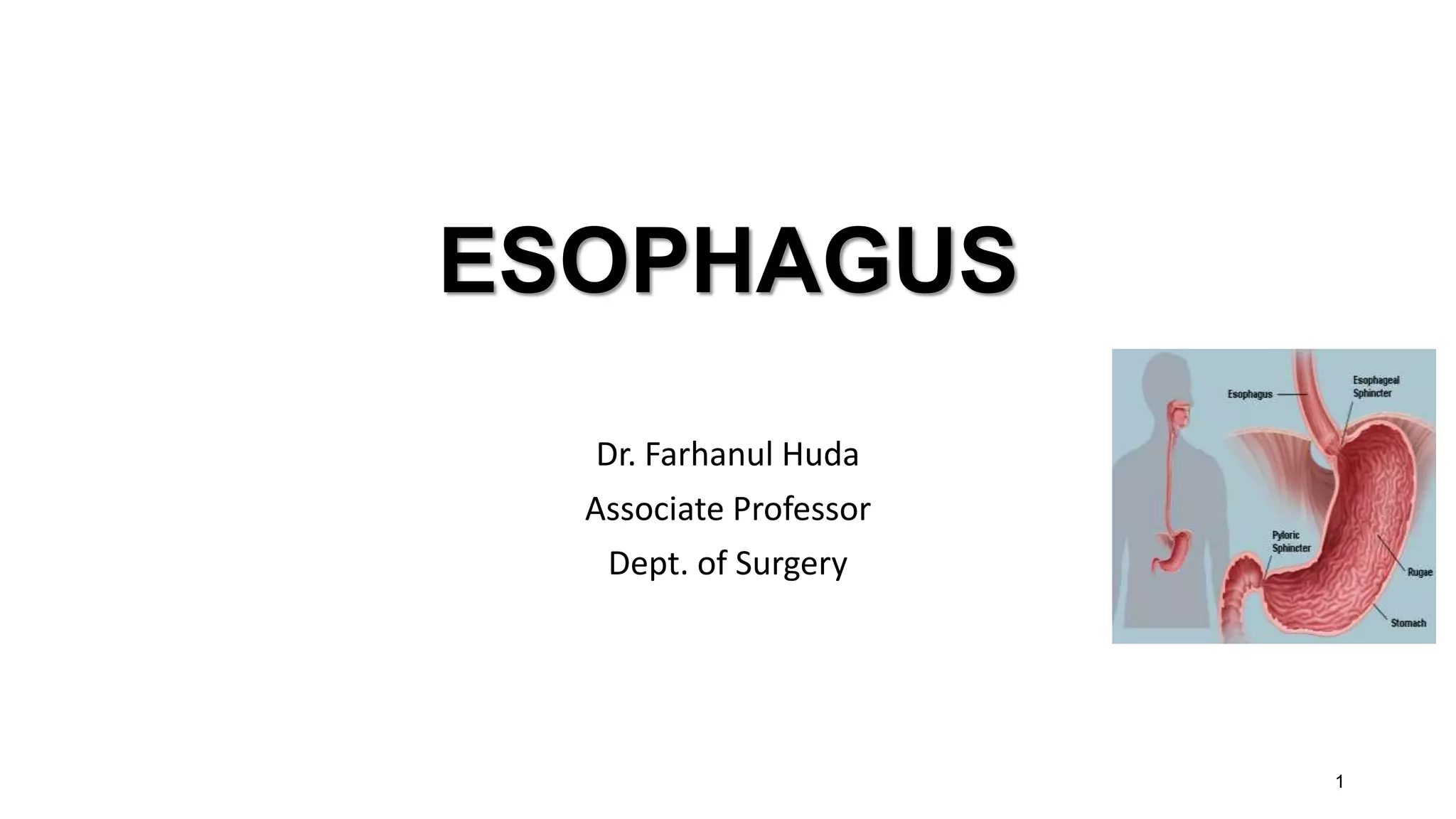
ESOPHAGUS
Dr. Farhanul Huda
Associate Professor
Dept. of Surgery
1
OBJECTIVES
• By the end of this lecture the student should be able to
• Describe the anatomy of the esophagus: extent, length,
parts, strictures, relations, blood supply, innervation and
lymphatics.
2
ESOPHAGUS
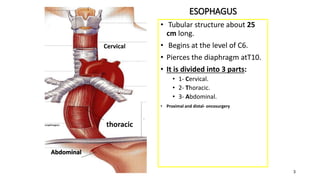
• Tubular structure about 25
cm long.
• Begins at the level of C6.
• Pierces the diaphragm atT10.
• It is divided into 3 parts:
• 1- Cervical.
• 2- Thoracic.
• 3- Abdominal.
• Proximal and distal- oncosurgery
Abdominal
thoracic
Cervical
3
4
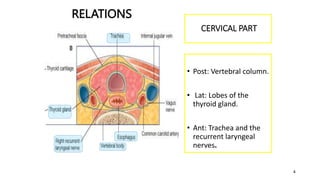
CERVICAL PART
• Posteriorly
• Post: Vertebral column.
• Laterally:
• Lat: Lobes of the
thyroid gland.
• Anteriorly:
• Ant: Trachea and the
recurrent laryngeal
nerves.
RELATIONS
5
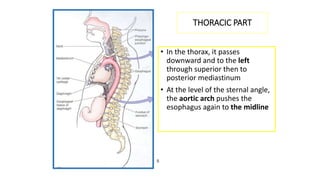
THORACIC PART
• In the thorax, it passes
downward and to the left
through superior then to
posterior mediastinum
• At the level of the sternal angle,
the aortic arch pushes the
esophagus again to the midline.
6
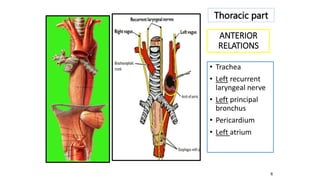
ANTERIOR
RELATIONS
• Trachea
• Left recurrent
laryngeal nerve
• Left principal
bronchus
• Pericardium
• Left atrium
Thoracic part
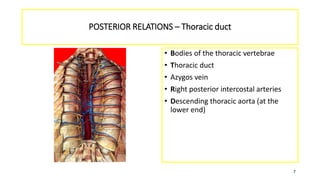
POSTERIOR RELATIONS – Thoracic duct
• Bodies of the thoracic vertebrae
• Thoracic duct
• Azygos vein
• Right posterior intercostal arteries
• Descending thoracic aorta (at the
lower end)
7
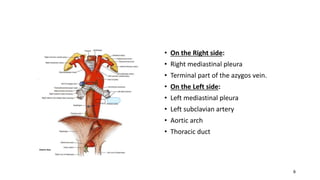
LATERAL RELATION
• On the Right side:
• Right mediastinal pleura
• Terminal part of the azygos vein.
• On the Left side:
• Left mediastinal pleura
• Left subclavian artery
• Aortic arch
• Thoracic duct
8
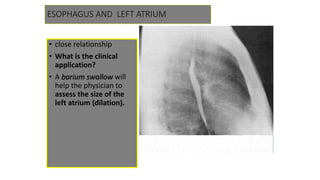
ESOPHAGUS AND LEFT ATRIUM
• close relationship
• What is the clinical
application?
• A barium swallow will
help the physician to
assess the size of the
left atrium (dilation).
10
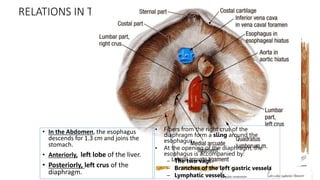
RELATIONS IN THE ABDOMEN
• In the Abdomen, the esophagus
descends for 1.3 cm and joins the
stomach.
• Anteriorly, left lobe of the liver.
• Posteriorly, left crus of the
diaphragm.
• Fibers from the right crus of the
diaphragm form a sling around the
esophagus.
• At the opening of the diaphragm, the
esophagus is accompanied by:
– The two vagi
– Branches of the left gastric vessels
– Lymphatic vessels.
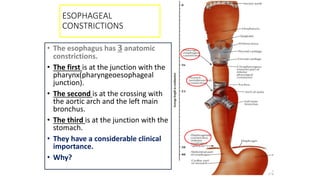
ESOPHAGEAL
CONSTRICTIONS
• The esophagus has 3 anatomic
constrictions.
• The first is at the junction with the
pharynx(pharyngeoesophageal
junction).
• The second is at the crossing with
the aortic arch and the left main
bronchus.
• The third is at the junction with the
stomach.
• They have a considerable clinical
importance.
• Why?
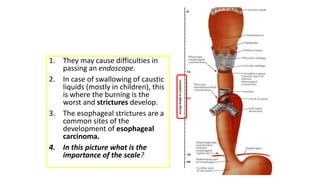
1. They may cause difficulties in
passing an endoscope.
2. In case of swallowing of caustic
liquids (mostly in children), this
is where the burning is the
worst and strictures develop.
3. The esophageal strictures are a
common sites of the
development of esophageal
carcinoma.
4. In this picture what is the
importance of the scale?
13
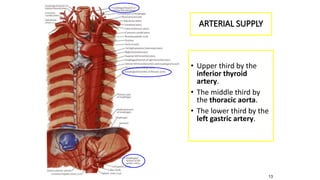
ARTERIAL SUPPLY
• Upper third by the
inferior thyroid
artery.
• The middle third by
the thoracic aorta.
• The lower third by the
left gastric artery.
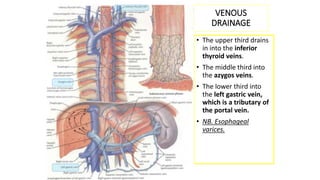
VENOUS
DRAINAGE
• The upper third drains
in into the inferior
thyroid veins.
• The middle third into
the azygos veins.
• The lower third into
the left gastric vein,
which is a tributary of
the portal vein.
• NB. Esophageal
varices.
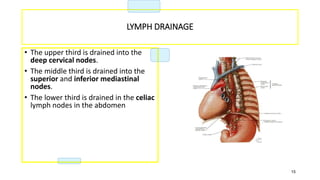
LYMPH DRAINAGE
• The upper third is drained into the
deep cervical nodes.
• The middle third is drained into the
superior and inferior mediastinal
nodes.
• The lower third is drained in the celiac
lymph nodes in the abdomen.
15
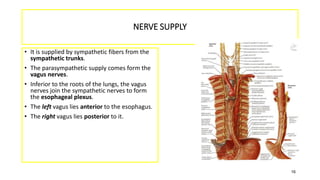
NERVE SUPPLY
• It is supplied by sympathetic fibers from the
sympathetic trunks.
• The parasympathetic supply comes form the
vagus nerves.
• Inferior to the roots of the lungs, the vagus
nerves join the sympathetic nerves to form
the esophageal plexus.
• The left vagus lies anterior to the esophagus.
• The right vagus lies posterior to it.
16
17
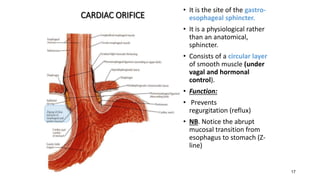
CARDIAC ORIFICE
• It is the site of the gastro-
esophageal sphincter.
• It is a physiological rather
than an anatomical,
sphincter.
• Consists of a circular layer
of smooth muscle (under
vagal and hormonal
control).
• Function:
• Prevents (GER)
regurgitation (reflux)
• NB. Notice the abrupt
mucosal transition from
esophagus to stomach (Z-
line)
Microscopic anatomy
• 2 layers of muscles- longitudinal and circular.
• Lined by non keratinizing stratified squamous epithelium.
• Squamocolumnar jn.
Recap
• Length ?
• Parts?
• Arterial supply?
• Venous drainage?
• Constrictions ?
• Relation with lt atrium?
• Barett’s esophagus?
Stricture
• Causes can be grouped into:
• Intrinsic – due to inflammation, fibrosis or neoplasia
• Extrinsic – due to external compression
• Disruption of peristalsis
Proximal and mid esophagus
• Caustic ingestion (acid or alkali)
• Malignancy
• Radiation therapy
• Infectious esophagitis - Candida, herpes simplex virus (HSV),
cytomegalovirus (CMV), human immunodeficiency virus (HIV)
• AIDS and immunosuppressed patients
• Diseases of the skin - Pemphigus vulgaris, benign mucous membrane
(cicatricial) pemphigoid, epidermolysis bullosa dystrophica
• Idiopathic eosinophilic esophagitis
• Extrinsic compression
• Squamous cell carcinoma
Distal esophagus
• Peptic stricture
• Adenocarcinoma
• Collagen vascular disease - Scleroderma, systemic lupus
erythematosus (SLE), rheumatoid arthritis
• Extrinsic compression
• Alkaline reflux following gastric resection
• Sclerotherapy and prolonged nasogastric intubation
• Heartburn
• Dysphagia, odynophagia
• Food impaction
• Weight loss
• Chest pain
• Poor nutritional status
• Patients with collagen vascular diseases -- joint abnormalities,
calcinosis, telangiectasias, sclerodactyly, or rashes
• Virchow node
Corrosive injury
• Accidental or suicidal.
• The type of agent, its concentration and the volume ingested
determine the extent of damage.
• Pathophysiology:
• Alkalis cause liquefaction that leads to fibrous scarring.
• Acids cause coagulative necrosis with eschar formation, and this coagulum
limit penetration to deeper layers.
• Acids cause more gastric damage because of intense pylorospasm with
pooling in the antrum.
Treatment
• Supportive
• Feeding jejunostomy until patient starts swallowing saliva.
• Repeated endoscopy and dilation.
• Esophageal replacement for very long or multiple strictures. Why not
resection?
Corrosive injury- Key points
Skilled early endoscopy is mandatory
Esophageal perforation
• Usually iatrogenic or due to ‘barotrauma’.
• Spontaneous perforation is a life-threatening condition.
• Iatrogenic perforation can be managed conservatively.
• Can be pathological
• Due to penetrating injury or foreign body
Barotrauma (spontaneous perforation,
Boerhaave syndrome)
• occurs classically when a person vomits against a closed glottis.
• The pressure in the oesophagus increases rapidly, and the
• oesophagus bursts at its weakest point in the lower third, sending
• a stream of material into the mediastinum and often the
• pleural cavity as well. The condition was first reported by
• Boerhaave, who reported the case of a grand admiral of the
• Dutch fleet who was a glutton and practised autoemesis.
• Boerhaave syndrome is the most serious type of perforation
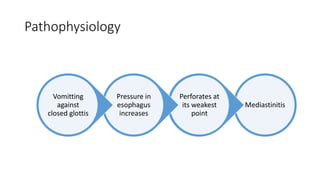
Pathophysiology
Mediastinitis
Perforates at
its weakest
point
Pressure in
esophagus
increases
Vomitting
against
closed glottis
Clinical presentation
• Severe pain in the chest or upper abdomen following a meal or a bout
of drinking
• SOB
• Sometimes misdiagnosed as MI, perforated peptic ulcer or
pancreatitis
• Rigidity of the upper abdomen
• Dec. breath sounds
• Dullness on percussion, subcutaneous emphysema
• In late cases sepsis is present
Investigations
• CXR - air in the mediastinum, pleura or peritoneum.
• Pleural effusion
• A barium swallow
• CECT
Iatrogenic injury
• Most common cause of esophageal perforation.
• Most common site is the cricopharyngeus.
• Factors associated with increased risk are including large anterior
cervical osteophytes, the presence of a pharyngeal pouch and
mechanical causes of obstruction
• It may follow biopsy
• Patients undergoing therapeutic endoscopy have a 10 times greater
perforation risk than those undergoing diagnostic endoscopy.
Treatment
• Aim is to limit mediastinal contamination and infection
• The decision between operative and non-operative management
rests on four factors:
1 the site of the perforation (cervical vs. thoracoabdominal oesophagus)
2 the event causing the perforation (spontaneous vs. instrumental)
3 underlying pathology (benign or malignant)
4 the status of the oesophagus before the perforation (fasted and empty vs.
obstructed with a stagnant residue).
• Indications for non-operative management include:
• pain that is readily controlled with opiates;
• absence of crepitus, diffuse mediastinal gas, hydropneumothorax or
pneumoperitoneum;
• no evidence of widespread extravasation of contrast material;
• no evidence of on-going luminal obstruction or a retained foreign body.
• patients who have remained clinically stable despite diagnostic delay.
• The principles of non-operative management are hyperalimentation,
nasogastric suction and broad-spectrum intravenous antibiotics.
• Surgical management is indicated when:
• Patients are unstable with sepsis or shock
• Have evidence of a heavily contaminated mediastinum, pleural space
or peritoneum.
• Surgery can be a primary repair, creation of an external fistula or
resection.
Key points
• Most perforations are iatrogenic.
• Surgical emphysema is pathognomonic.
• Complications are mediastinitis and sepsis.
• Treatment is both conservative or surgical but requires specialised
care.

esophagus.pptx

  • 1.
    ESOPHAGUS Dr. Farhanul Huda AssociateProfessor Dept. of Surgery 1
  • 2.
    OBJECTIVES • By theend of this lecture the student should be able to • Describe the anatomy of the esophagus: extent, length, parts, strictures, relations, blood supply, innervation and lymphatics. 2
  • 3.
    ESOPHAGUS • Tubular structureabout 25 cm long. • Begins at the level of C6. • Pierces the diaphragm atT10. • It is divided into 3 parts: • 1- Cervical. • 2- Thoracic. • 3- Abdominal. • Proximal and distal- oncosurgery Abdominal thoracic Cervical 3
  • 4.
    4 CERVICAL PART • Posteriorly •Post: Vertebral column. • Laterally: • Lat: Lobes of the thyroid gland. • Anteriorly: • Ant: Trachea and the recurrent laryngeal nerves. RELATIONS
  • 5.
    5 THORACIC PART • Inthe thorax, it passes downward and to the left through superior then to posterior mediastinum • At the level of the sternal angle, the aortic arch pushes the esophagus again to the midline.
  • 6.
    6 ANTERIOR RELATIONS • Trachea • Leftrecurrent laryngeal nerve • Left principal bronchus • Pericardium • Left atrium Thoracic part
  • 7.
    POSTERIOR RELATIONS –Thoracic duct • Bodies of the thoracic vertebrae • Thoracic duct • Azygos vein • Right posterior intercostal arteries • Descending thoracic aorta (at the lower end) 7
  • 8.
    LATERAL RELATION • Onthe Right side: • Right mediastinal pleura • Terminal part of the azygos vein. • On the Left side: • Left mediastinal pleura • Left subclavian artery • Aortic arch • Thoracic duct 8
  • 9.
    ESOPHAGUS AND LEFTATRIUM • close relationship • What is the clinical application? • A barium swallow will help the physician to assess the size of the left atrium (dilation).
  • 10.
    10 RELATIONS IN THEABDOMEN • In the Abdomen, the esophagus descends for 1.3 cm and joins the stomach. • Anteriorly, left lobe of the liver. • Posteriorly, left crus of the diaphragm. • Fibers from the right crus of the diaphragm form a sling around the esophagus. • At the opening of the diaphragm, the esophagus is accompanied by: – The two vagi – Branches of the left gastric vessels – Lymphatic vessels.
  • 11.
    ESOPHAGEAL CONSTRICTIONS • The esophagushas 3 anatomic constrictions. • The first is at the junction with the pharynx(pharyngeoesophageal junction). • The second is at the crossing with the aortic arch and the left main bronchus. • The third is at the junction with the stomach. • They have a considerable clinical importance. • Why?
  • 12.
    1. They maycause difficulties in passing an endoscope. 2. In case of swallowing of caustic liquids (mostly in children), this is where the burning is the worst and strictures develop. 3. The esophageal strictures are a common sites of the development of esophageal carcinoma. 4. In this picture what is the importance of the scale?
  • 13.
    13 ARTERIAL SUPPLY • Upperthird by the inferior thyroid artery. • The middle third by the thoracic aorta. • The lower third by the left gastric artery.
  • 14.
    VENOUS DRAINAGE • The upperthird drains in into the inferior thyroid veins. • The middle third into the azygos veins. • The lower third into the left gastric vein, which is a tributary of the portal vein. • NB. Esophageal varices.
  • 15.
    LYMPH DRAINAGE • Theupper third is drained into the deep cervical nodes. • The middle third is drained into the superior and inferior mediastinal nodes. • The lower third is drained in the celiac lymph nodes in the abdomen. 15
  • 16.
    NERVE SUPPLY • Itis supplied by sympathetic fibers from the sympathetic trunks. • The parasympathetic supply comes form the vagus nerves. • Inferior to the roots of the lungs, the vagus nerves join the sympathetic nerves to form the esophageal plexus. • The left vagus lies anterior to the esophagus. • The right vagus lies posterior to it. 16
  • 17.
    17 CARDIAC ORIFICE • Itis the site of the gastro- esophageal sphincter. • It is a physiological rather than an anatomical, sphincter. • Consists of a circular layer of smooth muscle (under vagal and hormonal control). • Function: • Prevents (GER) regurgitation (reflux) • NB. Notice the abrupt mucosal transition from esophagus to stomach (Z- line)
  • 18.
    Microscopic anatomy • 2layers of muscles- longitudinal and circular. • Lined by non keratinizing stratified squamous epithelium. • Squamocolumnar jn.
  • 19.
    Recap • Length ? •Parts? • Arterial supply? • Venous drainage? • Constrictions ? • Relation with lt atrium? • Barett’s esophagus?
  • 20.
  • 21.
    • Causes canbe grouped into: • Intrinsic – due to inflammation, fibrosis or neoplasia • Extrinsic – due to external compression • Disruption of peristalsis
  • 22.
    Proximal and midesophagus • Caustic ingestion (acid or alkali) • Malignancy • Radiation therapy • Infectious esophagitis - Candida, herpes simplex virus (HSV), cytomegalovirus (CMV), human immunodeficiency virus (HIV) • AIDS and immunosuppressed patients • Diseases of the skin - Pemphigus vulgaris, benign mucous membrane (cicatricial) pemphigoid, epidermolysis bullosa dystrophica • Idiopathic eosinophilic esophagitis • Extrinsic compression • Squamous cell carcinoma
  • 23.
    Distal esophagus • Pepticstricture • Adenocarcinoma • Collagen vascular disease - Scleroderma, systemic lupus erythematosus (SLE), rheumatoid arthritis • Extrinsic compression • Alkaline reflux following gastric resection • Sclerotherapy and prolonged nasogastric intubation
  • 24.
    • Heartburn • Dysphagia,odynophagia • Food impaction • Weight loss • Chest pain • Poor nutritional status • Patients with collagen vascular diseases -- joint abnormalities, calcinosis, telangiectasias, sclerodactyly, or rashes • Virchow node
  • 25.
    Corrosive injury • Accidentalor suicidal. • The type of agent, its concentration and the volume ingested determine the extent of damage. • Pathophysiology: • Alkalis cause liquefaction that leads to fibrous scarring. • Acids cause coagulative necrosis with eschar formation, and this coagulum limit penetration to deeper layers. • Acids cause more gastric damage because of intense pylorospasm with pooling in the antrum.
  • 26.
    Treatment • Supportive • Feedingjejunostomy until patient starts swallowing saliva. • Repeated endoscopy and dilation. • Esophageal replacement for very long or multiple strictures. Why not resection?
  • 27.
    Corrosive injury- Keypoints Skilled early endoscopy is mandatory
  • 28.
  • 29.
    • Usually iatrogenicor due to ‘barotrauma’. • Spontaneous perforation is a life-threatening condition. • Iatrogenic perforation can be managed conservatively. • Can be pathological • Due to penetrating injury or foreign body
  • 30.
    Barotrauma (spontaneous perforation, Boerhaavesyndrome) • occurs classically when a person vomits against a closed glottis. • The pressure in the oesophagus increases rapidly, and the • oesophagus bursts at its weakest point in the lower third, sending • a stream of material into the mediastinum and often the • pleural cavity as well. The condition was first reported by • Boerhaave, who reported the case of a grand admiral of the • Dutch fleet who was a glutton and practised autoemesis. • Boerhaave syndrome is the most serious type of perforation
  • 31.
    Pathophysiology Mediastinitis Perforates at its weakest point Pressurein esophagus increases Vomitting against closed glottis
  • 32.
    Clinical presentation • Severepain in the chest or upper abdomen following a meal or a bout of drinking • SOB • Sometimes misdiagnosed as MI, perforated peptic ulcer or pancreatitis • Rigidity of the upper abdomen • Dec. breath sounds • Dullness on percussion, subcutaneous emphysema • In late cases sepsis is present
  • 33.
    Investigations • CXR -air in the mediastinum, pleura or peritoneum. • Pleural effusion • A barium swallow • CECT
  • 34.
    Iatrogenic injury • Mostcommon cause of esophageal perforation. • Most common site is the cricopharyngeus. • Factors associated with increased risk are including large anterior cervical osteophytes, the presence of a pharyngeal pouch and mechanical causes of obstruction • It may follow biopsy • Patients undergoing therapeutic endoscopy have a 10 times greater perforation risk than those undergoing diagnostic endoscopy.
  • 35.
    Treatment • Aim isto limit mediastinal contamination and infection • The decision between operative and non-operative management rests on four factors: 1 the site of the perforation (cervical vs. thoracoabdominal oesophagus) 2 the event causing the perforation (spontaneous vs. instrumental) 3 underlying pathology (benign or malignant) 4 the status of the oesophagus before the perforation (fasted and empty vs. obstructed with a stagnant residue).
  • 36.
    • Indications fornon-operative management include: • pain that is readily controlled with opiates; • absence of crepitus, diffuse mediastinal gas, hydropneumothorax or pneumoperitoneum; • no evidence of widespread extravasation of contrast material; • no evidence of on-going luminal obstruction or a retained foreign body. • patients who have remained clinically stable despite diagnostic delay. • The principles of non-operative management are hyperalimentation, nasogastric suction and broad-spectrum intravenous antibiotics.
  • 37.
    • Surgical managementis indicated when: • Patients are unstable with sepsis or shock • Have evidence of a heavily contaminated mediastinum, pleural space or peritoneum. • Surgery can be a primary repair, creation of an external fistula or resection.
  • 38.
    Key points • Mostperforations are iatrogenic. • Surgical emphysema is pathognomonic. • Complications are mediastinitis and sepsis. • Treatment is both conservative or surgical but requires specialised care.