TELKOMNIKA Indonesian Journal of Electrical Engineering
Vol. 13, No. 2, February 2015, pp. 360 ~ 368
DOI: 10.11591/telkomnika.v13i2.6936  360
Received October 30, 2014; Revised December 18, 2014; Accepted January 10, 2015
ESL Reading Research Based on Eye Tracking
Techniques
Wenlian Zhan*, Zhulin Shen
Business English Department of Foreign Languages Studies,,Hunan International Economics University,
Changsha, Changsha, 410205,Chinam Tel.: 13807499918
*Corresponding author, e-mail: 513869962@qq.com
Abstract
Reading is a complex cognitive process. Through eye tracking techniques the cognitive features
can be observed in depth, and therefore a better grasp of the instant cognitive processing of language can
be achieved. Compared to traditional methods, the greatest advantage of eye tracking is that is that the
reader proceeds with reading coherently and fluently without interrupt and interference, which secures the
results in higher ecological validity. This paper is mainly about studies on eye movement features in ESL
reading, and particularly illustrates eye movement patterns, the relationship between eye movement and
perceptual processing, and eye movement control, aiming at providing some basic evidences for
explaining the relationship between eye movement behavior and cognitive processing thus helping to
solve some theoretical problems in reading.
Keywords: reading, eye movement, information tracking,cognitive process, perception span
Copyright © 2015 Institute of Advanced Engineering and Science. All rights reserved.
1. Introduction
Reading is a complex cognitive process, and through eye tracking techniques, the
cognitive features of reading process can be observed more in-depth, and therefore a better
grasp of real-time cognitive processing the language comprehension can be achieved. Eye
movement as an index to investigate reading process is an important area of psycholinguistics
and reading psychology. In reading activities, the research of the relationship between
cognitive processing and eye movement behavior can be dated back to the 19th century, when
the research focused on the basic parameters and features of eye movement. Since the 1970s,
with the development of eye movement recording technology, and particularly the use of
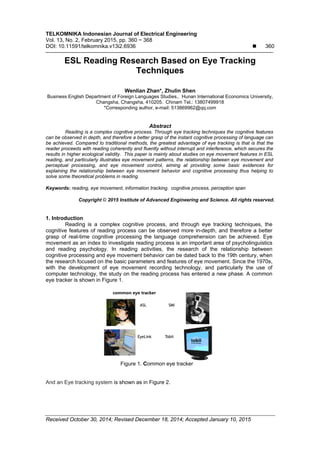
computer technology, the study on the reading process has entered a new phase. A common
eye tracker is shown in Figure 1.
Figure 1. Common eye tracker
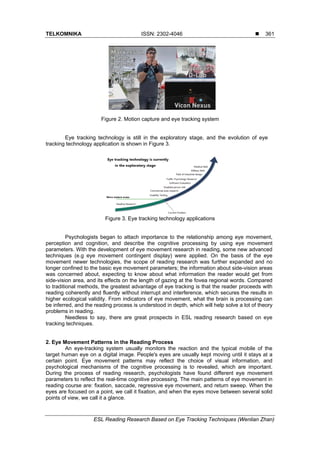
And an Eye tracking system is shown as in Figure 2.
TELKOMNIKA ISSN: 2302-4046 
ESL Reading Research Based on Eye Tracking Techniques (Wenlian Zhan)
361
Figure 2. Motion capture and eye tracking system
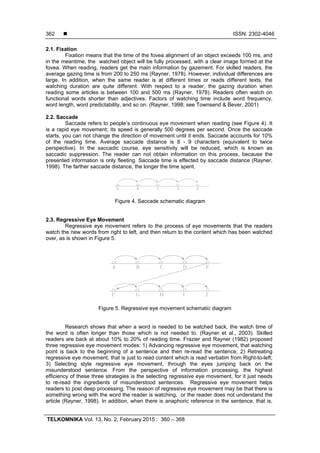
Eye tracking technology is still in the exploratory stage, and the evolution of eye
tracking technology application is shown in Figure 3.
Figure 3. Eye tracking technology applications
Psychologists began to attach importance to the relationship among eye movement,
perception and cognition, and describe the cognitive processing by using eye movement
parameters. With the development of eye movement research in reading, some new advanced
techniques (e.g eye movement contingent display) were applied. On the basis of the eye
movement newer technologies, the scope of reading research was further expanded and no
longer confined to the basic eye movement parameters; the information about side-vision areas
was concerned about, expecting to know about what information the reader would get from
side-vision area, and its effects on the length of gazing at the fovea regional words. Compared
to traditional methods, the greatest advantage of eye tracking is that the reader proceeds with
reading coherently and fluently without interrupt and interference, which secures the results in
higher ecological validity. From indicators of eye movement, what the brain is processing can
be inferred, and the reading process is understood in depth, which will help solve a lot of theory
problems in reading.
Needless to say, there are great prospects in ESL reading research based on eye
tracking techniques.
2. Eye Movement Patterns in the Reading Process
An eye-tracking system usually monitors the reaction and the typical mobile of the
target human eye on a digital image. People's eyes are usually kept moving until it stays at a
certain point. Eye movement patterns may reflect the choice of visual information, and
psychological mechanisms of the cognitive processing is to revealed, which are important.
During the process of reading research, psychologists have found different eye movement
parameters to reflect the real-time cognitive processing. The main patterns of eye movement in
reading course are: fixation, saccade, regressive eye movement, and return sweep. When the
eyes are focused on a point, we call it fixation, and when the eyes move between several solid
points of view, we call it a glance.
 ISSN: 2302-4046
TELKOMNIKA Vol. 13, No. 2, February 2015 : 360 – 368
362
2.1. Fixation
Fixation means that the time of the fovea alignment of an object exceeds 100 ms, and
in the meantime, the watched object will be fully processed, with a clear image formed at the
fovea. When reading, readers get the main information by gazement. For skilled readers, the
average gazing time is from 200 to 250 ms (Rayner, 1978). However, individual differences are
large. In addition, when the same reader is at different times or reads different texts, the
watching duration are quite different. With respect to a reader, the gazing duration when
reading some articles is between 100 and 500 ms (Rayner, 1978). Readers often watch on
functional words shorter than adjectives. Factors of watching time include word frequency,
word length, word predictability, and so on. (Rayner, 1998; see Townsend & Bever, 2001)
2.2. Saccade
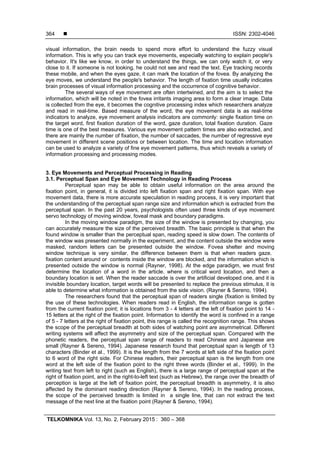
Saccade refers to people’s continuous eye movement when reading (see Figure 4). It
is a rapid eye movement; its speed is generally 500 degrees per second. Once the saccade
starts, you can not change the direction of movement until it ends. Saccade accounts for 10%
of the reading time. Average saccade distance is 8 - 9 characters (equivalent to twice
perspective). In the saccadic course, eye sensitivity will be reduced, which is known as
saccadic suppression. The reader can not obtain information on this process, because the
presented information is only fleeting. Saccade time is effected by saccade distance (Rayner,
1998). The farther saccade distance, the longer the time spent.
Figure 4. Saccade schematic diagram
2.3. Regressive Eye Movement
Regressive eye movement refers to the process of eye movements that the readers
watch the new words from right to left, and then return to the content which has been watched
over, as is shown in Figure 5.
Figure 5. Regressive eye movement schematic diagram
Research shows that when a word is needed to be watched back, the watch time of
the word is often longer than those which is not needed to. (Rayner et al., 2003). Skilled
readers are back at about 10% to 20% of reading time. Frazier and Rayner (1982) proposed
three regressive eye movement modes: 1) Advancing regressive eye movement, that watching
point is back to the beginning of a sentence and then re-read the sentence; 2) Retreating
regressive eye movement, that is just to read content which is read verbatim from Right-to-left;
3) Selecting style regressive eye movement, through the eyes jumping back on the
misunderstood sentence. From the perspective of information processing, the highest
efficiency of these three strategies is the selecting regressive eye movement, for it just needs
to re-read the ingredients of misunderstood sentences. Regressive eye movement helps
readers to post deep processing. The reason of regressive eye movement may be that there is
something wrong with the word the reader is watching, or the reader does not understand the
article (Rayner, 1998). In addition, when there is anaphoric reference in the sentence, that is,
TELKOMNIKA ISSN: 2302-4046 
ESL Reading Research Based on Eye Tracking Techniques (Wenlian Zhan)
363
using a pronoun to refer to a previous word or a group of words, regressive eye movement is
also prone.
2.4. Return Sweep
There are similarities between regressive eye movement and return sweep, because
they are both a right-to-left eye movement. However, the return sweep is reading from the end
line to the beginning of the next line, though also a right-to-left eye, but different from the
regressive eye movement. So, in order to distinguish from the regressive eye movement, we
call it return sweep, which is a natural eye movement from one line to another, as in Figure 6
from E to F.
Figure 6. Return sweep schematic diagram
Eye fixation usually takes 100-600 milliseconds, when the brain begins processing
visual information received from the eye at every point of fixation. Saccade usually refers to
jumping quickly from one fixation point to another fixation point. Typically the saccade average
time is 20-40 milliseconds. During this period, the eye does not transmit information to the
brain.
Vision of the human eye is probably in 200 º, the vast majority of light-sensitive cells
are located in the fovea on the retina, which is enough for us to see a variety of things with
color. The central concave area is quite small, usually covering only1-2 degrees of our vision. It
is worth mentioning that these light-sensitive cells in our brains also can accept the key factors
of visual information, as is shown in Figure 7.
Figure 7. The process of light-sensitive cells receiving visual information
When our eyes are in a resting state, the brain's attention may shift to other places. We
can divert attention, but the eyes do not move. Then, foveal vision monitoring is usually
effective means of changing the attention judgment, because the brain typically does not
process complex stimulation information outside the fovea. The brain is more efficient than the
peripheral visual information when dealing with foveal visual information. Compared clear
 ISSN: 2302-4046
TELKOMNIKA Vol. 13, No. 2, February 2015 : 360 – 368
364
visual information, the brain needs to spend more effort to understand the fuzzy visual
information. This is why you can track eye movements, especially watching to explain people's
behavior. It's like we know, in order to understand the things, we can only watch it, or very
close to it. If someone is not looking, he could not see and read the text. Eye tracking records
these mobile, and when the eyes gaze, it can mark the location of the fovea. By analyzing the
eye moves, we understand the people's behavior. The length of fixation time usually indicates
brain processes of visual information processing and the occurrence of cognitive behavior.
The several ways of eye movement are often intertwined, and the aim is to select the
information, which will be noted in the fovea irritants imaging area to form a clear image. Data
is collected from the eye, it becomes the cognitive processing index which researchers analyze
and read in real-time. Based measure of the word, the eye movement data is as real-time
indicators to analyze, eye movement analysis indicators are commonly: single fixation time on
the target word, first fixation duration of the word, gaze duration, total fixation duration. Gaze
time is one of the best measures. Various eye movement pattern times are also extracted, and
there are mainly the number of fixation, the number of saccades, the number of regressive eye
movement in different scene positions or between location. The time and location information
can be used to analyze a variety of fine eye movement patterns, thus which reveals a variety of
information processing and processing modes.
3. Eye Movements and Perceptual Processing in Reading
3.1. Perceptual Span and Eye Movement Technology in Reading Process
Perceptual span may be able to obtain useful information on the area around the
fixation point, in general, it is divided into left fixation span and right fixation span. With eye
movement data, there is more accurate speculation in reading process, it is very important that
the understanding of the perceptual span range size and information which is extracted from the
perceptual span. In the past 20 years, psychologists often used three kinds of eye movement
servo technology of moving window, foveal mask and boundary paradigms.
In the moving window paradigm, the size of the window is presented by changing, you
can accurately measure the size of the perceived breadth. The basic principle is that when the
found window is smaller than the perceptual span, reading speed is slow down. The contents of
the window was presented normally in the experiment, and the content outside the window were
masked, random letters can be presented outside the window. Fovea shelter and moving
window technique is very similar,the difference between them is that when readers gaze,
fixation content around or contents inside the window are blocked, and the information which is
presented outside the window is normal (Rayner, 1998). At the edge paradigm, we must first
determine the location of a word in the article,where is critical word location, and then a
boundary location is set. When the reader saccade is over the artificial developed one, and it is
invisible boundary location, target words will be presented to replace the previous stimulus, it is
able to determine what information is obtained from the side vision. (Rayner & Sereno, 1994).
The researchers found that the perceptual span of readers single (fixation is limited by
the use of these technologies. When readers read in English, the information range is gotten
from the current fixation point; it is locations from 3 - 4 letters at the left of fixation point to 14 -
15 letters at the right of the fixation point. Information to identify the word is confined in a range
of 5 - 7 letters at the right of fixation point, this range is called the recognition range. This shows
the scope of the perceptual breadth at both sides of watching point are asymmetrical. Different
writing systems will affect the asymmetry and size of the perceptual span. Compared with the
phonetic readers, the perceptual span range of readers to read Chinese and Japanese are
small (Rayner & Sereno, 1994). Japanese research found that perceptual span is length of 13
characters (Binder et al., 1999). It is the length from the 7 words at left side of the fixation point
to 6 word of the right side. For Chinese readers, their perceptual span is the length from one
word at the left side of the fixation point to the right three words (Binder et al., 1999). In the
writing text from left to right (such as English), there is a large range of perceptual span at the
right of fixation point, and in the right-to-left text (such as Hebrew), the range over the breadth of
perception is large at the left of fixation point, the perceptual breadth is asymmetry, it is also
affected by the dominant reading direction (Rayner & Sereno, 1994). In the reading process,
the scope of the perceived breadth is limited in a single line, that can not extract the text
message of the next line at the fixation point (Rayner & Sereno, 1994).
TELKOMNIKA ISSN: 2302-4046 
ESL Reading Research Based on Eye Tracking Techniques (Wenlian Zhan)
365
In addition to reading dominant direction and writing system itself influence on
perceptual span, the size of the perceived breadth is also affected by many other factors (such
as text difficulty, skill). Articles become difficult, the scope of the perceived breadth becomes
small, and especially the content difficulty of the fixation point would affect the reader to extract
information on the next vision. In addition, unskilled readers can perceive 12 letters in length at
the right side of the fixation point. It can be seen that the perceived span itself is not a definite
value, it is one of these problems which is also mentioned later and processing models can not
solve (Henderson et al., 1990).
3.2. Information is Obtained from the Perceptual Span
Readers get a variety of information which the reading process needs from perceptual
span range. Rayner (1978) would divide the line of text into three regions on the retina: foveal
region, parafoveal region, and peripheral region. Foveal vision region forms into 1-2 degree
perspective angle with reader’s fixation point, in this area, the reader visual acuity is high, and
you can clearly get a lot of information (Llewellyn-Thomas, 1968). Visual acuity outside the
fovea decreases significantly, its ability to identify is not better than the fovea. Vice foveal vision
region forms into 10 degree angle around with reader’s fixation point (Ditchburn, 1973). Edge
visual area includes the entire area outside the vice foveal vision area. Readers can get
different information on different areas of the retina, in the recognition range; you can get all the
information to identify a word.
In addition to the identifying scope of the area, the reader can also get a variety of
useful information. Readers can get the word visual features from sidelines vision. Rayner
(1983) found glyph similar words appear in the next vision, it will facilitate the subsequent gaze
target word naming response. Rayner and McConkie et al (1980) made preliminary letter
identification hypothesis to explain what information was gained in the next vision, and readers
can get the first few letters information of a word in the side vision, and this information can
provide the necessary context information for identification of the letters (such as visual
information or orthographic), it may cause to focus attention on the letters to be not identified,
thus the word recognition is promoted (Rayner et al., 1980). Whether start words are on the left
or the right of watching point, the starting word is the same several letters with before the target
word, it will promote the naming of the target word. In addition, the alphabetic writing is studied
in the reading process and readers can acquire the shaped information and voice information
from the sidelines vision (Jared, et al., 1999). Part of studies have shown that the side vision
can obtain semantic information, the results of some studies indicate semantic information can
not be obtained, font information or voice is only accessed (Rayner & Morris, 1992), outside the
range of the area identification, information is not able to promote word recognition (Rayner et
al., 1980). By Chinese study for eye movement, similar results are also obtained with
alphabetic writing, the reader can obtain font information and voice information from sidelines
vision, but there is no sufficient evidence that the reader can obtain semantic information from
sidelines vision. (Liu et al., 2002)
4. Eye Movement Control in Reading
In a gaze, what factors control the viewing time to be increased so that the subsequent
saccade distance becomes shorter, and there may be regressive eye movement? To answer
this question, the eye movement control must be researched in reading. On reading eye
movement control, there are two views: one is direct control, the identification of the current
attention word is completed, it means that the eye receives a signal to the next step movement,
the eye begins to move. Visual information is obtained from the current watching word, and the
next eye movement direction is decided. Another view is that cognitive control, eye movement
control is that information is obtained based on just reading texts, while information is obtained
by the watching word, and it is not necessary. The results also provide evidence to support
these two perspectives of eye movement control,which are the direct control and cognitive
control.
O 'Regan (1975) and Rayner (1979) found that saccade distance increases with
increasing word length at the right side of the fixation point (O' Regan, 1975), in the reading
process, the next fixation location information depends not only on the letters at the right of the
current fixation, but it is effected also by the right word boundary, the saccade length is decided
 ISSN: 2302-4046
TELKOMNIKA Vol. 13, No. 2, February 2015 : 360 – 368
366
by a length of a watched word and the next word length. For example, when next looking word
length information is unknown, the reader saccade distance will be shorter than the length of
the information, and it is already known (Rayner, 1998). Further, the gap between words is also
important for the reader. It not only helps the reader to distinguish between the start position
and end position of the word, but also it helps eye movement (Rayner, 1998). Bever (2002)
study on the other hand provides the evidence for these conclusions.
Researchers investigated the fixations rest position from different aspects. In the
process of reading eye movements, and on the next gaze point, there are the existence of
optimal fixation point and a preference for the fixation point. O 'Regan et al (1987) concluded
that the best fixation refers to the position which the reader spent least time in a word
perception, it is in a little at the right "preference gaze point". There are two effects in best
fixation point: re-fixation effect and processing-cost effect. Farther the sight of gaze word is
away from the best fixation point, the greater the likelihood of the heavy gaze of the word,
during the execution of saccadic eye, and noise is caused by eye movements (Rayner, 1998).
The reason for this phenomenon is that readers can obtain useful information from the side of
the fovea. People watch a particular word, and it may be considered as emission point of the
next word, and the distance between the fixation point and the target word will affect the
specific gaze positions of the next word. If the gaze word appears in the article, it will show a
heavy gaze effect, but the effect of processing consumption is small (Inhoff & Liu, 1998). The
watching effects and processing consumption effects are associated with reader cognitive
processing depth and cognitive capacity.
By studying the eye movement control in reading, you can learn to read in the direction
of eye movement and eye movement time, and then the scientific method of reading is put
forward to improve reading efficiency and to provide a theoretical foundation, especially, the
basis research evidence is provided to explain the relationship between eye movements in the
reading process and cognitive processes.
5. Conclusions and Outlook
Reading process requires complex cognitive activity participation; eye movement
recording method for real-time measurement of the reading process allows us a more profound
understanding on the nature of the reading process. From the above brief review of eye
movement control research progress in reading process, it can be seen that whether the
position of the fixation point, or regressive eye movement, saccade read, and watch time
studies have made some achievements. With the use of eye movement display technology
and eye movement studies in reading process, and a different language systems for cognitive
processing will show different performance, which it has opened up new research fields for eye
movement research in reading. In addition, eye movement processing model (Morrison, 1984),
strategic and tactical model (Regan, 1992), especially the EZ Reader model (Reichle, 1998), to
some extent, is a more reasonable explanation for the eye movement control phenomena.
Although eye movement data provide a wealth of information for reading cognitive
processes, eye movement indicators can not be trusted to the degree of superstition. Eye
movement technique is after all just a means of psychologist reading research, and eye
movement recording is not the most perfect reflection of only reading psychology. It also has
many deficiencies and limitations. First, the eye is able to truly reflect the cognitive processing,
which also involves the problem of “eye-brain" distance. Premise of eye movement research is
that eye movement reflects real-time cognitive processing, but whether it is able to accurately
reflect the cognitive processing, and it is also just a hypothesis. If we can absorb the derive
tight causal logic in terms of experimental design of traditional methods, eye movement
methods will better reveal the internal mechanisms of cognitive processing. The eye tracking
technology is combined with traditional reading methods, and Event-related Potential (ERP),
and Functional Magnetic Resonance Imaging (FMRI) technology to study cognitive processes
of reading, the only way makes reading of eye movement more in-depth study, the result is
more accurate. In addition, western researchers construct a theoretical model of eye
movement control, even though it can explain the experimental results within a certain range,
but it can not explain the mechanisms of information processing at a higher level of abstraction,
but also further improvement is done on the basis of the experimental data accumulation,
especially it is need to be combine the results of modern cognitive neuroscience, an integrated
TELKOMNIKA ISSN: 2302-4046 
ESL Reading Research Based on Eye Tracking Techniques (Wenlian Zhan)
367
model of cognitive processes has been established to read with widely interpreted validity. We
look forward to have more accurate and scientific indicators of eye movement control and
mental processing model in future studies, the eye movement process is to described and
explained in reading, by the eye movement analysis, the reading process can be inspected
more in-depth, thus cognitive processing mechanisms and nature are revealed in reading
processes.
.
References
[1] Binder KS, Pollatsek A, et al. Ext raction of Information to the Left of the Fixated Word in Reading.
Journal of Ex perimental Psychology: Human Percept ion and Perf romance. 1999; (25): 1162 - 1172.
[2] Ditchburn, RW. EyeOmovements and V isual Percept ion. Oxford: Oxford University Press. 1973.
[3] Enigbert R, Kliegl R. NoiseO enhanced Performance in Reading. Neurocomputin. 2003; (50): 473-
478.
[4] Frazier L, K Rayner. Making and Correcting Errors During Sentence Comprehension: Eye Movements
in the Analysis of St ructurally Ambiguous Sentences. Cognitive Psychology.1982; (14): 178 - 210.
[5] Henderson JM, Ferreira F. Effects of Fovea Processing Difficulty on the Perceptual Span in Reading:
Implications for Attention and Eye Movement Control. Journal of Experimental Psychology. Learning,
Memory and Cognition. 1990; (16): 417-429.
[6] Inhoff AW, W Liu. The Perception Span and Oculomotor Activity During the Reading of Chinese
Sentences. Journal of Experimental Psychology: Human Percept ion and Performance. 1998; (1): 20-
42.
[7] Jared D, Levy B A, et al. The Role of Phonology in the Activation of Word Meanings During Reading:
Evidence from Proof reading and Eye Movements. Journal of Experimental Psychology: General.
1999; (128): 219 - 264.
[8] Liu WM, AW Inhoff, et al. Use of Parafoveally Visible Characters During the Reading of Chinese
Sentences. Journal of Experimental Psychology: Learning, Memory and Cognition. 2002; (5): 1213 -
1227.
[9] Llewellyn Thomas, E Movements of the Eye. Scientific American. 1968; (2): 88 - 95.
[10] Liversedge SP, J Findlax. Saccadic Eye Movements and Cognition. Trendsin Cognitive Science.
2000; (1): 6 - 13.
[11] Morrison RE. Manipulation of Stimulus Onset Delay in Reading: Evidence for Parallel Programming of
Saccades. Journal of Experimental Psychology: Human Percept ion and Performance. 1984; (10):
667-682.
[12] O Regan JK. Structural and Contextual Const rains on Eye Movements in Reading. Unpublished
Doctoral Dissertation. University of Cambridge. 1975.
[13] O Regan JK, A LevyO Schoen. Eye Movement Strategy and Tactics in Word Recognition and
Reading. In M. Coltheart (ed.) At tention and Performance. The Psychology of Reading. Hillsdale, NJ:
Erlbaum. 1987; 12: 363-383.
[14] O Regan JK. Eye Movements and Reading. In E. Kowler (ed.) Reviews of Oculomotor Research. Eye
Movements and Their Role in Visual and Cognitive Processes. Amsterdam: Elservier. 1990; 4: 395 -
453.
[15] O Regan JK. Optimal Viewing Position in Words and the Strategy O tactics Theory of Eye Movement
in Reading. Rayner K (ed.) Eye Movement and Their Role in Visual and Cognitive Processes.
Armstadam: Elservier. 1992: 395 - 453.
[16] Rayner K. Eye Movements in Reading and Information Processing. Psychological Bulletin. 1978; (85):
618 - 660.
[17] Rayner K. Eye Guidance in Reading: Fixation Locations Within Words. Perception. 1979; (8): 21 - 30.
[18] Rayner K, McConkie GW. & D. Zola. Integrating Information Across Eye Movements. Cognitive
Psychology. 1980; (12): 206-226.
[19] Rayner K. Eye Movements, Perception Span, and Reading Disability. A nnuals of Dyslexia. 1983;
(33): 163 - 173.
[20] Rayner K, R Morris. Eye Movement Cont rol in Reading: Evidence Against Semantic Processing.
Journal of Ex perimental Psychology: Human Percept ion and Perf romance. 1992; (18): 163 - 172.
[21] Rayner K, SC Sereno. Eye Movements in Reading: Psycholinguistic Studies. In M. A. Gernsbacher
(ed.) Handbook of Psycholi nguistics. San Diego, CA: Academic. 1994.
[22] Rayner K. Eye Movements in Reading and Information Processing Years of Research. Psychology
Bulletin. 1998; 20(124): 372 - 422.
[23] Rayner K, Engbert et al. Unspaced Text Interferes with both Word Identification and Eye Movement
Control. V ision Research. 1998; (38): 1129 - 1144.
[24] Rayner K, J Babara, et al. Inhabition of Saccade Return in Reading. Vision Research. 2003; (43):
1027 - 1034.
 ISSN: 2302-4046
TELKOMNIKA Vol. 13, No. 2, February 2015 : 360 – 368
368
[25] Reichle, DPA Pollatsek, et al. Toward a Model of Eye Control in Reading. Psychological Review.
1998; (1): 125 - 157.
[26] Townsend D, Bever TJ. Sentence Comprehension: Integration of Habits and Rules. Cambridge, MA:
MIT Press. 2001.

ESL Reading Research Based on Eye Tracking Techniques

  • 1.
    TELKOMNIKA Indonesian Journalof Electrical Engineering Vol. 13, No. 2, February 2015, pp. 360 ~ 368 DOI: 10.11591/telkomnika.v13i2.6936  360 Received October 30, 2014; Revised December 18, 2014; Accepted January 10, 2015 ESL Reading Research Based on Eye Tracking Techniques Wenlian Zhan*, Zhulin Shen Business English Department of Foreign Languages Studies,,Hunan International Economics University, Changsha, Changsha, 410205,Chinam Tel.: 13807499918 *Corresponding author, e-mail: 513869962@qq.com Abstract Reading is a complex cognitive process. Through eye tracking techniques the cognitive features can be observed in depth, and therefore a better grasp of the instant cognitive processing of language can be achieved. Compared to traditional methods, the greatest advantage of eye tracking is that is that the reader proceeds with reading coherently and fluently without interrupt and interference, which secures the results in higher ecological validity. This paper is mainly about studies on eye movement features in ESL reading, and particularly illustrates eye movement patterns, the relationship between eye movement and perceptual processing, and eye movement control, aiming at providing some basic evidences for explaining the relationship between eye movement behavior and cognitive processing thus helping to solve some theoretical problems in reading. Keywords: reading, eye movement, information tracking,cognitive process, perception span Copyright © 2015 Institute of Advanced Engineering and Science. All rights reserved. 1. Introduction Reading is a complex cognitive process, and through eye tracking techniques, the cognitive features of reading process can be observed more in-depth, and therefore a better grasp of real-time cognitive processing the language comprehension can be achieved. Eye movement as an index to investigate reading process is an important area of psycholinguistics and reading psychology. In reading activities, the research of the relationship between cognitive processing and eye movement behavior can be dated back to the 19th century, when the research focused on the basic parameters and features of eye movement. Since the 1970s, with the development of eye movement recording technology, and particularly the use of computer technology, the study on the reading process has entered a new phase. A common eye tracker is shown in Figure 1. Figure 1. Common eye tracker And an Eye tracking system is shown as in Figure 2.
  • 2.
    TELKOMNIKA ISSN: 2302-4046 ESL Reading Research Based on Eye Tracking Techniques (Wenlian Zhan) 361 Figure 2. Motion capture and eye tracking system Eye tracking technology is still in the exploratory stage, and the evolution of eye tracking technology application is shown in Figure 3. Figure 3. Eye tracking technology applications Psychologists began to attach importance to the relationship among eye movement, perception and cognition, and describe the cognitive processing by using eye movement parameters. With the development of eye movement research in reading, some new advanced techniques (e.g eye movement contingent display) were applied. On the basis of the eye movement newer technologies, the scope of reading research was further expanded and no longer confined to the basic eye movement parameters; the information about side-vision areas was concerned about, expecting to know about what information the reader would get from side-vision area, and its effects on the length of gazing at the fovea regional words. Compared to traditional methods, the greatest advantage of eye tracking is that the reader proceeds with reading coherently and fluently without interrupt and interference, which secures the results in higher ecological validity. From indicators of eye movement, what the brain is processing can be inferred, and the reading process is understood in depth, which will help solve a lot of theory problems in reading. Needless to say, there are great prospects in ESL reading research based on eye tracking techniques. 2. Eye Movement Patterns in the Reading Process An eye-tracking system usually monitors the reaction and the typical mobile of the target human eye on a digital image. People's eyes are usually kept moving until it stays at a certain point. Eye movement patterns may reflect the choice of visual information, and psychological mechanisms of the cognitive processing is to revealed, which are important. During the process of reading research, psychologists have found different eye movement parameters to reflect the real-time cognitive processing. The main patterns of eye movement in reading course are: fixation, saccade, regressive eye movement, and return sweep. When the eyes are focused on a point, we call it fixation, and when the eyes move between several solid points of view, we call it a glance.
  • 3.
     ISSN: 2302-4046 TELKOMNIKAVol. 13, No. 2, February 2015 : 360 – 368 362 2.1. Fixation Fixation means that the time of the fovea alignment of an object exceeds 100 ms, and in the meantime, the watched object will be fully processed, with a clear image formed at the fovea. When reading, readers get the main information by gazement. For skilled readers, the average gazing time is from 200 to 250 ms (Rayner, 1978). However, individual differences are large. In addition, when the same reader is at different times or reads different texts, the watching duration are quite different. With respect to a reader, the gazing duration when reading some articles is between 100 and 500 ms (Rayner, 1978). Readers often watch on functional words shorter than adjectives. Factors of watching time include word frequency, word length, word predictability, and so on. (Rayner, 1998; see Townsend & Bever, 2001) 2.2. Saccade Saccade refers to people’s continuous eye movement when reading (see Figure 4). It is a rapid eye movement; its speed is generally 500 degrees per second. Once the saccade starts, you can not change the direction of movement until it ends. Saccade accounts for 10% of the reading time. Average saccade distance is 8 - 9 characters (equivalent to twice perspective). In the saccadic course, eye sensitivity will be reduced, which is known as saccadic suppression. The reader can not obtain information on this process, because the presented information is only fleeting. Saccade time is effected by saccade distance (Rayner, 1998). The farther saccade distance, the longer the time spent. Figure 4. Saccade schematic diagram 2.3. Regressive Eye Movement Regressive eye movement refers to the process of eye movements that the readers watch the new words from right to left, and then return to the content which has been watched over, as is shown in Figure 5. Figure 5. Regressive eye movement schematic diagram Research shows that when a word is needed to be watched back, the watch time of the word is often longer than those which is not needed to. (Rayner et al., 2003). Skilled readers are back at about 10% to 20% of reading time. Frazier and Rayner (1982) proposed three regressive eye movement modes: 1) Advancing regressive eye movement, that watching point is back to the beginning of a sentence and then re-read the sentence; 2) Retreating regressive eye movement, that is just to read content which is read verbatim from Right-to-left; 3) Selecting style regressive eye movement, through the eyes jumping back on the misunderstood sentence. From the perspective of information processing, the highest efficiency of these three strategies is the selecting regressive eye movement, for it just needs to re-read the ingredients of misunderstood sentences. Regressive eye movement helps readers to post deep processing. The reason of regressive eye movement may be that there is something wrong with the word the reader is watching, or the reader does not understand the article (Rayner, 1998). In addition, when there is anaphoric reference in the sentence, that is,
  • 4.
    TELKOMNIKA ISSN: 2302-4046 ESL Reading Research Based on Eye Tracking Techniques (Wenlian Zhan) 363 using a pronoun to refer to a previous word or a group of words, regressive eye movement is also prone. 2.4. Return Sweep There are similarities between regressive eye movement and return sweep, because they are both a right-to-left eye movement. However, the return sweep is reading from the end line to the beginning of the next line, though also a right-to-left eye, but different from the regressive eye movement. So, in order to distinguish from the regressive eye movement, we call it return sweep, which is a natural eye movement from one line to another, as in Figure 6 from E to F. Figure 6. Return sweep schematic diagram Eye fixation usually takes 100-600 milliseconds, when the brain begins processing visual information received from the eye at every point of fixation. Saccade usually refers to jumping quickly from one fixation point to another fixation point. Typically the saccade average time is 20-40 milliseconds. During this period, the eye does not transmit information to the brain. Vision of the human eye is probably in 200 º, the vast majority of light-sensitive cells are located in the fovea on the retina, which is enough for us to see a variety of things with color. The central concave area is quite small, usually covering only1-2 degrees of our vision. It is worth mentioning that these light-sensitive cells in our brains also can accept the key factors of visual information, as is shown in Figure 7. Figure 7. The process of light-sensitive cells receiving visual information When our eyes are in a resting state, the brain's attention may shift to other places. We can divert attention, but the eyes do not move. Then, foveal vision monitoring is usually effective means of changing the attention judgment, because the brain typically does not process complex stimulation information outside the fovea. The brain is more efficient than the peripheral visual information when dealing with foveal visual information. Compared clear
  • 5.
     ISSN: 2302-4046 TELKOMNIKAVol. 13, No. 2, February 2015 : 360 – 368 364 visual information, the brain needs to spend more effort to understand the fuzzy visual information. This is why you can track eye movements, especially watching to explain people's behavior. It's like we know, in order to understand the things, we can only watch it, or very close to it. If someone is not looking, he could not see and read the text. Eye tracking records these mobile, and when the eyes gaze, it can mark the location of the fovea. By analyzing the eye moves, we understand the people's behavior. The length of fixation time usually indicates brain processes of visual information processing and the occurrence of cognitive behavior. The several ways of eye movement are often intertwined, and the aim is to select the information, which will be noted in the fovea irritants imaging area to form a clear image. Data is collected from the eye, it becomes the cognitive processing index which researchers analyze and read in real-time. Based measure of the word, the eye movement data is as real-time indicators to analyze, eye movement analysis indicators are commonly: single fixation time on the target word, first fixation duration of the word, gaze duration, total fixation duration. Gaze time is one of the best measures. Various eye movement pattern times are also extracted, and there are mainly the number of fixation, the number of saccades, the number of regressive eye movement in different scene positions or between location. The time and location information can be used to analyze a variety of fine eye movement patterns, thus which reveals a variety of information processing and processing modes. 3. Eye Movements and Perceptual Processing in Reading 3.1. Perceptual Span and Eye Movement Technology in Reading Process Perceptual span may be able to obtain useful information on the area around the fixation point, in general, it is divided into left fixation span and right fixation span. With eye movement data, there is more accurate speculation in reading process, it is very important that the understanding of the perceptual span range size and information which is extracted from the perceptual span. In the past 20 years, psychologists often used three kinds of eye movement servo technology of moving window, foveal mask and boundary paradigms. In the moving window paradigm, the size of the window is presented by changing, you can accurately measure the size of the perceived breadth. The basic principle is that when the found window is smaller than the perceptual span, reading speed is slow down. The contents of the window was presented normally in the experiment, and the content outside the window were masked, random letters can be presented outside the window. Fovea shelter and moving window technique is very similar,the difference between them is that when readers gaze, fixation content around or contents inside the window are blocked, and the information which is presented outside the window is normal (Rayner, 1998). At the edge paradigm, we must first determine the location of a word in the article,where is critical word location, and then a boundary location is set. When the reader saccade is over the artificial developed one, and it is invisible boundary location, target words will be presented to replace the previous stimulus, it is able to determine what information is obtained from the side vision. (Rayner & Sereno, 1994). The researchers found that the perceptual span of readers single (fixation is limited by the use of these technologies. When readers read in English, the information range is gotten from the current fixation point; it is locations from 3 - 4 letters at the left of fixation point to 14 - 15 letters at the right of the fixation point. Information to identify the word is confined in a range of 5 - 7 letters at the right of fixation point, this range is called the recognition range. This shows the scope of the perceptual breadth at both sides of watching point are asymmetrical. Different writing systems will affect the asymmetry and size of the perceptual span. Compared with the phonetic readers, the perceptual span range of readers to read Chinese and Japanese are small (Rayner & Sereno, 1994). Japanese research found that perceptual span is length of 13 characters (Binder et al., 1999). It is the length from the 7 words at left side of the fixation point to 6 word of the right side. For Chinese readers, their perceptual span is the length from one word at the left side of the fixation point to the right three words (Binder et al., 1999). In the writing text from left to right (such as English), there is a large range of perceptual span at the right of fixation point, and in the right-to-left text (such as Hebrew), the range over the breadth of perception is large at the left of fixation point, the perceptual breadth is asymmetry, it is also affected by the dominant reading direction (Rayner & Sereno, 1994). In the reading process, the scope of the perceived breadth is limited in a single line, that can not extract the text message of the next line at the fixation point (Rayner & Sereno, 1994).
  • 6.
    TELKOMNIKA ISSN: 2302-4046 ESL Reading Research Based on Eye Tracking Techniques (Wenlian Zhan) 365 In addition to reading dominant direction and writing system itself influence on perceptual span, the size of the perceived breadth is also affected by many other factors (such as text difficulty, skill). Articles become difficult, the scope of the perceived breadth becomes small, and especially the content difficulty of the fixation point would affect the reader to extract information on the next vision. In addition, unskilled readers can perceive 12 letters in length at the right side of the fixation point. It can be seen that the perceived span itself is not a definite value, it is one of these problems which is also mentioned later and processing models can not solve (Henderson et al., 1990). 3.2. Information is Obtained from the Perceptual Span Readers get a variety of information which the reading process needs from perceptual span range. Rayner (1978) would divide the line of text into three regions on the retina: foveal region, parafoveal region, and peripheral region. Foveal vision region forms into 1-2 degree perspective angle with reader’s fixation point, in this area, the reader visual acuity is high, and you can clearly get a lot of information (Llewellyn-Thomas, 1968). Visual acuity outside the fovea decreases significantly, its ability to identify is not better than the fovea. Vice foveal vision region forms into 10 degree angle around with reader’s fixation point (Ditchburn, 1973). Edge visual area includes the entire area outside the vice foveal vision area. Readers can get different information on different areas of the retina, in the recognition range; you can get all the information to identify a word. In addition to the identifying scope of the area, the reader can also get a variety of useful information. Readers can get the word visual features from sidelines vision. Rayner (1983) found glyph similar words appear in the next vision, it will facilitate the subsequent gaze target word naming response. Rayner and McConkie et al (1980) made preliminary letter identification hypothesis to explain what information was gained in the next vision, and readers can get the first few letters information of a word in the side vision, and this information can provide the necessary context information for identification of the letters (such as visual information or orthographic), it may cause to focus attention on the letters to be not identified, thus the word recognition is promoted (Rayner et al., 1980). Whether start words are on the left or the right of watching point, the starting word is the same several letters with before the target word, it will promote the naming of the target word. In addition, the alphabetic writing is studied in the reading process and readers can acquire the shaped information and voice information from the sidelines vision (Jared, et al., 1999). Part of studies have shown that the side vision can obtain semantic information, the results of some studies indicate semantic information can not be obtained, font information or voice is only accessed (Rayner & Morris, 1992), outside the range of the area identification, information is not able to promote word recognition (Rayner et al., 1980). By Chinese study for eye movement, similar results are also obtained with alphabetic writing, the reader can obtain font information and voice information from sidelines vision, but there is no sufficient evidence that the reader can obtain semantic information from sidelines vision. (Liu et al., 2002) 4. Eye Movement Control in Reading In a gaze, what factors control the viewing time to be increased so that the subsequent saccade distance becomes shorter, and there may be regressive eye movement? To answer this question, the eye movement control must be researched in reading. On reading eye movement control, there are two views: one is direct control, the identification of the current attention word is completed, it means that the eye receives a signal to the next step movement, the eye begins to move. Visual information is obtained from the current watching word, and the next eye movement direction is decided. Another view is that cognitive control, eye movement control is that information is obtained based on just reading texts, while information is obtained by the watching word, and it is not necessary. The results also provide evidence to support these two perspectives of eye movement control,which are the direct control and cognitive control. O 'Regan (1975) and Rayner (1979) found that saccade distance increases with increasing word length at the right side of the fixation point (O' Regan, 1975), in the reading process, the next fixation location information depends not only on the letters at the right of the current fixation, but it is effected also by the right word boundary, the saccade length is decided
  • 7.
     ISSN: 2302-4046 TELKOMNIKAVol. 13, No. 2, February 2015 : 360 – 368 366 by a length of a watched word and the next word length. For example, when next looking word length information is unknown, the reader saccade distance will be shorter than the length of the information, and it is already known (Rayner, 1998). Further, the gap between words is also important for the reader. It not only helps the reader to distinguish between the start position and end position of the word, but also it helps eye movement (Rayner, 1998). Bever (2002) study on the other hand provides the evidence for these conclusions. Researchers investigated the fixations rest position from different aspects. In the process of reading eye movements, and on the next gaze point, there are the existence of optimal fixation point and a preference for the fixation point. O 'Regan et al (1987) concluded that the best fixation refers to the position which the reader spent least time in a word perception, it is in a little at the right "preference gaze point". There are two effects in best fixation point: re-fixation effect and processing-cost effect. Farther the sight of gaze word is away from the best fixation point, the greater the likelihood of the heavy gaze of the word, during the execution of saccadic eye, and noise is caused by eye movements (Rayner, 1998). The reason for this phenomenon is that readers can obtain useful information from the side of the fovea. People watch a particular word, and it may be considered as emission point of the next word, and the distance between the fixation point and the target word will affect the specific gaze positions of the next word. If the gaze word appears in the article, it will show a heavy gaze effect, but the effect of processing consumption is small (Inhoff & Liu, 1998). The watching effects and processing consumption effects are associated with reader cognitive processing depth and cognitive capacity. By studying the eye movement control in reading, you can learn to read in the direction of eye movement and eye movement time, and then the scientific method of reading is put forward to improve reading efficiency and to provide a theoretical foundation, especially, the basis research evidence is provided to explain the relationship between eye movements in the reading process and cognitive processes. 5. Conclusions and Outlook Reading process requires complex cognitive activity participation; eye movement recording method for real-time measurement of the reading process allows us a more profound understanding on the nature of the reading process. From the above brief review of eye movement control research progress in reading process, it can be seen that whether the position of the fixation point, or regressive eye movement, saccade read, and watch time studies have made some achievements. With the use of eye movement display technology and eye movement studies in reading process, and a different language systems for cognitive processing will show different performance, which it has opened up new research fields for eye movement research in reading. In addition, eye movement processing model (Morrison, 1984), strategic and tactical model (Regan, 1992), especially the EZ Reader model (Reichle, 1998), to some extent, is a more reasonable explanation for the eye movement control phenomena. Although eye movement data provide a wealth of information for reading cognitive processes, eye movement indicators can not be trusted to the degree of superstition. Eye movement technique is after all just a means of psychologist reading research, and eye movement recording is not the most perfect reflection of only reading psychology. It also has many deficiencies and limitations. First, the eye is able to truly reflect the cognitive processing, which also involves the problem of “eye-brain" distance. Premise of eye movement research is that eye movement reflects real-time cognitive processing, but whether it is able to accurately reflect the cognitive processing, and it is also just a hypothesis. If we can absorb the derive tight causal logic in terms of experimental design of traditional methods, eye movement methods will better reveal the internal mechanisms of cognitive processing. The eye tracking technology is combined with traditional reading methods, and Event-related Potential (ERP), and Functional Magnetic Resonance Imaging (FMRI) technology to study cognitive processes of reading, the only way makes reading of eye movement more in-depth study, the result is more accurate. In addition, western researchers construct a theoretical model of eye movement control, even though it can explain the experimental results within a certain range, but it can not explain the mechanisms of information processing at a higher level of abstraction, but also further improvement is done on the basis of the experimental data accumulation, especially it is need to be combine the results of modern cognitive neuroscience, an integrated
  • 8.
    TELKOMNIKA ISSN: 2302-4046 ESL Reading Research Based on Eye Tracking Techniques (Wenlian Zhan) 367 model of cognitive processes has been established to read with widely interpreted validity. We look forward to have more accurate and scientific indicators of eye movement control and mental processing model in future studies, the eye movement process is to described and explained in reading, by the eye movement analysis, the reading process can be inspected more in-depth, thus cognitive processing mechanisms and nature are revealed in reading processes. . References [1] Binder KS, Pollatsek A, et al. Ext raction of Information to the Left of the Fixated Word in Reading. Journal of Ex perimental Psychology: Human Percept ion and Perf romance. 1999; (25): 1162 - 1172. [2] Ditchburn, RW. EyeOmovements and V isual Percept ion. Oxford: Oxford University Press. 1973. [3] Enigbert R, Kliegl R. NoiseO enhanced Performance in Reading. Neurocomputin. 2003; (50): 473- 478. [4] Frazier L, K Rayner. Making and Correcting Errors During Sentence Comprehension: Eye Movements in the Analysis of St ructurally Ambiguous Sentences. Cognitive Psychology.1982; (14): 178 - 210. [5] Henderson JM, Ferreira F. Effects of Fovea Processing Difficulty on the Perceptual Span in Reading: Implications for Attention and Eye Movement Control. Journal of Experimental Psychology. Learning, Memory and Cognition. 1990; (16): 417-429. [6] Inhoff AW, W Liu. The Perception Span and Oculomotor Activity During the Reading of Chinese Sentences. Journal of Experimental Psychology: Human Percept ion and Performance. 1998; (1): 20- 42. [7] Jared D, Levy B A, et al. The Role of Phonology in the Activation of Word Meanings During Reading: Evidence from Proof reading and Eye Movements. Journal of Experimental Psychology: General. 1999; (128): 219 - 264. [8] Liu WM, AW Inhoff, et al. Use of Parafoveally Visible Characters During the Reading of Chinese Sentences. Journal of Experimental Psychology: Learning, Memory and Cognition. 2002; (5): 1213 - 1227. [9] Llewellyn Thomas, E Movements of the Eye. Scientific American. 1968; (2): 88 - 95. [10] Liversedge SP, J Findlax. Saccadic Eye Movements and Cognition. Trendsin Cognitive Science. 2000; (1): 6 - 13. [11] Morrison RE. Manipulation of Stimulus Onset Delay in Reading: Evidence for Parallel Programming of Saccades. Journal of Experimental Psychology: Human Percept ion and Performance. 1984; (10): 667-682. [12] O Regan JK. Structural and Contextual Const rains on Eye Movements in Reading. Unpublished Doctoral Dissertation. University of Cambridge. 1975. [13] O Regan JK, A LevyO Schoen. Eye Movement Strategy and Tactics in Word Recognition and Reading. In M. Coltheart (ed.) At tention and Performance. The Psychology of Reading. Hillsdale, NJ: Erlbaum. 1987; 12: 363-383. [14] O Regan JK. Eye Movements and Reading. In E. Kowler (ed.) Reviews of Oculomotor Research. Eye Movements and Their Role in Visual and Cognitive Processes. Amsterdam: Elservier. 1990; 4: 395 - 453. [15] O Regan JK. Optimal Viewing Position in Words and the Strategy O tactics Theory of Eye Movement in Reading. Rayner K (ed.) Eye Movement and Their Role in Visual and Cognitive Processes. Armstadam: Elservier. 1992: 395 - 453. [16] Rayner K. Eye Movements in Reading and Information Processing. Psychological Bulletin. 1978; (85): 618 - 660. [17] Rayner K. Eye Guidance in Reading: Fixation Locations Within Words. Perception. 1979; (8): 21 - 30. [18] Rayner K, McConkie GW. & D. Zola. Integrating Information Across Eye Movements. Cognitive Psychology. 1980; (12): 206-226. [19] Rayner K. Eye Movements, Perception Span, and Reading Disability. A nnuals of Dyslexia. 1983; (33): 163 - 173. [20] Rayner K, R Morris. Eye Movement Cont rol in Reading: Evidence Against Semantic Processing. Journal of Ex perimental Psychology: Human Percept ion and Perf romance. 1992; (18): 163 - 172. [21] Rayner K, SC Sereno. Eye Movements in Reading: Psycholinguistic Studies. In M. A. Gernsbacher (ed.) Handbook of Psycholi nguistics. San Diego, CA: Academic. 1994. [22] Rayner K. Eye Movements in Reading and Information Processing Years of Research. Psychology Bulletin. 1998; 20(124): 372 - 422. [23] Rayner K, Engbert et al. Unspaced Text Interferes with both Word Identification and Eye Movement Control. V ision Research. 1998; (38): 1129 - 1144. [24] Rayner K, J Babara, et al. Inhabition of Saccade Return in Reading. Vision Research. 2003; (43): 1027 - 1034.
  • 9.
     ISSN: 2302-4046 TELKOMNIKAVol. 13, No. 2, February 2015 : 360 – 368 368 [25] Reichle, DPA Pollatsek, et al. Toward a Model of Eye Control in Reading. Psychological Review. 1998; (1): 125 - 157. [26] Townsend D, Bever TJ. Sentence Comprehension: Integration of Habits and Rules. Cambridge, MA: MIT Press. 2001.