
Employees’ State Insurance Act, 1948 
Prepared by 
Janardan Raccha
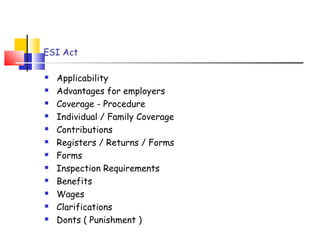
ESI Act 
 Applicability 
 Advantages for employers 
 Coverage - Procedure 
 Individual / Family Coverage 
 Contributions 
 Registers / Returns / Forms 
 Forms 
 Inspection Requirements 
 Benefits 
 Wages 
 Clarifications 
 Donts ( Punishment )
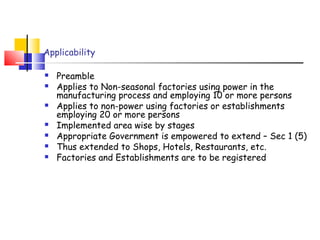
Applicability 
 Preamble 
 Applies to Non-seasonal factories using power in the 
manufacturing process and employing 10 or more persons 
 Applies to non-power using factories or establishments 
employing 20 or more persons 
 Implemented area wise by stages 
 Appropriate Government is empowered to extend – Sec 1 (5) 
 Thus extended to Shops, Hotels, Restaurants, etc. 
 Factories and Establishments are to be registered
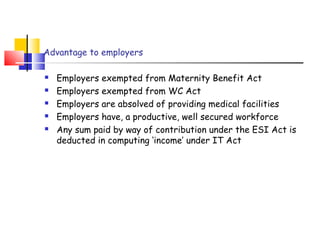
Advantage to employers 
 Employers exempted from Maternity Benefit Act 
 Employers exempted from WC Act 
 Employers are absolved of providing medical facilities 
 Employers have, a productive, well secured workforce 
 Any sum paid by way of contribution under the ESI Act is 
deducted in computing ‘income’ under IT Act
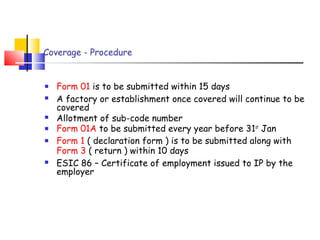
Coverage - Procedure 
 Form 01 is to be submitted within 15 days 
 A factory or establishment once covered will continue to be 
covered 
 Allotment of sub-code number 
 Form 01A to be submitted every year before 31st Jan 
 Form 1 ( declaration form ) is to be submitted along with 
Form 3 ( return ) within 10 days 
 ESIC 86 – Certificate of employment issued to IP by the 
employer
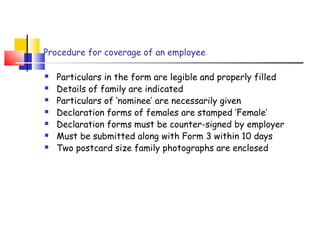
Procedure for coverage of an employee 
 Particulars in the form are legible and properly filled 
 Details of family are indicated 
 Particulars of ‘nominee’ are necessarily given 
 Declaration forms of females are stamped ‘Female’ 
 Declaration forms must be counter-signed by employer 
 Must be submitted along with Form 3 within 10 days 
 Two postcard size family photographs are enclosed
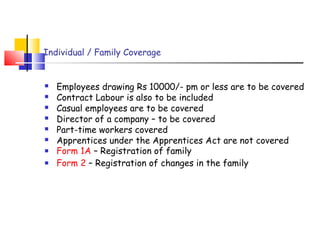
Individual / Family Coverage 
 Employees drawing Rs 10000/- pm or less are to be covered 
 Contract Labour is also to be included 
 Casual employees are to be covered 
 Director of a company – to be covered 
 Part-time workers covered 
 Apprentices under the Apprentices Act are not covered 
 Form 1A – Registration of family 
 Form 2 – Registration of changes in the family
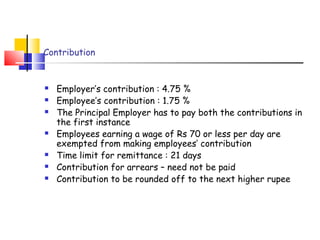
Contribution 
 Employer’s contribution : 4.75 % 
 Employee’s contribution : 1.75 % 
 The Principal Employer has to pay both the contributions in 
the first instance 
 Employees earning a wage of Rs 70 or less per day are 
exempted from making employees’ contribution 
 Time limit for remittance : 21 days 
 Contribution for arrears – need not be paid 
 Contribution to be rounded off to the next higher rupee
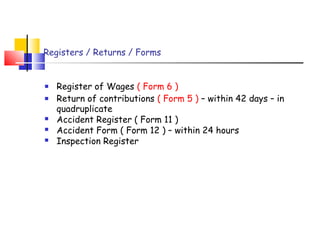
Registers / Returns / Forms 
 Register of Wages ( Form 6 ) 
 Return of contributions ( Form 5 ) – within 42 days – in 
quadruplicate 
 Accident Register ( Form 11 ) 
 Accident Form ( Form 12 ) – within 24 hours 
 Inspection Register
Forms 
 Form 28 – Abstention verification 
 ESIC 37 – Certificate of Re-employment / continuing 
employment 
 ESIC 53 – Application for change in BO / Dispensary 
 ESIC 72 – Application for duplicate identity card 
 ESIC 105 – Certificate of entitlement for medical treatment
Inspection Requirement 
 Attendance Register / Muster roll ( including CLs ) 
 Wages Register 
 Cash Book / Bank Book 
 Account Books ( including ledgers and vouchers, Balance 
Sheet ) 
 Register of employees 
 Accident Book 
 Return of Contribution 
 Return of Declaration Forms 
 Copies of Challans 
 Inspection Book
Sickness Benefit 
 For self 
 Contribution for 78 days in the corresponding CP 
 Standard Benefit Rate ( Roughly 50% of daily wages ) 
 Max period of sickness benefit – 91 days
Extended Sickness Benefit 
 For Self 
 34 diseases listed 
 Continuous employment for 2 years and contribution for 156 
days in 4 preceding CPs 
 40% more than SBR 
 ESB is payable for 309 days over and above 91 days of ( SB ) 
: Total – 400 days
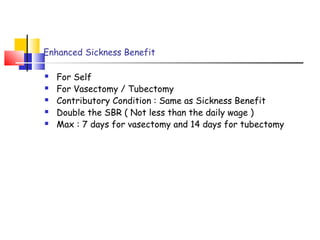
Enhanced Sickness Benefit 
 For Self 
 For Vasectomy / Tubectomy 
 Contributory Condition : Same as Sickness Benefit 
 Double the SBR ( Not less than the daily wage ) 
 Max : 7 days for vasectomy and 14 days for tubectomy
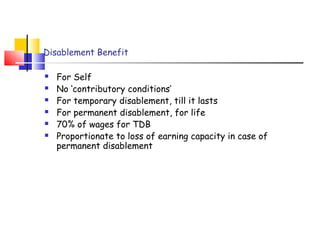
Disablement Benefit 
 For Self 
 No ‘contributory conditions’ 
 For temporary disablement, till it lasts 
 For permanent disablement, for life 
 70% of wages for TDB 
 Proportionate to loss of earning capacity in case of 
permanent disablement
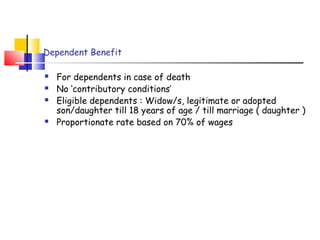
Dependent Benefit 
 For dependents in case of death 
 No ‘contributory conditions’ 
 Eligible dependents : Widow/s, legitimate or adopted 
son/daughter till 18 years of age / till marriage ( daughter ) 
 Proportionate rate based on 70% of wages
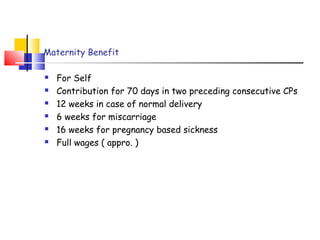
Maternity Benefit 
 For Self 
 Contribution for 70 days in two preceding consecutive CPs 
 12 weeks in case of normal delivery 
 6 weeks for miscarriage 
 16 weeks for pregnancy based sickness 
 Full wages ( appro. )
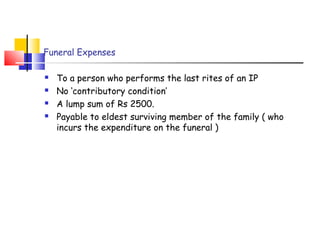
Funeral Expenses 
 To a person who performs the last rites of an IP 
 No ‘contributory condition’ 
 A lump sum of Rs 2500. 
 Payable to eldest surviving member of the family ( who 
incurs the expenditure on the funeral )
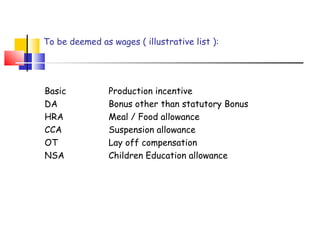
To be deemed as wages ( illustrative list ): 
Basic Production incentive 
DA Bonus other than statutory Bonus 
HRA Meal / Food allowance 
CCA Suspension allowance 
OT Lay off compensation 
NSA Children Education allowance
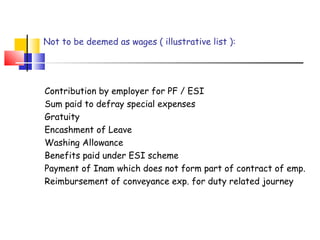
Not to be deemed as wages ( illustrative list ): 
Contribution by employer for PF / ESI 
Sum paid to defray special expenses 
Gratuity 
Encashment of Leave 
Washing Allowance 
Benefits paid under ESI scheme 
Payment of Inam which does not form part of contract of emp. 
Reimbursement of conveyance exp. for duty related journey
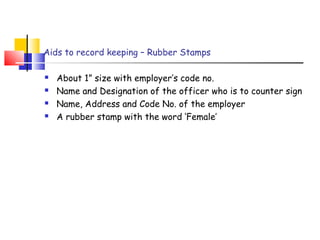
Aids to record keeping – Rubber Stamps 
 About 1” size with employer’s code no. 
 Name and Designation of the officer who is to counter sign 
 Name, Address and Code No. of the employer 
 A rubber stamp with the word ‘Female’
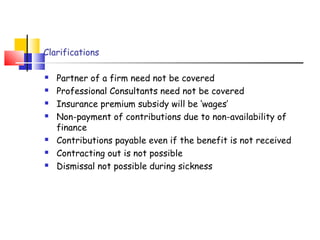
Clarifications 
 Partner of a firm need not be covered 
 Professional Consultants need not be covered 
 Insurance premium subsidy will be ‘wages’ 
 Non-payment of contributions due to non-availability of 
finance 
 Contributions payable even if the benefit is not received 
 Contracting out is not possible 
 Dismissal not possible during sickness
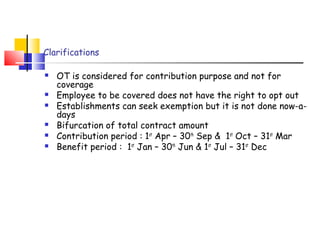
Clarifications 
 OT is considered for contribution purpose and not for 
coverage 
 Employee to be covered does not have the right to opt out 
 Establishments can seek exemption but it is not done now-a-days 
 Bifurcation of total contract amount 
 Contribution period : 1st Apr – 30th Sep & 1st Oct – 31st Mar 
 Benefit period : 1st Jan – 30th Jun & 1st Jul – 31st Dec
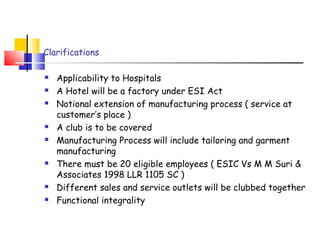
Clarifications 
 Applicability to Hospitals 
 A Hotel will be a factory under ESI Act 
 Notional extension of manufacturing process ( service at 
customer’s place ) 
 A club is to be covered 
 Manufacturing Process will include tailoring and garment 
manufacturing 
 There must be 20 eligible employees ( ESIC Vs M M Suri & 
Associates 1998 LLR 1105 SC ) 
 Different sales and service outlets will be clubbed together 
 Functional integrality
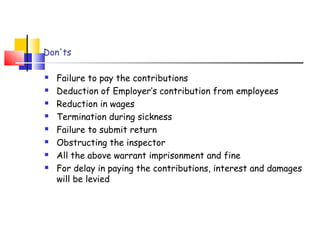
Don'ts 
 Failure to pay the contributions 
 Deduction of Employer’s contribution from employees 
 Reduction in wages 
 Termination during sickness 
 Failure to submit return 
 Obstructing the inspector 
 All the above warrant imprisonment and fine 
 For delay in paying the contributions, interest and damages 
will be levied
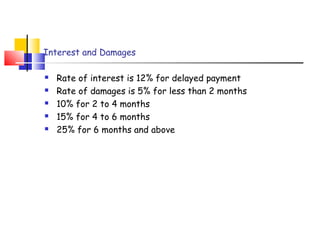
Interest and Damages 
 Rate of interest is 12% for delayed payment 
 Rate of damages is 5% for less than 2 months 
 10% for 2 to 4 months 
 15% for 4 to 6 months 
 25% for 6 months and above

Esi Training

  • 1.
    Employees’ State InsuranceAct, 1948 Prepared by Janardan Raccha
  • 2.
    ESI Act Applicability  Advantages for employers  Coverage - Procedure  Individual / Family Coverage  Contributions  Registers / Returns / Forms  Forms  Inspection Requirements  Benefits  Wages  Clarifications  Donts ( Punishment )
  • 3.
    Applicability  Preamble  Applies to Non-seasonal factories using power in the manufacturing process and employing 10 or more persons  Applies to non-power using factories or establishments employing 20 or more persons  Implemented area wise by stages  Appropriate Government is empowered to extend – Sec 1 (5)  Thus extended to Shops, Hotels, Restaurants, etc.  Factories and Establishments are to be registered
  • 4.
    Advantage to employers  Employers exempted from Maternity Benefit Act  Employers exempted from WC Act  Employers are absolved of providing medical facilities  Employers have, a productive, well secured workforce  Any sum paid by way of contribution under the ESI Act is deducted in computing ‘income’ under IT Act
  • 5.
    Coverage - Procedure  Form 01 is to be submitted within 15 days  A factory or establishment once covered will continue to be covered  Allotment of sub-code number  Form 01A to be submitted every year before 31st Jan  Form 1 ( declaration form ) is to be submitted along with Form 3 ( return ) within 10 days  ESIC 86 – Certificate of employment issued to IP by the employer
  • 6.
    Procedure for coverageof an employee  Particulars in the form are legible and properly filled  Details of family are indicated  Particulars of ‘nominee’ are necessarily given  Declaration forms of females are stamped ‘Female’  Declaration forms must be counter-signed by employer  Must be submitted along with Form 3 within 10 days  Two postcard size family photographs are enclosed
  • 7.
    Individual / FamilyCoverage  Employees drawing Rs 10000/- pm or less are to be covered  Contract Labour is also to be included  Casual employees are to be covered  Director of a company – to be covered  Part-time workers covered  Apprentices under the Apprentices Act are not covered  Form 1A – Registration of family  Form 2 – Registration of changes in the family
  • 8.
    Contribution  Employer’scontribution : 4.75 %  Employee’s contribution : 1.75 %  The Principal Employer has to pay both the contributions in the first instance  Employees earning a wage of Rs 70 or less per day are exempted from making employees’ contribution  Time limit for remittance : 21 days  Contribution for arrears – need not be paid  Contribution to be rounded off to the next higher rupee
  • 9.
    Registers / Returns/ Forms  Register of Wages ( Form 6 )  Return of contributions ( Form 5 ) – within 42 days – in quadruplicate  Accident Register ( Form 11 )  Accident Form ( Form 12 ) – within 24 hours  Inspection Register
  • 10.
    Forms  Form28 – Abstention verification  ESIC 37 – Certificate of Re-employment / continuing employment  ESIC 53 – Application for change in BO / Dispensary  ESIC 72 – Application for duplicate identity card  ESIC 105 – Certificate of entitlement for medical treatment
  • 11.
    Inspection Requirement Attendance Register / Muster roll ( including CLs )  Wages Register  Cash Book / Bank Book  Account Books ( including ledgers and vouchers, Balance Sheet )  Register of employees  Accident Book  Return of Contribution  Return of Declaration Forms  Copies of Challans  Inspection Book
  • 12.
    Sickness Benefit For self  Contribution for 78 days in the corresponding CP  Standard Benefit Rate ( Roughly 50% of daily wages )  Max period of sickness benefit – 91 days
  • 13.
    Extended Sickness Benefit  For Self  34 diseases listed  Continuous employment for 2 years and contribution for 156 days in 4 preceding CPs  40% more than SBR  ESB is payable for 309 days over and above 91 days of ( SB ) : Total – 400 days
  • 14.
    Enhanced Sickness Benefit  For Self  For Vasectomy / Tubectomy  Contributory Condition : Same as Sickness Benefit  Double the SBR ( Not less than the daily wage )  Max : 7 days for vasectomy and 14 days for tubectomy
  • 15.
    Disablement Benefit For Self  No ‘contributory conditions’  For temporary disablement, till it lasts  For permanent disablement, for life  70% of wages for TDB  Proportionate to loss of earning capacity in case of permanent disablement
  • 16.
    Dependent Benefit For dependents in case of death  No ‘contributory conditions’  Eligible dependents : Widow/s, legitimate or adopted son/daughter till 18 years of age / till marriage ( daughter )  Proportionate rate based on 70% of wages
  • 17.
    Maternity Benefit For Self  Contribution for 70 days in two preceding consecutive CPs  12 weeks in case of normal delivery  6 weeks for miscarriage  16 weeks for pregnancy based sickness  Full wages ( appro. )
  • 18.
    Funeral Expenses To a person who performs the last rites of an IP  No ‘contributory condition’  A lump sum of Rs 2500.  Payable to eldest surviving member of the family ( who incurs the expenditure on the funeral )
  • 19.
    To be deemedas wages ( illustrative list ): Basic Production incentive DA Bonus other than statutory Bonus HRA Meal / Food allowance CCA Suspension allowance OT Lay off compensation NSA Children Education allowance
  • 20.
    Not to bedeemed as wages ( illustrative list ): Contribution by employer for PF / ESI Sum paid to defray special expenses Gratuity Encashment of Leave Washing Allowance Benefits paid under ESI scheme Payment of Inam which does not form part of contract of emp. Reimbursement of conveyance exp. for duty related journey
  • 21.
    Aids to recordkeeping – Rubber Stamps  About 1” size with employer’s code no.  Name and Designation of the officer who is to counter sign  Name, Address and Code No. of the employer  A rubber stamp with the word ‘Female’
  • 22.
    Clarifications  Partnerof a firm need not be covered  Professional Consultants need not be covered  Insurance premium subsidy will be ‘wages’  Non-payment of contributions due to non-availability of finance  Contributions payable even if the benefit is not received  Contracting out is not possible  Dismissal not possible during sickness
  • 23.
    Clarifications  OTis considered for contribution purpose and not for coverage  Employee to be covered does not have the right to opt out  Establishments can seek exemption but it is not done now-a-days  Bifurcation of total contract amount  Contribution period : 1st Apr – 30th Sep & 1st Oct – 31st Mar  Benefit period : 1st Jan – 30th Jun & 1st Jul – 31st Dec
  • 24.
    Clarifications  Applicabilityto Hospitals  A Hotel will be a factory under ESI Act  Notional extension of manufacturing process ( service at customer’s place )  A club is to be covered  Manufacturing Process will include tailoring and garment manufacturing  There must be 20 eligible employees ( ESIC Vs M M Suri & Associates 1998 LLR 1105 SC )  Different sales and service outlets will be clubbed together  Functional integrality
  • 25.
    Don'ts  Failureto pay the contributions  Deduction of Employer’s contribution from employees  Reduction in wages  Termination during sickness  Failure to submit return  Obstructing the inspector  All the above warrant imprisonment and fine  For delay in paying the contributions, interest and damages will be levied
  • 26.
    Interest and Damages  Rate of interest is 12% for delayed payment  Rate of damages is 5% for less than 2 months  10% for 2 to 4 months  15% for 4 to 6 months  25% for 6 months and above