Presented By:
Anita Verma
(HR Manager)
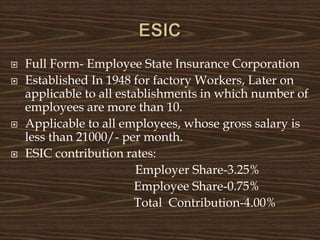
 Full Form- Employee State Insurance Corporation
 Established In 1948 for factory Workers, Later on
applicable to all establishments in which number of
employees are more than 10.
 Applicable to all employees, whose gross salary is
less than 21000/- per month.
 ESIC contribution rates:
Employer Share-3.25%
Employee Share-0.75%
Total Contribution-4.00%
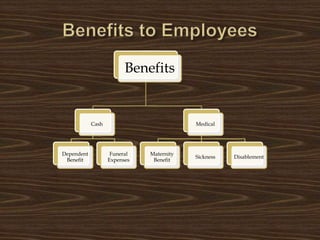
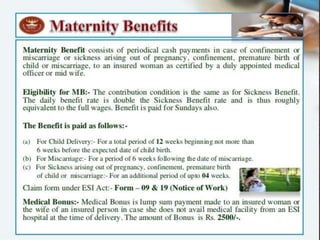
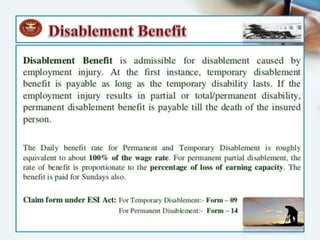
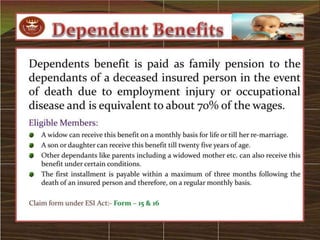
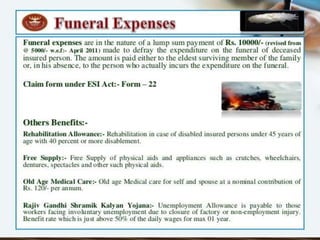
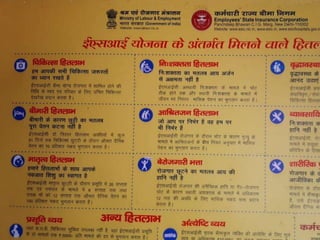
Benefits
Cash
Dependent
Benefit
Funeral
Expenses
Medical
Maternity
Benefit
Sickness Disablement
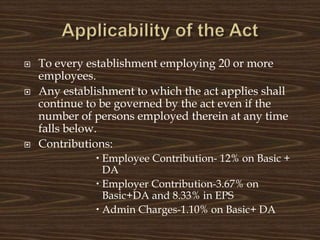
 To every establishment employing 20 or more
employees.
 Any establishment to which the act applies shall
continue to be governed by the act even if the
number of persons employed therein at any time
falls below.
 Contributions:
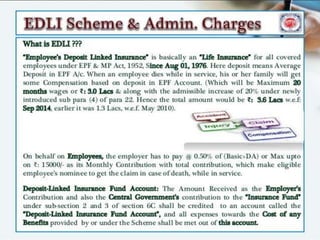
 Employee Contribution- 12% on Basic +
DA
 Employer Contribution-3.67% on
Basic+DA and 8.33% in EPS
 Admin Charges-1.10% on Basic+ DA
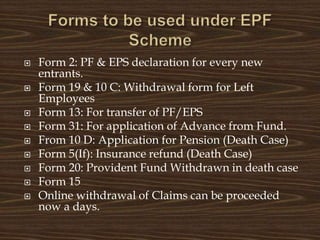
 Form 2: PF & EPS declaration for every new
entrants.
 Form 19 & 10 C: Withdrawal form for Left
Employees
 Form 13: For transfer of PF/EPS
 Form 31: For application of Advance from Fund.
 From 10 D: Application for Pension (Death Case)
 Form 5(If): Insurance refund (Death Case)
 Form 20: Provident Fund Withdrawn in death case
 Form 15
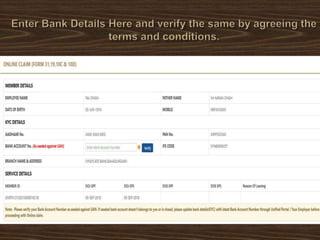
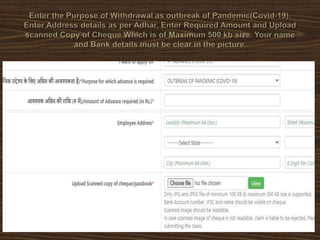
 Online withdrawal of Claims can be proceeded
now a days.
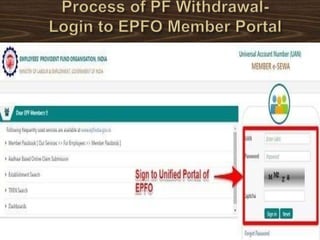
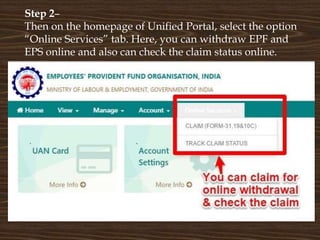
Step 2–
Then on the homepage of Unified Portal, select the option
“Online Services” tab. Here, you can withdraw EPF and
EPS online and also can check the claim status online.
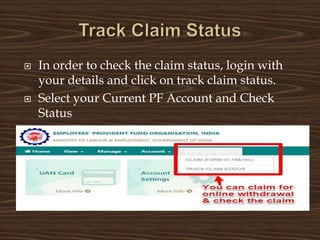
 In order to check the claim status, login with
your details and click on track claim status.
 Select your Current PF Account and Check
Status
 The scope of this Act is extended to housing, family care &
worker's health service by providing medical examination,
clinic for general treatment, infant welfare, women’s general
education, workers activity facilities, marriage, education,
funeral etc. State specific Labour Welfare Funds are funded
by contributions from the employer, employee and in few
states, the government also.
 Some of the major benefits of labour welfare are:
 (1) Improved Industrial Relations
 (2) Increase in the General Efficiency and Income
 (3) High Morale
 (4) Creation of Permanent Labour Force
 (5) Improvement in the Mental and Moral Health
 (6) Change in the Outlook of Employers and
 (7) Social Benefits.
 The Payment of Bonus Act, 1965 provides for a
minimum bonus of 8.33 percent of wages. The salary limited fixed
for eligibility purposes is Rs. 3,500 per month and the payment is
subject to the stipulation that the bonus payable to employees
drawing wages or salary not exceeded to Rs. 25000/ -per Month.
Eligibility:
 Employee shall be eligible for bonus for minimum of 8.33% of the
salary/wages even if there is loss in the establishment whereas a
maximum of 20% of the employee's salary/wages is payable
as bonus in an accounting year depending upon the employer. He
must attend the office minimum for a period of 30 days in a year.
Frequency:
 Bonus can either be paid in monthly salary or annually that
depends on employer.
 An act to provide for a scheme for the payment of
Gratuity to employees engaged in factories, Mines,
oilfields, Plantations, Ports, Railway Companies,
Shops or other establishments.
 Eligibility for Gratuity: Gratuity shall be payable to
an employee on termination of his employment
after he/she has rendered continuous service for
not less than 5 years –
 On his Superannuation or
 On his retirement or resignation
 Or his death or disablement(Five years services not
required) due to accident or disease.
 In case of death of Employee, gratuity payable
to him shall be paid to his nominee or
 If no nomination has been made, to his heirs,
whereas if heirs is a minor the share of such
minor shall be deposited with the controlling
authority ( i.e. government officer) who shall
invest the same for the benefit of such minor in
such bank or other financial institution, as may
be prescribed, until such minor attains the
majority.
 Computing the gratuity payable to an
employee who is re-employed, after his
disablement, on reduced wages,
 His wages for the period preceding his
disablement , shall be taken to be the wages
received by him during that period , and
 His wages for the period subsequent to his
disablement shall be taken to be the wages as
so reduced.
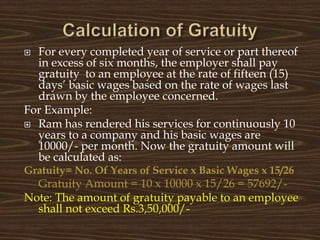
 For every completed year of service or part thereof
in excess of six months, the employer shall pay
gratuity to an employee at the rate of fifteen (15)
days’ basic wages based on the rate of wages last
drawn by the employee concerned.
For Example:
 Ram has rendered his services for continuously 10
years to a company and his basic wages are
10000/- per month. Now the gratuity amount will
be calculated as:
Gratuity= No. Of Years of Service x Basic Wages x 15/26
Gratuity Amount = 10 x 10000 x 15/26 = 57692/-
Note: The amount of gratuity payable to an employee
shall not exceed Rs.3,50,000/-
Employee, whose services have been terminated
for any act, wilful omission or negligence causing
any damage or loss to, or destruction of, property
belonging to the employer , shall be forfeited to the
extent of the damage or loss so caused; the gratuity
payable to an employee may be wholly or partially
forfeited if the services of such employee have
been terminated for his disorderly conduct or any
other act of violence on his part, or any act which
constitutes an offence , provided that such offence
is committed by him in the course of his
employment.
ESI, PF, LWF & Gratuity

ESI, PF, LWF & Gratuity

  • 1.
  • 2.
     Full Form-Employee State Insurance Corporation  Established In 1948 for factory Workers, Later on applicable to all establishments in which number of employees are more than 10.  Applicable to all employees, whose gross salary is less than 21000/- per month.  ESIC contribution rates: Employer Share-3.25% Employee Share-0.75% Total Contribution-4.00%
  • 4.
  • 14.
     To everyestablishment employing 20 or more employees.  Any establishment to which the act applies shall continue to be governed by the act even if the number of persons employed therein at any time falls below.  Contributions:  Employee Contribution- 12% on Basic + DA  Employer Contribution-3.67% on Basic+DA and 8.33% in EPS  Admin Charges-1.10% on Basic+ DA
  • 17.
     Form 2:PF & EPS declaration for every new entrants.  Form 19 & 10 C: Withdrawal form for Left Employees  Form 13: For transfer of PF/EPS  Form 31: For application of Advance from Fund.  From 10 D: Application for Pension (Death Case)  Form 5(If): Insurance refund (Death Case)  Form 20: Provident Fund Withdrawn in death case  Form 15  Online withdrawal of Claims can be proceeded now a days.
  • 19.
    Step 2– Then onthe homepage of Unified Portal, select the option “Online Services” tab. Here, you can withdraw EPF and EPS online and also can check the claim status online.
  • 22.
     In orderto check the claim status, login with your details and click on track claim status.  Select your Current PF Account and Check Status
  • 23.
     The scopeof this Act is extended to housing, family care & worker's health service by providing medical examination, clinic for general treatment, infant welfare, women’s general education, workers activity facilities, marriage, education, funeral etc. State specific Labour Welfare Funds are funded by contributions from the employer, employee and in few states, the government also.  Some of the major benefits of labour welfare are:  (1) Improved Industrial Relations  (2) Increase in the General Efficiency and Income  (3) High Morale  (4) Creation of Permanent Labour Force  (5) Improvement in the Mental and Moral Health  (6) Change in the Outlook of Employers and  (7) Social Benefits.
  • 24.
     The Paymentof Bonus Act, 1965 provides for a minimum bonus of 8.33 percent of wages. The salary limited fixed for eligibility purposes is Rs. 3,500 per month and the payment is subject to the stipulation that the bonus payable to employees drawing wages or salary not exceeded to Rs. 25000/ -per Month. Eligibility:  Employee shall be eligible for bonus for minimum of 8.33% of the salary/wages even if there is loss in the establishment whereas a maximum of 20% of the employee's salary/wages is payable as bonus in an accounting year depending upon the employer. He must attend the office minimum for a period of 30 days in a year. Frequency:  Bonus can either be paid in monthly salary or annually that depends on employer.
  • 25.
     An actto provide for a scheme for the payment of Gratuity to employees engaged in factories, Mines, oilfields, Plantations, Ports, Railway Companies, Shops or other establishments.  Eligibility for Gratuity: Gratuity shall be payable to an employee on termination of his employment after he/she has rendered continuous service for not less than 5 years –  On his Superannuation or  On his retirement or resignation  Or his death or disablement(Five years services not required) due to accident or disease.
  • 26.
     In caseof death of Employee, gratuity payable to him shall be paid to his nominee or  If no nomination has been made, to his heirs, whereas if heirs is a minor the share of such minor shall be deposited with the controlling authority ( i.e. government officer) who shall invest the same for the benefit of such minor in such bank or other financial institution, as may be prescribed, until such minor attains the majority.
  • 27.
     Computing thegratuity payable to an employee who is re-employed, after his disablement, on reduced wages,  His wages for the period preceding his disablement , shall be taken to be the wages received by him during that period , and  His wages for the period subsequent to his disablement shall be taken to be the wages as so reduced.
  • 28.
     For everycompleted year of service or part thereof in excess of six months, the employer shall pay gratuity to an employee at the rate of fifteen (15) days’ basic wages based on the rate of wages last drawn by the employee concerned. For Example:  Ram has rendered his services for continuously 10 years to a company and his basic wages are 10000/- per month. Now the gratuity amount will be calculated as: Gratuity= No. Of Years of Service x Basic Wages x 15/26 Gratuity Amount = 10 x 10000 x 15/26 = 57692/- Note: The amount of gratuity payable to an employee shall not exceed Rs.3,50,000/-
  • 29.
    Employee, whose serviceshave been terminated for any act, wilful omission or negligence causing any damage or loss to, or destruction of, property belonging to the employer , shall be forfeited to the extent of the damage or loss so caused; the gratuity payable to an employee may be wholly or partially forfeited if the services of such employee have been terminated for his disorderly conduct or any other act of violence on his part, or any act which constitutes an offence , provided that such offence is committed by him in the course of his employment.